Charts that look like demand isn’t booming

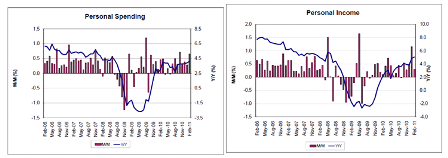
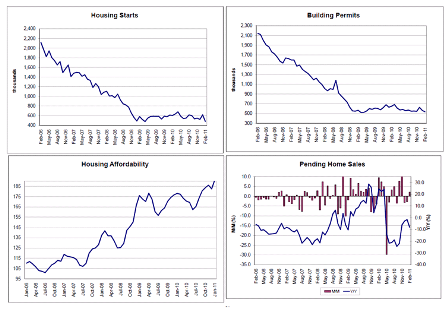
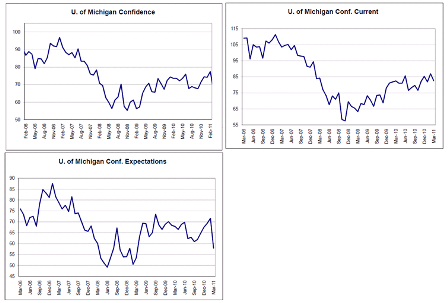
Charts that Say Demand Isn’t Doing Much of Anything

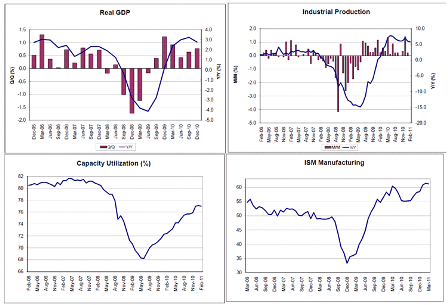
Yes, there’s modest top line growth, but not a lot of evidence anything more than that is likely to happen any time soon, especially with global post earthquake issues, US fiscal cutbacks of at least $31 billion as a ‘down payment’ next week, Japan showing no inclination to rebuild without ‘paying for it’, UK austerity kicking in for real this month, continued tightening in the euro zone, and China still fighting inflation with spending and lending cuts.

Q1 GDP now forecast with a 2 handle, and manufacturing, though sort of strong, is only about 11% of GDP and considerable slack remains.

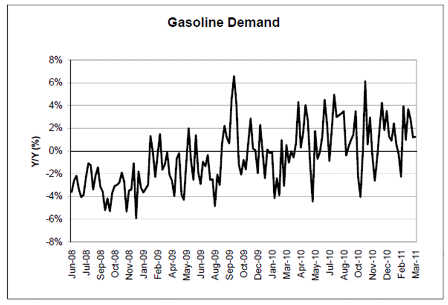
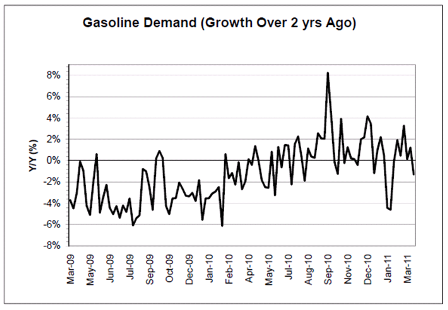
Given the more than 2 years of positive headline GDP growth, gasoline demand, previously a pretty good coincident indicator, is looking pretty flat.

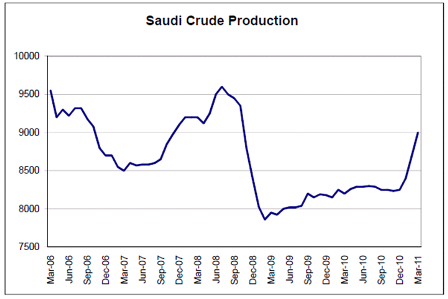
Saudi crude production has been increased to make up for lost Libyan output, and not due to an increase in world demand.

These series are doing ok, but no sign of accelerating demand. In fact the growth rates are less than they were when the output gap was a whole lot smaller in 06 and 07.

No sign of demand picking up here.

Consumer buying plans don’t look inspiring either, which makes sense with rising food and fuel prices.

With ‘normal’ credit conditions, govt deficits would be plenty high for us to be doing a lot better than this by now.

So given today’s credit conditions, seems to me govt deficits are far too small to see much progress on the demand side, and tightening fiscal at this point only makes that more so.

The Wall of Shame (cont.)

Today is year and in Japan,
which means the last few days could be mainly quarter end and year end maneuvers,
with a high probability of ‘buy the rumor sell the news’ types of unwinds coming up.

This would include the anticipation of another 200,000 new private sector jobs to be reported tomorrow am.
And the euro strength we’ve seen in front of the announced ECB rate hike next week.

There have been lots of promotional reasons to rush to get stocks on your books for year and/quarter end reporting,
as well as a bit of gold, silver, foods, and other commodities.

But fundamentally I see what’s going on below- a world heck bent on removing aggregate demand.

More noises from Japan on how they will pay for the rebuild, which looks to be a very modest appropriation tempered by fears of being at a fiscal tipping point.

UK austerity ratchets up April 1.

China still fighting inflation with further reduced spending and lending.

The euro zone demanding and getting austerity in return for funding, with signs in some members of austerity no longer bringing down deficits as revenues fall off from economic weakness. And no fiscal safety net if it does all go bad as markets have shown extreme reluctance to fund countercyclical deficits.

And food and fuel from monopoly pricing both eating into consumer demand and driving large segments of the world population into desperation.

Talk of Q1 US GDP down to maybe only +2%, housing still bumping along the bottom, and Q2 threatened by supply shortages due to the earthquake in Japan.

And the US debt ceiling showdown now possibly happing late next week as the deficit terrorists seal their congressional victory with the promised down payment on net spending cuts that won’t end there.

In fact, their army of support is now all but universal.

Everyone in DC and the mainstream media and economics profession agrees on the problem.

The only discussion is where the cuts should be, and who should pay more.

March 31, 2011
President Barack Obama
The White House
1600 Pennsylvania Avenue, NW
Washington, DC 20500
The Honorable John Boehner
Speaker of the House
1101 Longworth House Office Building
Washington, DC 20515
The Honorable Nancy Pelosi
House Minority Leader
235 Cannon House Office Building
Washington, DC 20515
The Honorable Harry Reid
Senate Majority Leader
522 Hart Senate Office Building
Washington, DC 20510
The Honorable Mitch McConnell
Senate Minority Leader
361-A Russell Senate Office Building
Washington, DC 20510

Dear President Obama, Speaker Boehner, Minority Leader Pelosi, Majority Leader Reid, and Minority Leader McConnell:


As you continue to work on our current budget situation, we are writing to let you know that we join with the 64 Senators who recently wrote that comprehensive deficit reduction measures are imperative, and to urge you to work together in support of a broad approach to solving the nation’s fiscal problems. As they said in their letter to President Obama:

“As you know, a bipartisan group of Senators has been working to craft a comprehensive deficit reduction package based upon the recommendations of the Fiscal Commission. While we may not agree with every aspect of the Commission’s recommendations, we believe that its work represents an important foundation to achieve meaningful progress on our debt. The Commission’s work also underscored the scope and breadth of our nation’s long-term fiscal challenges.

Beyond FY2011 funding decisions, we urge you to engage in a broader discussion about a comprehensive deficit reduction package. Specifically, we hope that the discussion will include discretionary spending cuts, entitlement changes and tax reform.

By approaching these negotiations comprehensively, with a strong signal of support from you, we believe that we can achieve consensus on these important fiscal issues. This would send a powerful message to Americans that Washington can work together to tackle this critical issue. Thank you for your attention to this matter.”

We agree with this letter and hope that you will work together to agree on a comprehensive, multi-year debt stabilization package.

Sincerely,
The Honorable Roger C. Altman
Former Assistant Secretary of the U.S.
Department of the Treasury; Founder
and Chairman, Evercore Partners

Barry Anderson
Former Acting Director, Congressional
Budget Office

Joseph Antos
Wilson H. Taylor Scholar in Health Care
and Retirement Policy, American
Enterprise Institute

The Honorable Martin Baily
Former Chairman, Council of Economic
Advisers

Robert Bixby
Executive Director, Concord Coalition

Charles Blahous
Research Fellow, Hoover Institute

Erskine Bowles
Former Co-Chair, National Commission
on Fiscal Responsibility and Reform

The Honorable Charles Bowsher
Former Comptroller General of the
United States

The Honorable John E. Chapoton
Former Assistant Secretary for Tax
Policy, U.S. Department of the Treasury

David Cote
Former Member, National Commission
on Fiscal Responsibility and Reform;
Chairman and CEO, Honeywell
International

Pete Davis
President, Davis Capital Investment
Ideas

John Endean
President, American Business
Conference

The Honorable Vic Fazio
Former Member of Congress

The Honorable Martin Feldstein
Former Chairman, Council of Economic
Advisers

The Honorable William Frenzel
Former Ranking Member, House
Budget Committee; Co-Chair,
Committee for a Responsible Federal
Budget

Ann Fudge
Former Member, National Commission
on Fiscal Responsibility and Reform;
Former CEO, Young & Rubicam Brands

William G. Gale
Senior Fellow, Brookings Institution William A. Galston
Senior Fellow and Ezra K. Zilkha Chair,
Brookings Institution

The Honorable Bill Gradison
Former Ranking Member, House
Budget Committee

The Honorable Judd Gregg
Former Chairman, Senate Budget
Committee

Ron Haskins
Senior Fellow, Brookings Institution

Kevin Hassett
Senior Fellow and Director of Economic
Policy Studies, American Enterprise
Institute

G. William Hoagland
Former Staff Director, Senate Budget
Committee

The Honorable Glenn Hubbard
Former Chairman, Council of Economic
Advisers; Dean, Columbia Business
School

David B. Kendall
Senior Fellow for Health and Fiscal
Policy, Third Way

The Honorable Bob Kerrey
Former Member of Congress

Donald F. Kettl
Dean, School of Public Policy,
University of Maryland

The Honorable Charles E.M. Kolb
President, Committee for Economic
Development

The Honorable Jim Kolbe
Former Member of Congress

Lawrence B. Lindsey
President and CEO, The Lindsey Group;
Former Director, National Economic
Council

Maya MacGuineas
President, Committee for a Responsible
Federal Budget

The Honorable N. Gregory Mankiw
Former Chairman, Council of Economic
Advisers

The Honorable Donald Marron
Director, Urban-Brookings Tax Policy
Center; Former Acting Director,
Congressional Budget Office

William Marshall
President, Progressive Policy Institute

The Honorable James T. McIntyre, Jr.
Former Director, Office of Management
and Budget

Olivia S. Mitchell
Economist

The Honorable William A. Niskanen
Chairman Emeritus and Distinguished
Senior Economist, Cato Institute; Former
Acting Chairman, Council of Economic
Advisers

The Honorable Jim Nussle
Former Director, Office of Management
and Budget; Former Chairman, House
Budget Committee; Co-Chair,
Committee for a Responsible Federal
Budget Michael E. O’Hanlon
Senior Fellow and Sydney Stein Jr.
Chair, Brookings Institution

The Honorable Paul O’Neill
Former Secretary of the U.S.
Department of the Treasury

Marne Obernauer, Jr.
Chairman, Beverage Distributors
Company

Rudolph G. Penner
Former Director, Congressional Budget
Office

The Honorable Timothy Penny
Former Member of Congress; Co-Chair,
Committee for a Responsible Federal
Budget

The Honorable Alice Rivlin
Former Director, Congressional Budget
Office; Former Director, Office of
Management and Budget; Former
Member, National Commission on
Fiscal Responsibility and Reform

The Honorable Charles Robb
Former Member of Congress

Diane Lim Rogers
Chief Economist, Concord Coalition

The Honorable Christina Romer
Former Chairwoman, Council of
Economic Advisers

The Honorable Robert E. Rubin
Former Secretary of the U.S.
Department of the Treasury

The Honorable Martin Sabo
Former Chairman, House Budget
Committee

Isabel V. Sawhill
Senior Fellow, Brookings Institution

Allen Schick
Distinguished University Professor,
University of Maryland

Sylvester J. Schieber
Former Chairman, Social Security
Advisory Board

Daniel N. Shaviro
Wayne Perry Professor of Taxation,
New York University School of Law

The Honorable George P. Shultz
Former Secretary of the U.S.
Department of the Treasury; Former
Secretary of the U.S. Department of
State; Former Secretary of the U.S.
Department of Labor

The Honorable Alan K. Simpson
Former Member of Congress; Co-Chair,
National Commission on Fiscal
Responsibility and Reform

C. Eugene Steuerle
Institute Fellow and Richard B. Fisher
Chair, Urban Institute

The Honorable Charlie Stenholm
Former Member of Congress; Co-Chair,
Committee for a Responsible Federal
Budget The Honorable Phillip Swagel
Former Assistant Secretary for
Economic Policy, U.S. Department of the
Treasury

The Honorable John Tanner
Former Member of Congress

John B. Taylor
Mary and Robert Raymond Professor of
Economics, Stanford University; George
P. Shultz Senior Fellow in Economics,
Hoover Institution
The Honorable Laura D. Tyson
Former Chairwoman, Council of
Economic Advisers; Former Director,
National Economic Council
The Honorable George Voinovich
Former Member of Congress

The Honorable Paul Volcker
Former Chairman, Federal Reserve
System

Carol Cox Wait
Former President, Committee for a
Responsible Federal Budget

The Honorable David M. Walker
Former Comptroller General of the
United States


The Honorable Murray L.
Weidenbaum
Former Chairman, Council of Economic
Advisers

The Honorable Joseph R. Wright, Jr.
Former Director, Office of Management
and Budget
Mark Zandi
Chief Economist, Moody’s Analytics

WARNING- Euro Zone Automatic Fiscal Stabilizers Deactivated!

I now believe that system risk in the euro zone is being grossly under discounted.

The implied assumption for the major currency regions is that during a slowdown the automatic fiscal stabilizers- falling government ‘revenues’ and increased transfer payments- will kick in to increase deficit spending, and thereby add the income and savings to catch the fall and support the next expansion.

This has always been the case, and as we all know, the most accurate forecasts are the ones that assume it’s not different this time.

But the relatively new and evolving euro zone arrangements are qualitatively different.
Spending by euro zone national governments is now market constrained in Greece, Ireland, and Portugal, with the rest looking like they aren’t far away from those same market constraints.

In a slow down, this means as tax revenues fall, markets may not permit government spending to rise, unless the ECB immediately funds all the national governments as well as the banks. Just as we see happening to the US states.

Not that the ECB won’t eventually do that, but that they are unlikely to proactively do it.
In other words, it will all have to get bad enough for the ECB to write the check that only they can write.

This means the euro zone is now flying without a net.

And the potential drop in aggregate demand is far higher than markets are discounting.

And that kind of catastrophic collapse in aggregate demand in the euro zone will have immediate catastrophic global impact.

And the fiscal discussions going on in Japan and elsewhere tell me there is a clear risk even the operationally unconstrained nations will be very reluctant to immediately and proactively move towards fiscal expansion.
Instead, they will let it all deteriorate until their automatic fiscal stabilizers to kick in.
Much like what happened with the 2008 financial crisis, where the lack of a will to engage in an immediate fiscal response let that financial crisis spill over into the real economy.

Can all this be avoided? Yes, and the remedy is both simple, immediate, and would quickly lead to unprecedented global prosperity.

All the euro zone has to do is have the ECB write the check, and announce immediate and annual distributions of 10% of GDP to member nations to pay down their outstanding debts, and at the same time impose national deficit ceilings sufficiently high to promote desired levels of aggregate demand. And the penalty for non compliance would be the withdrawal of ECB support. This would remove credit concerns, without increasing government spending, so there would be no inflationary impact.

And all the rest of the world has to do is recognize that federal taxes function to regulate aggregate demand, and not to fund expenditures per se. And then set taxation and/or government spending at levels that sustain desired aggregate demand.

They need to know the question is not whether longer term the budget deficit is sustainable- as it’s always nominally sustainable- but instead worry about sustaining aggregate demand at desired levels, both long term and short term.

But, unfortunately, I see the odds of a catastrophic collapse in aggregate demand as far higher than the odds of an awakening to a global understanding of actual monetary operations.

Japan Weighs Scrapping Company-Tax Cut, Lifting Sales Levies

More talk on ‘paying for’ the reconstruction.

Fearing they could be the next Greece will ensure they remain in the rut they’ve been in for most of the last two decades.

Global austerity continues to push Europe towards the tipping point of where cutting spending and increasing taxes starts raising deficits though economic weakness/automatic fiscal stabilizers.

China appears to be continuing to ‘tighten’ to fight inflation, even though growth has already slowed considerably.

The US govt seems heck bent on cutting spending even in this fragile recover, and with risks to overseas demand for our exports at risk from global austerity measures.

Crude went up very little with the NATO action in Libya, and seems to have stabilized at current levels of Brent. That means at some point (when delivery issues get sorted out) WTI converges to Brent.

It remains to be seen how much the earthquake in Japan will slow down world gdp in Q2 due to parts shortages.

It’s starting to look to me like the US needs current levels of federal deficit spending just to muddle through without a pickup in private sector credit expansion, which historically means housing and cars. I don’t see any signs of life in housing yet, and cars could soften some for Q2 due to parts issues.

The lack of understanding of monetary operations (along with burning up our food supply for motor fuel) is now driving global unemployment to the point of social unrest.

Another setback can only make things worse.

Japan Weighs Scrapping Company-Tax Cut, Lifting Sales Levies

By Kyoko Shimodoi and Toru Fujioka

March 29 (Bloomberg) — Japan’s ruling party is considering
abandoning a proposed corporate-tax cut and boosting levies on
individuals to help pay for earthquake reconstruction and reduce
the need to step up bond sales.

Vice Finance Minister Fumihiko Igarashi said yesterday the
government may scrap the planned 5 percentage-point reduction in
company tax rates, a step that the head of the nation’s largest
business lobby endorsed. The deputy chairman of the Democratic
Party of Japan’s tax committee, Ikkou Nakatsuka, said separately
in an interview: “We can’t avoid raising taxes as the great
earthquake may worsen an already dangerous fiscal situation.”


Increasing taxes would risk deepening the hit to economic
growth in the aftermath of the nation’s record earthquake and
ensuing tsunami on March 11. Some legislators have instead
advocated that the Bank of Japan buy debt directly from the
government to pay for the reconstruction.

“A tax increase will likely dampen personal consumption
when household sentiment has already cooled,” said Norio
Miyagawa, senior economist at Mizuho Securities Research and
Consulting Co. in Tokyo. He also said that “if the government
totally calls off a corporate tax cut, not temporarily abandons
it, it could accelerate the risk of the hollowing out of Japan”
as manufacturers shift operations abroad.

Toyota, Sony

Company earnings are likely to be impaired by the
catastrophe, which forced firms from Toyota Motor Corp. to Sony
Corp. to suspend factories in the devastated northeast and
elsewhere as supply chain and power disruptions spread. The
Nikkei 225 Stock Average fell 1.6 percent to 9,330.12 at 9:54
a.m. in Tokyo. It has lost about 11 percent since the temblor.


Prime Minister Naoto Kan may avoid a political cost from
the tax measures, as 67.5 percent of the public support higher
levies to fund reconstruction, according to an opinion poll
released by Kyodo News two days ago. A tax increase may help to
push back the possibility of a future fiscal crisis with public
debt already about twice the size of the $5 trillion economy.


The government estimates damage from the disaster, which
left more than 27,000 people dead or missing, at as high as 25
trillion yen ($306 billion).

Sales Tax Increase

Japanese government data released today suggested that the
economy was recovering in February before the quake struck this
month. The unemployment rate unexpectedly fell to 4.6 percent
from January’s 4.9 percent, according to the statistics bureau
in Tokyo. The number of available jobs rose to the highest level
in two years, and retail sales increased last month, the data
showed.


Goldman Sachs Group Inc. today said Japan’s economy will
shrink next quarter and lowered its growth forecast for the year
starting April 1 to 0.7 percent from 1.3 percent.


Finance Minister Yoshihiko Noda said today he believes
taxpayers are willing to help pay for the rebuilding.


To raise about 5 trillion yen a year for the reconstruction,
Nakatsuka has suggested a two-percentage point increase in the
sales tax rate, currently at 5 percent.


It would be the first increase since 1997, when the sales
levy was raised from 3 percent. The economy fell into a
recession after the increase and the then ruling Liberal
Democratic Party lost an election as a result. Mentioning a
possible increase in the tax was one reason Kan’s DPJ lost
control of the upper house in a national ballot last year.

Corporate Tax

Shinichiro Furumoto, a DPJ member and director-general of
the party’s fiscal committee, said a sales tax would be the
desirable option.


“Only the consumption tax imposes the burden equally among
citizens, from young to old and from men to women,” he said in
an interview last week.


To secure more funds, the government may forego the planned
reduction in the corporate tax rate, Igarashi told reporters
yesterday. The levy cut, which was supposed to begin in the year
starting April 1, would have decreased revenue by between 1.4
trillion yen and 2.1 trillion yen, according to calculations by
the Ministry of Finance.


The company tax rate in Tokyo is 40.69 percent, compared
with 28 percent in the U.K. and 25 percent in China, according
to the ministry’s data.


“If this will lead to a speedy reconstruction, personally
it’s fine with me if the tax reduction is scrapped,” Hiromasa
Yonekura, chairman of the business lobby Keidanren, told a news
conference yesterday

Budget Overhaul

The government will need to review its entire budgetary
spending and revenue plans when examining how to fund
reconstruction, Katsuya Okada, the No. 2 official of the DPJ
said yesterday.


Some other lawmakers in both the ruling and opposition
parties are against tax increases, saying such steps would
damage private demand already depressed by the disaster.


“There’s no way that taxes can be increased when there’s
deflation,” Kozo Yamamoto, a member of parliament with the
opposition Liberal Democratic Party, said in an interview last
week.


He instead called for a 20 trillion yen rebuilding program
financed by Bank of Japan debt purchases. A group of ruling-
party lawmakers submitted a similar proposal to Noda this month,
DPJ member Yoichi Kaneko said in a blog post.


The LDP’s leader, Sadakazu Tanigaki, appears to disagree
with Yamamoto’s views, as he said this month that he proposed to
Kan a temporary tax to help fund the relief effort.


Moody’s Investors Service said after the quake that Japan
may eventually reach a fiscal “tipping point” if investors
lose confidence in the soundness of public finances and demand a
risk premium on government bonds.


Japanese Economic and Fiscal Policy Minister Kaoru Yosano
said today the country is close to its limit in terms of the
amount of bonds it can sell.

Wall of Shame

Unsustainable budget threatens nation

March 24 (Politico) — Repeated battles over the 2011 budget are taking attention from a more dire problem—the long-run budget deficit.

Divided government is no excuse for inaction. The bipartisan National Commission on Fiscal Responsibility and Reform, under co-chairmen Erskine Bowles and Alan Simpson, issued a report on the problem in December supported by 11 Democrats and Republicans — a clear majority of the panel’s 18 members.

As former chairmen and chairwomen of the Council of Economic Advisers, who have served in Republican and Democratic administrations, we urge that the Bowles-Simpson report, “The Moment of Truth,” be the starting point of an active legislative process that involves intense negotiations between both parties.

There are many issues on which we don’t agree. Yet we find ourselves in remarkable unanimity about the long-run federal budget deficit: It is a severe threat that calls for serious and prompt attention.

This is just plain wrong, of course, but look at the list of supporters, below, disgracing themselves.

While the actual deficit is likely to shrink over the next few years as the economy continues to recover, the aging of the baby-boom generation and rapidly rising health care costs are likely to create a large and growing gap between spending and revenues. These deficits will take a toll on private investment and economic growth. At some point, bond markets are likely to turn on the United States — leading to a crisis that could dwarf 2008.

There is absolutely no applicable theory or evidence to support any of this. Any presumed supporting evidence or theory always applies to a gold standard or other fixed rate regime, but is always entirely inapplicable to our current non convertible currency/floating exchange rate regime.

“The Moment of Truth” documents that “the problem is real, and the solution will be painful.” It is tempting to act as if the long-run budget imbalance could be fixed by just cutting wasteful government spending or raising taxes on the wealthy. But the facts belie such easy answers.

The commission has proposed a mix of spending cuts and revenue increases. But even this requires cuts in useful programs and entitlements, as well as tax increases for all but the most vulnerable.

All this can do is lower aggregate demand, which means reduced real output and higher unemployment in general. How do any of these economics professionals think that producing less, including less real investment, addresses our very real needs?

The commission’s specific proposals cover a wide range. It recommends cutting discretionary spending substantially, relative to current projections. Everything is on the table, including security spending, which has grown rapidly in the past decade.

So do they think that current Social Security payments result in a too high standard of living for our seniors? I don’t see any of them flying on private jets to sporting events on their Social Security? In fact, current levels of Social Security payments are just barely enough to keep them from needing to eat out of garbage cans. And there certainly is no shortage of the real goods and services they consume, particularly with unemployment so high and the output gap in general so wide?

It also urges significant tax reform. The key principle is to limit tax expenditures—tax breaks designed to encourage certain activities—and so broaden the tax base. It advocates using some of the resulting revenues for deficit reduction and some for lowering marginal tax rates, which can help encourage greater investment and economic growth.

The commission’s recommendations for slowing the growth of government health care expenditures — the central cause of our long-run deficits — are incomplete. It proposes setting spending targets and calls for a process to suggest further reforms if the targets aren’t met. But it also lays out a number of concrete steps, like increasing the scope of the new Independent Payment Advisory Board and limiting the tax deductibility of health insurance.

How about taking a look at the real goods and services we devote to actual health care, and making decisions accordingly? Seems that used to be what economists did, before they got lost in finance to the point of absurdity?

To be sure, we don’t all support every proposal here. Each one of us could probably come up with a deficit reduction plan we like better. Some of us already have. Many of us might prefer one of the comprehensive alternative proposals offered in recent months.

Yet we all strongly support prompt consideration of the commission’s proposals. The unsustainable long-run budget outlook is a growing threat to our well-being. Further stalemate and inaction would be irresponsible.

Do any of them see the current budget leading to an irreversible excess of aggregate demand? If they do they never mention it. In fact, I’ve yet to see a long term inflation forecast from anyone that shows an excess of aggregate demand looming.

We know the measures to deal with the long-run deficit are politically difficult. The only way to accomplish them is for members of both parties to accept the political risks together. That is what the Republicans and Democrats on the commission who voted for the bipartisan proposal did.

Because they are afraid we could become the next Greece they are trying to turn us into the next Jonestown.

Feel free to repost and distribute, thanks.

We urge Congress and the president to do the same.

I urge them to recognize taxes function to regulate aggregate demand, and not to raise revenue per se.

Martin N. Baily

Martin S. Feldstein

R. Glenn Hubbard

Edward P. Lazear

N. Gregory Mankiw

Christina D. Romer

Harvey S. Rosen

Charles L. Schultze

Laura D. Tyson

Murray L. Weidenbaum

Plosser on ‘removing accomodation’

Plosser Speach

Some comments below:

Let me begin by noting that the economy has gained significant strength and momentum since late last summer and seems to be on a much firmer foundation going forward. Consumer spending continues to expand at a reasonably robust pace, and business investment, particularly on equipment and software, continues to support overall growth. Labor market conditions are improving. Firms are adding to their payrolls, which will result in continued modest declines in the unemployment rate. The residential and commercial real estate sectors remain weak but appear to have stabilized. Nevertheless, I do not believe that weakness in these sectors will prevent a broader economic recovery. Indeed, the nonresidential real estate sector is likely to improve as the overall economy gains ground.

If this forecast is broadly accurate, then monetary policy will have to reverse course in the not-too-distant future and begin to remove the massive amount of accommodation it has supplied to the economy.

No it won’t. As the Fed’s own Kohn and Carpenter have stated, there is no ‘monetary channel’ from reserves to anything else.

Failure to do so in a timely manner could have serious consequences for inflation and economic stability in the future.

Not true.

But what matters is that pretty much the entire FOMC believes it to be true and will act accordingly.
Market participants also believe it to be true and shift portfolios accordingly.

To avoid this outcome, the Fed must confront at least two challenges. The first is selecting the appropriate time to begin unwinding the accommodation. The second is how to use the available tools to move monetary policy toward a more neutral stance over time.

Looks to me like the current situation- 2 years of very modest gdp growth, high unemployment that is forecast to fall only slowly, and very little signs of private credit expanding- is telling us policy is already relatively neutral, given the circumstances.

First, monetary policy should operate using the federal funds rate as its policy instrument. Because the Fed can now pay interest on reserves, monetary policy could use the interest rate on reserves (IOR) as its instrument, establishing a floor for rates and allow reserves to be supplied in an elastic manner.3 However, targeting the federal funds rate is more familiar to both the markets and policymakers than is an administered rate paid on reserves. To make the funds rate the primary policy instrument, the target federal funds rate would be set above the rate paid on reserves and below the discount or primary credit rate that banks pay when they borrow from the Fed.

This means the that at the margin the NY Fed has to keep the banks net borrowed to keep the fed funds rate above the floor, and net long to keep it below the ceiling.

Good luck and who cares if the rate paid on reserves equals the fund funds rate?

This operating framework is sometimes referred to as a corridor or channel system and is used by a number of other central banks around the world.4 I have argued elsewhere that our goal should be to operate with a corridor system instead of a floor system,

Yes, this greatly simplifies life for the NY Fed trading desk, especially if you allow fed funds to trade at the floor rate. The should have done it a long time ago, like most other CB’s in the world. And while they are at it, they should also drop reserve requirements, like Canada did a while back, and get rid of that anachronism. (I recall being at a monetary conference in Canada, where a senior monetary crank- sorry, I mean senior mainstream economist- was on a rant about how dropping reserve requirements to 0 was going to be hyper inflationary.)

in part because it constrains the size of the balance sheet while the floor system does not.

Like the salesman who went on after he made the sale and discredited himself. This last part again reveals is anachronistic, gold standard understanding of monetary operations.

The second element of the environment follows from the first. To ensure that the funds rate constitutes a viable policy instrument and thus is above the interest rate on reserves, the volume of reserves in the banking system must shrink to the point where the demand for reserves is consistent with the targeted funds rate. This will require a significant reduction in the size of the Fed’s balance sheet, with reserve balances falling by $1.4 trillion to $1.5 trillion to about $50 billion.

Yes, pretty much the problem I described above.
So why would the fed funds rate not be ‘a viable policy instrument’ if it equaled the rate of interest the Fed payed on reserves?

My proposed strategy involves raising rates and shrinking the balance sheet concurrently and tying the pace of asset sales to the pace and size of interest rate increases.8

The important thing here is not the wisdom of the policy, but that these statements are in fact what the FOMC is likely to be doing.

The first element of the plan to exit and normalize policy would be to move away from the zero bound and stop the reinvesting program and allow securities to run off as they mature. Thus, we would raise the interest paid on reserves from 25 basis points to 50 basis points and seek to achieve a funds rate of 50 basis points rather than the current range of 0 to 25 basis points.

This indicates the fed funds rate and the interest paid on reserves would be roughly equal, which makes sense operationally.

We would also announce that between each FOMC meeting, in addition to allowing assets to run off as they mature or are prepaid, we would sell an additional specified amount of assets. These “continuous sales,” plus the natural run-off, imply that the balance sheet, and thus reserves, would gradually shrink between each FOMC meeting on an ongoing basis.

Again, good to know what they plan on doing. And it seems this time around the all seem pretty much to be on the same page. At least so far.

Now the remaining question is whether the employment outlook will improve sufficiently and core inflation measures stabilize sufficiently in the FOMC’s comfort zone for them to begin ‘removing accommodation’ as they call it.

I’d suggest that could be by Q4 if not for the global bias towards ‘fiscal responsibility’ along with the inflation fighting going on in China which threatens to keep output gaps wide and employment low.

And at least so far price pressures are mainly from crude oil, which the Fed (rightly) considers a ‘relative value story’ and from food prices, which are closely related to fuel prices through various bio fuels and fertilizer inputs. Wages and unit labor costs remain subdued and with productivity relatively high there are, so far, no signs of ‘pass through’ from food and fuel prices to core measures.

The second element of the plan would be to announce that at each subsequent meeting the FOMC will, as usual, evaluate incoming data to determine if the interest rate on reserves and the funds rate should rise or not. Monetary policy should be conditional on the state of the economy and the outlook. If the funds rate and interest on excess reserves do not change, the balance sheet would continue to shrink slowly due to run-off and the continuous sales. On the other hand, if the FOMC decides to raise rates by 25 basis points, it would automatically trigger additional asset sales of a specified amount during the intermeeting period. This approach makes the pace of asset sales conditional on the state of the economy, just as the Fed’s interest rate decisions are. If it were necessary to raise the interest rate target more, say, by 50 basis points, because the economy was improving faster and inflation expectations were rising, then the pace of conditional sales would also be doubled during the intermeeting period.10

Dean Baker: Krugman Is Wrong: The United States Could Not End Up Like Greece

Krugman Is Wrong: The United States Could Not End Up Like Greece

By Dean Baker

March 25 — It does not happen often, but it does happen; I have to disagree with Paul Krugman this morning. In an otherwise excellent column criticizing the drive to austerity in the United States and elsewhere, Krugman comments:

“But couldn’t America still end up like Greece? Yes, of course. If investors decide that we’re a banana republic whose politicians can’t or won’t come to grips with long-term problems, they will indeed stop buying our debt.”

Actually this is not right for the simple reason that the United States has its own currency. This is important because even in the worst case scenario, where the deficit in United States spirals out of control, the crisis would not take the form of the crisis in Greece.

Yes, precisely!

Greece is like the state of Ohio. If Ohio has to borrow, it has no choice but to persuade investors to buy its debt. Unless Greece leaves the euro (an option that it probably should be considering, at least to improve its bargaining position), it must pay the rate of interest demanded by private investors or meet the conditions imposed by the European Union/IMF as part of a bailout.

However, because the United States has its own currency it would always have the option to buy its own debt. The Federal Reserve Board could in principle buy an unlimited amount of debt simply by printing more money. This could lead to a serious problem with inflation, but it would not put us in the Greek situation of having to go hat in hand before the bond vigilantes.

This is also true under current institutional arrangements.

However, with regards to inflation, for all practical purposes the fed purchasing us treasury securities vs selling them to the public is inconsequential.

This distinction is important for two reasons. First, the public should be aware that the Fed makes many of the most important political decisions affecting the economy. For example, if the Fed refused to buy the government’s debt even though interest rates had soared, this would be a very important political decision on the Fed’s part to deliberately leave the country at the mercy of the bond market vigilantes. This could be argued as good economic policy, but it is important that the public realize that such a decision would be deliberate policy, not an unalterable economic fact.

True! And, again, for all practical purposes the decision is inconsequential with regards to inflation.

The other reason why the specifics are important is because it provides a clearer framing of the nature of the potential problem created by the debt. The deficit hawks want us to believe that we could lose the confidence of private investors at any moment, therefore we cannot delay making the big cuts to Social Security and Medicare they are demanding. However if we have a clear view of the mechanisms involved, it is easy to see that there is zero truth to the deficit hawks’ story.

Agreed!

Suppose that the bond market vigilantes went wild tomorrow and demanded a 10 percent interest rate on 10-year Treasury bonds, even as there was no change in the fundamentals of the U.S. economy. In this situation, the Fed could simply step in and buy whatever bonds were needed to finance the budget deficit.

Correct.

And this would result in additional member bank reserve balances at the Fed, with the Fed voting on what interest is paid on those balances.

Does anyone believe that this would lead to inflation in the current economic situation? If so, then we should probably have the Fed step in and buy huge amounts of debt even if the bond market vigilantes don’t go on the warpath because the economy would benefit enormously from a somewhat higher rate of inflation. This would reduce the real interest rate that firms and individuals pay to borrow and also alleviate the debt burden faced by tens of millions of homeowners following the collapse of the housing bubble.

However not to forget that the Fed purchases also reduce interest income earned by the economy, as evidenced by the Fed’s ‘profits’ it turns over to the treasury.

The other part of the story is that the dollar would likely fall in this scenario. The deficit hawks warn us of a plunging dollar as part of their nightmare scenario. In fact, if we ever want to get more balanced trade and stop the borrowing from China that the deficit hawks complain about, then we need the dollar to fall. This is the mechanism for adjusting trade imbalances in a system of floating exchange rates. The United States borrows from China because of our trade deficit, not our budget deficit.

True, but with qualifications.

China didn’t start out with any dollars. They get their dollars by selling things to us. When they sell things to us and get paid they get a credit balance in what’s called their reserve account at the Fed.

What we then call borrowing from China- China buying US treasury securities- is nothing more than China shifting its dollar balances from its Fed reserve account to its Fed securities account.

And paying back China is nothing more than shifting balances from their securities account at the Fed to their reserve account at the Fed.

Which account China keeps its balances in is of no further economic consequence,

And poses no funding risk or debt burden to our grandchildren.

Nor does it follow that the US is in any way dependent on China for funding.

Nor is balanced per se trade desirable, as imports are real economic benefits and exports real economic costs.

This also puts the deficit hawks’ nightmare story in a clearer perspective. Ostensibly, the Obama administration has been pleading with China’s government to raise the value of its currency by 15 to 20 percent against the dollar. Can anyone believe that China would suddenly let the yuan rise by 40 percent, 50 percent, or even 60 percent against the dollar? Will the euro rise to be equal to 2 or even 3 dollars per euro?

And, with imports as real economic benefits and exports as real economic costs, in my humble opinion, the Obama administration is negotiating counter to our best interests.

Also, inflation is a continuous change in the value of the currency, and not a ‘one time’ shift which is generally what happens when currencies adjust.

This story is absurd on its face. The U.S. market for imports from these countries would vanish and our exports would suddenly be hyper-competitive in their home markets. As long as we maintain a reasonably healthy industrial base (yes, we still have one), our trading partners have more to fear from a free fall of the dollar than we do. In short, this another case of an empty water pistol pointed at our head.

The deficit hawks want to scare us with Greece in order to push their agenda of cutting Social Security, Medicare and other programs that benefit the poor and middle class. This is part of their larger agenda for upward redistribution of income.

We should be careful to not give their story one iota of credibility more than it deserves. By implying that the United States could ever be Greece, Krugman commits this sin.

Agreed!

Addendum: In response to the Krugman post, which I am not sure is intended as a response to me, I have no quarrel with the idea that large deficits could lead to a serious problem with inflation at a point where the economy is closer to full employment. My point is that the problem with the U.S. would be inflation, not high interest rates, unless the Fed were to decide to allow interest rates to rise as an alternative to higher inflation.

Agreed!

Nor would today’s size deficits necessarily mean inflation should we somehow get to full employment.

It all depends on the ‘demand leakages’ at the time.

This point is important because the deficit hawk story of the bond market vigilantes is irrelevant in either case. In the first case, where we have inflation because we are running large deficits when the economy is already at full employment, the problem is an economy that is running at above full employment levels of output. The bond market vigilantes are obviously irrelevant in this picture.

In the second case, where the Fed allows the bond market vigilantes to jack up interest rates even though the economy is below full employment, the problem is the Fed, not the bond market vigilantes.

We have to keep our eyes on the ball. The deficit hawks pushing the bond market vigilante story are making things up, as Sarah Pallin would say, their arguments do not deserve to be treated seriously.

Agreed.

They should be unceremoniously refutiated!

US Approaching Insolvency, Fix To Be ‘Painful’: Fisher

I waited a couple of days before doing this thinking there might be some retractions.
Or some serious mainstream push back.
But apparently not.
Apparently this high ranking Fed official, as well as the mainstream financial press,
actually believes the US Government could lose it’s ability to make payments,
demonstrating they all have no grasp of actual Fed monetary operations.

This is further confirmed when he goes on to discuss
‘tightening’ where he indicates that in addition to rate hikes,
‘tightening’ can be done by reducing reserves per se.
He doesn’t seem to realize that this went out with the gold standard.

Highlights below:

US Approaching Insolvency, Fix To Be ‘Painful’: Fisher

March 22 (Reuters) — The United States is on a fiscal path towards insolvency and policymakers are at a “tipping point,” a Federal Reserve official said on Tuesday.

“If we continue down on the path on which the fiscal authorities put us, we will become insolvent, the question is when,” Dallas Federal Reserve Bank President Richard Fisher said in a question and answer session after delivering a speech at the University of Frankfurt. “The short-term negotiations are very important, I look at this as a tipping point.

But he added he was confident in the Americans’ ability to take the right decisions and said the country would avoid insolvency.

“I think we are at the beginning of the process and it’s going to be very painful,” he added.

Fisher earlier said the US economic recovery is gathering momentum, adding that he personally was extremely vigilant on inflation pressures.

“We are all mindful of this phenomenon. Speaking personally, I am concerned and I am going to be extremely vigilant on that front,” Fisher said in an interview with CNBC.

Fisher also said that the U.S. Federal Reserve had ways to tighten its monetary policy other than interest rates, including by selling Treasurys, changing reserves levels and using time deposits.

He added that he does not support the Fed embarking on an additional round of quantitative easing.

“Barring some extraordinary circumstance I cannot forsee…I would vote against a QE3,” Fisher told CNBC. “I don’t think it’s necessary. Again, we have a self-sustaining recovery.”

BoJ Gov Shirakawa – Japan’s Fiscal Situation “Very Severe”

Because they think they could be the next Greece they *are* Japan.

BOJ’s Shirakawa Says Japan’s Fiscal Situation Is ’Very Severe’

By Mayumi Otsuma

March 23 (Bloomberg) — Bank of Japan Governor Masaaki Shirakawa said that while Japan’s fiscal situation is “very severe,” investors’ trust in the country’s policy makers is keeping bond yields low. He spoke in parliament today in Tokyo.

Japan Mulls Postwar-Style Reconstruction Agency, Adds Cash

By Takashi Hirokawa and Keiko Ujikane

March 23 (Bloomberg) — Japan may set up a reconstruction agency to oversee earthquake repairs, while data showed the central bank pumped record liquidity into lenders, as the nation grappled with its worst disaster since World War II.

Underwriting Bonds

“If a central bank starts to underwrite government bonds, there may be no problems at first, but it would lead to a limitless expansion of currency issuance, spur sharp inflation and yield a big blow to people’s lives and economic activities,” as has happened in the past, Shirakawa said.

By law, the central bank can directly buy JGBs only in extraordinary circumstances with the permission of the Diet. Vice Finance Minister Fumihiko Igarashi said in parliament that the government needed to be “cautious” in considering whether to have the BOJ make direct purchases.

Bond sales, cuts to other spending and tax measures could pay for reconstruction, Economic and Fiscal Policy Minister Kaoru Yosano said yesterday. Morgan Stanley MUFG Securities Co. analysts led by Robert Feldman in Tokyo wrote in a note this week that policy makers will likely implement “several” spending packages of 10 trillion yen or more.

Loan Programs

Fiscal spending won’t be the only channel for stimulus, according to Chotaro Morita, chief strategist at Barclays Capital Japan Ltd. in Tokyo.

“We expect the utilization of government lending” vehicles such as the Government Housing Loan Corporation and Finance Corporation for Municipal Governments, as was done in the wake of the 1995 Kobe earthquake, Morita wrote in a report to clients yesterday. This would help reduce the increase in government-bond issuance, he said.

In the wake of the devastation of World War II, Japan’s government set up the Economic Stabilization Board in August 1946. Among its duties was to ration commodities and oversee the revival of the nation’s industries.

To maintain short-term financial stability, BOJ policy makers have added emergency cash every business day since the quake. Lenders’ current-account balances at the central bank yesterday exceeded the 36.4 trillion yen record set in March 2004, when officials were implementing so-called quantitative easing measures to counter deflation. Deposits have climbed from about 17.6 trillion yen on March 10.

Japan Forecasts Earthquake Damage May Swell to $309 Billion

By Keiko Ujikane

March 23 (Bloomberg) — Japan’s government estimated the damage from this month’s record earthquake and tsunami at as much as 25 trillion yen ($309 billion), an amount almost four times the hit imposed by Hurricane Katrina on the U.S.

The destruction will push down gross domestic product by as much as 2.75 trillion yen for the year starting April 1, today’s report showed. The figure, about 0.5 percent of the 530 trillion yen economy, reflects a decline in production from supply disruptions and damage to corporate facilities without taking into account the effects of possible power outages.

The figures are the first gauge of the scale of rebuilding Prime Minister Naoto Kan’s government will face after the quake killed more than 9,000 people. Japan may set up a reconstruction agency to oversee the rebuilding effort and the central bank has injected record cash to stabilize financial markets.

Damages will probably amount to between 16 trillion yen and 25 trillion yen, today’s report said. It covers destruction to infrastructure in seven prefectures affected by the disaster, including damages to nuclear power facilities north of Tokyo.

Wider implications on the economy, including how radiation will affect food and water supply, are not included in the estimate.

Bank of Japan board member Ryuzo Miyao said today that it may take more time to overcome the damage of the quake than it did after the 1995 disaster in Kobe, western Japan.

Power Shortage

Tokyo’s power supply may fall 20,500 megawatts short of summer demand, or 34 percent less than the peak consumption last year, according to figures from Tokyo Electric Power Co. The utility is capable of supplying 37,500-megawatts and plans to add about 2,000 megawatts of thermal generation by the end of this month, company spokesman Naoyuki Matsumoto said by telephone today.

The government had previously projected growth of 1.5 percent for the year starting April 1 after growing an estimated 3.1 percent this year.

Bank of America Merrill Lynch cut its GDP projection for fiscal 2011 to 1 percent from 1.7 percent. RBS Securities and Nomura Securities Co. have also cut their forecasts while noting that the economy will still expand because the rebuilding will spur demand and help offset damage on growth in the period.

Rebuilding efforts in fiscal 2011 could push up GDP by 5 trillion yen to 7.75 trillion yen, the government said today.

Japan’s growth will return to normal “very soon” as reconstruction work starts, Justin Lin, the World Bank’s chief economist, said in Hong Kong today. At the same time, some are worried the boost won’t come soon enough.

Biggest Concern

“My biggest concern is that a positive impact from reconstruction may take a while to materialize,” said Akiyoshi Takumori, chief economist at Sumitomo Mitsui Asset Management Co. in Tokyo. “This earthquake and tsunami destroyed infrastructure and that will delay a recovery in production, a major driving force for the economy.”

The government maintained its assessment of the economy for March as the economic indicators released before the earthquake showed exports and production rebounding, while also voicing “concern” about the impact of the temblor on the economy.

“Although the Japanese economy is turning to pick up, its ability to self-sustain itself is weak,” the Cabinet Office said in a monthly report.

The U.S. National Hurricane Center in August 2006 calculated the damage of Hurricane Katrina, which slammed into New Orleans the year before, at $81 billion.

Future assessments will need to address damage to much of the northeast’s economy, and the disruptions to electricity and distribution systems that’s spread south to Tokyo and beyond.

Toyota Motor Corp. said yesterday it will halt car assembly in Japan through March 26. Sony Corp. said it shut five more plants.

Export Decline

Koji Miyahara, president of the Japanese Shipowners’ Association, said today exports may decline for six to 12 months after the earthquake, adding that the disaster won’t affect the industry in the longer term as reconstruction efforts take hold.

Kan is now faced with the challenge of finding ways to pay for the damage to the economy. BOJ Governor Masaaki Shirakawa has reiterated a reluctance to underwrite debt from the government and said today that nation’s fiscal situation is “very severe.”

Welcome to the 7th US depression, Mr. bond market

Looks to me like the lack of noises out of Japan means there won’t be a sufficient fiscal response to restore demand.

If anything, the talk is about how to pay for the rebuilding, with a consumption tax at the top of the list.

That means they aren’t going to inflate.
More likely they are going to further deflate.
Yes, the yen will go down by what looks like a lot, maybe even helped by the MOF, but I doubt it will be enough to inflate.

In fact, all the evidence indicates that Japan doesn’t don’t know how to inflate, nor does anyone else.

Worse, what they all think inflates, more likely actually deflates.

0 rate policies mean deficits can be that much higher without causing ‘inflation’ due to income channels and supply side effects.
There is no such thing as a debt trap springing to life.
Debt monetization is a meaningless expression with non convertible currency and floating fx.
QE mainly serves to further remove precious income from an already income starved economy.

Only excess deficit spending can directly support prices, output, and employment from the demand side, as it directly adds to incomes, spending, and net savings of financial assets.

The international fear mongering surrounding deficits and debt issues is entirely a chicken little story that’s keeping us in this depression (unemployment over 10% the way it was measured when the term was defined) that’s now taking a turn for the worse.

The euro zone is methodically weakening it’s ‘engines of growth’- its own (weaker) members being subjected to austerity measures that are reducing their deficit spending that paid for their imports from Germany. And now China, Japan, the US and others will be cutting imports as well.

UK fiscal austerity measures are accelerating on schedule.

The US is also working to tighten fiscal policy, particularly now that both sides agree that deficit reduction is in order, beaming as they make progress towards agreeing on the cuts.

The US had 6 depressions while on the gold standard, which followed the only 6 periods of budget surpluses.
And now, even with a floating fx policy and non convertible currency that allows for immediate and unlimited fiscal adjustments,
we have allowed the deflationary forces unleashed by the Clinton budget surpluses to result in this 7th depression.

We were muddling through with modest real growth and a far too high output gap and may have continued to do so all else equal.

But all else isn’t equal.

Collective, self inflicted proactive austerity has been working against growth, including China’s ‘fight against inflation.’

And now Japan’s massive disaster will be deflationary shock that, in the absence of a proactive fiscal adjustment, is highly likely to further reduce world demand.

Hopefully, the Saudis capitulate and follow the price of crude lower, easing the burden somewhat on the world’s struggling populations.
If so, watch for a strong dollar as well.

And watch for a lot more global civil unrest as no answers emerge to the mass unemployment that will likely get even worse. Not to mention food prices that may come down some, but will remain very high at the consumer level as we continue to burn up our food supply for motor fuel.

And it’s all only likely to get worse until the world figures out how its monetary system actually works.