Wells capping sub prime autos, bank margins and income, personal income and spending, ISM manufacturing, construction spending

Wells pulling back some on sub prime auto loans:

Wells Fargo Puts a Ceiling on Subprime Auto Loans

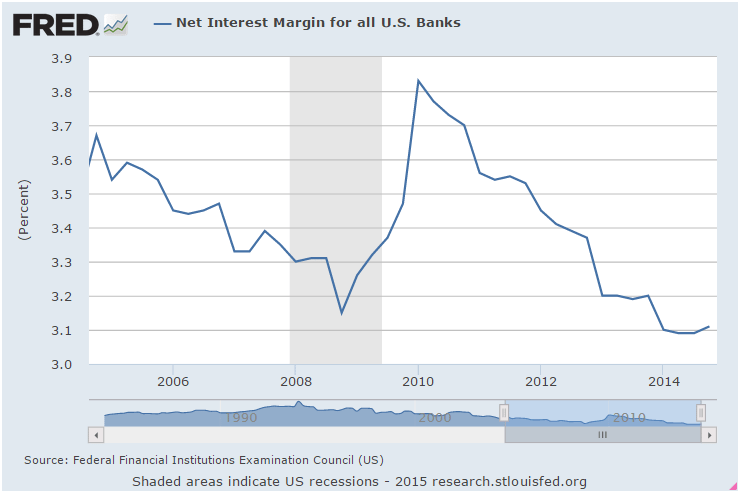
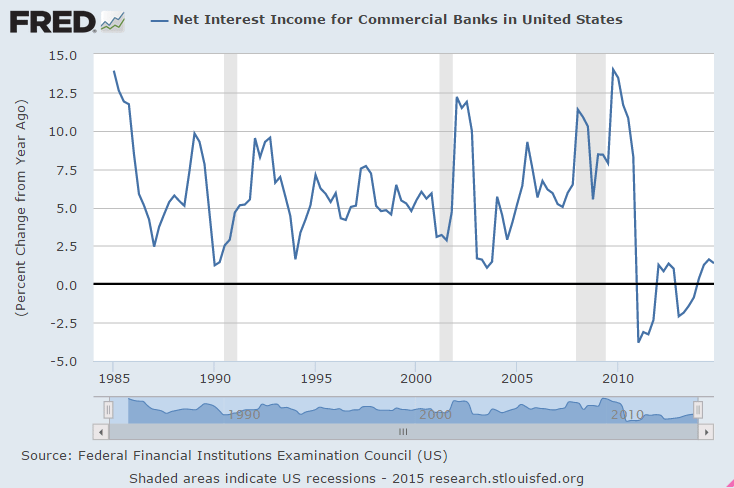
And banks in general fighting this:

net-income-margin-1

net-income-margin-2

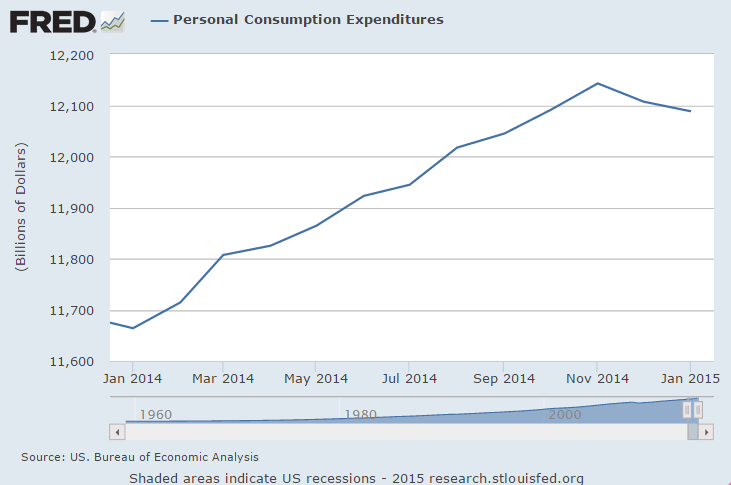
A bit worse than expected. Fewer dollars spent, but more ‘real things’ purchased due to lower prices, but any calculation of a deflator with the large drop in oil prices is problematic:

Personal Income and Outlays
personal-income-table-jan
Highlights
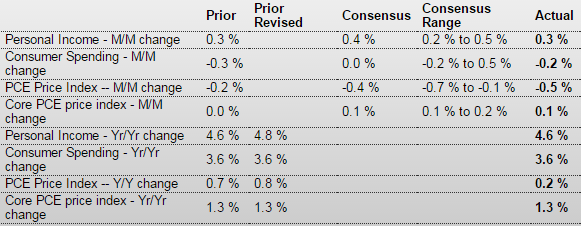
In January, personal income was moderately healthy as was spending after price effects are discounted. Personal income posted a gain of 0.3 percent after growing 0.3 percent in December. January fell short of analysts’ forecast for a 0.4 percent boost. The wages & salaries component jumped 0.6 percent, following a rise of 0.1 percent the prior month.

Personal spending decreased 0.2 percent, following a decline of 0.3 percent in December. Durables slipped 0.1 percent, following a 1.4 percent drop in December-due to sluggish auto sales. Nondurables plunged 2.2 percent in January after decreasing 1.4 percent the month before—with lower gasoline prices pulling this component down. Services advanced 0.5 percent after a 0.2 percent gain in December.

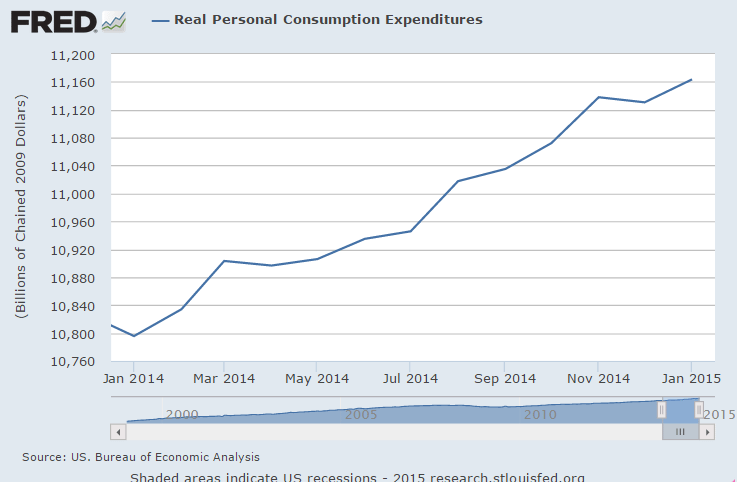
But weakness in current dollar spending was price related as chain-weighted (price adjusted) personal spending came in at 0.3 percent, following a 0.1 percent dip in December. January actually is a good start for first quarter GDP in the PCE component.

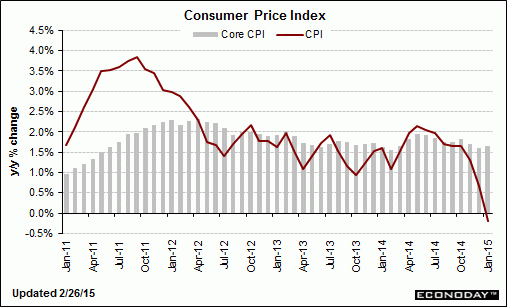
Prices at the headline level fell again, down 0.5 percent in January after a 0.2 percent dip the month before. The core PCE price index firmed to up 0.1 percent from flat in December. On a year-ago basis, headline inflation eased to 0.2 percent from 0.8 percent in December. The year-ago core rate was steady at 1.3 percent.

Income growth was moderately healthy in January. The consumer sector has fuel for spending-especially in the important wages & salaries component. Inflation is low and well below the Fed’s target of 2 percent year-ago inflation, meaning the Fed likely will stick with no rate hike before June.

pce-jan

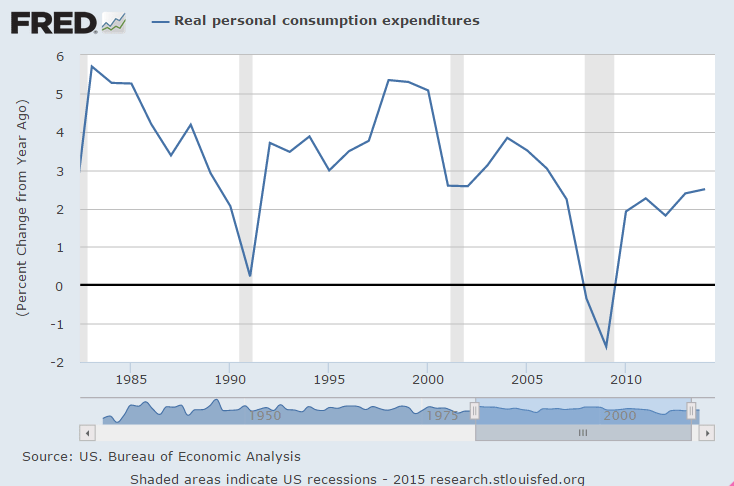
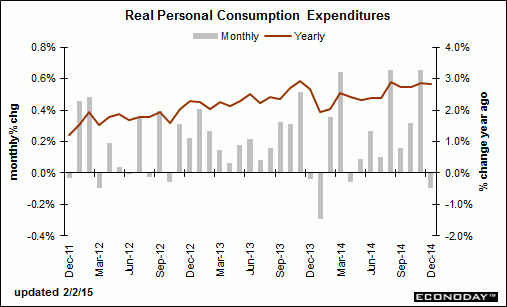
From the GDP report, through Q4:

rpce-jan
The monthly number shows January 2015 did better than January 2014 when the winter was particularly cold:
rpce-jan-2
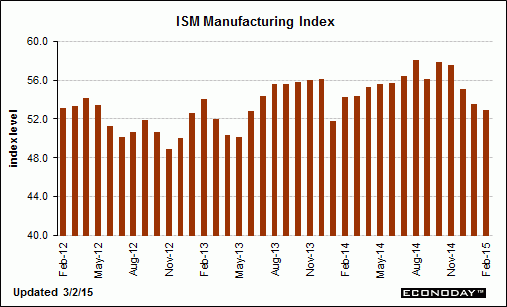
ism-feb

Construction Spending
construction-spending-jan-table
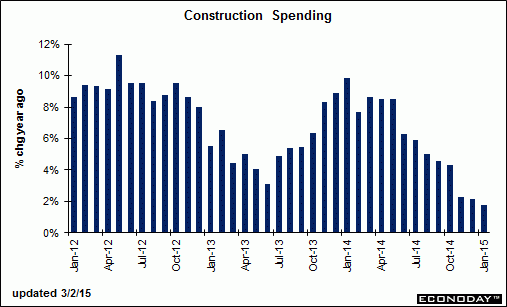
construction-spending-jan

GDP, Pending home sales, Chicago ISM, Consumer Sentiment

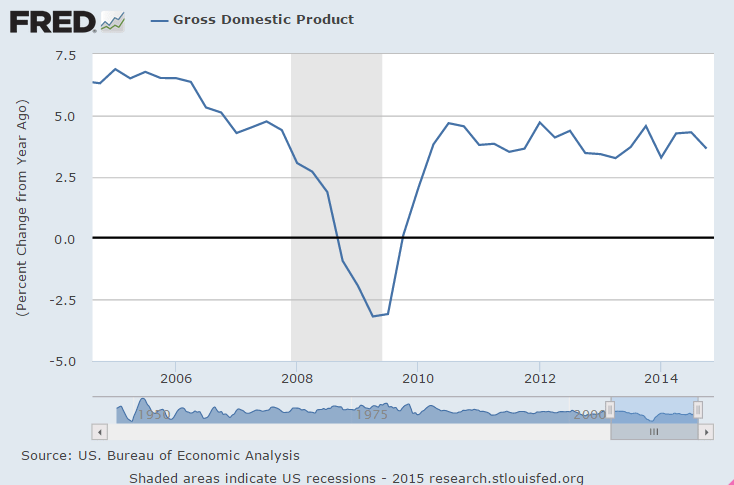
No ‘surge’ happening and Q1 GDP at risk as well from collapse of oil and gas investment:

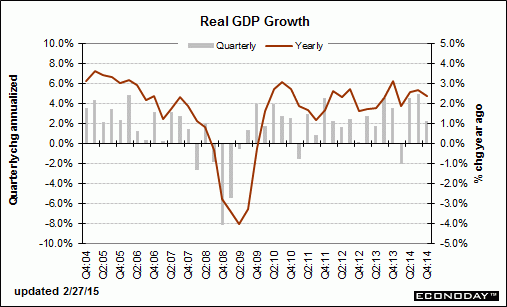
GDP Growth Slows to 2.2% in 4Q, revised lower but still better than expected

Latest figures indicate breakout pace of growth in the second and third quarters was unsustainable. The latest figures indicate the breakout 5% pace in the third quarter and 4.6% in the second quarter were unsustainable. For 2014 as a whole, GDP expanded 2.4%, slightly better than the average 2.2% growth of 2010-2013. By comparison, the economy grew an average 3.4% a year during the 1990s. Real personal consumption expenditures increased 4.2% in the 4Q, compared with an increase of 3.2% in the 3Q.

2-27-1
2-27-2
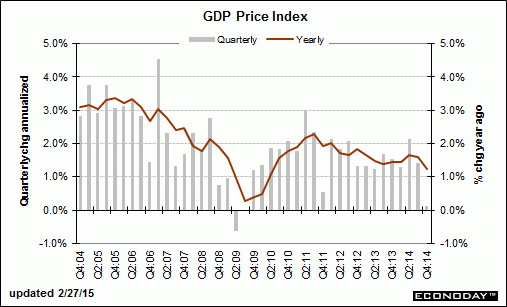
This is nominal GDP (not inflation adjusted):
2-27-3

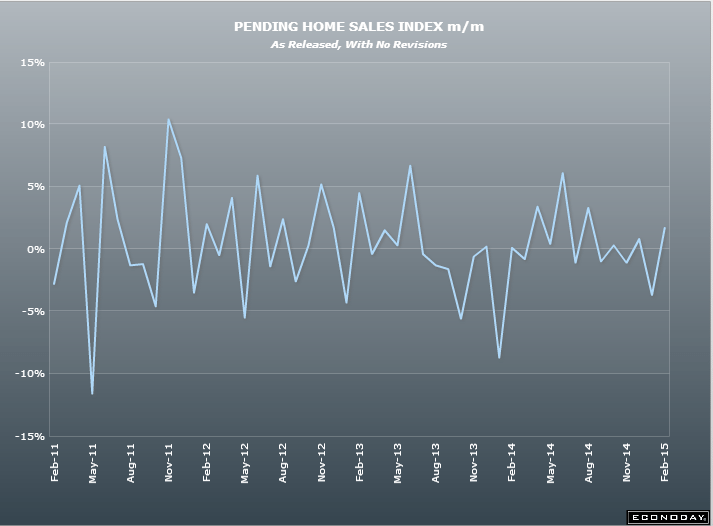
NAR: Pending Home Sales Rise in January to Highest Level in 18 Months, climbed 1.7% to 104.2 in January from an upwardly revised 102.5 in December and is now 8.4% above January 2014 (96.1). Improved buyer demand at the beginning of 2015 pushed pending home sales in January to their highest level since August 2013. All major regions except for the Midwest saw gains in activity in January. NAR chief economist, says “Contract activity is convincingly up compared to a year ago despite comparable inventory levels,” he said. “The difference this year is the positive factors supporting stronger sales, such as slightly improving credit conditions, more jobs and slower price growth.” “All indications point to modest sales gains as we head into the spring buying season,” “However, the pace will greatly depend on how much upward pressure the impact of low inventory will have on home prices. Appreciation anywhere near double-digits isn’t healthy or sustainable in the current economic environment.” Total existing-homes sales in 2015 are forecast to be around 5.26 million, an increase of 6.4% from 2014. The national median existing-home price for all of this year is expected to increase near 5%. In 2014, existing-home sales declined 2.9% and prices rose 5.7%.

Looks to me like a dip and a recovery before and then after mtg rules were altered in Jan.

With the ‘average’ still near 0:
2-27-4

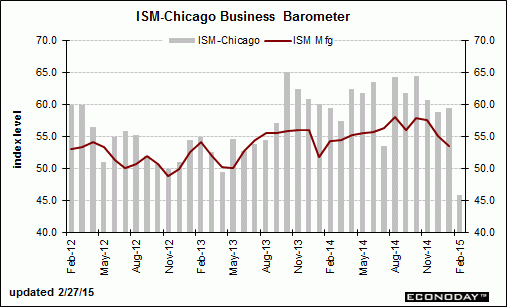
ISM Chicago Business Barometer At 5½-Year Low, Down 13.6 Points to 45.8 in February.

Production, New Orders, Backlogs Suffer Double Digit Declines.

LA port strike being blamed for some of the decline:
2-27-5

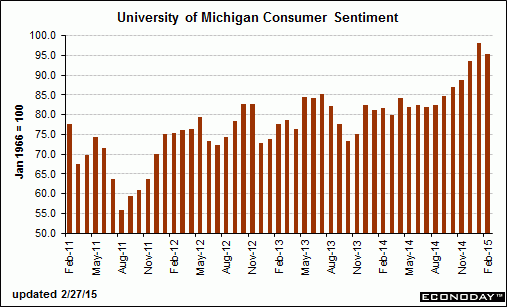
U of M Consumer Sentiment fell to 95,4 in February (final) from 98.1 in January.

Consumer optimism was affected by lower gas prices and an unusually harsh winter. The small overall decline from January still left consumer confidence at the highest levels in eight years

This is one man one vote, not one $ one vote:
2-27-6

Greece, Euro inflation

Greece gets to choose its own poison:

Greece Delays Awaited Reform Proposals Until Tuesday

Feb 23 (WSJ) — Greece’s government pushed back until early Tuesday a list of awaited reforms that its eurozone partners had demanded in exchange for continuing to fund the country for another few months. Greek officials said late Monday that the list would be sent the following morning, past the original midnight deadline. Eurozone finance ministers are due to review the proposed reforms during a conference call Tuesday afternoon. “We are still expecting the list today, but if it comes at 6 a.m. tomorrow morning then that’s OK for us,” said a European Union official in Brussels. The important thing, the official added, was for the measures to comply with the terms of Greece’s bailout program and that the proposals arrive ahead of Tuesday afternoon’s teleconference.

Greece submits reform proposals to creditors

By Holly Ellyatt

Feb 1 (CNBC) — Greece’s Finance Minister Yanis Varoufakis sent a list of reform proposals to the euro zone at around midnight on Monday, just making a deadline set by its international creditors.

A Greek government source confirmed that the reform measures were sent to the Eurogroup of euro zone finance ministers for approval. They will also need to be approved by the so-called “troika” overseeing the country’s bailout, made up of the International Monetary Fund, European Commission and European Central Bank.

A source close to the European Commission said they were “encouraged” by Greece’s “strong commitment” to combat tax evasion and corruption, Reuters reported. These were among the proposals according to a list released by the Greek government’s press office.

“In the Commission’s view, this list is sufficiently comprehensive to be a valid starting point for a successful conclusion of the review,” the source said, according to Reuters.

Other proposals included pledges to reform tax policy, consolidate pension funds and to eliminate incentives for early retirement. In addition, the proposals include plans to review and control public spending, and commitments not to roll back privatizations that have been completed.

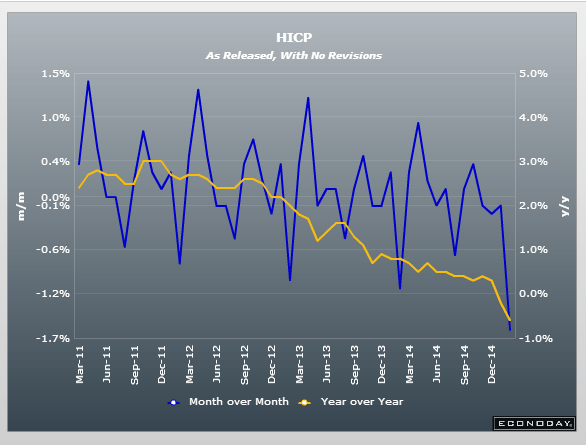
Euro inflation even with the weak euro!

eu-inflation

Existing home sales, Dallas Fed manufacturing, Chicago Fed

Again, with mtg purchase apps down and cash sales down why expect this to go up?

And with the oil credit expansion over it could get worse.

Existing Home Sales
existing-home-sales-jan-table
Highlights
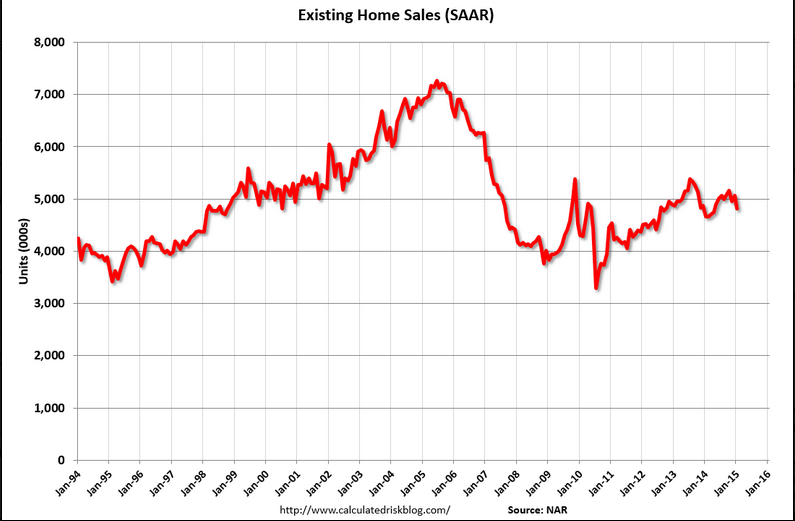
Despite a strong jobs market and low mortgage rates, demand for housing, whether for existing or new homes, remains flat. Sales of existing homes in January fell a very steep 4.9 percent to an annual rate of 4.82 million which is the lowest rate since April last year. All regions show single-digit declines with the West the deepest, at minus 7.1 percent. Declines hit both single-family homes, at minus 5.1 percent, and condos, at minus 3.5 percent.

Price concessions didn’t help the month’s sales with the median down 4.1 percent to $199,600. This is the first reading below $200,000 since March last year. The drop in sales made for a sizable rise in inventory relative to sales, to 4.7 months vs December’s 4.4 months.

The lack of sales punch has the National Association of Realtors wondering. The NAR says it’s “puzzled” that homeowners are now staying in their homes 10 years on average vs the long term average of 7 years, saying that homeowners may be happy with their mortgage rates and are perhaps doubtful that housing will rebound.
existing-home-sales-jan
existing-home-sales-jan-2
Dallas Fed Mfg Survey
dallas-fed-feb-table
Highlights
The latest regional Fed survey on manufacturing points to weakness in the manufacturing sector in February.

Texas factory activity posted a second month of no growth in February, according to business executives responding to the Texas Manufacturing Outlook Survey. The production index, a key measure of state manufacturing conditions, remained near zero (0.7) and indicated output was essentially unchanged from January levels.

Other measures of current manufacturing activity reflected contraction in February. The new orders index pushed further into negative territory, coming in at minus 12.2, its lowest reading since June 2009. The shipments index fell to minus 3.3, also reaching a low not seen since 2009. The capacity utilization index turned negative as well, dropping from 5.1 to minus 4.9.

Perceptions of broader business conditions remained rather pessimistic this month. The general business activity index moved further negative to minus 11.2, posting its lowest reading in nearly two years. The company outlook index remained slightly negative and edged down from -3.8 to -4.4.

Labor market indicators reflected only minor employment growth and slightly shorter workweeks. The February employment index moved down from 9 to 1.3. Fifteen percent of firms reported net hiring, compared with 14 percent reporting net layoffs. The hours worked index edged further into negative territory, coming in at minus1.6.

Prices fell slightly in February and upward pressure on wages continued to ease. The raw materials prices index held steady at minus1.7, indicating marginal downward pressure on input costs. The finished goods prices index was also slightly negative but edged up from minus 6.7 to minus 4.4. Manufacturers are no longer expecting sizeable price increases six months ahead, as the indexes of future prices were in single digits this month, down markedly from 2014 readings. The wages and benefits index edged down for a second month in a row and came in at 16.8.

Expectations regarding future business conditions rebounded somewhat in February. The index of future general business activity shot up 12 points to 5.5 after posting a negative reading in January. The index of future company outlook rose nearly 10 points to 11.8, although it remains well below the index level seen throughout 2014. Indexes for future manufacturing activity showed mixed movements in February but remained in solidly positive territory.

The latest Dallas Fed report plays into the hands of the doves on the FOMC. Manufacturing activity is weak and inflation pressures are non-existent currently. It will be interesting to hear Dallas Fed president Richard Fisher’s comments in speech since he has been hawkish. Fed chair Janet Yellen will be speaking to Congress this Tuesday and Wednesday and likely will comment on sector strengths and weakness and on price pressures.
dallas-fed-feb

Chicago Fed National Activity Index

chicago-fed-feb-table
Highlights
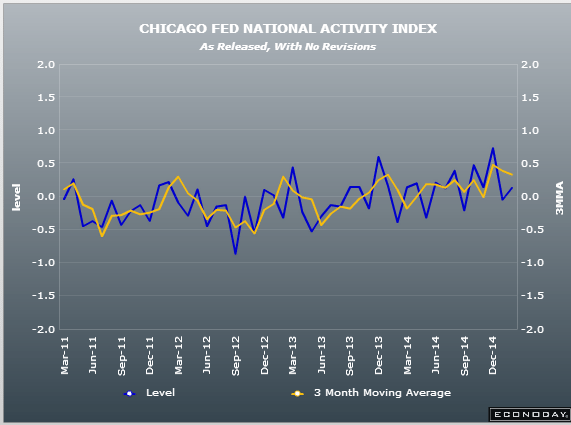
January was a good month for the economy based on the national activity index which jumped back into the plus column, to 0.13 from December’s revised minus 0.7. The 3-month average is very strong, little changed at plus 0.33.

The big swing factor for January is production-related indicators which rose to plus 0.02 from December’s minus 0.22 in a gain driven by a swing higher for industrial production. The negative reading from consumption & housing improved to minus 0.10 from minus 0.13 while the contribution from sales/orders/inventories held unchanged at plus 0.03. Employment remains a big plus but, due to a tick higher for the unemployment rate to 5.7 percent, a little less so, at plus 0.18 from plus 0.28.
chicago-fed-feb

mtg prch apps, housing starts, Producer prices, Redbook retail sales

More bad housing news:

MBA Purchase Applications
mba-2-13
Highlights
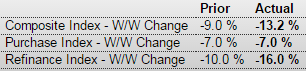
The purchase index is down for a 5th straight week, 7.0 percent lower for the 2nd consecutive week. Rates have been rising in recent weeks including the latest week which is especially depressing refinancing activity where the index fell a very sharp 16.0 percent following the prior week’s 10 percent fall. The report notes that demand for larger refinancing loans is especially down.

The average mortgage for conforming loans ($417,000 or less) rose 9 basis points in the week to 3.93 percent. The decline in the purchase index is a negative signal for underlying home sales.

More bad housing news:

Housing Starts
housing-starts-jan
Highlights
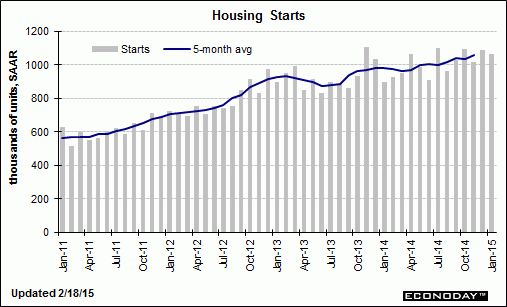
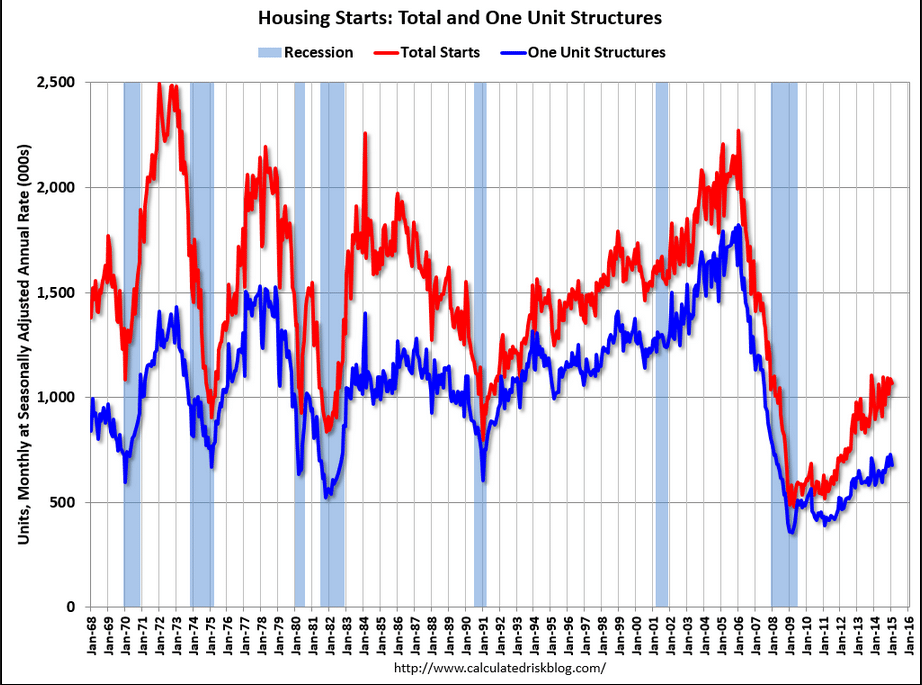
Housing is not adding to economic momentum. Housing starts slipped in January on weakness in single-family starts. Housing starts declined 2.0 percent in January after a 7.1 percent jump the month before. The 1.065 million unit pace was up 18.7 percent on a year-ago basis. Expectations were for a 1.070 million pace for January.

Single-family permits dropped 6.7 percent after a 7.9 percent boost in December. Multifamily starts gained 7.5 percent, following a 5.6 percent rise in December.

Again, permits suggest that housing activity is muted. Housing permits dipped 0.7 percent, following no change in December. The 1.053 million unit pace was up 8.1 percent on a year-ago basis. The market consensus was for a 1.070 million unit pace.

The bottom line is that housing is not adding to economic activity. This means the Fed likely will continue to reinvest mortgage-backed securities to keep rates low. But the long-term trend appears to be that single-family housing is not viewed as strong an investment as in the past.
housing-starts-jan-graph

housing-starts-jan-graph-2

PPI-FD
ppi-jan
Highlights
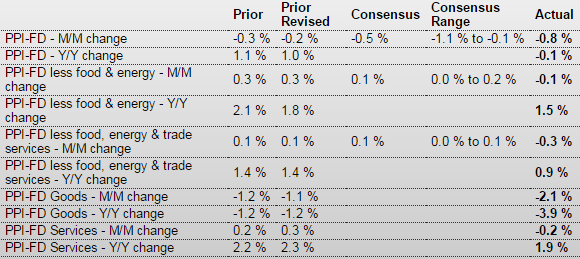
The PPI for total final demand decreased 0.8 percent after falling 0.2 percent in December. The consensus forecast a 0.5 percent drop. A sharp drop in energy pulled the headline number down. Excluding food and energy, producer price inflation slipped 0.1 percent after firming 0.3 percent the month before. Expectations were for a 0.1 percent rise.

The index for final demand goods fell 2.1 percent after dropping 1.1 percent in December. The January decrease was led by prices for final demand energy, which fell a monthly 10.3 percent. The decline in prices for final demand goods was led by the index for gasoline, which dropped 24.0 percent. Prices for diesel fuel, jet fuel, basic organic chemicals, dairy products, and home heating oil also moved lower. Conversely, the index for residential electric power moved up 1.2 percent. Prices for pharmaceutical preparations and for fresh and dry vegetables also advanced. Prices for final demand foods decreased 1.1 percent after slipping 0.1 percent in December.

The index for final demand services eased 0.2 percent after advancing 0.3 percent in December. In January, prices for final demand services less trade declined 0.3 percent after rising 0.1 percent the month before. This was the first decline since falling 0.3 percent in September 2014. In January, a major contributor to the decline in the index for final demand services was prices for outpatient care (partial), which fell 0.7 percent.

On a seasonally adjusted year-ago basis, PPI final demand was down 0.1 percent, compared to up 1.0 percent in December. Excluding food & energy, PPI final demand was up 1.5 percent versus 1.8 percent the month before.

Overall, inflation at the manufacturers’ level is muted even after discounting energy declines. The Fed is likely to see the numbers as allowing delayed rate increases.
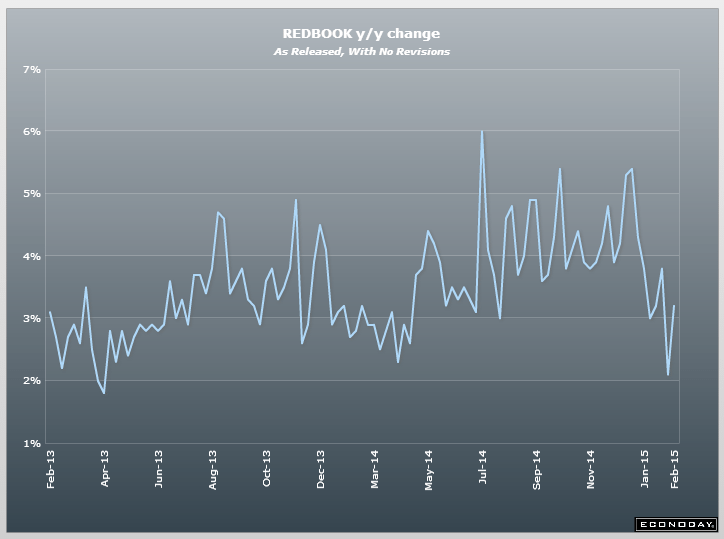
redbook-2-15

And yet another disappointing report:

Industrial Production
ip-jan

Highlights
The industrial sector turned modestly positive in January-including for the manufacturing component. Industrial production for January rebounded 0.2 percent after a December decrease of 0.3 percent. Market expectations were for a 0.4 percent boost for January.

Manufacturing rose 0.2 percent in January after no change the month before. But the negative is that December manufacturing was revised down from a 0.3 percent gain. The manufacturing increase fell short of the 0.4 percent market forecast.

Manufacturing output rose 0.2 percent in January, as the production of durable goods advanced 0.4 percent and the production of nondurable goods was unchanged. Gains were posted by all major durable goods industries except motor vehicles and parts, aerospace and miscellaneous transportation equipment, and furniture and related products. Increases of more than 1.0 percent were recorded in the production of primary metals and of computer and electronic products. Among the major nondurable goods industries, gains in the indexes for apparel and leather, for chemicals, and for plastics and rubber products offset losses elsewhere. The production of other manufacturing industries (publishing and logging) moved down 0.4 percent.

Mining dropped 1.0 percent in January after a 2.1 percent jump the prior month. Utilities made a partial rebound of 2.3 percent after plunging 6.9 percent in December.

Overall capacity utilization was unchanged at 79.4 percent.

The biggest news from this report was the downward revision to December. Manufacturing is still sluggish although on a barely positive uptrend.

RT interview, UK inflation, retail sales mystery, Greece, Italian trade surplus

Greece must threaten Grexit to get best outcome from Troika

Edward talks to Warren Mosler, chairman of Consulier Engineering on why the EU’s approach to the Greek debt crisis has failed to lift the Greek …

So for decades the BOJ has tried to create inflation and failed, for 7 years the Fed has tried and failed, the ECB has tried and failed, etc. etc. etc. Maybe it’s not so easy for a CB to create inflation? Or impossible…;)

UK inflation hits lowest level since records began

Abe hopes BOJ keeps stimulus to meet inflation goal, upbeat on economy

Feb 16 (Reuters) — Abe hopes BOJ keeps stimulus to meet inflation goal, upbeat on economy (Reuters) Japanese Prime Minister Shinzo Abe said on Monday praised the BOJ’s aggressive stimulus program for helping revive the economy and wipe out the public’s “sticky deflationary mindset.” “I hope the BOJ continues to steadily proceed with bold monetary easing to achieve 2 percent inflation,”

No consideration that the lower prices in the first instance only shift income from sellers of oil to buyers of oil:

Even excluding gas, retail spending was flat last month after ticking down 0.2% in December. The retail restraint is somewhat surprising given that the average household is expected to save hundreds of dollars this year on gas that averaged $2.23 a gallonon Thursday, down from $3.32 a year ago, according to the AAA.

Greece demands a credible growth package:

“No more loans — not until we have a credible plan for growing the economy in order to repay those loans, help the middle class get back on its feet and address the hideous humanitarian crisis.” YV

Italy : Merchandise Trade
it-trade
Highlights
The seasonally adjusted trade balance returned a sizeable E5.1 billion surplus in December following a slightly larger revised E3.8 billion excess in November.

December’s sharp improvement was mainly attributable to a 2.6 percent monthly bounce in exports, their fourth increase in the last five months, which easily more than reversed a 1.1 percent mid-quarter drop. Outside of durable consumer goods all of the major sectors saw solid monthly gains and total exports were up 6.3 percent from their level in December 2013.

However, weak domestic demand and lower oil costs were also once again a factor in the expansion of the black ink. Hence, imports were down 1.6 percent versus December (minus 0.5 percent ex-energy), their third straight month of decline. Compared with a year ago, purchases from overseas were off 1.3 percent.

Having hit a low of E-4.1 billion in March 2011 the turnaround in the Italian trade balance has been sharp and quite steady. Net exports probably provided a useful boost to economic growth last quarter and look likely to play a key role in any sustained upswing in 2015.

Jobs, Currency wars, etc.

Heaps stronger than expected:

Employment Situation
payrolls-jan
Highlights
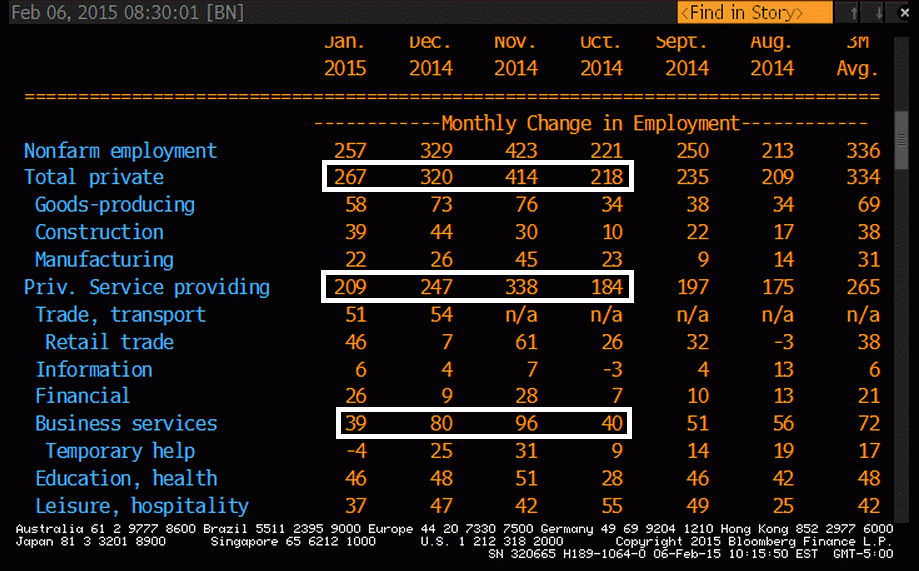
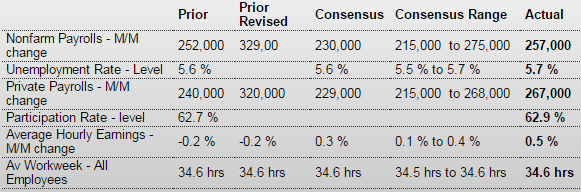
Today’s employment situation was heavily positive even though the unemployment rate edged up. Payroll jobs gained 257,000 in January after strong increases of 329,000 in December and 423,000 in November. December and November were revised up a net 86,000. With the revision, November is the strongest month since May 2010. Today’s report may tip the balance for the Fed to think about a first increase in policy rates this year rather than next-although still at a slow pace.

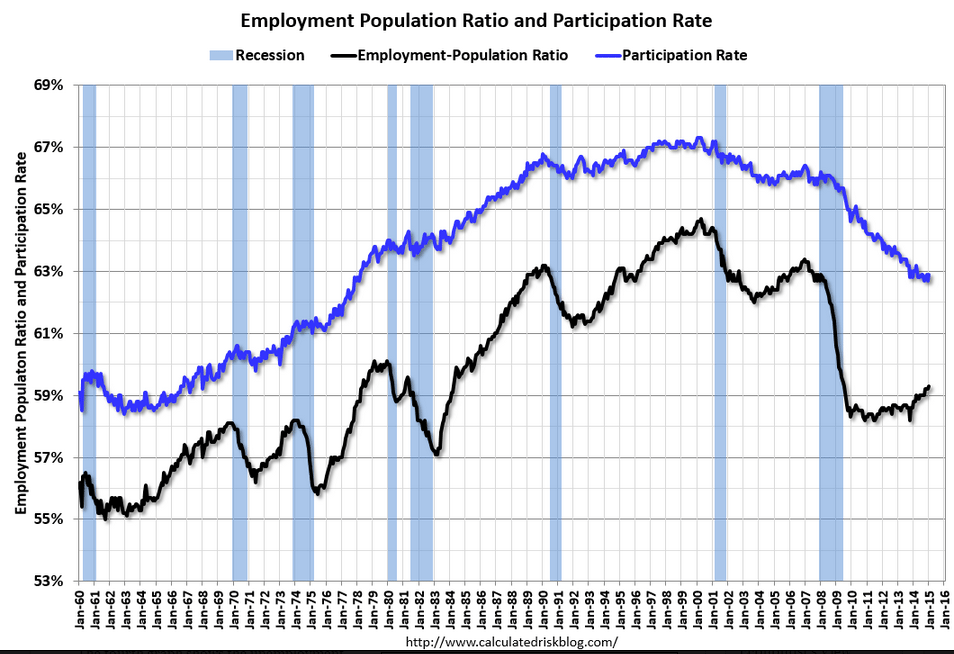
The unemployment rate nudged up to 5.7 percent from 5.6 percent in December. The rise was due to a sharp rebound in the labor force. The labor force participation rate rose to 62.9 percent from 62.7 percent in December. It appears that some discouraged workers are returning to the labor force—a positive sign for how workers view the economy.

Turning back to the establishment survey, private payrolls increased 267,000 in January after a 329,000 boost the month before.

Goods-producing jobs increased 58,000 after a 73,000 boost in December. Manufacturing increased 22,000 after rising 26,000 in December. Construction jumped 39,000 in January after gaining 44,000 the month before. Mining slipped 4,000 after rising 3,000 in December. These numbers offer hope that the manufacturing and construction sectors are improving. In recent months, they have been sluggish.

Private service-providing industries posted a 209,000 increase after a gain of 247,000 in December. Government jobs declined by 10,000 in January after a rise of 9,000 the month before.

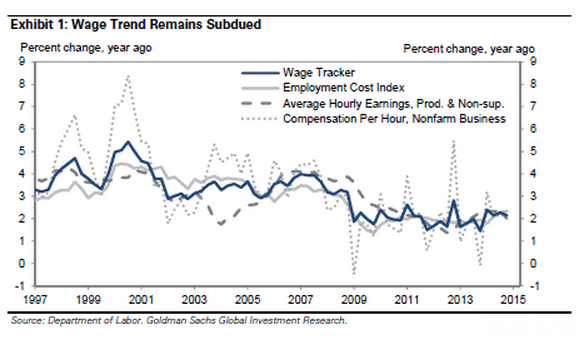
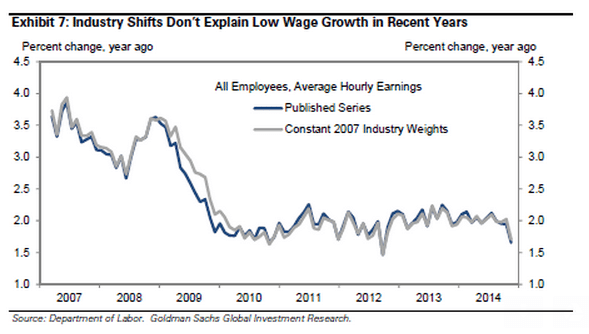
The labor force may be tightening a bit as average hourly earnings rebounded 0.5 percent, following a 0.2 percent dip in December. However, part of the boost in wages was due to increases in some states’ minimum wage. The average workweek held steady at 34.6 hours.

Overall, the latest employment situation suggests that the consumer sector is still the current backbone of the recovery. Also, the labor market has been given an upgrade with upward revisions to November and December. A caveat for the latest report is that seasonal factors for cold weather months can be volatile.

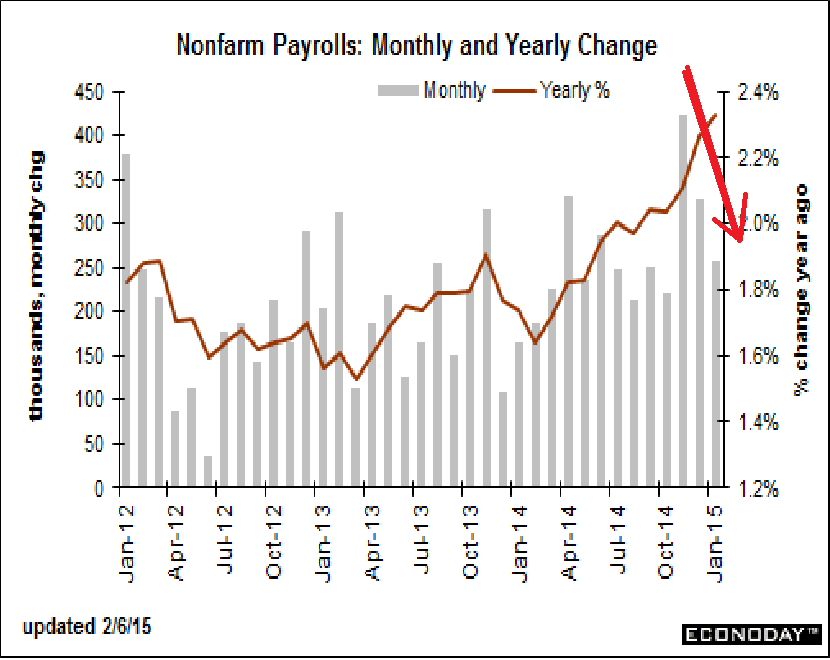
So anyone remember what that big spike in November was all about?

I don’t recall anything at the time in the news, etc. that would have indicated any kind of hiring surge was happening?

Anyway, whatever it was seems to be unwinding?
payrolls-jan-2

payrolls-jan-3

payrolls-jan-4

Currency wars, deflation fights, and with all the guns shooting backwards. As the carpenter said, ‘no matter how much I cut off it’s still too short.’

History will not be kind to these people…

Currency war a worry ahead of G-20 finance gathering (Nikkei) With a number of countries loosening monetary policy, avoiding competitive currency devaluation has emerged as a key issue for the meeting of Group of 20 finance ministers and central bankers that kicks off Monday in Istanbul. The communique released after the September G-20 meeting in Cairns, Australia, included language that in effect tacitly condoned monetary easing aimed at economic improvement. “Monetary policy in advanced economies … should address, in a timely manner, deflationary pressures where needed,” it read in part. The IMF, in January, projected growth of 1.2% in the eurozone, down 0.2 point from the October 2014 edition. The IMF cut its outlook for emerging markets by 0.6 point as well.

Fed’s Rosengren: Weak inflation is key challenge for central banks (WSJ) “The problem of significantly undershooting inflation—a dynamic which could well keep interest rates at the zero lower bound—is likely to be a key challenge to central bankers in the first two decades of the 21st century,” Federal Reserve Bank of Boston President Eric Rosengren said. “As with the oil shock in the 1970s, the current shock has served to accentuate a potential monetary policy pitfall—in this case, the failure to quickly and vigorously address a significant undershooting of inflation targets,” the central banker said. “We still are a long way from normalizing either short-term interest rates or our balance sheet,” the official said.

Benefits of aggressive Fed policy still to peak (WSJ) “The net stimulus to real activity and inflation was limited by the gradual nature of the changes in policy expectations and term premium effects, as well as by a persistent belief on the part of the public that the pace of recovery would be much faster than proved to be the case,” according to a new Fed board paper. “The peak unemployment effect—subtracting 1¼ percentage points from the unemployment rate relative to what would have occurred in the absence of the unconventional policy actions—does not occur until early 2015, while the peak inflation effect—adding ½ percentage point to the inflation rate—is not anticipated until early 2016,” write the authors.

Denmark Cuts Rates Again to Protect Currency Peg (WSJ) Denmark’s central bank scrambled to defend its under-pressure currency peg Thursday, cutting its benchmark interest rate for the fourth time in less than three weeks. The decision to cut the interest rate on deposits—to -0.75% from -0.5%–marks the latest effort to maintain the peg. Last week, the central bank, known as Nationalbanken, announced the surprise suspension of government bond auctions, and the bank said Tuesday it sold record amounts of kroner in January to weaken its currency. Nationalbanken Governor Lars Rohde tried to calm any fears about the future of the policy cornerstone. The central bank “has the necessary instruments to defend the fixed exchange rate policy for as long as it takes,” he said in a statement.

China cuts bank reserve requirement to spur growth (Reuters) China’s central bank made a system-wide cut to bank reserve requirements on Wednesday, the first time it has done so in over two years, to unleash a fresh flood of liquidity to fight off economic slowdown and looming deflation.

Greek leadership assures policy is good for its banks, while real economy and real people are devastated:

Greek central bank says ‘absolutely no problem’ with banks (Reuters) Greek central bank governor Yannis Stournaras said on Thursday that Greek banks were solid and under control. “Deposits and liquidity are absolutely safe,” Stournaras, who is also a member of the European Central Bank’s Governing Council, told reporters. “There is absolutely no problem with the banks. We are under control. It was a calm day today,” he said referring to bank deposits. Greek Prime Minister Alexis Tsipras and Finance Minister Yanis Varoufakis have been seeking support for a new deal with Greece’s international lenders that would allow an end to years of imposed austerity. “The ECB’s decision can be taken back if there is a deal from the Greek government (and its EU partners),” he said.

Not a good sign:

Baltic Dry Freight Index Plummets Amid Commodities Slump (WSJ) The Baltic Dry Index fell to 577 this week, a far cry from its peak of 11,793 in 2008. The size of the world’s fleet of dry-bulk ships far exceeds demand for the vessels which carry commodities, with over capacity estimated at around 20% above demand over the past few years. Many ships ordered at a time of booming global trade before the 2008 financial crisis have come into service as economic growth has spluttered in the years since. Rui Guo, a freight analyst at ICAP Shipping, said the tonnage in the water of dry-bulk vessels has gone up 85% since 2008, even as demand has fallen. Mr. Guo said daily freight rates for a 150,000-ton freight vessel are now around $5,500, with the break-even point around $7,500.

The Korea International Trade Association reported that exports of general machinery to China declined 7.1% in the January-November period of 2014, in contrast to a 2.0% increase in 2013.

payrolls-jan-5

Turkey’s President has it right!

Maybe they’ll invite me there for Thanksgiving- see where it all started!
;)

Erdogan: You Can’t Decide Interest Rates According to Inflation

By Ali Berat Meric

Feb 4 (Bloomberg) — Turkish President Recep Tayyip Erdogan says making interest-rate cuts dependent on slowing inflation is the result of a “wrong mentality.”

Erdogan, speaking to small business federation in Ankara:

* Says interest rates cause inflation

* “There are still those who don’t understand that if you cut interest rates you’ll cut inflation’’

* Some are trying to hold Turkey back with high interest rates

* Referring to Turkish central bank’s decision not to cut rates: “Unfortunately, this is the point we come to when the institution is independent”

personal income/spending, labor charts and comments, ISM, construction spending, earnings chart

The mainstream assert that the drop in oil prices is an unambiguous positive for the US economy, as it’s like maybe a $200 billion tax cut for consumers. The idea is that the $ saved on oil products get spent elsewhere, increasing real spending. On the negative side they see the fall in capital expenditures as under $100 billion and hurting only a few consumers but not nearly as many as get helped.

So far the data isn’t showing this happening, at least not in a meaningful way.

What they’ve left out is that falling oil prices only shift income from sellers of oil to buyers of oil, and even nominal spending due to that shift increases only to the extent that buyers of oil spend more of they savings than sellers of oil cut back due to loss of income. Additionally, capex reductions are from lack of potential profits, and not from shifting incomes. Putting all this together there is the reasonable possibility that the drop in oil prices turns out to be an unambiguous negative.

Personal Income and Outlays
eco-release-2-2-1
Highlights
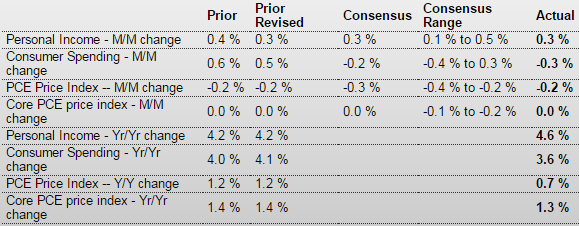
The consumer sector has been volatile on a monthly basis for spending while income growth has been steadier. Meanwhile, inflation has been weak. Personal income grew 0.3 percent in December after advancing 0.3 percent in November. Market expectations were for a 0.3 percent rise. December matched expectations. The wages & salaries component increased a modest 0.1 percent, but followed a jump of 0.6 percent the prior month.

Personal spending decreased 0.3 percent, following a boost of 0.5 percent in November. Analysts projected a dip of 0.2 percent for December.

Durables fell 1.2 percent on a swing in auto sales, following a rise of 1.8 percent in November. Nondurables, tugged down by gasoline prices, decreased 1.3 percent after decreasing 0.3 percent the prior month. Services edged up 0.1 percent, following a 0.5 percent spike in November.

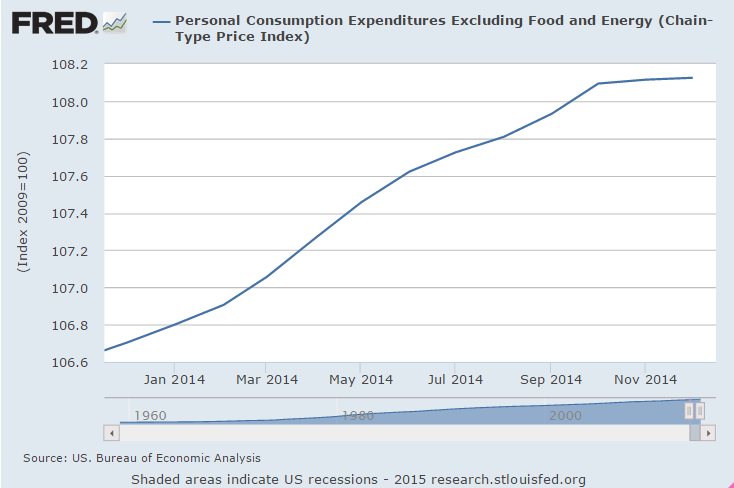
PCE inflation remained weak-largely due to lower energy costs. Headline inflation decreased 0.2 percent on a monthly basis, following a drop of 0.2 percent in November. Forecasts were for a 0.3 percent drop. Core PCE inflation was flat in both December and November. December matched expectations.

On a year-ago basis, headline PCE inflation decelerated to 0.7 percent in December from 1.2 percent the prior month. Year-ago core inflation posted at 1.3 percent in December compared to 1.4 percent in November. Both series remain below the Fed goal of 2 percent year-ago inflation.
eco-release-2-2-2

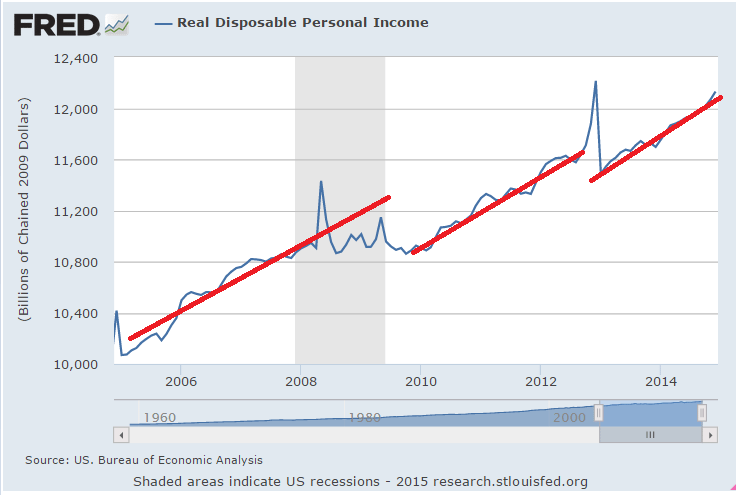
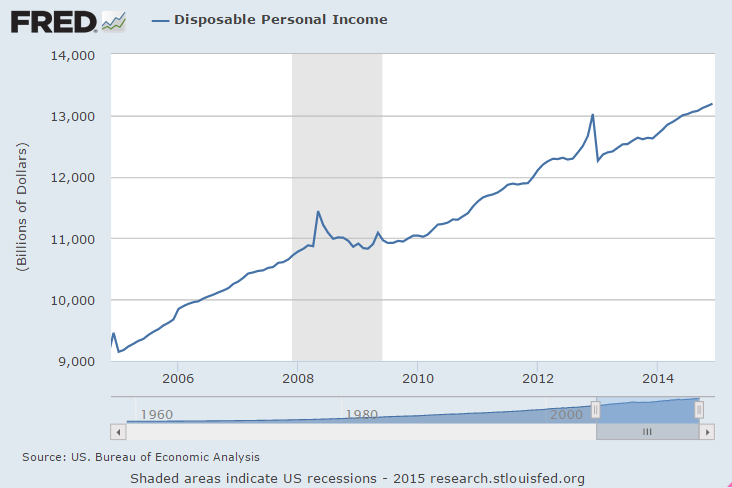
Note how after tax real income has had two shifts lower and isn’t growing fast enough to ‘catch up.’
eco-release-2-2-3
And nominal after tax income growth has actually slowed recently:
eco-release-2-2-4
Interesting that this slowed!
eco-release-2-2-5

eco-release-2-2-6
eco-release-2-2-7
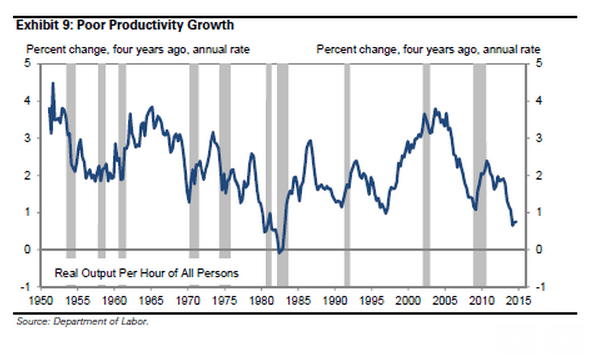
This may also show business has been ‘over hiring’?
eco-release-2-2-8
New export orders collapse- who would have thought???
;)

And import orders rose bit, also as expected from the shift in oil income.

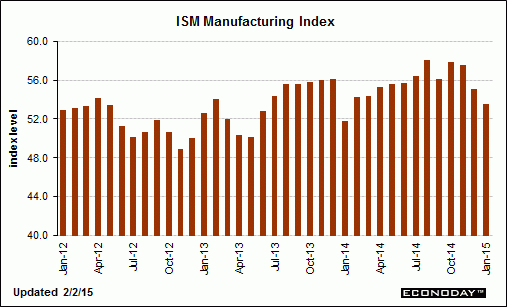
ISM Mfg Index
eco-release-2-2-9
Highlights
ISM growth had been running hot compared to other manufacturing reports but has slowed down noticeably the last two readings. January’s composite score of 53.5 compares with a revised 55.1 in December and 57.6 in November. October was the fourth quarter’s peak at 57.9.

New orders slowed substantially in January, to 52.9 from 57.8. In contrast, November and October growth in orders was in the low 60s. Weakness in foreign demand is a key factor here as new export orders fell 2.5 points to a sub-50 49.5. This is the lowest export reading since November 2012. Total backlog orders also moved into contraction, to 46.0 for a 6.5 point loss.

Production remained strong in part because of the working down of backlogs. A big headline is prices paid which fell 3.5 points to 35.0 which is very low, the lowest reading since April 2009.

This report is a concern, reflecting weak foreign markets and also troubles in the oil patch. The ISM wasn’t the first to signal slowing but it now heavily underscore prior indications.
eco-release-2-2-10

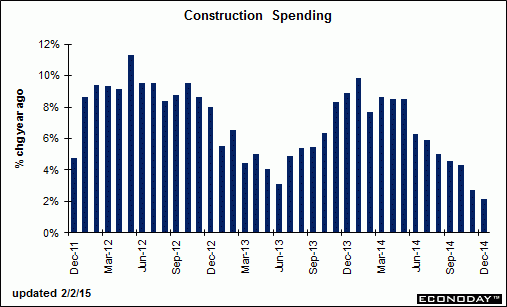
The chart says it all:

Construction Spending
eco-release-2-2-11
Highlights
Construction outlays rebounded 0.4 percent in December after dipping 0.2 percent the month before. December was below market expectations were for a 0.6 percent gain.

December’s increase was led by public outlays which rebounded 1.1 percent after dropping 1.8 percent jump in November. Private residential spending rose 0.3 percent after edging up 0.1 percent in November. Private nonresidential construction spending eased 0.2 percent in December after a 0.8 percent rise the month before.

On a year-ago basis, total outlays were up 2.2 percent in December compared to 2.7 percent in November.

eco-release-2-2-12

eco-release-2-2-13