China, Saudi Output, Credit Check

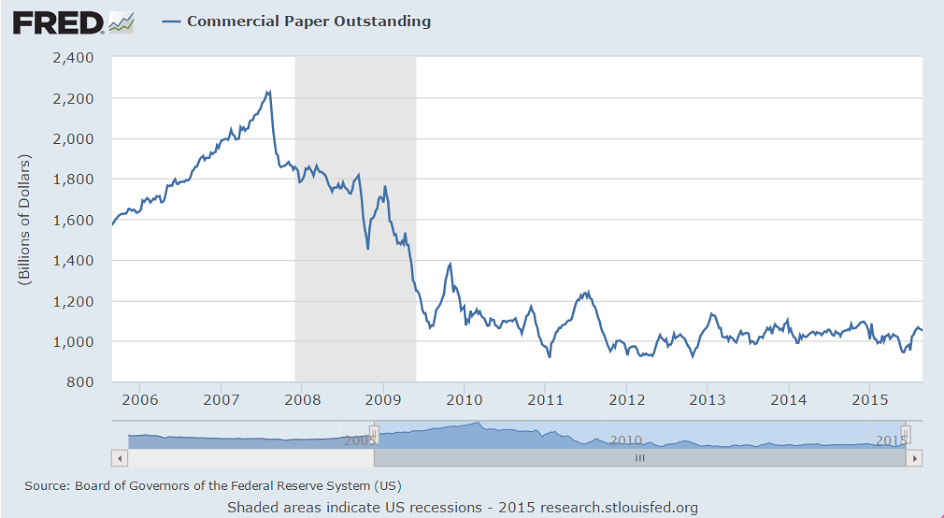
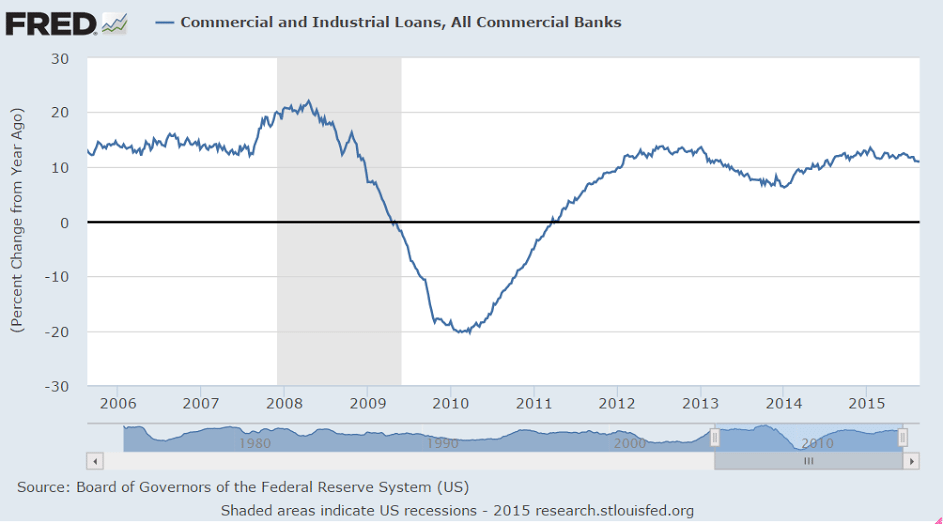
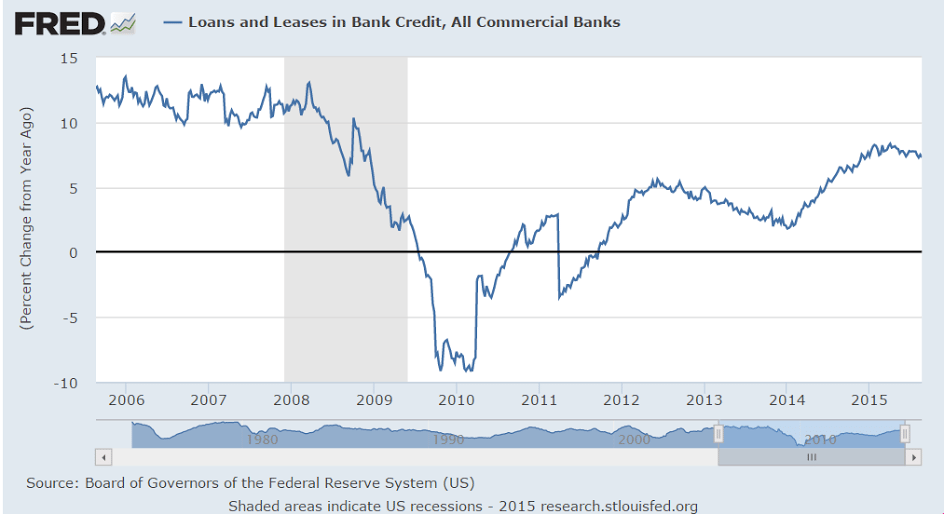
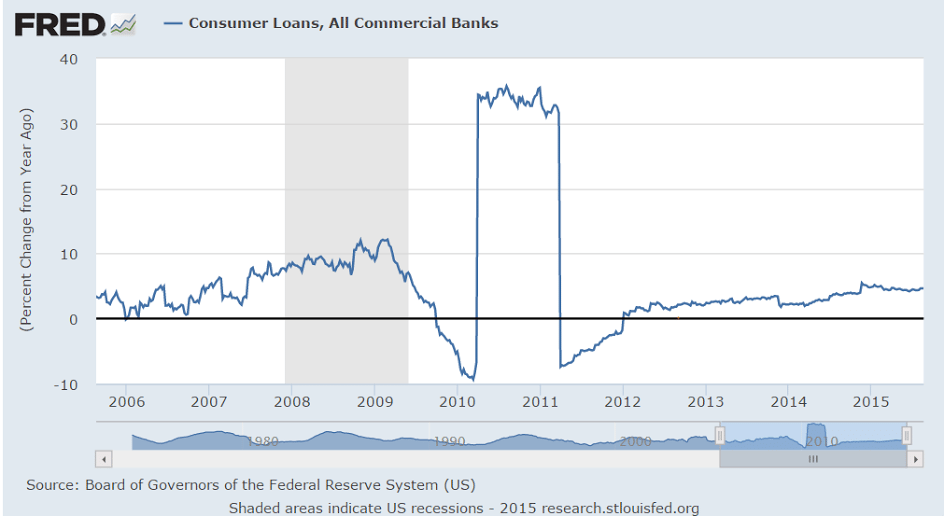
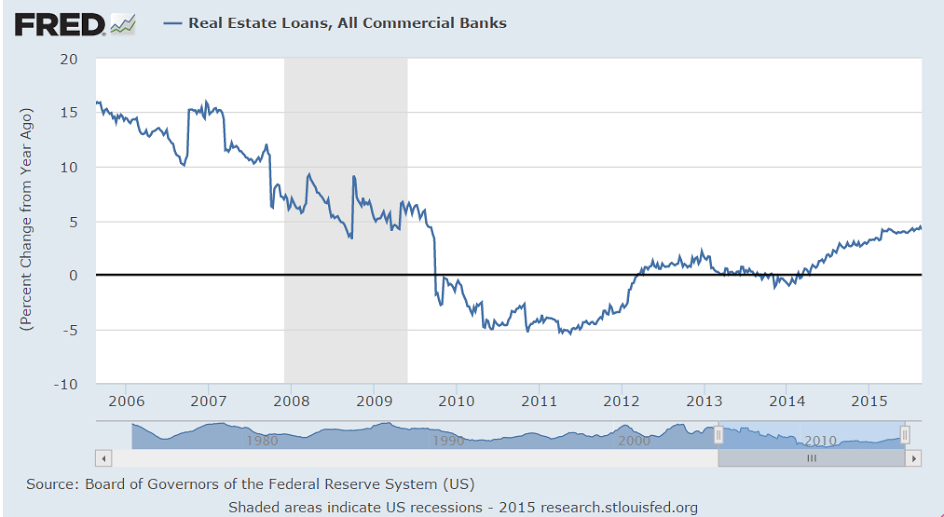
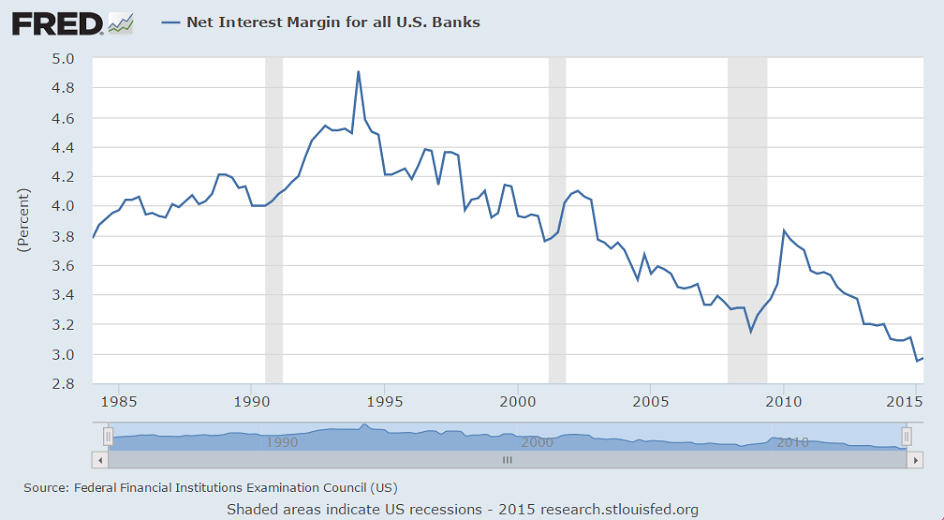
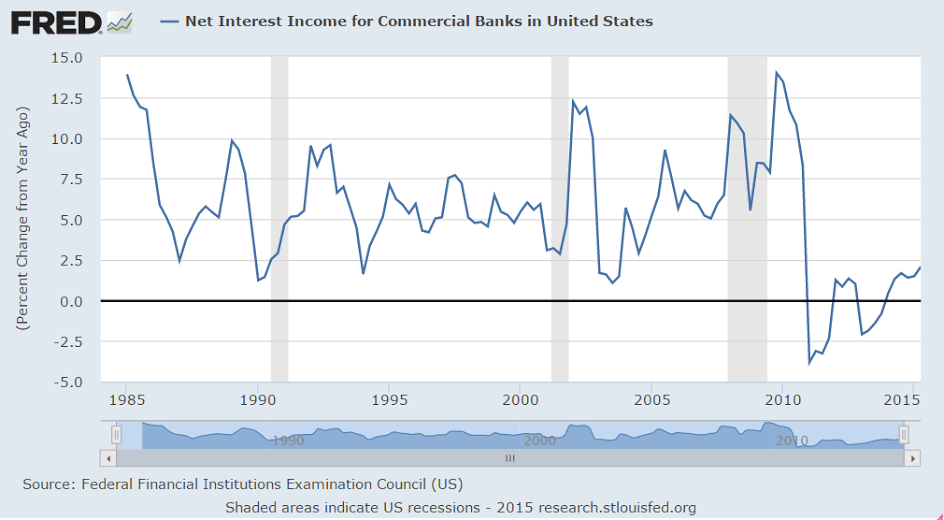
This monetarist stuff doesn’t work:

China removes regulation on loan-to-deposit ratio

Aug 28 (Xinhua) — China’s top legislature on Saturday adopted an amendment to the Law on Commercial Banks, removing a 75-percent loan-to-deposit ratio stipulation. China has kept the 75-percent ratio since the law was enacted and put into effect in 1995. “The ratio was set to prevent overly quick expansion of commercial banks’ credit scale and control liquidity risk, but it has become improper for current needs,” said Shang Fulin, chairman of the China Banking Regulatory Commission. Such an outdated ratio is now hindering the already market-oriented banks to better support the real economy, Shang said.

And this kind of stuff will further slow things down:

Obama

By Carlos Tejada

Aug 30 (WSJ) — China Places Cap on Local Government Debt () Chinese lawmakers have placed a 16-trillion-yuan cap on local government debt. The Standing Committee of China’s National People’s Congress imposed a 600 billion yuan limit on the direct debt local governments are allowed to run up this year. That would be on top of 15.4 trillion yuan on debt owed by local governments as of the end of 2014. The caps don’t include indirect liabilities, which officials said totaled 8.6 trillion yuan. The latest government estimate put China’s local debt load at 17.9 trillion yuan as of the middle of 2013, up from negligible levels just six years before, including debt held indirectly.

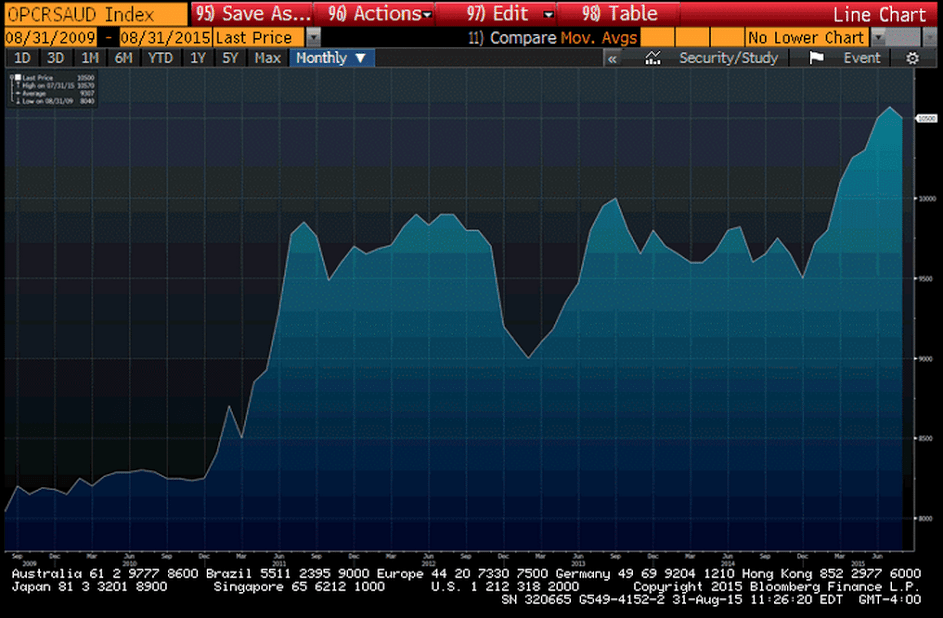
Saudi output fell only a small amount, indicating that demand held reasonably steady at that level at their posted prices, and that they remain comfortably control of price:
er-9-1-1
Growth still slowing:
er-9-1-2
er-9-1-3
er-9-1-4
er-9-1-5

This one’s showing steady growth, though low still very low:
er-9-1-6
er-9-1-7
er-9-1-8

Dallas Fed, Chicago PMI, Japan Industrial Production, Italy Retail Sales, Comments on GDI and GDP

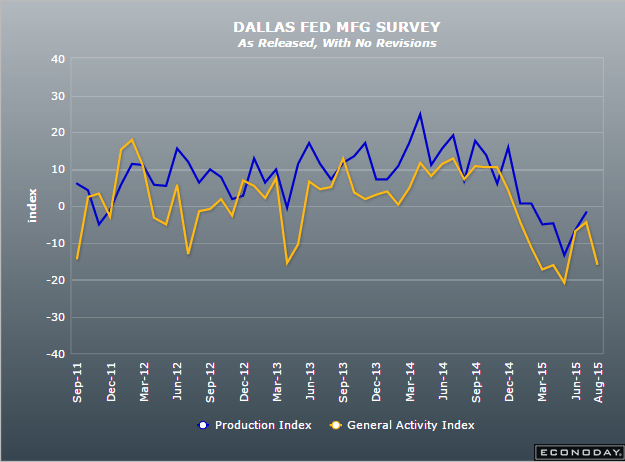
Shockingly negative:

Dallas Fed Mfg Survey
er-9-31-1
er-9-31-2

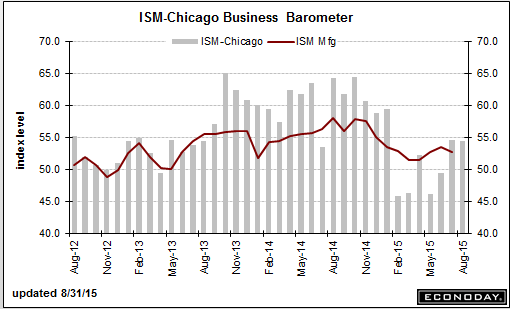
Not so good:

Chicago PMI
er-9-31-3
Highlights
The headline for August looks solid, at 54.4 for the Chicago PMI, but the details look weak. New orders and production both slowed and order backlogs fell into deeper contraction. Employment contracted for a fourth straight month while prices paid fell back into contraction. Lifting the composite index are delays in shipments which point to tight conditions in the supply chain. Inventories rose sharply in the month and the report hints that the build, despite the weakness in orders, was likely intentional. But strength is less than convincing and this report suggests that activity for the Chicago-area economy may be flat going into year end.
er-9-31-4

Japan : Industrial Production
er-9-31-5
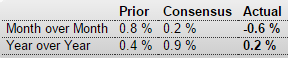
Italy : Retail Sales
er-9-31-6

Highlights
Retailers had another poor month in June as nominal sales fell 0.3 percent versus May when they declined a slightly steeper revised 0.2 percent. Unadjusted annual growth actually accelerated from 0.1 percent to 1.7 percent but this was due to extra shopping days in this year’s report. Volume purchases were also 0.3 percent lower on the month.

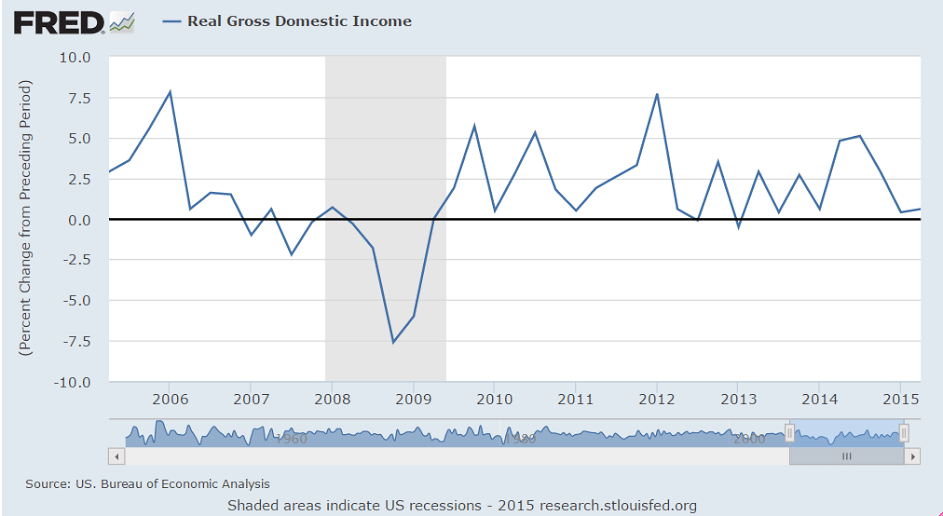
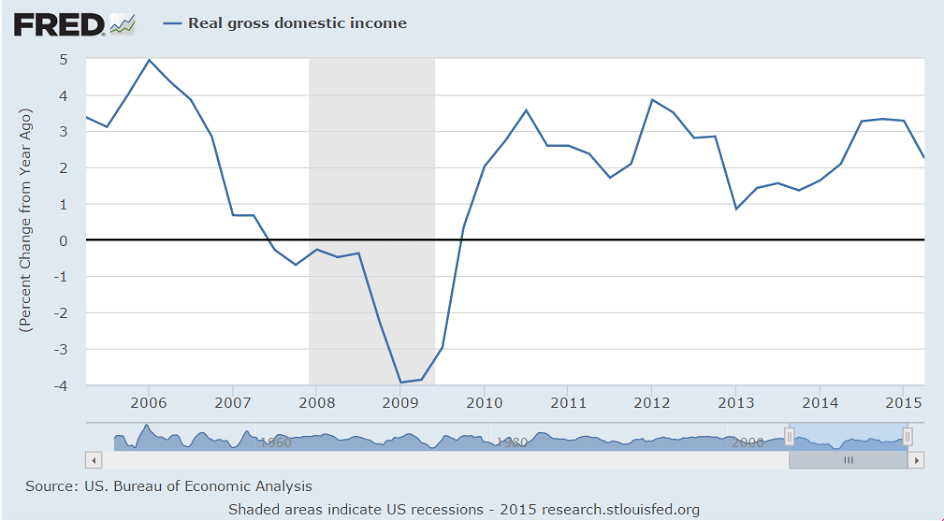
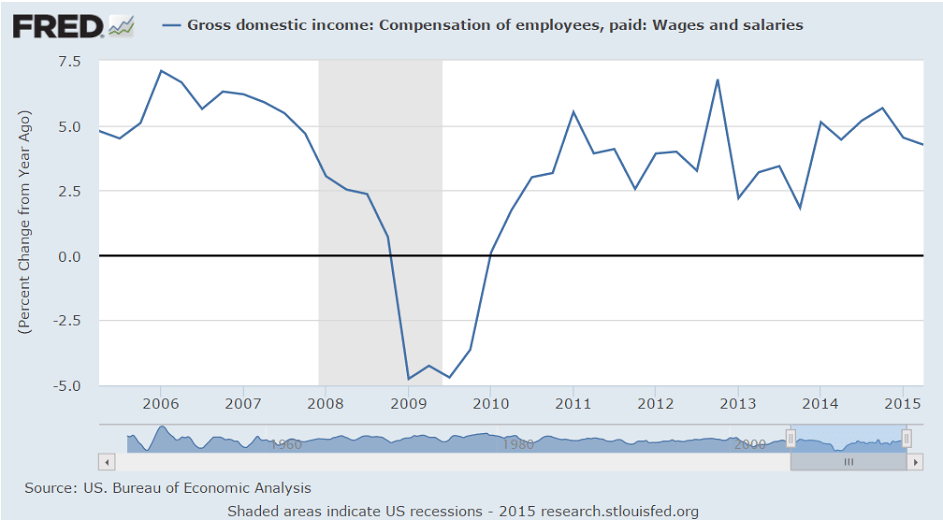
Real gross domestic income (GDI) was up at only a .6% annual rate, only a bit higher than Q1, and in contrast to GDP being up 3.7% for the same quarter. This time looks to me like it’s GDP that’s out of line, as per my narrative where I don’t see any signs of any other sector stepping up and replacing the GDP supported by the now lost oil capital expenditures:
er-8-31-7

er-8-31-8
er-8-31-9
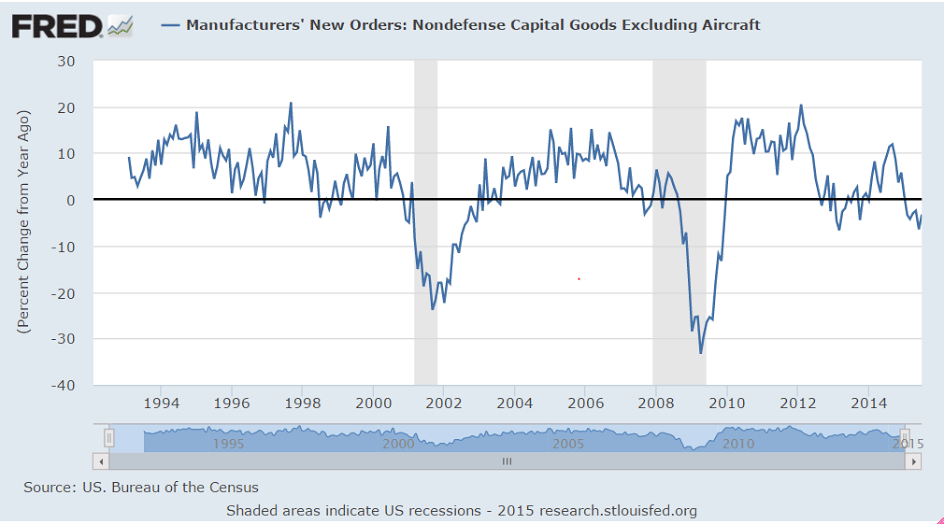
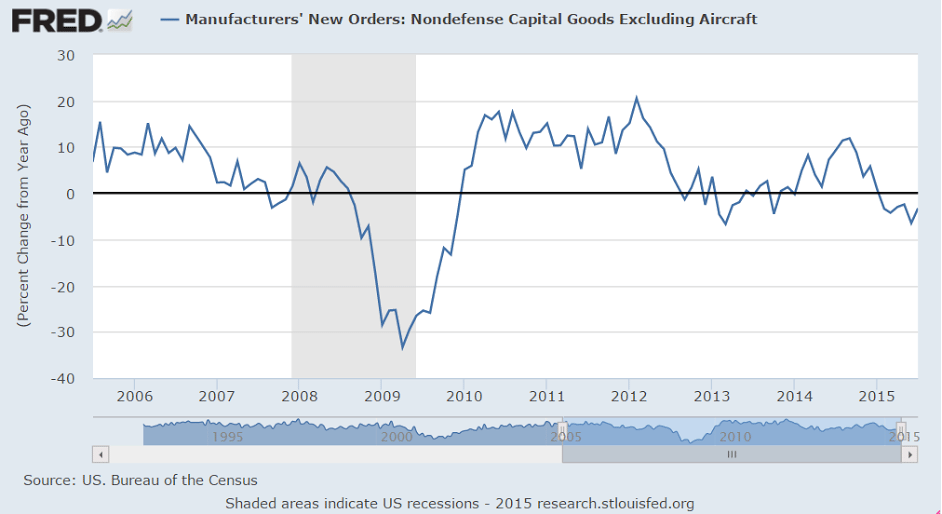
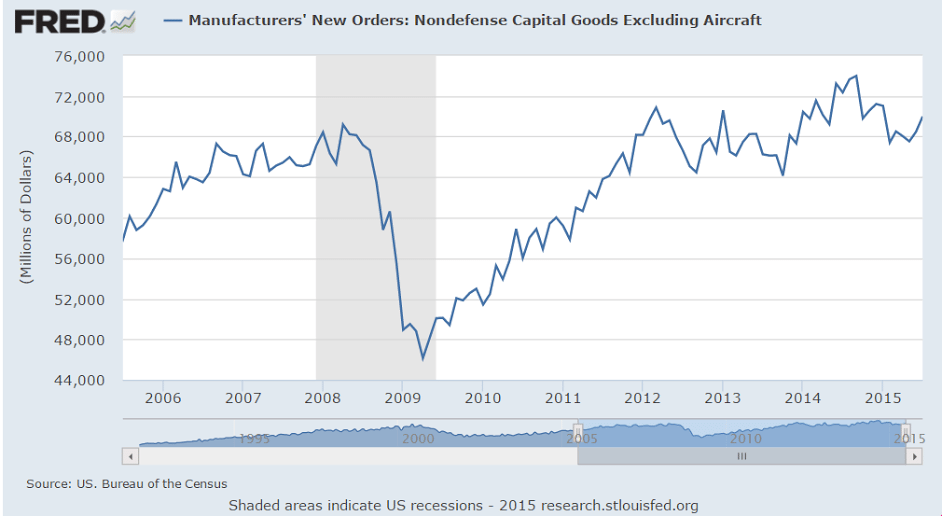
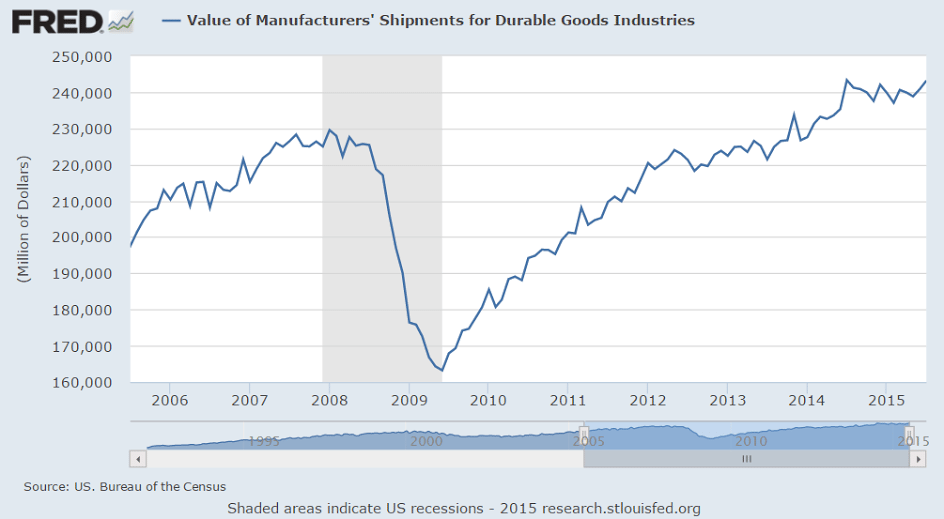
The capital goods sector remains in retreat:
er-8-31-10
Lots of anecdotals don’t jibe with 3.7% growth:

21 August 2015: ECRI’s WLI Growth Index Sinks Slightly More Into Contraction

(Econintersect) — ECRI’s WLI Growth Index which forecasts economic growth six months forward – remains in negative territory. This index had spent 28 weeks in negative territory then 15 weeks in positive territory – and now is in its second week in negative territory.

Rail Week Ending 22 August 2015: Some Improvement But Continued Deterioration Of Year-over-Year Rolling Averages

(Econintersect) — Week 33 of 2015 shows same week total rail traffic (from same week one year ago) marginally expanded according to the Association of American Railroads (AAR) traffic data. Intermodal traffic expanded year-over-year, which accounts for approximately half of movements. but weekly railcar counts continued in contraction.

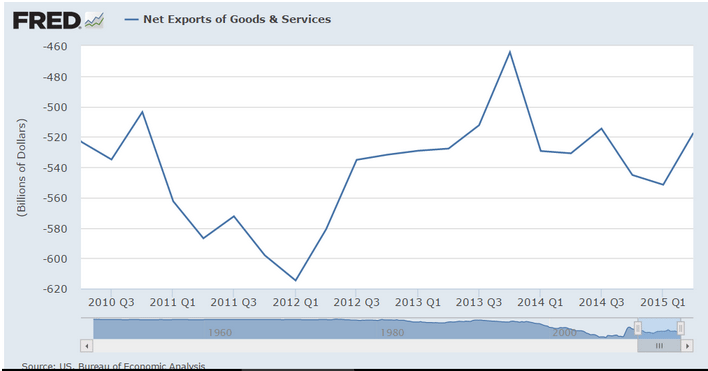
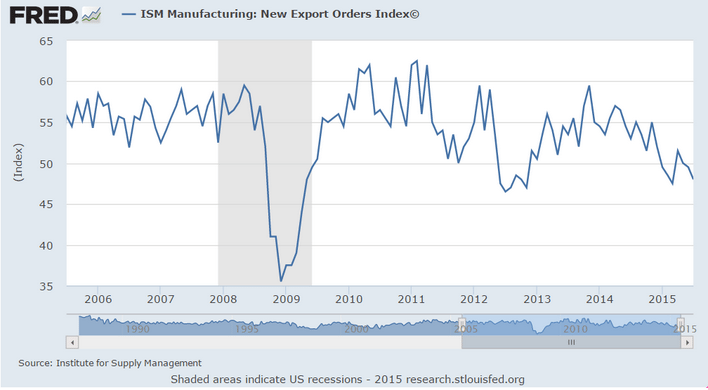
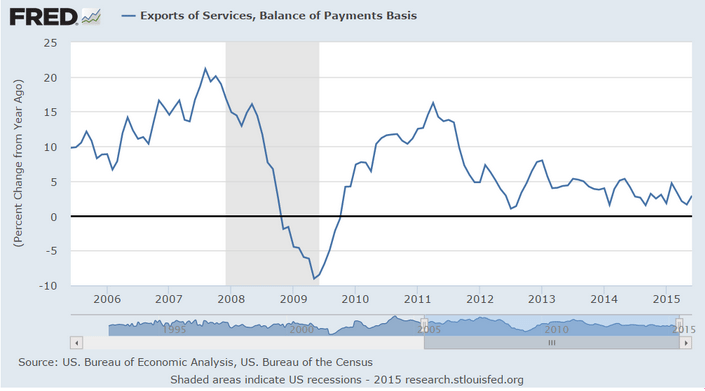
Lots of reasons to suspect net exports will revert in Q3, or be revised down for Q2 as blips up like this latest one tend to quickly reverse, especially with all the surveys showing exports in retreat:
er-8-31-11
The goods component is looking in full retreat:
er-8-31-12
And the service component of exports isn’t offering any material support either:
er-8-31-13
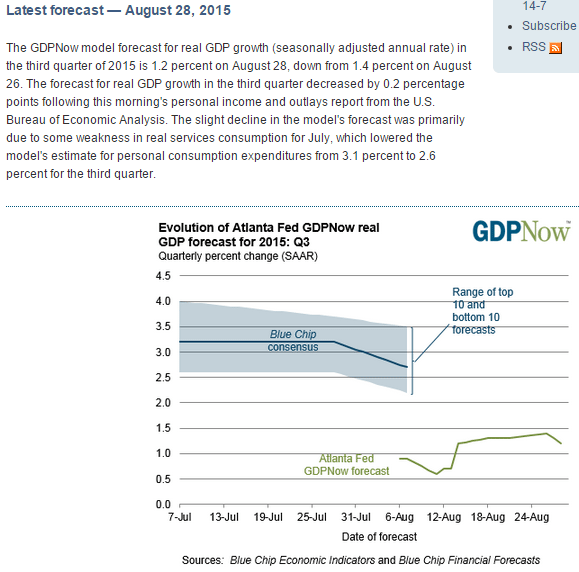
And the Atlanta Fed’s Q3 GDP forecast of only 1.2% remains well below mainstream forecasts:
er-8-31-14

Personal Income and Outlays, Consumer Sentiment, Japan Household Spending, China Profits

Everything pretty much as expected and the same, helped by vehicle sales which are both volatile and leveling off:

United States : Personal Income and Outlays
er-8-28-1
Highlights
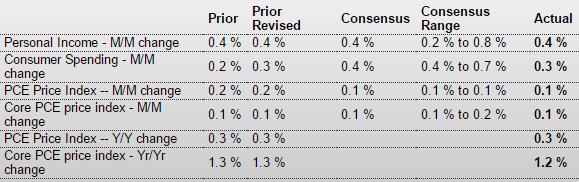
There’s no hurry for a rate hike based on the July personal income and outlays report where inflation readings are very quiet. Core PCE prices rose only 0.1 percent in the month with the year-on-year rate moving backwards, not forwards, to a very quiet plus 1.2 percent. Total prices are also quiet, also at plus 0.1 percent for the monthly rate and at only plus 0.3 percent the yearly rate.

On the consumer, the data are very solid led by a 0.4 percent rise in income that includes a 0.5 percent rise in wages & salaries which is the largest since November last year. Other income details, led by transfer receipts, also gained in the month. Spending rose 0.3 percent led by a 1.1 gain in durables that’s tied to vehicle sales. The savings rate is also healthy, up 2 tenths to 4.9 percent.

The growth side of this report is very favorable and marks a good beginning for the third quarter. This at the same time that inflation pressures remain stubbornly dormant. And remember this report next month will reflect the August downturn in fuel prices. With the core PCE index out of the way, next week’s August employment report looks to be the last big question mark going into the September 17 FOMC.

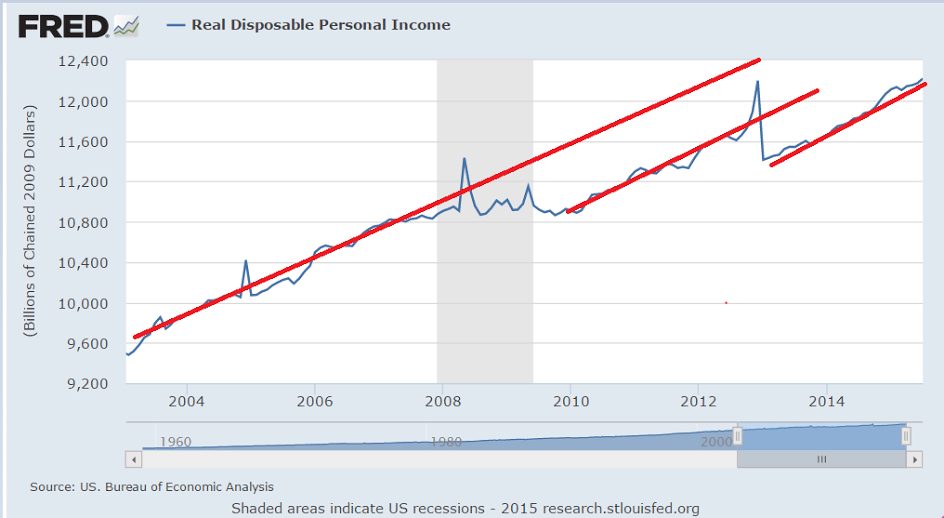
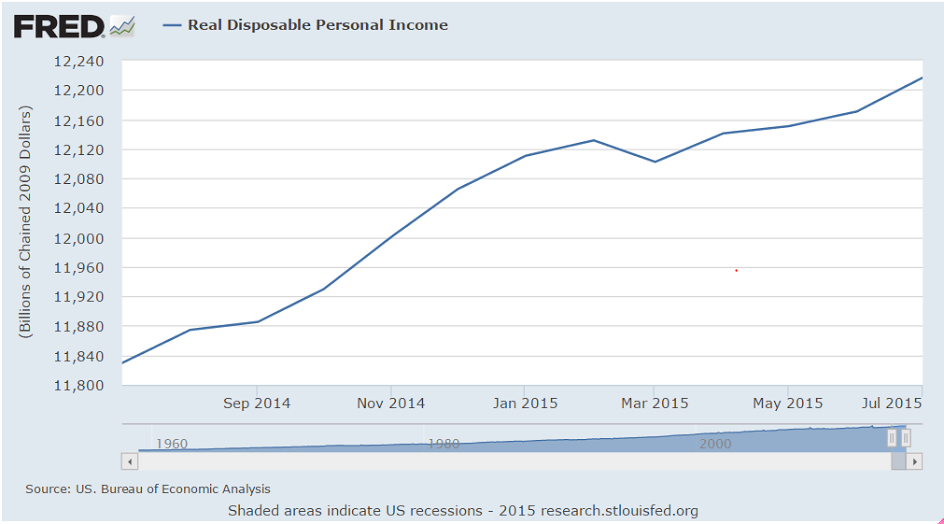
First the recession then the tax hikes and sequesters ratchet down after tax income, and the growth rate is both low and never enough to ‘catch up’:
er-8-28-2
And over the last year you can see how the drop in oil capex after the price fell did the same thing though on a smaller scale, at least so far:
er-8-28-3

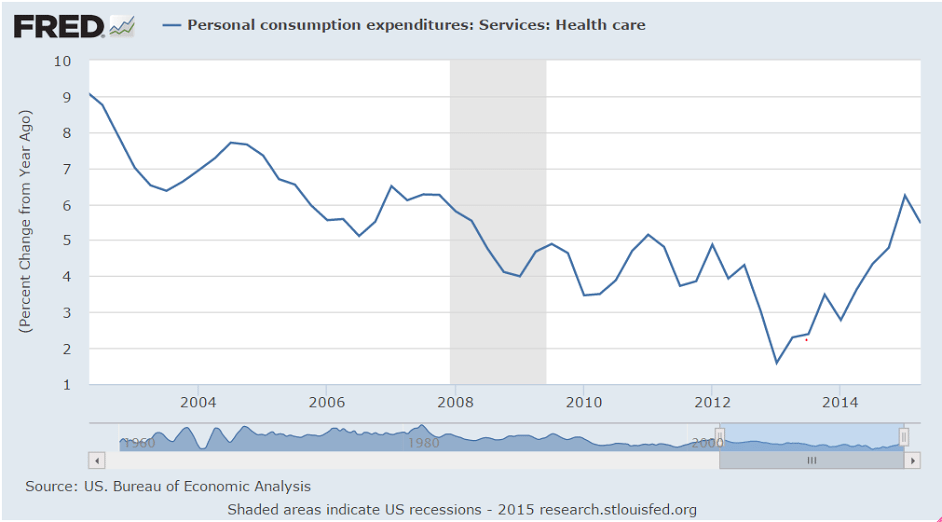
This is further decelerating from already weak numbers, not to forget health care premiums count as consumption expenditures, with a one time adjustment in progress as previously uninsured people become insured and begin paying premiums:
er-8-28-4

This is a quarterly number updated yesterday. The ‘one time’ increase may be cresting:
er-8-28-5
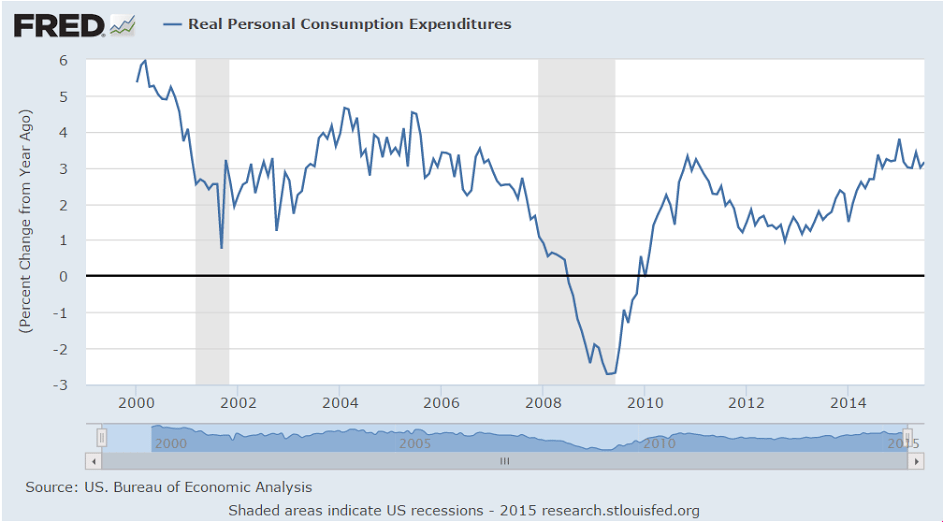
Starting to decelerate, even with low gas prices:
er-8-28-6

Japan : Household Spending
er-8-28-7

China’s industrial profits fell faster in July

Aug 28 (Xinhua) — Profits of China’s major industrial firms fell 2.9 percent year on year in July, sharply down from the 0.3-percent decline posted in June. The NBS attributed the poor performance to weak domestic demand and a continuous fall in factory gate prices, which have suffered 41 consecutive months of declines. Profits at industrial companies with annual revenues of more than 20 million yuan (about 3.1 million U.S. dollars) totaled 471.6 billion yuan in July. During the first seven months, industrial profits dropped one percent from a year earlier, compared with a fall of 0.7 percent registered in the first half of the year, the NBS said.

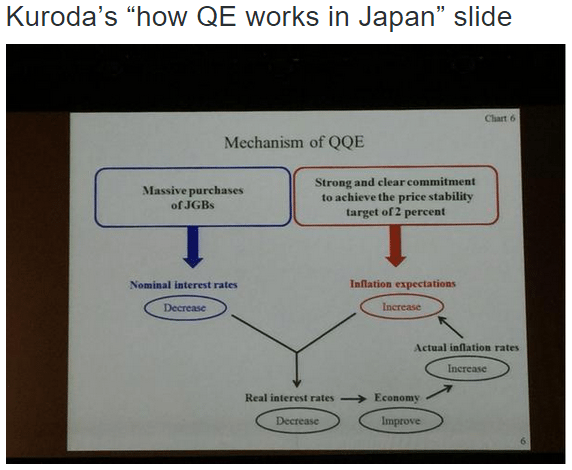
WRKO Interview, GDP, Pending Home Sales, KC Fed, Corporate Profits, BOJ QE chart

WRKO Interview

Higher than expected, still a bit lower year over year, and supported by heavy unsold inventory building that’s exceeding the growth of new orders, as well as an increase in net exports which is counter to all the survey information and other hard data as well. Net export reports tend to be volatile, with relatively large zigs followed by large zags. And note reported GDI- gross domestic income (the flip side of GDP)- was up only .6 as discussed below. And a few comments below on health care premium expense:

United States : GDP
er-8-27-1
Highlights
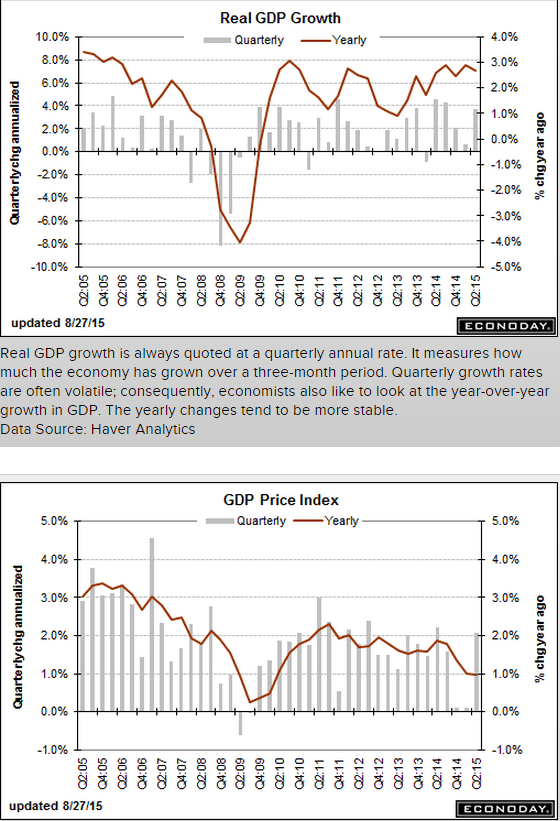
The second-quarter did show a big bounce after all, up at a revised annualized growth rate of 3.7 percent which is 5 tenths over the Econoday consensus and just ahead of the high estimate. The initial estimate for second-quarter GDP was 2.3 percent. This report points to better-than-expected momentum going into the current quarter.

Consumer demand was strong with personal consumption expenditures at a 3.1 percent rate led by an 8.2 percent rate for durables, a gain that was tied to vehicle spending. Residential investment was very strong, at plus 7.8 percent, as was nonresidential fixed investment which, boosted by an upward revision to structures, came in at plus 3.2 percent. Inventories contributed to second-quarter growth as did improvement in net exports. Final demand proved very solid, at plus 3.5 percent. The GDP price index, unlike many other price readings, is showing some pressure, at 2.1 percent and just above the Fed’s general policy goal.

The economy’s acceleration is now much more respectable from the first quarter when growth, at only 0.6 percent, was depressed by heavy weather and special factors. Splitting the difference, first-half growth came in a bit over 2 percent which, as it turns out, is right in line with the similar performance of 2014 when first-quarter growth, again depressed by severe weather, fell 2.1 percent followed by a 4.6 percent surge in the second quarter. Growth in the third quarter last year was 4.3 percent which would be a very good performance for this third quarter.

The impact of today’s report on Fed policy for September’s FOMC is likely to be minimal. Focus at the upcoming meeting will be on the state of the global financial markets and, very importantly, the strength of next week’s employment report for August.

er-8-27-2

Note the volatility of exports and imports, particularly for the last two quarters:
er-8-27-3
er-8-27-4

The state and local increase looks suspect as well:
er-8-27-5
er-8-27-6

The upward revisions to second-quarter growth also reflected the accumulation of $121.1 billion worth of inventories, up from the previous estimate of $110 billion. That meant inventories contributed 0.22 percentage point to GDP instead of subtracting 0.08 percentage point as reported last month.

Apparently health care premiums are counted as personal consumption expenditures, and with the ACA there’s a one time increase in progress as more people get funded to pay premiums. This is adding some support to GDP growth until it levels off.
er-8-27-7

This has not necessarily increased actual health care services received or costs:
er-8-27-8

Gross domestic income was also released. While GDP measures total sales, GDI measures total income received from those sales. So while those numbers are necessarily identical, in practice they tend to differ initially as they are calculated independently and entail numerous estimates, and converge over time as hard numbers become available.

This is from the US Bureau of Economic Analysis:

Real gross domestic income (GDI) — the value of the costs incurred and the incomes earned in the production of goods and services in the nation’s economy — increased 0.6 percent in the second quarter, compared with an increase of 0.4 percent (revised) in the first. The average of real GDP and real GDI, a supplemental measure of U.S. economic activity that equally weights GDP and GDI, increased 2.1 percent in the second quarter, compared with an increase of 0.5 percent in the first quarter.

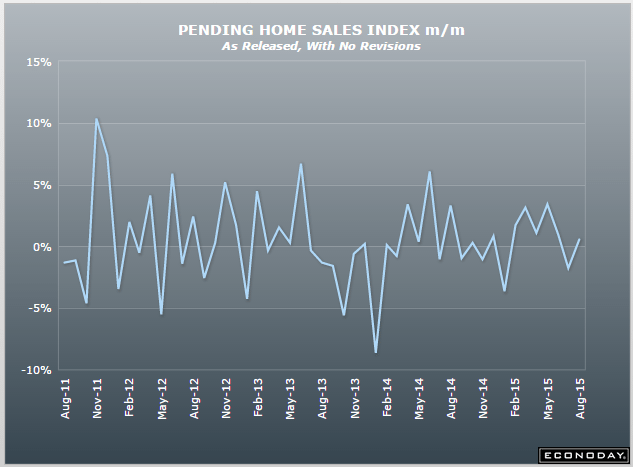
No acceleration here:

United States : Pending Home Sales Index
er-8-27-9
Highlights
Pending home sales came in at the low end of expectations, up however a still respectable 0.5 percent. Regional data show a strong 4.0 percent gain for the Northeast, which however is the smallest region for existing home sales, and a 1.4 percent dip for the West. Sales were unchanged in the Midwest and rose 0.6 percent in the South which is the largest region. This report is positive but far from exceptional, pointing to no more than moderate growth ahead for existing home sales.

er-8-27-10

The bad news in manufacturing continues:

United States : Kansas City Fed Manufacturing Index
er-8-27-11
Highlights
Factory activity in the Kansas City Fed’s region remains in deep contraction, at minus 9 in August vs minus 7 in July and deeper than the Econoday consensus for minus 4. New orders are also at minus 9 with backlog orders at minus 21. These are deeply depressed readings that point to a long run of weak activity in the months ahead. Production is already far into the negative column at minus 16 with hiring at minus 10. Price readings in the August report are in contraction.

This report speaks to significant distress for the region which is getting hit by the oil-led fall in commodity prices. Taken together, regional reports have been mixed to soft so far this month, pointing to slowing for a factory sector that got a bit boost from the auto sector in June and July. The Dallas Fed report, which like this one has been badly depressed, will be posted on Monday.
er-8-27-12

This is amateur hour.

After 20 years of this stuff, they still just need more time…
er-8-27-13

Chemical Activity Barometer, Durable Goods Orders, Mtg Purchase apps, Oil Inventory

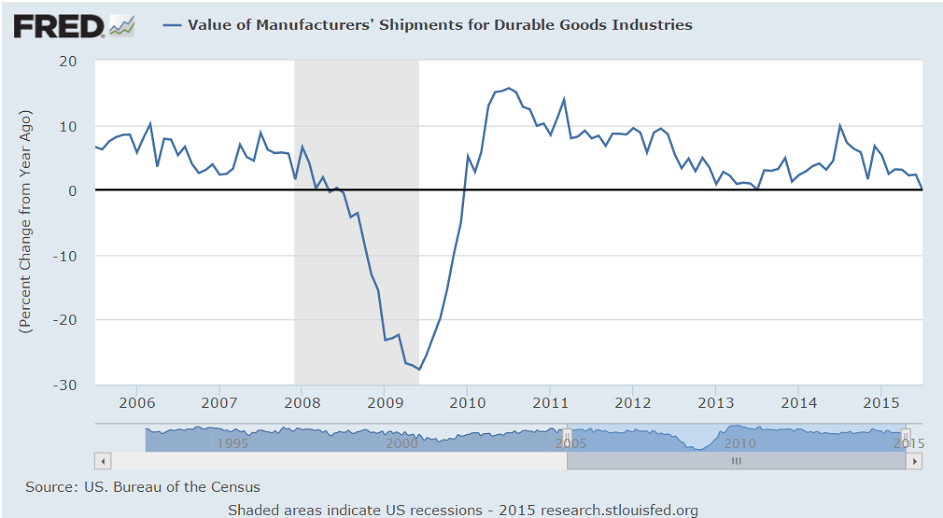
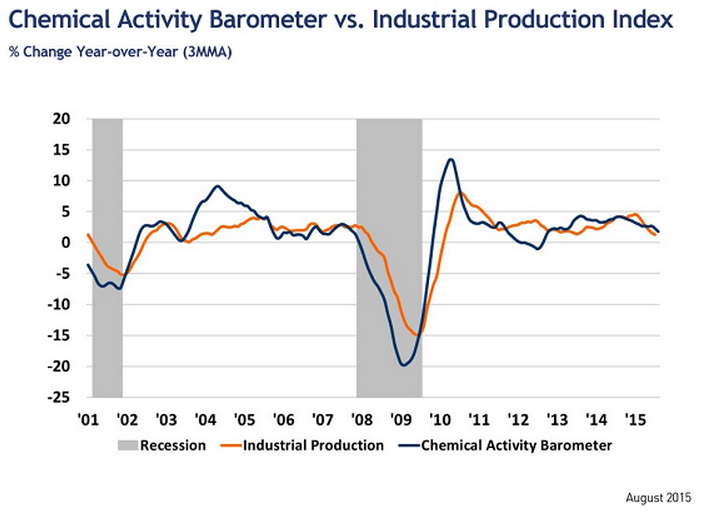
Sagging along with industrial production:
er-8-26-1
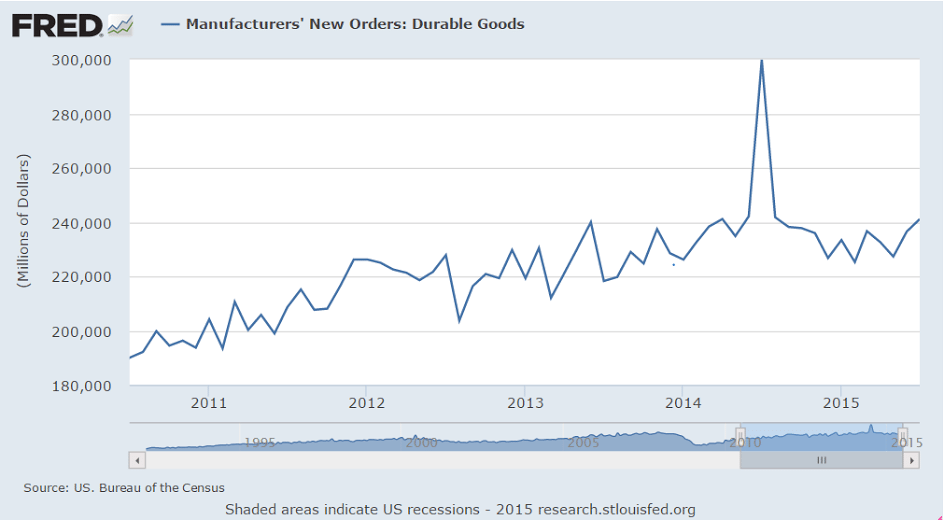
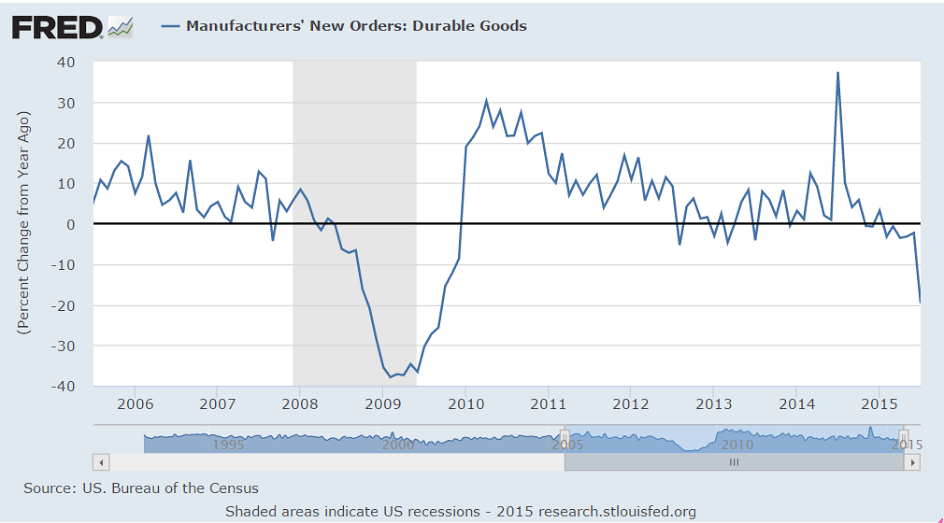
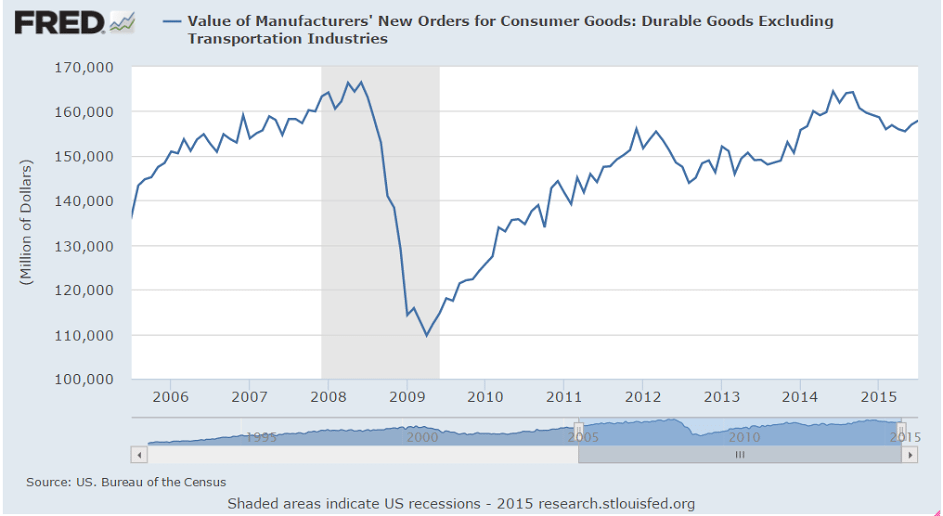
Better than expected which is nice, but nothing to get excited about. Durable goods tend to chug along at 3 or 4% pretty much regardless of what else happens. But this time they’ve been disrupted to the downside by the oil capex collapse. And note the large year over year drop is due to the comp with last year’s spike from aircraft orders and should reverse next month, but the trend remains weak:
er-8-26-2
er-8-26-3
er-8-26-4

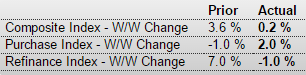
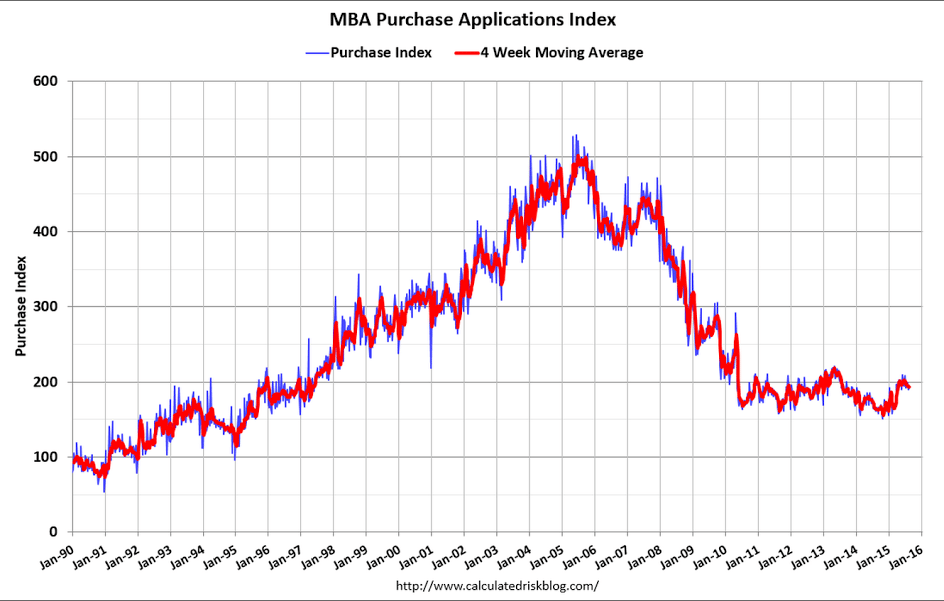
Still up from last year, but more recently this year it’s been going sideways at best, and remains severely depressed:

United States : MBA Mortgage Applications
er-8-26-5

er-8-26-6

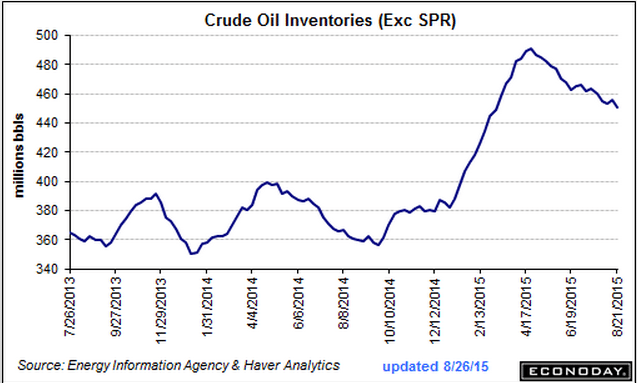
Looks to me like increased demand and falling domestic production are doing their thing to cause WTI to converge with Brent as well as increase US imports over time:

United States : EIA Petroleum Status Report
er-8-26-7

Highlights
A dip in imports made for a 5.5 million barrel draw in weekly oil inventories to 450.8 million. Gasoline and distillate inventories both rose, up 1.7 million and 1.4 million respectively. Demand indications for gasoline are very strong, up a year-on-year 5.8 percent. WTI bounced 50 cents higher to $39.75 in immediate reaction to the headline draw in oil before quickly easing back to $39.25.
er-8-26-8

Redbook retail sales, Inflation adjustment, China, House prices, Consumer confidence

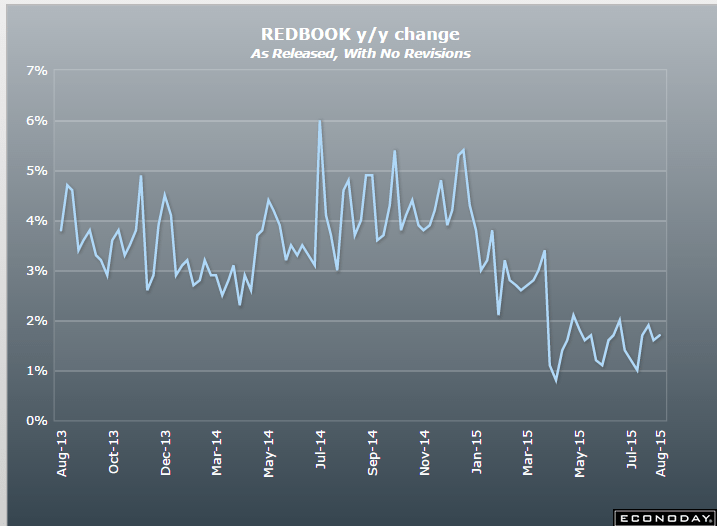
Still depressed
er-8-25-1
Lower than the Fed thought:

U.S. inflation probably lower than reported, Fed study says

Aug 24 (Reuters) — U.S. inflation in the first half of the year was probably “markedly lower” than reported according to the San Francisco Federal Reserve Bank. Researchers at the regional Fed bank had earlier found that the very weak readings for economic growth in the early part of the year were likely due to inadequate adjustments for seasonal fluctuations. The same researchers applied similar methodology to inflation data and found that core PCE inflation was probably overstated by 0.3 and 0.2 percentage points in the first two quarters of the year, respectively.

This does nothing for output and employment:

China’s central bank pumps in billions to ease liquidity strain

Aug 25 (Xinhua) — The People’s Bank of China (PBOC) conducted 150 billion yuan (23.4 billion U.S. dollars) of seven-day reverse repurchase agreements (repo). The reverse repo was priced to yield 2.5 percent, unchanged from the yield on a net injection last week of 150 billion yuan using reverse repos, according to a PBOC’s statement. The PBOC also channelled another 110 billion yuan via its medium-term lending facility. Despite the cash injection the benchmark overnight Shanghai Interbank Offered Rate (Shibor) climbed by 1.3 basis points to 1.879 percent.

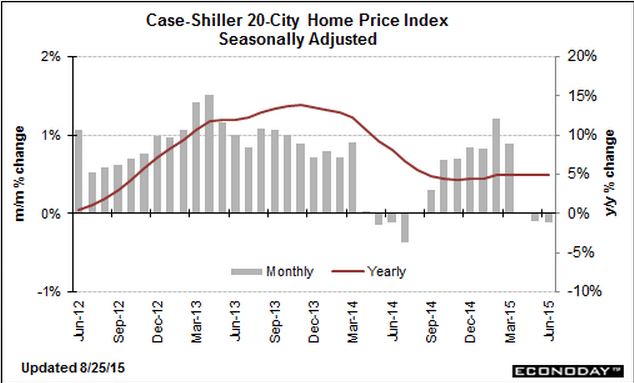
Not a good sign:

S&P Case-Shiller HPI
er-8-25-2
Highlights
Inventories may be low and sales rates firm, but both Case-Shiller and FHFA are pointing to a surprising flat spot for home-price appreciation. Case-Shiller’s 20-city adjusted index fell 0.1 percent in June vs Econoday expectations for a 0.1 percent rise. Year-on-year, 20-city prices, whether adjusted or unadjusted, are unchanged at plus 5.0 percent. This rate has been inching higher but looks like it may be ready to fall back unless prices pick up.
er-8-25-3

A bit less than expected and still at very depressed levels:

New Home Sales
er-8-25-4

Settled back to depressed levels from last month’s blip up:

Richmond Fed Manufacturing Index
er-8-25-5

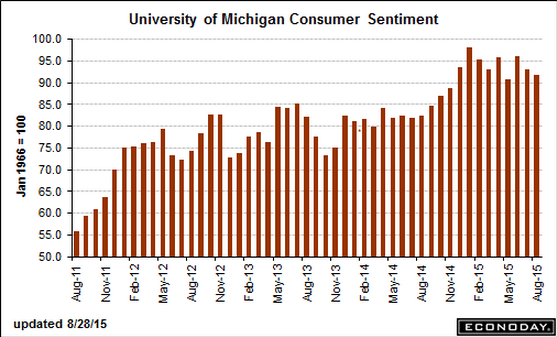
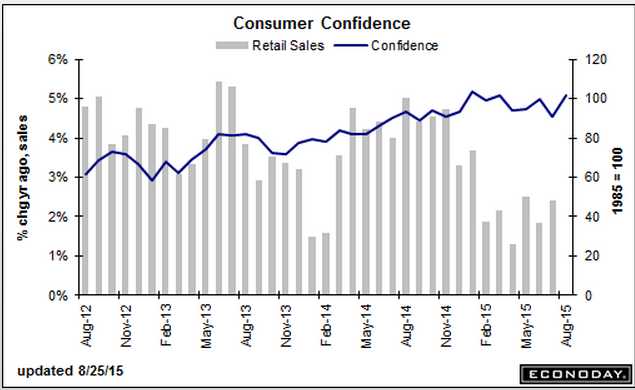
Consumer confidence bounced up with lower gas prices, as it’s one man one vote, not one dollar one vote, and so hasn’t been a reliable indicator of retail sales.
er-8-25-6

quick macro update

It all started when the FICA tax cuts and a few of the Bush tax reductions were allowed to expire at the end of 2012, followed by the sequesters a few months later 2013. That resulted in 2013 GDP growth of a bit less than 2% or so that might have been closer to 4% without the tax hikes and spending cuts.

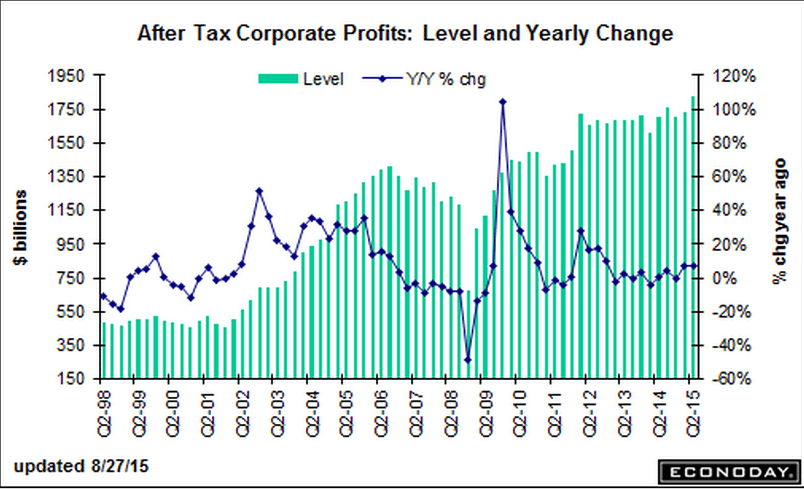
Going into 2014 GDP I suggested growth might be closer to 0 than to the 3.5% being forecast. It again printed about in the middle averaging a bit over 2% (with some ups and downs…), and then towards the end of 2014 the price of oil collapsed and it was discovered there had been $hundreds of billions of planned capital expenditures that would be cut, domestically and globally, after which I again suggested GDP growth for the year- this time 2015- would now be near 0, and in fact could well be negative. Additionally, it was revealed the extent to which it was the large and growing oil capex expenditures up to that time that had been supporting at least 1% GDP growth up to that point. And so far GDP growth for 2015 has been less than 2014, even after 2014’s recent downward revisions, and along with slowing GDP has come slowing corporate revenues and earnings growth. All subject to further revisions, of course, which lately have been downward revisions.
macro-8-24-1

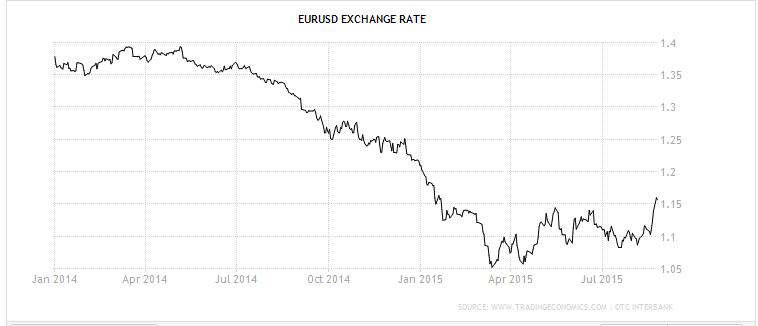
Meanwhile, in the first half of 2014 the euro began falling against the $ as well as other currencies. The fall coincided with the ECB threatening and then following through with negative rates and QE, much to the consternation of global portfolio managers, including Central Bankers, pension funds and hedge funds, who collectively proceeded to lighten up on their euro allocations. And along the way, issues surrounding Greece further frightened the portfolio managers into further selling of euro assets. This relentless selling pressure drove the euro down, particularly vs the US dollar. Specifically, a euro based portfolio manager might, for example, sell his euro securities, and then sell the euros to buy dollars, and then use the dollars to buy US stocks. Or a CB might manage its reserves such that the % of euro assets declined vs dollar assets. And a hedge fund might simply buy the $US index, which is about half dollar/euro and a way to sell euro and other currencies vs the dollar. All of this, along with several other ways to skin the same cat, constituted euro selling that drove the dollar up and the euro down, and at the same time produced buyers of US stocks.

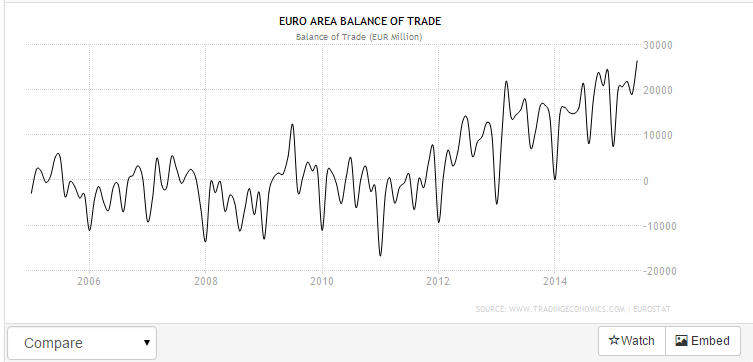
Fundamentally, however, the opposite was happening. The euro area had a (small) trade surplus, which was removing euro from global markets, but not as fast as the sellers were selling, and the euro went ever lower. But as it did this it made the euro area that much more ‘competitive’ (euro area goods and services were that much less expensive in dollar terms) which resulted in an ever larger trade surplus, with the latest release showing a record trade surplus of about 24 billion euro per month. And at the same time, the increased euro exports helped support the economy and generated forecasts for improved future growth, all of which supported euro stocks.

It now appears the curves (finally) crossed, with the euro area trade surplus now exceeding the euro portfolio selling which seems to have run its course, which caused the euro to bottom and start to appreciate. This started generating adverse marks to market for those short euro and long US stocks, for example, who subsequently began reversing their positions by buying euro and selling US stocks. And the strong euro also threatens euro area exports and therefore output, employment, and GDP forecasts, causing euro stocks to sell off as well.

So far I’ve left out what turned out to be the catalyst for this reversal- China. When China moved to allow the yuan to trade lower against the dollar, it was deemed a credible threat to both euro and US exports, and world demand in general, which set off the latest wave of selling.
macro-8-24-2
macro-8-24-3

So what’s next?

More selling of US stocks and buying euro to reverse those positions. Hedge funds might move quickly, but, for example, pension funds often do their reallocating at quarterly and annual meetings, so it could all take quite a bit of time.

Additionally, buying of euro will drive the euro up, as there is no ‘excess supply’ being generated. Quite the reverse, in fact, as the trade surplus works to make euro that much harder to get. That means the euro will appreciate until the trade surplus reverses (whether there is any causation or not…), which should prove highly problematic for the euro economy and euro stocks. The other side of this coin is the weaker dollar that should lend some support to the US stock market, though a collapsing euro area economy with it’s associate debt issues and political conflicts might do more harm than the weak dollar does good, not to mention the weakening domestic demand in the post oil capex world with no relief in sight from other sectors.

Lastly, the stock market has been maybe the best leading indicator, and probably because of it’s direct effect on perceptions of wealth and its influence on spending and investing decisions. And the Fed doesn’t target stocks,
but it doesn’t ignore them either, as it too recognizes the influence it can have on output and employment, especially on the downside.

Of course all of this can be reversed for the better with a simple fiscal expansion, as the underlying problem remains- the Federal deficit is too small in the absence of sufficient private sector deficit spending needed to offset desires to not spend income. (Yes, it’s always an unspent income story…)

But politics, at least for now, renders that sure fire remedy entirely out of the question.

credit check, rail traffic, ecri index, china pmi

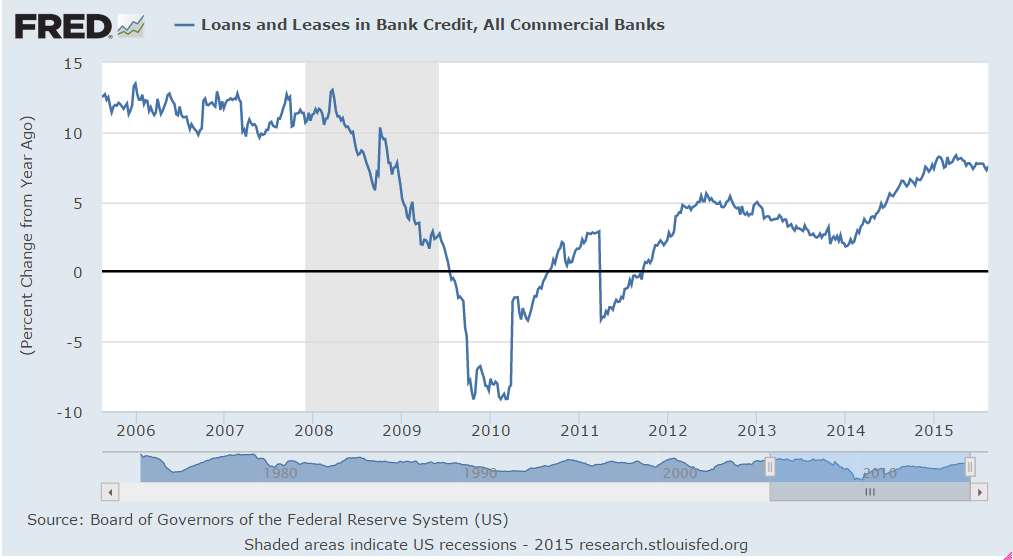
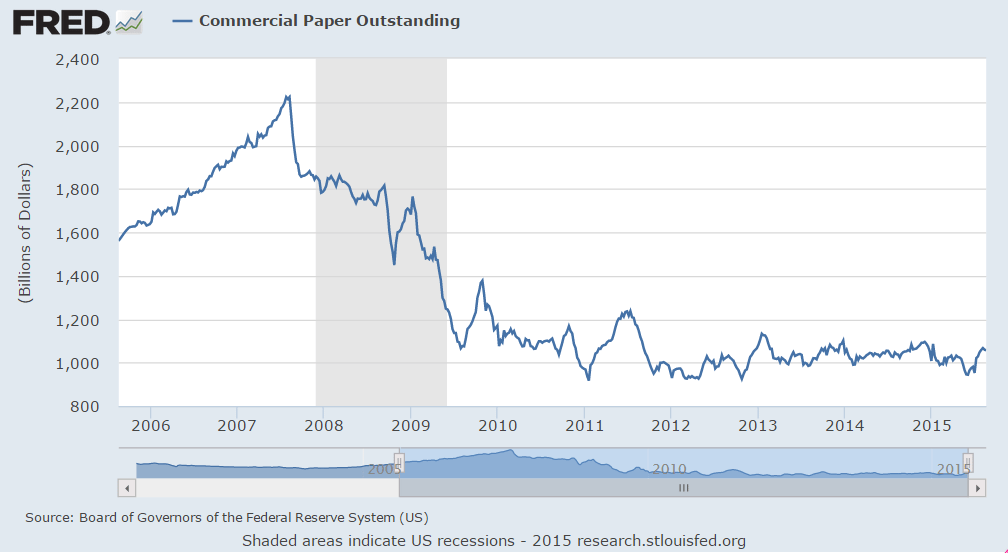
Still no sign of acceleration, as some deceleration continues:
cc-8-22-1
cc-8-22-2

cc-8-22-3
cc-8-22-4

Rail Week Ending 15 August 2015: Continued Deterioration Of Year-over-Year Rolling Averages

(Econintersect) — Week 32 of 2015 shows same week total rail traffic (from same week one year ago) contracted according to the Association of American Railroads (AAR) traffic data. Intermodal traffic expanded year-over-year, which accounts for approximately half of movements. and weekly railcar counts continued in contraction.

07 August 2015: ECRI’s WLI Growth Index Returns to the Dark Side – Economic Slowing Forecast.

(Econintersect) — ECRI’s WLI Growth Index which forecasts economic growth six months forward – just slipped back into negative territory. This index had spent 28 weeks in negative territory then 15 weeks in positive territory – and now returned to negative territory. ECRI released their coincident and lagging indicators for July this week.

China Manufacturing PMI Plummets to 6-Year Low

(Econintersect) — China’s manufacturing sector reported the lowest PMI (Purchasing Managers’ Index) reading in 6 years with an August 2015 Caixin/Markit “Flash” (preliminary) survey result of 47.1. Readings below 50 reflect a contracting manufacturing sector. The low value for the survey result was a surprise. This was down from a July reading of 47.8 June reading of 49.4 and was the sixth consecutive reading below 50. Analysts surveyed by Bloomberg indicated expectations were for a reading of 49.7.

Krugman on debt

Debt Is Good

By Paul Krugman

Aug 21 (NYT) — Rand Paul said something funny the other day. No, really — although of course it wasn’t intentional. On his Twitter account he decried the irresponsibility of American fiscal policy, declaring, “The last time the United States was debt free was 1835.”


Which consequently was followed by the worst depression in US history.

Wags quickly noted that the U.S. economy has, on the whole, done pretty well these past 180 years, suggesting that having the government owe the private sector money might not be all that bad a thing. The British government, by the way, has been in debt for more than three centuries, an era spanning the Industrial Revolution, victory over Napoleon, and more.

But is the point simply that public debt isn’t as bad as legend has it? Or can government debt actually be a good thing?

Believe it or not, many economists argue that the economy needs a sufficient amount of debt out there to function well.


Yes, to offset desires to not spend income (save) when private sector borrowing to spend isn’t sufficient, as evidenced by unemployment.

And how much is sufficient? Maybe more than we currently have. That is, there’s a reasonable argument to be made that part of what ails the world economy right now is that governments aren’t deep enough in debt.


Yes, it’s called unemployment, which is the evidence that deficit spending is insufficient to offset desires to not spend income. Something economists have known by identity for at least 300 years.

I know that may sound crazy. After all, we’ve spent much of the past five or six years in a state of fiscal panic, with all the Very Serious People declaring that we must slash deficits and reduce debt now now now or we’ll turn into Greece, Greece I tell you.

But the power of the deficit scolds was always a triumph of ideology over evidence, and a growing number of genuinely serious people — most recently Narayana Kocherlakota, the departing president of the Minneapolis Fed — are making the case that we need more, not less, government debt.

Why?


This is the right answer- because the US public debt, for example, is nothing more than the dollars spent by the govt that haven’t yet been used to pay taxes. Those dollars constitute the net financial dollar assets of the global economy (net nominal savings), as actual cash, or dollar balances in bank accounts at the Federal Reserve Bank called reserve accounts and securities accounts. Functionally, it is not wrong to call these dollars the ‘monetary base’. And a growing economy that generates increasing quantities of unspent income likewise needs an increasing quantity of spending that exceeds income- private or public- for a growing output to get sold.
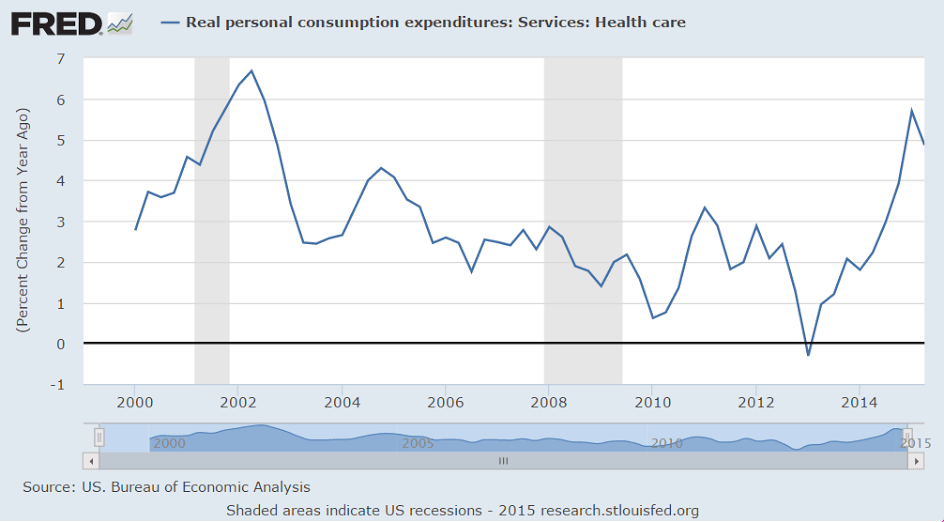
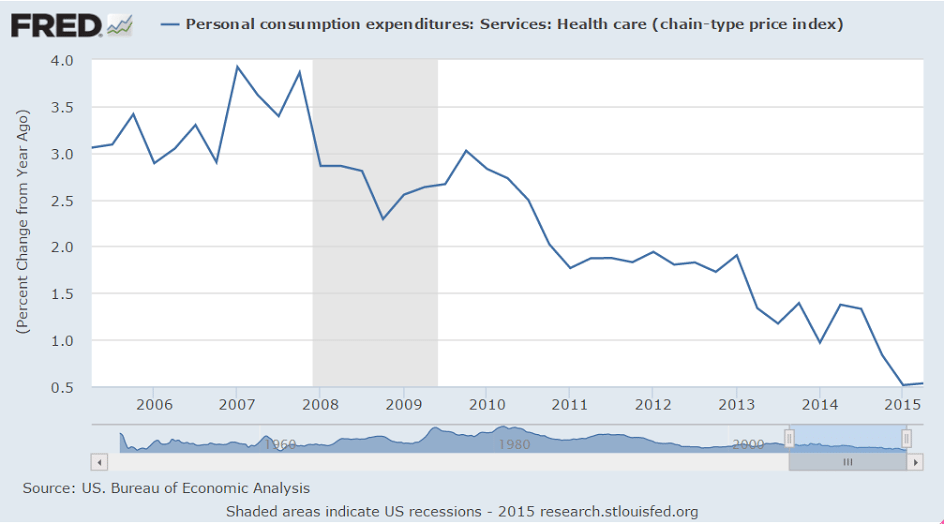
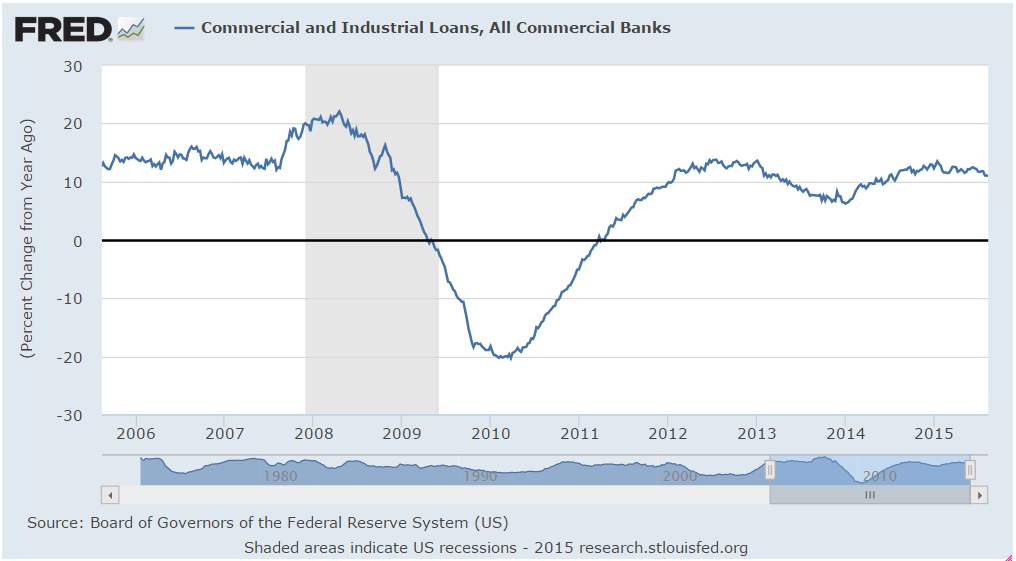
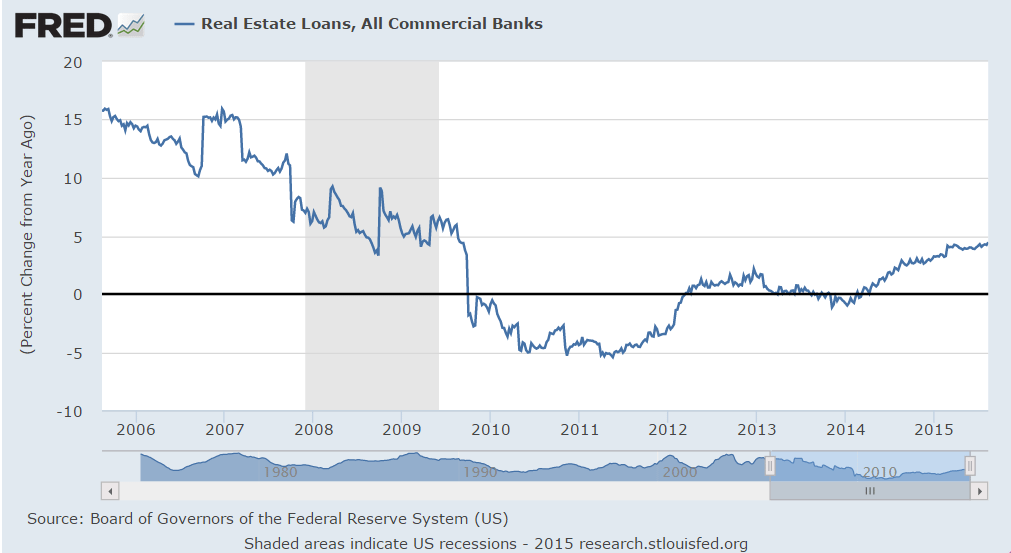
One answer is that issuing debt is a way to pay for useful things, and we should do more of that when the price is right.


Wrong answer. It’s never about ‘when the price is right’. It is always a political question regarding resource allocation between the public sector and private sector.

The United States suffers from obvious deficiencies in roads, rails, water systems and more; meanwhile, the federal government can borrow at historically low interest rates.


Wrong answer. Yes, there is a serious infrastructure deficiency. The right question, however, is whether the US has the available resources and whether it wants to allocate them for that purpose.

So this is a very good time to be borrowing and investing in the future, and a very bad time for what has actually happened: an unprecedented decline in public construction spending adjusted for population growth and inflation.


I agree it’s a good time to fund infrastructure investment, due to said deficiencies.

However, whether or not it’s a good time to increase deficit spending is a function of how much slack is in the economy, as evidenced by the unemployment rates, participation rates, etc. And not by infrastructure needs.

And my read based on that criteria is that it’s a good time for proactive fiscal expansion.

Nor in any case is deciding whether or not to increase deficit spending rightly about whether or not to increase borrowing per se for a government that, under close examination, from inception necessarily spends or lends first, and then borrows. As Fed insiders say, ‘you can’t do a reserve drain without first doing a reserve add.’

Beyond that, those very low interest rates are telling us something about what markets want.


Wrong, they are telling is something about what level market participants think the fed will target the Fed funds rate over time.

I’ve already mentioned that having at least some government debt outstanding helps the economy function better. How so?


Right answer- deficit spending adds income and net financial assets to the economy to support sufficient spending to get the output sold.

The answer, according to M.I.T.’s Ricardo Caballero and others, is that the debt of stable, reliable governments provides “safe assets” that help investors manage risks, make transactions easier and avoid a destructive scramble for cash.


Wrong answer. Net govt spending provides in the first instance provides dollars (tax credits) in the form of dollar deposits in reserve accounts at the Federal Reserve Bank. Treasury securities are nothing more than alternative deposits in securities accounts at the Federal Reserve Bank for those dollars. Both are equally ‘safe’.

Now, in principle the private sector can also create safe assets, such as deposits in banks that are universally perceived as sound. In the years before the 2008 financial crisis Wall Street claimed to have invented whole new classes of safe assets by slicing and dicing cash flows from subprime mortgages and other sources.

But all of that supposedly brilliant financial engineering turned out to be a con job: When the housing bubble burst, all that AAA-rated paper turned into sludge. So investors scurried back into the haven provided by the debt of the United States and a few other major economies. In the process they drove interest rates on that debt way down.


Rates went down in anticipation of future rate setting by the fed.

What investors did was reprice financial assets. Investors can’t change total financial assets. The total only changes with new issues and redemptions/maturities.

And those low interest rates, Mr. Kocherlakota declares, are a problem. When interest rates on government debt are very low even when the economy is strong, there’s not much room to cut them when the economy is weak, making it much harder to fight recessions.


True, but cutting rates doesn’t fight recessions. In fact low rates reduce interest income paid by govt to the economy, thereby weakening it.

There may also be consequences for financial stability: Very low returns on safe assets may push investors into too much risk-taking — or for that matter encourage another round of destructive Wall Street hocus-pocus.


That would be evidenced by an increase in the issuance of higher risk securities, but there has been no evidence of that. In fact, it was $100 oil that at the margin drove the credit expansion that supported GDP growth, as evidenced by the collapse when prices fell.

What can be done? Simply raising interest rates, as some financial types keep demanding (with an eye on their own bottom lines), would undermine our still-fragile recovery.


It would more likely very modestly strengthen it from the increase in the govt deficit due to the increased interest income paid by govt to the economy. However, I’d prefer a tax cut and/or spending increase to support GDP, rather than an interest rate increase. But that’s just me…

What we need are policies that would permit higher rates in good times without causing a slump. And one such policy, Mr. Kocherlakota argues, would be targeting a higher level of debt.


Mr. K isn’t wrong, but again I’d rather just have a larger tax cut to get to the same point, but, again, that’s just me…

In other words, the great debt panic that warped the U.S. political scene from 2010 to 2012, and still dominates economic discussion in Britain and the eurozone, was even more wrongheaded than those of us in the anti-austerity camp realized.


True, and this author…

Not only were governments that listened to the fiscal scolds kicking the economy when it was down, prolonging the slump; not only were they slashing public investment at the very moment bond investors were practically pleading with them to spend more; they may have been setting us up for future crises.


True but for differing reasons. It’s never about investors pleading. It’s always about the public purpose behind the policies.

And the ironic thing is that these foolish policies, and all the human suffering they created, were sold with appeals to prudence and fiscal responsibility.


The larger problem with this editorial is that the wrong reasons it gives for what’s largely the right policy are out of paradigm reasons that the opposition routinely shoots down and shouts down, easily convincing the electorate that they are correct and the ‘headline left’ is wrong.

Feel free to distribute