The Center of the Universe

St Croix, United States Virgin Islands

MOSLER'S LAW: There is no financial crisis so deep that a sufficiently large tax cut or spending increase cannot deal with it.

Archive for the 'Interest Rates' Category

Low FF rate and down shift of Labor Particpation

Posted by WARREN MOSLER on 24th April 2013

Maybe they are beginning to confirm my ‘suspicion’ the mainstream has the rate thing backwards? Not that I agree with all their reasons, of course!

Subject: For The Economist in Us – Low FF rate and down shift of Labor Particpation

A short and interesting piece can be found on the St Louis Fed web site (and attached). Good chart on the second page showing the Federal Funds Rate and the Employment-to-Population Ratio. Towards the end of the report there is an interesting point about the current near zero rate and how it lifted, it could have have people re-enter the work force because it would increase the return to saving(s). I guess the labor force drop-outs view they’re not “leaving much on the table” . -Peter
—————————————————————————–
It is titled “Low Interest Rates Have Yet to Spur Job Growth”.

The study says that “low interest rates , of late, do not seem to be having much of the intended effect either on spending or on job growth.”

A serious concern in labor market has been the down shift of the labor participation rate which may be hiding the true level of unemployment as people drop out of the labor force.

The paper states “”Interest rates represent the return we get for waiting to consume. Low interest rates encourage more spending today, which the Fed intends, and more leisure today, which the Fed does not intend. Labor participation rates decline for many reasons, but low interest rates work in the direction of discouraging labor market participation.”

Apparently, the Fed has been chasing its own tail and the more it has lowered rates in order to produce higher demand for labor, it has generated lower participation rates.

The paper concludes, with great understatement, “After four years of low interest rates and stagnating growth around the world, a better understanding of low interest rate policies is needed.”

Maybe Chair Bernanke agrees and this explains his announced absence from Jackson Hole.

Posted in Employment, Fed, Interest Rates | No Comments »

Thaler’s Corner 04-22-2013 2013: And now?

Posted by WARREN MOSLER on 23rd April 2013

Again, very well stated!

Thaler’s Corner

I must admit that I am at a loss for words these days. The analytical items at our disposal describe a situation so complex, given a myriad of contradictory influences, that I find it impossible to develop any sort of reasonable scenario.


I have spent a lot of time in recent weeks exchanging ideas and perceptions with academics, political officials and others in an effort to develop a coherent explanation of the events unfolding before us (Cyprus, wealth tax, etc.), but the conclusions are anything but conclusive!

Changes in financial securities will no longer be determined by purely economic factors but more and more by political decisions, such as whether or not to establish a real European banking union with all that implies in terms of cross-border budget transfer risks.

Whatever, lets take a look at the state of the real economy in the United Sates and Europe, given that it is still a bit early to draw any sort of conclusions about a third economic motor, Japan.

By the way, I strongly recommend that people check out the links in todays Macro Geeks Corner toward the end of the newsletter. It is interesting to see how two fairly divergent schools of thinking (the two first texts) end up with rather similar conclusions.

United States

In the United States, the economy is (logically) slowing as the effects of the Sequester slowly make themselves felt. Only the (increasingly discredited) partisans of Reinhold & Rogoffs constructive austerity thought it would not affect household consumption.

We had to wait for the hike in payroll taxes for the effect to be seen in retail sales figures, down 0.4% in March. Similarly, all the latest leading economic (PMI) and confidence indicators came in below expectations, which augurs for a soft patch in the US.

Moreover, the yens decline can only have a negative impact on America trade balance with Japan as it puts US exporters at a disadvantage, in particular, as they compete with their Japanese rivals on Asian markets. And the pitiful state of the European economy is not going to help this sector of the US economy either.

But there remains one bright spot, namely the residential real estate market, which should remain a powerful support in the quarters ahead. Check out one of my favorite graphs real animal rates.

Real animal rates in the US:


Full size image

These rates are calculated using a proprietary equation I developed, which includes, in addition to terms like mortgage interest rates, recent home price trends, the difference between the reported unemployment rate and that during periods of full employment, and the difference between the average length of unemployment and that existing in times of full employment.

With the Animal Spirits so dear to Keynes and behavioral science in mind, the goal was to factor in items more subjective than simple economic criteria (nominal borrowing rates) in the home purchase decision-making process of a household.

If experience has taught us anything, it is that the factors which most influence a potential homebuyers decision is his degree of job security and the feeling that prices can only rise.

The first point is that the only time these real animal rates dipped into negative territory (in the upper part of graph, transcribed in inverted scale) corresponds perfectly with the great real estate bubble of 1998 to 2006.

This big trend reversal occurred in 2006 when rates resurfaced above zero and thus below the graphs red line.

The only other time real animal rates became negative was in 1989, but that was abruptly reversed by the sharp hike in nominal interest rates.

In the current context, nominal interest rates are unlikely to undergo any such sharp hike in the quarters ahead, and this dip of real animal rates into negative territory should enable the real estate market to continue to recover. This all the more true, given that the yens decline will only strengthen disinflationary trends in North America, which ensure accommodative monetary policies for some time to come!

All you need to do is look at the steep decline in inflationary expectations, as expressed by the TIPS market in the US, to understand that investors seem to have finally realized that QE policies have nothing to do with the so-called dollar printing press. Notwithstanding the ZeroHedge paranoids!

That said, existing home sales in the US, out just a few minutes ago, came in weak, at -0.6% m-o-m (vs expected +0.4%, i.e. 4.92M vs 5M), which explains this afternoon shiver on stockmarket indices.

Now, as the IMF has said in recent days, the main brake on a worldwide recovery is the Eurozone, which remains paralyzed by the obsession of its northern member states on austerity and by the ECBs total and unforgivable incapacity to comply with its own mandate! In todays Macro Geeks Corner, you will find two instructive links on this matter.

Eurozone

Instead of harping on the endless stream of errors made by our beloved European monetary and governmental leaders, I prefer to comment on some far more instructive graphs.

Lets start with our graph on aggregate 2-year Eurozone government bond rates, which have proven to be so useful in recent years for evaluating the ECBs reaction function.

This rate, currently at a record low 0.55%, is now well below the 0.75% set for the refi. This stems from two factors.

First, in view of the state of the economy and the latest comments by certain ECB board members, investors expect that the refi rate will very soon (May or June) be cut to 0.50%.

Second, certainty that short-term interest rates, like the Eonia, which have been stuck between 5 bps and 12 bps for the past 9 months, are not going to rise anytime soon is pushing investors to seek yields wherever they can still find them, like in Spain and Italy where 2-year bonds still fetch between 1.95% and 1.25%, now that they are assured that, henceforth, in case of insolvency, bank depositors will be forced to pay the bill without pushing sovereign issuers into default, as happened in Greece!

Aggregated Eurozone government 2-year rate:

Full size image

However, we have reason to be concerned that the ECB, if it does lower the refi to 0.50%, will be satisfied with what it already deems a low rate and highly accommodative monetary policy. Such is far from being the case, even if we go by the ECBs own obsolete aggregates, like M3, as money velocity continues to skid to a halt, following Cyprus.

And all this has an impact on the real economy, as you can see in the following graphs.

Eurozone Industrial Production

Full size image

The least we can say is that this graph is particularly distressing. Of course, it does not account for the economys industrial aspect, which some call the old economy. But it provides a whole lot of jobs and no economic area can afford to neglect it.

And the impact of Mr Sarkozys renowned Walk of Canossa, following his summons by Ms Merkel in July 2011 to Berlin where the unfortunate decision to create the first sovereign default of a developed country was endorsed (Greek PSI), is very clear on this graph. Together with a hardening of austerity policies and the nefarious consequences of the ECBs hikes of benchmark interest rates in the spring of 2011, this decision torpedoed already distressed economies, with the consequences we all know today.


But if there is one depressing economic indicator, which reflects even more cruelly how austerity affected the Eurozone, it is surely the unemployment curve.

Eurozone Unemployment

Full size image

Here again, no comment is needed. I included earlier in this newsletter the graph comparing the US and Eurozone curves, but even that is no longer all that relevant. If people are happy to underperform the United States, who cares? If the Eurozone wants to try liquidationist economic policies to help drive home the morality message, it has every right to do so, just as its citizens merit the leadership they elect.

But to go from there to creating a situation of hysteria, leading to an increasingly large segment of the active population being ejected from the labor market, is a big step that must never be taken.

In some countries, the figures are just horrifying, with nearly 30% general unemployment and over 50% for those under 25 years of age. It is incredible that some continue to boast the merits of such policies for countries like Ireland while ignoring the daily siphoning of the population due to massive immigration to seek jobs elsewhere!!

I wonder if those responsible for such policies have forgotten the consequences of such an approach in Europe and the breakdown in the social fabric during the Great Depression, especially now, with so many leaders spicing their speeches with anti-German references?

This pathetic situation, reflecting month after month of economic policies based on no worthwhile or credible foundations, be it on a theoretical or empirical basis, explains why I am having a hard time re-establishing a decent pace of publication.

This is especially so in that the conflict between this depressive macro situation and the strong efforts undertaken by the Fed and the BoJ (among others) to reignite economic activity leave no space for laying out clear asset allocation biases.

We continue to enable our clients to take advantage of opportunities on option markets which make it possible during these troubled times to make bets on the cheap but without any real conviction.

Has our asset allocation strategy, dating from 2007 (a bit early, I know), of favoring government debt came to maturity with German 10-year rates at 1.23%, i.e. more than 30 bps below those of the United States?

Will European stock markets continue to suffer from our big fear, the Japanese syndrome? Or will popular pressure push the ECB and the Austrian School proponents to realize that they have a modern currency at their disposal and that reversing their entire intellectual edifice is possible?


Despite all my efforts, studies, reading and discussion, I am totally incapable of responding to these questions, which a great lesson in humility. Sorry for the consequences in terms of this newsletters clarity and frequency of publication, but if anyone has any ideas, I am all ears!

The Macro Geeks Corner:

Dear Northern Europeans Monetary easing is not a bailout

A factual rebuttal of remarks of ECB chief Jrg Asmussen, made at the Bank of America/Merrill Lynch Investor conference

Breaking bad inflation expectations

Posted in ECB, EU, Housing, Interest Rates, USA | No Comments »

financial repressionists painting frauds

Posted by WARREN MOSLER on 22nd April 2013

Conclusion: The financial repressionists have it all backwards

So the idea is the govt is ‘pushing rates down’ through QE and the like, thereby keeping rates below the rate of inflation, and that without this active ‘financial repression’ rates would otherwise be higher and not ‘repressed’.

That is, the govt is interfering with the ‘free market’ by said pushing of rates down, and this ‘distortion’ adversely affects all kinds of things, as happens with any interference in said ‘free markets’.

Well, to begin with, interest rates are subject to market forces with fixed exchange rate regimes, like a gold standard, currency board arrangement, or other such ‘peg’ where the govt by law exchanges the currency to some ‘reserve’ thing at a fixed rate. So today this would, at best, apply to HK, for example.

However, it does not apply to floating fx regimes, where the currency has no conversion features at the govt of issue, like the $US, yen, pound, euro, etc. etc. etc. contrary to the claims of the repressionists.

Either way, the currency is a public monopoly, with taxation a coercive, non market ‘interference’.
And, of course, monopolists are ‘price setters’ rather than ‘price takers’.

With a gold standard, for example, the govt sets the price of gold and in theory allows all other price to express relative value as they continuously gravitate towards floating indifference levels.
This includes interest rates (the ‘own rate’ for the currency) which then fluctuate based on ‘storage costs’ of the object of conversion which includes govt default risk with regard to conversion. The same holds for other fixed exchange rate arrangements.

With floating exchange rate policy, without govt interference, the ‘risk free rate’ is permanently at 0%, as there is no conversion option, and therefore no conversion default risk.

In this case, the only way rates can be supported at higher levels is by ‘govt interference’. This includes paying interest on reserve balances at the Fed, issuing Treasury Securities, and open market operations where the Fed buys and sells Treasury securities directly or via repurchase agreements and other such arrangements. All of these function as ‘interest rate support’ to keep rates higher than otherwise.

So once again, and another ‘who would have thought’, it seems the mainstream has it entirely backwards. Yes, govt is ‘interfering’ in the interest rate markets, but rather than engaging in ‘repression’ via ‘pushing rates down’ it’s instead engaging in ‘rentier support’ by pushing rates up.

So if these ‘free market types’ want to make the case that govt isn’t sufficiently interfering to push rates up to adequately support holders of various financial assets, fine. Bring it on! But more likely the realization of what they’ve actually be purporting should be embarrassing enough to cause them to back off for at least 3 or 4 minutes, don’t you think?

(Feel free to distribute)

Posted in Currencies, Interest Rates | No Comments »

Mosler/Murphy ‘debate’

Posted by WARREN MOSLER on 15th April 2013

Details to follow.

Posted in Government Spending, Inflation, Interest Rates | No Comments »

Wall of Shame

Posted by WARREN MOSLER on 10th April 2013

Wall of shame:

High Debt Countries

April 9 — Countries that let their debt loads get high risk losing control of their own fiscal sustainability, through an adverse feedback loop in which doubts by lenders lead to higher government bond rates, which in turn make debt problems more severe.

Posted in Bonds, Currencies, Deficit, Interest Rates | No Comments »

Business conditions weaken again in March amid strong $A, weak spending

Posted by WARREN MOSLER on 9th April 2013

Anyone noticing how lower rates seem to be making things worse?

Business conditions weaken again in March amid strong $A, weak spending

Posted in Interest Rates | No Comments »

The Stockman’s big swinging whip

Posted by WARREN MOSLER on 1st April 2013

The Man from Snowy River

By Banjo Paterson

So Clancy rode to wheel them — he was racing on the wing
Where the best and boldest riders take their place,
And he raced his stock-horse past them, and he made the ranges ring
With the stockwhip, as he met them face to face.
Then they halted for a moment, while he swung the dreaded lash,
But they saw their well-loved mountain full in view,
And they charged beneath the stockwhip with a sharp and sudden dash,
And off into the mountain scrub they flew.

Unemployment is everywhere and always a monetary phenomenon, and necessarily a government imposed crime against humanity. The currency is a simple public monopoly.

The dollars to pay taxes, ultimately come from government spending or lending (or counterfeiting…)

Unemployment can only happen when a govt fails to spend enough to cover the tax liabilities it imposed, and any residual desire to save financial assets that are created by the tax and by other govt policy.

Said another way, for any given size government, unemployment is the evidence of over taxation.

Motivation not withstanding, David Stockman has long been aggressively promoting policy that creates and sustains unemployment.

Comments below:

State-Wrecked: The Corruption of Capitalism in America

By David Stockman

March 30 (NYT) — The Dow Jones and Standard & Poors 500 indexes reached record highs on Thursday, having completely erased the losses since the stock markets last peak, in 2007. But instead of cheering, we should be very afraid.

Over the last 13 years, the stock market has twice crashed and touched off a recession: American households lost $5 trillion in the 2000 dot-com bust and more than $7 trillion in the 2007 housing crash. Sooner or later within a few years, I predict this latest Wall Street bubble, inflated by an egregious flood of phony money from the Federal Reserve rather than real economic gains, will explode, too.

Phony money? What else are $US other than credit balances at the Fed or actual cash in circulation? Of course he fails to realize US treasury securities, also known as ‘securities accounts’ by Fed insiders, are likewise nothing more than dollar balances at the Fed, and that QE merely shifts dollar balances at the Fed from securities accounts to reserve accounts. It’s ‘money printing’ only under a narrow enough definition of ‘money’ to not include treasury securities as ‘money’. Additionally, of course, QE removes interest income from the economy, but that’s another story…

Since the S.&P. 500 first reached its current level, in March 2000, the mad money printers at the Federal Reserve have expanded their balance sheet sixfold (to $3.2 trillion from $500 billion).

And also debited/reduced/removed an equal amount of $US from Fed securities accounts. The net ‘dollar printing’ is 0.

Yet during that stretch, economic output has grown by an average of 1.7 percent a year (the slowest since the Civil War); real business investment has crawled forward at only 0.8 percent per year; and the payroll job count has crept up at a negligible 0.1 percent annually. Real median family income growth has dropped 8 percent, and the number of full-time middle class jobs, 6 percent. The real net worth of the bottom 90 percent has dropped by one-fourth. The number of food stamp and disability aid recipients has more than doubled, to 59 million, about one in five Americans.

Yes, and anyone who understood monetary operations knows exactly why QE did not add to sales/output/employment, as explained above.

So the Main Street economy is failing while Washington is piling a soaring debt burden on our descendants,

‘Paying off the debt’ is simply a matter of debiting securities accounts at the Fed and crediting reserve accounts at the Fed. There are no grandchildren or taxpayers involved, except maybe a few to program the computers and polish the floors and do the accounting, etc.

unable to rein in either the warfare state or the welfare state or raise the taxes needed to pay the nations bills.

The nations bills are paid via the Fed crediting member bank accounts on its books. Today’s excess capacity and unemployment means that for the size govt we have we are grossly over taxed, not under taxed.

By default, the Fed has resorted to a radical, uncharted spree of money printing.

As above, ‘money printing’ only under a narrow definition of ‘money’.

But the flood of liquidity, instead of spurring banks to lend and corporations to spend, has stayed trapped in the canyons of Wall Street, where it is inflating yet another unsustainable bubble.

With floating exchange rates, bank liquidity, for all practical purposes, is always unlimited. Banks are constrained by capital and asset regulation, not liquidity.

When it bursts, there will be no new round of bailouts like the ones the banks got in 2008.

There is nothing to ‘burst’ as for all practical purposes liquidity is never a constraint.

Instead, America will descend into an era of zero-sum austerity and virulent political conflict, extinguishing even todays feeble remnants of economic growth.

This dyspeptic prospect results from the fact that we are now state-wrecked. With only brief interruptions, weve had eight decades of increasingly frenetic fiscal and monetary policy activism intended to counter the cyclical bumps and grinds of the free market and its purported tendency to underproduce jobs and economic output. The toll has been heavy.

The currency itself is a simply public monopoly, and the restriction of supply by a monopolist as previously described, is, in this case the cause of unemployment and excess capacity in general.

As the federal government and its central-bank sidekick, the Fed, have groped for one goal after another smoothing out the business cycle, minimizing inflation and unemployment at the same time, rolling out a giant social insurance blanket, promoting homeownership, subsidizing medical care, propping up old industries (agriculture, automobiles) and fostering new ones (clean energy, biotechnology) and, above all, bailing out Wall Street they have now succumbed to overload, overreach and outside capture by powerful interests.

He may have something there!

The modern Keynesian state is broke,

Not applicable. Congress spends simply by having its agent, the tsy, instruct the Fed to credit a member bank’s reserve account.

paralyzed and mired in empty ritual incantations about stimulating demand, even as it fosters a mutant crony capitalism that periodically lavishes the top 1 percent with speculative windfalls.

Some truth there as well!

The culprits are bipartisan, though youd never guess that from the blather that passes for political discourse these days. The state-wreck originated in 1933, when Franklin D. Roosevelt opted for fiat money (currency not fundamentally backed by gold), economic nationalism and capitalist cartels in agriculture and industry.

Under the exigencies of World War II (which did far more to end the Depression than the New Deal did), the state got hugely bloated, but remarkably, the bloat was put into brief remission during a midcentury golden era of sound money and fiscal rectitude with Dwight D. Eisenhower in the White House and William McChesney Martin Jr. at the Fed.

Actually it was the Texas railroad commission pretty much fixing the price of oil at about $3 that did the trick, until the early 1970′s when domestic capacity fell short, and pricing power shifted to the saudis who had other ideas about ‘public purpose’ as they jacked the price up to $40 by 1980.

Then came Lyndon B. Johnsons guns and butter excesses, which were intensified over one perfidious weekend at Camp David, Md., in 1971, when Richard M. Nixon essentially defaulted on the nations debt obligations by finally ending the convertibility of gold to the dollar. That one act arguably a sin graver than Watergate meant the end of national financial discipline and the start of a four-decade spree during which we have lived high on the hog, running a cumulative $8 trillion current-account deficit. In effect, America underwent an internal leveraged buyout, raising our ratio of total debt (public and private) to economic output to about 3.6 from its historic level of about 1.6. Hence the $30 trillion in excess debt (more than half the total debt, $56 trillion) that hangs over the American economy today.

It also happens to equal the ‘savings’ of financial assets of the global economy, with the approximately $16 trillion of treasury securities- $US in ‘savings accounts’ at the Fed- constituting the net savings of $US financial assets of the global economy. And the current low levels of output and high unemployment tell us the ‘debt’ is far below our actual desire to save these financial assets. In other words, for the size government we have, we are grossly over taxed. The deficit needs to be larger, not smaller. We need to either increase spending and/or cut taxes, depending on one’s politics.

This explosion of borrowing was the stepchild of the floating-money contraption deposited in the Nixon White House by Milton Friedman, the supposed hero of free-market economics who in fact sowed the seed for a never-ending expansion of the money supply.

And the never ending expansion of $US global savings desires, including trillions of accumulations in pension funds, IRA’s, etc. Where there are tax advantages to save, as well as trillions in corporate reserves, foreign central bank reserves, etc. etc.

As everyone at the CBO knows, the US govt deficit = global $US net savings of financial assets, to the penny.

The Fed, which celebrates its centenary this year, fueled a roaring inflation in goods and commodities during the 1970s that was brought under control only by the iron resolve of Paul A. Volcker, its chairman from 1979 to 1987.

It was the Saudis hiking price, not the Fed. Note that similar ‘inflation’ hit every nation in the world, regardless of ‘monetary policy’. And it ended a few years after president Carter deregulated natural gas in 1978, which resulted in electric utilities switching out of oil to natural gas, and even OPEC’s cutting of 15 million barrels per day of production failing to stop the collapse of oil prices.

Under his successor, the lapsed hero Alan Greenspan, the Fed dropped Friedmans penurious rules for monetary expansion, keeping interest rates too low for too long and flooding Wall Street with freshly minted cash. What became known as the Greenspan put the implicit assumption that the Fed would step in if asset prices dropped, as they did after the 1987 stock-market crash was reinforced by the Feds unforgivable 1998 bailout of the hedge fund Long-Term Capital Management.

The Fed didn’t bail out LTCM. They hosted a meeting of creditors who took over the positions at prices that generated 25% types of annual returns for themselves.

That Mr. Greenspans loose monetary policies didnt set off inflation was only because domestic prices for goods and labor were crushed by the huge flow of imports from the factories of Asia.

No, because oil prices didn’t go up due to the glut from the deregulation of natural gas .

By offshoring Americas tradable-goods sector, the Fed kept the Consumer Price Index contained, but also permitted the excess liquidity to foster a roaring inflation in financial assets. Mr. Greenspans pandering incited the greatest equity boom in history, with the stock market rising fivefold between the 1987 crash and the 2000 dot-com bust.

No, it wasn’t about Greenspan, it was about the private sector and banking necessarily being pro cyclical. And the severity of the bust was a consequence of the Clinton budget surpluses ‘draining’ net financial assets from the economy, thereby removing the equity that supports the macro credit structure.

Soon Americans stopped saving and consumed everything they earned and all they could borrow. The Asians, burned by their own 1997 financial crisis, were happy to oblige us. They China and Japan above all accumulated huge dollar reserves, transforming their central banks into a string of monetary roach motels where sovereign debt goes in but never comes out. Weve been living on borrowed time and spending Asians borrowed dimes.

Yes, the trade deficit is a benefit that allows us to consume more than we produce for as long as the rest of the world continues to desire to net export to us.

This dynamic reinforced the Reaganite shibboleth that deficits dont matter and the fact that nearly $5 trillion of the nations $12 trillion in publicly held debt is actually sequestered in the vaults of central banks. The destruction of fiscal rectitude under Ronald Reagan one reason I resigned as his budget chief in 1985

I wonder if he’ll ever discover how wrong he’s been, and for a very long time.

was the greatest of his many dramatic acts. It created a template for the Republicans utter abandonment of the balanced-budget policies of Calvin Coolidge and allowed George W. Bush to dive into the deep end, bankrupting the nation

Hadn’t heard about an US bankruptcy filing? Am I missing something?

through two misbegotten and unfinanced wars, a giant expansion of Medicare and a tax-cutting spree for the wealthy that turned K Street lobbyists into the de facto office of national tax policy. In effect, the G.O.P. embraced Keynesianism for the wealthy.

He’s almost convinced me deep down he’s a populist…

The explosion of the housing market, abetted by phony credit ratings, securitization shenanigans and willful malpractice by mortgage lenders, originators and brokers, has been well documented. Less known is the balance-sheet explosion among the top 10 Wall Street banks during the eight years ending in 2008. Though their tiny sliver of equity capital hardly grew, their dependence on unstable hot money soared as the regulatory harness the Glass-Steagall Act had wisely imposed during the Depression was totally dismantled.

Can’t argue with that!

Within weeks of the Lehman Brothers bankruptcy in September 2008, Washington, with Wall Streets gun to its head, propped up the remnants of this financial mess in a panic-stricken melee of bailouts and money-printing that is the single most shameful chapter in American financial history.

The shameful part was not making a fiscal adjustment when it all started falling apart. I was calling for a full ‘payroll tax holiday’ back then, for example.

There was never a remote threat of a Great Depression 2.0 or of a financial nuclear winter, contrary to the dire warnings of Ben S. Bernanke, the Fed chairman since 2006. The Great Fear manifested by the stock market plunge when the House voted down the TARP bailout before caving and passing it was purely another Wall Street concoction. Had President Bush and his Goldman Sachs adviser (a k a Treasury Secretary) Henry M. Paulson Jr. stood firm, the crisis would have burned out on its own and meted out to speculators the losses they so richly deserved. The Main Street banking system was never in serious jeopardy, ATMs were not going dark and the money market industry was not imploding.

While the actual policies implemented were far from my first choice, they did keep it from getting a lot worse. Yes, it would have ‘burned out’ as it always has, but via the automatic fiscal stabilizers working to get the deficit high enough to catch the fall. I would argue it would have gotten a lot worse by doing nothing. And, of course, a full payroll tax holiday early on would likely have sustained sales/output/employment as the near ‘normal’ levels of the year before. In other words, Wall Street didn’t have to spill over to Main Street. Wall Street Investors could have taken their lumps without causing main street unemployment to rise.

Instead, the White House, Congress and the Fed, under Mr. Bush and then President Obama, made a series of desperate, reckless maneuvers that were not only unnecessary but ruinous. The auto bailouts, for example, simply shifted jobs around particularly to the aging, electorally vital Rust Belt rather than saving them. The green energy component of Mr. Obamas stimulus was mainly a nearly $1 billion giveaway to crony capitalists, like the venture capitalist John Doerr and the self-proclaimed outer-space visionary Elon Musk, to make new toys for the affluent.

Some good points there. But misses the point that capitalism is about business competing for consumer dollars, with consumer choice deciding who wins and who loses. ‘Creative destruction’ is not about a collapse in aggregate demand that causes sales in general to collapse, with survival going to those with enough capital to survive, as happened in 2008 when even Toyota, who had the most desired cars, losing billions when 8 million people lost their jobs all at once and sales in general collapsed.

Less than 5 percent of the $800 billion Obama stimulus went to the truly needy for food stamps, earned-income tax credits and other forms of poverty relief. The preponderant share ended up in money dumps to state and local governments, pork-barrel infrastructure projects, business tax loopholes and indiscriminate middle-class tax cuts. The Democratic Keynesians, as intellectually bankrupt as their Republican counterparts (though less hypocritical), had no solution beyond handing out borrowed money to consumers, hoping they would buy a lawn mower, a flat-screen TV or, at least, dinner at Red Lobster.

Ok, apart from the ‘borrowed money’ part. Congressional spending is via the Fed crediting a member bank reserve account. They call it borrowing when they shift those funds from reserve accounts at the Fed to security accounts at the Fed. The word ‘borrowed’ is highly misleading, at best.

But even Mr. Obamas hopelessly glib policies could not match the audacity of the Fed, which dropped interest rates to zero and then digitally printed new money at the astounding rate of $600 million per hour.

And ‘unprinted’ securities accounts/treasury securities at exactly the same pace, to the penny.

Fast-money speculators have been purchasing giant piles of Treasury debt and mortgage-backed securities, almost entirely by using short-term overnight money borrowed at essentially zero cost, thanks to the Fed. Uncle Ben has lined their pockets.

Probably true, though quite a few ‘headline’ fund managers and speculators have apparently been going short…

If and when the Fed which now promises to get unemployment below 6.5 percent as long as inflation doesnt exceed 2.5 percent even hints at shrinking its balance sheet, it will elicit a tidal wave of sell orders, because even a modest drop in bond prices would destroy the arbitrageurs profits. Notwithstanding Mr. Bernankes assurances about eventually, gradually making a smooth exit, the Fed is domiciled in a monetary prison of its own making.

It’s about setting a policy rate. The notion of prison isn’t applicable.

While the Fed fiddles, Congress burns. Self-titled fiscal hawks like Paul D. Ryan, the chairman of the House Budget Committee, are terrified of telling the truth: that the 10-year deficit is actually $15 trillion to $20 trillion, far larger than the Congressional Budget Offices estimate of $7 trillion. Its latest forecast, which imagines 16.4 million new jobs in the next decade, compared with only 2.5 million in the last 10 years, is only one of the more extreme examples of Washingtons delusions.

And with no long term inflation problem forecast by anyone, the savings desires over that time period are at least that high.

Even a supposedly bold measure linking the cost-of-living adjustment for Social Security payments to a different kind of inflation index would save just $200 billion over a decade, amounting to hardly 1 percent of the problem.

Thank goodness, as the problem is the deficit is too low, as evidenced by unemployment.

Mr. Ryans latest budget shamelessly gives Social Security and Medicare a 10-year pass, notwithstanding that a fair portion of their nearly $19 trillion cost over that decade would go to the affluent elderly. At the same time, his proposal for draconian 30 percent cuts over a decade on the $7 trillion safety net Medicaid, food stamps and the earned-income tax credit is another front in the G.O.P.s war against the 99 percent.

Never seen him play the class warfare card like this?

Without any changes, over the next decade or so, the gross federal debt, now nearly $17 trillion, will hurtle toward $30 trillion and soar to 150 percent of gross domestic product from around 105 percent today.

Not that it will, but if it does and inflation remains low it just means savings desires are that high.

Since our constitutional stasis rules out any prospect of a grand bargain, the nations fiscal collapse will play out incrementally, like a Greek/Cypriot tragedy, in carefully choreographed crises over debt ceilings, continuing resolutions and temporary budgetary patches.

No description of what ‘fiscal collapse’ might look like. Because there is no such thing.

The future is bleak. The greatest construction boom in recorded history Chinas money dump on infrastructure over the last 15 years is slowing. Brazil, India, Russia, Turkey, South Africa and all the other growing middle-income nations cannot make up for the shortfall in demand.

Agreed.

The American machinery of monetary and fiscal stimulus has reached its limits.

Do not agree. In fact, there are no numerical limits.

Japan is sinking into old-age bankruptcy and Europe into welfare-state senescence. The new rulers enthroned in Beijing last year know that after two decades of wild lending, speculation and building, even they will face a day of reckoning, too.

The state-wreck ahead is a far cry from the Great Moderation proclaimed in 2004 by Mr. Bernanke, who predicted that prosperity would be everlasting because the Fed had tamed the business cycle and, as late as March 2007, testified that the impact of the subprime meltdown seems likely to be contained. Instead of moderation, whats at hand is a Great Deformation, arising from a rogue central bank that has abetted the Wall Street casino, crucified savers on a cross of zero interest rates and fueled a global commodity bubble that erodes Main Street living standards through rising food and energy prices a form of inflation that the Fed fecklessly disregards in calculating inflation.

It’s not at all disregarded. And the Fed has only done ‘pretend money printing’ since they ‘unprint’ treasury securities as they ‘print’ reserve balances.

These policies have brought America to an end-stage metastasis. The way out would be so radical it cant happen.

How about a full payroll tax holiday? Too radical to happen???

It would necessitate a sweeping divorce of the state and the market economy. It would require a renunciation of crony capitalism and its first cousin: Keynesian economics in all its forms. The state would need to get out of the business of imperial hubris, economic uplift and social insurance and shift its focus to managing and financing an effective, affordable, means-tested safety net.

These are the conclusions of his way out of paradigm conceptualizing.

All this would require drastic deflation of the realm of politics and the abolition of incumbency itself, because the machinery of the state and the machinery of re-election have become conterminous. Prying them apart would entail sweeping constitutional surgery: amendments to give the president and members of Congress a single six-year term, with no re-election; providing 100 percent public financing for candidates; strictly limiting the duration of campaigns (say, to eight weeks); and prohibiting, for life, lobbying by anyone who has been on a legislative or executive payroll. It would also require overturning Citizens United and mandating that Congress pass a balanced budget, or face an automatic sequester of spending.

Whatever…

It would also require purging the corrosive financialization that has turned the economy into a giant casino since the 1970s. This would mean putting the great Wall Street banks out in the cold to compete as at-risk free enterprises, without access to cheap Fed loans or deposit insurance. Banks would be able to take deposits and make commercial loans, but be banned from trading, underwriting and money management in all its forms.

I happen to fully agree with narrow banking, as per my proposals.

It would require, finally, benching the Feds central planners, and restoring the central banks original mission: to provide liquidity in times of crisis but never to buy government debt or try to micromanage the economy. Getting the Fed out of the financial markets is the only way to put free markets and genuine wealth creation back into capitalism.

Rhetoric that shows his total lack of understanding of monetary operations.

That, of course, will never happen because there are trillions of dollars of assets, from Shanghai skyscrapers to Fortune 1000 stocks to the latest housing market recovery, artificially propped up by the Feds interest-rate repression.

No govt policy necessarily supports rates. Without the issuance of treasury securities, paying interest on reserves, and other ‘interest rate support’ policy rates fall to 0%. He’s got the repression thing backwards.

The United States is broke fiscally, morally, intellectually and the Fed has incited a global currency war (Japan just signed up, the Brazilians and Chinese are angry, and the German-dominated euro zone is crumbling) that will soon overwhelm it. When the latest bubble pops, there will be nothing to stop the collapse.

How about a full payroll tax holiday???

If this sounds like advice to get out of the markets and hide out in cash, it is.

I tend to agree but for the opposite reason.

The deficit may have gotten too small with the latest tax hikes and spending cuts.

(feel free to distribute)

Posted in Banking, Bonds, CBs, China, Comodities, Currencies, Deficit, Employment, Exports, Fed, Government Spending, Greece, Inflation, Interest Rates, Oil, Political, Recession, trade | No Comments »

JPY Market Color Mar/21/2013

Posted by WARREN MOSLER on 21st March 2013

Debt to GDP over 200%
0 rates for decades
Strong currency
Alarmingly low term structure of rates

Recent yen weakness looking ‘fundamental’ as trade goes negative maybe until nukes are restarted and ‘replacement’ gas and oil imports go back to where they were.

Trade going negative after initial yen weakening due to ‘j curve’ effect where initially actual quantities of imports stay pretty much the same but prices are higher. Only some time later do quantities respond to the higher price.


Yen:

Full size image

Posted in Bonds, Currencies, Interest Rates, Japan | No Comments »

Warren Mosler – economist – George Jarkesy Radio Show

Posted by WARREN MOSLER on 15th February 2013

Link to audio

Posted in Government Spending, Interest Rates, Political | No Comments »

the macro cons

Posted by WARREN MOSLER on 4th February 2013

Skipping the pros and focusing on the cons regarding the economy:

1. 0 rates (including QE) continue to be a highly deflationary bias that require deficits to be that much higher.

2. The FICA hike’s a serious setback that reduces growth from 3 or 4% to 1.5 or 2.5% or less.

3. Corporate cash building, foreign dollar accumulation, pension fund rebuilding, etc. are demand leakages

4. Past expansions were fueled by things we won’t do again- sub prime fraud, tech/y2k bubble, S&L expansion leg, emerging market fx debt fueled bubble, etc.- and that Japan has been careful to avoid.

5. Global austerity, where, in general, everyone of consequence thinks the problem is deficits are too large when in fact they are far too small for current credit conditions.

The January ‘bounce back’ from avoiding the cliff, debt ceiling delay, ideologues angry at the election results, etc. and the head fakes from the accelerated dividends and bonuses in Dec, seasonal issues with claims, the strong euro, some relatively modest China strength, and a few other things, is all fading fast.

Posted in CBs, Deficit, GDP, Interest Rates, Japan, Pension | No Comments »

a word on the euro, US deficit doves, and Japan

Posted by WARREN MOSLER on 30th January 2013

As previously discussed, the euro looks to keep going up until the trade surplus reverses. Problem is the strong euro doesn’t necessarily cause the trade surplus to reverse, at least not in the short term. But it does tend to work against earnings and growth. And there’s nothing the ECB can do about it, short of buying dollars via direct intervention, which would be counter to their core ideology, as building dollar reserves would give the appearance of the dollar backing the euro. The solvency issue has now been behind them for quite a while, and still no sign of any ‘official’ recognition that deficits need to be higher to restore output and employment.

And, also as previously discussed, while the future was looking up for the US a few months ago, the caveat of ‘austerity’ has come into play with the year end FICA and other tax hikes, and now the odds are the sequesters are allowed to come into play March 1 as well. Note this has been Japan’s policy as well- fiscal tightening at the first sign of any hope for expansion. Fed policy also looks to remain restrictive as blatantly evidenced by the recent turn over of some $90 billion of ‘profits’ to the Treasury that otherwise would have been earned by the economy.

The headline ‘deficit doves’ pushing for larger deficits with their ‘out of paradigm’ arguments are also serving to continue to support austerity. They have been arguing that the low interest rates are a signal from the markets (as if they know anything about markets) indicating the economy wants the govt to sell more bonds. This is in response to the hawk’s equally out of paradigm argument that financing deficits will eventually drive up interest rates. So now that interest rates have started going higher, the dove’s case is for higher deficits is pretty much gone, removing the resistance to ‘getting our fiscal house in order’ just as the sequester date is approaching. Whether it’s gross ignorance or intellectual dishonesty doesn’t matter all that much at this point- it’s happening. At the same time oil and gasoline prices have been creeping up, taking a few more shekels away from consumers. January and it’s strong equity inflows/allocations and releases of December’s stats ends tomorrow. February’s releases of Jan stats will bring more post FICA hike clarity.

Japan’s weak yen, pro inflation policy seems to have been all talk with only a modest fiscal expansion to do the heavy lifting. Changing targets does nothing, nor does the BOJ have any tools that do the trick as evidenced now by two decades of using all those tools to the max. And while I’ve been saying all the while that 0 rates, QE, and all that are deflationary biases that make the yen stronger, there is no sign of that understanding even being considered by policy makers, so expect more of same. What has been happening to weaken the yen is a quasi govt policy of the large pension funds and insurance companies buying euro and dollar denominated bonds, which shifts their portfolio compositions from yen to euros and dollars, thereby acting to weaken the yen. I have no idea now long this will continue, but if history is any guide, it could go on for a considerable period of time. Yes, it adds substantial fx risk to those institutions, but that kind of thing has never gotten in the way before. And should it all blow up some day, look for the govt to simply write the check and move on.

Posted in Bonds, CBs, Comodities, Currencies, EU, Government Spending, Inflation, Interest Rates, Japan | No Comments »

QE follow up

Posted by WARREN MOSLER on 21st September 2012

It’s been about a week, and the initial reactions are already wearing off and markets settling in.

The lasting effects are those of the income lost to the economy as the Fed earns the interest on the securities it buys instead of the economy. This reduces the federal deficit and is a ‘contractionary’ force. At the same time the Fed removes securities/duration/convexity/vol from the economy which tends to lower the term structure of risk free rates some and further reduce volatility as well.

Initially the long end sold off on the presumption that QE works to lower the output gap/restore growth and employment, which means the Fed would, down the road, be hiking rates in response to the improving economy.

However, as the reality that QE doesn’t work to support aggregate demand sinks in, long end yields can come down on the anticipation that future growth prospects are not good, increasing the odds that the Fed will be keeping rates low that much longer.

Likewise, it’s a mixed bag for stocks, though overall modestly supportive. QE doesn’t improve earnings prospects, and serves to keep growth down, but the lower interest rates help valuations, and high unemployment along with productivity increases work to keep unit labor costs down.

Europe has solved the solvency issue, but it’s all conditional on bringing deficits down, and so far it looks like they are all working to keep doing exactly that, and with no prospects for material private sector credit expansion or export growth,
GDP can continue to be negative.

Then there’s the US fiscal cliff. Everyone agrees deficit reduction slows things down, which is why they say we shouldn’t do it now. But they also therefore know it will slow down things whenever they do it in the future. So how hard should it be to come to recognize that slowing things down is actually the point of deficit reduction, and is appropriate only for that reason? Apparently it’s impossible. And the fiscal cliff is already taking its toll as anticipated contracts for next year along with purchases are being delayed.

So without some kind of fiscal paradigm shift I don’t see much good happening, and even the muddle through scenario is now at risk.

Posted in Banking, Bonds, CBs, Deficit, Government Spending, Inflation, Interest Rates | 46 Comments »

Quick update

Posted by WARREN MOSLER on 2nd August 2012

A few more modest ‘green shoots’ including US personal income up .5, a few more jobs, houses and cars looking reasonable firm, etc. and markets starting to ‘undiscount’ a US recession.

Govt deficits remain plenty high to support income/sales/employment at current (depressed) levels and promote modest growth. Just as in the prior two double dip panics of the last several years, markets and the mainstream tend to give little if any weight to the notion that large deficits support aggregate demand. (Interesting how ideology seems to be adversely influencing their forecasting.)

So right now I see no fundamental reason for a meaningful drop in aggregate demand, apart from a politically driven external shock of some sort from Europe or maybe Iran, where there have been a few too many very recent noises regarding an Israeli attack for comfort.

Swiss Manufacturing Slump Unexpectedly Eases on Output Gain

By Simone Meier and Klaus Wille

August 2 (Bloomberg) — Swiss manufacturing contracted at a slower pace in July than in the previous month as companies stepped up production, suggesting that the economy is weathering Europe’s deepening slump.


The procure.ch Purchasing Managers’ Index rose to 48.6 from 48.1 in June, when adjusted for seasonal swings, Credit Suisse Group AG said in an e-mailed statement today. That’s the highest since March. A reading below 50 indicates contraction.

Marginal rise in construction output, but new orders continue to decline during July

August 2 (Markit) — At 50.9 in July, up from 48.2, the Markit/CIPS Construction PMI rebounded slightly from June’s two-and-a-half year low. However, the latest reading was well below the long-run series average (54.2). Growth was largely confined to the commercial sub-sector in July, as house building and civil engineering activity continued to decline. July data indicated a further reduction in new work received by construction companies. Although the rate of decline eased over the month, it was still the second-fastest since January 2010. Survey respondents widely cited a lack of new opportunities to tender and a general weakness in underlying market demand.

Sweden Krona Jumps as Rate Cut Calls Fade on Accelerating Growth

By Stephen Treloar and Johan Carlstrom

August 1 (Bloomberg) — Sweden’s krona surged, posting the biggest gains of all major currencies, after a report showed manufacturing unexpectedly expanded, damping speculation the Riksbank will cut interest rates at its meeting next month.

The krona rose as much as 0.8 percent to 8.2979 per euro, the highest since Sept. 11, 2000, and was up 0.5 percent at 8.3217 as of 1:15 p.m. in Stockholm. It surged almost 0.9 percent against the dollar to 6.7411, a three-month high. It gained against all 16 major currencies tracked by Bloomberg.

An index based on responses from purchasing managers rose to a seasonally adjusted 50.6 in July from 48.4 the previous month, Stockholm-based Swedbank AB said today. A reading above 50 signals an expansion. It was estimated to drop to 47.7, according to the median estimate in a Bloomberg survey.

“Following the surprisingly strong GDP number Monday this gives further ammunition for unchanged Riksbank rates at the September meeting and lends additional support to krona appreciation,” said Claes Maahlen, head of trading strategy at Svenska Handelsbanken AB in Stockholm, in a note today.

Sweden has been able to avoid a recession this year as companies such as retailer Hennes & Mauritz AB and Sandvik AB have benefitted from demand outside Europe and as the central bank cut interest rates. The economy expanded 1.4 percent in the second quarter as increased exports of services offset a decline in the export of goods. Consumer spending also rose.

The yield on Sweden’s two-year notes increased three basis points to 0.9 percent.

Posted in Employment, Government Spending, Interest Rates | 6 Comments »

Interest income loss from rate cuts

Posted by WARREN MOSLER on 31st July 2012

Word’s getting around, from CS:

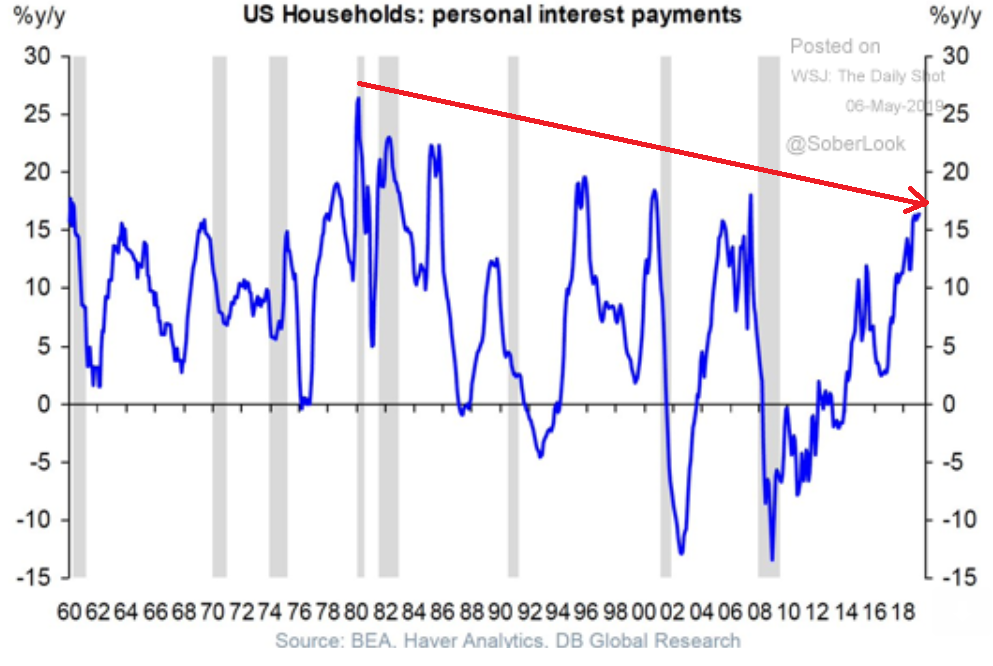
The side-effect of the Fed’s near-zero interest medicine – the collapse in personal interest income over the last few years. The decline in interest income actually dwarfs estimates of debt service savings. Exhibit 2 compares the evolution of household debt service costs and personal interest income. Both aggregates peaked around $1.4 trn at roughly the same time – the middle of 2008. According to our analysis of Federal Reserve figures, total debt service – which includes mortgage and consumer servicing costs – is down $206bn from the peak. The contraction in interest income amounts to roughly $407bn from its peak, more than double the windfall from lower debt service.

Posted in Fed, Interest Rates | 22 Comments »

John’s got it!

Posted by WARREN MOSLER on 17th July 2012

Congress, Not the Fed, Needs to ‘Get to Work’

By John Carney

July 17 (CNBC) — The Senate Banking Committee’s grilling of Federal Reserve Chairman Ben Bernanke just got weird.

Senator Charles Schumer, the New York Democrat, proposed a novel theory of political management of the economy shortly before 11 am Tuesday morning.

The gist of the theory: If the elected branches of government cannot agree to act, the responsibility for the economy falls to the Fed.

Schumer’s argument amounted to the idea that that because disagreements between Republican and Democrats (and, of course, the political ambitions of members of both parties in a presidential election year) are blocking any agreement to provide fiscal relief to the economy, the Fed should “get to work.”

It’s tempting to say that this is the drunk’s theory of the bar tab.

The drunk has been drinking so much he can’t work—and therefore can’t afford to pay his tab. So it’s up to the bartender to pour another cocktail and extend the tab a bit longer.

But this would be insulting to drunks everywhere. The drunk actually understands the economics of the bar better than Schumer understands the difference between monetary and fiscal policy.

The economy right now suffers because the private sector is attempting to save more than it spends, mostly by paying down its enormous debt burden. Because everyone’s income comes from someone else’s spending, reduced overall spending results in income reduction. In our economy, that means higher unemployment.

If the economy is going to grow while households and businesses pay down their debts instead of spending, someone else must take the opposite side of the trade by growing spending more than its income.

With the rest of the world heading toward recession, the only plausible source of this added income is the government. In other words, the government must cut taxes relative to spending (or grow spending relative to taxes) to replace the lost income in the private sector.

What the economy certainly isn’t suffering from right now is a shortage of liquidity or a meager money supply. Which is to say, we’ve reached the limits of what the Fed can do to spur growth. (Although perhaps not the limits of what the Fed can do to fend off a sharp turn downward in the economy.)

To hear a member of the shirker branch of our government blame the Fed for not doing enough would be laughable if we weren’t living with the consequences of the shirking.

Sen. Schumer—and his fellow lawmakers—are the ones who should “get to work.”

Posted in Fed, Government Spending, Interest Rates | 13 Comments »

Banks Face $6 Billion of Libor Litigation, Morgan Stanley estimates

Posted by WARREN MOSLER on 12th July 2012

The libor scandal is particularly bad, even though not a lot of actual $ gains/losses involved, in that it happened after the financial crisis when there was at least some hope that the surviving major banks had, in general, cleaned up their act. And also at least some hope that the crisis was a wake up call to bank regulators and supervisors.

It’s not that hard to spot. For example, relatively wide libor basis swaps indicate markets are discounting libor settings being away from actual deposit rates by more than typical bid/offered spreads.

Banks Face $6 Billion of Libor Litigation, Morgan Stanley estimates

July 12 (Bloomberg) — Banks being probed for attempting to rig benchmark interest rates could face $6 billion of related litigation costs, analysts at Morgan Stanley estimated. The 16 banks may also lose 4 percent to 13 percent in 2012 earnings per share from regulatory fines on a base case scenario, Morgan Stanley analysts led by Betsy Graseck wrote in a note to investors today. They may also suffer from tighter scrutiny from regulators in response to the Libor investigations, the analysts said.

Posted in Banking, Interest Rates | 31 Comments »

Libor Criminal Investigations Will Happen: Diamond

Posted by WARREN MOSLER on 5th July 2012

Libor Criminal Investigations Will Happen: Diamond

By Catherine Boyle

July 4 (CNBC) — Bob Diamond, the recently-departed chief executive of Barclays, told U.K. politicians that there would be criminal investigations into the manipulation of the London interbank offered rate (Libor) scandal which led to his resignation.

From my 2009 proposals here:

2. US banks should not be allowed to contract in LIBOR. LIBOR is an interest rate set in a foreign country (the UK) with a large, subjective component that is out of the hands of the US government. Part of the current crisis was the Federal Reserve’s inability to bring down the LIBOR settings to its target interest rate, as it tried to assist millions of US homeowners and other borrowers who had contacted with US banks to pay interest based on LIBOR settings. Desperate to bring $US interest rates down for domestic borrowers, the Federal Reserve resorted to a very high risk policy of advancing unlimited, functionally unsecured, $US lines of credit called ‘swap lines’ to several foreign central banks. These loans were advanced at the Fed’s low target rate, with the hope that the foreign central banks would lend these funds to their member banks at the low rates, and thereby bring down the LIBOR settings and the cost of borrowing $US for US households and businesses. The loans to the foreign central banks peaked at about $600 billion and did eventually work to bring down the LIBOR settings. But the risks were substantial. There is no way for the Fed to collect a loan from a foreign central bank that elects not to pay it back. If, instead of contracting based on LIBOR settings, US banks had been linking their loan rates and lines of credit to the US fed funds rate, this problem would have been avoided. The rates paid by US borrowers, including homeowners and businesses, would have come down as the Fed intended when it cut the fed funds rate.

Posted in Banking, Interest Rates | 8 Comments »

Brazil Cuts Rates to Record Low as Economy Stalls

Posted by WARREN MOSLER on 31st May 2012

Another central bank may have it backwards as lower rates turn out to be deflationary and slow things down via interest income channels?

Brazil Cuts Rates to Record Low as Economy Stalls

May 30 (Bloomberg) — Brazil’s central bank cut interest rates on Wednesday for the seventh straight time to a record low 8.50 percent, moving into uncharted territory in a bid to shield a fragile recovery from a gloomy global outlook.

President Dilma Rousseff has made lower interest rates one of the top priorities of her government which is struggling to steer the economy back to the 4 percent-plus growth rates that made Brazil one of the world’s most attractive emerging markets in the last decade.

The central bank’s monetary policy committee, known as Copom, voted unanimously to lower the benchmark Selic rate 50 basis points from 9 percent, in line with market expectations.

“At this moment, Copom believes that the risks to the inflation outlook remain limited,” the bank said in a statement that accompanied the decision. The statement used the exact same language as the previous statement when the bank cut the Selic rate in April.

With Wednesday’s cut, the central bank has now lopped 400 basis points off the Selic rate since August 2011, when it surprised markets by starting an easing cycle despite widespread concerns at the time about surging consumer prices.

Inflation has eased since then with some help from a sluggish global economy, bringing the annual rate to well below the 6.5 percent ceiling of the central bank’s target range.

That has allowed the central bank to test the boundaries on interest rates, ushering in what some economists predict might be a new era of lower borrowing costs for Brazil.

The size of Wednesday’s rate cut marked a slowdown in the pace of easing after two straight reductions of 75 basis points in March and April. The central bank signaled after its April policy meeting that future rate cuts might be more cautious.

The previous low for the Selic was set in 2009, when the central bank in the administration of former President Luiz Inacio Lula da Silva slashed the rate to 8.75 percent to fend off the global financial crisis.

Posted in BRIC, CBs, Inflation, Interest Rates | 139 Comments »

Reuter’s Ed Rombach on US vs Japan

Posted by WARREN MOSLER on 7th May 2012

Ed researched this issue after discussing with Warren August 2011.

Ed Rombach on US vs Japan

Posted in Bonds, Government Spending, Interest Rates, Japan, USA | 31 Comments »

People who reject free lunches are fools: Liquidity trap – part II

Posted by WARREN MOSLER on 20th April 2012

Fiscal and monetary policy in a liquidity trap – part II

By Martin Wolf

Output is produced by work.
Work is a cost, not a benefit.
It is in that sense that there is no free lunch.

Might fiscal expansion be a free lunch? This is the question addressed in a thought-provoking paper “Fiscal Policy in a Depressed Economy”, March 2012, by Brad DeLong and Larry Summers, the most important conclusion of which is obvious, but largely ignored: the impact of fiscal expansion depends on the context. *

In normal times, with resources close to being fully utilised, the multiplier will end up very close to zero; in unusual times, such as the present, it could be large enough and the economic benefits of such expansion significant enough to pay for itself.

‘Paying for itself’ implies there is some real benefit to a lower deficit outcome vs a higher deficit outcome. With the govt deficit equal to the net financial assets of the non govt sectors, ‘Paying for itself’ implies there is a real benefit to the non govt sectors have fewer net financial assets.

In a liquidity trap fiscal retrenchment is penny wise, pound foolish.

I would say it’s penny foolish as well, as it directly reduces net financial assets of the non govt sectors with no economic or financial benefit to either the govt sector or the non govt sectors.

Indeed, relying on monetary policy alone is the foolish policy: if it worked, which it probably will not, it does so largely by expanding stretched private balance sheets even further.

Agreed.

As the authors note: “This paper examines the impact of fiscal policy in the context of a protracted period of high unemployment and output short of potential like that suffered by the United States and many other countries in recent years. We argue that, while the conventional wisdom rejecting discretionary fiscal policy is appropriate in normal times, discretionary fiscal policy where there is room to pursue it has a major role.”

There are three reasons for this.

1. First, the absence of supply constraints means that the multiplier is likely to be large.

Why is a large multiplier beneficial?

A smaller multiplier means the fiscal adjustment can be that much larger.

That is, the tax cuts and/or spending increases (depending on political preference) can be that much larger with smaller multipliers.

It is likely to be made even bigger by the fact that fiscal expansion may well raise expected inflation and so lower the real rate of interest, when the nominal rate is close to zero.

However the ‘real rate of interest’ is defined. Most would think CPI, which means the likes of tobacco taxes move the needle quite a bit.

And with the MMT understanding that the currency itself is in fact a simple public monopoly, and that any monopolist is necessarily ‘price setter’, the ‘real rate of interest’ concept doesn’t have a lot of relevance.

2. Second, even moderate hysteresis effects of such fiscal expansion, via increases in the likely level of future output, have big effects on the future debt burden.

Back to the errant notion of a public sector debt in its currency of issue being a ‘burden’.

3. Finally, today’s ultra-low real interest rates at both the short and long end of the curve, suggest that monetary policy is relatively ineffective, on its own.

Most central bank studies show monetary policy is always relatively ineffective.

The argument is set out in a simple example. “Imagine a demand-constrained economy where the fiscal multiplier is 1.5, and the real interest rate on long-term government debt is 1 per cent. Finally, assume that a $1 increase in GDP increased tax revenues and reduces spending by $0.33. Assume that the government is able to undertake a transitory increase in government spending, and then service the resulting debt in perpetuity, without any impact on risk-premia.

“Then the impact effect of an incremental $1.00 of spending is to raise the debt stock by $0.50. The annual debt service needed on this $0.50 to keep the real debt constant is $0.005. If reducing the size of the current downturn in production by $1.50 avoids a 1 per cent as large fall in future potential output – avoids a fall in future potential output of $0.0015 – then the incremental $1.00 of spending now augments future tax-period revenues by $0.005. And the fiscal expansion is self-financing.”

This is a very powerful result.

Yes, it tells you that the ‘automatic fiscal stabilizers’ must be minded lest the expansion reduce the govt deficit and, by identity, reduce the net financial assets of the non govt sectors to the point of aborting the economic recovery. Which, in fact, is how most expansion cycles end.

For the non govt sectors, net financial assets are the equity that supports the credit structure.

So when a recovery driven by a private sector credit expansion (which is how most are driven), causes tax liabilities to increase and transfer payments to decrease (aka automatic fiscal stabilizers)- reducing the govt deficit and by identity reducing the growth of private sector net financial assets- private sector/non govt leverage increases to the point where it’s unsustainable and it all goes bad again.

It rests on the three features of the present situation: high multipliers; low real interest rates; and the plausibility of hysteresis effects.

A table in the paper (Table 2.2) shows that at anything close to current real interest rates fiscal expansion is certain to pay for itself even with zero multiplier and hysteresis effects: it is a “no-brainer”.

And, if allowed to play out as I just described, the falling govt deficit will also abort the expansion.

Why is this? It is because the long-term real interest rate paid by the government is below even the most pessimistic view of the future growth rate of the economy. As I have argued on previous occasions, the US (and UK) bond markets are screaming: borrow.

The bond markets are screaming ‘the govt. Will never get its act together and cause the conditions for the central bank to raise rates.’

Of course, that is not an argument for infinite borrowing, since that would certainly raise the real interest rate substantially!

Infinite borrowing implies infinite govt spending.

Govt spending is a political decision involving the political choice of the ‘right amount’ of real goods and services to be moved from private to public domain.

Yet, more surprisingly, the expansion would continue to pay for itself even if the real interest rate were to rise far above the prospective growth rate, provided there were significantly positive multiplier and hysteresis effects.

I’d say it this way:
Providing increasing private sector leverage and credit expansion continues to offset declines in govt deficit spending.

Let us take an example: suppose the multiplier were one and the hysteresis effect were 0.1 – that is to say, the permanent loss of output were to be one tenth of the loss of output today. Then the real interest rate at which the government could obtain positive effects on its finances from additional stimulus would be as high as 7.4 per cent.

Thus, state the authors, “in a depressed economy with a moderate multiplier, small hysteresis effects, and interest rates in the historical range, temporary fiscal expansion does not materially affect the overall long-run budget picture.” Investors should not worry about it. Indeed, they should worry far more about the fiscal impact of prolonged recessions.

They shouldn’t worry about the fiscal impact in any case. The public sector deficit/debt is nothing more than the net financial assets of the non govt sectors. And these net financial assets necessarily sit as balances in the central bank, as either clearing balances (reserves) or as balances in securities accounts (treasury securities). And ‘debt management’ is nothing more than the shifting of balances between these accounts.

(and there are no grandchildren involved!)
(and all assuming floating exchange rate policy)

Are such numbers implausible? The answer is: not at all.

Multipliers above one are quite plausible in a depressed economy, though not in normal circumstances. This is particularly true when real interest rates are more likely to fall, than rise, as a result of expansion.

The ‘multipliers’ are nothing more than the flip side of the aggregate ‘savings desires’ of the non govt sectors. And the largest determinant of these savings desires is the degree of credit expansion/leverage.

Similarly, we know that recessions cause long-term economic costs. They lower investment dramatically: in the US, the investment rate fell by about 4 per cent of gross domestic product in the wake of the crisis. Businesses are unwilling to invest, not because of some mystical loss of confidence, but because there is no demand.

Again, we know that high unemployment has a permanent impact on workers, both young and old. The US, in particular, seems to have slipped into European levels of separation from the labour force: that is to say, the unemployment rate is quite low, given the sharp fall in the rate of employment. Workers have given up. This is a social catastrophe in a country in which work is effectively the only form of welfare for people of working age.

Not to mention the lost real output which over the last decade has to be far higher than the total combined real losses from all the wars in history.

Indeed, we can see hysteresis effects at work in the way in which forecasters, including official forecasters, mark down potential output in line with actual output: a self-fulfilling prophecy if ever there was one. This procedure has been particularly marked in the UK, where the Office for Budget Responsibility has more or less eliminated the notion that the UK is in a recession. Yet such effects are not God-given; they are man-chosen. They are the product of fundamentally misguided policies.

This is an important paper. It challenges complacent “do-nothingism” of policymakers, let alone the “austerians” who dominate policy almost everywhere. Policy-makers have allowed a huge financial crisis to impose a permanent blight on economies, with devastating social effects. It makes one wonder why the Obama administration, in which prof Summers was an influential adviser, did not do more, or at least argue for more, as many outsiders argued.

The private sector needs to deleverage.

It’s no coincidence that with a relatively constant trade deficit, private sector net savings, as measured by net financial $ assets, has increased by about the amount of the US budget deficit.

In other words, the $trillion+ federal deficits have added that much to domestic income and savings, thereby reducing private sector leverage.

However, as evidenced by the gaping output gap, for today’s credit conditions, it’s been not nearly enough.

The government can help by holding up the economy. It should do so. People who reject free lunches are fools.

Posted in Bonds, CBs, Currencies, Deficit, Government Spending, Interest Rates | 41 Comments »