Re: Comments on Thoughts on Treasury plan


[Skip to the end]

(an interoffice email exchange)

>   
>   On Fri, Sep 19, 2008 at 9:50 AM, David wrote:
>   So creating liquidity for toxic assets RTC style.
>   

maybe, jury is still out on how that might work

>   
>   Make the government a little money and inspire confidence in banks, ok.
>   
>   We are thinking that this is overtly inflationary for financial assets (maybe all
>   assets?)
>   

supports a lot of equity value by removing a large element of risk, but cost to shareholders still unknown

fixed income going higher in yield, prices there going down

>   
>   Should I expect this to re-inflate the commodity asset bubble in the medium
>   term???
>   

not directly. crude price up to the Saudis.

>   
>   Do you think the dollar’s rally will help cap any commodity asset price rise???
>   

yes, in the competitive markets. crude is not a competitive market. saudis merely set price and let quantity adjust

>   
>   PS- I expected to come in today to $110+ crude, $8+ gas, and $900+ gold.
>   

as above. crude up even with dollar up, but gold down.

warren


[top]

Bloomberg: Thoughts on Treasury plan


[Skip to the end]

My take is an RTC type solution only works when the government owns the institutions, so this will probably be different.

I suspect it will be more like Japan, where the government bought a new class of preferred stock in the banks to add capital.

Whatever they will do will cause credit spreads to come in, which will make the assets of AIG far more valuable and probably result in a ‘profit’ for the government.

Unsold Lehman assets will also appreciate.

More comments below:

Paulson, Bernanke Push New Plan to Cleanse Books

by Alison Vekshin and Dawn Kopecki

Government Options
Options that U.S. officials are considering include establishing an $800 billion fund to purchase so-called failed assets

I see this as problematic as above and as below.

and a separate $400 billion pool at the Federal Deposit Insurance Corp. to insure investors in money-market funds, said two people briefed by congressional staff. They spoke on condition of anonymity because the plans may change.

This puts money funds on par with insured bank deposits. Seems no need for both.

Instead, better to remove the $100,000 cap on bank deposit insurance to allow large investors use bank deposits safely. There is no economic reason for the low cap in any case.

Another possibility is using Fannie and Freddie, the federally chartered mortgage-finance companies seized by the government last week, to buy assets, one of the people said.

That’s already in place. They already have treasury funding to buy mortgages.

“We will try to put a bill together and do it fairly quickly,” House Financial Services Committee Chairman Barney Frank, a Massachusetts Democrat, said after the meeting. “We are not in a position to give you any specifics right now” on the proposals, he said when asked about the potential cost.

The likelihood of the government taking on yet more devalued assets, after the seizures of Fannie, Freddie and AIG and the earlier assumption by the Fed of $29 billion of Bear Stearns Cos. investments, may spur concern about its own balance sheet.

We need to get past this concern about government solvency. It’s simply not an operational issue.

Debt Concern
The Treasury has pledged to buy up to $200 billion of Fannie and Freddie stock to keep them solvent, while the Fed agreed Sept. 16 to an $85 billion bridge loan to AIG. The Treasury also plans to buy $5 billion of mortgage-backed debt this month under an emergency program.

“It sounds like there’s going to be a giant dumpster for illiquid assets,” said Mirko Mikelic, senior portfolio manager at Fifth Third Asset Management in Grand Rapids, Michigan, which oversees $22 billion in assets. “It brings up the more troubling question of whether the U.S. government is big enough to take on this whole problem, relative” to the size of the American economy, he said.

This is ridiculous and part of the problem that got us to this point.


[top]

From Professor Mitchell


[Skip to the end]

The JG is job guarantee, and it’s identical to ELR which is simply offering a national service job to anyone willing and able to work.

Bill is based in Australia, and his book can be ordered from this website.

He is one of the few who is ‘in paradigm’.

Excerpts from Bill’s email to me:

>   
>   I have been in South Africa and now in Europe. Today I gave workshops to
>   senior policy managers at the ILO in Geneva on employment guarantees. I have
>   some further meetings tomorrow with managers of ILO programs in Nepal and
>   Mozambique and they are keen to map out an agenda to introduce JGs in those
>   countries.
>   

Well done!

>   
>   I will provide a full report about all the workshops and meetings I have had in
>   the last 3 weeks when I get back home on Tuesday.
>   
>   Hope all is getting back to normal. The financial markets certainly are going
>   crazy. No-one has really said that the US government cannot afford to pump 82
>   billion here and some more there etc into defending financial capital. That issue
>   - of financial solvency and capacity of the Govt hasn’t come up. interesting.
>   

There have those giving warnings about solvency, and that the US will get downgraded if it goes too far.

And there are those that say ‘pumping in all that money’ is inflationary.
 
 
All the best!,
Warren


[top]

NYT: Treasury bills program


[Skip to the end]

>   
>   On Thu, Sep 18, 2008 at 4:21 PM, Eric Tymoigne wrote:
>   
>   One former FOMC member at least gets it (From the NYT) (well, at least if you
>   replace “can create money” by “can create reserve”):
>   

I’ve heard him before, and he definately doesn’t quite get it. See my comments below:

September 18, 2008, 3:15 pm

Will Government Bailouts Lead to Inflation?

by Catherine Rampell

A reader asks about inflation concerns, and finds a divided response from our panel:

I’m worried about how much the government is intervening. It appears that the last remaining weapon the government will have is printing more money. Is hyperinflation a real concern down the road? — Geoffrey Bell

The question is about hyperinflation.

From Bob McTeer of the National Center for Policy Analysis:

All the offsets do is to alter the resulting interest rate. The offsets have nothing to do with inflation. Fed operations are about pricing, not about inflation per se. The only connection Fed policy has regarding inflation is the further effect of the interest rate they select. It has nothing to do with quantity.

The Fed’s ability to lend is limitless because it can create money.

All Fed lending is ‘creating money’ (changing a number in a member bank’s reserve account).

So it’s not that it’s limitless because it ‘can’ ‘create money,’ it’s limitless because it always/only does ‘create money’.

Its ability to offset the lending is limited by its portfolio. Hence, its request to the Treasury to sell some extra Treasury bills. — Bob McTeer

Yes, and this is a self imposed constraint put on by government.

Functionally and operationally, a treasury security is nothing more than a credit balance in a security account.

Current law doesn’t allow the Fed to take funds into a securities account of its own creation.

This is one of many self-imposed constraints by government that are contributing to ‘the problem’.

warren


[top]

2008-09-18 USER


[Skip to the end]


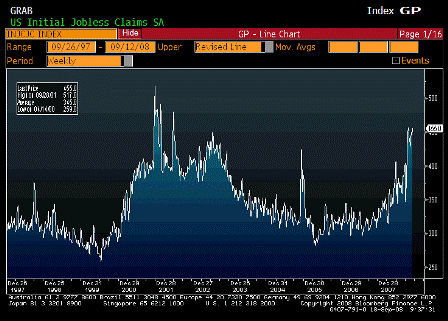
Initial Jobless Claims (Sep 13)

Survey 440K
Actual 445K
Prior 445K
Revised n/a

 
Staying at the top of the new range since the extended benefit package went into force. And might be a touch high due to the hurricane.

[top][end]

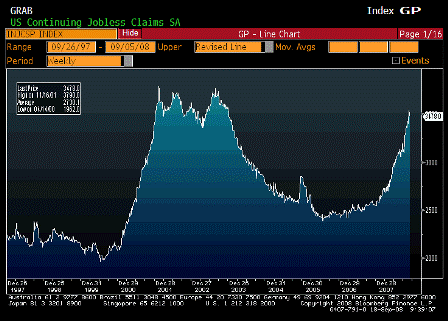
Continuing Jobless Claims (Sep 6)

Survey 3525K
Actual 3478K
Prior 3525K
Revised 3533K

 
Down a bit and better than expected but still on the high side.

[top][end]

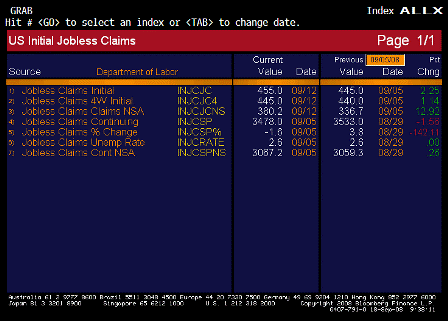
Jobless Claims ALLX (Sep 13)

[top][end]


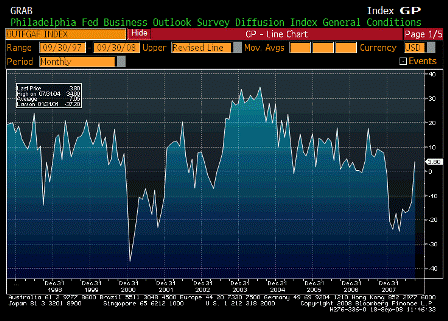
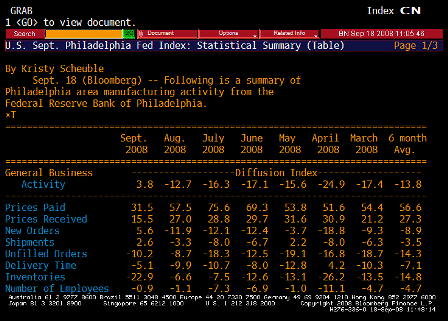
Philadelphia Fed (Sep)

Survey -10.0
Actual 3.8
Prior -12.7
Revised n/a

 
Back to positive territory with an upside surprise.

[top][end]

Philadelphia Fed TABLE (Sep)

[top][end]

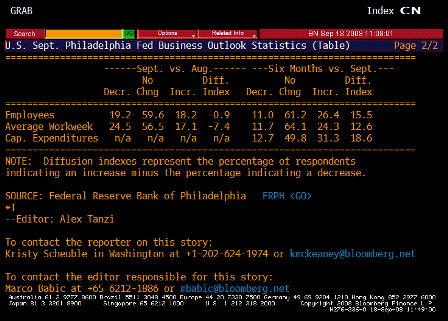
Philadelphia Fed TABLE 2 (Sep)

[top][end]

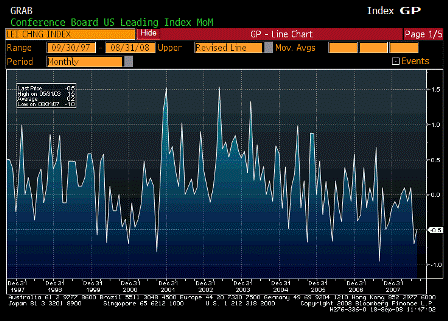
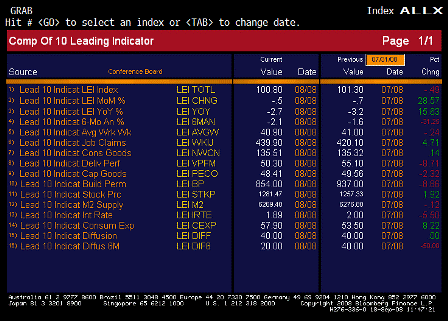
Leading Indicators (Aug)

Survey -0.2%
Actual -0.5%
Prior -0.7%
Revised n/a

 
Leading indicators down more than expected. This is largely a financial conditions indicator.

[top][end]

Leading Indicators ALLX (Aug)

<

Karim writes:

  • Initial claims rise 10k to new cycle of 455k but DOL states Gustav-related claims helped boost weekly rise.

  • 4wk avg rises to 445k from 440k.

  • Continuing claims fall 55k to 3478k, partially reversing prior weeks large 129k increase.

  • 4wk average of continuing rises from 3431k to 3461k.

  • Even if initial claims would have been lower ex-Gustav, recent trends in both IJC and CC reflect a faster pace of labor market deterioration.

  • Next month’s payrolls likely to be down more than 100k.


  • Activity index rises from -12.7 to 3.8.

  • Prices paid drop from 57.5 to 31.5.

  • Orders and shipments rise 17.5 and 5.9pts, respectively, both into modest positive position.

  • Employment component basically unch at -0.9.


[top]

On the floor of the Senate today


[Skip to the end]

From the last two paragraphs it looks like another fiscal package is on the way?

Interesting how little damage to the real economy it takes to trigger a fiscal response – GDP last printed at 3.3% and the relatively modest job losses are not nearly enough to have triggered a fiscal response in the past from either party?

So it seems behind the rhetoric the Democrats in Congress are in fact reacting more to financial sector needs.

Probably because, like the Republicans, most of their constituents are also shareholders.

The move to broaden shareholdings has had profound political ramifications that has undercut the previous agendas of both parties.

A few months ago the far left in Congress was congratulating the Fed chairman for keeping inflation expectation well contained even as other prices were rising, after it was explained that this meant keeping wages in check.

Since when doe the ‘far left’ praise a Fed chairman for suppressing wages, especially when the cost of living is on the rise???

Having a nation of shareholders seems to have redirected overall public purpose?

The 30% corporate income tax means the government already ‘better than ownes’ 30% off all the US based equity- it’s the direct pipe, and easily increased or decreased by decree.

Equity held at this level has very different political effects than individual ownership of shares.

Yet there is no discussion of any of this, anywhere in the public debate.

Meanwhile, crude seems to be acting like the ‘Master’s inventory liquidation’ may have run its course and the Saudis are again moving prices back up as demand for their output remains firm and their excess capacity is too thin for comfort.

This drives down the USD, making our stocks ‘cheaper’ to foreigners, so look for more foreign takeovers, which will be spun as the US ‘needing’ foreign borrowers and being ‘rescued’ by them.

Reid: While Financial Markets Reel, Bush-McCain Republicans Call For More Of The Same

Washington, DC—Senate Majority Leader Harry Reid made the following statement today on the floor of the U.S. Senate. Below are his remarks as prepared for delivery:

“On the morning of October 30, 1929, President Herbert Hoover awoke the day after the biggest one-day stock market crash in American history, surveyed the state of the U.S. economy and declared, ‘The fundamental business of the country, that is production and distribution of commodities, is on a sound and prosperous basis.’

“In the coming weeks and months, President Hoover remained in an economic bubble, unaware of the extreme suffering of ordinary Americans – even declaring that anyone who questioned the state of the economy was a ‘fool.’ For Herbert Hoover, ignorance was bliss. And it wasn’t until the American people replaced this out of touch Republican president with a Democrat, Franklin Roosevelt, that our nation’s economic recovery began.

“Yesterday, nearly 80 years after the Hoover Administration took America with blissful ignorance into depression, the Dow Jones Industrial Average dropped more than 500 points – the biggest one-day decline since trading opened after the attacks of 9/11. With one major investment bank headed for bankruptcy, another sold at a bargain-basement price, and one of the world’s largest insurance companies teetering, investors rushed to sell their shares.

“With our financial markets reeling, the American people are wondering whether they will lose their jobs, whether they will be able to pay their child’s next tuition bill, whether their pension and retirement savings will be safe.

“There is no reason to think we are headed into an economic depression. There is no reason to panic. Yet one Senator – John McCain – woke up yesterday morning, surveyed the state of the U.S. economy, summoned the ghost of his fellow Republican, Herbert Hoover, and declared, ‘The fundamentals of our economy are strong.’

“For whom are the fundamentals of our economy strong? Not for the 606,000 Americans who have lost their jobs this year alone. Not for the commuters and truckers who are sending more and more of their hard-earned dollars to pay for fuel. Not for all those struggling to make one pay check last until the next, with record hme heating prices looming in the coming winter months. Not for cities and towns that have been forced to cut back on police, schools and firefighters because their tax base is shrinking. And certainly not for the millions of families who have or may soon lose their homes, or for the tens of millions who are seeing their home equity plummet.

“No matter what George Bush, John McCain or the ghost of Herbert Hoover may think, this economy is not strong, and the American people deserve better.

“This is not a time for panic. But it is a time to look back on the past eight years of Bush-Hoover-McCain economics and figure out what brought us to this point so that we don’t repeat the same mistakes. And the tragic truth is that this disaster was avoidable. In its palpable disdain for all things relating to government, the Bush/Cheney Administration willfully neglected the government’s most important function: to safeguard the American people from harm.

“In their simplistic philosophy of ‘big business equals good, government equals bad,’ the Administration and the Republican Congress failed to conduct oversight and let the financial sector go wild. Without anyone regulating their actions, market excess destroyed the financial prudence that allowed a firm like Lehman Brothers to prosper for 158 years. Vast fortunes were made virtually over night, and now vast fortunes have been lost literally over night.

“The unfortunate irony is that the Bush Administration’s zeal to favor big business has now crippled it – and left the American people to pay the price. President Bush did nothing to stop this disaster, and now it’s clear he’ll leave the mess to the next president.

“Now our nation must decide who is better suited to end Bush-Hoover economics and return sanity and security to our economy. Senator McCain says the economy is not his strong suit, so he went searching for an economic advisor who could bolster his weakness. Who did he choose? Former Senator Phil Gramm. The same Phil Gramm who, as a Senator, was responsible for deregulation in the financial services industries that paved the way for much of this crisis to occur.

“A respected economist at the University of Texas, James K. Galbraith, said that Gramm was ‘the most aggressive advocate of every predatory and rapacious element that the financial sector has’ and that ‘he’s a sorcerer’s apprentice of instability and disaster in the financial system.’

“It was Phil Gramm who pushed legislation through a Republican Senate that allowed firms like Enron to avoid regulation and destroy the life savings of its employees, and it was Phil Gramm’s legislation that now allows Wall Street traders to bid up the price of oil, leaving us to pay the bill. Warren Buffet called the result of Gramm’s legislation ‘financial weapons of mass destruction.’ And now, the architect and leading cheerleader for every mistake and neglect that created the Bush/Cheney financial nightmare is whispering into the ear of John McCain – who says he doesn’t know much about the economy.

“Whether you call it Hoover economics, Bush economics, or McCain economics, it is not a recipe for change – it’s a recipe for more of the same.

“For all of the college students worried about finding a job, the working families who don’t know how they’ll pay the bills, and the fixed-income senior citizens trying to figure out how to pay for medicine, we must do better.

“We can’t afford another Republican president who will follow his party’s ghosts down the path of recession, depression and more suffering. We desperately need a president who understands that working people, not industry titans, are the backbone of our economy. We need a president who will cut taxes for working people and senior citizens; end the windfall profits of oil companies and put that money back into the pockets of those who are paying record prices at the pump; and put millions of Americans back to work by investing in jobs on Main Street, not Wall Street.

“In November, we can elect that President who will break from the past and invest in the future. Until then, the Senate should pass a second economic stimulus plan that funds infrastructure projects that will create jobs; prevents cuts in desperately-needed state services; and invests in renewable energy, expanded unemployment benefits for victims of the Bush-McCain economy, and helps working people and senior citizens afford the costs of energy.

“I expect the House of Representatives to pass a stimulus bill in the coming days. When it arrives in the Senate, I hope it will be embraced by Senators from both parties as a critical first step on the long road from economic ruin toward economic recovery.”


[top]

Fed increasing $ vs fx swap lines to ECB and others


[Skip to the end]

This is an extension of credit to those CBs which functionally allows them to borrow (and thereby also get ‘short’) USD, presumably to fund their local USD needs for their institutions short USD, and presumably to cover losses on their USD financial assets and to finance the remaining balances.

The ECB has no USD to fund its member banks, and is not inclined to sell euros and buy USD as, at a minimum, a matter of ideology.

This is not a good sign for the eurozone banking system solvency, though the size is modest, at least for now.


[top]

Equity prices dropping to takeover levels


[Skip to the end]

A while back I wrote about how shareholders were at risk of management selling them up the river with dilutive converts and the like.

But if a someone buys all the shares in a takeover they don’t have that risk.

Therefore, I concluded, equities would get cheap enough for a massive round of takeovers.

Now a different risk has presented itself. Seems when the Fed or the Treasury decides to step in and help they take 79.9% of the equity.

So when the stock of a too-big-to-fail prospect starts going down, the incentives are in place for it going down further/faster as the risk of government intervention increases.

Lower prices make takeovers even more attractive.

Once they get going, look for record takeover volume.


[top]

Re: Commentary


[Skip to the end]

>   
>   On Wed, Sep 17, 2008 at 8:54 AM, Pat wrote:
>   
>   Summary of Michael Cloherty (BoA) assessment this morning:
>   
>   Following Reserve’s Primary Money Mkt Fund breaking the buck, we are looking
>   at possible structural changes to the funding markets depending on how the
>   money investor’s perception of Money Mkts funds safety is. Massive
>   withdrawals from this $4.6 trillion market could be devastating most of the
>   money would go to T-bills and bank deposits.
>   

all the t bills are already sold so what it does is bid up t bills to new indifference levels. quantity stays the same

yes, bank deposits would go up, and banks would invest in what the money funds were investing in, though perhaps at different spreads

the move to money markets was a disintermediating event.

instead of putting funds in banks, they put them in money funds

since ‘loans create deposits’ this changed the entire financial landscape

repo, commercial paper and other funding instruments replaced bank lending to create the newly desired money fund balances.

>   
>   This is rattling the repo markets which were already under enormous pressure.
>   The repo market relies on the MMKT funds cash to back it. “If withdrawals are
>   large enough we will head towards a bank financed system (as if balance sheets
>   weren’t crowded enough already). Liquidity could get worse”.
>   

with the falling desire for money fund balances vs bank deposits funding returns to the banking system.

>   
>   At the very least money market funds will be defensive and cash will be
>   expensive in the mornings as they switch to O/N repos and CP.
>   

yes, it’s all returning to bank funding at the moment, which means wider spreads for borrowers

we are now in the endgame of the great repricing of risk as previous business models go by the wayside and new ones emerge.

warren

>   
>   -Pat–
>   


[top]