Welcome to the 7th US depression, Mr. bond market

Looks to me like the lack of noises out of Japan means there won’t be a sufficient fiscal response to restore demand.

If anything, the talk is about how to pay for the rebuilding, with a consumption tax at the top of the list.

That means they aren’t going to inflate.
More likely they are going to further deflate.
Yes, the yen will go down by what looks like a lot, maybe even helped by the MOF, but I doubt it will be enough to inflate.

In fact, all the evidence indicates that Japan doesn’t don’t know how to inflate, nor does anyone else.

Worse, what they all think inflates, more likely actually deflates.

0 rate policies mean deficits can be that much higher without causing ‘inflation’ due to income channels and supply side effects.
There is no such thing as a debt trap springing to life.
Debt monetization is a meaningless expression with non convertible currency and floating fx.
QE mainly serves to further remove precious income from an already income starved economy.

Only excess deficit spending can directly support prices, output, and employment from the demand side, as it directly adds to incomes, spending, and net savings of financial assets.

The international fear mongering surrounding deficits and debt issues is entirely a chicken little story that’s keeping us in this depression (unemployment over 10% the way it was measured when the term was defined) that’s now taking a turn for the worse.

The euro zone is methodically weakening it’s ‘engines of growth’- its own (weaker) members being subjected to austerity measures that are reducing their deficit spending that paid for their imports from Germany. And now China, Japan, the US and others will be cutting imports as well.

UK fiscal austerity measures are accelerating on schedule.

The US is also working to tighten fiscal policy, particularly now that both sides agree that deficit reduction is in order, beaming as they make progress towards agreeing on the cuts.

The US had 6 depressions while on the gold standard, which followed the only 6 periods of budget surpluses.
And now, even with a floating fx policy and non convertible currency that allows for immediate and unlimited fiscal adjustments,
we have allowed the deflationary forces unleashed by the Clinton budget surpluses to result in this 7th depression.

We were muddling through with modest real growth and a far too high output gap and may have continued to do so all else equal.

But all else isn’t equal.

Collective, self inflicted proactive austerity has been working against growth, including China’s ‘fight against inflation.’

And now Japan’s massive disaster will be deflationary shock that, in the absence of a proactive fiscal adjustment, is highly likely to further reduce world demand.

Hopefully, the Saudis capitulate and follow the price of crude lower, easing the burden somewhat on the world’s struggling populations.
If so, watch for a strong dollar as well.

And watch for a lot more global civil unrest as no answers emerge to the mass unemployment that will likely get even worse. Not to mention food prices that may come down some, but will remain very high at the consumer level as we continue to burn up our food supply for motor fuel.

And it’s all only likely to get worse until the world figures out how its monetary system actually works.

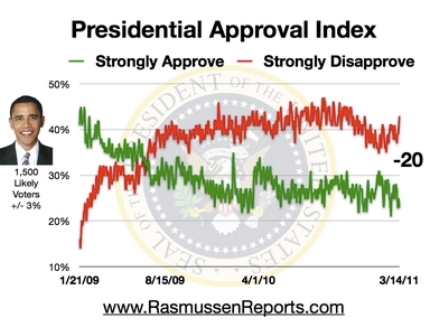
Presidential approval index

This is not looking good.

The economy is perceived to be at least modestly growing and improving.

The President is now perceived to be working with the opposition, first to extend the tax cuts at year end, and now with the spending cuts.

The President has kept us out of direct conflict in the latest round of disruptions.

So what’s the problem?

Gasoline is pushing $4/gallon and there’s no plan except to tax it so we don’t use so much?

They all believe we’ve run out of money, are dependent on borrowing from the likes of China, and could be the next Greece?

The rebels are losing in Libya and there seems to be nothing we can do about it?

Homes are still being lost by the hundreds of thousands?

Vast numbers of people owe more on their house than it’s worth?

People can’t find decent jobs?

The healthcare situation is worse than ever?

There is a perception that the President and Congress are insensitive to what people are going through?

There is no actual recovery plan, nor even any proposals that make sense?

There is a general feeling that America is in decline?

A few Boehnalities and other notables on the US going broke

Cross currents of right and wrong but always for the wrong reasons.

Bonds Show Why Boehner Saying We’re Broke Is Figure of Speech

By David J. Lynch

March 7 (Bloomberg) — House Speaker John Boehner routinely offers this diagnosis of the U.S.’s fiscal condition: “We’re broke; Broke going on bankrupt,” he said in a Feb. 28 speech in Nashville.

Boehner’s assessment dominates a debate over the federal budget that could lead to a government shutdown. It is a widely shared view with just one flaw: It’s wrong.

“The U.S. government is not broke,” said Marc Chandler, global head of currency strategy for Brown Brothers Harriman & Co. in New York. “There’s no evidence that the market is treating the U.S. government like it’s broke.”

Wrong reason! Broke implies not able to spend.

The US spends by crediting member bank accounts at the Fed, and taxes by debiting member bank accounts at the Fed.

It never has nor doesn’t have any dollars.

The U.S. today is able to borrow at historically low interest rates, paying 0.68 percent on a two-year note that it had to offer at 5.1 percent before the financial crisis began in 2007.

That’s simply a function of where the Fed, a agent of Congress, has decided to set rates, and market perceptions of where it may set rates in the future. Solvency doesn’t enter into it.

Financial products that pay off if Uncle Sam defaults aren’t attracting unusual investor demand. And tax revenue as a percentage of the economy is at a 60-year low, meaning if the government needs to raise cash and can summon the political will, it could do so.

All taxing does is debit member bank accounts. The govt doesn’t actually ‘get’ anything.

To be sure, the U.S. confronts long-term fiscal dangers.

For example???

Over the past two years, federal debt measured against total economic output has increased by more than 50 percent and the White House projects annual budget deficits continuing indefinitely.

So?

“If an American family is spending more money than they’re making year after year after year, they’re broke,” said Michael Steel, a spokesman for Boehner.

So?
What does that have to do with govts ability to credit accounts at its own central bank?

$1.6 Trillion Deficit

A person, company or nation would be defined as “broke” if it couldn’t pay its bills, and that is not the case with the U.S. Despite an annual budget deficit expected to reach $1.6 trillion this year, the government continues to meet its financial obligations, and investors say there is little concern that will change.

Still, a rhetorical drumbeat has spread that the U.S. is tapped out. Republicans, including Representative Ron Paul of Texas, chairman of the House domestic monetary policy subcommittee, and Fox News commentator Bill O’Reilly, have labeled the U.S. “broke” in recent days.

Chris Christie, the Republican governor of New Jersey, said in a speech last month that the Medicare program is “going to bankrupt us.” Julian Robertson, chairman of Tiger Management LLC in New York, told The Australian newspaper March 2: “we’re broke, broker than all get out.”

A similar claim was even made Feb. 28 by comedian Jon Stewart, the host of “The Daily Show” on Comedy Central.

So much for their legacies.

Cost of Insuring Debt

Financial markets dispute the political world’s conclusion. The cost of insuring for five years a notional $10 million in U.S. government debt is $45,830, less than half the cost in February 2009, at the height of the financial crisis, according to data provider CMA data. That makes U.S. government debt the fifth safest of 156 countries rated and less likely to suffer default than any major economy, including every member of the
G20.

There are two factors in default insurance. Ability to pay and willingness to pay. While the US always has the ability to pay, Congress does not always show a united willingness to pay. Hence the actual default risk.

Creditors regard Venezuela, Greece and Argentina as the three riskiest countries. Buying credit default insurance on a notional $10 million of those nations’ debt costs $1.2 million, $950,000 and $665,000 respectively.

“I think it’s very misleading to call a country ‘broke,'” said Nariman Behravesh, chief economist for IHS Global Insight in Lexington, Massachusetts. “We’re certainly not bankrupt like Greece.”

In any case, the euro zone member nations put themselves in the fiscal position of US states when they joined the euro.

That means a state like Illinois could be the next Greece, but not the US govt.

Less Likely to Default

CMA prices for credit insurance show that global investors consider it more likely that France, Japan, China, the United Kingdom, Australia or Germany will default than the U.S.

Pacific Investment Management Co., which operates the largest bond fund, the $239 billion Total Return Fund, sees so little risk of a U.S. default it may sell other investors insurance against the prospect. Andrew Balls, Pimco managing director, told reporters Feb. 28 in London that the chances the U.S. would not meet its obligations were “vanishingly small.”

Presumably a statement with regard to willingness of Congress to pay.

George Magnus, senior economic adviser for UBS Investment Bank in London, says the U.S. dollar’s status as the global economy’s unit of account means the U.S. can’t go broke.

That has nothing to do with it.

“You have the reserve currency,” Magnus said. “You can print as much as you need. So there’s no question all debts will be repaid.”

Any nation can do that with its own currency

The current concerns over debt contrast with the views of founding father Alexander Hamilton, the nation’s first Treasury secretary. At Hamilton’s urging, the federal government in 1790 absorbed the Revolutionary War debts of the states and issued new government securities in about the same total amount.

Alexander Hamilton

Unlike today’s debt critics, Hamilton “had no intention of paying off the outstanding principal of the debt,” historian Gordon S. Wood wrote in “Empire of Liberty: A History of the Early Republic 1789-1815.”

Instead, by making regular interest payments on the debt, Hamilton established the U.S. government as “the best credit risk in the world” and drew investors’ loyalties to the federal government and away from the states, wrote Wood, who won a Pulitzer Prize for a separate history of the colonial period.

Far be it from me to argue with a Pulitzer Prize winner…

From Oct. 1, 2008, the beginning of the 2009 fiscal year, through the current year, which ends Sept. 30, 2011, the U.S. will have added more than $4.3 trillion of debt. Despite White House forecasts of an additional $2.4 trillion of debt over the next three fiscal years, investors’ appetite for Treasury securities shows little sign of abating.

It’s just a reserve drain- get over it!

Govt spending credits member bank reserve accounts at the Fed

Tsy securities exist as securities accounts at the Fed.

‘Going into debt’ entails nothing more than the Fed debiting Fed reserve accounts and crediting Fed securities accounts and ‘paying off the debt’ is nothing more than debiting securities accounts and crediting reserve accounts

No grandchildren involved.

Longer-Term Debt

In addition to accepting low yields on two-year notes, creditors are willing to lend the U.S. money for longer periods at interest rates that are below long-term averages. Ten-year U.S. bonds carry a rate of 3.5 percent, compared with an average 5.4 percent since 1990. And U.S. debt is more attractive than comparable securities from the U.K., which has moved aggressively to rein in government spending. U.K. 10-year bonds offer a 3.6 percent yield.

“You are never broke as long as there are those who will buy your debt and lend money to you,” said Edward Altman, a finance professor at New York University’s Stern School of Business who created the Z-score formula that calculates a company’s likelihood of bankruptcy.

Who also completely misses the point.

Any doubts traders had about the solvency of the U.S. would immediately be reflected in the markets, a fact noted by James Carville, a former adviser to President Bill Clinton, after he saw how bond investors could determine the success or failure of economic policy.

No they can’t.

“I used to think if there was reincarnation, I wanted to come back as the president or the Pope or a .400 baseball hitter,” Carville said. “But now I want to come back as the bond market. You can intimidate everyone.”

Only those who don’t know any better.

Republican Dissenters

Republican assertions that the U.S. is “broke” are shorthand for a complex fiscal situation, and some in the party acknowledge the claim isn’t accurate.

“To say your debts exceed your income is not ‘broke,'” said Tony Fratto, former White House and Treasury Department spokesman in the George W. Bush administration.

The U.S. government nonetheless faces a daunting gap between its expected financial resources

It’s not about ‘financial resources’ when it comes to a govt that never has nor doesn’t have any dollars, and just changes numbers in our accounts when it spends and taxes

and promised future outlays. Fratto said the Obama administration’s continued accumulation of debt risked a future crisis, as most major economies also face growing debt burdens.

The burden is that of making data entries.

In the nightmare scenario, a crush of countries competing to simultaneously sell IOUs to global investors could bid up the yield on government debt and compel overleveraged countries such as the U.S. to abruptly slash public spending.

It could only compel leaders who didn’t know how it all worked to do that.

Not selling the debt simply means the dollars stay in reserve accounts at the Fed and instead of being shifted by the Fed to securities accounts. Why would anyone who knew how it worked care which account the dollars were in? Especially when spending has nothing, operationally, to do with those accounts.

Fratto dismissed the markets’ current calm, noting that until the European debt crisis erupted early last year, investors had priced German and Greek debt as near equivalents.

“Markets can make mistakes,” Fratto said.

So can he. That all applies to the US states, not the federal govt.

$9.4 Trillion Outstanding

If recent budgetary trends continue unchanged, the U.S. risks a fiscal day of reckoning, slower growth or both.

No it doesn’t.

Altman notes that the U.S. debt outstanding is “enormous.” As of the end of 2010, debt held by the public was $9.4 trillion or 63 percent of gross domestic product — roughly half of the corresponding figures for Greece (126.7 percent) and Japan (121 percent) and well below countries such as Italy (116 percent), Belgium (96.2 percent) and France (78.1 percent).

Once a country’s debt-to-GDP ratio exceeds 90 percent, median annual economic growth rates fall by 1 percent, according to economists Kenneth Rogoff and Carmen Reinhart.

Wrong, that’s for convertible currency/fixed exchange rate regimes, not nations like the US, Uk, and Japan which have non convertible currencies and floating exchange rates.

The Congressional Budget Office warns that debt held by the public will reach 97 percent of GDP in 10 years if certain tax breaks are extended rather than allowed to expire next year and if Medicare payments to physicians are held at existing levels rather than reduced as the administration has proposed.

So???

AAA Rating

For now, Standard & Poor’s maintains a stable outlook on its top AAA rating on U.S. debt, assuming the government will “soon reveal a credible plan to tighten fiscal policy.” Debate over closing the budget gap thus far has centered on potential spending reductions. S&P says a deficit-closing plan “will require both expenditure and revenue measures.”

Measured against the size of the economy, U.S. federal tax revenue is at its lowest level since 1950. Tax receipts in the 2011 fiscal year are expected to equal 14.4 percent of GDP, according to the White House. That compares with the 40-year average of 18 percent, according to the Congressional Budget Office. So if tax receipts return to their long-term average amid an economic recovery, about one-third of the annual budget deficit would disappear.

Likewise, individual federal income tax rates have declined sharply since the top marginal rate peaked at 94 percent in 1945. The marginal rate — which applies to income above a numerical threshold that has changed over time — was 91 percent as late as 1963 and 50 percent in 1986. For 2011, the top marginal rate is 35 percent on income over $373,650 for individuals and couples filing jointly.

Not Overtaxed

Americans also aren’t overtaxed compared with residents of other advanced nations. In a 28-nation survey, only Chile and Mexico reported a lower total tax burden than the U.S., according to the Organization for Economic Development and Cooperation.

In 2009, taxes of all kinds claimed 24 percent of U.S. GDP, compared with 34.3 percent in the U.K., 37 percent in Germany and 48.2 percent in Denmark, the most heavily taxed OECD member.

“By the standard of U.S. history, by the standard of other countries — by the standard of where else are we going to get the money — increased tax revenues have to be a part of the solution,” said Jeffrey Frankel, an economist at Harvard University who advises the Federal Reserve Banks of Boston and New York.

So much for his legacy.

Fiscal panel co-chair blasts critics as “jerks”

History will not be kind to either Simpson or the equally out of paradigm headline critics who are equally responsible for losing this battle.

Fiscal panel co-chair blasts critics as “jerks”

February 6 (Reuters) — Any fiscal plan that fails to tackle military spending, Medicare, Medicaid and Social Security is “a sparrow’s belch in the midst of a typhoon,” a chairman of a presidential deficit-reduction commission said in an interview aired on Sunday.

Former Senator Alan Simpson, Republican co-chair of the National Commission on Fiscal Responsibility and Reform, also trashed certain critics as “jerks” and compared the United States to “a milk cow with 300 million teats.”

“If you have a career politician get up and say, ‘I know we can get this done; we’re going to get rid of all earmarks, all waste, fraud, and abuse, all foreign aid, Air Force one, all congressional pensions,’ that’s a sparrow’s belch in the midst of a typhoon,” Simpson told CNN’s “State of the Union.”

President Barack Obama created the bipartisan, 18-member commission to address fiscal challenges centered around a deficit of more than $1.3 trillion, the highest since World War Two, and a record federal debt now topping $14 trillion.

A bold budget-balancing plan floated by Simpson — long noted for earthy, sometimes off-color remarks — and his fellow co-chairman, Erskine Bowles, fell short in December of the support needed from panel members to trigger congressional action.

“So I’m waiting for the politician to get up and say, there’s only one way to do this, you dig into the big four: Medicare, Medicaid, Social Security, and defense,” Simpson said. “And anybody giving you anything different than that, you want to walk out the door, stick your finger down your throat and give them the green weenie.”

Simpson and Bowles recommended Social Security benefit cuts via a higher retirement age, lower annual cost-of-living adjustments and a change in the way benefits are calculated.

“We’re not talking about privatization,” he said on CNN. “These jerks who keep dragging that up are lying. We never suggested that.”

Simpson served from 1979 to 1997 as a Senator from Wyoming. He had apologized in August for comparing Social Security to “a milk cow with 310 million teats.”

But in the interview he said he had merely misspoken.

“I meant to say that America was a milk cow with 300 million teats, and not just Social Security.”

Clinton presses OAS solution to Haiti impasse

So we send our Secretary of State to Haiti at the height of the Egyptian crisis?

Maybe it’s to highlight that we can’t even get it anywhere near right with Haiti, so don’t expect anything out of the US with regard to promoting human rights and representative government in Egypt.

Nor, of course, do we have any idea regarding improving the lives of majority of the citizens of the world, including our own, as we continue to believe the US govt. has run out of money and is dependent on borrowing from the likes of China and leaving the tab to the grandchildren.

Meanwhile, the risk of oil and trade disruption from the Egyptian crisis remains, however markets are today telling us they don’t think it will be much of an economic event, as the world watches to see if it spreads to other ‘non democratic’ regimes in the region.

Clinton presses OAS solution to Haiti impasse
Published: Sunday, 30 Jan 2011 | 9:27 PM ET

 
PORT-AU-PRINCE – Secretary of State Hillary Clinton urged Haiti’s leaders on Sunday to adopt an internationally backed solution to untangle an election dispute, saying the poor, earthquake-battered country needed a stable government to rebuild.

 
Clinton held talks in Port-au-Prince with outgoing Haitian President Rene Preval and leading presidential candidates on a visit overshadowed by the unfolding political crisis in Egypt.

 
She said she delivered the message that Washington wants Haitian authorities to enact recommendations by Organization of American States experts that revise contested preliminary results from chaotic November 28 elections in the Caribbean nation.

Senator Pat Toomey- Pay China First Act

Gets stupider by the day…

“Sen. Pat Toomey (R-Pa.) introduced what Democrats are calling the “Pay China First Act,” which would require the federal government to pay all its debt obligations first and everything else — vets, schools, you name it — with what’s left.”

Okay, so we tell Ben Bernanke to press the “China debit/credit buttons” on the keyboard first. That should take about 2 seconds, and then we can get back to crediting and debiting everything else as we always do.

This is what supposedly qualifies for serious economic debate in the US these days.

Pre Christmas update

The good news is the US budget deficit still looks to be plenty large to support modest top line growth.

And as the deficit continuously adds to incomes and savings, the financial burdens ratios continue to fall, and the stage is set for a ‘borrow to spend’, ‘get a job buy a car’, ‘it’s cheaper to own than to rent’ good old fashioned credit expansion.

But most all of that good news may already be discounted by the higher term structure of interest rates and the latest stock market rally.

And there are troubling near term and medium term risks out there that don’t seem at all priced in.

The rise in crude prices is particularly troubling.

Net demand isn’t up, and Saudi production remains relatively low.

So the Saudis are supporting higher prices for another reason. Maybe it’s the wiki leaks, or maybe they just had a bad night in London.

No way to tell, but they are hiking prices, and there’s no way to tell when they will stop.

Crude prices are already up enough to be a substantial tax on US consumers that has probably more than offset whatever aggregate demand might have been added by the latest tax package.

Might explain the weaker than expected holiday retail sales?

Congress will soon have a deficit terrorist majority, with many pledged to a balanced budget amendment.

And the world seems to be leaning towards fiscal tightening pretty much everywhere.

The unemployment benefits program has been extended but benefits still expire after 99 weeks, and less in many states.

Net state spending continues to decline as state and local govs continue to reduce their deficits and capital expenditures.

Catchup in the funding of unfunded pension liabilities will continue to be a drag on demand.

A federal pay freeze has been proposed.

The Fed’s 0 rate policy and qe continue to reduce net interest income earned by the economy.

Bank regulators continue to impose policies that work against small bank lending.

Seems some income has likely been accelerated into this quarter from next year over prior concerns of taxes rising, distorting q4 earnings to the upside and maybe lowering q1 earnings a bit?

Euro zone muddles through with very weak domestic demand, and curves perhaps flattening as markets start to believe the ECB will fund it all indefinitely?

China slows as a result of fighting inflation?

Same with Brazil?

Maybe India as well?

Commodity price slump with demand flattening?

Fed low forever?

Stocks in a long term trading range like Japan?

US term structure of interest rates gradually flattens to Japan like levels?

Relatively weak demand gradually brings on alternatives to over priced crude?

Merry Christmas!!!

Comments on BS2 (Bernanke speech #2)

Rebalancing the Global Recovery

Chairman Ben S. Bernanke

November 19, 2010

The global economy is now well into its second year of recovery from the deep recession triggered by the most devastating financial crisis since the Great Depression. In the most intense phase of the crisis, as a financial conflagration threatened to engulf the global economy, policymakers in both advanced and emerging market economies found themselves confronting common challenges. Amid this shared sense of urgency, national policy responses were forceful, timely, and mutually reinforcing. This policy collaboration was essential in averting a much deeper global economic contraction and providing a foundation for renewed stability and growth.

The main policy response as the automatic fiscal stabilizers that, fortunately were in place to cut govt revenues and increase transfer payments, automatically raising the federal deficit to levels where it added sufficient income and savings of financial assets to support aggregate demand at current levels. And while the contents selected weren’t my first choice, the fiscal stimulus package added some support as well.

In recent months, however, that sense of common purpose has waned. Tensions among nations over economic policies have emerged and intensified, potentially threatening our ability to find global solutions to global problems. One source of these tensions has been the bifurcated nature of the global economic recovery: Some economies have fully recouped their losses

Those who have sustained adequate domestic aggregate demand through appropriate fiscal policy.

while others have lagged behind.

Those who have not had adequate fiscal responses.

But at a deeper level, the tensions arise from the lack of an agreed-upon framework to ensure that national policies take appropriate account of interdependencies across countries and the interests of the international system as a whole. Accordingly, the essential challenge for policymakers around the world is to work together to achieve a mutually beneficial outcome–namely, a robust global economic expansion that is balanced, sustainable, and less prone to crises.

Unfortunately, that would require an understanding of monetary operations and that a currency is a (simple) public monopoly. And with that comes the understanding that the us, for example, is far better off going it alone.

The Two-Speed Global Recovery
International policy cooperation is especially difficult now because of the two-speed nature of the global recovery. Specifically, as shown in figure 1, since the recovery began, economic growth in the emerging market economies (the dashed blue line) has far outstripped growth in the advanced economies (the solid red line). These differences are partially attributable to longer-term differences in growth potential between the two groups of countries, but to a significant extent they also reflect the relatively weak pace of recovery thus far in the advanced economies. This point is illustrated by figure 2, which shows the levels, as opposed to the growth rates, of real gross domestic product (GDP) for the two groups of countries. As you can see, generally speaking, output in the advanced economies has not returned to the levels prevailing before the crisis, and real GDP in these economies remains far below the levels implied by pre-crisis trends. In contrast, economic activity in the emerging market economies has not only fully made up the losses induced by the global recession, but is also rapidly approaching its pre-crisis trend. To cite some illustrative numbers, if we were to extend forward from the end of 2007 the 10-year trends in output for the two groups of countries, we would find that the level of output in the advanced economies is currently about 8 percent below its longer-term trend, whereas economic activity in the emerging markets is only about 1-1/2 percent below the corresponding (but much steeper) trend line for that group of countries. Indeed, for some emerging market economies, the crisis appears to have left little lasting imprint on growth. Notably, since the beginning of 2005, real output has risen more than 70 percent in China and about 55 percent in India.

No mention of the size of the budget deficits in those nations, not forgetting to include lending by state owned institutions that is, functionally, deficit spending.

In the United States, the recession officially ended in mid-2009, and–as shown in figure 3–real GDP growth was reasonably strong in the fourth quarter of 2009 and the first quarter of this year.

Mainly a bounce from an oversold inventory position due to the prior fear mongering and real risks of systemic failure.

However, much of that growth appears to have stemmed from transitory factors, including inventory adjustments and fiscal stimulus. Since the second quarter of this year, GDP growth has moderated to around 2 percent at an annual rate, less than the Federal Reserve’s estimates of U.S. potential growth and insufficient to meaningfully reduce unemployment. And indeed, as figure 4 shows, the U.S. unemployment rate (the solid black line) has stagnated for about eighteen months near 10 percent of the labor force, up from about 5 percent before the crisis; the increase of 5 percentage points in the U.S. unemployment rate is roughly double that seen in the euro area, the United Kingdom, Japan, or Canada. Of some 8.4 million U.S. jobs lost between the peak of the expansion and the end of 2009, only about 900,000 have been restored thus far. Of course, the jobs gap is presumably even larger if one takes into account the natural increase in the size of the working age population over the past three years.

Of particular concern is the substantial increase in the share of unemployed workers who have been without work for six months or more (the dashed red line in figure 4). Long-term unemployment not only imposes extreme hardship on jobless people and their families, but, by eroding these workers’ skills and weakening their attachment to the labor force, it may also convert what might otherwise be temporary cyclical unemployment into much more intractable long-term structural unemployment. In addition, persistently high unemployment, through its adverse effects on household income and confidence, could threaten the strength and sustainability of the recovery.

Low rates of resource utilization in the United States are creating disinflationary pressures. As shown in figure 5, various measures of underlying inflation have been trending downward and are currently around 1 percent, which is below the rate of 2 percent or a bit less that most Federal Open Market Committee (FOMC) participants judge as being most consistent with the Federal Reserve’s policy objectives in the long run.1 With inflation expectations stable, and with levels of resource slack expected to remain high, inflation trends are expected to be quite subdued for some time.

Yes, the FOMC continues to fear deflation.

Monetary Policy in the United States
Because the genesis of the financial crisis was in the United States and other advanced economies, the much weaker recovery in those economies compared with that in the emerging markets may not be entirely unexpected (although, given their traditional vulnerability to crises, the resilience of the emerging market economies over the past few years is both notable and encouraging). What is clear is that the different cyclical positions of the advanced and emerging market economies call for different policy settings. Although the details of the outlook vary among jurisdictions, most advanced economies still need accommodative policies to continue to lay the groundwork for a strong, durable recovery. Insufficiently supportive policies in the advanced economies could undermine the recovery not only in those economies, but for the world as a whole. In contrast, emerging market economies increasingly face the challenge of maintaining robust growth while avoiding overheating, which may in some cases involve the measured withdrawal of policy stimulus.

Let me address the case of the United States specifically. As I described, the U.S. unemployment rate is high and, given the slow pace of economic growth, likely to remain so for some time. Indeed, although I expect that growth will pick up and unemployment will decline somewhat next year, we cannot rule out the possibility that unemployment might rise further in the near term, creating added risks for the recovery. Inflation has declined noticeably since the business cycle peak, and further disinflation could hinder the recovery. In particular, with shorter-term nominal interest rates close to zero, declines in actual and expected inflation imply both higher realized and expected real interest rates, creating further drags on growth.2 In light of the significant risks to the economic recovery, to the health of the labor market, and to price stability, the FOMC decided that additional policy support was warranted.

Again, fear of deflation, especially via expectations theory.

The Federal Reserve’s policy target for the federal funds rate has been near zero since December 2008,

And not done the trick. And no mention that the interest income channels might be the culprits.

so another means of providing monetary accommodation has been necessary since that time. Accordingly, the FOMC purchased Treasury and agency-backed securities on a large scale from December 2008 through March 2010,

Further reducing interest income earned by the private sector.

a policy that appears to have been quite successful in helping to stabilize the economy and support the recovery during that period.

I attribute the stabilization to the automatic fiscal stabilizers increasing federal deficit spending, adding that much income and savings to the economy.

Following up on this earlier success, the Committee announced this month that it would purchase additional Treasury securities. In taking that action, the Committee seeks to support the economic recovery, promote a faster pace of job creation, and reduce the risk of a further decline in inflation that would prove damaging to the recovery.

Although securities purchases are a different tool for conducting monetary policy than the more familiar approach of managing the overnight interest rate, the goals and transmission mechanisms are very similar. In particular, securities purchases by the central bank affect the economy primarily by lowering interest rates on securities of longer maturities,

Very good! Looks like the officials in monetary operations have finally gotten the point across. It’s been no small effort.

just as conventional monetary policy, by affecting the expected path of short-term rates, also influences longer-term rates. Lower longer-term rates in turn lead to more accommodative financial conditions, which support household and business spending. As I noted, the evidence suggests that asset purchases can be an effective tool; indeed, financial conditions eased notably in anticipation of the Federal Reserve’s policy announcement.

Incidentally, in my view, the use of the term “quantitative easing” to refer to the Federal Reserve’s policies is inappropriate. Quantitative easing typically refers to policies that seek to have effects by changing the quantity of bank reserves, a channel which seems relatively weak, at least in the U.S. context.

While the channel is more than weak- it doesn’t even exist- even here his story has improved.

In contrast, securities purchases work by affecting the yields on the acquired securities and, via substitution effects in investors’ portfolios, on a wider range of assets.

Leaving out that they remove interest income from the private sector.

This policy tool will be used in a manner that is measured and responsive to economic conditions. In particular, the Committee stated that it would review its asset-purchase program regularly in light of incoming information and would adjust the program as needed to meet its objectives. Importantly, the Committee remains unwaveringly committed to price stability and does not seek inflation above the level of 2 percent or a bit less that most FOMC participants see as consistent with the Federal Reserve’s mandate. In that regard, it bears emphasizing that the Federal Reserve has worked hard to ensure that it will not have any problems exiting from this program at the appropriate time. The Fed’s power to pay interest on banks’ reserves held at the Federal Reserve will allow it to manage short-term interest rates effectively and thus to tighten policy when needed, even if bank reserves remain high. Moreover, the Fed has invested considerable effort in developing tools that will allow it to drain or immobilize bank reserves as needed to facilitate the smooth withdrawal of policy accommodation when conditions warrant. If necessary, the Committee could also tighten policy by redeeming or selling securities.

Not bad!

The foreign exchange value of the dollar has fluctuated considerably during the course of the crisis, driven by a range of factors. A significant portion of these fluctuations has reflected changes in investor risk aversion, with the dollar tending to appreciate when risk aversion is high. In particular, much of the decline over the summer in the foreign exchange value of the dollar reflected an unwinding of the increase in the dollar’s value in the spring associated with the European sovereign debt crisis.

Agreed.

The dollar’s role as a safe haven during periods of market stress stems in no small part from the underlying strength and stability that the U.S. economy has exhibited over the years.

Further supported by the desire of foreign govts to support exports to the US, but that is a different matter.

Fully aware of the important role that the dollar plays in the international monetary and financial system, the Committee believes that the best way to continue to deliver the strong economic fundamentals that underpin the value of the dollar, as well as to support the global recovery, is through policies that lead to a resumption of robust growth in a context of price stability in the United States.

This is a bit defensive, as it implies he does believe QE itself weakens the dollar in the near term. If he knew that wasn’t the case he would have stated it all differently.

In sum, on its current economic trajectory the United States runs the risk of seeing millions of workers unemployed or underemployed for many years. As a society, we should find that outcome unacceptable. Monetary policy is working in support of both economic recovery and price stability, but there are limits to what can be achieved by the central bank alone. The Federal Reserve is nonpartisan and does not make recommendations regarding specific tax and spending programs. However, in general terms, a fiscal program that combines near-term measures to enhance growth with strong, confidence-inducing steps to reduce longer-term structural deficits would be an important complement to the policies of the Federal Reserve.

Ok, it’s something.

But how about repeating that operationally, govt spending is not constrained by revenues, and therefore there is no solvency problem? That’s not politics, just monetary operations.

He could also explain how tsy secs are functionally nothing more than time deposits at the Fed, while reserves are overnight deposits, and funding the deficit and paying it down are nothing more than shifting dollar balances from reserve accounts to securities accounts, and from securities accounts to reserve accounts.

And he could spell out the accounting identity that govt deficits add exactly that much to net financial assets of the non govt sectors.

In other words, he could easily dispel the deficit myths that are preventing the policy he is recommending.

So why not???

Global Policy Challenges and Tensions
The two-speed nature of the global recovery implies that different policy stances are appropriate for different groups of countries. As I have noted, advanced economies generally need accommodative policies to sustain economic growth. In the emerging market economies, by contrast, strong growth and incipient concerns about inflation have led to somewhat tighter policies.

Unfortunately, the differences in the cyclical positions and policy stances of the advanced and emerging market economies have intensified the challenges for policymakers around the globe. Notably, in recent months, some officials in emerging market economies and elsewhere have argued that accommodative monetary policies in the advanced economies, especially the United States, have been producing negative spillover effects on their economies. In particular, they are concerned that advanced economy policies are inducing excessive capital inflows to the emerging market economies, inflows that in turn put unwelcome upward pressure on emerging market currencies and threaten to create asset price bubbles. As is evident in figure 6, net private capital flows to a selection of emerging market economies (based on national balance of payments data) have rebounded from the large outflows experienced during the worst of the crisis. Overall, by this broad measure, such inflows through the second quarter of this year were not any larger than in the year before the crisis, but they were nonetheless substantial. A narrower but timelier measure of demand for emerging market assets–net inflows to equity and bond funds investing in emerging markets, shown in figure 7–suggests that inflows of capital to emerging market economies have indeed picked up in recent months.

To a large degree, these capital flows have been driven by perceived return differentials that favor emerging markets, resulting from factors such as stronger expected growth–both in the short term and in the longer run–and higher interest rates, which reflect differences in policy settings as well as other forces. As figures 6 and 7 show, even before the crisis, fast-growing emerging market economies were attractive destinations for cross-border investment. However, beyond these fundamental factors, an important driver of the rapid capital inflows to some emerging markets is incomplete adjustment of exchange rates in those economies, which leads investors to anticipate additional returns arising from expected exchange rate appreciation.

The exchange rate adjustment is incomplete, in part, because the authorities in some emerging market economies have intervened in foreign exchange markets to prevent or slow the appreciation of their currencies. The degree of intervention is illustrated for selected emerging market economies in figure 8. The vertical axis of this graph shows the percent change in the real effective exchange rate in the 12 months through September. The horizontal axis shows the accumulation of foreign exchange reserves as a share of GDP over the same period. The relationship evident in the graph suggests that the economies that have most heavily intervened in foreign exchange markets have succeeded in limiting the appreciation of their currencies. The graph also illustrates that some emerging market economies have intervened at very high levels and others relatively little. Judging from the changes in the real effective exchange rate, the emerging market economies that have largely let market forces determine their exchange rates have seen their competitiveness reduced relative to those emerging market economies that have intervened more aggressively.

It is striking that, amid all the concerns about renewed private capital inflows to the emerging market economies, total capital, on net, is still flowing from relatively labor-abundant emerging market economies to capital-abundant advanced economies. In particular, the current account deficit of the United States implies that it experienced net capital inflows exceeding 3 percent of GDP in the first half of this year. A key driver of this “uphill” flow of capital is official reserve accumulation in the emerging market economies that exceeds private capital inflows to these economies. The total holdings of foreign exchange reserves by selected major emerging market economies, shown in figure 9, have risen sharply since the crisis and now surpass $5 trillion–about six times their level a decade ago. China holds about half of the total reserves of these selected economies, slightly more than $2.6 trillion.

It is instructive to contrast this situation with what would happen in an international system in which exchange rates were allowed to fully reflect market fundamentals. In the current context, advanced economies would pursue accommodative monetary policies as needed to foster recovery and to guard against unwanted disinflation. At the same time, emerging market economies would tighten their own monetary policies to the degree needed to prevent overheating and inflation. The resulting increase in emerging market interest rates relative to those in the advanced economies would naturally lead to increased capital flows from advanced to emerging economies and, consequently, to currency appreciation in emerging market economies. This currency appreciation would in turn tend to reduce net exports and current account surpluses in the emerging markets, thus helping cool these rapidly growing economies while adding to demand in the advanced economies. Moreover, currency appreciation would help shift a greater proportion of domestic output toward satisfying domestic needs in emerging markets. The net result would be more balanced and sustainable global economic growth.

Given these advantages of a system of market-determined exchange rates, why have officials in many emerging markets leaned against appreciation of their currencies toward levels more consistent with market fundamentals? The principal answer is that currency undervaluation on the part of some countries has been part of a long-term export-led strategy for growth and development. This strategy, which allows a country’s producers to operate at a greater scale and to produce a more diverse set of products than domestic demand alone might sustain, has been viewed as promoting economic growth and, more broadly, as making an important contribution to the development of a number of countries. However, increasingly over time, the strategy of currency undervaluation has demonstrated important drawbacks, both for the world system and for the countries using that strategy.

First, as I have described, currency undervaluation inhibits necessary macroeconomic adjustments and creates challenges for policymakers in both advanced and emerging market economies. Globally, both growth and trade are unbalanced, as reflected in the two-speed recovery and in persistent current account surpluses and deficits. Neither situation is sustainable. Because a strong expansion in the emerging market economies will ultimately depend on a recovery in the more advanced economies, this pattern of two-speed growth might very well be resolved in favor of slow growth for everyone if the recovery in the advanced economies falls short. Likewise, large and persistent imbalances in current accounts represent a growing financial and economic risk.

Second, the current system leads to uneven burdens of adjustment among countries, with those countries that allow substantial flexibility in their exchange rates bearing the greatest burden (for example, in having to make potentially large and rapid adjustments in the scale of export-oriented industries) and those that resist appreciation bearing the least.

Third, countries that maintain undervalued currencies may themselves face important costs at the national level, including a reduced ability to use independent monetary policies to stabilize their economies and the risks associated with excessive or volatile capital inflows. The latter can be managed to some extent with a variety of tools, including various forms of capital controls, but such approaches can be difficult to implement or lead to microeconomic distortions. The high levels of reserves associated with currency undervaluation may also imply significant fiscal costs if the liabilities issued to sterilize reserves bear interest rates that exceed those on the reserve assets themselves. Perhaps most important, the ultimate purpose of economic growth is to deliver higher living standards at home; thus, eventually, the benefits of shifting productive resources to satisfying domestic needs must outweigh the development benefits of continued reliance on export-led growth.

Improving the International System
The current international monetary system is not working as well as it should. Currency undervaluation by surplus countries is inhibiting needed international adjustment and creating spillover effects that would not exist if exchange rates better reflected market fundamentals. In addition, differences in the degree of currency flexibility impose unequal burdens of adjustment, penalizing countries with relatively flexible exchange rates. What should be done?

The answers differ depending on whether one is talking about the long term or the short term. In the longer term, significantly greater flexibility in exchange rates to reflect market forces would be desirable and achievable. That flexibility would help facilitate global rebalancing and reduce the problems of policy spillovers that emerging market economies are confronting today. The further liberalization of exchange rate and capital account regimes would be most effective if it were accompanied by complementary financial and structural policies to help achieve better global balance in trade and capital flows. For example, surplus countries could speed adjustment with policies that boost domestic spending, such as strengthening the social safety net, improving retail credit markets to encourage domestic consumption, or other structural reforms. For their part, deficit countries need to do more over time to narrow the gap between investment and national saving. In the United States, putting fiscal policy on a sustainable path is a critical step toward increasing national saving in the longer term. Higher private saving would also help. And resources will need to shift into the production of export- and import-competing goods. Some of these shifts in spending and production are already occurring; for example, China is taking steps to boost domestic demand and the U.S. personal saving rate has risen sharply since 2007.

In the near term, a shift of the international regime toward one in which exchange rates respond flexibly to market forces is, unfortunately, probably not practical for all economies. Some emerging market economies do not have the infrastructure to support a fully convertible, internationally traded currency and to allow unrestricted capital flows. Moreover, the internal rebalancing associated with exchange rate appreciation–that is, the shifting of resources and productive capacity from production for external markets to production for the domestic market–takes time.

That said, in the short term, rebalancing economic growth between the advanced and emerging market economies should remain a common objective, as a two-speed global recovery may not be sustainable. Appropriately accommodative policies in the advanced economies help rather hinder this process. But the rebalancing of growth would also be facilitated if fast-growing countries, especially those with large current account surpluses, would take action to reduce their surpluses, while slow-growing countries, especially those with large current account deficits, take parallel actions to reduce those deficits. Some shift of demand from surplus to deficit countries, which could be compensated for if necessary by actions to strengthen domestic demand in the surplus countries, would accomplish two objectives. First, it would be a down payment toward global rebalancing of trade and current accounts, an essential outcome for long-run economic and financial stability. Second, improving the trade balances of slow-growing countries would help them grow more quickly, perhaps reducing the need for accommodative policies in those countries while enhancing the sustainability of the global recovery. Unfortunately, so long as exchange rate adjustment is incomplete and global growth prospects are markedly uneven, the problem of excessively strong capital inflows to emerging markets may persist.

Conclusion
As currently constituted, the international monetary system has a structural flaw: It lacks a mechanism, market based or otherwise, to induce needed adjustments by surplus countries, which can result in persistent imbalances. This problem is not new. For example, in the somewhat different context of the gold standard in the period prior to the Great Depression, the United States and France ran large current account surpluses, accompanied by large inflows of gold. However, in defiance of the so-called rules of the game of the international gold standard, neither country allowed the higher gold reserves to feed through to their domestic money supplies and price levels, with the result that the real exchange rate in each country remained persistently undervalued. These policies created deflationary pressures in deficit countries that were losing gold, which helped bring on the Great Depression.3 The gold standard was meant to ensure economic and financial stability, but failures of international coordination undermined these very goals. Although the parallels are certainly far from perfect, and I am certainly not predicting a new Depression, some of the lessons from that grim period are applicable today.4 In particular, for large, systemically important countries with persistent current account surpluses, the pursuit of export-led growth cannot ultimately succeed if the implications of that strategy for global growth and stability are not taken into account.

Thus, it would be desirable for the global community, over time, to devise an international monetary system that more consistently aligns the interests of individual countries with the interests of the global economy as a whole. In particular, such a system would provide more effective checks on the tendency for countries to run large and persistent external imbalances, whether surpluses or deficits. Changes to accomplish these goals will take considerable time, effort, and coordination to implement. In the meantime, without such a system in place, the countries of the world must recognize their collective responsibility for bringing about the rebalancing required to preserve global economic stability and prosperity. I hope that policymakers in all countries can work together cooperatively to achieve a stronger, more sustainable, and more balanced global economy.

And They’re Off!!!!!

:(

12 billion won’t break the economy but it’s a bad start for sure.

And they still have to act soon to stop the tax hikes coming at year end before withholding goes up.

Unemployment Aid Extension Blocked in House Over Cost Concerns

By Brian Faler

November 18 (Bloomberg) — A bill to extend jobless benefits for three months was defeated today in the U.S. House, increasing the odds that some of the nation’s long-term unemployed will start losing aid.
The measure fell short of the two-thirds majority needed for approval under an expedited process. The vote on the bill was 258 in favor, 154 opposed.

Republican lawmakers complained that the bill’s $12 billion cost would be added to the government’s budget deficit. They demanded offsetting savings elsewhere in the budget.

The vote was a replay of a partisan dispute earlier this year that led to benefits being cut off for some jobless people for more than a month. Aid again is set to expire Nov. 30 for some of the unemployed.

No firm number of those who would be affected was available, though Representative Sander Levin, a Michigan Democrat and chairman of the House Ways and Means committee, estimated almost 2 million Americans could see their aid cut off by the end of this year if Congress does not act.

The nation’s unemployment rate in October was 9.6 percent.

Congress will be out of session next week for the Thanksgiving holiday, which means lawmakers will have little time to find agreement by the end of this month.

“This bill is like déjà vu all over again, and not in a good way,” said Representative Charles Boustany, a Louisiana Republican. “We all want to help those in need but the American people also know someone has to pay when government spends money, and it shouldn’t be our children and grandchildren.”
Levin said, “I don’t see how we can go home for Thanksgiving when as a result of a failure of benefits, hundreds of thousands of people may not have a turkey on their table because they can’t afford it.”

press release

Senate Candidate Bets Congress $100 Million That the U.S. Government Cannot Run out of Money

Warren Mosler Offers $100 Million of His Own Money to Pay Down the Federal Deficit If Any Lawmaker Can Prove Him Wrong


WATERBURY, Conn.–(BUSINESS WIRE)–Warren Mosler, Connecticut’s Independent candidate for U.S. Senate today announced that it is an indisputable fact that U.S. Government spending is not operationally constrained by revenue and will give $100 million of his own money to pay down the Federal deficit if any Congressman or Senator can prove him wrong. “I am running for U.S. Senate to see my policies implemented to create the 20 million jobs we need. And to do this it must be understood that there is simply no such thing as the U.S. Federal government running out of money, nor is the Federal government operationally dependent on borrowing from China or anyone else. U.S. states, individuals, and companies can indeed become insolvent, but U.S. government checks will never bounce,” states Mosler. “Yes, large Federal deficits that push the economy beyond the point of full employment can lead to inflation or currency devaluation, but not bankruptcy and not bounced checks. If lawmakers today understood this fact, they would not be looking to cut Social Security and we would not still be mired in this disastrous recession.”

With 37 years of experience as an ‘insider’ in monetary operations, Mosler knows that President Obama is wrong when he says that the U.S. government has ‘run out of money’ and is dependent on borrowing from China in order to spend. As Fed Chairman Bernanke publicly stated in March of 2009, the Fed makes payments by simply marking up numbers in bank accounts with its computer. Mosler explains further; “The Government doesn’t get anything ‘real’ when it taxes and doesn’t give up anything ‘real’ when it spends. There is no gold coin that goes into a bucket at the Fed when you are taxed and the government doesn’t hammer a gold coin into its computer when it spends. It just changes numbers in our bank accounts.” Mosler likens this scenario to a football game; when a touchdown is scored, the number on the scoreboard changes from 0 to 6. No one wonders where the stadium got the 6 points, no one demands that stadiums keep a reserve of points in a “lockbox” and no one is worried about using up all the points and thereby denying our children the chance to play.

Warren Mosler urges his opponents, Linda McMahon and Richard Blumenthal, and the entirety of Congress to recognize how the monetary system actually works and implement a full payroll tax (FICA) holiday and his other proposals to restore full employment and prosperity while not cutting Social Security benefits or eligibility.

About Warren Mosler

Warren Mosler is running as an Independent. His populist economic message features: 1) A full payroll tax (FICA) holiday so that people working for a living can afford to buy the goods and services they produce. 2) $500 per capita Federal revenue distribution for the states 3) An $8/hr federally funded job to anyone willing and able to work to facilitate the transition from unemployment to private sector employment. He has also pledged never to vote for cuts in Social Security payments or benefits. Warren is a native of Manchester, Conn., where his father worked in a small insurance office and his mother was a night-shift nurse. After graduating from the University of Connecticut (BA Economics, 1971), and working on financial trading desks in NYC and Chicago, Warren started his current investment firm in 1982. For the last twenty years, Warren has also been involved in the academic community, publishing numerous journal articles, and giving conference presentations around the globe. Mosler’s new book “The 7 Deadly Innocent Frauds of Economic Policy” is a non-technical guide to the actual workings of the monetary system and exposes the most commonly held misconceptions. He also founded Mosler Automotive, which builds the Mosler MT900, the world’s top performance car that also gets 30 mpg at 55 mph.