
We can have BOTH low priced imports AND good jobs for all Americans
Attorney General Richard Blumenthal has urged US Treasury Secretary Geithner to take legal action to force China to let its currency appreciate. As stated by Blumenthal: “By stifling its currency, China is stifling our economy and stealing our jobs. Connecticut manufacturers have bled business and jobs over recent years because of China’s unconscionable currency manipulation and unfair market practices.”
The Attorney General is proposing to create jobs by lowering the value of the dollar vs. the yuan (China’s currency) to make China’s products a lot more expensive for US consumers, who are already struggling to survive. Those higher prices then cause us to instead buy products made elsewhere, which will presumably means more American products get produced and sold. The trade off is most likely to be a few more jobs in return for higher prices (also called inflation), and a lower standard of living from the higher prices.
Fortunately there is an alternative that allows the US consumer to enjoy the enormous benefits of low cost imports and also makes good jobs available for all Americans willing and able to work. That alternative is to keep Federal taxes low enough so Americans have enough take home pay to buy all the goods and services we can produce at full employment levels AND everything the world wants to sell to us. This in fact is exactly what happened in 2000 when unemployment was under 4%, while net imports were $380 billion. We had what most considered a ‘red hot’ labor market with jobs for all, as well as the benefit of consuming $380 billion more in imports than we exported, along with very low inflation and a high standard of living due in part to the low cost imports.
The reason we had such a good economy in 2000 was because private sector debt grew at a record 7% of GDP, supplying the spending power we needed to keep us fully employed and also able to buy all of those imports. But as soon as private sector debt expansion reached its limits and that source of spending power faded, the right Federal policy response would have been to cut Federal taxes to sustain American spending power. That wasn’t done until 2003- two long years after the recession had taken hold. The economy again improved, and unemployment came down even as imports increased. However, when private sector debt again collapsed in 2008, the Federal government again failed to cut taxes or increase spending to sustain the US consumer’s spending power. The stimulus package that was passed almost a year later in 2009 was far too small and spread out over too many years. Consequently, unemployment continued to rise, reaching an unthinkable high of 16.9% (people looking for full time work who can’t find it) in March 2010.
The problem is we are conducting Federal policy on the mistaken belief that the Federal government must get the dollars it spends through taxes, and what it doesn’t get from taxes it must borrow in the market place, and leave the debts for our children to pay back. It is this errant belief that has resulted in a policy of enormous, self imposed fiscal drag that has devastated our economy.
My three proposals for removing this drag on our economy are:
1. A full payroll tax (FICA) holiday for employees and employers. This increases the take home pay for people earning $50,000 a year by over $300 per month. It also cuts costs for businesses, which means lower prices as well as new investment.
2. A $500 per capita distribution to State governments with no strings attached. This means $1.75 billion of Federal revenue sharing to the State of Connecticut to help sustain essential public services and reduce debt.
3. An $8/hr national service job for anyone willing and able to work to facilitate the transition from unemployment to private sector employment as the pickup in sales from my first two proposals quickly translates into millions of new private sector jobs.
Because the right level of taxation to sustain full employment and price stability will vary over time, it’s the Federal government’s job to use taxation like a thermostat- lowering taxes when the economy is too cold, and considering tax increases only should the economy ‘over heat’ and get ‘too good’ (which is something I’ve never seen in my 40 years).
For policy makers to pursue this policy, they first need to understand what all insiders in the Fed (Federal Reserve Bank) have known for a very long time- the Federal government (not State and local government, corporations, and all of us) never actually has nor doesn’t have any US dollars. It taxes by simply changing numbers down in our bank accounts and doesn’t actually get anything, and it spends simply by changing numbers up in our bank accounts and doesn’t actually use anything up. As Federal Reserve Chairman Bernanke explained in to Scott Pelley on ’60 minutes’ in May 2009:
(PELLEY) Is that tax money that the Fed is spending?
(BERNANKE) It’s not tax money. The banks have– accounts with the Fed, much the same way that you have an account in a commercial bank. So, to lend to a bank, we simply use the computer to mark up the size of the account that they have with the Fed.
Therefore, payroll tax cuts do NOT mean the Federal government will go broke and run out of money if it doesn’t cut Social Security and Medicare payments. As the Fed Chairman correctly explained, operationally, spending is not revenue constrained.
We know why the Federal government taxes- to regulate the economy- but what about Federal borrowing? As you might suspect, our well advertised dependence on foreigners to buy US Treasury securities to fund the Federal government is just another myth holding us back from realizing our economic potential.
Operationally, foreign governments have ‘checking accounts’ at the Fed called ‘reserve accounts,’ and US Treasury securities are nothing more than savings accounts at the same Fed. So when a nation like China sells things to us, we pay them with dollars that go into their checking account at the Fed. And when they buy US Treasury securities the Fed simply transfers their dollars from their Fed checking account to their Fed savings account. And paying back US Treasury securities is nothing more than transferring the balance in China’s savings account at the Fed to their checking account at the Fed. This is not a ‘burden’ for us nor will it be for our children and grand children. Nor is the US Treasury spending operationally constrained by whether China has their dollars in their checking account or their savings accounts. Any and all constraints on US government spending are necessarily self imposed. There can be no external constraints.
In conclusion, it is a failure to understand basic monetary operations and Fed reserve accounting that caused the Democratic Congress and Administration to cut Medicare in the latest health care law, and that same failure of understanding is now driving well intentioned Americans like Atty General Blumenthal to push China to revalue its currency. This weak dollar policy is a misguided effort to create jobs by causing import prices to go up for struggling US consumers to the point where we buy fewer Chinese products. The far better option is to cut taxes as I’ve proposed, to ensure we have enough take home pay to be able to buy all that we can produce domestically at full employment, plus whatever imports we want to buy from foreigners at the lowest possible prices, and return America to the economic prosperity we once enjoyed.
Category Archives: Inflation
Found one buyer of euro- Swiss Nat Bank
Seems they are willing to take the credit risk to support their exporters at the expense of the macro economy, rather than cut taxes to sustain domestic demand:
(Dow Jones) — A Swiss National Bank official reiterated Sunday that the central bank will act decisively to prevent excessive appreciation of the Swiss franc against the euro, adding the central bank is taking into account the development of the economy in its entirety.
Interest Rates Have Nowhere to Go but Up – NYTimes.com
>
> (email exchange)
>
> On Sun, Apr 11, 2010 at 10:58 AM, wrote:
>
> What is your call?
>
It’s certainly possible, but my suspicion is that we may be going the way of Japan, with interest rates low for very long. With core CPI going negative and the output gap/unemployment remaining very high, especially people who can’t find full time work hitting a new high of 16.9%, the Fed is far from meeting its dual mandate of full employment and price stability (along with low long term rates). And the recent dollar strength, stubbornly high jobless claims numbers, weak loan demand numbers, and not much sign of life in housing has to be a concern about the recovery being more L shaped than V shaped as well.
Seems the Fed would have to have some pretty strong forecasts for CPI and much higher levels of employment to move any time soon apart from perhaps going to what they consider a more ‘normal’ real rate of 1% or so.
And when I look at the euro dollar rates out past 5 years they’re higher than libor got in the last cycle, and this one doesn’t feel like it’s stronger than the last, at least so far. So to discount rates that high (well over 5%) as midpoints of expectations for fed funds looks high to me.
Consumers in U.S. Face the End of an Era of Cheap Credit
By Nelson D. Schwartz
April 10 (NYT) — Even as prospects for the American economy brighten, consumers are about to face a new financial burden: a sustained period of rising interest rates.
That, economists say, is the inevitable outcome of the nation’s ballooning debt and the renewed prospect of inflation as the economy recovers from the depths of the recent recession.
The shift is sure to come as a shock to consumers whose spending habits were shaped by a historic 30-year decline in the cost of borrowing.
“Americans have assumed the roller coaster goes one way,” said Bill Gross, whose investment firm, Pimco, has taken part in a broad sell-off of government debt, which has pushed up interest rates. “It’s been a great thrill as rates descended, but now we face an extended climb.”
The impact of higher rates is likely to be felt first in the housing market, which has only recently begun to rebound from a deep slump. The rate for a 30-year fixed rate mortgage has risen half a point since December, hitting 5.31 last week, the highest level since last summer.
China Inflation Seen at 15% With Wen Jiabao Losing Boom Control
More info dripping out regarding an inflation problem which ultimately weakens a currency.
Earlier reports showing US Treasury holdings falling and State dollar debt growing point to the same thing, as does
the reports of govt. efforts to ‘tighten’ policy via reductions in the growth of lending etc.
China Inflation Seen at 15% With Wen Jiabao Losing Boom Control
By Bloomberg News
April 8 (Bloomberg) — “Look at the scale of this,” said
Li Chongyi, an engineer, as he watched a 4-kilometer line of
trucks and earth movers busy quadrupling the size of Chongqing’s
Jiangbei International Airport. “This will take years.”
Jiangbei, which begins work on a third terminal when the
second is done next year, is one of 15 trillion yuan ($2.2
trillion) in projects begun in 2009, almost twice the economy of
India. Most were started by local governments as China’s
stimulus package sparked a record 9.6 trillion yuan of loans.
The projects and their loans are stymieing efforts by
Premier Wen Jiabao to curtail investment as inflation rose to
2.7 percent in February, a 16-month high. Failure to rein in
local government spending could push inflation to 15 percent by
2012, said Victor Shih, a political economist at Northwestern
University who spent months tallying government borrowing.
“Increasingly the choice facing the government is between
inflation or bad loans,” said Shih, author of the book
“Finance and Factions in China,” who teaches political science
at the university in Evanston, Illinois. “The only mechanism
for controlling inflation in China is credit restriction, but if
they use that, this show is over — a gigantic wave of bad loans
will appear on banks’ balance sheets.”
Attempts to curb borrowing by raising interest rates would
boost debt-servicing costs for local governments. At the same
time, tightening credit may stall projects, triggering “a
build-up of bad loans,” the Basel, Switzerland-based Bank for
International Settlements said in a quarterly report in December.
Debt Rising
Nomura Holdings Inc., Japan’s biggest brokerage, estimates
local government projects started last year totaled up to 10
trillion yuan — 2.5 times the official 4 trillion yuan stimulus
plan. The Chongqing Economic Times reported April 6 that the
city plans to spend 1 trillion yuan on another 323 projects.
Construction companies working on projects begun by
provincial governments may be shielded from a wider slowdown in
China’s property market, said Ephraim Fields, a fund manager
with Echo Lake Capital in New York.
“These vital, long-term projects should get the necessary
funding even if the overall economy slows down a bit,” said
Fields, who holds shares of China Advanced Construction
Materials Group Inc., a Nasdaq-listed concrete maker that gets
more than 75 percent of its sales from government infrastructure
projects.
Cement Stocks
Roth Capital Partners also favors Beijing-based CADC. The
company’s stock may rise 52 percent to $8 within a year, the
Newport Beach, California-based fund manager forecast. BOC
International analyst Patrick Li recommends buying Xinjiang
Tianshan Cement Co., which he forecasts may gain more than 15
percent, and Tangshan Jidong Cement Co., which may rise almost
23 percent. The projects begun in 2009 will help China’s cement
output rise 11 percent, or 186 million tons, this year, Li
predicts.
Chongqing, China’s wartime capital on the Yangtze River, is
a prime example of how provincial governments multiplied the
effect of the central government’s stimulus plan. The city had
900 billion yuan in loans and credit lines outstanding at the
end of 2009, said Northwestern’s Shih. Chongqing’s economy
expanded 14.9 percent last year, with investment in factories
and property expanding the most in 13 years.
“Chongqing really stood out,” said Hong Kong-born Shih,
35, who joined Northwestern in 2003 after completing a PhD in
government at Harvard University.
Roads and Rail
Chongqing’s projects include a light rail system that will
receive more than 10 billion yuan in investment this year.
The city will spend at least 8 billion yuan on rail
construction and another 15.5 billion yuan on 288 kilometers
(179 miles) of new expressways. Jiangbei airport said it plans
to raise passenger capacity to an annual 30 million when Phase
II is completed next year, from 14 million in 2009. Phase III,
would raise throughput to 55 million passengers.
The municipality’s construction boom has boosted business
confidence and the property market, said Bruce Yang, managing
director of Australia Eastern Elevators Group (China).
Sales at Eastern Elevators surged 51 percent in 2009, aided
by projects such as a local-government office block in Nan’an
district that needed 20 elevators, Yang said at the company’s
headquarters in Nan’an. He has an order this year to install 23
lifts in a government-sponsored hospital near Chengdu in Sichuan
province.
Macau Bridge
Chongqing isn’t alone. Sun Mingchun, an economist with
Nomura in Hong Kong, estimates local governments have proposed
projects with a value of more than 20 trillion yuan since the
stimulus package was announced in November 2008. They include
high-speed rail links between Wuhan in central China and
Guangzhou in the south, the Hong Kong-Macao-Zhuhai Bridge, and
the construction or upgrading of 35 airports. The economic
planning agency says 5,557 kilometers of railways and 98,000
kilometers of highways opened last year.
The building boom boosted construction and materials stocks,
raising concerns of a bubble. Baoshan Iron & Steel Co. rose
almost 74 percent since the stimulus was announced while Anhui
Conch Cement Co. gained 135 percent. The Shanghai Composite
Index rose 80 percent in the period.
Construction of high-speed rail lines linking Xi’an with
Ankang and Datong in Shaanxi province have pushed CADC’s output
to capacity, President Jeremy Goodwin said in a phone interview.
“The demand is so great we are struggling to keep up,”
said Goodwin.
Burst Bubble
Should the boom end in a property-market collapse, even
those stocks tied to the local government projects will be
affected along with most other industries, said Shanghai-based
independent economist Andy Xie, formerly Morgan Stanley’s chief
Asia economist.
“Corporate profits are very much driven by the property
sector,” said Xie. “The largest sectors will be hit hard,
especially banks and insurance companies.”
A gauge of property stocks has fallen more than 6 percent
this year after more than doubling in 2009 as the government
takes steps to cool rising prices, including raising the deposit
requirement to 20 percent of the minimum price of auctioned land.
Property sales were equivalent to 13 percent of gross domestic
product last year.
“Policy makers may need to start thinking about how to
handle the aftermath of the bust,” said Nomura’s Sun.
Lending Target
Policy makers have also moved to tighten credit. The
central bank is seeking to slow lending growth by 22 percent to
7.5 trillion this year.
China’s local governments set up investment vehicles to
circumvent regulations that prevent them borrowing directly.
These vehicles borrow money against the land injected into them
and guarantees by local governments, said Shih.
Chinese officials have pledged to limit the risks posed by
these vehicles. China plans to nullify guarantees provided by
local governments for some loans, said Yan Qingmin, head of the
banking regulator’s Shanghai branch, March 5.
The World Bank said on March 17 that China, the world’s
third-biggest economy, needs to raise interest rates to help
contain the risk of a property bubble and allow a stronger yuan
to damp inflation.
“Massive monetary stimulus” risks triggering large asset-
price increases, a housing bubble, and bad debts, from financing
local-government projects, the Washington-based World Bank said
in its quarterly report on China. The World Bank raised its
economic growth forecast for China this year to 9.5 percent from
9 percent in January.
The financial burden of those measures on local governments
means that “loose liquidity conditions” will persist for
longer than they should, said Shen Minggao, a Citigroup Inc.
economist in Hong Kong.
Any effort to quickly exit stimulus policies would lead to
“an immediate increase in non-performing loans in the banking
sector,” he said. “To avoid a credit crisis, Chinese
authorities may have to delay a policy exit in the hope that
time remedies the pain.”
Gold Lending
Gold has been lent to short sellers ever since I can remember. We had a lending operation at Banker’s Trust in the 1970, and it might go back thousands of years as well. So this is nothing new. Lending gold is nothing more than selling it for spot delivery and buying it for forward delivery. And if you hold gold lending it’s a way to make money with very little risk. You lend it to someone who gives you the cash as collateral and the price for the guy borrowing the gold and the incentive for you to lend it is the below market interest rate you have to pay on the cash. And when rates are near 0 as they are now, you get the cash collateral plus a fee to lend that gold, or you don’t do it. It’s also marked to market, so there’s little risk unless the short seller goes belly up if prices spike enough. (I’m sure the last run up to over 1,200 probably saw lots of short sellers getting forced out and scrambling to cover.)
And a lot of the short sellers are gold producers. They sell for forward delivery because they have to mine it and refine it before they can deliver it. And they don’t want to take the chance prices might fall, but would rather lock their profits in upfront. So if their cost of production is maybe $300/oz the might sell gold for 6 months forward or more for over $1,100 and be happy locking that in. And if they have bank loans financing their gold operations the lender may insist they do that.
So when buyers want their gold right away and producers won’t have it ready for 6 months, what brings those people together? It’s the holders of gold lending their gold in the spot market so buyers can get it right away, and then the lender getting the gold back 6 months later when the producers make their deliveries. Market forces organize this process and with current record world gold production it’s no surprise that lenders are very low on inventory, as only a fraction of the world’s gold is available for lending.
GATA is complaining that the US govt. has lent gold and is therefore artificially keeping the price of gold lower than it would otherwise be. There is some truth to the idea that lending keeps spot gold prices lower than otherwise, as it keeps the spreads between spot an forward prices ‘in line’ but you can just as easily say that lenders selling spot and buying forward keep the forward prices higher than otherwise.
So all that gold ‘missing’ from depositories is in the form of cash in the depositories and contracts to buy gold in the forward markets. And with gold being produced in record amounts for untold years into the future it’s hard to say for sure that there isn’t enough gold coming to market over that time to satisfy the demand.
One last thing. The fee paid to gold holders to lend their gold is a market price for that service. At some price holders of gold will take cash collateral, fully marked to market, plus a fee to lend their gold. It’s voluntary. It adds to their incomes. It more than pays for their storage charges. So if the desire to hold gold and not lend it goes up, that’s expressed in the higher fee paid to people who do lend. So if you watch that fee you can see the supply and demand for lending rising and falling.
Hope this helps!
It’s Ponzimonium in the Gold Market
By Nathan Lewis
We’ve had a string of amazing revelations recently regarding the world’s precious metals market. This is important stuff for anyone (like me) who holds gold as a means to avoid currency turmoil and counterparty risk.
This news has been actively suppressed in the mainstream media.
The Commodity Futures Trading Commission, a U.S. government regulatory agency, held hearings in Washington D.C. in late March regarding position limits in the futures market.
People involved in the markets have known/suspected for years that they have been manipulated by certain large entities, notably JP Morgan and Goldman Sachs.
Analysts like silver maven, Ted Butler, hedge fund giant, Eric Sprott, and the Gold Anti-Trust Action Committee (GATA) have been collecting evidence of this manipulation for years.
These hearings were supposed to be a non-event. However, despite the media lock-down, the word is getting out.
The CFTC, like the SEC, is a conflicted agency. Some people, notably Chairman Gary Gensler and Commissioner Bart Chilton, seem to want to clean up the sleaze, fraud and corruption.
The CFTC even invited GATA’s Bill Murphy and Adrian Douglas to make statements. Would you be surprised to learn that the cameras had a “technical malfunction” during Bill Murphy’s statement, which magically righted itself immediately after he finished?
After the hearing, according to Douglas, Murphy was contacted by several major media outlets for more interviews. Within 24 hours, all the interviews were canceled. All of them.
You can follow the links above to see the research that Butler, Sprott and GATA have done over the years. That was only one part of the emerging story.
The second part is the appearance of London metals trader and now whistleblower Andrew Maguire, who understands JP Morgan’s manipulation scheme inside and out.
Maguire understands the process so well that he was able to describe it to the CFTC’s Bart Chilton on the phone in real time. As in: “in a few minutes, they are going to do this, and then they will do that.”
Listen to an extended interview with Maguire and GATA’s Adrian Douglas on King World News here.
Maguire has taken some personal risks to tell all this in public. In fact, almost immediately after his initial statements, he was run over by a car while walking down the street. The driver sped away, nearly running over some other pedestrians in his haste to escape. Fortunately, Maguire survived the hit-and-run “accident” with minor injuries. What a coincidence.
The third item was during the question-and-answer session at the CFTC hearings. GATA’s Adrian Douglas.
For many years, people assumed that the London Bullion Market Association (LBMA), the world’s largest gold market, was a simple bullion market. Cash for gold. However, just in the past few months, more people are realizing that there is actually very little gold within the LBMA system.
Even long-time gold specialists like Maguire have been amazed to learn that there is no gold corresponding to the vast “gold deposits” at the major LBMA banks.
During the CFTC hearings, Jeffrey Christian of CPM Group apparently informed us that the LBMA banks actually have about a hundred times more gold deposits than actual gold bullion.
(GATA on CFTC hearing revelations, including video clips.
ZeroHedge on the LBMA “paper gold ponzi”)
This means that there are thousands of clients — Asian and Middle Eastern governments and sovereign wealth funds among them — who think they own hundreds of billions and perhaps trillions of dollars of gold bullion, and are being charged storage fees on that fantasy bullion, but they really own unsecured gold loans to the banks at a negative interest rate.
There is nothing new about this. Morgan Stanley paid several million dollars in 2007 to settle claims that it had charged 22,000 clients for storage fees on silver bullion that didn’t exist.
Imagine now that you are one of these people who think they own billions of dollars of gold in an LBMA bank depository. Now you find out that this gold doesn’t really exist.
You would ask for delivery of your gold immediately. It would be a “run on the bank.”
What about things like ETFs linked to gold? Most of them also claim, as assets, these “deposits” at the LBMA banks.
The entire gold market is complete “ponzimonium,” a word popularized by the CFTC’s Bart Chilton.
This does not even take into account the tungsten gold bar counterfeit issue, which has emerged over the past year or so.
Imagine that you are an LBMA gold bank — like JP Morgan, Goldman Sachs or HSBC. Your clients start asking for their gold, which you have been telling them is safely stored in your super-safe depository, but the gold doesn’t actually exist. It’s not so easy to buy it either, because none of the other LBMA members actually have any gold. Can you see the incentive to deliver a phony tungsten counterfeit instead? You might even ask your buddies in the U.S. government whether there is any gold left in Fort Knox that they could use — this being an issue of National Security and all.
Four 400 oz. LBMA standard bars were discovered to be tungsten counterfeits in Hong Kong. This set off a wave of investigations, turning up more such phony bars worldwide.
These were very high quality counterfeits. According to some investigators, it appears that the original source and creator of these counterfeits was the U.S. government itself. Some people put the possible number of counterfeit bars out there in the hundreds of thousands!
Let’s say you are an Asian or Middle Eastern sovereign wealth fund taking delivery on a few billion dollars’ worth of gold bullion. You find out that you were given a bunch of phony tungsten by an LBMA bank, whose original source was the U.S. government itself.
Heck, I’d be pissed. I might even want to do something about it.
(Saturday Night Live approximates the Chinese reaction to U.S. government scams and lies.)
There is an easy way to sidestep all the scams, frauds, and phony nonsense. Take delivery on your bullion, whether a 1 oz. Kruggerand or a truckload of 400 oz. institutional bars. Put it in an independent, insured depository that is not affiliated with any bank. Assay all the holdings for tungsten counterfeits. Then audit it periodically, for exact serial numbers and specified weights.
When will the music stop on this merry-go-round of lies and corruption? Who knows. But you can take your seat now, while they are still easy to come by. I suspect those who do not act in advance will eventually find that they are victims of the Ponzimonium.
What if you don’t have any gold, and have no interest in owning any? This could affect you too.
Ultimately, a lot of these “gold suppression” schemes amount to dollar-support schemes. Many of the same games were played in the late 1960s, the days of the London Gold Pool.
The London Gold Pool was an agreement among world central banks to stabilize the gold market at $35/oz. This was really an attempt to stabilize the dollar, which tended to decline in value due to the Keynesian “easy money” policies popular in those days (and today as well).
These Keynesian “easy money” policies have consequences. You can’t “easy money” your way to prosperity. Prosperity is built on “hard money” — money that is unchanging in value.
The London Gold Pool eventually blew up, of course, and the dollar fell to about 1/24th of its original value, hitting $850/oz. in 1980. This dollar decline produced a horrible decade of inflation, during the 1970s. We spent most of the 1980s and 1990s just recovering from that disaster.
Click below for a graph of U.S. Treasury interest rates from 1955 to 2005
View image
Thus, when the “New London Gold Pool” blows up, we might find that the dollar decline that has been going on since 2001 could accelerate dramatically.
You would be surprised how little most big hedge funds know about gold. But they do know the scent of blood in the water. And they learn quick.
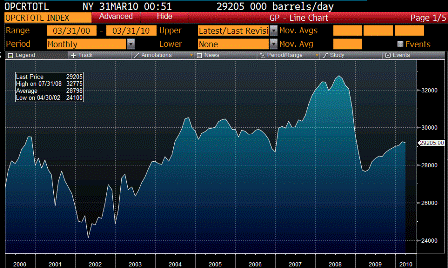
OPEC March Crude Output Down 30,000 Bbl/Day to 29.205 Mln
With supply following demand, as with any monopolistic arena, it looks like the world crude oil balance remains very much neutral leaving the Saudis in full control as swing producer where they set prices and let quantity adjust to market demand.
Stable crude prices with 0 interest rates, high excess capacity and low aggregate demand should keep inflation at bay indefinitely, with productivity increases making deflation the greater risk.

EU Daily
The institutional structure puts the Eurozone in a very awkward position.
The higher deficits desired by the economy to restore non govt net financial assets at the same cause a deterioration in the credit worthiness of the member nations running the deficits, which seems to limit the process as these to two forces collide in a counterproductive, unstable and turbulent manner.
The higher member nation deficits also are a force that moves the euro lower which can continue until exports somehow resume via the foreign sector reducing its net financial euro assets as evidenced by a pickup in net euro zone exports. That process can be drawn out and problematic as well in a world where global politics is driven by export desires from all governments.
EU Headlines:
Trichet Expects Investors to ‘Recognize’ Greek Moves
Italian Consumer Prices Rose in March on Energy Costs
Europe Inflation Jumps More Than Economists Forecast
Euro Area Needs to Substantially Improve Governance, EU Says
German Unemployment Unexpectedly Declined in March
German Machine Orders Jumped 26% in February on Foreign Demand
France’s 2009 deficit hits record high 7.5 percent of GDP
CPI/Claims
Interesting how years of 0 rate policies don’t seem to generate inflation.
Karim writes:
Data in past week (retail sales, Empire survey, claims, PPI, CPI) continues to show best of both worlds—economy improving and inflation very low.
Initial claims drop another 5k to 457k.
- CPI unch on headline basis and +0.053% on core.
- Core now 1.3% y/y and has a couple more mths of favorable base effects that should allow it to fall below 1%.
- Core inflation running 0.1% on a 3mth annualized basis!
- OER (unch) continues to hold down the series with apparel (-0.7%) the only notable outlier this month.
Saudi Oil Minister Sees No Need to Alter OPEC Production Now
The Saudis continue to set price and let quantity adjust, and output levels are ‘comfortable’ with substantial room to go higher or lower to support their target price. If they do leave it ‘in the 70-80 range’ there should be no inflation in the US and most other nations. The US has never had a serious ‘inflation problem’ that wasn’t oil driven.
Saudi’s Naimi Sees No Need to Alter OPEC Production
By Ayesha Daya and Grant Smith
March 16 (Bloomberg) — Saudi Arabia, the biggest and most influential member of the Organization of Petroleum Exporting Countries, said oil prices are in the right range and there’s no need to change production policy.
“We are extremely happy with the market, the economy is doing well, it will do better down the road, so I don’t see any reason to disturb this happy situation,” Saudi Oil Minister Ali Al-Naimi said late yesterday in Vienna, where OPEC meets tomorrow. “The price has stayed very well in the range of $70 to $80. It is in a very happy situation.”
The Eurozone Solution For Greece Is A Very “Clever Bluff”?
The Eurozone Solution For Greece Is A Very “Clever Bluff”?
The Guardian is today reporting that, after weeks of crisis, the Eurozone has agreed to what appears to be a multibillion-euro assistance package for Greece that will be finalized on Monday. Member states have apparently agreed on “coordinated bilateral contributions” in the form of loans or loan guarantees to Greece, but only if Athens finds that it is unable to refinance its soaring debt and asks for help. Other sources said the aid could total €25bn (£22.6bn) to meet funding needs estimated in European capitals that Greece could need up to €55bn by the end of this year.
Once again, however, since funding is a function of interest rates, this proposal has the appearance of a very “clever bluff”. It says nothing about how high interest rates for Greece would have to go before the Greek government is somehow declared unable to refinance, and asks for additional help. The member nations probably structured the loan package and terms this way hoping to try to draw in lenders who would rely on this member nation as a back stop when making their investment decisions. However, if this ploy fails, Greek rates will go sky high in an attempt to refinance, and as Greece asks for more help, the spike in rates will make it all the more difficult for the entire Eurozone monetary system to function. Additionally, the prerequisite austerity measures will subtract aggregate demand in Greece and the rest of the Eurozone, and, to some extent, the rest of the world as well.
I have a very different proposal. It is designed to be fair to all, and not a relief package for any one member nation. It is also designed to not add nor subtract from aggregate demand, and also provide an effective enforcement tool for any measures the Eurozone wishes to introduce.
My proposal is for the ECB to distribute 1 trillion euro annually to the national governments on a per capita basis. The per capita criteria means that it is neither a targeted bailout nor a reward for bad behavior. This distribution would immediately adjust national government debt ratios downward which eases credit fears without triggering additional national government spending. This serves to dramatically ease credit tensions and thereby foster normal functioning of the credit markets for the national government debt issues.
The 1 trillion euro distribution would not add to aggregate demand or inflation, as member nation spending and tax policy are in any case restricted by the Maastricht criteria. Furthermore, making this distribution an annual event greatly enhances enforcement of EU rules, as the penalty for non compliance can be the withholding of annual payments. This is vastly more effective than the current arrangement of fines and penalties for non compliance, which have proven themselves unenforceable as a practical matter.
There are no operational obstacles to the crediting of the accounts of the national governments by the ECB. What would likely be required is approval by the finance ministers. I see no reason why any would object, as this proposal serves to both reduce national debt levels of all member nations and at the same time tighten the control of the European Union over national government finances.