Proposal update, including the JG

My proposals remain:

1. A full FICA suspension:

The suspension of FICA paid by employees restores spending which supports output and employment.
The suspension of FICA paid by business helps keep costs down which in a competitive environment lowers prices for consumers.

2. $150 billion one time distribution by the federal govt to the states on a per capita basis to get them over the hump.

3. An $8/hr federally funded transition job for anyone willing and able to work to assist in the transition from unemployment to private sector employment.

Call me an inflation hawk if you want. But when the fiscal drag is removed with the FICA suspension and funds for the states I see risk of what will be seen as ‘unwelcome inflation’ causing Congress to put on the brakes long before unemployment gets below 5% without the $8/hr transition job in place, even with the help of the FICA suspension in lowering costs for business.

It’s my take that in an expansion the ’employed labor buffer stock’ created by the $8/hr job offer will prove a superior price anchor to the current practice of using the current unemployment based buffer stock as our price anchor.

The federal government caused this mess for allowing changing credit conditions to cause its resulting over taxation to unemploy a lot more people than the government wanted to employ. So now the corrective policy is to suspend the FICA taxes, give the states the one time assistance they need to get over the hump the federal government policy created, and provide the transition job to help get those people that federal policy is causing to be unemployed back into private sector employment in a more orderly, more ‘non inflationary’ manner.

I’ve noticed the criticism the $8/hr proposal- aka the ‘Job Guarantee’- has been getting in the blogosphere, and it continues to be the case that none of it seems logically consistent to me, as seen from an MMT perspective. It seems the critics haven’t fully grasped the ramifications of the recognition of the currency as a (simple) public monopoly as outlined in Full Employment AND Price Stability and the other mandatory readings.

So yes, we can simply restore aggregate demand with the FICA suspension and funds for the states, but if I were running things I’d include the $8 transition job to improve the odds of both higher levels of real output and lower ‘inflation pressures’.

Also, this is not to say that I don’t support the funding of public infrastructure (broadly defined) for public purpose. In fact, I see that as THE reason for government in the first place, and it should be determined and fully funded as needed. I call that the ‘right size’ government, and, in general, it’s not the place for cyclical adjustments.

4. An energy policy to help keep energy consumption down as we expand GDP, particularly with regard to crude oil products.

Here my presumption is there’s more to life than burning our way to prosperity, with ‘whoever burns the most fuel wins.’

Perhaps more important than what happens if these proposals are followed is what happens if they are not, which is more likely going to be the case.

First, given current credit conditions, world demand, and the 0 rate policy and QE, it looks to me like the current federal deficit isn’t going to be large enough to allow anything better than muddling through we’ve seen over the last few years.

Second, potential volatility is as high as it’s ever been. Europe could muddle through with the ECB doing what it takes at the last minute to prevent a collapse, or doing what it takes proactively, or it could miss a beat and let it all unravel. Oil prices could double near term if Iran cuts production faster than the Saudis can replace it, or prices could collapse in time as production comes online from Iraq, the US, and other places forcing the Saudis to cut to levels where they can’t cut any more, and lose control of prices on the downside.

In other words, the risk of disruption and the range of outcomes remains elevated.
the Fed and the dollar

Imagine being on the FOMC and in the mainstream paradigm

In 2008 you moved quickly to make sure the US would not become the next Japan

You cut rates to 0, even faster than Japan did.

You provided unlimited liquidity to the dollar money markets,
both home and abroad.

You did trillions of QE, sooner than Japan did.

You announced you expected rates to stay down for two years.

etc. etc. etc.

And what do you have to show for it, 3 years later?

GDP marginally positive, much like Japan
Inflation working its way lower to Japan-like levels, especially housing and wages.
Employment stagnant a la Japan.

And now, after 3 years of 0 rates, and trillions of QE, the dollar is going up, much like the yen did.
After the Fed has done all it could think of to reinflate, and then some.

And all just like MMT suspected.
And for what should be obvious reasons.

John Carney on MMT and Austrian Economics

Another well stated piece from John Carney on the CNBC website:

Modern Monetary Theory and Austrian Economics

By John Carney

Dec 27 (CNBC) — When I began blogging about Modern Monetary Theory, I knew I risked alienating or at least annoying some of my Austrian Economics friends. The Austrians are a combative lot, used to fighting on the fringes of economic thought for what they see as their overlooked and important insights into the workings of the economy.

Which is one of the things that makes them a lot like the MMT crowd.

There are many other things that Austrian Econ and MMT share. A recent post by Bob Wenzel at Economic Policy Journal, which is presented as a critique of my praise of some aspects of MMT, actually makes this point very well.

The MMTers believe that the modern monetary system—sovereign fiat money, unlinked to any commodity and unpegged to any other currency—that exists in the United States, Canada, Japan, the UK and Australia allows governments to operate without revenue constraints. They can never run out of money because they create the money they spend.

This is not to say that MMTers believe that governments can spend without limit. Governments can overspend in the MMT paradigm and this overspending leads to inflation. Government financial assets may be unlimited but real assets available for purchase—that is, goods and services the economy is capable of producing—are limited. The government can overspend by (a) taking too many goods and services out of the private sector, depriving the private sector of what it needs to satisfy the people, grow the economy and increase productivity or (b) increasing the supply of money in the economy so large that it drives up the prices of goods and services.

As Wenzel points out, Murray Rothbard—one of the most important Austrian Economists the United States has produced—takes exactly the same position. He says that governments take “control of the money supply” when they find that taxation doesn’t produce enough revenue to cover expenditures. In other words, fiat money is how governments escape revenue constraint.

Rothbard considers this counterfeiting, which is a moral judgment that depends on the prior conclusion that fiat money isn’t the moral equivalent of real money. Rothbard is entitled to this view—I probably even share it—but that doesn’t change the fact that in our economy today, this “counterfeiting” is the operational truth of our monetary system. We can decry it—but we might as well also try to understand what it means for us.

Rothbard worries that government control of the money supply will lead to “runaway inflation.” The MMTers tend to be more sanguine about the danger of inflation than Rothbard—although I do not believe they are entitled to this attitude. As I explained in my piece “Monetary Theory, Crony Capitalism and the Tea Party,” the MMTers tend to underestimate the influence of special interests—including government actors and central bankers themselves—on monetary policy. They have monetary policy prescriptions that would avoid runaway inflation but, it seems to me, there is little reason to expect these would ever be followed in the countries that are sovereign currency issuers. I think that on this point, many MMTers confuse analysis of the world as it is with the world as they would like it to be.

In short, the MMTers agree with Rothbard on the purpose and effect of government control of money: it means the government is no longer revenue constrained. They differ about the likelihood of runaway inflation , which is not a difference of principle but a divergence of political prediction.

This point of agreement sets both Austrians and MMTers outside of mainstream economics in precisely the same way. They appreciate that the modern monetary system is very, very different from older, commodity based monetary systems—in a way that many mainstream economists do not.

In MM, CC & TP, I briefly mentioned a few other positions on the economy MMTers tend to share. Wenzel writes that “there is nothing right about these views.”

I don’t think Wenzel actually agrees with himself here. Let’s run through these one by one.

1. The MMTers think the financial system tends toward crisis. Wenzel writes that the financial system doesn’t tend toward crisis. But a moment later he admits that the actual financial system we have does tend toward crisis. All Austrians believe this, as far as I can tell.

What has happened here is that Wenzel is now the one confusing the world as it is with the world as he wishes it would be. Perhaps under some version of the Austrian-optimum financial system—no central bank, gold coin as money, free banking or no fractional reserve banking—we wouldn’t tend toward crisis. But that is not the system we have.

The MMTers aren’t engaged with arguing about the Austrian-optimum financial system. They are engaged in describing the actual financial system we have—which tends toward crisis.

They even agree that the tendency toward crisis is largely caused by the same thing, credit expansions leading to irresponsible lending.

2. The MMTers say that “capitalist economies are not self-regulating.” Again, Wenzel dissents. But if we read “capitalist economies” as “modern economies with central banking and interventionist governments” then the point of disagreement vanishes.

Are we entitled to read “capitalist economies” in this way? I think we are. The MMTers are not, for the most part, attempting to argue with non-existent theoretical economies or describe the epic-era Icelandic political economy. They are dealing with the economy we have, which is usually called “capitalist.” Austrians can argue that this isn’t really capitalism—but this is a terminological quibble. When it comes down to the problem of self-regulation of our so-called capitalist system, the Austrians and MMTers are in agreement.

3. Next up is the MMT view (borrowed from an earlier economic school called “Functional Finance”) that fiscal policy should be judged by its economic effects. Wenzel asks if this means that this “supercedes private property that as long as something is good for the economy, it can be taxed away from the individual?”

Here is a genuine difference between the Austrians—especially those of the Rothbardian stripe—and the MMTers. The MMTers do indeed envision the government using taxes to accomplish what is good for the economy—which, for the most part, means combating inflation. They think that the government may need to use taxation to snuff out inflation at times. Alternatively, the government can also reduce its own spending to extinguish inflation.

Note that we’ve come across a gap between MMTers and Rothbardians that is far smaller than the chasm between either of them and mainstream economics, where taxation of private property and income is regularly seen as justified by the need to fund government operations. MMTers and Austrians both agree that under the current circumstances people in most developed countries are overtaxed.

4. Wenzel actually overlooks the larger gap between Austrians and MMTers, which has to do with the efficacy of government spending. Many MMTers believe that most governments in so-called capitalist economies are not spending enough. Most—if not all—Austrians think that these same government are spending too much.

The Austrian view is based on the idea that government spending tends to distort the economy, in part because—as the MMTers would agree—government spending in our age typically involves monetary expansion. The MMTers, I would argue, have a lot to learn from the Austrians on this point. I think that an MMT effort to more fully engage the Austrians on the topic of the structure of production would be well worth the effort.

5. Wenzel’s challenge to the idea of functional finance is untenable—and not particularly Austrian. He argues that the subjectivity of value means it is impossible for us to tell whether something is “good for the economy.” Humbug. We know that an economy that more fully reflects the aspirations and choices of the individuals it encompasses is better than one that does not. We know that high unemployment is worse than low unemployment. All other things being equal, a more productive economy is superior to a less productive economy, a wealthier economy is better than a more impoverished one.

Wenzel’s position amounts to nihilism. I think he is confusing the theory of subjective value with a deeper relativism. Subjectivism is merely the notion that the value of an economic good—that is, an object or a service—is not inherent to the thing but arises from within the individual’s needs and wants. This does not mean that we cannot say that some economic outcome is better or worse or that certain policy prescription are good for the economy and certain are worse.

It would be odd for any Austrian to adopt the nihilism of Wenzel. It’s pretty rare to ever encounter an Austrian who lacks normative views of the economy. These normative views depend on the view that some things are good for economy and some things are bad. I doubt that Wenzel himself really subscribes to the kind of nihilism he seems to advocate in his post.

Wenzel’s final critique of me is that I over-emphasize cronyism and underplay the deeper problems of centralized power. My reply is three-fold. First, cronyism is a more concrete political problem than centralization; tactically, it makes sense to fight cronyism. Second, cronyism is endemic to centralized government decisions, as the public choice economists have shown. They call it special interest rent-seeking, but that’s egg-head talk from cronyism. Third, I totally agree: centralization is a real problem because the “rationalization” involved necessarily downplays the kinds of unarticulated knowledge that are important to everyday life, prosperity and happiness.

At the level of theory, Austrians and MMTers have a lot in common. Tactically, an alliance makes sense. Intellectually, bringing together the descriptive view of modern monetary systems with Austrian views about the structure of production and limitations of economic planning (as well Rothbardian respect for individual property rights) should be a fruitful project.

So, as I said last time, let’s make it happen.

Bini Smaghi Says ECB Should Use QE If Deflation Risk Arises

As if QE is an inflationary bias.
They are all clueless.

MMT to the ECB:
QE addresses the solvency issue, not ‘deflation’ or aggregate demand issues.

Bini Smaghi Says ECB Should Use QE If Deflation Risk Arises

By Gabi Thesing

Dec 23 (Bloomberg) — European Central Bank Executive Board member Lorenzo Bini Smaghi said that policy makers shouldn’t shirk from using quantitative easing if deflation becomes a danger to the euro region.

“I do not understand the quasi-religious discussions about quantitative easing,” Bini Smaghi, who will leave his post at the end of the month, said in an interview published yesterday by the Financial Times. The ECB confirmed the comments. “It is appropriate if economic conditions justify it, in particular in countries facing a liquidity trap that may lead to deflation.”

Monetary Theory, Crony Capitalism and the Tea Party

Just posted on CNBC:

Monetary Theory, Crony Capitalism and the Tea Party

By John Carney

Dec 21 (CNBC) — The past few years have taught us a lot about the effects and operations of monetary policy in the United States.

The Federal government responded to the economic downturn by spending enormous amounts and Federal Reserve responded to the financial crisis with an enormous expansion of its balance sheet — what the proles call “printing money” — and both occurred without any attendant inflation or giant soaring of interest rates.

The so-called “bond vigilantes” turned out to be mythological creatures, at least as far as U.S. federal debt is concerned. Even the crisis over the debt ceiling and the downgrade of the U.S.’s credit rating only lead to lower interest rates.

The school of economics that best explains this phenomenon is called “Modern Monetary Theory” or MMT. The MMT school is made up of scholars, businessmen and online advocates who have a deep understanding of the operations of the actual operational aspects of our monetary system.

They argue, quite persuasively, that our monetary system is built in such a way that our government is never revenue constrained, which is to say it can spend as much as it likes, because the government creates our money. The real constraint on government spending is price inflation, which occurs when government and private spending outpace economic output.

I was first attracted to MMT because of the focus on monetary operations. I really enjoy figuring out the nitty-gritty details of how things like swap lines, Treasury auctions, and payment of claims on the Treasury occur. I like reading detailed papers on the daily meetings of the Treasury and the Fed estimating what Federal spending will amount to. Many of the MMT people have studied this stuff in detail.

Monetary nerds of the world unite, you have nothing to lose but the interest of your cooler friends.

For those of you interested in learning more, I suggest you start with the website Pragmatic Capitalism, which is edited by Cullen Roche. Now, Cullen isn’t a fully orthodox MMTer but he is one of its clearest exponents. It was my first doorway into MMT.

Other sites that I regularly read include Warren Mosler’s MoslerEconomics; Mike Norman Economics, which tends toward the combative, and New Economic Perspectives, which tends toward the academic side of things. There are dozens of other sites, which you’ll no doubt encounter if you follow the links to the ones I just named. I’d also recommend reading Mosler’s book, “The Seven Deadly Innocent Fraud’s of Economic Policy.”

There’s a lot more to MMT than its view of monetary operations and government funding, however. They believe the government should guarantee jobs for everyone, that the financial system tends toward crisis and corruption, that capitalist economies are not self-regulating, and that fiscal policy should be measured by its effect on the economy not on whether budgets are balanced. Some of this is fine, other parts I regard as distractions (such as the jobs guarantee).

But my biggest point of departure with the MMTers is they display a political and economic naivete when it comes to the effects of government spending. When they talk about spending it is almost always in terms of abstract aggregates, which is weird for a school of economics so focused on the specifics of monetary operations. What this means is that they miss the distortions of crony capitalism the accompanies so much government spending.

Government spending occurs through specific channels, not in aggregate abstractions. This means that certain companies and sectors of the economy benefit, and others suffer, because of government spending.

The sectors and companies that benefit are not those that bring the most or the widest prosperity but, conversely, those in which prosperity is most concentrated in the hands of a few. The spending is accompanied by regulatory privileges and barriers that also benefit the very same groups. When government spending levels and regulatory operations are high, this has a widely distortive effect on the economy that effectively impoverishes most of the population. This is basic public choice Econ 101 but the MMTers seem blind to it.

If any MMTers want to learn more about this effect of government spending and regulation, a good place to start would be two books by my brother Tim Carney. Tim covers politics for the Washington Examiner, and his columns often address these very points. But for a fuller treatment of the subject I suggest you read “The Big Ripoff: How Big Business and Big Government Steal Your Money” and”Obamanomics: How Barack Obama Is Bankrupting You and Enriching His Wall Street Friends, Corporate Lobbyists, and Union Bosses.”

Likewise, the MMTers seem not to understand the politics of inflation and why government often doesn’t prevent inflation from occurring, even though it is obviously within its power to do so. The problem with inflation was first and best described by Austrian economists, who explained that inflation does not spread evenly through the economy. It benefits some economic players and harms others because it moves through the economy sequentially.

The first recipients of inflated dollars are those closest to government, those on the receiving end of government payments. They get to pay non-inflated prices for the goods and services they consume because other economic actors have not yet realized that inflation is taking place. Those closest to the primary recipients are also advantaged against those further away. The real losers are private citizens whose economic activities are furthest removed from the crony capitalist and financiers who primarily benefit from inflation. This is, again, a case where those receiving concentrated benefits will almost always beat out those suffering dispersed costs. Public choice 101 again.

Because they do not at least publicly address the crony capitalist distortions of government spending and inflation, the MMTers are at a loss when dealing with Tea Party objections to government spending.

Much of the Tea Party’s objection to spending and deficits is not to counter-cyclical stimulus spending or broad-based entitlements. (I doubt very many of them want to reform Social Security, for instance.) It’s to the fact that the government picks winners and losers when it spends, especially when it engages in stimulus, that is, discretionary, spending.

This objection to cronyism is at the very heart of the Tea Party movement. It is controlling the Republican primaries right now. It is why the bailouts irked so many. It is, in fact, a deep part of the Occupy Wall Street movement.

It’s also why the public isn’t really that interested in the things that bother the policy wonks so much. Things like the cost of Social Security or medical care. People don’t mind these so much because they are less prone to cronyism and distort the economy less. This kind of spending is more neutral than discretionary spending. So it doesn’t bother the Tea Partiers or the Occupiers.

And guess what? This aligns the Tea Party with MMT. You guys also don’t think Social Security is in danger of going bankrupt. You know the government won’t run out of money, that Social Security checks will never bounce. The wonks have it wrong; the proles have it right.

Even your Jobs Guarantee might be sellable on the grounds that it is government spending without cronyism.

So my recommendation to the MMTers is that they stop talking about spending in the abstract. Start talking about spending that leads to crony capitalism and spending that does not. Get on the side of the anti-crony, Tea Party brigades. There’s a natural friendship to be made.

Let’s make it happen.

Japan To Buy Chinese Govt Bonds Under Bilateral Pact

This is peculiar.
This supports the yuan vs the yen,
supporting Japan’s exports to China.

Could be more evidence of China’s inflation concern?

Japan To Buy Chinese Govt Bonds Under Bilateral Pact

TOKYO (Nikkei) — Japan will likely purchase yuan-denominated bonds issued by the Chinese government under a proposed bilateral currency and financial agreement, The Nikkei learned Monday.

Japanese and Chinese officials are working out plans to have the pact signed when their leaders meet for a summit this coming Sunday. The agreement will be pillared on the purchase of Chinese government bonds using Japan’s foreign exchange fund special account, along with the joint establishment of a green investment fund.

Japan seeks to diversify its forex fund special account, which now focuses on dollar investments. It also aims to strengthen economic cooperation with China by supporting that nation’s efforts to turn the yuan into a more international currency.

The bond purchases may total up to 10 billion dollars’ worth, or roughly 780 billion yen, with buying carried out in stages through the special account.

The Chinese government counts Japanese government bonds among its foreign-currency reserves. Through cross-holding of bonds, Japan and China will be better poised to exchange information on financial developments in the bond market and elsewhere.

The Japanese government also plans to aid Chinese efforts to nurture an offshore market for yuan-denominated transactions.

The proposed joint fund for environmental investment would feature the participation of the Japan Bank for International Cooperation and private-sector companies from the Japanese side. Details of the fund’s size and investment percentages are to be fleshed out in the near future.

Thailand and Nigeria are among the countries that hold yuan-denominated government bonds through their central banks. Tokyo and Beijing believe that having a developed nation like Japan maintain a certain amount of yuan-denominated holdings may help lift the Chinese currency’s standing on the international stage.

China’s government bond offerings totaled 1.4 trillion yuan in 2009, up 55% on the year.

Such issuances have recently increased in Hong Kong. Overseas investors can acquire government bonds issued on the mainland, but regulations — including a ceiling on purchase amounts — remain strict. top

China Bond Purchases Could Help Ties: Finance Minister

Japan To Buy Chinese Govt Bonds Under Bilateral Pact

TOKYO (NQN) — Finance Minister Jun Azumi on Tuesday confirmed a report that Japan is considering buying Chinese government bonds, arguing that such purchases will offer the two countries significant advantages while strengthening bilateral economic ties.

At a news conference after a Cabinet meeting, Azumi said Japan should hold yuan-denominated bonds as a means of strengthening diplomatic relations.

Azumi said no official decisions have been made on the matter, and that Tokyo will discuss the issue at a future Japan-China summit. He also suggested that the two nations may be able to strike an agreement when Prime Minister Yoshihiko Noda visits China.

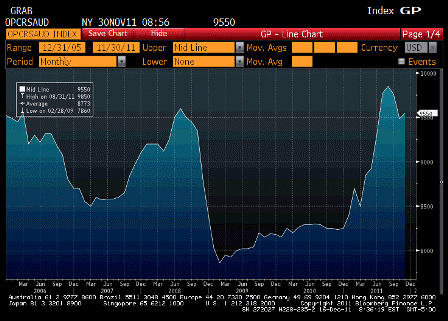
Saudi production

The Saudis are the only producer with excess capacity, which puts them in the position of swing producer.

They post prices and then let their refiners buy as much as they want at their posted prices.

They have no choice but to be price setter, but they also don’t want anyone to know they are simply setting prices, so they talk around it and have obviously done a good pr job in that regard.

So after production spiked due to lost Libyan output, production now seems be falling back to prior levels as Libya comes back online.

There are other things affecting supply and demand as well, also altering Saudi production accordingly.

The Saudis lose control of price on the upside only when they don’t have sufficient productive capacity to meet demand. And they lose control on the downside when they can’t cut sufficiently to address a fall in net demand.

Looks to me like they will remain in that catbird seat for quite a while.

And if they keep prices relatively stable there will not likely be a 70’s style global inflation problem.

oil

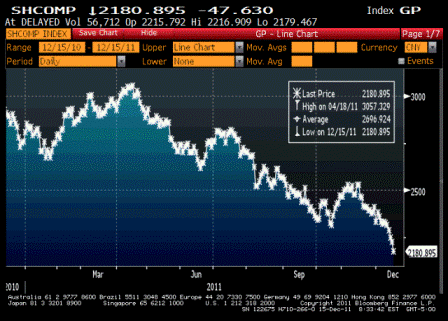
Chart of Shanghai Composite Equity Index – China

Best I can tell the jury is still out as to whether China is going through
the ‘hard landing’ scenario that began when modest first half state lending was
followed by lower second half state lending, all to control inflation.

Note the recent social unrest that could be inflation linked.
All we know is the regime change risk was sufficient for them to cut back on growth.
And so far not much sign of anything of consequence in the pro growth direction,
which means the political concerns over inflation are still there.

The currency could also be heading south fundamentally due to inflation.
Net fx reserves may be down to minimum levels
after factoring in their dollar debt that has been indirectly supporting the yuan.
And with foreign direct investment tapering off,
that source of currency support seems to have subsided.

While slower growth in China hurts some US companies,
lower resource costs for the US are consumer friendly.

If gold has lost enough of it’s bid from central bankers,
it could be headed back to it’s marginal cost of production, 1980’s style,
which is where it goes without global central bank accumulation.
I recall the buyers earlier this year included the Greek and Mexican central banks,
as well as the central bank of Bangladesh.
I suppose with high unemployment,
govt figures it might as well put people to work in the gold mines? Whatever!
Anyway, the final leg up for this cycle may have been the spike after Chavez
opted to take delivery of his gold, which he now has,
debunking the speculation that it wasn’t there to be delivered.

Next is whether Congress lets the FICA cuts expire and take maybe 1% off of Q1 GDP.
The President just said he wouldn’t veto the Republican plan, so they may work something out.
But with their bent on ‘paying for it’ no telling what the final result will be.

China headlines:

China’s Manufacturing May Contract a Second Month
Foreign Direct Investment in China Falls as Factories Slow
China Money Rate Rises Most in 2 Weeks
Yuan Forwards Fall for an Eighth Day as Manufacturing May Shrink
Chinese Cut Back on London Luxury Homes as Stock Losses Bite
China Money Supply Growth Slows to Weakest Pace in Decade
China Affirms Property Curbs Amid ‘Grim’ Outlook
China’s Stocks Fall to Lowest in 33 Months on Economic Concerns

ch equity

Why the EU won’t fix anything this weekend

Yes, the Germans are concerned that ECB bond buying and direct funding might be inflationary,
but there is something even more fundamental supporting their to objection to ECB support.

The problem is,
the EU leaders believe the high rates, failed auctions, and related funding and liquidity issues
are caused by the national government budget deficits being too high.

And therefore the fundamental solution is deficit reduction.
That is, only by reducing deficits,
will the ability to independently fund return to where it was before the 2008 financial crisis hit.

So while they recognize that ECB funding can keep them muddling through,
though with some perceived inflation risk,
they firmly believe it is deficit reduction that will allow them to return to pre 2008 funding dynamics,
where each member nation could independently fund itself in the market place at reasonable rates.

Unfortunately, that’s a bit like saying that by adjusting his financial ratios,
Bernie Madoff’s fund could return to pre crisis business as usual.

And just like Bernie could only be back in business if somehow he got
the Fed to guarantee his investors against loss,
the way I see it (but, unfortunately, not the way they see it),
the euro member nations now require ECB backing, directly or indirectly,
to be back in business.

As previously discussed, spending and deficits for currency issuers like the US, Japan, UK,
and the euro members when they had their own currencies are not constrained by income or
market forces. Observed debt to GDP levels for currency issuers can be anywhere from
50% to maybe 200%, as they serve to provide the net financial assets demanded by the
various institutional structures of those nations. And regardless of debt ratios, interest rates
are necessarily set by the Central Banks, and not market forces.

Spending and deficits for currency users, including the US states, businesses, households, and the euro member nations since
adopting the euro, are, however, necessarily constrained by income and market forces.
That’s why observed deficits for currency users are far lower than currency issuers.
California, for example, has seen its financing difficulties even though it’s debt to GDP ratio is under 5%.

Luxembourg’s debt to GDP ratio of about 15% when it adopted the euro was by far the lowest of the euro member nations.
And that’s because Luxembourg never did have it’s own currency. It was always a currency user,
and so market forces never let it’s debt get any higher than that. And even with the current financial crisis
Luxembourg’s debt is only about 20% of GDP.

So what happened about 13 lucky years ago is that the currency issuers of mainland Europe decided to turn themselves into currency users.
And at the same time, now as currency users rather than currency issuers,
simply waltz into the euro zone with their suddenly/absurdly too high existing debt ratios they incurred as currency issuers.

The ‘right’ way to do it back then would have been to have the ECB guarantee their debt from the inception of the euro,
and use the Growth and Stability Pact to avoid moral hazard issues and enforce compliance.
But that would not have worked politically.
The only way they would all come together is the way they did all come together.
The priority was union first, and work out subsequent problems as needed.

So now they have two problems-
a solvency problem where they can’t fund themselves without ECB support,
and a bad economy, now further deteriorating as evidenced by negative growth and rising unemployment.

And while the Germans aren’t entirely wrong in their belief that lower deficits would restore funding capacity,
I don’t think they recognize that as currency users debt to GDP ratios may need to be under 30% to get to that point.

Nor do they recognize that given current private sector credit conditions, deficits and debt ratios need to be higher
to offset the demand leakages (unspent income) inherent in their institutional structures. These include pension contributions,
insurance reserves, corporate reserves, individual retirement plans, and the demand for actual cash in circulation.
This means that what they call austerity- pro active tax increases and spending cuts- will slow the economy and therefore cause
tax revenue to fall and transfer payments to rise to the point where deficits increase rather than decrease.
The only remaining hope for growth is exports, but with all the world doing much the same that channel is not currently open.

So back to the present.

(And yes, without the 2008 financial crisis all of this may not yet have happened.
But it all did happen, and here we are.)

The firm belief is that deficit reduction is what is needed to return to independent funding.
And while funding by the ECB can allow things to muddle through, and hopefully not prove inflationary,
there is no exit from ECB funding and the inherent inflation risk it carries apart from deficit reduction.

Therefore I expect the upcoming discussions to focus entirely around deficit reduction, with little if any discussion of funding.
And, as is currently the case, funding assistance will only come conditionally with accelerated austerity.

That is, all options on the table will only cause a bad economy to get worse.
And all options on the table will tend to drive deficits higher,
which both makes matters worse, and,
as recent history has shown,
triggers demands for more austerity.

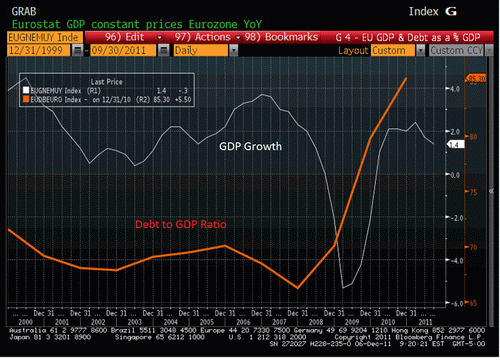
The chart, below, shows how the financial crisis of 2008 caused what seemed to be working just fine on the way up
to come apart when private sector credit expansion faltered, and the economy took a dive, driving up national government
debt to GDP ratios, and causing it all to go bad in typical ponzi fashion.

eu debt gdp