My story of the Thatcher era

Here’s how I remember it all.
I didn’t look anything up, with the idea that memories matter.

The ‘golden age’ from WWII was said to have ended around 1973. Inflation and employment was remembered as relatively low, productivity high, the American middle class thriving.

Why? Keynes was sort of followed. The Kennedy tax cuts come to mind. But also of consequence and ignored was the fact that the US had excess crude production capacity, with the Texas Railroad Commission setting quotas, etc. to support prices at maybe the $2.50-$3.00 price range. And stable crude prices, though maybe a bit higher than they ‘needed’ to be, meant reasonable price stability, as much was priced on a cost plus basis, and the price of oil was a cost of most everything, directly or indirectly.

But in the early 1970’s demand for crude exceeded the US’s capacity to produce it, and Saudi Arabia became the swing producer, replacing the Texas Railroad commission as price setter. And, of course, price stability wasn’t their prime objective, as they hiked price first to about $10 by maybe 1975, which caused a near panic globally, then after a too brief pause they hiked to $20, and finally $40 by maybe 1980.

With oil part of the cost structure, the consumer price index, aka ‘inflation’, soared to double digits by the late 70’s. Headline Keynesian proposals were largely the likes of price and wage controls, which Nixon actually tried for a while. But it turned out the voters preferred inflation to their government telling them what they could earn (wage controls on organized labor and others) and what they could charge. Arthur Burns had the Fed funds rate up to maybe 6%. Miller took over and quickly fell out of favor, followed by tall Paul in maybe 1979 who put on what might be the largest display of gross ignorance of monetary operations with his borrowed reserve targeting policy. However, a year or so after the price of oil broke as did inflation giving tall Paul the spin of being the man who courageously broke inflation. Overlooked was that Jimmy Carter had allowed the deregulation of natural gas in 1978, triggering a massive increase in supply, with our electric utilities shifting from oil to nat gas, and OPEC desperately cutting production by maybe 15 million barrels/day in what turned out to be an unsuccessful effort to hold price above $30, as the supply shock was too large for them and they drowned in the flood of no longer needed oil, with prices falling to maybe the $10 range where they stayed for almost 20 years, until climbing demand again put the Saudis in the catbird seat. Meanwhile, Greenspan got credit for that goldilocks period that again was the product of stable oil prices, not the Fed (at least in my story.)

So back to the 70’s, and continuous oil price hikes by a foreign monopolist. All nations experienced pretty much the same inflation. And it all ended at about the same time as well when the price of crude fell. The ‘heroes’ were coincidental. In fact, my take is they actually made it worse than it needed to be, but it did ‘get better’ and they of course were in the right place at the right time to get credit for that.

So back to the 70’s. With the price of oil being hiked by a foreign monopolist, I see two choices. The first is to try to let there be a relative value shift (as the Fed tries to do today) and not let those price hikes spill into the rest of the price level, which means wages, for the most part. This is another name for a decline in real terms of trade. It would have meant the Saudis would get more real goods and services for the oil. The other choice is to let all other price adjust upward to keep relative value the same, and try to keep real terms of trade from deteriorating. Interestingly, I never heard this argument then and I still don’t hear it now. But that’s how it is none the less. And, ultimately, the answer fell somewhere in between. Some price adjustment and some real terms of trade deterioration. But it all got very ugly along the way.

It was decided the inflation was caused by unions trying to keep up or stay ahead of things for their members, for example. It was forgotten that the power of unions was a derivative of price power of their companies, and as companies lost pricing power to foreign competition, unions lost bargaining power just as fast. And somehow a recession and high unemployment/lost output was the medicine needed for a foreign monopolist to stop hiking prices??? And there was Ford’s ‘whip inflation now’ buttons for his inflation fighting proposal, and Carter with his hostage thing adding to the feeling of vulnerability. And the nat gas dereg of 1978, the thing that actually did break the inflation two years later, hardly got a notice, before or after, and to this day.

As today, the problem back then was no one of political consequence understood the monetary system, including the mainstream Keynesians who had been the intellectual leadership for a long time. The monetarists came into vogue for real only after the failure of the Keynesians, who never did recover, and to this day I’ve heard those still alive push for price and wage controls, fixed exchange rates, etc. etc. in the name of price stability.

So in this context the rise of Thatcher types, including Reagan, makes perfect sense. And even today, those critical of Thatcher type policies have yet to propose any kind of comprehensive proposals that make any sense to me. They now all agree we have a long term deficit problem, and so put forth proposals accordingly, etc. as they are all destroying our civilization with their abject ignorance of the monetary system. Or, for some unknown reason, they are just plain subversive.

Thatcher?
It was the blind leading the blind then and it’s the same now.
And that’s how I remember it/her.
And i care a whole lot more about what happens next than about what happened then.

:(

Draghi Considers Plan B

Yet more proposals that won’t work.

The problem remains:
Deficits are too small while they all think they are too large.

Draghi Considers Plan B as Sentiment Dims After Cyprus Fumble

By Jeff Black and Jana Randow and Stefan Riecher

April 4 (Bloomberg) — European Central Bank President Mario Draghi is under pressure to reveal Plan B.

A botched attempt to rescue Cyprus last month sent bank shares tumbling across the euro area and rattled confidence in policy makers’ ability to tame the sovereign debt crisis. With doubts growing about Draghi’s forecast for a second-half economic recovery, he’s considering his options.

They range from an interest-rate cut to a new round of long-term loans to banks, to a plan to encourage lending to companies, three officials with knowledge of the deliberations said. They stressed that such action may not be announced today.

“They have to start thinking about a plan for unconventional measures if the recovery does not materialize,” said Martin van Vliet, senior euro-area economist at ING Bank NV in Amsterdam. “It may be too early for them to do that this month, but I’d expect Draghi to acknowledge that the economy is not improving and the chances of a surprise are bigger than they were.”

With Europe entering a second year of recession and fragmented financial markets preventing the ECB’s record-low borrowing costs from reaching the countries that need them most, Draghi may prefer to use so-called non-standard measures. He is particularly concerned about a lack of credit being extended to small and medium-sized companies in countries such as Italy and Spain, two of the officials said on condition of anonymity.

Rates on Hold

The Frankfurt-based ECB will leave its benchmark rate at a record low of 0.75 percent today, according to 54 of 56 economists in a Bloomberg News survey. Two predict a cut. The decision is due at 1:45 p.m. and Draghi holds a press conference 45 minutes later.

The Bank of England will hold its key rate at a record low of 0.5 percent and maintain bond purchases at 375 billion pounds ($568 billion), separate surveys of economists show. That decision is due at noon in London.

The Bank of Japan (8301) decided today to increase monthly bond purchases to 7 trillion yen ($74 billion) in a bid to reach 2 percent inflation in two years. At the first meeting led by Governor Haruhiko Kuroda, it also temporarily suspended a cap on some bond holdings and dropped a limit on the maturities of debt it buys.

Economists from ABN Amro Bank NV to Nordea Bank AB say Draghi needs to give reassurance he still has policy options at his disposal as evidence mounts that the recovery is faltering.

The ECB’s measure of bank lending to the private sector fell for a 10th month in February, dropping 0.9 percent from a year earlier, and manufacturing activity, measured by a survey of purchasing managers, contracted more than economists forecast in March.

Case for Action

“If you look at the world around you, with the economy weak, inflation falling to low levels, the disparities between countries and the credit mechanism not getting any better, you can’t conclude that no further action from the ECB is necessary,” said Nick Kounis, head of macro research at ABN Amro in Amsterdam. “The case for further action from the ECB remains very strong.”

Still, ECB officials haven’t provided clear guidance on what that further action might be. A rate reduction has been discussed since December, with Draghi saying last month that the “prevailing consensus” was against such a move.

That may be because lower ECB interest rates aren’t being fully passed on to the parts of the euro economy that really need them. A cut would also raise the issue of whether to take the deposit rate — the rate the ECB pays banks to park cash with it overnight — below zero.
Rates ‘Disconnect’

The ECB may be more concerned with what Executive Board member Benoit Coeure on March 12 called the “disconnect” between official lending rates and those that businesses are actually charged.

More than four times as many small businesses in Spain were rejected for loans in the second half of last year than in Germany, or walked away from an offer because it was too expensive, research published by Barclays Plc shows.

While the ECB is studying ways to ease that fragmentation, such as the Bank of England’s Funding for Lending Scheme, Draghi said at last month’s press conference on March 7 that it isn’t “planning anything special.”

‘Expectations’

An asset-purchase plan targeted at small- and medium-sized business lending is far from straightforward, said Jan von Gerich, chief fixed-income analyst at Nordea Bank in Helsinki.

“There are a lot of expectations but they’re quite limited in what they can do,” he said. “It’s most likely for them to ease collateral requirements and make it easier to package SME loans. But it gets messy quickly and hawkish members are probably not comfortable with it.”

With excess liquidity in the banking sector halving in the past six months, lenders in some parts of the region might be in need of more central-bank funds. Longer-term refinancing operations, or LTROs, have been the ECB’s signature tool to ease tensions in financial markets and encourage lending, and policy makers may resort to this option again if they can’t find consensus on more complex measures, economists said.

Draghi is also likely to be questioned today on the ECB’s role in Cyprus’s bailout. The ECB was party to and welcomed an initial plan to tax all deposits in Cypriot banks, which the nation’s parliament rejected.

While a revised agreement ditching a tax on deposits under 100,000 euros ($128,580) was negotiated over a week later under threat of the ECB cutting emergency funding to Cypriot banks, capital controls have been introduced for the first time in the euro region to prevent capital flight.

Confidence Damaged

The episode damaged investor confidence across the currency bloc. The Stoxx Europe 600 Banks Index (SX7P) dropped 6.8 percent between March 15 and 27, the day before banks reopened in Cyprus.

The cost of insuring against default on European bank bonds surged 41 percent in that period, with the Markit iTraxx Europe Senior Financial Index of credit-default swaps on 25 lenders jumping 58 points to 201.

Allowing a flawed plan to go to the Cypriot parliament exacerbated the financial reaction to the bailout and harmed trust in Europe’s crisis-fighting abilities, said Ken Wattret, chief euro-area economist at BNP Paribas in London, who predicts a rate cut today.

“The error originated in Cyprus, but the error from finance ministers and the ECB was to support it,” he said. “We saw an increase in stress in financial markets and a drop in economic sentiment. What we’re missing is a policy response.”

Bank of Japan aggressively pretends to ease

After two decades of this, how can anyone believe it makes any difference???

Bank of Japan Unveils Aggressive Monetary Policy

By Dhara Ranasinghe

April 4 (CNBC) — The Bank of Japan (BOJ) on Thursday embarked on an aggressive monetary policy to end years of deflation in the world’s third largest economy, moving its target when setting policy to base money from the current overnight call rate.

The central bank concluded a two-day policy meeting, the first under new Governor Haruhiko Kuroda, with a statement that it would pursue quantitative easing as long as it needed to achieve its 2 percent inflation target.

The BOJ said it would double its holdings of long-term government bonds and exchange-traded funds and purchase Japanese government bonds (JGBs) off all maturities.

It also plans to bring forward the timing of open-ended asset purchases and said it was likely to buy 7 trillion yen in long-term JGBs a month.

Markets welcomed the BOJ’s moves, with the benchmark Nikkei stock index reversing its losses to nudge into positive territory. The yen weakened to about 94.22 per dollar, having traded around 93.50 just before the decision.

Japanese shares have surged since mid-November and the Nikkei on Wednesday enjoyed its biggest one-day rise in two months on expectations for aggressive monetary easing.

Those expectations have also knocked the yen down about 16 percent against the dollar since mid-November, although the currency had risen in recent days on some caution as to whether Kuroda would be able to build a consensus among the nine members of the BOJ policy board for an unorthodox monetary policy.

Significantly then, the BOJ said its decisions were made unanimously.

Tough Task

Japan has suffered from persistent deflation and has slipped in and out of recession in recent years.

Prime Minister Shinzo Abe, whose ruling Liberal Democratic Party returned to power following elections in December, has pledged to revive the Japanese economy and pushing for a much bolder monetary policy than the BOJ has pursued in the past is part of his plan.

Kuroda has pledged to do whatever it takes to achieve the 2 percent inflation target, adopted by the central bank in January, within two years.

There is some skepticism among economists as to whether the target can be achieved. Jesper Koll, head of Japanese equity research at JPMorgan Securities, believes it can be.

“You’ve got credit growth, you’ve got demand for credit and you will find that within 15 to 18 months, consumer price inflation in Japan will be well in excess of 1 percent,” he said.

Latest data shows that Japan’s core consumer prices fell 0.3 percent in February from a year earlier.

Kuroda will hold a news conference later in the day. The BOJ meets again on April 26.

The Stockman’s big swinging whip

The Man from Snowy River

By Banjo Paterson

So Clancy rode to wheel them — he was racing on the wing
Where the best and boldest riders take their place,
And he raced his stock-horse past them, and he made the ranges ring
With the stockwhip, as he met them face to face.
Then they halted for a moment, while he swung the dreaded lash,
But they saw their well-loved mountain full in view,
And they charged beneath the stockwhip with a sharp and sudden dash,
And off into the mountain scrub they flew.

Unemployment is everywhere and always a monetary phenomenon, and necessarily a government imposed crime against humanity. The currency is a simple public monopoly.

The dollars to pay taxes, ultimately come from government spending or lending (or counterfeiting…)

Unemployment can only happen when a govt fails to spend enough to cover the tax liabilities it imposed, and any residual desire to save financial assets that are created by the tax and by other govt policy.

Said another way, for any given size government, unemployment is the evidence of over taxation.

Motivation not withstanding, David Stockman has long been aggressively promoting policy that creates and sustains unemployment.

Comments below:

State-Wrecked: The Corruption of Capitalism in America

By David Stockman

March 30 (NYT) — The Dow Jones and Standard & Poors 500 indexes reached record highs on Thursday, having completely erased the losses since the stock markets last peak, in 2007. But instead of cheering, we should be very afraid.

Over the last 13 years, the stock market has twice crashed and touched off a recession: American households lost $5 trillion in the 2000 dot-com bust and more than $7 trillion in the 2007 housing crash. Sooner or later within a few years, I predict this latest Wall Street bubble, inflated by an egregious flood of phony money from the Federal Reserve rather than real economic gains, will explode, too.

Phony money? What else are $US other than credit balances at the Fed or actual cash in circulation? Of course he fails to realize US treasury securities, also known as ‘securities accounts’ by Fed insiders, are likewise nothing more than dollar balances at the Fed, and that QE merely shifts dollar balances at the Fed from securities accounts to reserve accounts. It’s ‘money printing’ only under a narrow enough definition of ‘money’ to not include treasury securities as ‘money’. Additionally, of course, QE removes interest income from the economy, but that’s another story…

Since the S.&P. 500 first reached its current level, in March 2000, the mad money printers at the Federal Reserve have expanded their balance sheet sixfold (to $3.2 trillion from $500 billion).

And also debited/reduced/removed an equal amount of $US from Fed securities accounts. The net ‘dollar printing’ is 0.

Yet during that stretch, economic output has grown by an average of 1.7 percent a year (the slowest since the Civil War); real business investment has crawled forward at only 0.8 percent per year; and the payroll job count has crept up at a negligible 0.1 percent annually. Real median family income growth has dropped 8 percent, and the number of full-time middle class jobs, 6 percent. The real net worth of the bottom 90 percent has dropped by one-fourth. The number of food stamp and disability aid recipients has more than doubled, to 59 million, about one in five Americans.

Yes, and anyone who understood monetary operations knows exactly why QE did not add to sales/output/employment, as explained above.

So the Main Street economy is failing while Washington is piling a soaring debt burden on our descendants,

‘Paying off the debt’ is simply a matter of debiting securities accounts at the Fed and crediting reserve accounts at the Fed. There are no grandchildren or taxpayers involved, except maybe a few to program the computers and polish the floors and do the accounting, etc.

unable to rein in either the warfare state or the welfare state or raise the taxes needed to pay the nations bills.

The nations bills are paid via the Fed crediting member bank accounts on its books. Today’s excess capacity and unemployment means that for the size govt we have we are grossly over taxed, not under taxed.

By default, the Fed has resorted to a radical, uncharted spree of money printing.

As above, ‘money printing’ only under a narrow definition of ‘money’.

But the flood of liquidity, instead of spurring banks to lend and corporations to spend, has stayed trapped in the canyons of Wall Street, where it is inflating yet another unsustainable bubble.

With floating exchange rates, bank liquidity, for all practical purposes, is always unlimited. Banks are constrained by capital and asset regulation, not liquidity.

When it bursts, there will be no new round of bailouts like the ones the banks got in 2008.

There is nothing to ‘burst’ as for all practical purposes liquidity is never a constraint.

Instead, America will descend into an era of zero-sum austerity and virulent political conflict, extinguishing even todays feeble remnants of economic growth.

This dyspeptic prospect results from the fact that we are now state-wrecked. With only brief interruptions, weve had eight decades of increasingly frenetic fiscal and monetary policy activism intended to counter the cyclical bumps and grinds of the free market and its purported tendency to underproduce jobs and economic output. The toll has been heavy.

The currency itself is a simply public monopoly, and the restriction of supply by a monopolist as previously described, is, in this case the cause of unemployment and excess capacity in general.

As the federal government and its central-bank sidekick, the Fed, have groped for one goal after another smoothing out the business cycle, minimizing inflation and unemployment at the same time, rolling out a giant social insurance blanket, promoting homeownership, subsidizing medical care, propping up old industries (agriculture, automobiles) and fostering new ones (clean energy, biotechnology) and, above all, bailing out Wall Street they have now succumbed to overload, overreach and outside capture by powerful interests.

He may have something there!

The modern Keynesian state is broke,

Not applicable. Congress spends simply by having its agent, the tsy, instruct the Fed to credit a member bank’s reserve account.

paralyzed and mired in empty ritual incantations about stimulating demand, even as it fosters a mutant crony capitalism that periodically lavishes the top 1 percent with speculative windfalls.

Some truth there as well!

The culprits are bipartisan, though youd never guess that from the blather that passes for political discourse these days. The state-wreck originated in 1933, when Franklin D. Roosevelt opted for fiat money (currency not fundamentally backed by gold), economic nationalism and capitalist cartels in agriculture and industry.

Under the exigencies of World War II (which did far more to end the Depression than the New Deal did), the state got hugely bloated, but remarkably, the bloat was put into brief remission during a midcentury golden era of sound money and fiscal rectitude with Dwight D. Eisenhower in the White House and William McChesney Martin Jr. at the Fed.

Actually it was the Texas railroad commission pretty much fixing the price of oil at about $3 that did the trick, until the early 1970’s when domestic capacity fell short, and pricing power shifted to the saudis who had other ideas about ‘public purpose’ as they jacked the price up to $40 by 1980.

Then came Lyndon B. Johnsons guns and butter excesses, which were intensified over one perfidious weekend at Camp David, Md., in 1971, when Richard M. Nixon essentially defaulted on the nations debt obligations by finally ending the convertibility of gold to the dollar. That one act arguably a sin graver than Watergate meant the end of national financial discipline and the start of a four-decade spree during which we have lived high on the hog, running a cumulative $8 trillion current-account deficit. In effect, America underwent an internal leveraged buyout, raising our ratio of total debt (public and private) to economic output to about 3.6 from its historic level of about 1.6. Hence the $30 trillion in excess debt (more than half the total debt, $56 trillion) that hangs over the American economy today.

It also happens to equal the ‘savings’ of financial assets of the global economy, with the approximately $16 trillion of treasury securities- $US in ‘savings accounts’ at the Fed- constituting the net savings of $US financial assets of the global economy. And the current low levels of output and high unemployment tell us the ‘debt’ is far below our actual desire to save these financial assets. In other words, for the size government we have, we are grossly over taxed. The deficit needs to be larger, not smaller. We need to either increase spending and/or cut taxes, depending on one’s politics.

This explosion of borrowing was the stepchild of the floating-money contraption deposited in the Nixon White House by Milton Friedman, the supposed hero of free-market economics who in fact sowed the seed for a never-ending expansion of the money supply.

And the never ending expansion of $US global savings desires, including trillions of accumulations in pension funds, IRA’s, etc. Where there are tax advantages to save, as well as trillions in corporate reserves, foreign central bank reserves, etc. etc.

As everyone at the CBO knows, the US govt deficit = global $US net savings of financial assets, to the penny.

The Fed, which celebrates its centenary this year, fueled a roaring inflation in goods and commodities during the 1970s that was brought under control only by the iron resolve of Paul A. Volcker, its chairman from 1979 to 1987.

It was the Saudis hiking price, not the Fed. Note that similar ‘inflation’ hit every nation in the world, regardless of ‘monetary policy’. And it ended a few years after president Carter deregulated natural gas in 1978, which resulted in electric utilities switching out of oil to natural gas, and even OPEC’s cutting of 15 million barrels per day of production failing to stop the collapse of oil prices.

Under his successor, the lapsed hero Alan Greenspan, the Fed dropped Friedmans penurious rules for monetary expansion, keeping interest rates too low for too long and flooding Wall Street with freshly minted cash. What became known as the Greenspan put the implicit assumption that the Fed would step in if asset prices dropped, as they did after the 1987 stock-market crash was reinforced by the Feds unforgivable 1998 bailout of the hedge fund Long-Term Capital Management.

The Fed didn’t bail out LTCM. They hosted a meeting of creditors who took over the positions at prices that generated 25% types of annual returns for themselves.

That Mr. Greenspans loose monetary policies didnt set off inflation was only because domestic prices for goods and labor were crushed by the huge flow of imports from the factories of Asia.

No, because oil prices didn’t go up due to the glut from the deregulation of natural gas .

By offshoring Americas tradable-goods sector, the Fed kept the Consumer Price Index contained, but also permitted the excess liquidity to foster a roaring inflation in financial assets. Mr. Greenspans pandering incited the greatest equity boom in history, with the stock market rising fivefold between the 1987 crash and the 2000 dot-com bust.

No, it wasn’t about Greenspan, it was about the private sector and banking necessarily being pro cyclical. And the severity of the bust was a consequence of the Clinton budget surpluses ‘draining’ net financial assets from the economy, thereby removing the equity that supports the macro credit structure.

Soon Americans stopped saving and consumed everything they earned and all they could borrow. The Asians, burned by their own 1997 financial crisis, were happy to oblige us. They China and Japan above all accumulated huge dollar reserves, transforming their central banks into a string of monetary roach motels where sovereign debt goes in but never comes out. Weve been living on borrowed time and spending Asians borrowed dimes.

Yes, the trade deficit is a benefit that allows us to consume more than we produce for as long as the rest of the world continues to desire to net export to us.

This dynamic reinforced the Reaganite shibboleth that deficits dont matter and the fact that nearly $5 trillion of the nations $12 trillion in publicly held debt is actually sequestered in the vaults of central banks. The destruction of fiscal rectitude under Ronald Reagan one reason I resigned as his budget chief in 1985

I wonder if he’ll ever discover how wrong he’s been, and for a very long time.

was the greatest of his many dramatic acts. It created a template for the Republicans utter abandonment of the balanced-budget policies of Calvin Coolidge and allowed George W. Bush to dive into the deep end, bankrupting the nation

Hadn’t heard about an US bankruptcy filing? Am I missing something?

through two misbegotten and unfinanced wars, a giant expansion of Medicare and a tax-cutting spree for the wealthy that turned K Street lobbyists into the de facto office of national tax policy. In effect, the G.O.P. embraced Keynesianism for the wealthy.

He’s almost convinced me deep down he’s a populist…

The explosion of the housing market, abetted by phony credit ratings, securitization shenanigans and willful malpractice by mortgage lenders, originators and brokers, has been well documented. Less known is the balance-sheet explosion among the top 10 Wall Street banks during the eight years ending in 2008. Though their tiny sliver of equity capital hardly grew, their dependence on unstable hot money soared as the regulatory harness the Glass-Steagall Act had wisely imposed during the Depression was totally dismantled.

Can’t argue with that!

Within weeks of the Lehman Brothers bankruptcy in September 2008, Washington, with Wall Streets gun to its head, propped up the remnants of this financial mess in a panic-stricken melee of bailouts and money-printing that is the single most shameful chapter in American financial history.

The shameful part was not making a fiscal adjustment when it all started falling apart. I was calling for a full ‘payroll tax holiday’ back then, for example.

There was never a remote threat of a Great Depression 2.0 or of a financial nuclear winter, contrary to the dire warnings of Ben S. Bernanke, the Fed chairman since 2006. The Great Fear manifested by the stock market plunge when the House voted down the TARP bailout before caving and passing it was purely another Wall Street concoction. Had President Bush and his Goldman Sachs adviser (a k a Treasury Secretary) Henry M. Paulson Jr. stood firm, the crisis would have burned out on its own and meted out to speculators the losses they so richly deserved. The Main Street banking system was never in serious jeopardy, ATMs were not going dark and the money market industry was not imploding.

While the actual policies implemented were far from my first choice, they did keep it from getting a lot worse. Yes, it would have ‘burned out’ as it always has, but via the automatic fiscal stabilizers working to get the deficit high enough to catch the fall. I would argue it would have gotten a lot worse by doing nothing. And, of course, a full payroll tax holiday early on would likely have sustained sales/output/employment as the near ‘normal’ levels of the year before. In other words, Wall Street didn’t have to spill over to Main Street. Wall Street Investors could have taken their lumps without causing main street unemployment to rise.

Instead, the White House, Congress and the Fed, under Mr. Bush and then President Obama, made a series of desperate, reckless maneuvers that were not only unnecessary but ruinous. The auto bailouts, for example, simply shifted jobs around particularly to the aging, electorally vital Rust Belt rather than saving them. The green energy component of Mr. Obamas stimulus was mainly a nearly $1 billion giveaway to crony capitalists, like the venture capitalist John Doerr and the self-proclaimed outer-space visionary Elon Musk, to make new toys for the affluent.

Some good points there. But misses the point that capitalism is about business competing for consumer dollars, with consumer choice deciding who wins and who loses. ‘Creative destruction’ is not about a collapse in aggregate demand that causes sales in general to collapse, with survival going to those with enough capital to survive, as happened in 2008 when even Toyota, who had the most desired cars, losing billions when 8 million people lost their jobs all at once and sales in general collapsed.

Less than 5 percent of the $800 billion Obama stimulus went to the truly needy for food stamps, earned-income tax credits and other forms of poverty relief. The preponderant share ended up in money dumps to state and local governments, pork-barrel infrastructure projects, business tax loopholes and indiscriminate middle-class tax cuts. The Democratic Keynesians, as intellectually bankrupt as their Republican counterparts (though less hypocritical), had no solution beyond handing out borrowed money to consumers, hoping they would buy a lawn mower, a flat-screen TV or, at least, dinner at Red Lobster.

Ok, apart from the ‘borrowed money’ part. Congressional spending is via the Fed crediting a member bank reserve account. They call it borrowing when they shift those funds from reserve accounts at the Fed to security accounts at the Fed. The word ‘borrowed’ is highly misleading, at best.

But even Mr. Obamas hopelessly glib policies could not match the audacity of the Fed, which dropped interest rates to zero and then digitally printed new money at the astounding rate of $600 million per hour.

And ‘unprinted’ securities accounts/treasury securities at exactly the same pace, to the penny.

Fast-money speculators have been purchasing giant piles of Treasury debt and mortgage-backed securities, almost entirely by using short-term overnight money borrowed at essentially zero cost, thanks to the Fed. Uncle Ben has lined their pockets.

Probably true, though quite a few ‘headline’ fund managers and speculators have apparently been going short…

If and when the Fed which now promises to get unemployment below 6.5 percent as long as inflation doesnt exceed 2.5 percent even hints at shrinking its balance sheet, it will elicit a tidal wave of sell orders, because even a modest drop in bond prices would destroy the arbitrageurs profits. Notwithstanding Mr. Bernankes assurances about eventually, gradually making a smooth exit, the Fed is domiciled in a monetary prison of its own making.

It’s about setting a policy rate. The notion of prison isn’t applicable.

While the Fed fiddles, Congress burns. Self-titled fiscal hawks like Paul D. Ryan, the chairman of the House Budget Committee, are terrified of telling the truth: that the 10-year deficit is actually $15 trillion to $20 trillion, far larger than the Congressional Budget Offices estimate of $7 trillion. Its latest forecast, which imagines 16.4 million new jobs in the next decade, compared with only 2.5 million in the last 10 years, is only one of the more extreme examples of Washingtons delusions.

And with no long term inflation problem forecast by anyone, the savings desires over that time period are at least that high.

Even a supposedly bold measure linking the cost-of-living adjustment for Social Security payments to a different kind of inflation index would save just $200 billion over a decade, amounting to hardly 1 percent of the problem.

Thank goodness, as the problem is the deficit is too low, as evidenced by unemployment.

Mr. Ryans latest budget shamelessly gives Social Security and Medicare a 10-year pass, notwithstanding that a fair portion of their nearly $19 trillion cost over that decade would go to the affluent elderly. At the same time, his proposal for draconian 30 percent cuts over a decade on the $7 trillion safety net Medicaid, food stamps and the earned-income tax credit is another front in the G.O.P.s war against the 99 percent.

Never seen him play the class warfare card like this?

Without any changes, over the next decade or so, the gross federal debt, now nearly $17 trillion, will hurtle toward $30 trillion and soar to 150 percent of gross domestic product from around 105 percent today.

Not that it will, but if it does and inflation remains low it just means savings desires are that high.

Since our constitutional stasis rules out any prospect of a grand bargain, the nations fiscal collapse will play out incrementally, like a Greek/Cypriot tragedy, in carefully choreographed crises over debt ceilings, continuing resolutions and temporary budgetary patches.

No description of what ‘fiscal collapse’ might look like. Because there is no such thing.

The future is bleak. The greatest construction boom in recorded history Chinas money dump on infrastructure over the last 15 years is slowing. Brazil, India, Russia, Turkey, South Africa and all the other growing middle-income nations cannot make up for the shortfall in demand.

Agreed.

The American machinery of monetary and fiscal stimulus has reached its limits.

Do not agree. In fact, there are no numerical limits.

Japan is sinking into old-age bankruptcy and Europe into welfare-state senescence. The new rulers enthroned in Beijing last year know that after two decades of wild lending, speculation and building, even they will face a day of reckoning, too.

The state-wreck ahead is a far cry from the Great Moderation proclaimed in 2004 by Mr. Bernanke, who predicted that prosperity would be everlasting because the Fed had tamed the business cycle and, as late as March 2007, testified that the impact of the subprime meltdown seems likely to be contained. Instead of moderation, whats at hand is a Great Deformation, arising from a rogue central bank that has abetted the Wall Street casino, crucified savers on a cross of zero interest rates and fueled a global commodity bubble that erodes Main Street living standards through rising food and energy prices a form of inflation that the Fed fecklessly disregards in calculating inflation.

It’s not at all disregarded. And the Fed has only done ‘pretend money printing’ since they ‘unprint’ treasury securities as they ‘print’ reserve balances.

These policies have brought America to an end-stage metastasis. The way out would be so radical it cant happen.

How about a full payroll tax holiday? Too radical to happen???

It would necessitate a sweeping divorce of the state and the market economy. It would require a renunciation of crony capitalism and its first cousin: Keynesian economics in all its forms. The state would need to get out of the business of imperial hubris, economic uplift and social insurance and shift its focus to managing and financing an effective, affordable, means-tested safety net.

These are the conclusions of his way out of paradigm conceptualizing.

All this would require drastic deflation of the realm of politics and the abolition of incumbency itself, because the machinery of the state and the machinery of re-election have become conterminous. Prying them apart would entail sweeping constitutional surgery: amendments to give the president and members of Congress a single six-year term, with no re-election; providing 100 percent public financing for candidates; strictly limiting the duration of campaigns (say, to eight weeks); and prohibiting, for life, lobbying by anyone who has been on a legislative or executive payroll. It would also require overturning Citizens United and mandating that Congress pass a balanced budget, or face an automatic sequester of spending.

Whatever…

It would also require purging the corrosive financialization that has turned the economy into a giant casino since the 1970s. This would mean putting the great Wall Street banks out in the cold to compete as at-risk free enterprises, without access to cheap Fed loans or deposit insurance. Banks would be able to take deposits and make commercial loans, but be banned from trading, underwriting and money management in all its forms.

I happen to fully agree with narrow banking, as per my proposals.

It would require, finally, benching the Feds central planners, and restoring the central banks original mission: to provide liquidity in times of crisis but never to buy government debt or try to micromanage the economy. Getting the Fed out of the financial markets is the only way to put free markets and genuine wealth creation back into capitalism.

Rhetoric that shows his total lack of understanding of monetary operations.

That, of course, will never happen because there are trillions of dollars of assets, from Shanghai skyscrapers to Fortune 1000 stocks to the latest housing market recovery, artificially propped up by the Feds interest-rate repression.

No govt policy necessarily supports rates. Without the issuance of treasury securities, paying interest on reserves, and other ‘interest rate support’ policy rates fall to 0%. He’s got the repression thing backwards.

The United States is broke fiscally, morally, intellectually and the Fed has incited a global currency war (Japan just signed up, the Brazilians and Chinese are angry, and the German-dominated euro zone is crumbling) that will soon overwhelm it. When the latest bubble pops, there will be nothing to stop the collapse.

How about a full payroll tax holiday???

If this sounds like advice to get out of the markets and hide out in cash, it is.

I tend to agree but for the opposite reason.

The deficit may have gotten too small with the latest tax hikes and spending cuts.

(feel free to distribute)

Consumer Spending rises

So I see this:

More Signs of Sturdy Growth: Consumer Spending Rises

March 29 (Reuters) — U.S. consumer spending rose in February and income rebounded, further signs economic activity accelerated in the first quarter, even though part of the increase in consumption reflected higher gasoline prices.

The Commerce Department said on Friday consumer spending increased 0.7 percent last month after an upwardly revised 0.4 percent rise in January. Spending had previously been estimated to have increased 0.2 percent in January.

Economists polled by Reuters had expected spending, which accounts for about 70 percent of U.S. economic activity, to increase 0.6 percent last month.

After adjusting for inflation, spending was up 0.3 percent after advancing by the same margin in January.

While Americans paid 35 cents more for gasoline last month, they also bought long-lasting goods such as automobiles and spent more on services, thanks to a bounce-back in income growth.

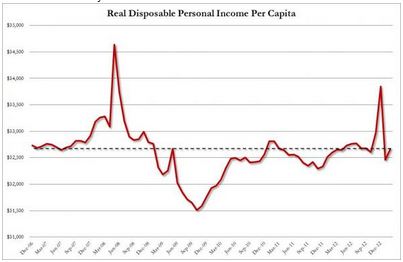
Income increased a healthy 1.1 percent after tumbling 3.7 percent in January.

“Both numbers are consistent with a continued recovery of the U.S. economy,” said Kathy Lien, managing director at BK Asset Management in New York.

A sustained pace of steady job gains is starting to boost wages, which should help to provide some cushion for households from higher taxes and support economic growth.

Personal income in December was sharply higher because of a rush to pay dividends and bonuses before tax hikes took effect this year. That also skewed data for January.

A 2 percent payroll tax cut expired on Jan. 1 and tax rates for wealthy Americans also went up. Data ranging from employment to factory activity has so far shown little sign the tighter fiscal policy has been a major drag on the economy.

First-quarter GDP growth estimates currently range as high as a 3.2 percent annual rate. The economy grew at only a 0.4 percent pace in the fourth quarter.

INFLATION GENERALLY MUTED

Last month, the income at the disposal of households after inflation and taxes increased 0.7 percent in February after dropping 4.0 percent in January.

With income growth outpacing spending, the saving rate – the percentage of disposable income households are socking away – rose to 2.6 percent from 2.2 percent in January.

The higher gasoline prices pushed up inflation, with a price index for consumer spending rising 0.4 percent after being flat for two straight months. February’s increase in the PCE index was the largest since August.

But a core reading that strips out food and energy costs rose only 0.1 percent after increasing 0.2 percent in January, showing no sign of underlying inflation pressures.

Over the past 12 months, inflation has risen 1.3 percent after rising by the same margin in the period through January.

Core prices were up 1.3 percent, well below the Federal Reserve’s 2 percent target. They also had risen 1.3 percent in the 12 months through January.

The benign inflation picture should give the U.S. central bank room to continue with its monetary stimulus as it seeks to boost job growth.

The Fed said last week it would maintain its monthly $85 billion purchases of mortgage and Treasury bonds until it saw a substantial improvement in the job market.

Then this:

Boehner- debt crisis dead ahead

Wrong.
If there’s no inflation problem there’s no deficit problem:

The country isn’t facing an immediate debt crisis, House Speaker John Boehner (R-Ohio) said Sunday, but he argued that Congress and the president must reform entitlements to avert one that lies dead ahead.

“We all know that we have one looming,” Boehner said onABC’s “This Week”. “And we have one looming because we have entitlement programs that are not sustainable in their current form. They’re going to go bankrupt.”

Food price increases drive China’s inflation to 10-month high

‘inflation’ there can mean a lot of people can’t afford to eat, and, hence, regime change:

Food price increases drive China’s inflation to 10-month high

March 9 (Xinhua) — China’s annual consumer inflation rebounds to a 10-month high of 3.2 percent in February on accounts of rising food prices during the Spring Festival season. On a month-on-month basis, February’s CPI gained 1.1 percent from the previous month. Food prices, accounting for nearly one-third of weighting in China’s CPI, remained a key driver of inflation in February as the Spring Festival season, which fell within that month, pushed up demands. The NBS statement said food prices jumped 6 percent last month from the same period last year, propelling the CPI up by 1.98 percentage points. But the upward trend is unlikely to sustain as the holiday effect fades off and the warming weather will help supplies, the NBS said.

China’s Economic Data Show Weakest Start Since 2009

China’s Economic Data Show Weakest Start Since 2009

March 10 (Bloomberg) — China’s industrial output had the weakest start to a year since 2009 and lending and retail sales growth slowed, toughening challenges for a new leadership that wants to narrow the gap between rich and poor.

Production increased 9.9 percent in the first two months and retail sales rose 12.3 percent, government data showed March 9, trailing economists’ estimates. New local-currency loans in February fell to 620 billion yuan ($99.6 billion), the People’s Bank of China said yesterday, lower than the estimates of 27 out of 28 analysts in a Bloomberg News survey.

Strengthening U.S. demand after the unemployment rate fell to a four-year low may help incoming Premier Li Keqiang achieve the 7.5 percent expansion in gross domestic product sought by policy makers entering the final week of their meeting at the National People’s Congress in Beijing. China’s exports jumped 23.6 percent in the first two months of the year, the most for a January-February period since 2010.

“Exports are still an important growth driver for China so the pickup should make policy makers less concerned about the disappointment in some of the other indicators,” said Louis Kuijs, chief China economist at Royal Bank of Scotland Plc in Hong Kong. “When push comes to shove, they know the recipe to kick-start growth, so if things do slow down to a rate they aren’t comfortable with, they can encourage investment.”

At the same time, February credit data indicate the central bank may be working to contain the expansion in lending and aggregate financing that started last year, said Kuijs, who previously worked as an economist for the World Bank in Beijing.

Increasing Optimism

New local-currency loans in February trailed the 700 billion yuan median estimate in a Bloomberg survey and were lower than the 710.7 billion yuan in the same month last year and the 1.07 trillion yuan figure in January. Aggregate financing, a broader measure of credit, fell to 1.07 trillion yuan last month from a record 2.54 trillion yuan the previous month, PBOC data showed.

U.S. stocks have risen 8.8 percent this year, compared with a 2.2 percent gain in the Chinese benchmark index, as optimism increases that the world’s biggest economy is responding to an unprecedented monetary stimulus. In China, the decline in four February purchasing managers’ indexes, and official data released over the past week, are raising concerns that a recovery that started in the fourth quarter may be peaking even as house-price gains accelerate and inflation risks increase.

Spending Crackdown

The growth in January-February retail sales was below the lowest economist projection of 13.8 percent and was the smallest for that period since 2004. The moderation follows a crackdown by new Communist Party chief Xi Jinping on lavish spending by government officials and state-owned companies, part of efforts to curb corruption and waste.

Shares of Kweichow Moutai Co. (600519), maker of the eponymous high- end white spirit, have dropped 19 percent since Xi took power on Nov. 15, compared with a 14 percent gain in the Shanghai Composite Index.

The increase in factory output compared with the 10.6 percent median estimate in a Bloomberg survey. The statistics bureau doesn’t break out figures for January and February retail sales and industrial output in an attempt to smooth distortions caused by the timing of the Lunar New Year holiday.

Fixed-asset investment excluding rural areas in the first two months of the year rose 21.2 percent, against a median economist estimate of 20.7 percent and a 20.6 percent pace for the whole of 2012.

Inflation Worry

Consumer prices climbed a more-than-estimated 3.2 percent in February from a year earlier. Standard Chartered Plc estimates inflation will average 4 percent this year, compared with the government’s target of 3.5 percent.

“From a monetary policy perspective, by mid-2013, the inflation issue should begin to move up policy makers’ list of things to worry about,” Li Wei, a Shanghai-based economist with Standard Chartered, said in March 9 note. Li forecasts the central bank will raise benchmark interest rates once in the fourth quarter by 25 basis points as the CPI rises above 5 percent.

China’s economic growth slowed for seven quarters before recovering to 7.9 percent in the final three months of 2012, led by government-directed spending on infrastructure. The central bank also allowed expansion in credit in the less-regulated shadow banking sector.

The rebound may accelerate to 8.2 percent in the first quarter before slowing to 8 percent in the last three months of the year, according to median estimates in Bloomberg surveys last month.

Policy Dilemma

At the same time, the PBOC has flagged growing inflation and financial risks since December and the government stepped up efforts to curb resurgent home prices on March 1, ordering higher down payments and interest rates for some mortgages and implementation of a 20 percent capital gains tax.

“Policy makers face a dilemma as growth is weakening yet inflationary pressure keeps building,” said Zhang Zhiwei, chief China economist at Nomura Holdings Inc. in Hong Kong. “The government will eventually have to tighten policy to contain inflation but in the short term, the next several months, the government may put policy on hold to observe how growth and inflation move and fine-tune accordingly.”

Remember this? No one’s even tried to collect ;)

Press Release

Oct 22 2010

Senate Candidate Bets Congress $100 Million That the U.S. Government Cannot Run out of Money

Warren Mosler Offers $100 Million of His Own Money to Pay Down the Federal Deficit If Any Lawmaker Can Prove Him Wrong

WATERBURY, Conn.–(BUSINESS WIRE)–Warren Mosler, Connecticut’s Independent candidate for U.S. Senate today announced that it is an indisputable fact that U.S. Government spending is not operationally constrained by revenue and will give $100 million of his own money to pay down the Federal deficit if any Congressman or Senator can prove him wrong. “I am running for U.S. Senate to see my policies implemented to create the 20 million jobs we need. And to do this it must be understood that there is simply no such thing as the U.S. Federal government running out of money, nor is the Federal government operationally dependent on borrowing from China or anyone else. U.S. states, individuals, and companies can indeed become insolvent, but U.S. government checks will never bounce,” states Mosler. “Yes, large Federal deficits that push the economy beyond the point of full employment can lead to inflation or currency devaluation, but not bankruptcy and not bounced checks. If lawmakers today understood this fact, they would not be looking to cut Social Security and we would not still be mired in this disastrous recession.”

With 37 years of experience as an ‘insider’ in monetary operations, Mosler knows that President Obama is wrong when he says that the U.S. government has ‘run out of money’ and is dependent on borrowing from China in order to spend. As Fed Chairman Bernanke publicly stated in March of 2009, the Fed makes payments by simply marking up numbers in bank accounts with its computer. Mosler explains further; “The Government doesn’t get anything ‘real’ when it taxes and doesn’t give up anything ‘real’ when it spends. There is no gold coin that goes into a bucket at the Fed when you are taxed and the government doesn’t hammer a gold coin into its computer when it spends. It just changes numbers in our bank accounts.” Mosler likens this scenario to a football game; when a touchdown is scored, the number on the scoreboard changes from 0 to 6. No one wonders where the stadium got the 6 points, no one demands that stadiums keep a reserve of points in a “lockbox” and no one is worried about using up all the points and thereby denying our children the chance to play.

Warren Mosler urges his opponents, Linda McMahon and Richard Blumenthal, and the entirety of Congress to recognize how the monetary system actually works and implement a full payroll tax (FICA) holiday and his other proposals to restore full employment and prosperity while not cutting Social Security benefits or eligibility.

About Warren Mosler

Warren Mosler is running as an Independent. His populist economic message features: 1) A full payroll tax (FICA) holiday so that people working for a living can afford to buy the goods and services they produce. 2) $500 per capita Federal revenue distribution for the states 3) An $8/hr federally funded job to anyone willing and able to work to facilitate the transition from unemployment to private sector employment. He has also pledged never to vote for cuts in Social Security payments or benefits. Warren is a native of Manchester, Conn., where his father worked in a small insurance office and his mother was a night-shift nurse. After graduating from the University of Connecticut (BA Economics, 1971), and working on financial trading desks in NYC and Chicago, Warren started his current investment firm in 1982. For the last twenty years, Warren has also been involved in the academic community, publishing numerous journal articles, and giving conference presentations around the globe. Mosler’s new book “The 7 Deadly Innocent Frauds of Economic Policy” is a non-technical guide to the actual workings of the monetary system and exposes the most commonly held misconceptions. He also founded Mosler Automotive, which builds the Mosler MT900, the world’s top performance car that also gets 30 mpg at 55 mph.

comments on Bass and Koll

Cooler Heads: The Rebuttal to Kyle Bass’s Japan Market Meltdown Scenario from JPMorgan’s Jesper Koll and Masaaki Kanno

By Stephen Harner

Bass comments:

At 24 times central government tax revenues, cumulative Japanese government debt has reached a level which ensures financial collapse.

Not, just a reserve drain.

With the Abe/Aso government setting a 2% inflation target, the collapse will occur sooner—probably within the next 18 to 24 months.

Not, inflation targets are meaningless. Inflation expectations theory is a myth.

The revelation will be that interest on the debt—currently 25% of national tax revenue—will double under higher interest rates.

Could be. But deficits generally come down as well during an expansion, of course posing a risk to that expansion, etc.

The result will be massive JGB selling, a collapsing yen, and systematic financial crisis resulting from a collapse in yen asset prices.

Yes, when rates go up bond prices go down. There are both winners and losers when/if prices change.

Koll suggests:

Rising interest rates would of course raise debt service costs for all borrowers, and especially the hugely indebted government. But they would enable lenders–including household depositors–to charge higher rates on new debt and raise returns on non-fixed rate debt. Since net stock of private savings is larger than the net stock of public sector liabilities, Koll reckons that the overall effect on the economy would be positive.

Agreed! Rate hikes are expansionary, cuts contractionary due to interest income channels.

Rising interest rates would not spell large losses for Japanese financial institutions because these institutions’ bond–and especially JGB–portfolios are largely held to maturity, avoiding the requirement to be marked to market. The institutions would have no incentive to sell, and ample incentive to hold the JGBs [the weighted average duration of which they have in any event been shortening to well under five years–Harner].

They represent at least lost income, and if implied costs of funds rise implied losses. Etc. Again, winners and losers with change.

As to who is or would buy JGBs, the answer for the present and foreseeable near term future is: the Bank of Japan. BOJ is already committed to buying the entire debt out to a maturity of three years and a new governing board to be installed in April may extend the range to three to five years. Interest rates will rise only as much as BOJ will allow. This is why foreigners and domestic institutions are still buying the bonds.

Note that functionally the BOJ buying is the same as the MOF not issuing.

Whether or not significant inflation develops in Japan depends on productivity. Significant increases in productivity could fully mitigate inflationary pressures.

I’d guess most ‘inflation’ comes through the ‘cost channels’ as low aggregate demand tends to keep ‘monetary inflation’ in check.

There is plenty of room in Japan’s economy for raising productivity. Agriculture, in particular, has abysmal productivity that could easily be raised through deregulation. Land policy that affects housing is another. Health care is another. Indeed, deregulation is needed throughout the economy. “The Abe administration must implement real deregulation, so that private investors put their savings and capital to work, by building new factories, new hospitals, and so forth.” [This is a point I emphasized in my post a week ago on Abe’s “Three Arrows” program.–Harner]

Deregulation could be deflationary as suggested.

The proposed BOJ policies won’t do anything, the fiscal could move the needle some. And relighting the nukes will firm the yen.