Reuters: Food price supports


[Skip to the end]

more inflation.

Prices are up due to short supplies due to biofuels and weather.

And the political response is handing out funds to those in need, even though that doesn’t create more to eat.

As previously discussed, governments have no choice but to step on the inflation pedal.

Whether it be for food support payments or financial sector support.

That’s how ‘democracy’ works.

(And democracy is way better than the second choice!)

World Bank’s Zoellick: Food prices high until 2012

by Alexandra Hudson

World Bank President Robert Zoellick said on Saturday he expected food prices to remain above 2004 levels until at least 2012 and energy prices would also remain high and volatile.

He repeated that with food and fuel prices in a “danger zone” there was a need for $10 billion to provide food and cash handouts for the world’s poorest.

Soaring oil and food prices have fueled inflation across the globe at the same time as economies slow, posing a sharp dilemma for lawmakers.


[top]

FT: Time for comrade Paulson to pull the plug on the Fannie and Freddie charade


[Skip to the end]

Totally misguided regarding public purpose.

For one thing, the shareholders of the agencies are still there for ‘market discipline’ – all that’s been done for them is eliminated liquidity issues, not solvency issues.

At the end of the day a lot of houses were built for a lot of people who live there.

These are real assets and real standards of living that have been supported.

Is anyone arguing it’s a waste of real resources? That’s the real issue.

Also, fiscal policy is all about demand management, not a ‘pretty’ balance sheet by some arbitrary standard.

And, of course, without the fundamental understanding that the funds to pay taxes and buy government securities comes from government spending policy is likely to be suboptimal at best.

Also, note the bias towards ‘inflation’ that’s built into the political process.

This all supports prices and GDP.

There are no supply side constraints on government spending and/or lending with floating fx, unlike the gold standard of 1907/1930, and other fixed fx regimes, past and present.

Time for comrade Paulson to pull the plug on the Fannie and Freddie charade

by Willem Buiter

Are Fannie Mae and Freddie Mac adequately capitalised, as asserted recently by US Treasury Secretary Hank Paulson, Federal Reserve Board Chairman Ben Bernanke and their regulator Office of Federal Housing Enterprise Oversight Director James B. Lockhart III? The answer is: obviously not, if these two government-sponsored enterprises of the US federal government had to make a living on normal private commercial terms. Obviously not if they were subject to the market discipline preached by Paulson and Bernanke, but not practiced when it comes to large financial institutions perceived as systemically important (too large or too interconnected to fail) or too politically sensitive to fail.


[top]

2008-07-11 US Economic Releases


[Skip to the end]


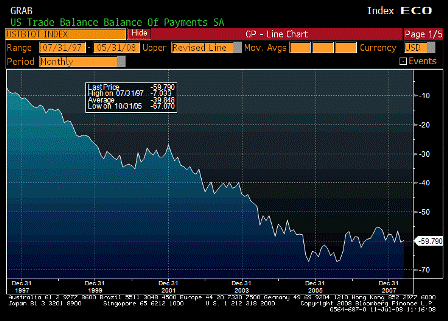
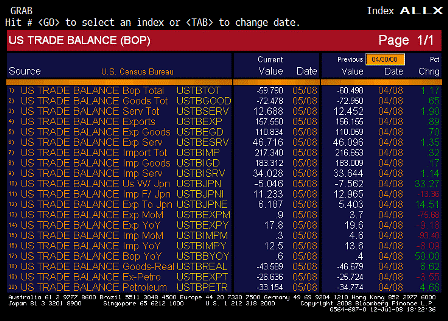
Trade Balance (May)

Survey -$62.5B
Actual -$59.8B
Prior -$60.9B
Revised -$60.5B

[top][end]

Trade Balance (May)

Seems to be working its way lower, but rising import prices are a moving target.
Without CBs and monetary authorities buying to help their exporters, I don’t think the rest of the world wants to accumulate $60 billion a month of financial assets, which means the USD will continue to fall and US prices will continue higher until the real trade gap falls to desired levels.

[top][end]


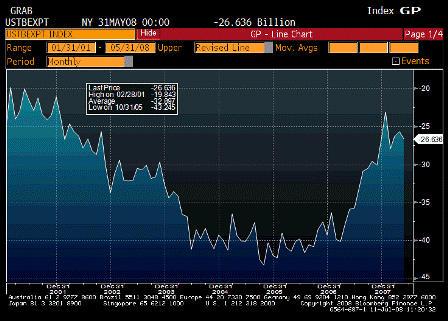
Trade Balance Ex Petroleum (May)

Survey n/a
Actual -$26.636B
Prior -$25.724B
Revised n/a

This has come down quite a bit and should continue to fall over time.

[top][end]


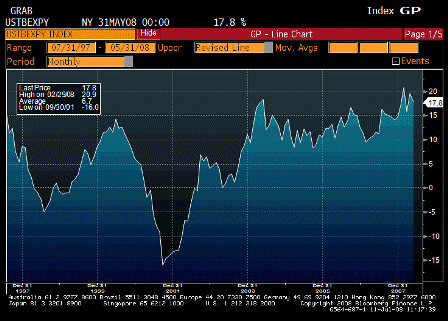
Exports YoY (May)

Survey n/a
Actual 17.8%
Prior 19.6%
Revised n/a

Booming!

[top][end]


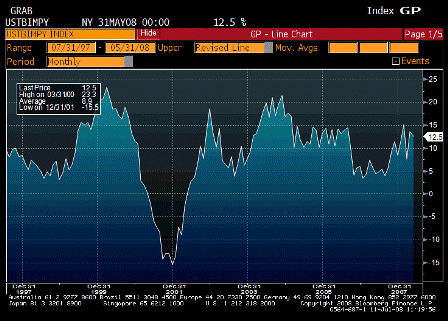
Imports YoY (May)

Survey n/a
Actual 12.5%
Prior 13.6%
Revised n/a

Working their way to lower rates of increase, even with energy prices rising.

[top][end]


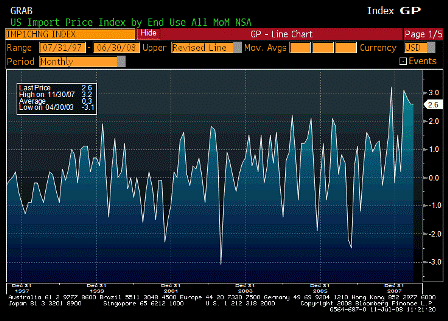
Import Price Index MoM (Jun)

Survey 2.0%
Actual 2.6%
Prior 2.3%
Revised 2.6%

‘Inflation’ pouring in through the open window.

[top][end]


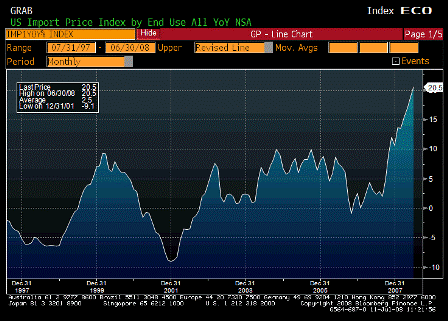
Import Price Index YoY (Jun)

Survey 18.6%
Actual 20.5%
Prior 17.8%
Revised 18.8%

Inflation pouring in through the open window.

[top][end]


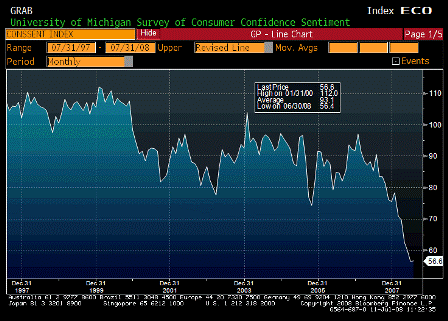
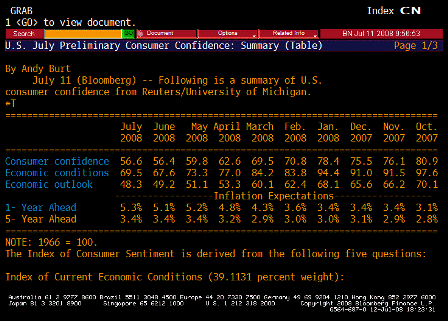
U. of Michigan Confidence (Jul P)

Survey 55.5
Actual 56.6
Prior 56.4
Revised

[top][end]

U. of Michigan Confidence TABLE (Jul P)

Inflation hurting confidence even as current conditions have improved some.

[top][end]


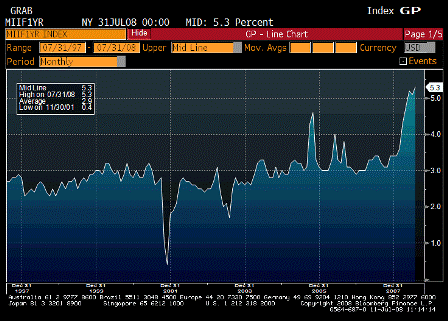
Inflation Expectations 1yr Fwd (Jul P)

Survey n/a
Actual 5.3%
Prior 5.1%
Revised n/a

Fed considers this reason for alarm.

[top][end]


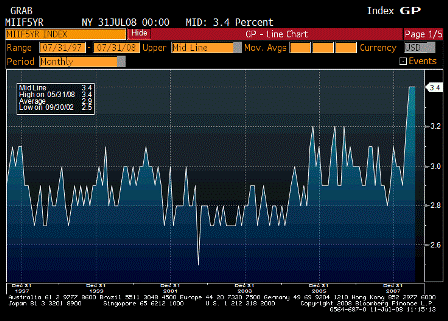
Inflation Expectations 5y Fwd (Jul P)

Survey n/a
Actual 3.4%
Prior 3.4%
Revised n/a

Way too high for the Fed and going the wrong way.

[top][end]


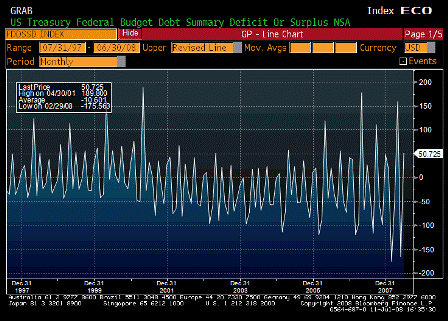
Monthly Budget Statement (Jun)

Survey $34.0B
Actual $50.7B
Prior $27.5B
Revised n/a

Haven’t seen the detail. This can be very volatile due to timing issues.


[top]

2008-07-08 China News Highlights


[Skip to the end]

Highlights:

Chinese entrepreneurs less confident in Q2
China’s Inflation Eased to 7.1% Last Month, Reuters Reports
China Home Prices to Drop More as Curbs Stay, Citic Ka Wah Says
Trade: China’s textile export growth drops significantly
Investors’ confidence in stock market remain

 
Perhaps coming apart with the approach of the Olympics as many have anticipated.

The crowd’s not always wrong!


[top]

Bernanke’s July 07 speech and today’s inflation issue


[Skip to the end]

From Chairman Bernanke’s July 07 speech:

As you know, the control of inflation is central to good monetary policy. Price stability, which is one leg of the Federal Reserve’s dual mandate from the Congress, is a good thing in itself, for reasons that economists understand much better today than they did a few decades ago. Inflation injects noise into the price system, makes long-term financial planning more complex, and interacts in perverse ways with imperfectly indexed tax and accounting rules. In the short-to-medium term, the maintenance of price stability helps avoid the pattern of stop-go monetary policies that were the source of much instability in output and employment in the past. More fundamentally, experience suggests that high and persistent inflation undermines public confidence in the economy and in the management of economic policy generally, with potentially adverse effects on risk-taking, investment, and other productive activities that are sensitive to the public’s assessments of the prospects for future economic stability. In the long term, low inflation promotes growth, efficiency, and stability–which, all else being equal, support maximum sustainable employment, the other leg of the mandate given to the Federal Reserve by the Congress.

Note that the current anti-‘inflation’ argument within the FOMC is that the high prices for imports take discretionary income from consumers that reduces domestic demand and reduces the ability to service domestic debt. There was no thought or mention of that reason for ‘inflation’ being a ‘bad thing’ a year ago.

I suppose one could argue that this problem is due to there not being inflation, as with wages ‘well-anchored’ there is only a relative value story. If we did have ‘real inflation’ with rising wages, we wouldn’t have the problem of insufficient consumer income to support domestic demand, but we would have the traditional negatives from inflation.

But Bernanke’s response to Congress was that exports are replacing domestic consumption and that is a ‘good thing’ as it brings the US trade back to ‘balance’ and restores ‘national savings’ – the old mercantilist, gold standard imperatives. But it does leave weak domestic demand and rising prices. That brings us back to the tail end of Bernanke’s statement:

Admittedly, measuring the long-term relationship between growth or productivity and inflation is difficult. For example, it may be that low inflation has accompanied good economic performance in part because countries that maintain low inflation tend to pursue other sound economic policies as well. Still, I think we can agree that, at a minimum, the opposite proposition–that inflationary policies promote employment growth in the long run–has been entirely discredited and, indeed, that policies based on this proposition have led to very bad outcomes whenever they have been applied.

Seems that either way you look at it, rising prices (whether you call it inflation or not) lead to ‘bad’ outcomes.

And it sure looks to the dissenters in the FOMC that this is exactly what is happening. Only time will tell, but all Fed speakers now agree the risk of inflation is elevated substantially, and we will soon see if they still agree the cost of letting the inflation cat out of the bag is far higher than letting a near-term recession run its course and (hopefully) contain prices and keep a relative value story from turning into an inflation story.

Also, not how the Fed continues to use ‘other tools’ for market functioning as Bernanke just now indicates they will keep lending directly to their primary dealers.


[top]

2008-07-05 Valance Chart Review


[Skip to the end]

Twin themes remain – weakness and higher prices.
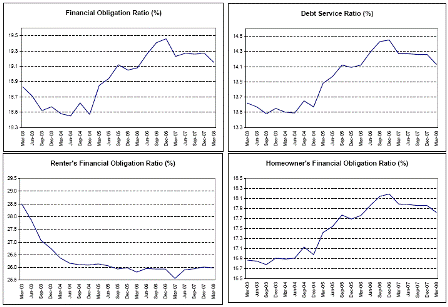
In Q2 2006 it seemed to me that the financial obligations ratio couldn’t get much higher which meant consumer debt could not grow at a faster pace.

With the budget deficit in decline and the trade gap still widening, it would have taken increasing rates of growth of consumer debt to sustain GDP, so my forecast was for gradually declining GDP growth rates over time.

At the same time, I was calling for ever higher crude prices as I saw the Saudis as a swing producer/price setter intent on hiking prices.

This was all temporarily derailed in Aug 2006 when Goldman changed the composition of its commodities index and liquidated substantial amounts of gasoline and crude from the basket of futures purchased and held by its fund, and another fund that followed the Goldman index also re-weighted funds and liquidated substantial numbers of futures contracts. This action pushed prices down until the liquidation was over, but then at year end Goldman and also AIG at year end changed their indexes and again drove prices down. Shortly thereafter it was announced that Goldman was turning its index over to S&P to avoid related party conflicts, or something like that, and the Saudis have resumed their clandestine price hiking.

In general, the Valance charts show economic weakening since Q2 2006. The subprime blow up took away demand in the housing sector as fewer buyers qualified for mortgages when the number of undetected fraudulent applications was reduced, with exports first picking up the slack in 07, and government kicking in soon after in 08.

With the government deficit now proactively growing again, and the financial obligations ratios starting to relax, GDP should continue to muddle through.

“Muddling through” also means, however, that demand will be high enough to support the current level of crude/food/import prices and allow core prices to catch up with headline CPI as the rising food/crude/import prices are also factors of production that are driving up costs.
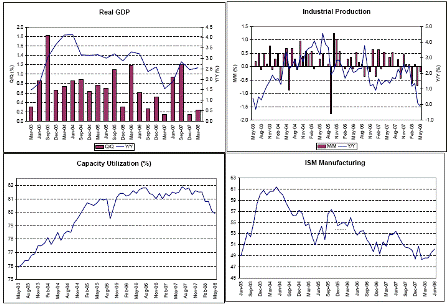
So far, GDP has muddled through as domestic demand has weakened.
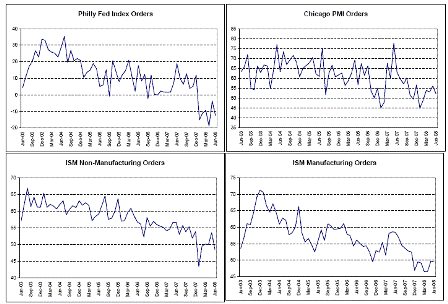
All the surveys look about like these – working their way lower over time, with some turning up recently from the lowest levels.
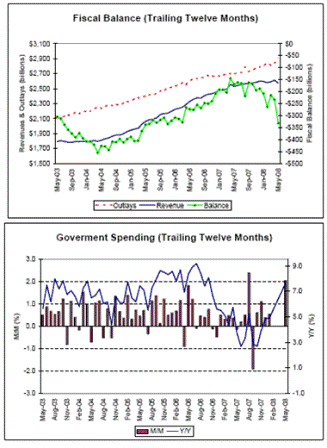
Government spending is on the rise, as a conspicuous drop in the rate of spending in 2007 is making a comeback in 2008, along with the fiscal package now kicking in.
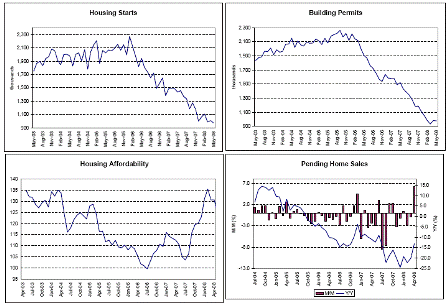
Housing is way down, to the point where it could recover by 50% and still be depressed.

Rising affordability and the passage of time to digest the disruption of the subprime related issues along with increased government spending and increasing exports are beginning to turn things around from the bottom that may have been reached last October/November.
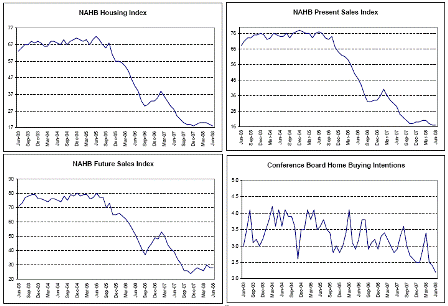
The outlook for the future may have bottomed at these very low levels.
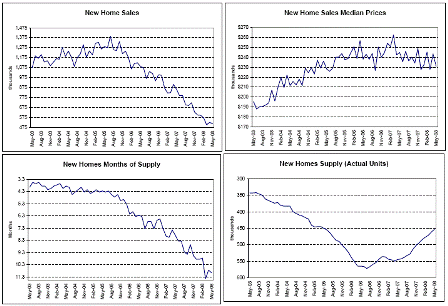
Actual inventories of unsold new homes are steadily falling and median prices are showing signs of a bottom also pointing to a possible bottom for the housing sector.

Government spending and exports have kept the economy from getting a lot worse.
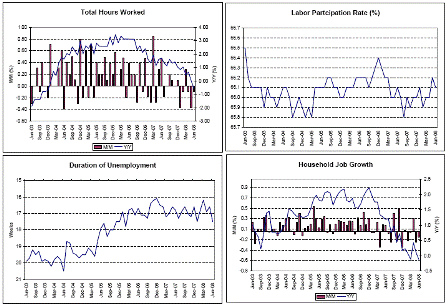
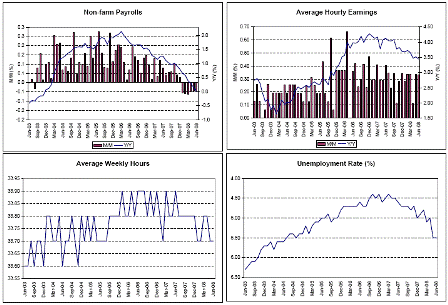
No matter how you look at it, the ‘labor markets’ are on the soft side.
Productivity increases have allowed positive GDP growth with reduced labor input.
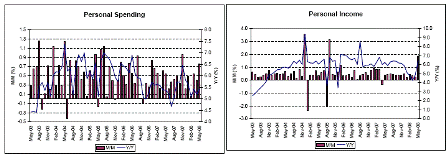
Government to the rescue! GDP will be sustained as long as this holds up.
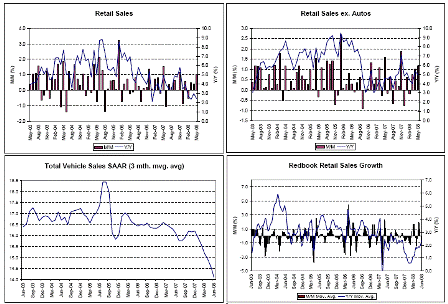
Not terrible here either, apart from the auto industry getting caught out with too many large trucks to sell.
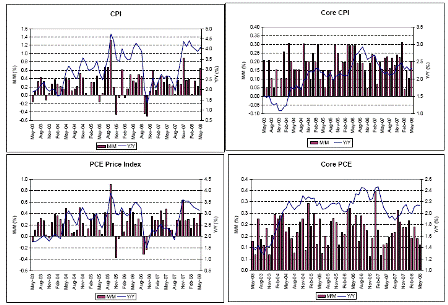
Inflation will only get a lot worse as crude keeps rising.

NOTE: The dip from the Goldman effect in August 2006 has been largely reversed in CPI with the others following with a lag.
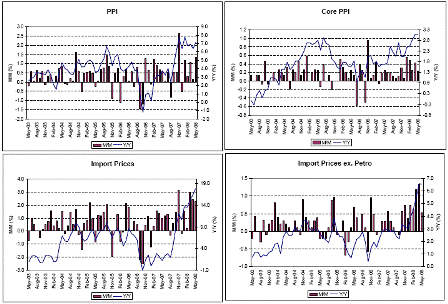
And these are the wholesale prices and import prices that have also more than recovered from the Goldman effect and are in the process of getting passed through to retail prices.
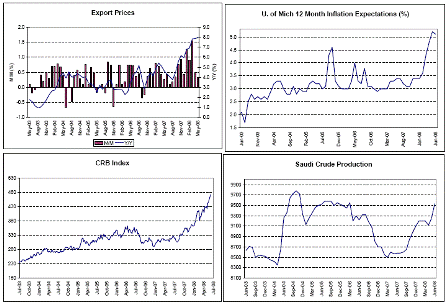
Export prices are booming, expectations way too high for the Fed, the CRB back on trend after the Goldman dip, and demand for Saudi crude holding firm at current prices.
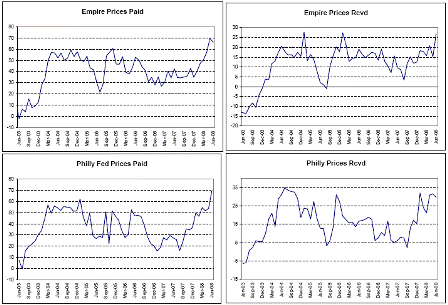
All the price surveys look about like this.
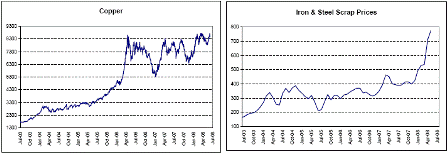
Demand looks strong here as well.
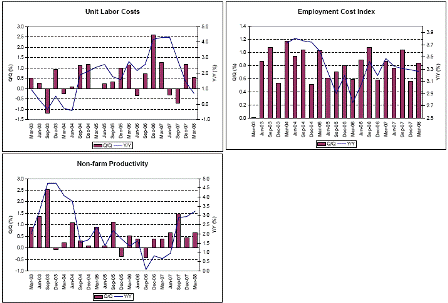
Meanwhile wages remain ‘well-anchored’ as real wages go negative after being about flat for a few decades. And even the most liberal members of Congress seem to think this is a ‘good thing’ as they congratulate the Fed Chairman for keeping wage pressures low.

We are in the process of discovering it IS possible to have inflation without wages leading the way, just like the rest of the banana republics with weak currencies, rising import prices, export led growth, and declining real terms of trade.


[top]

AP: Crippling effect of inflation in poor countries

Impossible – as long as wages are well anchored it’s not inflation…???!!!

Or at least not here?

Inflation surges to double-digit levels in 1 in 4 countries worldwide

by Rachel Beck

There is nowhere to hide from inflation.

Prices in one in four countries, many of them in emerging markets, are accelerating at a double-digit pace, which puts them at least two and a half times the 4 percent annual U.S. headline inflation rate, according to new research from Morgan Stanley.

That should be a wake up call for anyone counting on investments abroad to prop up their portfolios as U.S. stocks teeter on the edge of a bear market.

Sure, the “decoupling” strategy worked for investors in the recent past. Foreign holdings fared better because international economies were outperforming U.S. growth.

The U.S. economy has slowed to nearly a standstill in the last year because of the mounting inflation and the collapse in the housing and mortgage markets. Other industrialized countries have seen about a 2 percent average rate of growth while emerging economies have topped 7 percent.

That growth is now being threatened by inflation. And remember: In the developing world, a larger portion of household expenditures tends to go to the most inflationary items — food and fuel.

Food prices have jumped 39 percent from February 2007 to 2008, led by wheat, soybeans, corn and edible oils, according to the International Monetary Fund.

That hits residents of emerging markets much harder than those living in more advanced economies. People in countries like Vietnam, Russia, Egypt and India put at least 30 percent of their total spending toward food, well above the 6 percent allotment for U.S. households, according to U.S. Department of Agriculture.

That’s why Morgan Stanley economists Joachim Fels and Manoj Pradhan said they were “flabbergasted” by their findings that 50 countries had double-digit inflation rates. On that list were six of the 10 most populous countries in the world, including India, Indonesia, Pakistan, Bangladesh, Nigeria and Russia.

In total, those facing such pricing pressures accounted for 42 percent of the world population.

“In other words, close to three billion consumers are currently experiencing double-digit rates of price increases,” they wrote in a note to clients.

Soaring inflation is not easy to tame. Some countries, such as India where inflation is running at around 11 percent, may have no choice but to boost interest rates.

The Reserve Bank of India earlier this month announced an inter-meeting rate hike. It said in a statement accompanying the move that the “overriding priority for monetary policy is to eschew any further intensification of inflationary pressures and to firmly anchor inflation expectations.”

Others, however, will balk at tightening monetary policy because they don’t want their currencies to surge, which would then raise the price of their exports.

Many emerging-market economies also link their currencies to the dollar, and because of the U.S. Federal Reserve’s loose monetary policy stance right now — the central bank has aggressively cut interest rates in response to the credit crisis — that has helped feed inflationary pressures.

The longer inflation remains elevated, the more damage it will do to long-term economic growth.

“There is plenty of reason to worry about the continuation of the bull story for emerging markets, especially in those countries that have seen a sharp acceleration in inflation, are unable or unwilling to tighten policy sufficiently, and are commodity consumers rather than producers,” the Morgan Stanley economists wrote in their report.

But even as prices surge, earnings forecasts aren’t coming down in many global markets. That may give investors false hope that many countries will bypass the inflation storm.

For instance, in Asian countries outside Japan, earnings forecasts are still for 11.6 percent growth over the next 12 months and 15.1 percent growth in calendar year 2009, according to Barclays Capital.

Those estimates “are implicitly assuming that inflation will either miraculously disappear on its own accord or that central banks are not going to bother doing anything about it neither is particularly believable,” wrote Tim Bond, head of global asset allocation at Barclays.

Barclays is recommending that investors either avoid owning stocks in that region or that they short shares, meaning bet they will decline.

“Although the area is currently outperforming in terms of economic growth, the inflationary environment is not far short of disastrous,” Bond said.

Clearly, the inflation bogeyman is haunting all corners of the world.

Schmidt of RBS favors USD over Euro — a turning point?????


[Skip to the end]

Bloomberg News Video Clip

Maybe, but…

It will be tough for the USD index to move up without the CBs and monetary authorities buying it, and that means crossing Paulson and accepting being labeled a ‘currency manipulator’ and ‘outlaw.’

And the higher crude prices mean USD spent on imports increase and unless spending on US domestic assets, goods, and services goes up by that much those unspent USD need to be/are ‘saved’ by non-residents and the USD goes to a level that reflects their current desire to accumulate them.

A rising USD is evidence that the foreign sector wants the extra USDs and are fighting over them. A falling dollar is evidence of the reverse.

Also, if they don’t like the other currencies any more than they like the USD, the currencies can remain relatively stable as the excess USDs are all spent on US exports and US domestic assets. The evidence of this is rising/accelerating US exports and export prices and support for US assets which can include real estate and equities. Note the falling USD has made US equities that much cheaper for non-USD based investors.

This is all part of the same adjustment process, which includes ‘inflation’ as all the pieces described above support higher prices for goods and services both in the US and elsewhere.

And the ‘inflation channel’ also is part of the adjustment of the trade gap. I use the extreme example (hopefully it’s only an extreme example) of prices adjusting upward until coffee is $60 billion a cup, in which case the trade gap of $60 billion per month is only one cup of coffee. In other words, higher prices work to bring down the ‘real’ trade gap.

So they are all working together -trade, fx, prices- within current institutional arrangements (including CBs not wanting to be labeled outlaws and currency manipulators vs the desire to support their exporters, etc) as they always and continuously do to adjust desired to actual ‘savings’ of financial assets, and sustain all the indifference levels.

A turning point if the level of the USD is sufficiently low to drive the US exports and asset sales to non residents needed to keep their residual accumulation of USD to their desired levels.

And with crude prices still rising, it seems likely to me that more USD are being credited to ‘their’ accounts than they currently wish to cling to at current exchange rates, so more downward pressure on the USD would not surprise me. Along with the associated increase in US exports and higher prices in general.


[top]

The Independent: UK Bank deputy chief warning

Bank deputy chief warns of market trouble to come

by Ben Russell, Political Correspondent and Sean O’Grady

Britain is facing the risk of renewed turmoil in the financial markets, the new deputy governor of the Bank of England warned yesterday.

Professor Charlie Bean, the deputy governor for monetary policy and a former chief economist at the Bank, raised the prospect of a slowing global economy triggering a new round of problems with corporate loans and said that the impact of the credit squeeze could be greater than Bank projections.

Yes, but unlike the Eurozone, the BoE is permitted to ‘write the check’ as in the treasury.

National solvency is not an issue in the UK as it is in the Eurozone when weakness is addressed.

He told members of the Commons Treasury Select Committee that Britain faced “major conflicting risks” threatening the Government’s inflation target from the problems of a slowing economy and rising commodity prices.

Yes, the twin themes of weakness and inflation.

In a memorandum to the committee, Professor Bean warned that the “dislocation” in the financial markets “probably has further to run, especially if a slowing economy here and abroad generates a second round of write-downs, this time associated with corporate loans. Moreover, the impact of the tightening in the terms of availability of credit could prove greater than is embodied in the central case in our most recent set of projections”.

Agreed. And while ‘writing the check’ can readily address these issues with no risk to government solvency, it will also support the higher prices he next discusses:

He said that increasing oil and other commodity price rises would lead to higher inflation becoming “embedded in the economy”, warning that people might seek to offset price increases by making higher wage demands. He said: “There is no doubt that the UK economy presently faces the most challenging set of circumstances since at least the early 1990s and probably earlier.”

Professor Bean said oil prices could continue to rise for another two years and cautioned that Britain faced the danger of a pay-price spiral if workers tried to compensate by pushing up wages. He said: “It certainly poses a significant challenge. There is no doubt about that at all. It may be a relatively unlikely event but it could be particularly unfortunate if it happened, if households and businesses start losing faith in the idea that inflation will stay low, round about the target, they start building it into their pay and prices and inflation becomes much more embedded into the system… Provided pay growth remains subdued, the current pick-up in inflation will be temporary.”

Living standards, the deputy governor stressed, will inevitably be lower because of the global inflation in commodity prices.

Agreed. It’s all about real terms of trade, which have also been declining rapidly in the US as evidenced by the drop in growth of GDP and the drop in non-oil trade deficit.

My guess is the most likely political response in the US and the UK is proactive deficit spending from the treasury to address the weakness and higher interest rates to address the inflation.

Unfortunately the deficit spending that supports domestic demand will also support crude consumption (as well as housing) and ‘monetize’ the ever higher crude prices being set by the Saudis, thereby supporting ‘inflation’ in general.

And this will trigger ever higher interest rates from the Central Bank as inflation trends even higher.

2008-07-01 US Economic Releases


[Skip to the end]


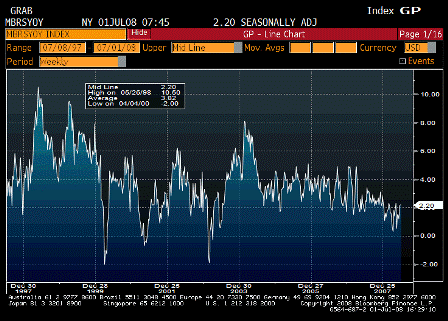
ICSC-UBS Store Sales Weekly Change (Jul 1)

Survey n/a
Actual 0.1
Prior -0.6
Revised n/a

Muddling through as govt spending and fiscal rebates offer support.

[top][end]


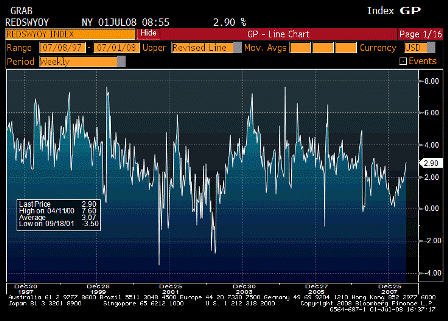
Redbook Weekly YoY (Jul 1)

Survey n/a
Actual 2.9
Prior 2.8
Revised n/a

A bit better than expected and seem to be moving higher.

[top][end]


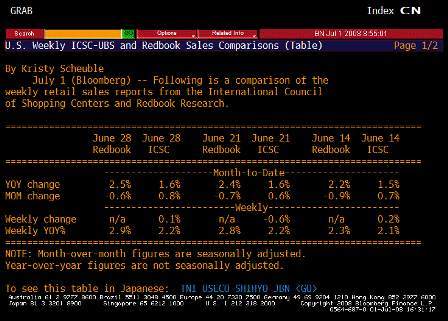
ICSC-UBS and Redbook TABLE (Jul 1)

Survey n/a
Actual n/a
Prior n/a
Revised n/a

[top][end]


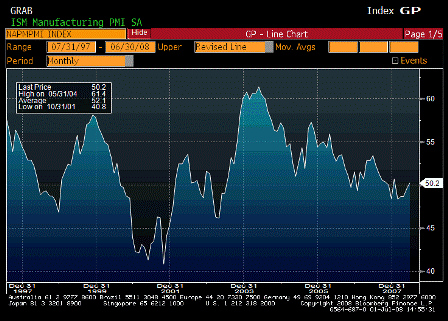
ISM Manufacturing (Jun)

Survey 48.5
Actual 50.2
Prior 49.6
Revised n/a

Better than expected, headline looks better than the detail, but holding up well above recession levels.

[top][end]

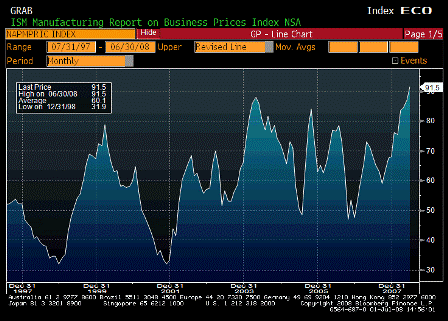
ISM Prices Paid (Jun)

Survey 87.0
Actual 91.5
Prior 87.0
Revised n/a

Breaking out. Question is whether there’s any level of inflation that will trigger a fed rate hike if GDP and financial conditions (whatever that means) stay at current levels.

[top][end]

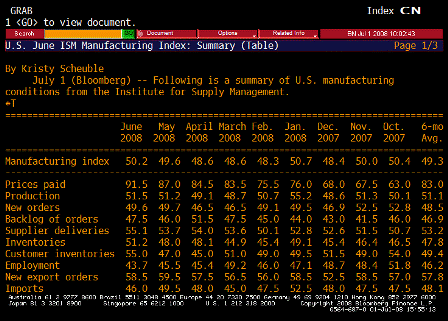
ISM TABLE (Jun)

Karim writes:

  • Not much change in headline or production/new order components.
  • Most material changes in prices paid (up 4.5; to new cycle high) and employment (down 1.8; to new cycle low).

Kohn’s speech: tolerate higher unemployment and higher inflation.

  • Based on continuing claims, conference board, and now ism, downside risk to -60k consensus for nfp on Thursday.

Weak, but not recession levels yet.

Government plus exports so far have made up for weak non-government domestic demand.

[top][end]


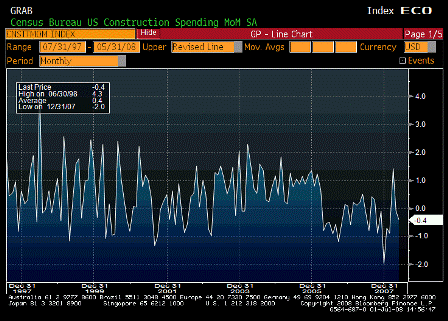
Construction Spending MoM (May)

Survey -0.6%
Actual -0.4%
Prior -0.4%
Revised -0.1%

A bit better than expected. Down but not terrible.

[top][end]


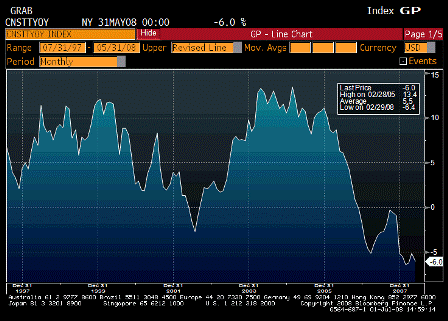
Construction Spending YoY (May)

Survey n/a
Actual -6.0%
Prior -5.1%
Revised n/a

Still near the lows, but a possible bottoming action.

[top][end]


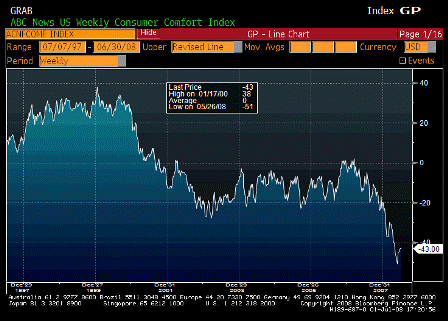
ABC Consumer Confidence (Jun 29)

Survey n/a
Actual -43
Prior -43
Revised n/a

Still looking pretty grim, probably mostly due to higher prices.


[top]