
EU Daily | Eurozone PMI at two-year low as new orders fall in all countries

Weakness and continued austerity. My guess is it will take serious blood in the streets before policy changes

IMF and eurozone clash over estimates

(FT) International Monetary Fund work, contained in a draft version of its Global Financial Stability Report, uses credit default swap prices to estimate the market value of government bonds of the three eurozone countries receiving IMF bail-outs – Ireland, Greece and Portugal – together with those of Italy, Spain and Belgium. Although the IMF analysis may be revised, two officials said one estimate showed that marking sovereign bonds to market would reduce European banks’ tangible common equity by about €200bn ($287bn), a drop of 10-12 per cent. The impact could be increased substantially, perhaps doubled, by the knock-on effects of European banks holding assets in other banks. The ECB and eurozone governments have rejected such estimates.

ECB Lends Euro-Area Banks 49.4 Billion Euros for Three Months

(Bloomberg) The European Central Bank said it will lend euro-area banks 49.4 billion euros ($71.3 billion) in three-month cash. The ECB said 128 banks bid for the funds, which will be lent at the average of the benchmark rate over the period of the loan. The key rate is currently at 1.5 percent. Banks must repay 48.1 billion euros in previous three-month loans tomorrow. The ECB re-introduced an unlimited six-month loan this month and extended full allotment in its shorter-term operations through the end of the year as tensions on European money markets grew. ECB President Jean-Claude Trichet on Aug. 27 rejected the suggestion that there could be a liquidity crisis in Europe, citing the central bank’s non-standard measures.

Eurozone PMI at two-year low as new orders fall in all countries

(Markit) Manufacturing PMI fell from 50.4 in July to 49.0 in August, its lowest level since August 2009 and below the earlier flash estimate of 49.7. National PMIs held just above the 50.0 no-change mark in Germany, the Netherlands and Austria, but signalled contractions in Ireland, France, Italy, Spain and Greece. Only the Irish PMI rose compared to July, but still remained in contraction territory. The weakness highlighted by the headline PMI reflected falling volumes of both output and new business in August. The Eurozone new orders-to-finished goods inventory ratio, which tends to lead the trend in production, fell to its lowest for almost two-and-a-half years.

European Central Bank Said To Purchase Italian Government Bonds

Sept. 1 (Bloomberg) — The European Central Bank is buying Italian securities, according to two people with knowledge of the transactions. They declined to be identified because the transactions are confidential.

A spokesman for the ECB declined to comment.

Germans, Dutch, Finns to Meet on Crisis Amid Collateral Spat

Sept. 1 (Bloomberg) — The German, Dutch and Finnish finance ministers will meet on Sept. 6 in Berlin to discuss the euro-area debt crisis as a Finnish demand for collateral threatens to delay a second Greek bailout.

“We will discuss how to go forward with this crisis and the future,” Dutch Finance Minister Jan Kees de Jager told reporters in The Hague today. “It’s about fighting this fire, but more importantly, how do we prevent such a fire.”

Finland’s demand for collateral from Greece as a condition for contributing to a second rescue package has triggered calls for similar treatment from countries including Austria and the Netherlands. De Jager said an agreement on collateral shouldn’t take long to reach.

“I see room for a solution; there are proposals on the table to discuss,” De Jager said. “I think it will be possible to provide equal treatment for creditors without the disadvantage of the proposed deal between Finland and Greece, which is unthinkable because it uses extra money from the EFSF to provide collateral to Finland.”

The 440 billion-euro ($628 billion) European Financial Stability Facility is the euro region’s rescue fund.

Weidmann Says ECB Must Scale Back Crisis Measures to Reduce Risk

Sept. 1 (Bloomberg) — European Central Bank council member Jens Weidmann said the bank must scale back the additional risks it has shouldered to help counter the region’s debt crisis.

Measures taken by the ECB have “strained the existing framework of the currency union and blurred the boundaries between the responsibilities of monetary policy on one side and fiscal policy on the other,” Weidmann, who heads Germany’s Bundesbank, said at an event in Hanover today. Over time this can damage confidence in the central bank, he said. “It is therefore valid to scale back the extra risks monetary policy has taken on.”

The ECB is lending euro-area banks as much money as they need at its benchmark rate and has also re-started its bond purchase program — a step Weidmann opposed — in an attempt to stem the spreading debt crisis. While European leaders on July 21 re-tooled their 440-billion-euro ($629 billion) rescue fund, allowing it to buy government debt on the secondary market, national parliaments still need to ratify the changes.

“Decisions on taking further risks should be made by governments and parliaments, as only they are democratically legitimized,” Weidmann said.

He said one option for a long-term solution to Europe’s debt crisis could be “a real fiscal union.”

“Should one be unwilling or unable to take this path, then the existing no-bailout clause in the treaties, and the accompanying disciplining of fiscal policy, should be strengthened instead of being completely gutted,” he said.

Weidmann said his comments don’t relate to current economic developments or ECB policy, citing the one-week blackout prior to a rate decision. ECB officials will convene on Sept. 8 in Frankfurt.

German manufacturing PMI lowest since September 2009

(Markit) At 50.9, down from 52.0 in July, the final seasonally adjusted Markit/BME Germany PMI was around one index point lower than the ‘flash’ figure of 52.0. Growth of German manufacturing output eased fractionally since the previous month and was the slowest since July 2009. Latest data pointed to a fall in intakes of new work for the second month running and the rate of contraction was the fastest since June 2009. The downturn in sales to export markets was highlighted by a further reduction in new business from abroad in August, with the rate of contraction also the sharpest for over two years. Meanwhile, stocks of finished goods at manufacturing firms accumulated at the steepest pace since the survey began in April 1996.


German Trade, Consumption Damped Second-Quarter GDP Growth

(Bloomberg) Private consumption contracted 0.7 percent in the second quarter. GDP increased 0.1 percent from the first quarter, when it gained 1.3 percent, the office said, confirming its initial Aug. 16 estimate. Exports rose 2.3 percent from the first quarter, when they gained 2.1 percent. Imports surged 3.2 percent in the second quarter after rising 1.7 percent in the first. That resulted in net trade reducing GDP growth by 0.3 percentage point. Companies stocked up inventories, which contributed 0.7 percentage point to GDP growth. Gross investment also added 0.7 percentage point to growth. Private consumption subtracted 0.4 percentage point and a 0.9 percent decline in construction spending cut 0.1 percentage point off GDP.

Carrefour posts net loss in 1st half

(AP) Europe’s largest retailer Carrefour SA posted an unexpected net loss in the first half and abandoned its growth target for the year amid the economic slowdown. The French retailer reported a net loss of euro249 million ($359 million) in the first six months of the year, compared with a profit of euro97 million a year earlier. Carrefour said it expects its operating profit to decline this year, reversing a target the retailer set in March when it said an ongoing and expensive “transformation plan” would raise profits this year. As it did last year, Carrefour booked what it calls “significant one-off charges” again in the first half. They amounted to euro884 million in the first half, over half of which went to writing down the value of Carrefour’s Italian assets.

Greece set to miss deficit target

(AP) Greece is likely to miss its budget targets in 2011 even if it fully implements painful reforms a parliamentary panel of financial experts said. “The increase in the primary deficit in combination with a further drop in economic activity strengthens significantly the dynamics of debt, offsetting the benefits from the decisions of the summit of July 21, and distancing the possibility of stabilization of the debt to GDP in 2012,” the panel, known as the State Budget Office, wrote in a report. Citing government figures, it said the 2011 January-July deficit stands at euro15.59 billion ($22.53 billion) with a primary deficit of 2.4 percent of gross domestic product, as opposed to a euro12.45 billion ($17.99 billion) shortfall and 1.5 percent primary deficit in that period last year.

Italy Drops Pension Changes, Will Announce Budget Amendments

(Bloomberg) The Italian government has dropped proposed changes to pension rules agreed to this week from a 45.5 billion-euro ($65.5 billion) austerity plan being discussed in parliament that aims to balance the budget by 2013. Giorgia Meloni, minister for youth and sport policy, told reporters that the government decided to withdraw the proposal agreed to by Prime Minister Silvio Berlusconi and Finance Minister Giulio Tremonti two days ago. On Aug. 29, Berlusconi’s office announced that the government had dropped a planned bonus tax on Italians earning more than 90,000 euros a year and reduced cuts in transfers to regional and local authorities. It did not provide details of how the lost deficit reduction of 4.5 billion euros from those changes would be compensated.

Crisis exposes weakness of Italian coalition

(FT) Giulio Tremonti, finance minister, was said to be in “damage limitation” mode on Wednesday, seeking to assure Italy’s partners that a budget could still get through parliament’s twin chambers by the end of next week, despite prime minister Silvio Berlusconi’s decision to jettison some key proposals, including a wealth tax. Three weeks after the centre-right cabinet agreed an austerity package – with €45.5bn ($65.4bn) of savings intended to balance the budget by 2013 – the government on Wednesday missed its self-imposed deadline to present legislation to the senate, the first step towards parliamentary approval. Insiders admit, however, that the budget could amount to a stopgap measure, the second since July, and might need to be reinforced at a later date.

Spanish PM: deficit cap amendment essential

(AP) “It is true that it is a reform done in a very short time span, because we need it,” Prime minister Jose Luis Rodriguez Zapatero said. The amendment of the 1978 constitution enshrines the principle of budgetary discipline into Spain’s constitution, but does not specify numbers. These will come in a separate law that is to be passed by June 2012. The Socialists and conservatives have agreed the law will stipulate that Spain’s deficit cannot exceed 0.4 percent of GDP, but that threshold will not take effect until 2020. Their support is enough for the bill to pass when it is voted on Friday in the lower house of Parliament and presumably next week in the Senate. Time is pressing because the legislature dissolves Sept. 27 in order to get ready for general elections Nov. 20.

Spain Expects ‘Chain’ of Market Turbulence, Valenciano Says

(Bloomberg) “We’re probably going to get back into a chain of financial turbulence in September and October,” Elena Valenciano, Socialist party campaign chief, said in an interview. Valenciano said the constitutional amendment is necessary as Spain must avoid following Greece, Ireland and Portugal into seeking a European bailout. “We have to say this because sometimes talking of a rescue seems almost something positive: any kind of intervention in Spain would be a great misfortune for the country,” she said. Valenciano said authorities “didn’t expect August to be as bad as it was” and that the gap may widen again in the next two months, “not so much because of our own debt, but because of Italy’s debt.”

Portugal Raises Taxes to Meet Deficit Targets in Rescue Plan

(Bloomberg) Portugal will raise capital gains tax and increase levies on corporate profit and high earners to reach the deficit-reduction goals in its 78 billion-euro ($112 billion) bailout. The government will impose a tax surcharge of 3 percent on companies with income above 1.5 million euros, add a bonus tax of 2.5 percent on the highest earners and raise the levy on capital gains by 1 percentage point to 21 percent, Finance Minister Vitor Gaspar said. The moves will help trim the budget deficit from 5.9 percent of gross domestic product this year to the European Union ceiling of 3 percent in 2013, he said. The shortfall will narrow to 0.5 percent in 2015. The government will reduce its deficit even as the economy contracts 2.2 percent this year and 1.8 percent next year, before expanding 1.2 percent in 2013, he said.

Ireland’s unemployment rate rises to 14.4 percent

(AP) Ireland’s unemployment rate has risen to 14.4 percent. Ireland has been trying to escape its 3-year recession through export growth led by its multinational companies. But the domestic economy remains dormant because of weak consumer demand, high household debts and a collapsed real-estate market. The Central Statistics Agency said Wednesday that unemployment rose from July’s rate of 14.3 percent, the fourth straight monthly increase. A record-high 470,000 people in Ireland, a country of 4.5 million, are claiming welfare payments for joblessness. About 17 percent are foreigners, chiefly Eastern Europeans who immigrated during the final years of Ireland’s 1994-2007 Celtic Tiger boom.
I’m ok, eur ok?

First, the euro funding issue/crisis could vanish with a simple announcement, like:

The ECB hereby guarantees all the debt of the national governments.

But they won’t do that.
They are worried about their ability to subsequently enforce the Growth and Stability Pact, which has already proven unenforceable.

In fact, the only enforcement tool for austerity seems to rest with the ECB, which conditions its funding on austerity.

This is also the disciplinary principle behind my proposed ECB annual revenue distribution of maybe 10% of euro zone GDP to the national govts on a per capita basis-
The ECB would have the right to withhold future distributions to members who fail to comply with deficit rules. But this proposal isn’t even a consideration, so not likely to happen.

Mosler bonds (in the case of default they can be used for payment of taxes) for individual euro nations offer real hope, but time is short and the political process long.

That leaves the euro zone with what it’s been doing all along.
Muddle along anticipating, entertaining, debating, various funding proposals,
but ultimately,
when it gets bad enough,
relying on the ECB writing the check and buying national govt debt in the market place to facilitate ongoing funding.

All contingent with the member nation in question complying with terms and conditions of austerity set by the ECB.

It’s all highly deflationary, strong euro medicine, while it lasts.
It’s also operationally sustainable.
And phase 1- where austerity reduces deficits- has proven politically sustainable as well.

However we may now be entering phase 2,
where austerity results in falling GDP and higher deficits for all the euro members.
Yes, it’s operationally sustainable and continues to support the euro.

So the question is whether austerity measures intended to bring deficits down, that instead cause deficits to increase, are politically sustainable.

And, if not, what next?
And when?
How bad does it all have to get before they change policy?
And what change would that be?
The first step would probably be some ‘new’ form of QE,
and maybe even an interest rate cut,
which only make things worse,
as they wait for the appropriate lag before said policy ‘kicks in’.

And how long would it all continue to deteriorate before they stop waiting for it to ‘kick in’ and again change policy?

US deficit reduction round 2 coming soon as well.

To again quote that carpenter working on his piece of wood,
‘no matter how many times i cut it, it’s still too short’.

Is a misguided fuss over a reserve drain going to bring down global capitalism?

From Professor Andrea Terzi, MMT’s non-gnome soldier in Lugano

Andea Terzi is a former student of Paul Davidson, now a professor of economics at Franklin College, Lugano, Switzerland.

The institutional structure in the euro zone has been it’s own undoing since inception, very much like we all described at that time.

Current policy responses continue to support the same repressive fiscal policies that again look to be driving the otherwise prosperous euro zone into negative GDP growth.

The glimmer of hope may be that they have discovered the sector balance approach.

The next step in the right direction would be a recognition of the actual causations.

From Professor Tezi:


Does the ECB understand sector financial balances?

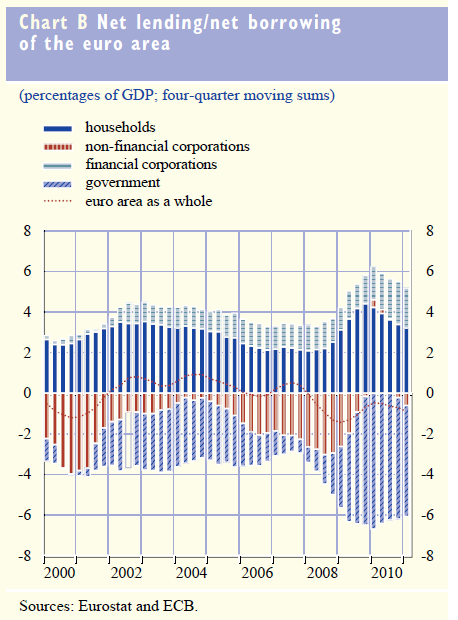
The August 2011 Monthly Bulletin of the European Central Bank has an interesting chart of financial balances of different sectors in the euro area. The chart is reproduced below.

chart


The figure shows how rising deficits in Europe in 2008 and 2009 have produced higher net financial savings in the private sector.

This is evidence that automatic (anti-cyclical) stabilizers worked as usual: as growth declines, or goes negative, tax revenues fall, government deficits increase, and this stops the economy from falling further. This can only work, however, until market-constrained governments in the euro area begin acting pro-cyclically. Governments acting pro-cyclically during recessions means that deficit reductions will reduce private savings below the desired level, and this means a further fall of demand and incomes.

Looking at 2010, and considering that the euro area’s current account balance is marginally negative, there is evidence of this pro-cyclical effect, as government deficits declined, and net private lending inevitably declined.

What is remarkable is how the ECB interprets the chart:

With euro area total investment growing faster than saving, the net borrowing of the euro area increased (to 0.9% of GDP, expressed as a four-quarter sum). From a sectoral point of view, this masked further rebalancing between sectors, with another reduction in government net borrowing (the government de?cit falling to 5.5% of GDP on a four-quarter moving-sum basis, from a peak of 6.7% in the ?rst quarter of 2010) and a further decline in households net lending, while the net borrowing of NFCs increased sharply. (ECB, Monthly Bulletin, August, 2011, pp. 37-8)

The ECB is assuming that savings are needed to finance investment and sector rebalancing is always a good thing. And it makes no reference to the connection between financial balances and nominal GDP growth.

In plain language, this is what the ECB is telling us:

In 2010, Euro area’s savings were insufficient to finance investment. Business needed to borrow to finance their investments and households savings were not enough to fill the gap. This is why the euro area runs a current account deficit, and is a net borrower. European governments, however, are doing their part by reducing their own net borrowing, thus contributing to a progressive rebalancing in financial deficits/surpluses across sectors.

For the ECB, the government net borrowing bar getting shorter (in the chart above) is a reason for optimism. In our reading, this optimism is unwarranted, and what the ECB calls “rebalancing between sectors” is a most worrying financial development of the euro area.

MMT to Ryan- Apologize NOW about the US being the next Greece

Congressman Ryan’s response to the President Obama’s State of the Union address included
something we’ve all hear a lot of ever since.

He warned along the lines that that the US could become the next Greece,
and be faced with some kind of a sudden financial crisis,
where the world would no longer lend to us,
interest rates would skyrocket,
and the US,
unable to spend,
would be down on it’s knees before the IMF begging for the needed funding.

And no one with any kind of national public forum took issue with him.
Including the President and the Democrats in Congress,
who for all appearances quietly agreed and acted accordingly.

Well, today, based on the near universal response to the S&P downgrade,
everyone now knows, or should know,
there is no such thing as the US becoming the next Greece.

The overwhelming response to the S&P downgrade by everyone from Buffet to Greenspan, and
most every financial and academic economist in the world was along the lines of:

The US is the issuer of the dollar.
It can print dollars.
So it can always make timely payments without limit.

THERE IS NO SOLVENCY ISSUE FOR THE US.
There is no such thing as the US running out of dollars to spend.
There is no such thing as the US being dependent on taxing or borrowing to get dollars to spend.

Greece is very different.
Greece, Ireland, Italy, and all the euro member nations, corporations, and households can’t print euro,
any more than the US states, corporations, and households can print dollars.
And so they are all indeed dependent on revenues from somewhere to be able to spend.

So, Congressman Ryan, please apologize NOW for being so wrong and so misleading.

There is no solvency risk for the US.
The Fed is price setter for the interest rates for the US government and the banking system, not the market,
just like the European Central Bank sets the interest rates for its banking system and its own debt.

Congressman Ryan,
your reasons for deficit reduction have vaporized.

You see,
the risk of overspending is inflation,
not solvency.

So if you want to argue for deficit reduction,
apologize NOW,
regroup,
and come back with your next round of fear mongering
about how the deficit can be inflationary,
or something like that,
and see how that flies.

Equity storm over for a bit

From Goldman:

Published August 8, 2011

* Following Friday’s downward revisions, we now expect real GDP to increase just 2%-2½% (annualized) through the end of 2012 and the unemployment rate to rise slightly to 9¼% during this period.

This is still higher than the first half, so presumably corporations will have a better second half as well, and they did just fine in the first half.

And with lower gasoline prices, consumers get a nice break there which should firm their spending on other things as well.

The tighter fiscal won’t matter for this year, and markets won’t discount what may happen in November until it’s closer to actually happening.

So still looks to me like the recent sell off in stocks was mainly technical, as the initial knee jerk sell off from the debt ceiling and downgrade uncertainties triggered further selling by those with short options positions, much like the crash of 1987.

And, like then, and unlike early 2008, the current federal deficit seems more than large to me to keep things chugging along at muddle through levels of modest growth, continued too high unemployment, and decent corporate profits and investment.

Yes, risks remain. Europe is a continuous risk, but the ECB, once again, stepped in and wrote the check. China looks to be slipping but the lower commodity prices will help US consumers maybe about as much as they hurt the earnings of some corps.

So for now, with the options related stock selling over, it looks like we’re back to calmer waters for a while.

And Congress goes back to trying to cut the deficit to put people back to work.
Someone needs to tell them they haven’t run out of dollars, they aren’t dependent on China, and they can’t become the next Greece, and so yes, the deficit is too small given the current output gap.

But until then, we keep working to become the next Japan.

QE Euro Style

It’s more of the same in the euro zone.

It all goes bad until, finally, when it gets bad enough,
the ECB writes the check and buys the bonds of whatever nation is in trouble.
Along with the usual imposition of austerity terms and conditions.

When the US and Japan do qe, they purchase their own liabilities
(the Treasury and Fed, BoJ and MoF, are central govt agencies under control of the national legislature)

When the ECB does QE, it buys the bonds of the euro member nations.
This would be analogous to the Fed buying the bonds of US states with funding problems.

In the US the Treasury took on the bulk of the counter cyclical deficit spending, with the states taking on a bit.

In the euro zone, the member nations took on all of the counter cyclical deficit spending, and buried themselves.
Like the US states, and unlike the Fed and the ECB, the euro member nations are credit sensitive entities.
And they are way over the practical limits of what markets will fund when push comes to shove.
So now the ECB is, reluctantly and as a last resort, taking the ‘burden’ of that deficit spending from the national govts to keep them afloat. (and imposing terms and conditions of austerity)

And the way things are going it will ultimately have to take on a lot.
Looks to me like that means multi trillions, just like the US federal govt does for it’s currency union.

Operationally this is no problem.
But politically the ECB has a politically imposed capital constraint that will most likely need to be addressed before too long.

And based on the way China blew it’s lid over US style QE and debt ceiling discussions, the question is how it might react to euro style QE, ECB capital discussions or discussion of haircuts of China’s holdings?

And the fact that neither qe nor QE are inflationary as they don’t add anything to aggregate demand,
may again mean nothing to China and much of the rest of the world who continue to believe it’s some kind of reckless and inflationary money printing.

quick update

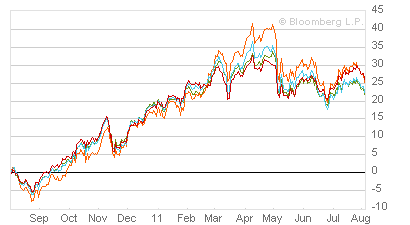
Below are various commodity indices.
If China was in fact melting down in the second half of this year due to cut backs in state spending and lending, and that front loaded into the first quarter, it would look something like that before breaking further.

chart

The Australian dollar is likewise falling, indicating shifting circumstances at China’s coal mine as well.

While good for the US consumer and US domestic demand, it’s not good for the earnings of quite a few
major corporations.

It’s also good for the dollar, which is also not good for corporate foreign earnings translations.

It also brings down headline inflation and could help moderate core CPI as well.

And if China doesn’t like US Fed style QE, ECB style QE- buying member nation debt- has to be all the more distasteful,
and could shift their reserve preference away from the euro.

Especially as the ECB check writing escalates much like it did when it supported the banking system’s liquidity. In theory the ECB’s check writing for the national govts could approach the size of the US budget deficit. Somewhat as ECB liquidity support for the euro member banks is analogous to FDIC insurance for the US banking system.

With the US budget deficit chugging along at about 9% of GDP, domestic demand and earnings should be no worse than they were in the first half of this year, as previously discussed, which means equities should be ok in general, though with some names benefiting as others get hurt.

Consumer credit up, Friday update

It doesn’t look to me like anything particularly bad has actually yet happened to the US economy.

The federal deficit is chugging along at maybe 9% of US GDP, supporting income and adding to savings by exactly that much, so a collapse in aggregate demand, while not impossible, is highly unlikely.

After recent downward revisions, that sent shock waves through the markets, so far this year GDP has grown by .4% in Q1 and 1.2% in Q2, with Q3 now revised down to maybe 2.0%. Looks to me like it’s been increasing, albeit very slowly. And today’s employment report shows much the same- modest improvement in an economy that’s growing enough to add a few jobs, but not enough to keep up with productivity growth and labor force growth, as labor participation rates fell to a new low for the cycle.

And, as previously discussed, looks to me like H1 demonstrated that corps can make decent returns with very little GDP growth, so even modestly better Q3 GDP can mean modestly better corp profits. Not to mention the high unemployment and decent productivity gains keeping unit labor costs low.

Lower crude oil and gasoline profits will hurt some corps, but should help others more than that, as consumers have more to spend on other things, and the corps with lower profits won’t cut their actual spending and so won’t reduce aggregate demand.

This is the reverse of what happened in the recent run up of gasoline prices.

Japan should be doing better as well as they recover from the shock of the earthquake.

Yes, there are risks, like the looming US govt spending cuts to be debated in November, but that’s too far in advance for today’s markets to discount.

A China hard landing will bring commodity prices down further, hurting some stocks but, again, helping consumers.

A euro zone meltdown would be an extreme negative, but, once again, the ECB has offered to write the check which, operationally, they can do without limit as needed. So markets will likely assume they will write the check and act accordingly.

A strong dollar is more a risk to valuations than to employment and output, and falling import prices are very dollar friendly, as is continuing a fiscal balance that constrains aggregate demand to the extent evidenced by the unemployment and labor force participation rates. And Japan’s dollar buying is a sign of the times. With US demand weakening, foreign nations are swayed by politically influential exporters who do not want to let their currency appreciate and risk losing market share.

The Fed’s reaction function includes unemployment and prices, but not corporate earnings per se. It’s failing on it’s unemployment mandate, and now with commodity prices coming down it’s undoubtedly reconcerned about failing on it’s price stability mandate as well, particularly with a Fed chairman who sees the risks as asymmetrical. That is, he believes they can deal with inflation, but that deflation is more problematic.

So with equity prices a function of earnings and not a function of GDP per se, as well as function of interest rates, current PE’s look a lot more attractive than they did before the sell off, and nothing bad has happened to Q3 earnings forecasts, where real GDP remains forecast higher than Q2.

So from here, seems to me both bonds and stocks could do ok, as a consequence of weak but positive GDP that’s enough to support corporate earnings growth, but not nearly enough to threaten Fed hikes.

Consumer borrowing up in June by most in 4 years

By Martin Crutsinger

May 25 (Bloomberg) — Americans borrowed more money in June than during any other month in nearly four years, relying on credit cards and loans to help get through a difficult economic stretch.

The Federal Reserve said Friday that consumers increased their borrowing by $15.5 billion in June. That’s the largest one-month gain since August 2007. And it is three times the amount that consumers borrowed in May.

The category that measures credit card use increased by $5.2 billion — the most for a single month since March 2008 and only the third gain since the financial crisis. A category that includes auto loans rose by $10.3 billion, the most since February.

Total consumer borrowing rose to a seasonally adjusted annual level of $2.45 trillion. That was 2.1 percent higher than the nearly four-year low of $2.39 trillion hit in September.