mtg purchase apps, NY manuf survey, industrial production, home builders index

Turned south again, unfortunately. Remains seriously depressed.

MBA Mortgage Applications
er-4-15-1
Highlights
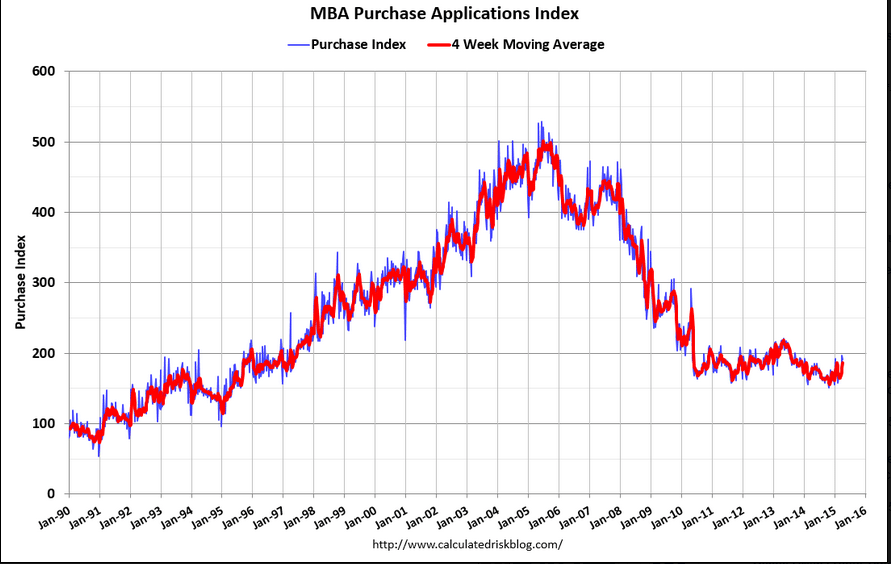
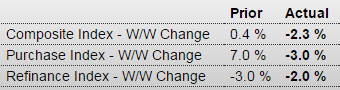
After three straight weeks of impressive gains, the purchase index slipped back 3.0 percent in the April 10 week. Year-on-year, the index is still up a solid 7.0 percent in a reading that points to strength for the spring housing market.
er-4-15-2

More bad news:

Empire State Mfg Survey
er-4-15-3
Highlights
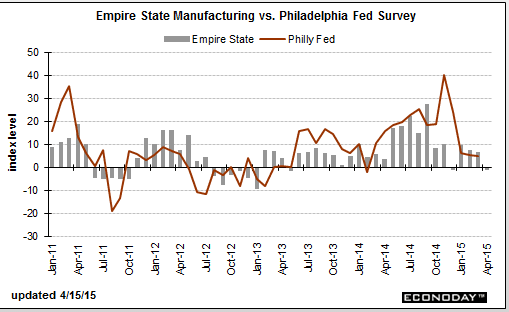
There’s no evidence yet that the manufacturing sector is building up steam early into the spring quarter. The Empire State index points to month-to-month contraction for April, at minus 1.19 for only the second negative reading in the last 23 months. The other negative reading was in December which was just about the beginning of this indicator’s slowdown.

New orders are contracting noticeably, at minus 6.00 for the second straight contraction. Weakness in exports, tied to the strong dollar and soft global demand, is a major factor behind the dip in orders. Unfilled orders, at minus 11.70, are in sharp contraction for a second straight month.

But the drop in orders has yet to pull down shipments which, at least for now, are still in the plus column and well into the plus column, at 15.23. Employment is also well into the plus column at 9.57 on top of March’s standout strength of 18.56.

Still, shipments and employment are certain to turn lower if orders don’t pick up. But, in an optimistic note, that’s exactly what the sample sees as a sizable 52 percent expect general conditions to improve in the next six months.

All in all, today’s report is soft reflecting weakness in global demand, weakness underscored by yesterday’s data out of China where GDP is at a 6-year low. Watch for the US industrial production and the latest hard data on manufacturing at 9:15 a.m. ET.
er-4-15-4

Another bad one:

Industrial Production
er-4-15-5
Highlights
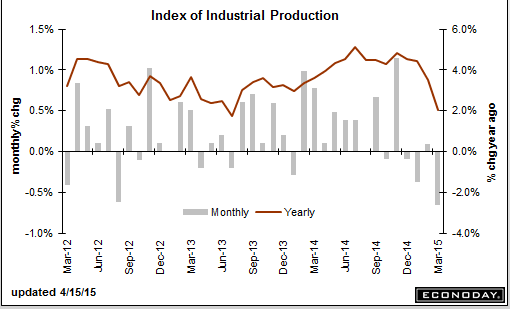
The manufacturing sector remains sluggish. Industrial production for March fell 0.6 percent after a February rise of 0.1 percent. The March drop was largely due to utilities although manufacturing was soft. Market expectations were for a 0.3 percent fall for overall production in March.

Manufacturing edged up 0.1 percent in March after dipping 0.2 percent the month before. Analysts projected a 0.2 percent increase.

Mining dropped 0.7 percent in March after a 1.6 percent decrease the prior month. Utilities plunged 5.9 percent after surging 5.7 percent in February.

The production of durable goods moved up 0.2 percent, on the strength of a rebound in the production of motor vehicles and parts. The output of primary metals declined 3.2 percent to register the largest loss among durable goods industries. The production of nondurable goods moved up 0.1 percent; decreases in the indexes for paper, for chemicals, and for plastics and rubber products mostly offset gains by the other major nondurables industries. The production of other manufacturing industries (publishing and logging) fell 0.4 percent. The decrease of 0.7 percent for mining reflected a drop of 17 1/2 percent in the index for oil and gas well drilling and servicing that was partly offset by gains in crude oil and natural gas extraction and by a bounce back in coal mining.

Overall capacity utilization declined to 78.4 percent from 79.0 percent in February.
er-4-15-6

Not terrible but still low historically:
er-4-15-7

labor market index, consumer credit, China trade, BIS on oil and debt

This is the Fed’s new indicator:

Labor Market Conditions Index
lm-conditions
Definition
The U.S. labor market is large and multifaceted. Often-cited indicators such as the unemployment rate or payroll employment, measure a particular dimension of labor market activity. It is not uncommon for different indicators to send conflicting signals about labor market conditions. The Fed’s research department has created a labor market conditions index (LMCI) based on 19 labor market indicators. It is not an official report. However, the monthly publication is carefully noted by Fed Chair Janet Yellen and has gained market attention.

Misleading at best as the two month average was just that, average:

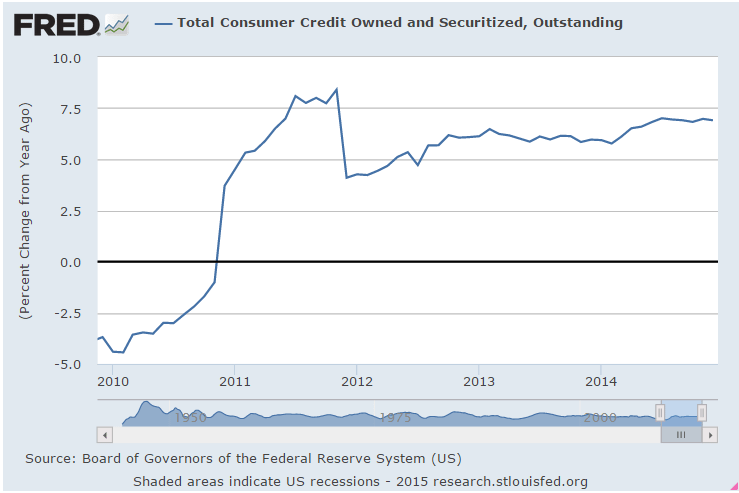
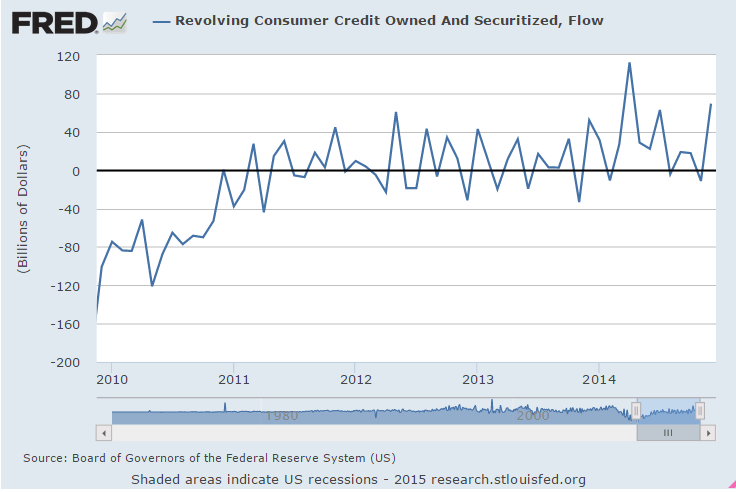
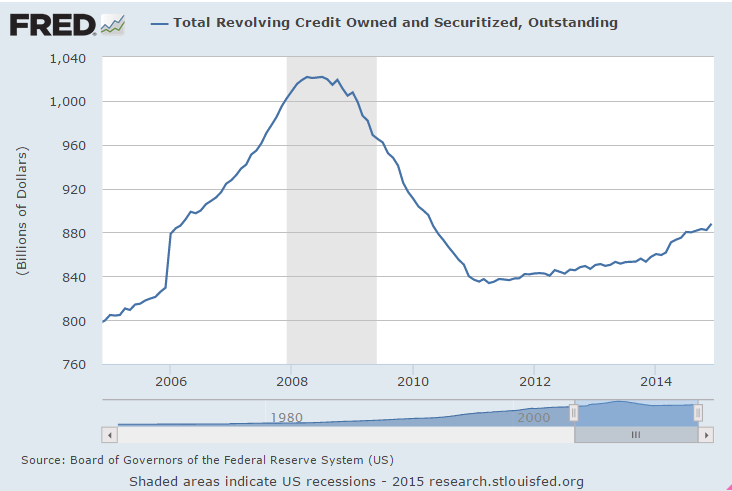
Consumers swipe way to largest increase in revolving credit since March (WSJ) Total outstanding consumer credit expanded at a 5.37% seasonally adjusted annual rate to $3.31 trillion in December. That was a slight acceleration from November’s 4.92% gain. Revolving credit grew at a 7.85% pace in December, a turnaround from November’s 1.28% decline. December’s expansion in revolving credit was the largest since March. Nonrevolving credit, such as auto and student loans, grew at a 4.46% pace during the month, the smallest monthly increase since October 2011. November’s nonrevolving balances grew 7.21%. Revolving credit tends to be volatile, but nonrevolving credit has consistently expanded since August 2011.

No acceleration in growth whatsoever:
cc-2-9-1
The revolving is volatile but doesn’t look to be going anywhere:
cc-2-9-2

cc-2-9-3

January data always suspect but sometimes indicative:

China’s imports slump, capping dismal January trade performance (Reuters) China exports fell 3.3 percent in January from year-ago levels while imports tumbled 19.9 percent. Last year the new year holiday idled factories and financial markets for a week in January, but this year the holiday comes in late February and January was a full month of business as usual. Coal imports dropped nearly 40 percent to 16.78 million tonnes, down from December’s 27.22 million tones. Crude oil imports slid by 7.9 percent in volume terms. While exports to the United States rose by 4.8 percent year-on-year to $35 billion, exports to the European Union slid 4.6 percent to $33 billion in the same period. Exports to Hong Kong, South Korea and Japan were also down, with exports to Japan slumping over 20 percent.

China’s Exports Post Surprise Drop in January (WSJ) Exports fell 3.3% in January from a year earlier, a sharp deterioration from December’s 9.7% rise. In January, exports to Southeast Asia and the U.S. were stronger, while shipments to the European Union, Japan and Hong Kong were all weaker in dollar terms. In a statement accompanying the trade data, China’s customs authorities said that a survey showed weaker confidence among exporters for the fourth consecutive month. “This shows that exports will be facing downward pressure in the first quarter as well as the beginning of the second quarter,” the statement said. Year-ago data for January may have been inflated by over-invoicing by exporters. Exports climbed nearly 11% year over year in January last year.

This is a lot more threatening than I had been led to believe:

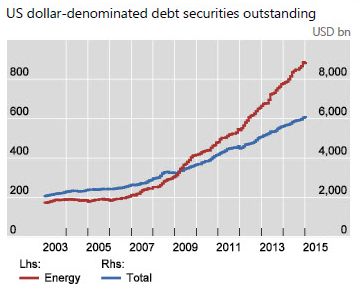
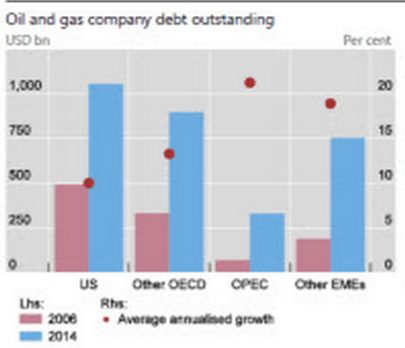
Box: Oil and debt

Note the rate of energy debt growth over the last few years, and that these charts don’t include all energy related debt. Looks to have been about 1% of GDP and added about that much plus ‘multipliers’, filling in for the tax hikes and sequesters of 2013.

And now it’s over.

Two things as price fell in half from $100/barrel.

1. Credit expansion slows and maybe reverses.

2. The value of the collateral behind the loans has been halved, which is highly problematic for the lenders.
cc-2-9-4
cc-2-9-5
These are just initial BIS findings. The full report comes out in March.

And not to forget there’s now a new King of Saudia Arabia who decides what the price will be.

Saudi discounts altered

Remember when they reduced some of their discounts I suggested they may be stabilizing prices?

Now they are increasing a discount, indicating they are trying to soften prices?

Saudis Deepen Asia Light-Oil Discount to Low in Market Fight

By Anthony DiPaola and Mark Shenk

Feb 6 — State-owned Saudi Arabian Oil Co. lowered its official selling price for Arab Light crude by 90 cents to $2.30 a barrel less than Middle East benchmarks, the company said in an e- mailed statement Thursday. That’s the lowest in at least the 14 years since Bloomberg began gathering data.

“This is further evidence that they are hellbent on protecting their market share in China,” Bill O’Grady, chief market strategist at Confluence Investment Management in St. Louis, which oversees $2.4 billion, said by phone Thursday. “They are trying to stay competitive in what is the biggest area of growth.”

Middle Eastern producers are increasingly competing with cargoes from Latin America, Africa and Russia for buyers in Asia. China was the world’s second-biggest crude consumer after the U.S. in 2014, according to International Energy Agency data.

Oil prices have collapsed since the Organization of Petroleum Exporting Countries decided to maintain its output target on Nov. 27, fanning speculation that Saudi Arabia and other members were determined to let North American shale drillers and other producers share the burden of reducing an oversupply.

Raised Premium

Brent crude, the benchmark for more than half of the world’s oil, rose as much as $2.31 a barrel, or 4.1 percent, to $58.88 on the London-based ICE Futures Europe exchange and traded at $58.47 at 10:53 a.m. local time. West Texas Intermediate, the U.S. benchmark, rose $1.78 to $52.26 a barrel on the New York Mercantile Exchange.

Saudi Aramco, as the producer is known, cut differentials on each of the four other grades it sells to Asia, its largest market, and raised them to the U.S., northwest Europe and the Mediterranean region, according to Thursday’s statement. The discount on Extra Light crude to Asia also dropped to a low of at least 14 years and Arab Medium was cut to within 10 cents of its record discount for buyers in Asia.

“Asia is still the market that they want to keep, so they are pricing to keep the crude attractive,” Olivier Jakob, managing director of Zug, Switzerland-based researcher Petromatrix GmbH, said by phone Friday. Saudi Aramco increased pricing to the Mediterranean region where “demand has been good because refining margins are good,” he said.

Refiners and traders in Asia had expected Saudi Aramco to cut Arab Light crude by $1 a barrel, according to the median estimate of eight buyers in a Bloomberg survey this week.

Persian Gulf oil producers sell most of their crude under long-term contracts to refiners. Most of the region’s state oil companies price their oil at a premium or discount, also known as the differential, to a benchmark. For Asia the benchmark is the average of Oman and Dubai oil grades.

China Market

Saudi Arabia’s share among the top three suppliers to China fell to 37 percent in December, from 44 percent in October, as the country lost ground to Angola and Russia, according to Julian Lee, an oil strategist for Bloomberg First Word. In the U.S., Saudi Aramco is in contention with Mexico to be the second-largest supplier behind Canada, Lee said.

The kingdom’s state oil producer raised the differentials on all crude it will ship to the U.S. next month by 15 cents a barrel, pushing the premium for Arab Light to 45 cents more than the U.S. Gulf Coast benchmark.

Saudi Aramco took the oil market by surprise when it trimmed its November crude pricing to five-year lows for Asia, signaling the biggest producer in OPEC would defend its market share rather than seek to prop up prices.

“The U.S. used to be the market the Saudis were most concerned about preserving market share in, but that’s no longer the case,” O’Grady said. “China is where they see growth coming from in the decades ahead and the U.S. is also producing a greater share of the oil it needs.”

Jobs, Currency wars, etc.

Heaps stronger than expected:

Employment Situation
payrolls-jan
Highlights
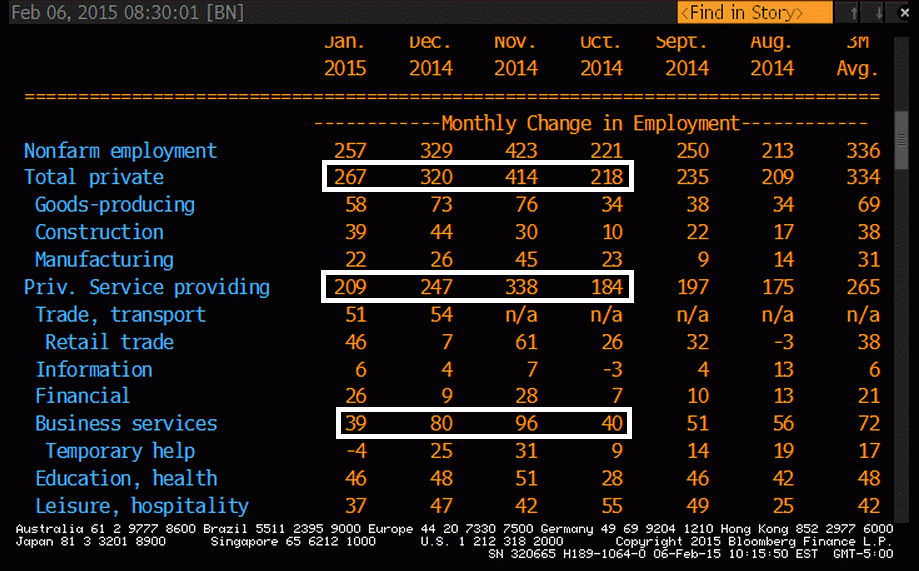
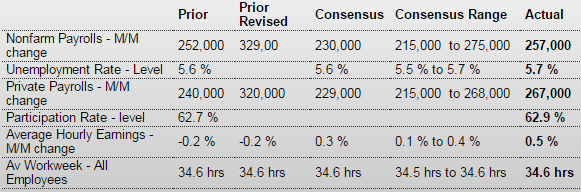
Today’s employment situation was heavily positive even though the unemployment rate edged up. Payroll jobs gained 257,000 in January after strong increases of 329,000 in December and 423,000 in November. December and November were revised up a net 86,000. With the revision, November is the strongest month since May 2010. Today’s report may tip the balance for the Fed to think about a first increase in policy rates this year rather than next-although still at a slow pace.

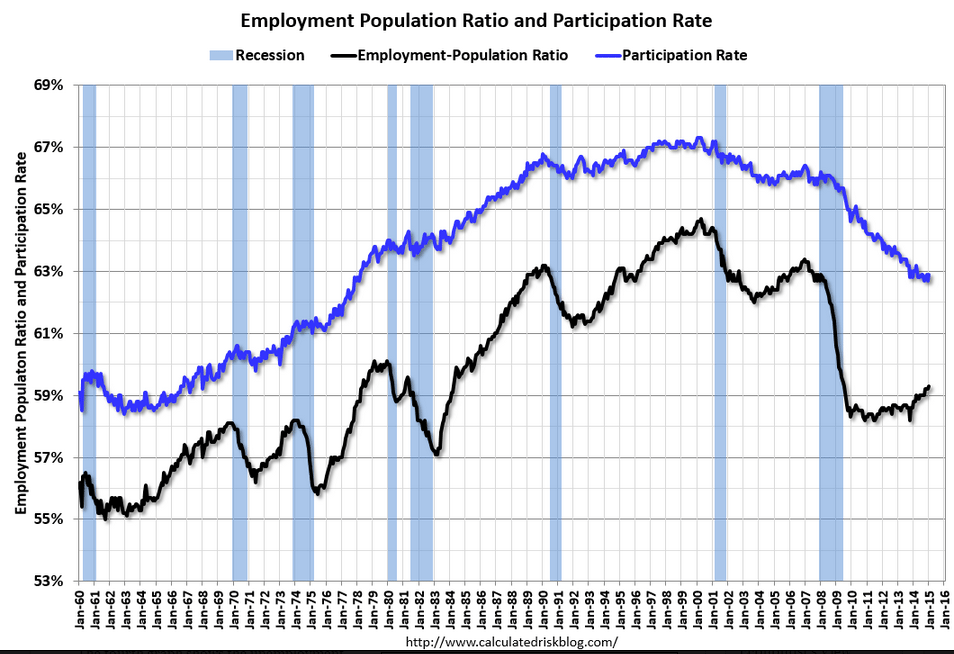
The unemployment rate nudged up to 5.7 percent from 5.6 percent in December. The rise was due to a sharp rebound in the labor force. The labor force participation rate rose to 62.9 percent from 62.7 percent in December. It appears that some discouraged workers are returning to the labor force—a positive sign for how workers view the economy.

Turning back to the establishment survey, private payrolls increased 267,000 in January after a 329,000 boost the month before.

Goods-producing jobs increased 58,000 after a 73,000 boost in December. Manufacturing increased 22,000 after rising 26,000 in December. Construction jumped 39,000 in January after gaining 44,000 the month before. Mining slipped 4,000 after rising 3,000 in December. These numbers offer hope that the manufacturing and construction sectors are improving. In recent months, they have been sluggish.

Private service-providing industries posted a 209,000 increase after a gain of 247,000 in December. Government jobs declined by 10,000 in January after a rise of 9,000 the month before.

The labor force may be tightening a bit as average hourly earnings rebounded 0.5 percent, following a 0.2 percent dip in December. However, part of the boost in wages was due to increases in some states’ minimum wage. The average workweek held steady at 34.6 hours.

Overall, the latest employment situation suggests that the consumer sector is still the current backbone of the recovery. Also, the labor market has been given an upgrade with upward revisions to November and December. A caveat for the latest report is that seasonal factors for cold weather months can be volatile.

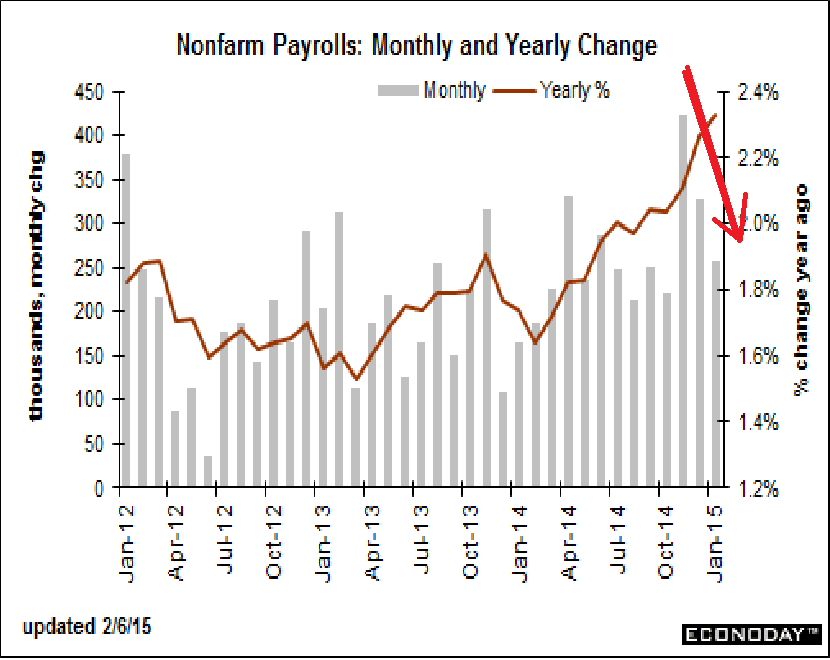
So anyone remember what that big spike in November was all about?

I don’t recall anything at the time in the news, etc. that would have indicated any kind of hiring surge was happening?

Anyway, whatever it was seems to be unwinding?
payrolls-jan-2

payrolls-jan-3

payrolls-jan-4

Currency wars, deflation fights, and with all the guns shooting backwards. As the carpenter said, ‘no matter how much I cut off it’s still too short.’

History will not be kind to these people…

Currency war a worry ahead of G-20 finance gathering (Nikkei) With a number of countries loosening monetary policy, avoiding competitive currency devaluation has emerged as a key issue for the meeting of Group of 20 finance ministers and central bankers that kicks off Monday in Istanbul. The communique released after the September G-20 meeting in Cairns, Australia, included language that in effect tacitly condoned monetary easing aimed at economic improvement. “Monetary policy in advanced economies … should address, in a timely manner, deflationary pressures where needed,” it read in part. The IMF, in January, projected growth of 1.2% in the eurozone, down 0.2 point from the October 2014 edition. The IMF cut its outlook for emerging markets by 0.6 point as well.

Fed’s Rosengren: Weak inflation is key challenge for central banks (WSJ) “The problem of significantly undershooting inflation—a dynamic which could well keep interest rates at the zero lower bound—is likely to be a key challenge to central bankers in the first two decades of the 21st century,” Federal Reserve Bank of Boston President Eric Rosengren said. “As with the oil shock in the 1970s, the current shock has served to accentuate a potential monetary policy pitfall—in this case, the failure to quickly and vigorously address a significant undershooting of inflation targets,” the central banker said. “We still are a long way from normalizing either short-term interest rates or our balance sheet,” the official said.

Benefits of aggressive Fed policy still to peak (WSJ) “The net stimulus to real activity and inflation was limited by the gradual nature of the changes in policy expectations and term premium effects, as well as by a persistent belief on the part of the public that the pace of recovery would be much faster than proved to be the case,” according to a new Fed board paper. “The peak unemployment effect—subtracting 1¼ percentage points from the unemployment rate relative to what would have occurred in the absence of the unconventional policy actions—does not occur until early 2015, while the peak inflation effect—adding ½ percentage point to the inflation rate—is not anticipated until early 2016,” write the authors.

Denmark Cuts Rates Again to Protect Currency Peg (WSJ) Denmark’s central bank scrambled to defend its under-pressure currency peg Thursday, cutting its benchmark interest rate for the fourth time in less than three weeks. The decision to cut the interest rate on deposits—to -0.75% from -0.5%–marks the latest effort to maintain the peg. Last week, the central bank, known as Nationalbanken, announced the surprise suspension of government bond auctions, and the bank said Tuesday it sold record amounts of kroner in January to weaken its currency. Nationalbanken Governor Lars Rohde tried to calm any fears about the future of the policy cornerstone. The central bank “has the necessary instruments to defend the fixed exchange rate policy for as long as it takes,” he said in a statement.

China cuts bank reserve requirement to spur growth (Reuters) China’s central bank made a system-wide cut to bank reserve requirements on Wednesday, the first time it has done so in over two years, to unleash a fresh flood of liquidity to fight off economic slowdown and looming deflation.

Greek leadership assures policy is good for its banks, while real economy and real people are devastated:

Greek central bank says ‘absolutely no problem’ with banks (Reuters) Greek central bank governor Yannis Stournaras said on Thursday that Greek banks were solid and under control. “Deposits and liquidity are absolutely safe,” Stournaras, who is also a member of the European Central Bank’s Governing Council, told reporters. “There is absolutely no problem with the banks. We are under control. It was a calm day today,” he said referring to bank deposits. Greek Prime Minister Alexis Tsipras and Finance Minister Yanis Varoufakis have been seeking support for a new deal with Greece’s international lenders that would allow an end to years of imposed austerity. “The ECB’s decision can be taken back if there is a deal from the Greek government (and its EU partners),” he said.

Not a good sign:

Baltic Dry Freight Index Plummets Amid Commodities Slump (WSJ) The Baltic Dry Index fell to 577 this week, a far cry from its peak of 11,793 in 2008. The size of the world’s fleet of dry-bulk ships far exceeds demand for the vessels which carry commodities, with over capacity estimated at around 20% above demand over the past few years. Many ships ordered at a time of booming global trade before the 2008 financial crisis have come into service as economic growth has spluttered in the years since. Rui Guo, a freight analyst at ICAP Shipping, said the tonnage in the water of dry-bulk vessels has gone up 85% since 2008, even as demand has fallen. Mr. Guo said daily freight rates for a 150,000-ton freight vessel are now around $5,500, with the break-even point around $7,500.

The Korea International Trade Association reported that exports of general machinery to China declined 7.1% in the January-November period of 2014, in contrast to a 2.0% increase in 2013.

payrolls-jan-5

Layoffs, Claims, Trade

Challenger Job-Cut Report
eco-release-2-5-1
Highlights
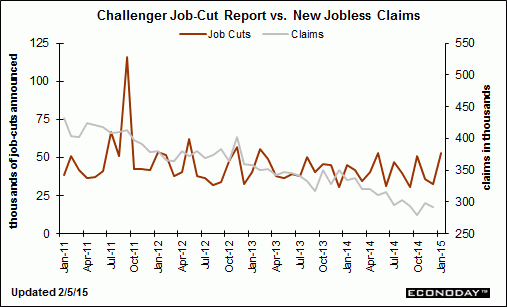
In perhaps the first warning of serious trouble from the oil patch, Challenger’s layoff count starts off the year with an elevated reading, at 53,041 for the highest reading since February 2013 and the highest January reading since 2012. Readings in December and November were much lower, at 32,640 and 35,940.

The energy sector represented roughly 40 percent of January’s cuts, at 20,193. Cuts in the energy sector were minimal in the fourth-quarter, averaging only 1,330 per month. The sector seeing the second largest number of cuts in January is retail, at 6,699 in downsizing following the holidays.

Jobless Claims
eco-release-2-5-2
Highlights
The jobs market is healthy based on jobless claims where initial claims, though up 11,000, came in at a much lower-than-expected 278,000 in the January 31 week, keeping the bulk of the improvement from the prior week’s revised 42,000 fall. The 4-week week average, down a sizable 6,500 in the week to 292,750, is trending right at the month-ago level in a comparison that points to another healthy monthly employment report for tomorrow.

Continuing claims, reported with a 1-week lag, are also at healthy levels though the month-ago comparison is less favorable. Continuing claims in the January 24 week rose 6,000 to 2.400 million while the 4-week average, though down 22,000, is at a 2.421 million level that is slightly above the month-ago trend. The unemployment rate for insured workers is holding at a recovery low of 1.8 percent.
eco-release-2-5-3

Negative productivity/jump in unit labor costs = over hiring given actual output?

Productivity and Costs
eco-release-2-5-4
Highlights
Nonfarm productivity growth for the fourth quarter declined an annualized 1.8 percent, following a 3.7 percent jump in the third quarter. Expectations were for a 0.2 percent rise. Unit labor costs increased 2.7 percent after falling an annualized 2.3 percent in the third quarter. Analysts projected a 1.2 percent gain.

Output growth softened to 3.2 percent in the fourth quarter, following a 6.3 percent jump the prior quarter. Compensation growth posted at 0.9 percent annualized after 1.3 percent the quarter before.

Year-on-year, productivity was unchanged in the fourth quarter, down from 1.3 percent in the third quarter. Year-ago unit labor costs were up 1.9 percent, compared to up 0.9 percent in the third quarter.

International Trade
eco-release-2-5-5
Highlights
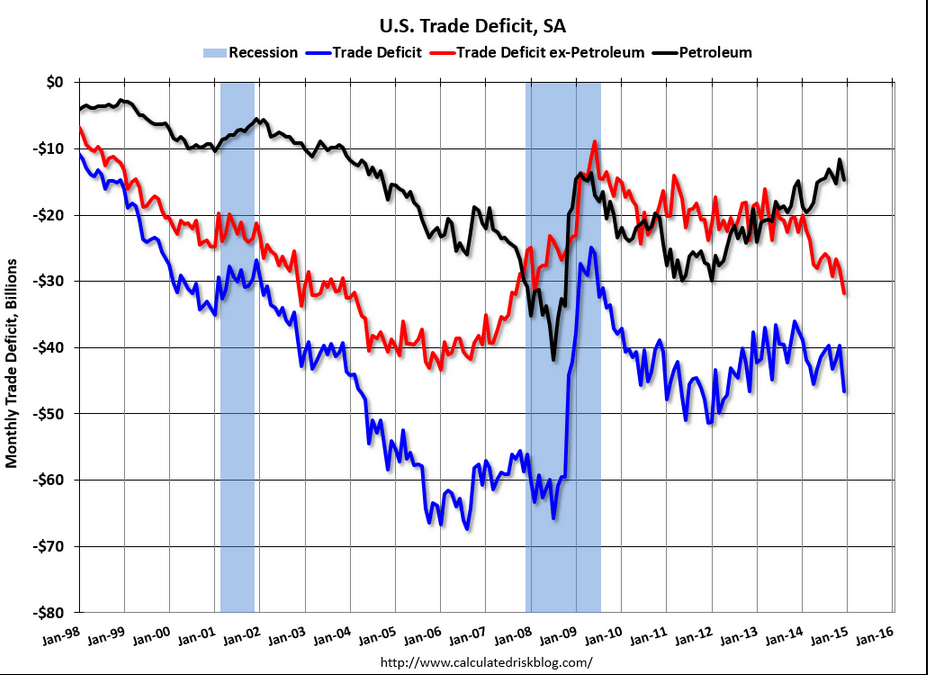
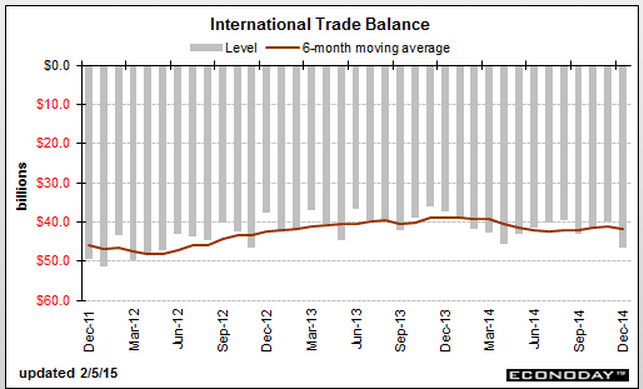
The U.S. trade balance for December widened instead of narrowing as expected. Lower oil prices actually cut into petroleum exports.

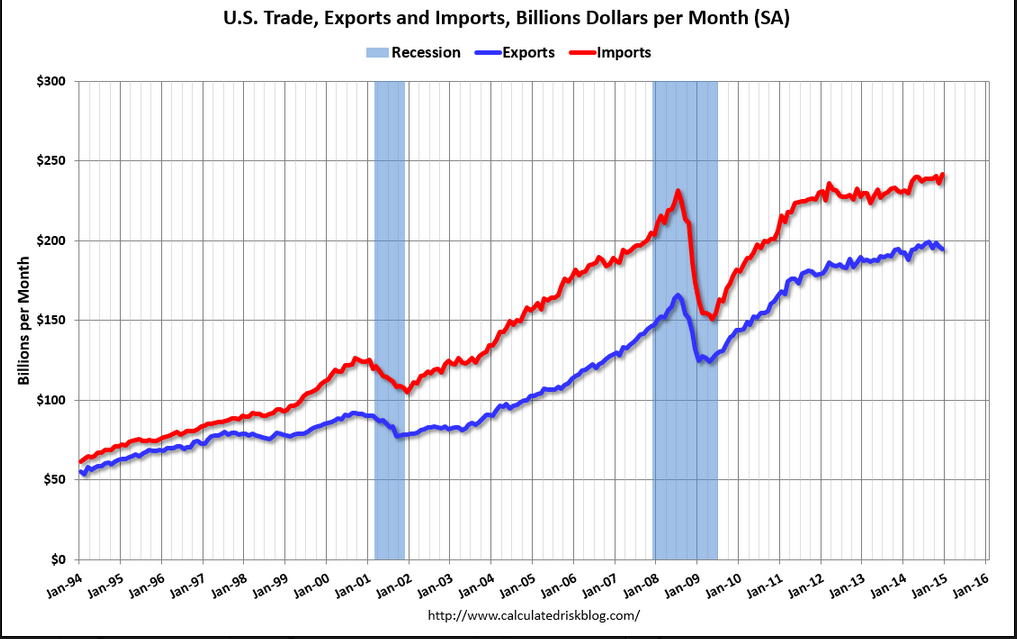
In December, the U.S. trade gap grew to $46.6 billion from a revised $39.8 billion in November. Analysts forecast the deficit to narrow to $37.9 billion. Exports were down 0.8 percent after declining 1.1 percent the month before. Imports rebounded 2.2 percent after falling 1.8 percent in November.

Expansion in the overall gap was led by the goods excluding petroleum gap which increased to $49.7 billion from $46.3 billion in November.

The petroleum goods trade gap posted at $14.7 billion from $11.6 billion in November. Petroleum imports were up 7.7 percent while exports decreased 11.6 percent.

The services surplus was essentially unchanged at $19.5 billion.

On a seasonally adjusted basis, the December figures show surpluses, in billions of dollars, with
with South and Central America ($2.6), Brazil ($0.4), and United Kingdom ($0.1). Deficits were recorded, in billions of dollars, with China ($30.4), European Union ($12.7), Germany ($5.6), Mexico ($5.6), Japan ($5.4), Canada ($3.3), South Korea ($2.7), OPEC ($2.3), India ($2.1), Italy ($2.1), France ($1.1), and Saudi Arabia ($1.0).

Overall, the December number will likely lower estimates for fourth quarter GDP growth. But the good news is that the import numbers suggest that demand is moderately healthy.

eco-release-2-5-6

eco-release-2-5-7

eco-release-2-5-8

mtg purch apps, adp

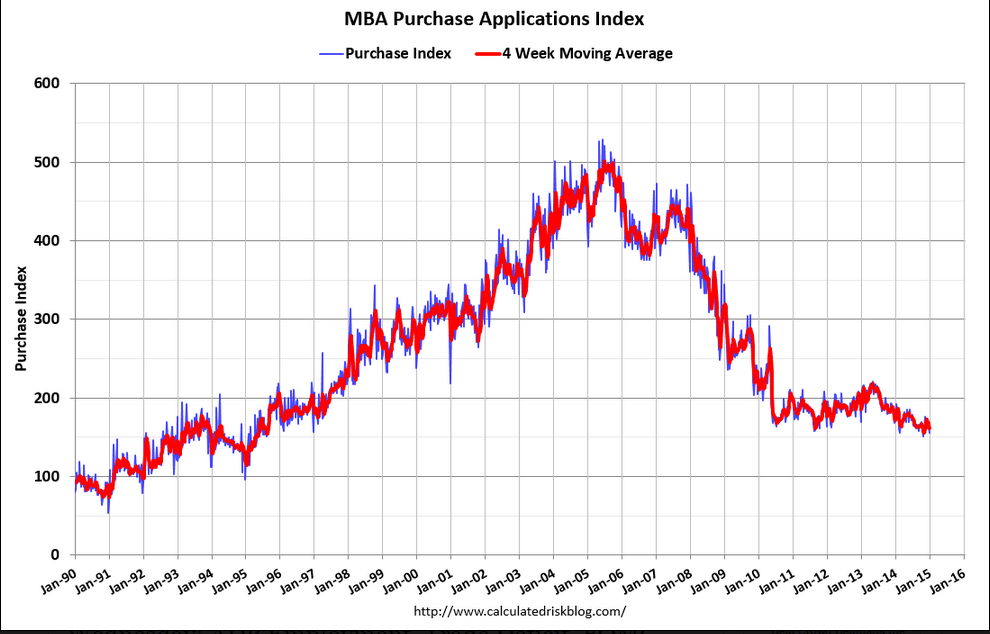
Weaker, and down 8% year over year, even with much lower rates.

MBA Purchase Applications
mba-1-2
Highlights
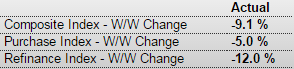
Mortgage application activity fell sharply in the 2 weeks to January 2, down 5.0 percent for purchase applications and down 12.0 percent for refinancing applications. The trend for purchase applications, which offers an indication on underlying home purchases, is clearly negative, at a year-on-year minus 8.0 percent.

The declines come despite low mortgage rates with the average 30-year rate down slightly in the 2-week period to 4.01 percent for conforming loans ($417,000 or less). Note that today’s report covers not the usual 1-week period but, due to a holiday for MBA, a 2-week period.
mba-graph-1-2

Remember, this is now a forecast of Friday’s number, and not the ‘core’ ADP employment itself.

ADP Employment Report
adp-dec
Highlights
ADP’s estimate for private payroll growth for December is 241,000 vs the Econoday consensus for 235,000 and against ADP’s upwardly revised 227,000 for November (initial estimate 208,000). Turning to government data, the corresponding Econoday consensus for Friday’s jobs report is 238,000 vs November’s 314,000.

Imports down, but exports down as well, which could be a trend as surveys have been indicating deceleration.

International Trade
trade-balance-nov
Highlights
The U.S. trade balance again narrowed and more than expected. And again, improvement was largely due to lower oil prices.

In November, the U.S. trade gap narrowed to $39.0 billion from a revised $42.2 billion in October. Market expectations were for the deficit to narrow to $41.5 billion. Exports were down 1.0 percent after gaining 1.6 percent the month before. But imports declined a sharp 2.2 percent after rising 0.7 percent in October.

Shrinkage in the overall gap was led by the petroleum goods trade gap which dropped to $11.4 billion from $15.2 billion in October. Petroleum imports were down 11.9 percent while exports rose 5.9 percent.

The goods excluding petroleum gap increased to $45.7 billion from $45.2 billion in October. The services surplus was essentially unchanged at $40.4 billion.

On a seasonally adjusted basis, the November figures show surpluses, in billions of dollars, with South and Central America ($4.3) and Brazil ($0.6). Deficits were recorded, in billions of dollars, with China ($29.8), European Union ($12.7), Germany ($6.3), Japan ($5.6), Mexico ($4.4), South Korea ($2.9), Italy ($2.3), India ($1.7), France ($1.6), OPEC ($1.6), Canada ($1.4), Saudi Arabia ($1.3), and United Kingdom ($0.2).

Overall, the November number will likely bump up estimates for fourth quarter GDP growth.

Saudi Arabia Raises Price of Main Oil Grade for Asian Buyer

More on Saudi price changes.

Maybe the mainstream will wake up to the fact that the price went down because of Saudi price cuts, and not because of excess supply, etc.

But maybe not…

Saudi Arabia Raises Price of Main Oil Grade for Asian Buyers

By Anthony DiPaola and Grant Smith

Jan 6 (Bloomberg) — Saudi Arabia raised the cost of its oil sales to Asia in February, prompting speculation the world’s biggest exporter is retreating from using record price discounts to defend market share.

Saudi Arabian Oil Co. will sell its Arab Light grade for $1.40 a barrel less than a regional average next month, the company said yesterday in a statement. That’s a narrowing from January, when the discount was $2, the biggest in at least 14 years. It decreased 11 prices globally and increased six. Brent oil fell 5.9 percent yesterday.

Oil prices collapsed 32 percent since the Organization of Petroleum Exporting Countries decided to maintain its output target on Nov. 27, amid signs Saudi Arabia and other members are determined to let North American shale drillers and other producers share the burden of reducing an oversupply. When Aramco lowered prices for November it prompted speculation the nation was seeking to preserve market share.

“They’re putting the brakes on a little bit,” Leo Drollas, a London-based independent consultant and former chief economist at the Centre for Global Energy Studies, said by phone. “It’s a little message that maybe prices are going down too far too quickly, and this is a little signal that they’re looking at things.”

Brent crude added 22 cents to $53.33 a barrel on the ICE Futures Europe exchange at 12:38 p.m. Singapore time. Prices yesterday declined $3.31, or 5.9 percent, to $53.11, the lowest close since May 1, 2009.

Swelling Supplies

The state-owned producer, known as Saudi Aramco, raised prices for all its crudes in Asia and cut all of them for Europe and most in the U.S.

Saudi Aramco surprised the oil market in October when it trimmed November crude prices to five-year lows in Asia, signaling the biggest producer in OPEC would defend its market share rather than seeking to prop up prices. It continued last month, cutting the discount for Arab Light crude for sale to Asia in January to the deepest in at least 14 years.

Swelling supplies from producers outside OPEC drove Brent crude into a bear market on Oct. 8 amid waning demand from China, the world’s second-largest importer. Middle Eastern producers are increasingly competing with cargoes from Latin America, North Africa and Russia for buyers in Asia.

“There is a fight for market share going on,” said Tariq Zahir, a New York-based commodity fund manager at Tyche Capital Advisors. “We are not seeing any kind of production decreased.”

OPEC decided at its last meeting to keep its production target unchanged at 30 million barrels a day. Members pumped more than that for a seventh straight month in December even as the group itself forecasts that markets will need less of its crude.

flow news in 2014 is bad for the Euro

So I still see all the fundamentals/trade flows favoring the euro vs the $US, with the EU running a trade surplus and the US a deficit, and low oil prices ‘helping’ the EU trade balance while ‘hurting’ the US’s.

But the portfolio shifts continue to go the other way, including this report of CB’s shifting some 100 billion out of euro, spurred by the belief that what the ECB is doing and the Greek risk is euro unfriendly, and what the Fed is doing is $US friendly.

It’s as if the corn crop failed, and supply fell below demand, but someone with a large warehouse full of corn decided to sell it all. The price would go down until he was finished, and then the shortage due to the ongoing consumption would start driving prices higher.

Subject: flow snippet: last piece of flow news in 2014 is bad for the Euro

Every quarter the IMF puts out a snapshot of global central bank reserve composition (with a quarters lag).

Today, we got the Q3 numbers, and after accounting for valuation effects, the numbers seem to signal a shift in central bank behavior.

Normally, central banks operate with fairly fixed currency allocation targets, and when a currency goes down in value, they accumulate, to stabilize its share.

In Q3, the Euro dropped sharply vs the dollar, but both G10 and EM central banks were on the margin active sellers of Euro’s.

This is a big deal, as it suggest ‘portfolio rebalancing’ has been put on hold.

This means that stabilizing flows, which could have been in the region $100bn, are not materializing.

If this is indeed the new trend, there may be potential for a faster move lower in the Euro in early 2015, driven more purely by private sector flows.

Happy new year!
Jens Nordvig

The Euro share of global central bank reserves fell significantly in Q3. According to IMF COFER data published today, the Euro share of global reserves dropped 1.5 percentage points to 22.6%. This is one of the largest quarterly declines in the share ever. What is particularly interesting about the fall is that it was a function both of the valuation effect (a weaker Euro vs the USD) and active sales of Euros. This is striking, as normally „portfolio rebalancing‟ would create positive flows (EUR buying) to offset valuation effects when the price of the Euro declines (this happened during the early part of the Euro-crisis for example). As such, it seems that global reserve managers have may have put „portfolio rebalancing on hold‟ in the face of monetary policy divergence and negative interest rates on a large portion of their EUR holdings. If this trend continues, leaving central banks on the sidelines as the Euro declines, the Euro has potential to decline steadily in coming months in line with the trend in private sector flows.

Central Banks accumulate reserves, valuation causes total to fall

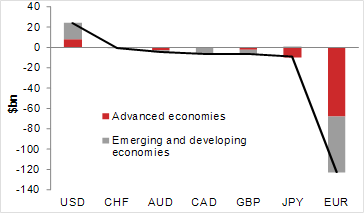
In the 2014 Q3 update of the IMF Composition of Official Foreign Exchange Reserves (COFER) data, global reserves decreased by $218bn, bringing the total reserves to $11.8trn. This is the first quarter that global reserves have fallen since the first quarter of 2009, and is only the third quarter total since the IMF began providing quarterly COFER data in 1999. The most recent data shows allocated reserves decreased by $128bn, while the unallocated reserves decreased by $90bn. However, the decline in reserves was driven by valuation adjustments. Excluding the valuation adjustments, advanced countries added $21bn in reserves, while emerging markets added $31bn.

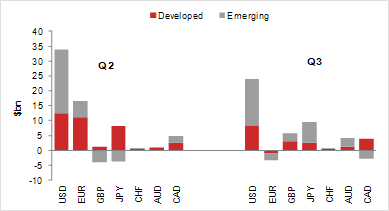
Adjusting the allocated reserves for currency valuation effects, there was central bank reserve buying of $52bn. This was dominated by USD buying, which totaled $24bn, with advanced economies buying $8bn and EM buying $16bn. EUR stood out as the most sold currency, with $3bn sold total, split with $1bn of selling from advanced economies and $2bn from emerging. EUR showed the biggest decline when including valuation and measured in USD, with reserves falling by $123bn (or just over 8% of outstanding EUR denominated (allocated) reserves).
cur-1

cur-2
According to our central bank intervention tracker, intervention slowed significantly to just $22bn in Q3, driven primarily by a large change in tact by China, which switched to FX selling (see Quarterly central bank reserve update, 16 October 2014). The valuation-adjusted flows from the IMF also suggest that intervention slowed, although to a lesser degree, with $52bn of total accumulation compared to $71bn in Q2 (in allocated reserves).

Allocation to USD up, EUR down

With the US dollar gaining strength in the third quarter, it would have been logical to assume a tendency to sell USD and buy some of the relatively cheaper currencies in order to maintain allocations in central bank portfolios. At least this has been the general pattern of central bank behavior in the past, including during the Euro-crisis.

However, in Q3 we saw the opposite. Reserve managers actively accumulated USD and sold EUR. Meanwhile, portfolio rebalancing worked as normal for other currencies, with reserve managers actively buying JPY, AUD and GBP during Q3, helping to stabilize allocated shares. With regard to the Euro, the active selling exacerbated the valuation effect rather than countering it. Hence the USD allocation jumped sharply to 62.3% from 60.7% (a 1.6pp increase) globally and EUR allocation fell to 22.6% from 24.1% (a 1.5pp decline). This fall in EUR allocation globally is the largest in a quarter since Q1 2004 (and larger than the declines during the Euro crisis periods). The USD allocation gain is tied historically with Q1 2004 as the largest.

One reason for the shift out of EUR as a reserve currency could be the low and often negative yields in Eurozone assets. As we highlighted in The Trillion Euro Question, a large amount of short-term bonds and deposits held in Eurozone assets were earning negative yield and at risk for a shift out of the Eurozone. If global reserve managers have indeed disabled portfolio rebalancing in the context of their EUR share, it has important negative implications for the Euro in coming months

If global reserve managers have indeed disabled portfolio rebalancing in the context of their EUR share, it has important negative implications for the Euro in coming months.

Housing starts, Japan discussion, China, US pmi, store sales

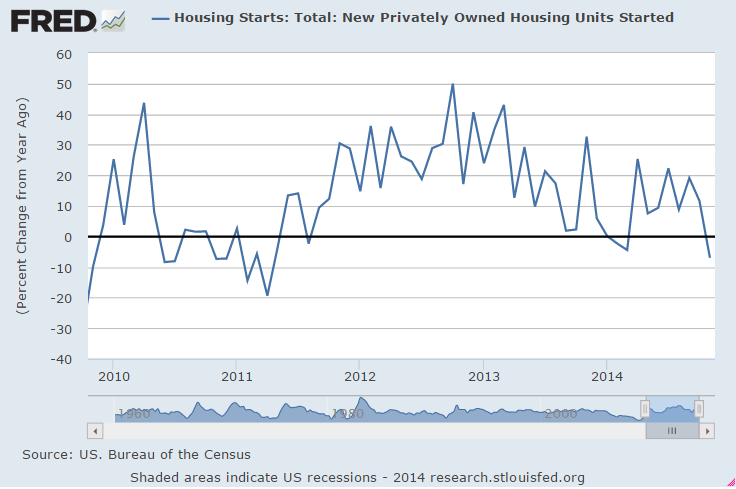
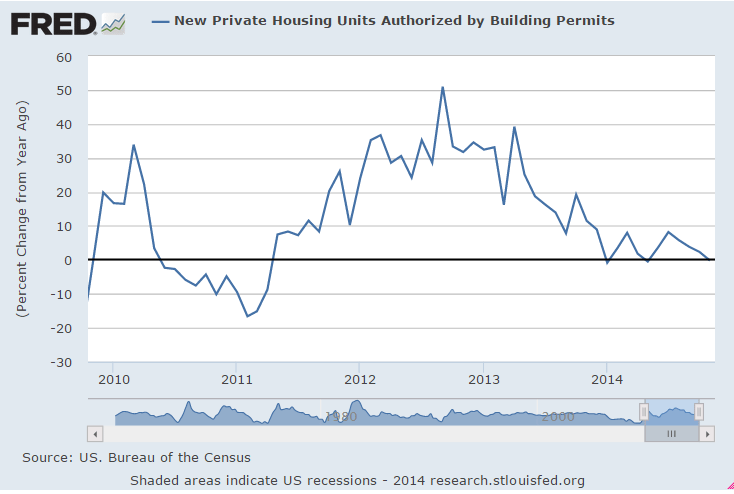
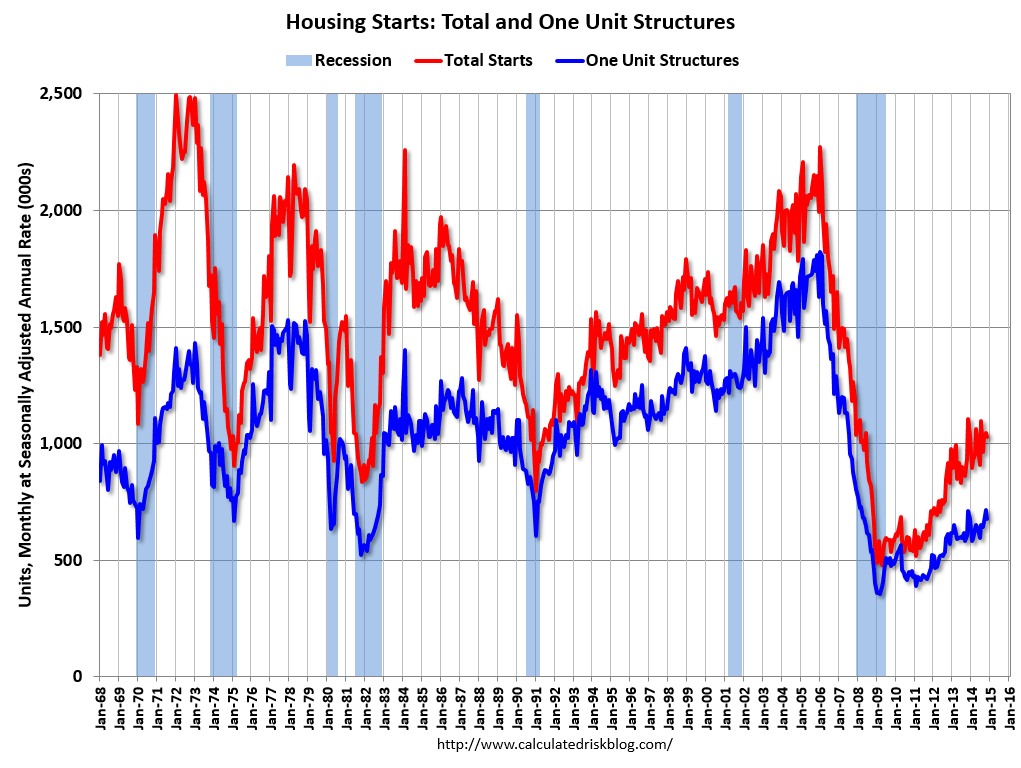
Looks bad to me. Remember, for GDP to grow at last year’s rate, all the pieces on average have to contribute that much. And, as previously discussed, hard to see how starts and sales can grow with cash buyers and mtg purchase apps declining year over year.

The charts look like we are well past this cycle’s peak and headed into negative territory. Not to mention multifamily had been leading the way and those units tend to be smaller/cheaper, so if you were to look at the $ being invested vs prior cycles it would look even worse.

Housing Starts
housing-starts-nov
Highlights
Housing remains on a flat trajectory. Single-family starts and multifamily starts moved in opposite directions. Housing starts dipped 1.6 percent after rebounding 1.7 percent in October. Analysts projected a 1.038 million pace for November. The 1.028 million unit pace was down 7.0 percent on a year-ago basis.

November strength was in the volatile multifamily component. Multifamily starts rebounded 6.7 percent after declining 9.9 percent in October. In contrast, single-family starts fell 5.4 percent in November after gaining 8.0 percent in October.

Housing permits declined a monthly 5.2 percent, following a 5.9 percent jump in October. The 1.035 million unit pace was down 0.2 percent on a year-ago basis. Market expectations were for 1.060 million units annualized.

Overall, recent housing numbers have oscillated notably. October was relatively good but November was not. On average, housing growth appears to be flat to modestly positive.

hs-nov-1

hs-nov-2

hs-nov-3
And how about this headline? Make any sense to you?

hs-headline

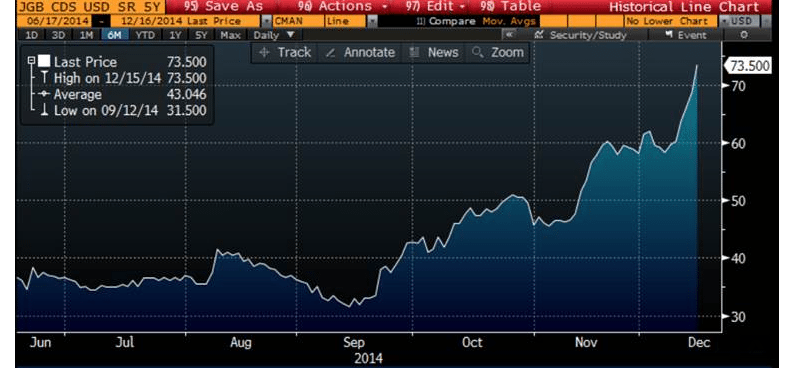
Japan’s got issues, but ability to ‘service it’s yen debt’ isn’t one of them, as it’s just a matter of debiting securities accounts at the BOJ/by the BOJ and crediting member bank accounts also at the BOJ. But markets don’t seem to quite believe that:

jgb-cds

Meanwhile, Japan’s ‘depreciate your currency to prosperity’ policy combined with tax hikes on domestic consumers- about as ‘pro exporter at the expense of most everyone else’- is producing the outcomes previously discussed. They include falling real domestic incomes/real standards of living, increased exporter margins/sales/profits, etc. And more to come, seems, under the ‘no matter how much I cut off it’s still too short, said the carpenter’ mantra now practiced globally.

A few anecdotes:

The day after his ruling coalition secured more than two-thirds of the seats in parliament’s lower house, Mr. Abe acknowledged at a news conference that higher stock prices and corporate profits under his administration have yet to translate into worker gains.

“As I toured around the nation during the election, I heard the opinions of ordinary citizens who are suffering from price increases and small-business owners in difficulties due to price hikes in raw materials,” Mr. Abe said, adding that he will draft an economic stimulus package by the end of the year.

For the second year in a row, the conservative prime minister and his historically pro-business Liberal Democratic Party find themselves in the position of imploring corporations to cut into their profits and give workers more. Mr. Abe said he would summon executives and labor leaders to a meeting Tuesday to make his pitch ahead of next spring’s annual wage talks.

The reason: If wages don’t rise as quickly as prices, households could cut back on spending, endangering an economic recovery. There have only been four months since Mr. Abe took power in December 2012 when real wages—the value of paychecks after accounting for inflation—have risen. A weaker yen has made imported food and other goods more expensive, and a rise in the national sales tax to 8% in April from 5% hit consumers further.

While wages have gone up in nominal terms this year, rising prices — partly the result of a consumption tax hike in April — have negated those gains. Adjusted for inflation, total cash earnings fell 2.8% on the year in October, dropping for a 16th straight month. Unions hope that with this month’s lower house election shaping up to be partly a referendum on Abenomics, the prime minister’s plan for ending deflation, Japan will see a serious debate on wage growth.

The corporate sector is coming to terms with the need to raise pay to some degree next spring.

“What is important is escaping the deflation that has persisted for 15 years,” Sadayuki Sakakibara, chairman of the Keidanren business lobby, told reporters Wednesday.

“Companies that have succeeded in growing their profits ought to reflect that success in their wage increases,” he added.

For the second year in a row, Keidanren will explicitly encourage member companies to raise wages in its guidance for the spring’s “shunto” negotiations.


But even as big export-driven manufacturers cruise toward record profits, many smaller companies, particularly those dependent on domestic demand, are suffering the side effects of a weak yen and still waiting for consumer spending to recover from the tax hike.

China continues to go down the tubes and the western educated hot shots keep pushing the tight fiscal and what they think is ‘loose monetary’ policy that’s failed every time it’s been tried in the history of the galaxy:

Operating conditions deteriorate for the first time since May

(Markit) — Flash China Manufacturing PMI slipped to 49.5 in December from 50.0 in November. Manufacturing Output Index ticked up to 49.7 from 49.6. New Orders decreased while New Export Orders increased at a faster rate. “The HSBC China Manufacturing PMI dropped to a seven-month low of 49.5 in the flash reading for December, down from 50.0 in November. Domestic demand slowed considerably and fell below 50 for the first time since April 2014. Price indices also fell sharply. The manufacturing slowdown continues in December and points to a weak ending for 2014. The rising disinflationary pressures, which fundamentally reflect weak demand, warrant further monetary easing in the coming months.”

Not good here either:

PMI Manufacturing Index Flash
dec-pmi

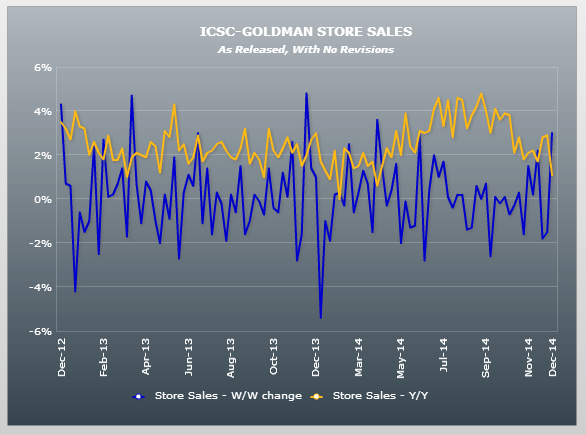
And this came out. Note the year over year trend.

icsc-goldman-dec

Macro update

First this, supporting what I’ve been writing about all along:

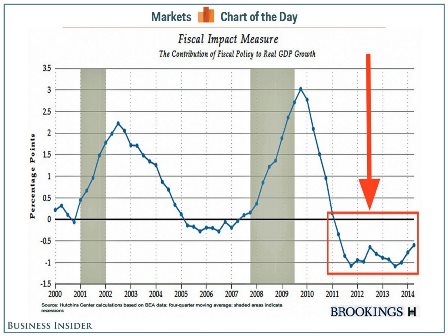
Here’s Proof That Congress Has Been Dragging Down The Economy For Years

By Shane Ferro

Oct 8 (Business Insider) — In honor of the new fiscal year, the Brookings Institution released the Fiscal Impact Measure, an interactive chart by senior fellow Louise Sheiner that shows how the balance of government spending and tax revenues have affected US GDP growth.

The takeaway? Fiscal policies have been a drag on economic growth since 2011.


Full size image

And earlier today it was announced that August wholesale sales were down .7%, while inventories were up .7%. This means they produced the same but sold less and the unsold inventory is still there. Not good!

Unfortunately the Fed has the interest rate thing backwards, as in fact rate cuts slow the economy and depress inflation. So with the Fed thinking the economy is too weak to hike rates, they leave rates at 0 which ironically keeps the economy where it is. Not that I would raise rates to help the economy. Instead I’ve proposed fiscal measures, as previously discussed.

Fed Minutes Show Concern About Weak Overseas Growth, Strong Dollar (WSJ) “Some participants expressed concern that the persistent shortfall of economic growth and inflation in the euro area could lead to a further appreciation of the dollar and have adverse effects on the U.S. external sector,” according to the minutes. “Several participants added that slower economic growth in China or Japan or unanticipated events in the Middle East or Ukraine might pose a similar risk.” “Several participants thought that the current forward guidance regarding the federal funds rate suggested a longer period before liftoff, and perhaps also a more gradual increase in the federal funds rate thereafter, than they believed was likely to be appropriate given economic and financial conditions,” the minutes said.

The case for patience strengthens yet further by a consideration of the risks around the outlook. Across GS economics and markets research, we have recently cut our 2015 growth forecasts for China, Germany, and Italy, noted the continued weakness in Japan, and made a further upgrade to our already-bullish dollar views. So far, our analysis suggests that the spillovers from foreign demand weakness and currency appreciation only pose modest risks to US growth and inflation. But at the margin they amplify the asymmetric risks facing monetary policy at the zero bound emphasized by Chicago Fed President Charles Evans. If the FOMC raises the funds rate too late and inflation moves modestly above the 2% target, little is lost. But if the committee hikes too early and has to reverse course, the consequences are potentially more serious given the limited tools available at the zero bound for short-term rates.

Germany not looking good:

German exports plunge by largest amount in five-and-a-half years (Reuters) German exports slumped by 5.8 percent in August, their biggest fall since the height of the global financial crisis in January 2009. The Federal Statistics Office said late-falling summer vacations in some German states had contributed to the fall in both exports and imports. Seasonally adjusted imports falling 1.3 percent on the month, after rising 4.8 percent in July. The trade surplus stood at 17.5 billion euros, down from 22.2 billion euros in July and less than a forecast 18.5 billion euros. Later on Thursday a group of leading economic institutes is poised to sharply cut its forecasts for German growth. The top economic priority of Merkel’s government is to deliver on its promise of a federal budget that is in the black in 2015.

UK peaking?

London house prices fall in Sept. for first time since 2011: RICS (Reuters) The Royal Institution of Chartered Surveyors said prices in London fell for the first time since January 2011. The RICS national balance slid to +30 for September from a downwardly revised +39 in August. The RICS data is based on its members’ views on whether house prices in particular regions have risen or fallen in the past three months. British house prices are around 10 percent higher than a year ago, and house prices in London have risen by more than twice that. Over the next 12 months, they predict prices will rise 1 percent in London and 2 percent in Britain as a whole. Over the next five years, it expects average annual price growth of just under 5 percent.

British Chambers of Commerce warns of ‘alarm bell’ for UK recovery (Reuters) “The strong upsurge in manufacturing at the start of the year appears to have run its course. We may be hearing the first alarm bell for the UK,” said British Chambers of Commerce director-general John Longworth. The BCC said growth in goods exports as well as export orders for goods and services was its lowest since the fourth quarter of 2012. Services exports grew at the slowest rate since the third quarter of 2012. Manufacturers’ growth in domestic sales and orders slowed sharply from a record high in the second quarter to its lowest since the second quarter of 2013. However, sales remained strong in the services sector and confidence stayed high across the board.

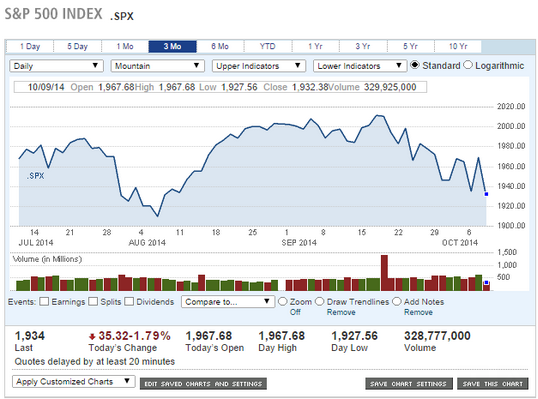
Not to forget the stock market is a pretty fair leading indicator.

Some even say it causes what comes next: