Payrolls

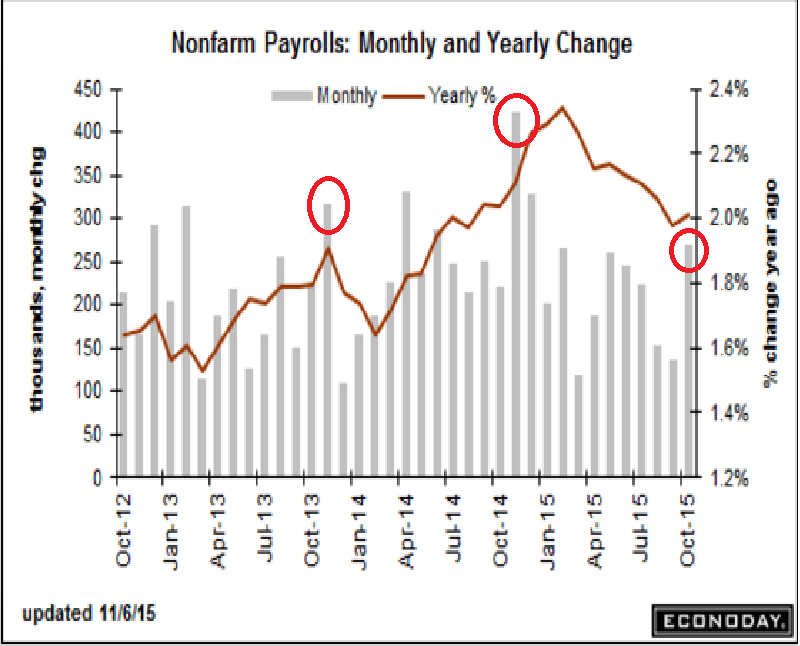
Much higher than expected, so unless next month’s number settles back down the Fed will be expected to hike rates some.

Note from the chart that the last few November releases showed similar spikes followed by much lower prints:
er-11-6-1

Employment Situation
er-11-6-2
Highlights
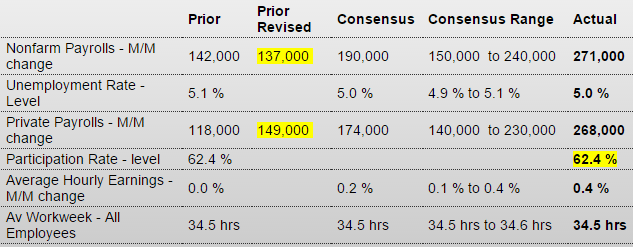
Bring on that rate hike! Nonfarm payrolls surged 271,000 in October vs expectations for 190,000 and against Econoday’s top-end forecast for 240,000. Revisions in prior months are not a factor. The unemployment is down 1 tenth at 5.0 percent with average hourly, to underscore all the strength, jumping 0.4 percent. Government payrolls did not inflate the headline payroll gain as private payrolls rose 268,000. There’s still one more employment report to go before the December FOMC but it seems academic following today’s report.

Among the superlatives, the 240,000 rise for nonfarm payrolls is the strongest since December last year. The 5.0 percent unemployment rate is the lowest since April 2008. The broadly defined U-6 unemployment rate, a favorite of Janet Yellen’s, is down 2 tenths to 9.8 percent for the lowest reading since May 2008. The year-on-year rate for average hourly earnings, at plus 2.5 percent, is the strongest since July 2009.

Payrolls in professional & business services surged 78,000 in the month with the subcomponent of temporary help services – considered a leading indicator of future hiring – up a very strong 25,000. Trade & transportation rose 51,000 while retail trade, which is gearing up for the holidays, rose 44,000. Construction spending is strong and payrolls show it, up 31,000 in the month. But the tide failed to lift the export-hit manufacturing sector where payrolls were unable to rise, unchanged in the month following two prior declines.

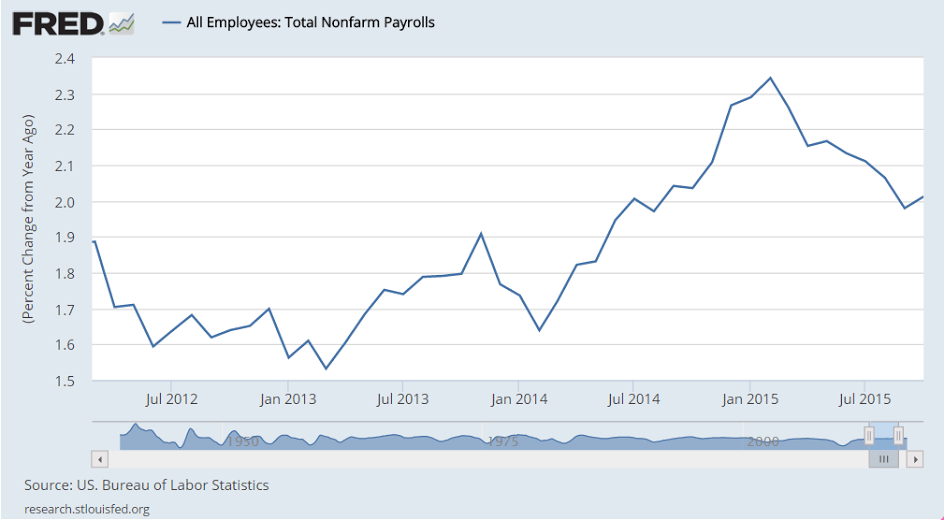
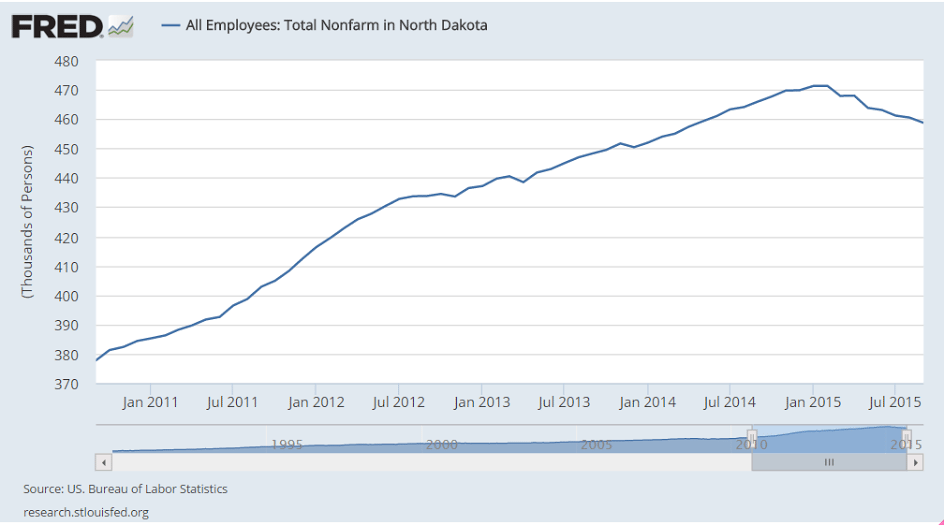
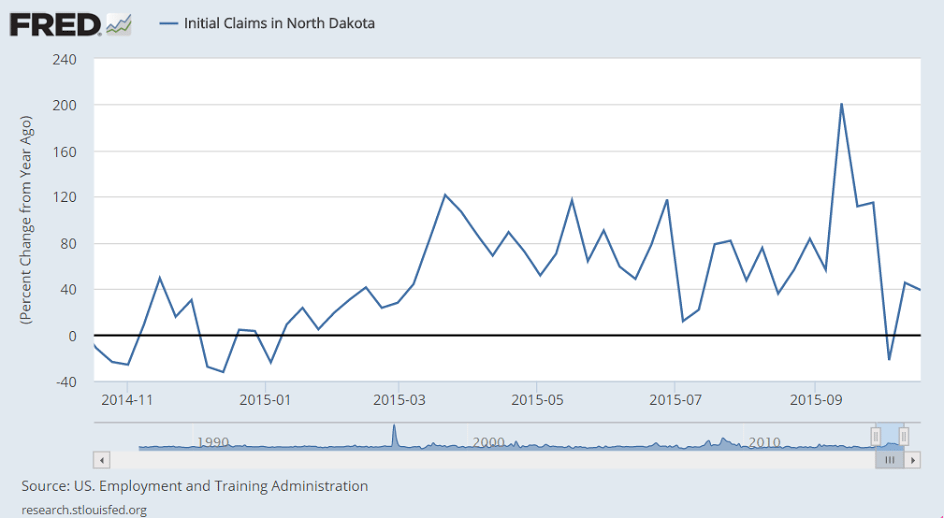
Payroll employment growth still looks to be decelerating since the oil price collapse:
er-11-6-3
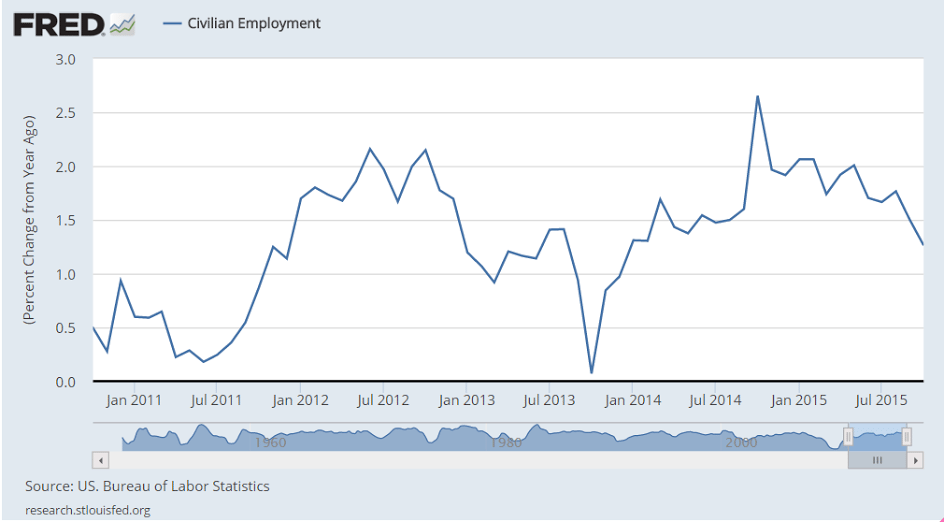
And this is from the Household survey employment report, also decelerating since the oil price collapse:
er-11-6-4

Job Cuts, Yellen Comment, Saudi Pricing, German Factory Orders, Maersk Job Cuts, China Trade Show

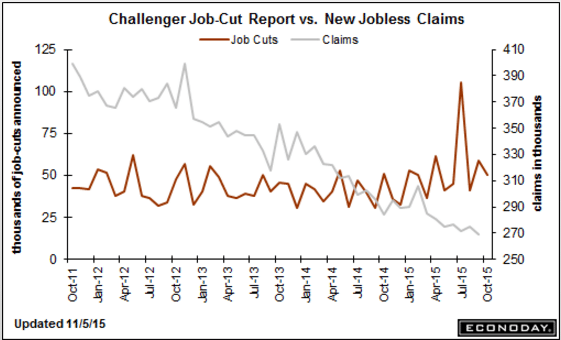
Down a bit but still trending higher since the oil price collapse:
er-11-5-1

Seems she still doesn’t realize negative rates are just another tax:

FED’S YELLEN: IF ECONOMY SIGNIFICANTLY DETERIORATED, NEGATIVE RATES AND OTHER TOOLS WOULD BE ON THE TABLE

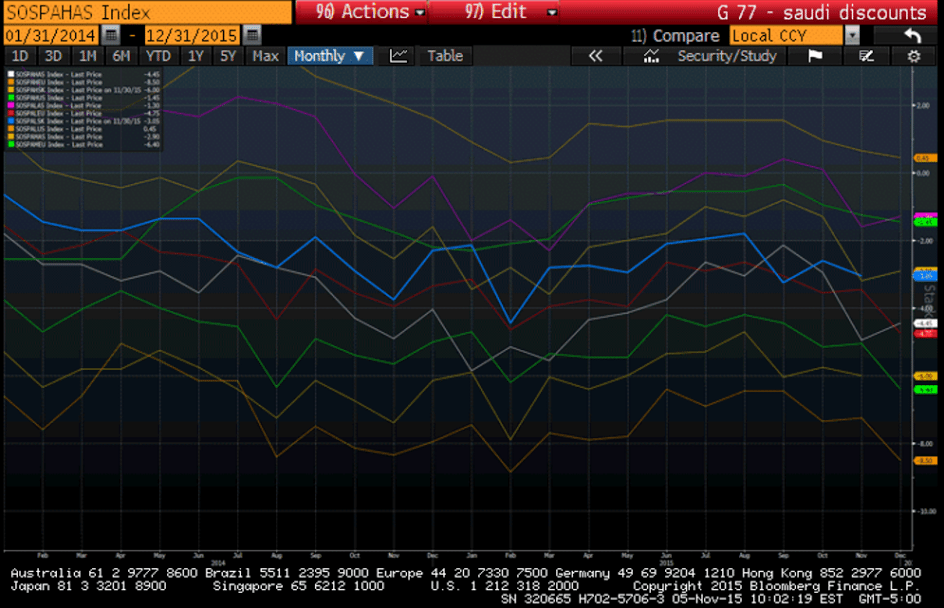
This implies the rest of Saudi pricing remains the same from November, when discounts to benchmarks were substantially increased.

In general, discounts have been increased over the last few months:

Saudi Arabia, the world’s largest oil exporter, raised pricing for December sales of all its crude grades to Asia as profit for refiners improved in the country’s largest market. OPEC’s biggest producer cut its monthly pricing for all blends for buyers in the U.S.

State-owned Saudi Arabian Oil Co. increased its official selling price for Arab Light grade crude by 30 cents to a discount of $1.30 below the regional benchmark, the company said in an e-mailed statement. That beat expectations for a 25-cent increase, according to the median estimate of of six refiners and traders surveyed by Bloomberg this week.

The chart shows that discounts were set at the wides back in Feb, then relaxed some, and are now generally back towards the wides, indicating the desire to keep prices down:
er-11-5-2

German Factory Orders Unexpectedly Decline for Third Month

Nov 5 (Bloomberg) — German factory orders, adjusted for seasonal swings and inflation, fell 1.7 percent in September from August, when they dropped 1.8 percent. Orders declined 1 percent from a year earlier. Factory orders dropped 2.8 percent in the third quarter from the previous one. Demand from within the country increased 0.3 percent and was up 0.9 percent for the euro area. Non-euro-area orders fell 8.6 percent in the July-to-September period. In September, orders for investment goods from the euro area fell 12.8 percent, reflecting a drop in demand for big-ticket items. Excluding bulk orders, demand fell 0.4 percent.

Maersk Line to Cut 4,000 Jobs as Market Deteriorates

Nov 4 (WSJ) — Danish conglomerate A.P. Møller-Maersk A/S saidWednesday its Maersk Line container-shipping unit would cut 4,000 jobs from its land-based staff of 23,000. It is also canceling options to buy six Triple-E vessels. Maersk said it would also push back plans to purchase eight slightly smaller vessels. The conglomerate said it would cut its annual administration costs by $250 million over the next two years and would cancel 35 scheduled voyages in the fourth quarter. That is on top of four regularly scheduled sailings it canceled earlier in the year.

Sliding Canton Fair orders signal poor outlook for producers

Nov 5 (Nikkei) — Foreign orders at China’s leading trade show slipped 7.4%. Chinese producers and overseas buyers at this year’s autumn session of the China Import and Export Fair, better known as the Canton Fair, signed contracts for $27 billion in goods, down from $29.1 billion last fall. Traffic from Europe shrank more than 10% from last fall amid the continent’s hazy economic outlook. The total value of contracts inked at the fair declined from the year-earlier figure for the eighth straight session, drawing alarmingly close to the $26.2 billion total from spring 2009.

Saudi Output, Mtg Purchase Apps, NY ISM, ADP, International Trade, PMI services, ISM Non-manufacturing, Motor Vehicle Sales

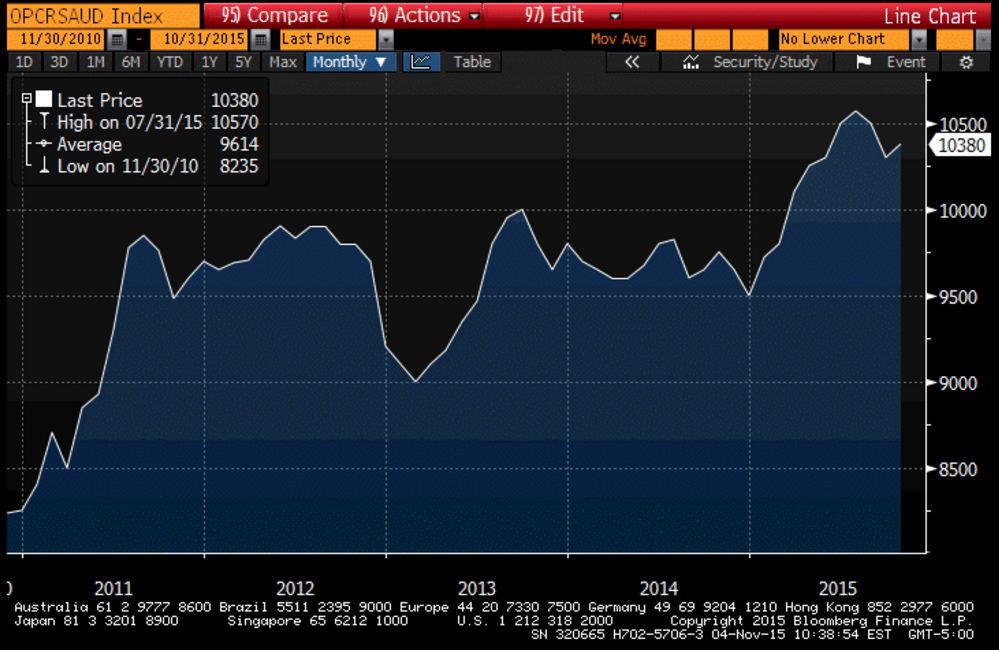
If the Saudis are looking to pump more seems they have to continue to lower prices:
er-11-4-3
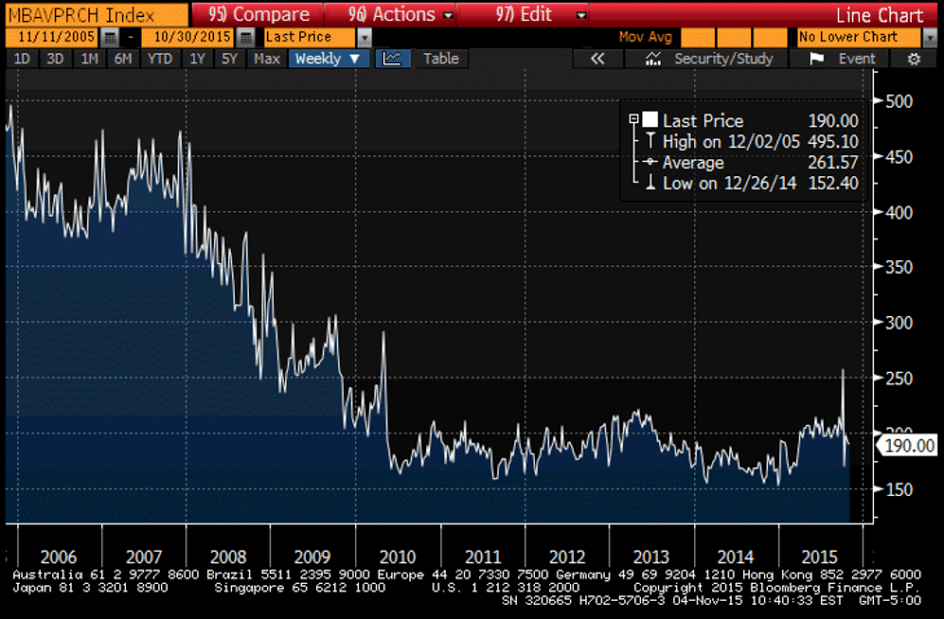
Sure looks like housing still can’t get out of its own way:

MBA Mortgage Applications
er-11-4-4
Highlights
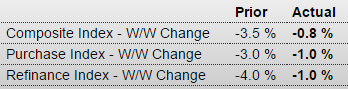
Mortgage applications are settling down after spiking and dipping sharply in volatility tied to new disclosure rules put in place last month. Both the purchase and refinance indexes fell an incremental 1.0 percent in the October 30 week with the purchase index up a very solid 20 percent year-on-year. Rates were mixed in the week with the average 30-year fixed mortgage for conforming loans ($417,000 or lower) up 3 basis points to 4.01 percent.
er-11-4-5
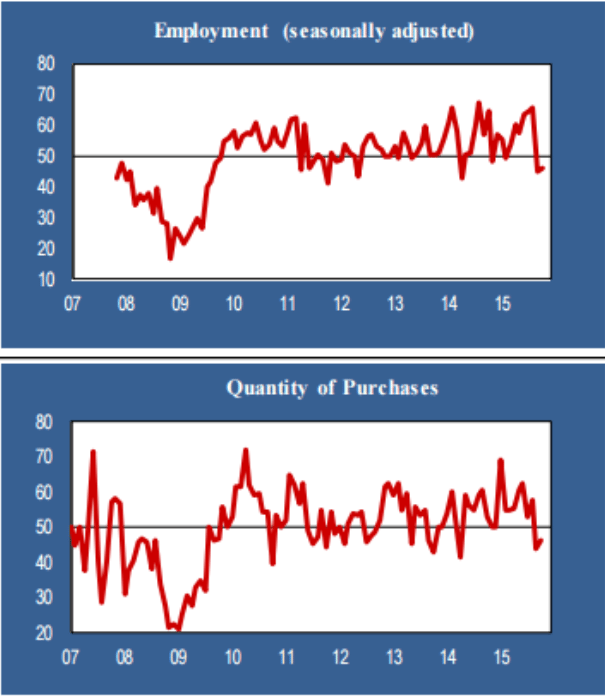
NY ISM company specific business report:
er-11-4-6
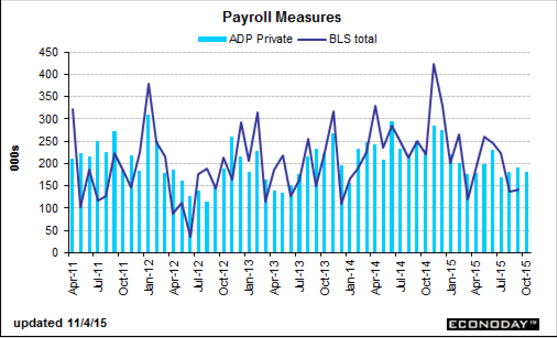
Still working it’s way lower. This is a forecast for Friday’s BLS payroll number:
er-11-4-7
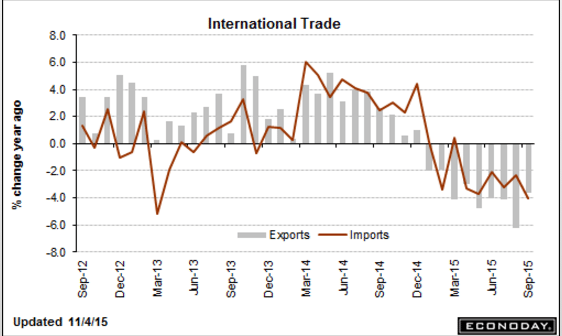
This is a September report. I expect a drop in exports for October and an increase in imports as oil imports increase in line with domestic production declines:

International Trade

er-11-4-8
Highlights
September’s trade deficit came in very near expectations, at $40.8 billion vs the Econoday estimate for $41.1 billion. August’s unusually large deficit is revised slightly lower to $48.0 billion. September’s goods gap came in at $60.3 billion vs last week’s advance estimate of $58.6 billion. This is offset in part by a $19.5 billion trade surplus in services that is slightly smaller than the August surplus.

Exports were solid in the month, up 1.6 percent and led by consumer goods that include artwork and jewelry. Exports of capital goods were also higher, all helping to offset a decline in exports of industrial supplies. Imports fell 1.8 percent with wide declines led by industrial supplies including crude oil followed by capital goods then autos.

The gain in exports is a positive of course and comes despite soft foreign demand which, for U.S. goods and services, is made softer by strength in the dollar. The dip in imports is good for the GDP calculation but isn’t a positive indication for domestic demand, especially given what is a favorable effect from the strong dollar.
er-11-4-9
PMI Services Index
er-11-4-10
Highlights
Growth in Markit’s U.S. service sector sample is slowing slightly, coming in at a final 54.8 vs the flash reading of 54.4 and vs September’s final reading of 55.1. Details are soft with growth in new business at its slowest pace since January and with backlogs down for a third straight month.

Weakness in orders in turn is pulling down 12-month expectations which are near July’s three-year low. Employment is described as modest with hiring at its slowest pace since February. Price readings are mute.

Despite the soft details, the service sector is still humming along solidly and helping to offset weakness in manufacturing.

The overall weakness in the economy began with the oil price and oil capex collapse about a year ago, and while this indicator is off it’s July highs, it seems to be holding firm, at least for now:

ISM Non-Mfg Index

er-11-4-11
Highlights
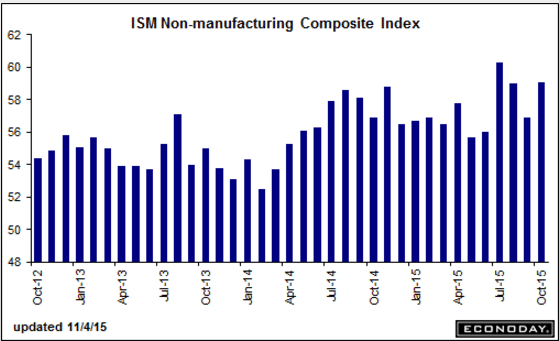
ISM’s non-manufacturing index continues its searing pace, rising nearly 2-1/2 points to a much higher-than-expected 59.1 which exceeds Econoday’s high-end forecast by more than 1-1/2 points. Orders are robust with new orders up more than 5 points to 62.0 and backlogs unchanged at 54.5 which is very strong for this reading. Export orders are also strong, up 2 points to 54.5 and underscoring the strength of the nation’s services surplus as seen in this morning international trade report. But the highlight of the report, ahead of Friday’s employment data, is a nearly 1 point rise in the employment index to 59.2 which is one of the very strongest readings in the history of the report.

Strength is distributed broadly across industries led by transportation & warehousing, health care & social assistance, and professional, scientific & technical services, the latter a center of strength for foreign demand. The two non-service industries covered in this report are mixed with construction rising but mining, hit by low commodity prices, the only industry to report contraction in the month.

Many readings in this report are near records and follow similar readings in July and August which were also unusually strong. This report has been a consistent upside outlier but it undeniably hints at strength for employment and at a December FOMC rate hike.
er-11-4-12

Good sales month but check out the import numbers, which don’t count for GDP:

Motor Vehicle Sales

er-11-4-13
Highlights
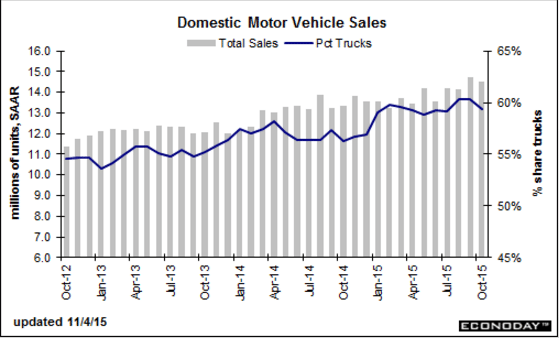
Consumers really showed up in October, at least when it came to dealerships as vehicle sales held unchanged at an 18.2 million annual rate, a 12-year high and outside the Econoday top-end estimate. Import sales, specifically sales of imported light trucks, were the key to October, rising to a 3.7 million rate from 3.5 million and making up for a downtick in sales of North American-made vehicles which slipped to 14.5 from 14.7 million. Still, the 14.5 million rate is also outside the top-end estimate.

These data offer convincing evidence of consumer strength and pull forward, at least to a degree, the Fed’s rate liftoff. But the results, because they do no better than match September, do not quite point to a third straight gain for the motor vehicle component of the October retail sales report.

Domestic sales fell some:
er-11-4-14

Crude Oil, Euro, Opec Spending Cuts

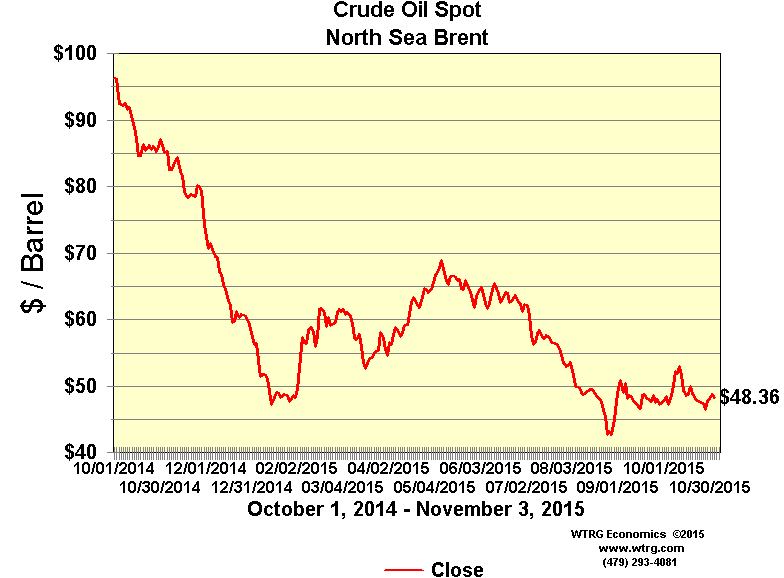
So when the Saudis widened their discounts on October 5 it looked to me like they were inducing a downward price spiral that would continue until either they altered pricing or their output increased to full capacity so they couldn’t sell any more at those discounts. So far neither has happened:
er-11-4-1

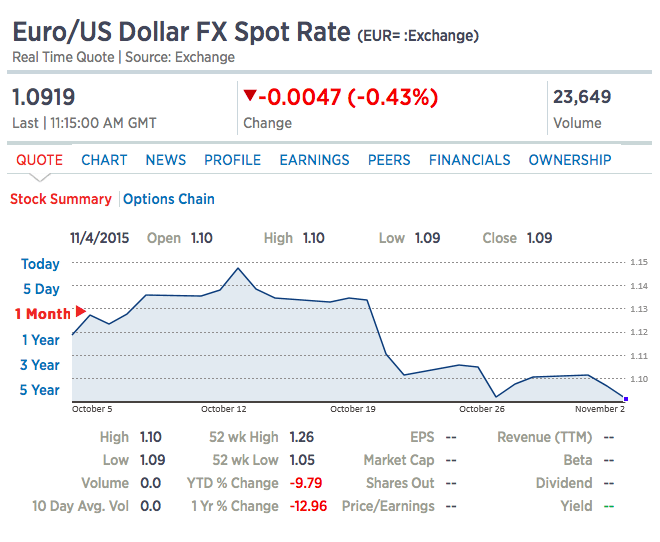
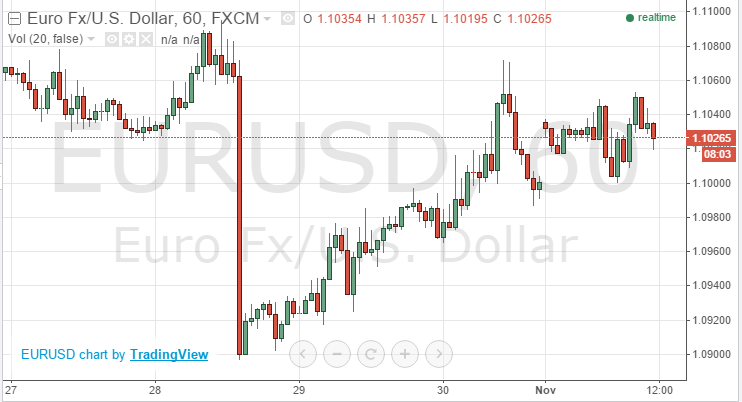
Fundamentally the euro also looks very strong to me, with a large and rising trade surplus vs a rising trade deficit for the US, and negative rates and QE ultimately further remove euro income from the economy likewise fundamentally making it stronger, while higher rates ultimately do the reverse. And deflation *is* a stronger currency, and inflation *is* a weaker currency. Yet the euro has most recently been moving lower on threats from Draghi of lower rates and more QE. So portfolio type selling, until exhausted, continues to dominate even as the fundamentals continue to improve. And there is only one portfolio that can sell indefinitely, and that’s the ECB. And I’ve been assured by all I’ve spoken to that the ECB is not selling euro:
er-11-4-2
It’s not just OPEC, but most entities with oil related income seem to have only partially cut back on spending as prices collapsed, perhaps ‘betting’ on a price recovery. This includes US states with oil and gas revenues, oil companies, and individuals collecting royalty checks. So seems there’s lots more to go:

OPEC Moves to Rein in Costs Amid Oil Price Slump

By Benoit Faucon

Nov 3 (WSJ) — The Organization of the Petroleum Exporting Countries is moving to rein in costs as its members struggle to pay their dues amid a protracted period of low oil prices, OPEC officials said. The producers’ group has delayed new hires, reduced training sessions for staff and scaled back travel. Staff-level OPEC officials are meeting this week in Vienna to discuss adjusting spending at the secretariat, the organization’s central body, officials said. Other topics over three days of talks ending Wednesday include the group’s long-term strategy report, they said.

Atlanta Fed, German Engineering Orders, Misc News, Redbook retail sales, North Dakota, Factory orders

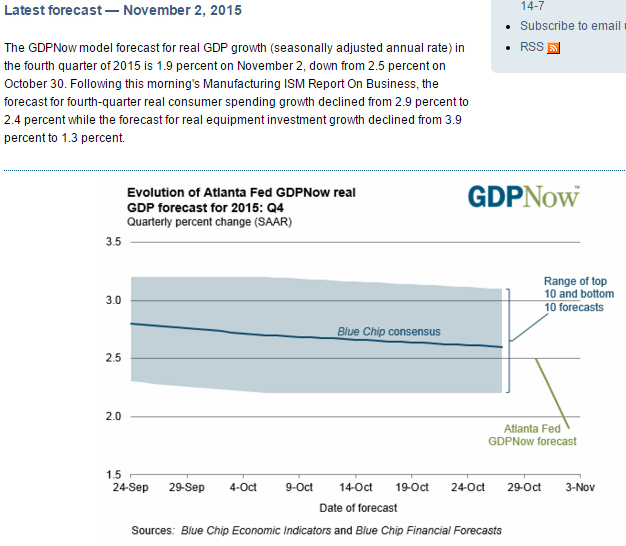
Down to 1.9 for Q4, after being very close for Q1, Q2 and Q3:
er-11-3-1

German Engineering Orders Hit by Lower Demand From China

By Nina Adam

Nov 2 (WSJ) — Germany’s VDMA engineering federation said Monday that its “plant and machinery makers are battling against global markets’ adversities.” German mechanical engineering orders slumped 13% year-over-year in September, hit by a 18% drop in foreign demand. Foreign orders from outside the eurozone were down 7% in the nine months through September from the same period a year earlier. “Companies are feeling the pinch from turbulences in China, which are also affecting other key developing markets,” said Olaf Wortmann, an economist at VDMA, which represents more than 3,000 midsize companies.

er-11-3-2
er-11-3-3
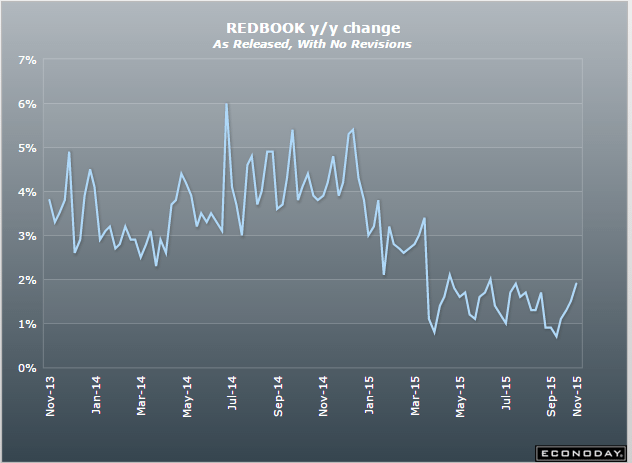
Still depressed but a hopeful forecast, though not long ago 2.8% year over year growth would have been considered low:

Redbook
er-11-3-4
Redbook’s same-store sales tally has been climbing, up 4 tenths in the October 31 to a year-on-year plus 1.9 percent. But the report’s commentary is mixed, saying some retailers benefited from Halloween shopping though it said the fact that Halloween fell on Saturday actually kept shoppers out of stores on Halloween itself. The report’s month-to-month reading shows no meaningful change against September. But the report’s outlook for the key shopping month of November is very strong, forecasting 2.8 percent year-on-year same-store sales growth for the month.

er-11-3-5
er-11-3-6
er-11-3-7
er-11-3-8
er-11-3-9

Bad, worse then expected, and prior month revised lower as well:

Factory Orders
er-11-3-10
Highlights
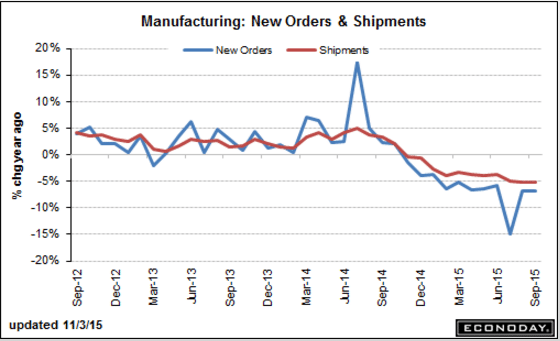
New orders for the export-hit factory sector fell 1.0 percent in September for the 11th decline in 14 months. Orders for durable goods, initially posted in last week’s advance report, are unrevised at minus 1.2 percent, held down in part by a downswing in civilian aircraft but nevertheless showing wide weakness. Orders for non-durable goods, pulled down by weakness for petroleum and coal products, fell 0.8 percent to extend a run of sizable declines going back to July. The factory sector has been struggling with weakness in the energy sector and especially weak foreign demand that for U.S. goods has been made weaker by the strength in the dollar.

er-11-3-11

Draghi Comments, Global Comments

ECB will do what is needed to keep inflation target on track: Draghi

By Stephen Jewkes

Oct 31 (Reuters) — “If we are convinced that our medium-term inflation target is at risk, we will take the necessary actions,” ECB president Draghi told Il Sole 24 Ore. “We will see whether a further stimulus is necessary. This is an open question,” he said, adding it would take longer than was foreseen in March to return to price stability. Draghi said inflation in the euro zone was expected to remain close to zero, if not negative, at least until the beginning of next year. “From mid-2016 to the end of 2017, also due to the delayed effect of the depreciation in the exchange rate, we expect inflation to increase gradually,” he said.

er-11-2-9

Operating conditions deteriorate at a slower pace in October

Nov 2 (Markit) — The China PMI posted 48.3 in October, up from 47.2 in September. Total new business placed at Chinese goods producers declined for the fourth month in a row in October. That said, the rate contraction eased since September’s recent record and was only modest. Softer domestic demand appeared to be a key factor weighing on overall new work as new export business increased for the first time since June, albeit marginally. Nonetheless, a further decline in overall new orders led firms to cut their production schedules again in October.

Weakest deterioration in business conditions since May

Nov 2 (Markit) — The headline Taiwan Manufacturing PMI rose from 46.9 in September to 47.8 in October. Production at manufacturing companies in Taiwan continued to decline in October, as has been the case in each month since April. However, the rate of contraction eased further from August’s 35- month record to the slowest since May. Companies that cut output generally attributed this to poor economic conditions and fewer new orders. The latter was highlighted by a further fall in total new work in October. As was the case with output, however, the rate of reduction was the weakest seen in five months.

Manufacturing conditions deteriorate at weak pace

Nov 2 (Markit) — The South Korean manufacturing PMI posted at 49.1, down slightly from 49.2 in September. Production at South Korean manufacturers declined for the eighth successive month in October. According to anecdotal evidence, global economic uncertainty and poor demand conditions contributed to the latest fall in output. Supporting the fall in output was a decline in total new orders during the month. A number of panellists mentioned unstable economic conditions and a decline in sales from both domestic and international clients as factors behind the latest contraction.

S.Korea Oct exports post worst drop in over 6 yrs as global demand sags

Oct 31 (Reuters) — The trade ministry attributed the declines mainly to a sharp fall in ship contracts and low oil prices. Exports fell 15.8 percent on-year to $43.5 billion in October, their 10th straight month of declines and the sharpest fall since August 2009. Imports slumped 16.6 percent to $36.8 billion. The trade surplus fell to $6.7 billion in October from a revised $8.9 billion in September. The slump in exports was partially expected by economists as South Korea posted a record high in shipments last year.

Growth of manufacturing production wanes further

Nov 2 (Markit) — Posting a 22-month low of 50.7 in October (September: 51.2), the seasonally adjusted Nikkei India Manufacturing PMI waned. Output growth eased in October on the back of a slower increase in new orders. Rates of expansion in both production and order books were the weakest in their current 24-month sequences of growth, with panellists reporting challenging economic conditions and a reluctance among clients to commit to new projects. New business from abroad placed with Indian manufacturers rose for the twenty-fifth straight month in October.

Health Care Expenditures, ISM Manufacturing, Construction Spending

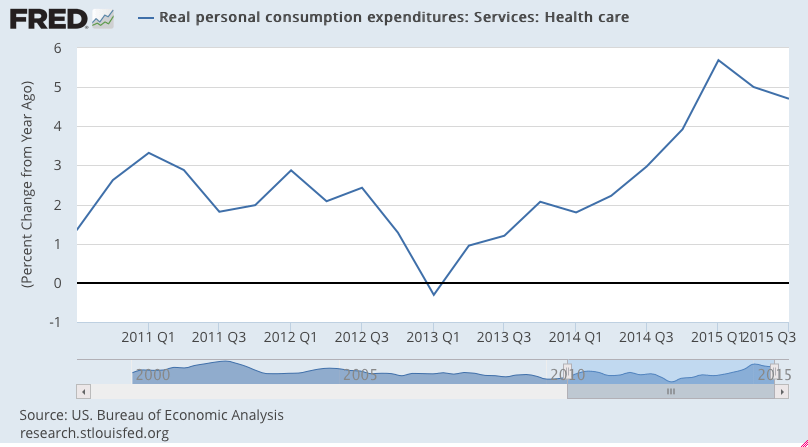
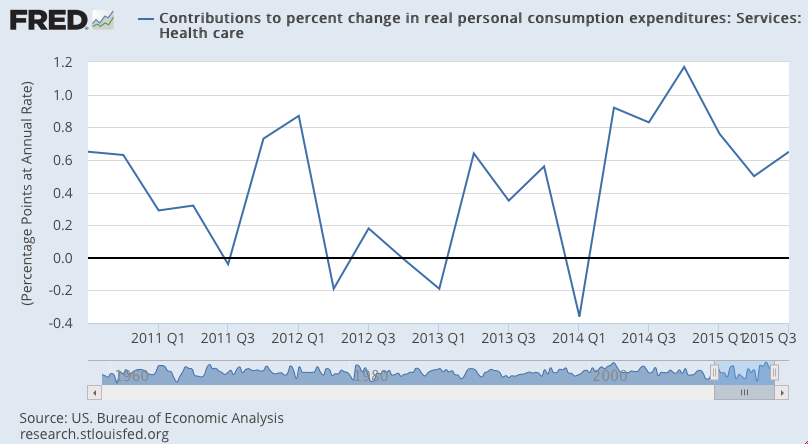
My understanding is that this series includes premiums paid for health insurance and so GDP has gotten a one time boost from from the newly insured who are now paying insurance premiums via the affordable care act. So Q4 should see another reduction and growth and a lower contribution to GDP growth:
er-11-2-1
er-11-2-2
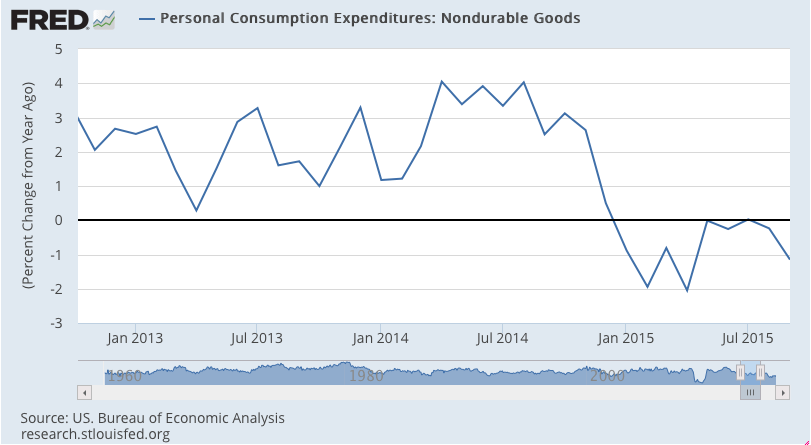
This kind of personal consumption collapsed with the collapse in oil prices and oil capex:
er-11-2-3
er-11-2-4

This is for September, and is slowing as previously discussed after permits peaked in June with the expiring tax laws:

Construction Spending
er-11-2-5
Highlights
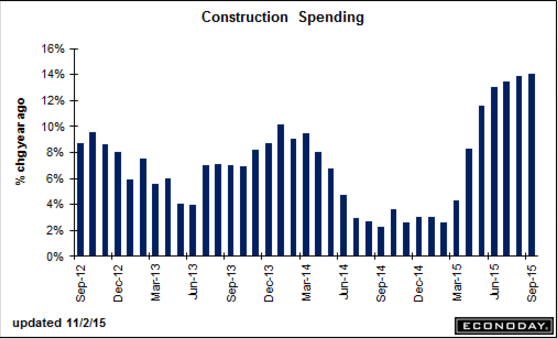
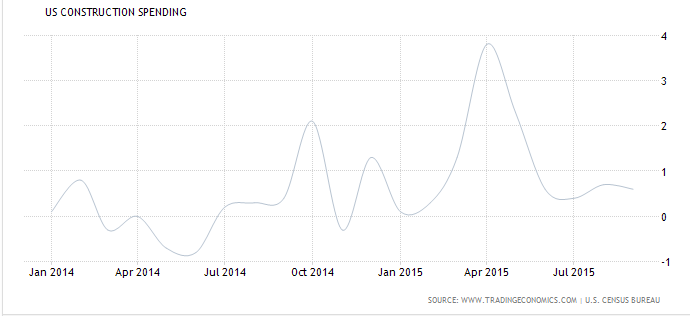
Construction spending looks solid, up a better-than-expected 0.6 percent in September with gains led by housing components. Residential spending extended six months of strong gains with a 1.9 percent increase for a year-on-year gain of 17.1 percent which is 3 percentage points better than the rate for total construction, at 14.1 percent. New multi-family units continue to lead the residential component, up 4.9 percent for a 26.7 percent year-on-year gain, while new single-family homes rose 1.3 percent for a more than respectable year-on-year gain of 12.7 percent.

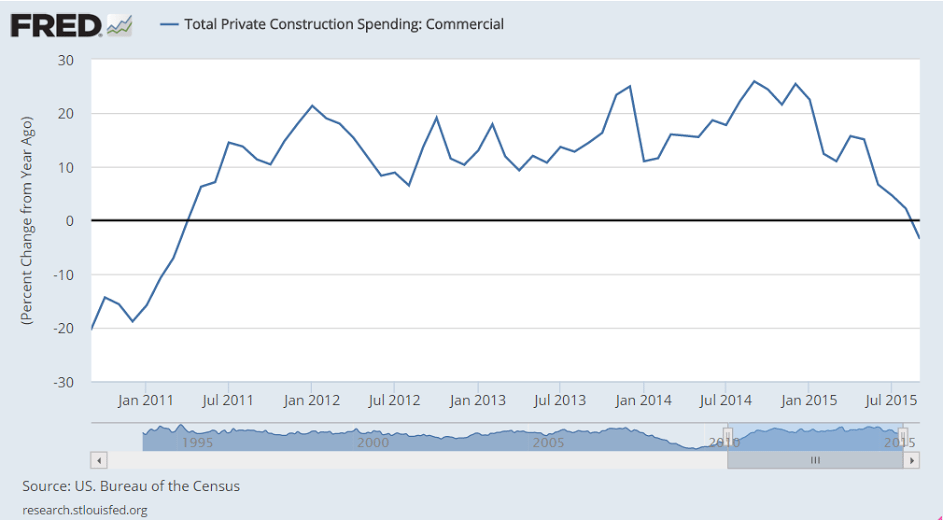
Private nonresidential construction has also been strong this year but not in September, down 0.7 percent including declines for most subcomponents especially both power and commercial. Still, the year-on-year rate for private nonresidential is plus 14.9 percent. Readings on public construction, up a total 0.7 percent in the month, are also favorable with subcomponents trending at or near double-digit year-on-year growth.

The gains in this report, especially for multi-family units, are the outcome of a spike in permits during the spring. Permits, however, have not been showing great strength in recent months, in turn pointing to moderation for what still looks to be, however, a solid construction sector.

er-11-2-6
er-11-2-7
Collapsed when oil prices and oil capex collapsed:
er-11-2-8

The scrap heap of capitalism

Capitalism has always been characterized by a massive scrap heap of failures.

Not to say the ‘winners’ don’t make it all worthwhile!
;)

Why technology spending isn’t all its cracked up to be: Study

By Javier E. David

Oct 31 (CNBC) — Large companies often spend a good deal of money on cultivating their technology, but a new study suggests nearly 70 percent of what they spend may be misallocated.

In a study, Genpact Research Institute recently found that, of nearly $600 billion spent on digital projects, almost $400 billion of it was invested in projects that fall short of expectations and returns on investment (ROI). In fact, much of what companies invest in technology sustains existing, or “legacy” systems, rather than new technology, the report found.

In a global market for technology spending estimated at $4 trillion, an amount that research firm Gartner expects to shrink by nearly 5 percent this year, the wasted money can be significant. It suggests companies will be operating from a smaller pool of money, and will need to invest it wisely.

Brent Spot Chart, China, Atlanta Fed

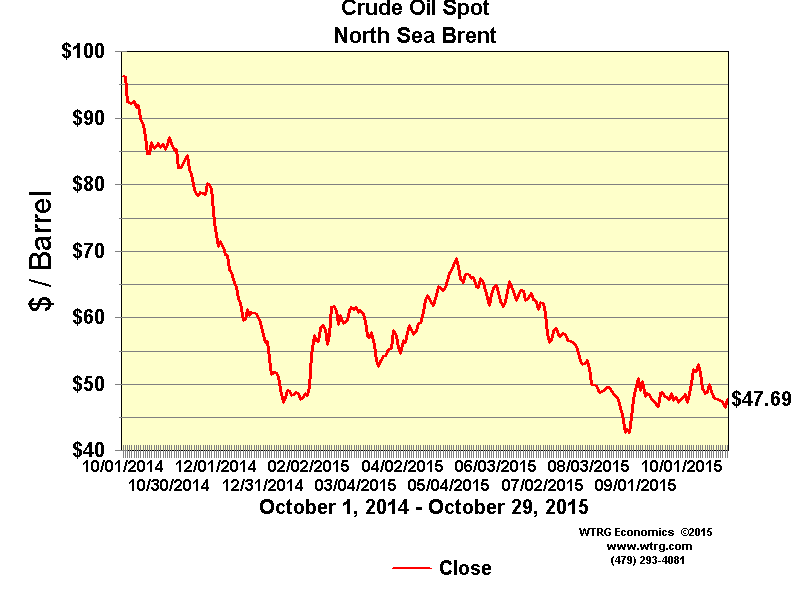
Looks a lot more negative since the October 5 Saudi price cuts than the futures markets. These price are more indicative of prices of physical oil vs financial portfolio activities:
er-11-1
Note the lack of results of ‘monetary policy’:

China’s October factory, services surveys show economy still wobbly

Nov 1 (Reuters) — Activity in China’s manufacturing sector unexpectedly contracted in October for a third straight month, an official survey showed on Sunday, fuelling fears the economy may still be losing momentum in the fourth quarter despite a raft of stimulus measures.

Adding to those concerns, China’s services sector, which has been one of the few bright spots in the economy, also showed signs of cooling last month, expanding at its slowest pace in nearly seven years.

“As deflation risks intensify, a further RRR cut before end of this year is still possible,” ANZ said, referring to reducing the amount of reserves that banks must hold in order to free up more funds for new loans.

The official Purchasing Managers’ Index(PMI) was at 49.8 in October, the same pace as in previous month and lagging market expectations of 50.0, according to the National Bureau of Statistics(NBS). A reading below 50 points suggests an contraction.

New export orders contracted for a 13th straight month, though the sub-index for new orders – a proxy for both domestic and foreign demand – edged up marginally to 50.3, compared with September’s 50.2.

Faced with persistently weak demand, factory owners continued to lay off workers and at a slightly faster pace than in September.

As for the services sector, whose growth has helped offset persistent weakness in manufacturing, the official non-manufacturing PMI fell to 53.1 in October from September’s 53.4. Though still a solid pace of expansion, it was the lowest reading since late 2008 during the global financial crisis, a similar survey showed.

SMALL FIRMS FACING BIGGER STRESSES

Activity in small and mid-sized firms continued to contract in October, with more small firms seeing fund shortages compared to big ones, the official survey showed. Small companies account for up to 80 percent of urban employment and 60 percent of China’s GDP.

The government has cut interest rates six times since November and lowered the amount of cash that banks must hold as reserves four times this year. The latest cut in interest rates and banks’ reserve requirement came on Oct 23.

Beijing has also quickened spending on infrastructure and eased curbs on the ailing property sector. The latter have helped revive weak home sales and prices but have not yet reversed a sharp decline in property investment.

Many economists had expected economic growth would bottom out in the third quarter, with a modest improvement late this year and into early 2016 as additional stimulus measures gradually take effect.

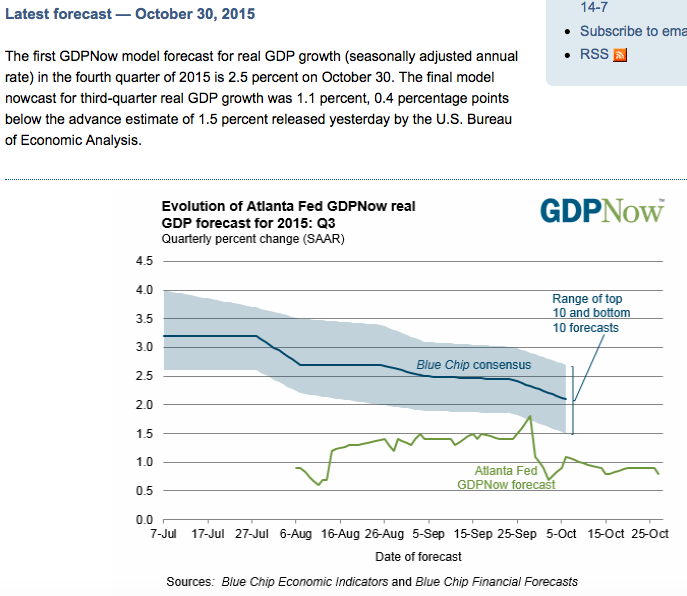
Starting out at 2.5% this quarter. We’ll see how it evolves as numbers are released:
er-11-2

Rail traffic, Personal Income, Credit Check

Rail Week Ending 24 October 2015: A Worse Week Among Bad Weeks

Week 42 of 2015 shows same week total rail traffic (from same week one year ago) and monthly total rail traffic (from same month one year ago) declined according to the Association of American Railroads (AAR) traffic data. Intermodal traffic contracted year-over-year, which accounts for approximately half of movements. and weekly railcar counts continued in contraction.

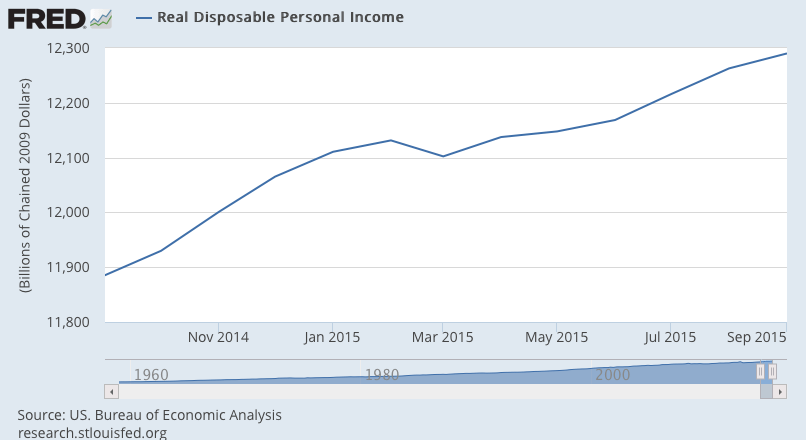
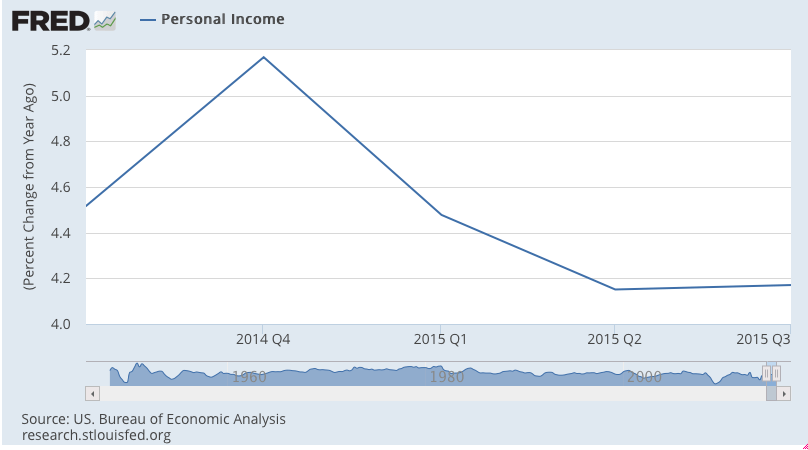
See how the growth rate slowed down just before year end?
er-10-31-1
er-10-31-2
er-10-31-3
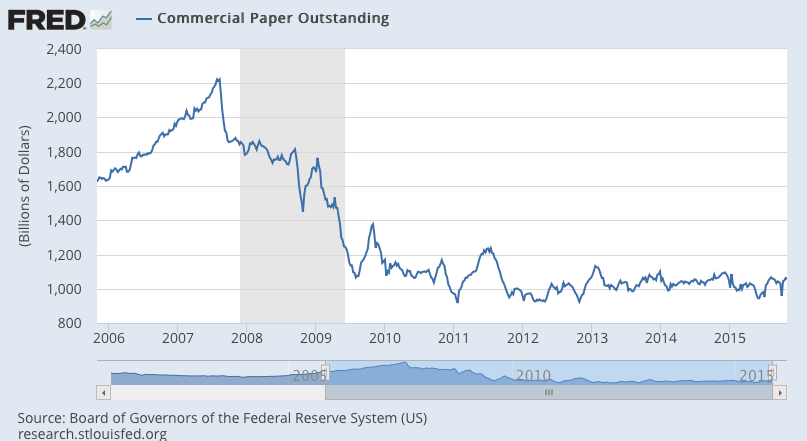
Growth peaked when oil peaked?

er-10-31-4
er-10-31-5