Payrolls


[Skip to the end]


Karim writes:

Apart from net revisions, this employment report pretty much stinks:

  • Jobs -190k
  • UE rate from 9.8% to 10.2%; ‘Total’ unemployment rate from 17% to 17.5%
  • Hours down 0.2%
  • Difffusion index down from 37.5 to 33.8
  • Median duration of unemployment up 1.4 weeks to 18.7
  • Manufacturing jobs -45k to -61k (so much for ISM employment index as a leader)
  • Retail and construction still soft; modest improvement in temp jobs and education


[top]

renting foreclosed houses to former owners


[Skip to the end]

I proposed this when the crisis first hit. Too late for millions of people in thousands of neighborhoods:

“Fannie Mae, the country’s largest mortgage holder, announced today that it is adopting a version of a “right to rent” policy under which foreclosed homeowners will be allowed to stay in their home paying the market rent. Under Fannie Mae’s Deed for Lease Program, foreclosed homeowners will be offered a lease of up to one year, in exchange for turning over the deed to their home. The lease will be at the prevailing market rent.”


[top]

productivity up 9.5%


[Skip to the end]

Lower labor costs for the same sales (top lines were relatively flat) mean revenue is being shifted from compensation to profits, which carry a much lower propensity to consume than wages.

This reduces aggregate demand, which is a good thing, as it means, for example, we can cut taxes to sustain incomes, sales, output, and employment.

Unfortunately, our leaders don’t understand the monetary system and take no constructive action in the name of ‘fiscal responsibility,’ while the main stream forecasts project unemployment to linger around the 10% level for an extended period of time:

The Labor Department said non-farm productivity surged at a 9.5 percent annual rate, the quickest pace since the third quarter of 2003. Productivity grew at a 6.9 percent pace in the April-June period.

Hours worked fell at a 5 percent rate in the third quarter, the Labor Department said. Unit labor costs, a gauge of inflation and profit pressures closely watched by the Federal Reserve, fell 5.2 percent after declining 6.1 percent in the second quarter. Analysts had expected unit labor costs to fall 4 percent in the third quarter. Compensation per hour rose at a 3.8 percent pace and, adjusted for inflation, was up 0.2 percent.

Compared with the July-September quarter of 2008, non-farm productivity rose at a 4.3 percent rate. Unit labor costs fell 3.6 percent year-on-year.


[top]

Goodhart on narrow banking


[Skip to the end]

He’s correct in a world that doesn’t know how to use fiscal adjustments to sustain demand.

If we had had a full payroll tax holiday and per capita revenue sharing for the states introduced immediately after the real economy started experiencing the drop in demand associated with the Lehman failure and the Masters commodity liquidation, and all along had fed funded $8/hr jobs for anyone willing and able to work, the real economy would likely not have sustained anywhere near the damage it did. Unemployment may have risen a percent or so, and the economy would have quickly recovered.

And no one outside of investors caught with bad investments would have much cared about the financial crisis.

As long as the real economy is sustained, any financial crisis is far less of a concern- 1987, 1998, Enron, etc.

Narrow banking is not the answer

By Charles Goodhart

The proponents of narrow banking focus, almost entirely, on the liability side of banks’ balance sheets, and their concern relates to the need to protect retail depositors and the payments system. While this concern is entirely valid, it has been notable in the recent crisis that virtually no retail depositors lost anything, and the payment systems continued at all times to work perfectly. The crisis was not much about that, and policies served to protect these key elements satisfactorily.

The key problem that developed, and to some large extent remains, is that the fragility was experienced in the availability of credit to the real economy, companies and households. The modern economy cannot do without credit, and the need to maintain credit flows has been uppermost in the minds of the authorities.

Credit can be replace by income, and with income restored and sustained, credit quickly follows. Unfortunately, modern governments lack the understanding of their monetary systems to adjust incomes through counter cyclical fiscal policy.

The narrow banking proposal would shift virtually all such credit flows out of narrow banking into those parts of the financial system outside the narrow banking boundary, because the narrow banks would be required to invest in safe assets. So had a narrow banking system been in place, the crisis would have been even worse, with a virtually complete cessation of credit flows to the real economy.

Banks are public private partnerships implemented presumably to serve public purpose

‘Narrow banking’ can include bank lending for home mortgages, automobiles, credit cards, and any other assets deemed to suit public purpose to help isolate those sectors from lender related issues.


[top]

Natural gas from shale


[Skip to the end]

Good story.

The key is to replace crude oil which is now largely used for ground transportation.

Pluggable hybrid cars can do the trick if we can get through the next 10 years while they begin to take over.

And natural gas can begin to replace coal for electric power generation needs as suggested below.

Crude has moved from about 70 to about 80 with no increase in demand, as Saudi and OPEC production, a good indicator of actual demand as the Saudis set price to their refiners and let quantity adjust, was relatively flat last month.

So it looks like the Saudis simply changed their prices under cover of investors giving the futures a bid as they moved maybe another $20 billion (from on what I’ve heard) into that asset class during October.

America’s Natural Gas Revolution

By Daniel Yergin and Robert Ineson


[top]

Short-Rate Thoughts: DEFLATION – Radical Thesis Turnaround


[Skip to the end]

Well stated!

*Not house view.

Since March I have been arguing that the world was a better place than people thought. I am now shifting my core view, which still might take several months to develop in the marketplace.

Skipping to the Conclusions

1. Deflation will be the surprise theme of 2010, when Congress will go into a pre-election deadlock; elections have only underscored this is the public direction

2. Excess Reserves will neither generate new lending nor generate inflation; actually, the quantity of reserves (M0) basically has no real economic effect

3. ZIRP and QE actually CONTRIBUTE to the deflation mostly by depriving the spending public of much-needed coupon income

4. When Federal Tax Rates increase in 2011 this problem will become even more severe

5. The overall level of public indebtedness (vs GDP) will not put upward pressure on yields in this backdrop and there will be a reckoning in the high-rates/deficit hawk community

6. Strong possibility that QE will actually be upsized next year rather than ended when the Fed observes these effects (and this might actually make things WORSE)

The Explanation (a Journey)

It seemed fairly intuitive and obvious for thousands of years that the Earth was at rest and the Sun moving around it. Likewise, it has seemed that the Fed controls the money supply, balances the economy by setting interest rates and fixing reserves which power bank lending, that more Fed money means less buying power per dollar (inflation), that the federal government needs to borrow this same money from The People in order to be able to spend, and that it needs to grow its way out of its debt burden or risks fiscal insolvency. I have, in just a fortnight, been COMPLETELY disabused of all these well-entrenched notions. Starting from the beginning, here is how I now think it works:

1. The first dollar is created when Treasury gives it to someone in exchange for something ammo, a bridge, labor. It is a coupon. In exchange for your bridge, here is something you or anyone you trade it with can give me back to cover your taxes. In the mean time, it goes from person A to person B, gets deposited in a bank, which then deposits it at the Fed, which then records the whole thing in a giant spreadsheet. Liability: One overnight reserve/demand deposit/tax coupon. Asset: IOU from Treasury general account. Tax day comes, Person A pulls his deposit, cashes in the coupon, the Treasury scraps it, and POOF, everything is back to even.

2. For various reasons (either a gold-standard relic or a conscious power restraint, depending who you ask), we make the Treasury cover its shortfall at the Fed and SWAP one type of tax-coupon (a deposit or reserve) for another by selling a Treasury note. Either the Fed (in the absence of enough reserves well get to this) or a Bank (to earn risk-free interest) or Person A (who sets a price for his need to save) is forced out his demand deposit dollar and into a treasury note at the auction clearing price. What about the fact that treasuries aren’t fungible like currency? On an overnight basis, that doesn’t really constrain anyones behavior. A reserve or a deposit means you get your money back the next day. Same thing with a treasury. Functionally its cash and wont influence your decision to buy a car. Likewise for the bank. In the overnight duration example, it does NOT affect their term lending decisions if they have more reserves and few overnight bills, or more bills and fewer reserves. Its even possible to imagine a world (W. J.Bryans dream) where the Fed, with its scorekeeping spreadsheet, combines the line-items we call treasuries and reserves.

3. Total public sector dissavings is equal to private sector savings (plus overseas holdings) as a matter of accounting identity. This really means that the only money available to buy treasuries came from government itself (here I am being a bit loose combining Tres+Fed), from its own tax coupons. If there arent enough ready coupons at settlement time for those Treasuries, the Fed MUST supply them by doing a repo (trading deposits/coupons for a treasury by purchasing one themselves at least temporarily). They dont really have a choice in the matter, however, because if the reserves in the banking system didnt cover it, overnight rates would go to the moon. So in setting interest rates they MUST do a recording on their spreadsheet and the Fedwire and shift around some reserve-coupons (usable as cash) for treasury-coupons (usable for savings but functionally identical).

4. Thus monetizing the deficit is actually just the Feds daily recordkeeping combined with its interest rate targetting, just keeping the score in balance. However, duration is real, as only overnight bills are usable as currency, and because people (and pensions!) need savings, they need to be able to pay taxes or trade tax-coupons for goods when they retire, and so there is a price for long-term money known as interest rates. The Fed CAN affect this by settings rates and by shifting between overnight reserves, longer-term treasuries, and cash in circulation. When the Fed does a term repo or a coupon sale, they shift around the banking and private sectors duration, trading overnight coupons for longer-term ones as needed to keep the balance in order.

5. But all this activity doesnt influence the real economy or even the amount of money out there. The amount of money out there dictates the recordkeeping that the Fed must do.

6. This is where QE comes in to play. In QE, aside from its usual recordkeeping activities, the Fed converts overnight reserves into treasuries, forcing the private sector out of its savings and into cash. This is just a large-scale version of the coupon-passes it needed to do all along. Again, they force people out of treasuries and into cash and reserves.

7. The private sector is net saving, by definition. It has saved everything the Treasury ever spent, in cash and in treasuries and in deposits. In fact, Treasuries outstanding plus cash in circulation plus reserves are just the tangible record of the cumulative deficit spending, also by IDENTITY.

8. So when QE is going on, there is some combination of savers getting fewer coupons which constrains their aggregate demand just like a lower social security check would, and banks being forced out of duration instruments and into cash reserves. I do not think this makes them lend more their lending decision was not a function of their cashflow but rather a function of their capital and the opportunities out there (even when you judge a banks asset/equity capital ratio, there is no duration in accounting, so a reserve asset and a treasury asset both cost the same). If they had the capital and the opportunities, they would keep lending and force the Fed to give them the cash (via coupon passes and repos, which we then wouldnt call QE but rather preventing overnight rates from going to infinity). As far as I can tell, excess reserves is a meaningless operational overhang that has no impact on the economy or prices. The Fed is actually powering rates (cost of money) not supply (amount of money) which is coming from everyone else in the economy (Tres spending and private loan demand).

9. Ill grant there is a psychological component to inflation phenomenon, as well as a preponderance of ignorance about what reserves are, and that might result in some type of inflationary event in another universe, but not in the one we are in where interest rates are low and taxes are going up and the demand for savings is therefore rising rather than falling.

10. One can now retell history through this better lens. Big surpluses in 97-01, then a big tax cut in 03. Big surpluses in 27-30, then a huge deficit in 40-41. Was an aging Japanese public shocked into its savings rate or is that savings just the record of the recessionary deficit spending that came after 97? It will be interesting to watch what happens there as the demographic story forces households to live moreso off JGB income will this force the BOJ to push rates higher or will they never get it and force the deflation deeper?

11. There are, as always mitigating factors. Unlike in the Japan example, a huge chunk of US fixed income is held abroad, so lower rates are depriving less exported coupon income which is actually a benefit. There is of course some benefit from lower private sector borrowing rates as well MEW, lower startup costs for new capital investment, etc. Also, even if one denies that higher debt/gdp ratios are what weakened it (rather than Chinas decisions again something unavailable to Japan), the dollar IS weaker now which is inflationary. But this is all more than offset, I think, by ppls expectation that higher taxes are coming, and thats hugely deflationary and curbs aggregate demand via multiple channels.

12. Additionally, there seems to be a finite amount of political capital that can be spent via the deficit, and that amount seems to be rapidly running out. See https://portal.gs.com/gs/portal/home/fdh/?st=1&d=8055164. The period of deficit stimulus is mostly behind us. Instead, people are depending upon ZIRP and the Fed to stimulate the economy, and in fact there is marginal, and possible negative, stimulation coming from that channel. The Fed is taking away the social security checks knowns as coupon interest.

13. Finally, there is a huge caveat that I cant get around, which is whether we are measuring inflation correctly. It happens that I don’t think we are strange effects like declining inventory will provide upward pressure and lagged-accounting for rents providing downward pressure in the CPI. This is an unfortunate, untradeable fact about the universe that I think will be offset by other indicators (Core PCE) sending a better signal. But this is part of the reason this whole story will take time to develop in the marketplace. As a massive importer of goods and exporter of debts we are not quite Japan, but the path of misunderstanding is remarkably similar.

* Credit due Warren Mosler and moslereconomics.com for guiding my logic.

J. J. Lando


[top]

GOLD: Making new highs


[Skip to the end]

If gold is a bubble it certainly hasn’t broken yet.

And if central banks decide to buy it in size they are capable of running it up until they decide to stop.
It’s what I’d call off balance sheet deficit spending. When a CB buys gold functionally it’s govt spending without taxing, adds to demand, etc. just as if the tsy had bought the gold with deficit spending, but it’s not accounted for as part of the deficit.

So we go out and spend enormous effort and energy to build the heavy equipment and related hardware to dig vast holes in the ground we call gold mines, bring up immense quantities of ore to get tiny quantities of gold out of it and by labor and energy intensive refining to make it into gold bars, which we then spend more time and energy to transport to each CB’s hole in the ground also constructed with large quantities of real resources, and spend more time and materials guarding our gold in our hole in the ground against someone going to the the trouble to take our gold out of our hole in the ground and put it in their hole in the ground. (Steve Cianciola, circa 1970)

Printing new highs in Gold this morning in London (1093.10 the high paid so far) 1 month atms up another +1.5pts (after being up 3.5pts yesterday: 17 –>20.5) as we continue to see a lot of interest and short dated upsides from a variety of accounts/investors over the past 24hrs. I have attached GSJBWere note below with their thoughts on IMF gold sales to India which they published overnight – it’s a quick read and just reiterates what we have been saying on the desk that this has been most certainly a key development for the gold market on its own; also worth noting that GSJBWere raised 12-month trading range in Gold to $950 – $1200/oz.


GSJBWere Commodities: Gold Sector: Indian Rope Trick
Commodities | Australia

• The International Monetary Fund (IMF) has completed a sale of 200 tonnes of gold to India, for a consideration of US$6.7 billion.


• The quantity is a little under 50% of the total of 403.3 tonnes of gold to be sold by the IMF, approved for sale as recently as September this year. It also constitutes half of the annual sales capacity agreed by the current Central Bank Gold Agreement.


• The gold price rallied to a fresh record high above US$1,085/oz shortly after the news was released.


• The fact that such a large sale was executed off-market and without any negative impact on the gold price will greatly reduce concerns about the overhang of the remaining 203 tonnes of approved sales quota.


• Furthermore, we find it hard to imagine that India will be the only country looking at gold as an opportunity to diversify its reserves away from the US dollar.


• We therefore view this development as very positive for the gold price outlook, and we have raised our 12-month trading range to US$950 – $1,200/oz (formerly $925 to $1,100/oz).


• We have also raised the base price for our gold price assumptions to $1,000/oz (formerly $950/oz), given that the average price in October exceeded our expectations at $1,043/oz. The changes to our annual average gold price assumptions and earnings estimates are tabulated below.


[top]

Mtg apps


[Skip to the end]

No sign of housing improvement here:

The MBA’s seasonally adjusted purchase index fell 1.8 percent to 250.3. The four-week moving average of mortgage applications, which smoothes the volatile weekly figures, was down 5.5 percent.

Refinancing Jumps

The Mortgage Bankers seasonally adjusted index of refinancing applications increased 14.5 percent to 2,693.7.


[top]

ISM Employment/Small Business Employment


[Skip to the end]


Karim writes:

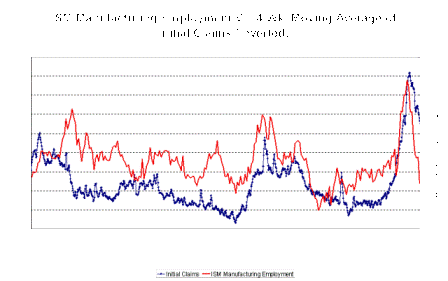
The employment component of ISM yesterday was much stronger than expected at 53.1.

Based on the chart below, one would expect to see claims near 350k and payrolls turn positive.

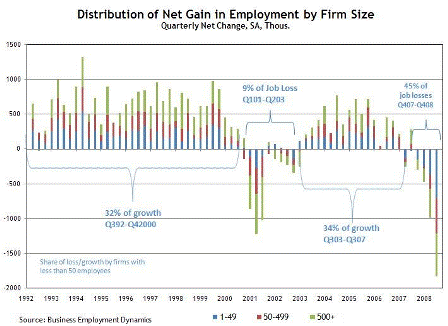
We should find out soon enough if true or not, but the lower chart shows good reason for skepticism.

Small businesses have been the largest contributor to job losses (way more than the typical downturn). ISM companies typically have more than 1000 employees.

Small businesses also depend most on small and regional banks for credit; helping to explain the Fed’s sensitivity to this issue


[top]