Email exchange on balanced budget multiplier

>   
>   (email exchange)
>   
>   Hi Warren, I’m a bit confused over one point. MEMMT says that only govt deficits (or an
>   external sector like foreign) can inject NFAs into nongovt. So if govt runs a balanced
>   budget over the years the NFAs left to nongovt will net to 0.
>   

Yes.

>   
>   Now take Keynes’ consumption function and the multiplier. Govt invests 100$ into Mr A in
>   nongovt. Mr A will spend on average 75% of that, and will save the rest.
>   

Yes.

>   
>   The next guy will spend 75% of the $ he got from A and save, and so on along an ever
>   dwindling series of consumption expenditures that will add to say 300$, ie the multiplier
>   effect.
>   

Ok. This presumes there is unemployment/unmet savings desires. And the additional 100$ of nfa will have resulted in higher levels of employment that produced the 300$ of incremental output.

>   
>   So, say that govt runs a balance budget, ie spends 1 billion and will tax 1 billion, however
>   the multiplier effect will have created in the aggregate a lot more $ out of the original
>   govt injection of 1 billion.
>   

If it all reduces savings desires unemployment will fall and output will rise. The presumption is that the 1 billion tax cuts spending by less than 1 billion, while the spending is the full 1 billion. That is, savings desires fell as those who were taxed spent from savings (or borrowed to spend, same thing).

And just as the initial govt spending is spent and respent as you describe, the tax also cuts spending which further cuts spending etc.

The presumption of the idea that an equal spending and tax will lower unemployment must be based on one of two things.

First, somehow those taxed simply reduce their savings and their savings desires. This is certainly possible.

The second is first illustrated at the extreme.

As govt employment grows the number of people left in the private sector falls, and we don’t measure unemployment as a % of the private sector work force. So if half the workforce in Italy is in the public sector, and unemployment is 10%, that means unemployment is some 20% of the available private sector labor.

So if, for example, govt employment was 90% of the labor force, it would be impossible for reported unemployment to be over 10%.

With 100% public employees there is 0 unemployment as defined.

I discussed this back in 2008 and I need to repeat it in a post thanks!

>   
>   And here is where I lose it. Will this mean that even in a balance budget regime in reality
>   govt is never able to tax as many FAs as the multiplier will have created in nongovt before
>   taxation is due? Is this disproving MEMMT and prove instead that a balance budget can
>   still create NFAs for nongovt? Thx P.
>   

Not at all.

ME MMT fully explains the workings of the condition described.

;)

Added link to Bill Mitchell’s dissertation on the subject here.

Monti Proposes More Than EU13.5 Billion in New Tax Breaks, Cuts

The headline is promising but the details don’t read at all well.

Italy needs aggregate demand/spending/sales/ouput/employment. Cutting corporate taxes does precious little of that, especially over 5 years beginning 2014. And tax cuts ‘paid for’ by spending cuts tend to reduce demand overall as well, as does fighting tax evasion. And there’s nothing he can do about bond yields.

And I doubt his opposition is offering anything better.

As the gag stated, the food was bad and the portions were small.

Monti Proposes More Than EU13.5 Billion in New Tax Breaks, Cuts

January 27 (Bloomberg) — Italian Prime Minister Mario Monti said that he plans tax breaks and reductions worth more than EU13b if hes elected to a second term in February. Monti spoke in an interview on La7 Television. Monti proposes cutting corporate taxes after 2014;Monti sees EU11.5b reduction in corporate taxes over 5-yr period; Monti says he plans tax breaks for first-home owners, families with children worth EU2b; Monti says he will revamp IMU property tax from this year; Monti says he will try to cut income tax rates after 2014; Tax cuts can be paid for through cutting spending, fightingtax evasion and keeping bond yields down.

Draghi Says Conditions Considerably More Favorable Than Last Yr

As previously discussed, looking like deficits high enough for stability and even modest growth, albeit with output and employment at tragically low levels, if they don’t further tighten fiscally.

It didn’t have be this way. They could have increased deficits pro actively vs via austerity.

Also, their ‘automatic fiscal stabilizers’ are very strong and, even if all is left alone, will tend to keep any recovery muted.

EU Headlines
Draghi Says Conditions Considerably More Favorable Than Last Yr
Merkel Takes Swipe at Yen
German Business Sentiment Rose More Than Forecast in January
Ifo Business Climate Index Rises
German Cooperative Banks See Growth Exceeding Government Outlook
France needs time to overtun rampant jobless rate: minister
Monti Says Monte Paschi Bailout Hinges on Bank of Italy
Italian PM under fire over bank crisis
Spain tries to peel back business rules

Berlusconi comments

As if their problems end with lower borrowing costs.
No mention of needing to run much larger deficits:
Yesterday Berlusconi put it plainly and simply:

Berlusconi says Italy may be forced to leave the euro zone

Silvio Berlusconi said that Italy would be forced to leave the euro zone unless the ECB gets more powers to ensure lower borrowing costs. Berlusconi, who will again lead his People of Freedom party (PDL) in a national election, said that the ECB should become a lender of last resort for the currency bloc. “If Germany doesn’t accept that the ECB must be a real central bank, if interest rates don’t come down, we will be forced to leave the euro and return to our own currency in order to be competitive,” Berlusconi said.Berlusconi is already campaigning hard for the election with a spate of television interviews in an attempt to close the wide gap with the center-left Democratic Party which is polling at above 30 percent, some 14 points above the PDL.

My response to a post on an Italian Keynes blog

Warren Mosler comments on Keynes blog, Italy

warren mosler 8 dicembre 2012 alle 15:33

First, let me remind that MMT was originally ‘Mosler Economics’ which began with ‘Soft Currency Economics’ (1993) which can be found at https://moslereconomics.com. Also, highlights of the ‘history of MMT’ are in ‘The 7 Deadly Innocent Frauds of Economic Policy’ free online also on my website. Note too that ‘Soft Currency Economics’ was a result of my first hand experience after 20 years in banking and monetary operations. I had never read Keynes, or even heard of Lerner, Knapp, or had any knowledge of any ‘post Keynesians’. So while it may be true that MMT can be derived from one school of thought or another, it didn’t happen that way. And, for example, when I put forward my ‘real vs nominal’ discussion of fiscal transfers in a monetary union earlier this year, explaining how the production of public goods and services for the benefit of the entire union is in fact a real cost to the region that receives the funding to produce these public goods and services, that was also ‘original MMT thought’ (fully recognizing the shortcomings of such a statement!).

Second, if there is a ‘fundamental’ contribution of MMT to ‘the literature’ it’s the explicit recognition that a currency like the dollar is in fact a simple public monopoly, and all the rest follows. Along those lines I have lectured on the long standing ‘Keynes vs the Classics’ discussion, where the Classics argued there can be no unemployment without monopoly, and Keynes argues there in fact can be persistent unemployment even without monopoly, due to the effects of unspent income, etc. in the monetary system. My response is they both failed to explicitly recognize the currency itself is a public monopoly. Notional demand is from taxation and from savings desires, and notional supply from state spending and/or state lending. And unemployment is the evidence of a restriction in supply from the monopolist- the failure to spend enough to satisfy the need to pay taxes and the desires to net save in that unit of account. So the classics were right in that unemployment does come from monopoly, but they failed to recognize the applicable monopoly. And Keynes was right, the problem was on the monetary side, but he failed to recognize the currency itself was a simple public monopoly, even though he described it much along those lines. If Keynes had recognized the currency was a monopoly, he surely would have explicitly said so in this discussion, and many other places as well to support many of his contentions. I’ll post this and then go on with additional response to the above blog.

warren mosler 8 dicembre 2012 alle 15:50

With regard to circuit theory, when I first met the Post Canadians ;) in the mid 1990’s who I very much respect, especially the M&M’s (Mario and Marc), and read a bit of circuit theory, it seemed so ‘intuitively obvious’- a case of ‘goes without saying’- I wondered why it was even worth writing about! And my first comment was that while I fully agreed with what they were saying, it didn’t ‘start from the beginning’ in that it began with firms borrowing to pay workers, but never discussed why anyone would work for the currency in the first place. I explained to them that it about the currency being a simply public monopoly, with tax liabilities the ‘driving force’ behind the ‘government circuit’ where, at the macro level, taxation creates sellers of real goods and services, including labor, which is why people work for businesses, etc. Professor Alain Parguez immediately picked up on this and added it to his model in his next paper, only to be severely criticized and isolated by much of the ‘Circuitist’ community for many years! Most came around to accept it over the years, though some continue to fail to do so.

warren mosler 8 dicembre 2012 alle 16:16

Next:

“I think it’s worth remembering that this thesis is a rigorous foundation of the theory of relative prices and distribution in the development of the so-called “theory of production”, which, among others, Leontief and Sraffa have made outstanding contributions above (see Pasinetti 1975; Kurz and Salvadori 1995, cf. Petri also 2004). In particular, in the light of the theory of production and the above-mentioned argument and its implications can be extended to so-called “long term”, and the objections of Krugman (2011) to the MMT can be effectively criticized.”

Relative prices, yes, but MMT reveals the source of absolute nominal prices. And it’s very simple. As everyone knows, a monopolist is ‘price setter’ rather than ‘price taker’.

And a monopolist is price setter for two prices. The first what Marshall called the ‘own rate’ which how his ‘item’ exchanges for itself. With a currency this is the rate of interest, which we know is set by the CB and not ‘the market’ as we know the CB is monopoly supplier of reserves to its banking system, and therefore is price setter as it prices the banking system’s marginal cost of funds. The second is how the monopolist’s ‘item’ exchanges for other goods and services, which we call ‘the general price level’

I say it this way- the price level is necessarily a function of prices paid by the issuer when it spends, and/or collateral demanded when it lends.

warren mosler 8 dicembre 2012 alle 16:28

Next:

“However, as Lavoie has shown, it is derived from a simple accounting convention: some modern monetary theorists analyze the central bank and the state as if they were a single sector consolidation. The mystery is easily solved, then. However, it should also add that this consolidation, in the current political and institutional reality, does not exist.” First, I do very well know, recognize, and account for the institutional realities at all times. As I do know that no matter how you look at it, spending comes first before taxing of borrowing for the issuer of the currency, which includes his designated agents.

Congress is the issuing authority, and has assigned various tasks to the Treasury and Fed to carry out its will.

The Fed operates a spread sheet that contains the accounts of its member banks, as well as an account for the Treasury.

I begin, for purposes of this discussion, at inception, with no balances in any accounts.

Any payment of taxes would require the Fed to debit a member bank account and credit the account of the treasury.

This is impossible with no balances in the member bank accounts, unless they are permitted to have negative balances.

However, negative balances- overdrafts- are functionally loans from the Fed, an agent of Congress. This means paying taxes via overdraft is paying taxes via obtaining a loan from the Fed. That is, in this example, the Fed must lend the dollars that it accounts for as payment of taxes.

The way ‘insiders’ say it, there can’t be a ‘reserve drain’ without a ‘reserve add’

That is, the dollars to pay taxes and to buy treasury securities necessarily ‘come from’ govt. spending and/or lending.

There is no way around it. Any issuer must issuer before he can collect the thing he issues as a simple point of logic.

warren mosler 8 dicembre 2012 alle 16:36

regarding trade, with a floating exchange rate there is ‘continuous balance.’ For example, in the case of the US, with perhaps a $400 billion trade deficit, it can be said that we have the goods and services we imported, and non residents are holding the additional $400 billion of $US financial assets they received in payment, and at this point in time there is that ‘balance’ which has resulted in the current exchange rate martix.

So I see only ‘balance’ at any given point in time, never ‘imbalance’, as a point of logic. Am I missing something? If so, rather than I write about every possible question I can imagine you might raise, can I ask for any of you to give me an example of why this is a ‘problem’ so to speak? Thanks!

warren mosler 8 dicembre 2012 alle 16:45

“In a period in which the theme of the insertion of foreign capital in the ownership and control seems to go beyond the scope of the last strategic assets in public hands and even get to lick the banking system, it would be good to do a lot more clarity on this point .”

Yes, at any time I see public purpose in sourcing matters of strategic purpose domestically. For example, you do not want to outsource the programming of your military software which could render it useless in time of war. And I see public purpose in producing goods and services with strategic military purpose domestically, like the steel that goes into maintaining the military, and domestic sources of energy, food, etc. etc. Again, government is there for public infrastructure that serves public purpose, which includes strategic planning.

On the other hand, I don’t see the public purpose in not allowing non residents to sell us most of what we call ‘consumer goods and services’ where, for example, a cut off in time of war would not alter the outcome of the war.

Along these lines, I see a serious problem with the euro zone’s dependence on Russian energy supplies, even though Russia has ‘promised’ never to cut them off.

That and $20 will get you a cup of coffee in Rome…

I see the euro zone as paying a heavy price in regards to real terms of trade with Russia and others, due to arrangements that I don’t see serving public purpose, though the certainly do serve influential private purpose.

warren mosler 8 dicembre 2012 alle 16:53

Remember, economically speaking, employment is a real cost to the worker. He is selling his time. The real benefit is the output. So I suggest you look at real consumption with regard to the euro members, to see who’s winning and losing economically. But yes, any monetary union needs a system of fiscal transfers to ensure full employment and price stability. And I suggest the reason it doesn’t happen is because it’s not widely understood that if a region is assigned the production of public goods and services, in real terms that process is a real cost to that region, as it’s employed to produce real goods and services that other parts of the union are consuming. Instead, because that region gets funding, it’s assumed that region is benefiting in real terms. In other words, fiscal transfers can be effected to use the areas of higher unemployment to produce goods and services that are exported to the rest of the union. This all comes back to exports being real costs, and imports real benefits, etc.

warren mosler 8 dicembre 2012 alle 17:00

let me conclude today that as a matter of simple game theory labor is not a fair game, and if not supported in some manner real wages will stagnate at very low levels. This is because people must ‘work to eat’ while business hire only if they can make a desired return on investment.

For me it suits public purpose to make sure people actually working for a living and producing real goods and services consumed by the majority are worthy of being supported with high levels of education, health care, and other such publlc services, as well as being fed, housed, and clothed at levels that make feel proud to be members of that society. The proposals on my website are intended to work to that end.

Italian article this am

Misrepresents what I say a bit, but they do have my picture next to JFK!
;)

The IMF: sovereign currency, no longer the monopoly of the banks

Eliminate the public debt of the United States at once, and do the same with Great Britain, Italy, Germany, Japan, Greece. At the same time revive the ‘ economy, stabilize prices and oust the bankers. In a clean and painless, and faster than what you can imagine. With a magic wand? No. With a simple law, but able to replace the current system, in which to create money out of nothing are private banks. We only need a measure requiring the banks to hold a financial reserve real, 100%. To propose two economists at the International Monetary Fund, Jaromir Bene and Michael Kumhof. You, the bank, you want to make money on the loan of money? First you have to prove it really that much money. Too easy to have it by the central bank (which the factory from scratch) and then “extort” families, businesses and entire states, imposing exorbitant interest.

The study of two economists, “The Chicago Plan Revisited,” with “a revolutionary and” scandalous “‘Maria Grazia Bruzzone,” La Stampa “, emphasizes the global resonance of the dossier, that bursts like a bomb on the world capitalist system now jammed. The global debt came the exorbitant sum of 200 trillion, that is 200 trillion dollars, while the world GDP is less than 70 trillion. Translated: the world debt is 300% of gross domestic product of the entire planet. “And to hold this huge mountain of debt – which continues to grow – there are more advanced economies and developing countries,” says the Bruzzone, stressing that “the heart of the problem and the cross” is the highest “power” Japan, Europe and the United States. Hence the sortie “heretical” by Bene and Kumhof: simply write off the debt, it disappears.Sparked the debate was the last IMF report, which points the finger on austerity policies aimed at reducing thepublic debt . Policies that “could lead to recession in the economies ‘, since’ cuts and tax increases depress the ‘economy ‘.

Not only. The IMF would be really worried the crisis that is ravaging the ‘ Europe threatens to be worse than the 2008 financial. The surprise is that even the IMF now thinks that “austerity can be used to justify the privatization of public services,” with consequences “potentially disastrous”. But if the problem is the debt – public, but now “privatized” by finance – you can not delete? Solution already ventilated by the Bank of England, which holds 25% of the British sovereign debt: the Bank of England may reset it by clicking on the computer. Advantages: “You will pay much less interest, it would free up cash and you could make less harsh austerity.” The debate rages on many media, starting from the same “Financial Times”. thread which breaks now the revolutionary proposal of the two IMF economists targati: cancel the debt.

“The Chicago Plan Revisited,” writes Maria Grazia Bruzzone, raises and explores the “Chicago Plan” original, drawn up in the middle of the Great Depression of the ’30s by two other economists, Irving Fisher, Henry Simons of the University of Chicago, the cradle of liberalism . Cancel 100% of the debt? “The trick is to replace our system, where money is created by private banks – for 95-97% of the supply of money – money created by the state. It would mean return to the historical norm, before the English King Charles II put in private hands control of the money available, “back in 1666. It would mean a frontal assault on the “fractional reserve” banking, accused of seigniorage on the issue of currency speculation: if lenders are instead forced to hold 100% of its reserves to guarantee deposits and loans, “pardon the exorbitant privilege of create money out of nothing. ” As a result: “The nation regained control over the availability of money,” and also “reduces the pernicious cycles of expansion and contraction of credit.”

The authors of the first “Plan of Chicago” had thought that the cycles of expansion and contraction of credit lead to an unhealthy concentration of wealth: “They had seen in the early thirties creditors seize farmers effectively bankrupt, grab their lands or comprarsele for a piece of bread. ” Today, the authors of the new edition of this plan argue that the “trauma” of the credit cycle that expands and contracts – caused by private money creation – is a historical fact that is already outlined with Jubilees Debt ancient Mesopotamia, as well as in ancient Greece and even Rome. Sovereign control (the state or the Pope) on currency, recalls Bruzzone, Britain remained so throughout the Middle Ages, until 1666, when it began the era of the cycles of expansion and contraction. With the “bank privatization” of money, add the “Telegraph”, “opened the way for the agricultural revolution, and after the industrial revolution and the biggest leap Economic ever seen “- but it is not the case of” quibbling, “quips the newspaper.

According to the young economists of the IMF, is just a myth – disclosed “innocently” by Adam Smith – that the money has been developed as a medium of exchange based on gold, or related to it. Just as it is a myth, the study points out the IMF, what you learn from books: that is the Fed, the U.S. central bank, to control the creation of the dollar. “In fact, money is created by private banks to 95-97% through loans.” Private banks, in fact, do not lend as owners of cash deposits, the process is exactly the opposite. “Every time a bank makes a loan, the computer writes the loan (plus interest) and the corresponding liability in its balance sheet. But the money that pays the bank has a small part. If it does borrow from another bank, or by the central bank. And the central bank, in turn, creates out of nothing that lends the money to the bank. ”

In the current system, in fact, the bank is not required to have its own reserves – except for a tiny fraction of what it provides. Under a system of “fractional reserve”, each money created out of nothing is a debt equivalent: “Which produces an exponential increase in the debt, to the point that the system collapses on itself.” The economists of the IMF hours overturn the situation. The key is the clear distinction between the amount of money and the amount of credit between money creation and lending. If you impose banks to lend only numbers covered by actual reserves, loans would be fully funded from reserves or profits accrued. At that point, the banks can no longer create new money out of thin air. Generate profits through loans – without actually having a cash reserve – is “an extraordinary and exclusive privilege, denied to other business.”

“The banks – says Maria Grazia Bruzzone – would become what he mistakenly believed to be, pure intermediaries who have to get out their funds to be able to make loans.” In this way, the U.S. Federal Reserve “is approprierebbe for the first time the control over the availability of money, making it easier to manage inflation.” In fact, it is observed that the central bank would be nationalized, becoming a branch of the Treasury, and now the Fed is still owned by private banks. “Nationalizing” the Fed, the huge national debt would turn into a surplus, and the private banks’ should borrow reserves to offset possible liabilities. ” Already wanted to do John Fitzgerald Kennedy, who began to print – at no cost – “dollars of the Treasury,” against those “private” by the Fed, but the challenge of JFK died tragically, as we know, under the blows of the killer of Dallas , quickly stored from “amnesia” of powerful debunking.

Sovereign coin, issued directly by the government, the state would no longer be “liable”, but it would become a “creditor”, able to buy private debt, which would also be easily deleted. After decades, back on the field the ghost of Kennedy. In short: even the economists of the IMF hours espouse the theory of Warren Mosler, who are fighting for their monetary sovereignty as a trump card to go out – once and for all – from financial slavery subjecting entire populations, crushed by the crisis , the hegemonic power of a very small elite of “rentiers”, while the ‘ economic reality – with services cut and the credit granted in dribs and drabs – simply go to hell. And ‘the cardinal assumption of Modern Money Theory supported in Italy by Paul Barnard: if to emit “money created out of nothing” is the state, instead of banks, collapsing the blackmail of austerity that impoverishes all, immeasurably enriching only parasites of finance . With currency sovereign government can create jobs at low cost. That is, welfare, income and hope for millions of people, with a guaranteed recovery of consumption. Pure oxygen ‘s economy . Not surprisingly, adds Bruzzone, if already the original “Chicago Plan”, as approved by committees of the U.S. Congress, never became law, despite the fact that they were caldeggiarlo well 235 academic economists, including Milton Friedman and English liberal James Tobin, the father of the “Tobin tax”. In practice, “the plan died because of the strong resistance of the banking sector.” These are the same banks, the journalist adds the “Print”, which today recalcitrano ahead to reserve requirements a bit ‘higher (but still of the order of 4-6%) required by the Basel III rules, however, insufficient to do deterrent in the event of a newcrisis . Banks: “The same who spend billions on lobbying and campaign contributions to presidential candidates. And in front of the new “Chicago Plan” threaten havoc and that “it would mean changing the nature of western capitalism. ‘” That may be true, admits Bruzzone: “Maybe but it would be a better capitalism. And less risky. ”

Cameron and Draghi continue to push austerity

I wonder what, if anything, it would take to reverse all this self inflicted global destruction.

Clearly evidence and theory isn’t enough.
Too often change comes from some form of ‘blood in the streets’

Draghi Says No Alternative to Austerity as Economies Shrink

By John Fraher and Jeff Black

October 9 (Bloomberg) — European Central Bank President Mario Draghi said there is no alternative to austerity as Italian and Spanish officials balk at asking for bailouts that may impose more budget cuts.

“It’s without doubt that the process of fiscal consolidation has depressed output in parts of the euro area,”

Draghi told lawmakers in testimony to the European Parliament in Brussels today. “But what’s the alternative? We need to do that, we need to do that in the best possible way, as effective and as short as possible, complying with basic grounds of social justice.”

European officials are pushing debt-strapped nations across southern European for more cuts despite the risk that they will worsen recessions gripping the region. Draghi last month said that the ECB is prepared to take the unprecedented step of buying unlimited quantities of Spanish and Italian bonds if they sign up to certain conditions.

At the same time, Italian Prime Minister Mario Monti said in an interview last month that uncertainty about what those terms will look like is making him and his Spanish counterpart reluctant to apply for help.

International Monetary Fund Chief Economist Olivier Blanchard today suggested bond yields in Spain and Italy may resume rising if the countries don’t meet investor expectations and seek aid.

Cameron Says U.K. Needs to Implement Plan A Plus on Economy

October 9 (Bloomberg) — Prime Minister David Cameron said the U.K. government needs to implement an economic policy that he called “Plan A Plus,” without abandoning its deficit-reduction strategy.

Cameron was speaking after the International Monetary Fund cut its U.K. economic outlook and said the government may need to ease its fiscal squeeze if Bank of England stimulus fails to help the economy gather momentum. The Washington-based lender said today it sees the economy shrinking 0.4 percent this year before expanding 1.1 percent in 2013. It previously projected growth of 0.2 percent and 1.4 percent in those years.

“What we need is Plan A Plus” Cameron told Sky News television today from his Conservative Party’s annual conference in Birmingham, central England. He said that means pursuing deficit reduction alongside adopting fiscal measures to help businesses as well as easing planning rules to spur enterprise.

His opponents in the Labour Party have called on Cameron to reduce the speed and depth at which he is imposing government spending cuts, saying the government should alter its course to a “Plan B.”

The IMF is “not advising us to change course,” Cameron told BBC Radio 5. “What they says is we should stick to our plans unless things get dramatically worse.”

He said that while “there are signs that the economy is rebalancing,” including an increase in private-sector employment, “we need to do more and we need to do it faster.”

Healing Process

The prime minister said the IMF’s move meant it was falling into line with other forecasters, underlining the need for the government to ensure that its plans to spur growth are “firing on all cylinders.

Speaking to BBC Radio 4’s “Today” program, Cameron said the government is doing everything it can to encourage growth and a “slow and difficult healing process” is now under way.

He said there will be a new crackdown on tax evasion and “aggressive avoidance,” when asked to give details of his promise to take further action to increase taxes on the rich.

Chancellor of the Exchequer George Osborne told the party conference yesterday the U.K. economy is “taking longer” to heal than hoped. Still, he pledged to “finish the job” of reducing the deficit and signaled that deep cuts to welfare will be needed after the next general election in 2015.

Cameron Says IMF Forecast for U.K. Coming Into Line With Others

October 9 (Bloomberg) —Prime Minister David Cameron said the International Monetary Fund’s decision to cut its economic outlook for Britain meant the IMF was falling into line with other forecasters.

Cameron told BBC television from his Conservative Party’s annual conference in Birmingham, central England, that the goverment needs to ensure that its plans to spur growth are “firing on all cylinders,” rejecting calls for more borrowing to fund extra spending. He pointed to an increase in private- sector employment as a sign that the government’s policies are working.

Mafin 2012 Genova, Italy presentation

Very good!
One suggestion, in caps:

In reality, BECAUSE AN OVERDRAFT AT A CENTRAL BANK *IS* A LOAN FROM THAT CENTRAL BANK, central banks have no option other than supplying the amount of reserves banks require to settle payments through standard operations, bilateral lending, or intra-day overdrafts.

Yet, it can unilaterally set the interest rate on reserves borrowing and reserves holding.

Revising the quantity theory of money in a financial balance approach

MMT in Italy

Translation:
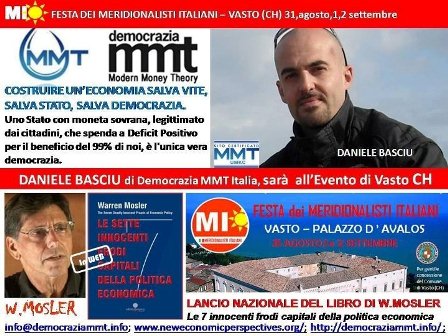
The national launching of the book by W. Mosler – The Seven Deadly Innocent Frauds

MI – Feast of the Southern Italians (Meriondalisti italiani)
MMT Democracy
Modern Monetary Theory
To build an economy that saves lives, saves the state, and saves democracy
A state with sovereign money, legitimized by the citizens, that spends with a positive deficit for the benefits of us 99%, that is the only true democracy.
Daniele Basciu of MMT Democracy – Italy will be at the event in Vasto, CH
The national launching of the book by W. Mosler – The Seven Deadly Innocent Frauds