Re: Resource allocation


[Skip to the end]

>   
>   On 8/3/08, Craig wrote:
>   
>   Ok. And the irony is as prices fall, demand increases again.
>   Until consuming governments get their head around that fact
>   and put some kind of floor under crude prices to incent
>   substitution (which may be beyond their thinking and/or impossible
>   politically), it seems like crude prices are gonna play rope-a-dope
>   with consumers.
>   
>   
>   Craig
>   
>   

Crude will be rationed as is everything else (scarcity, etc.).

The question is how. Ration by price or by other things?

Rationing by price is the most pervasive and means the wealthy (by definition) outbid the less wealthy for the available supply.

Make you wonder why the Democrats support higher prices, as that means they support their supporters going without while the wealthy drive any size SUV they want. Much like wondering why Obama supports Bernanke after Bernanke explained to Congress how he’s keeping inflation down by keeping a lid on inflation expectations after explaining the main component of inflation expectations is workers demanding higher wages, meaning Obama, Kennedy, and the rest of the left is praising Bernanke for doing a good job of suppressing wages.

Non-price rationing is less common but not unfamiliar, such as mandating cars get an average of 27 mpg, minimum efficiency standards for refrigerators, windows, etc. This takes an element of rationing by price away and results in the wealthy consuming less and leaving some for the less wealthy to consume a bit.

So seems to me the logical path for the Democrats would be something like my 30 mph speed limit for private transportation, which is ‘progressive’ and also drives the move towards public transportation with non price incentives as previously outlined. But there hasn’t even been any discussion of a progressive policy response. All seem highly regressive to me.

So I expect the world’s new and growing class of wealthy will continue to outbid our least wealthy for fuel and other resources.

Also, there may be limits to how high we want world consumption/burning of fuels for all the various ‘green’ reasons.

That would mean drilling and other production increases are out, as would be increased use of coal via the electric grid for electric cars.

And, again, it would be the world’s wealthy outbidding the less wealthy for consumption of the allowable annual fuel burn, as somehow allocation by price continues to rule.

Most paths keep coming down to the continuing combination of weakness and higher prices.

Warren

[top][end]


(comments from my brother, Seth, who was cc’d)

>   
>   I think democrats have lots of business and profits waiting
>   in govt subsidies for wind and solar. If oil prices fall that goes
>   away for now and they can’t produce on the subsidies for
>   them-cynical view but probably true
>   
>   There are also a lot of wealthy democrats and they want their
>   votes. Poor people all vote for democrats anyway-even with
>   declining lifestyles they are not going to McCain. So I think
>   Obama is pandering to the wealthy-it might be who he is-no
>   one really knows.
>   
>   With all of their green talk I have not seen any of them reduce
>   air travel, suv caravans or turn off the a/c in the capital. Just a
>   way to get votes and sound concerned. I saw a tv program
>   about how the chinese olympic swimming building is a green
>   sustainable building. It is 7 acres, pools, 25,000 people.
>   they finally said it uses about 25% less energy than a comparable
>   building would have. That is not green or sustainable, especially
>   since the building was not needed in the first place. I think “green”
>   is about making money, not the environment.
>   
>   
>   Seth
>   

I just can’t allow myself to be that cynical like you new yorkers!

:)

Warren

>   
>   
>   I think I am cynical usually, but this green thing drives me nuts
>   it started 30 years ago but is now all about money
>   when I see some lights turned off in Times Square (even in the
>   daytime) or the 5 huge spot lights on the CBS building lighting up
>   Katie Couric’s 50′ x 30′ poster which are on 24 hours a day turned
>   off, then I will believe it is about resources and not money.
>   there is a long way to go.
>   they advertise expensive green buildings here-I am not kidding-the
>   big thing is thermostats with timers on them and bamboo floors-didn’t
>   we have those 30 years ago??
>   
>   they talked about the oscar ceremony being green this year-the
>   celebrities were all giddy about it-what they did was use red
>   carpet made of recycled fibers????? what is that?
>   absolutely nothing-
>   anyway, time to calm down. too much excitement here
>   seth –
>   
>   

[top]
Fed Governor Mishkin on monetary policy


[Skip to the end]

In case there was any doubt things have changed.

from his July 28 speech:

Policymakers, academic economists, and the general public broadly agree that maintaining a low and stable inflation rate significantly benefits the economy. For example, low and predictable inflation simplifies the savings and retirement planning of households, facilitates firms’ production and investment decisions, and minimizes distortions that arise because the tax system is not completely indexed to inflation. Moreover, I interpret the available economic theory and empirical evidence as indicating that a long-run average inflation rate of about 2 percent, or perhaps a bit lower, is low enough to facilitate the everyday decisions of households and businesses while also alleviating the risk of debt deflation and other pitfalls of excessively low inflation.

The rationale for promoting maximum sustainable employment is also fairly obvious: Recessions weaken household income and business production, and unemployment hurts workers and their families.

No mention of lost real output. Must have been an oversight.

As I have outlined elsewhere, these two objectives are typically complementary and mutually reinforcing: that is, done properly, stabilizing inflation contributes to stabilizing economic activity around its sustainable level, and vice versa.

Hence the dual mandate is met by sustaining low and stable inflation rates.

Nevertheless, it’s important to note a fundamental difference between the objectives of price stability and maximum sustainable employment. On the one hand, the long-run average rate of inflation is solely determined by the actions of the Federal Reserve.

And they do believe that. They believe it’s all a function of the interest rates they select.

On the other hand, the level of maximum sustainable employment is not something that can be chosen by the Federal Reserve, because no central bank can control the level of real economic activity or employment over the longer run.

And they are not responsible for the level of economic activity, only the rate of inflation.

In fact, any attempt to use stimulative monetary policy to maintain employment above its long-run sustainable level would inevitably lead to an upward spiral of inflation with severe adverse consequences for household income and employment.


[top]

2008-07-28 UK News Highlights


[Skip to the end]

Highlights:

U.K. Hometrack House Prices Fall the Most Since 2001
Brown Says He Won’t Turn to ’70s Agenda After Defeat
Darling Considers Expanding Mortgage Bond-Swap Scheme, FT Says


U.K. Hometrack House Prices Fall the Most Since 2001

by Brian Swint

(Bloomberg) The average cost of a residential property in England and Wales slipped 4.4 % in July from a year earlier to 168,500 pounds ($336,000), Hometrack Ltd. said. Prices fell 1.2 % from June. “With no immediate end in sight to the current uncertainty, activity levels are likely to remain suppressed with prices remaining under pressure into the autumn,” said Richard Donnell, director of research at Hometrack. Prices “are now back to levels last seen in October 2006.” Demand for housing has declined 20 % in the past three months, Hometrack said.

Note how much higher prices are vs the US.

It’s another case of going up very fast and now working its way down towards a more historically normal trend line.

But as in the US, they never come down quite that far before turning up on a new path from a higher base as much of past ‘inflation’ remains indefinitely.


[top]

2008-07-25 US Economic Releases


[Skip to the end]


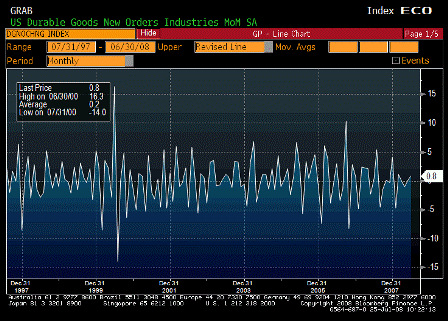
Durable Goods Orders MoM (Jun)

Survey -0.3%
Actual 0.8%
Prior 0.0%
Revised 0.1%

Better than expected, partially because fiscal and government is kicking in harder than expected.

[top][end]

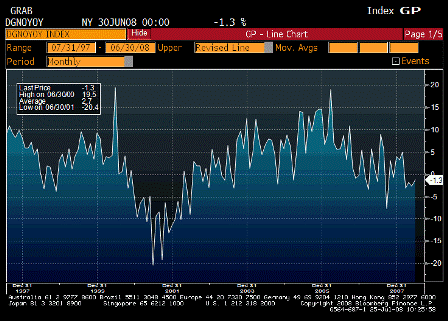
Durable Goods Orders YoY (Jun)

Survey n/a
Actual -1.3%
Prior -2.7%
Revised n/a

Still has turned up in a meaningful way, but moving away from recession levels.

When car sales normalize we’ll see a further boost.

[top][end]

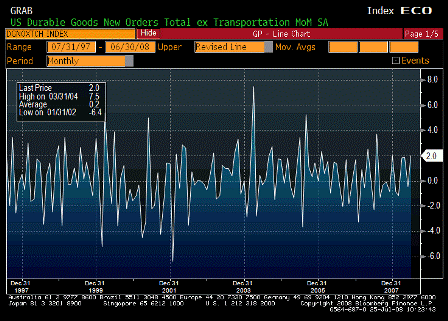
Durables Ex Transportation (Jun)

Survey -0.2%
Actual 2.0%
Prior -0.8%
Revised -0.5%

Headline numbers being held down by car sales.

[top][end]

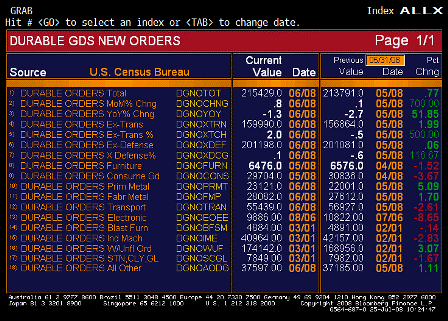
Durable Goods Orders ALLX (Jun)

Durables better than expected, likely due to companies taking advantage of new accelerated depreciation allowance

  • Capital goods orders ex-defense and aircraft up 1.4%
  • Defense orders up 30% in past 2mths, so production/shipments likely to improve for some manufacturers in coming months
  • Small appliances up as well. Seems some rebate checks went for down payments on appliances and home improvements.

    Electronics and consumer goods down.

    [top][end]


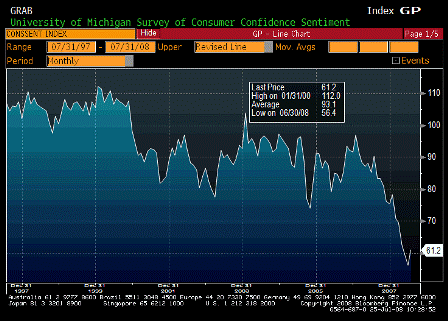
    U of Michigan Confidence (Jul F)

    Survey 56.4
    Actual 61.2
    Prior 56.6
    Revised n/a

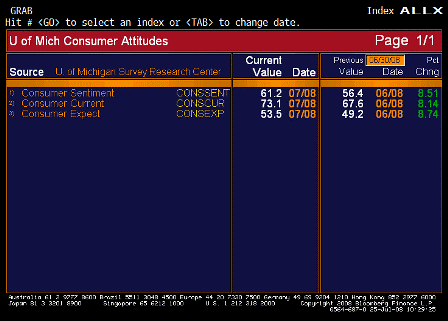
    Better than expected and a possible bottom from a very low level.

    [top][end]

    U of Michigan Confidence ALLX (Jul F)

    Gas prices ‘stabilizing’ likely lead to the modest improvement in the Michigan survey and the ebbing of inflation expectations:

    • Headline confidence rose from 56.6 to 61.2

    Don’t underestimate the fiscal package!

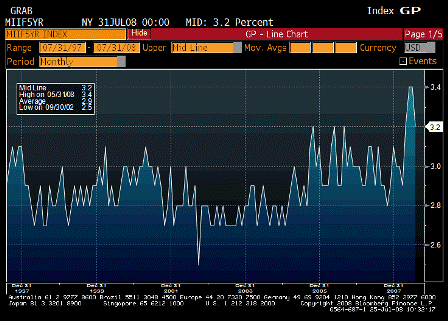
    • 5-10yr inflation expectations fell from 3.4% to 3.2%

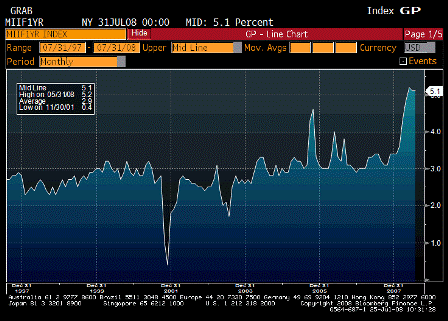
    One year steady at 5.1%.

    [top][end]

    Inflation Expectations 1yr Forward (Jul F)

    Survey n/a
    Actual 5.1%
    Prior 5.1%
    Revised n/a

    Two months over 5% is very troubling for the Fed. They see this as a direct cause of inflation.

    [top][end]

    Inflation Expectations 5yr Forward (Jul F)

    Survey n/a
    Actual 3.2%
    Prior 3.4%
    Revised n/a

    Down some but still way too high.

    The Fed wants this back to their long term target of something under 2.5%.

    [top][end]


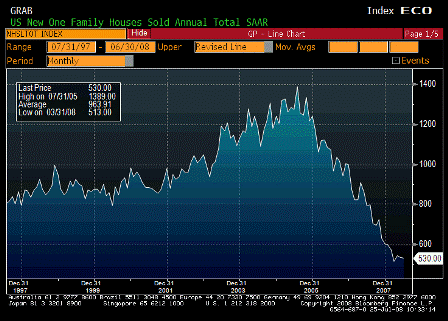
    New Home Sales (Jun)

    Survey 503K
    Actual 530K
    Prior 512K
    Revised 533K

    Better than expected and last month revised up as well.

    [top][end]

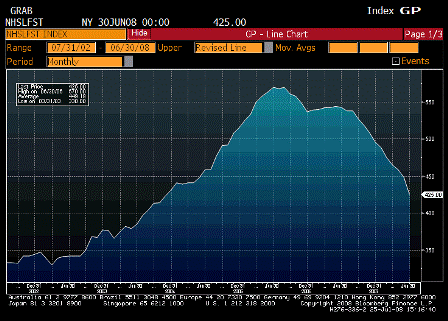
    New Home Sales – Total for Sale (Jun)

    Survey n/a
    Actual 425K
    Prior 448K
    Revised n/a

    Sales can quickly be stifled by dwindling actual inventories.

    [top][end]

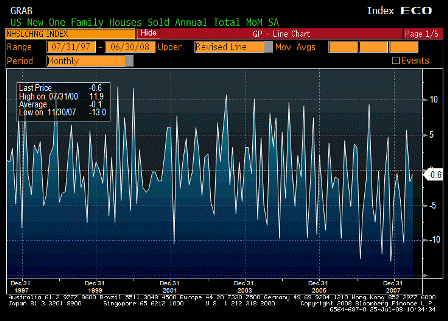
    New Home Sales MoM (Jun)

    Survey -1.8%
    Actual -0.6%
    Prior -2.5%
    Revised -1.7%

    Better than expected and from an upwardly revised May number.

    [top][end]

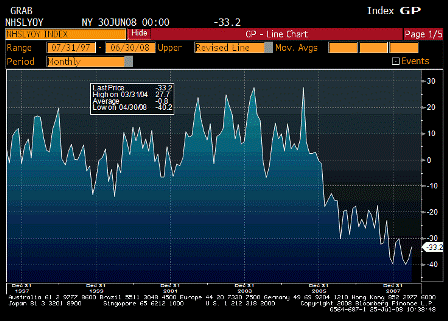
    New Home Sales YoY (Jun)

    Survey n/a
    Actual -33.2%
    Prior -37.8%
    Revised n/a

    [top][end]

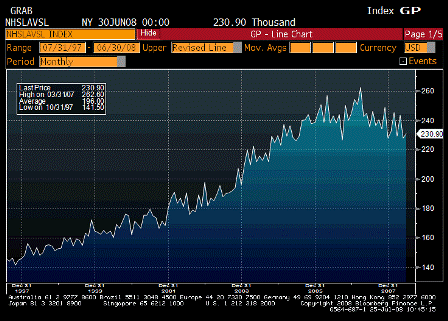
    New Home Sales Median Price (Jun)

    Survey n/a
    Actual 230.9
    Prior 227.7
    Revised n/a

    The decline may be about over.

    Median prices are already rising from the lows.

    Watch for a shortage of new homes.

    [top][end]

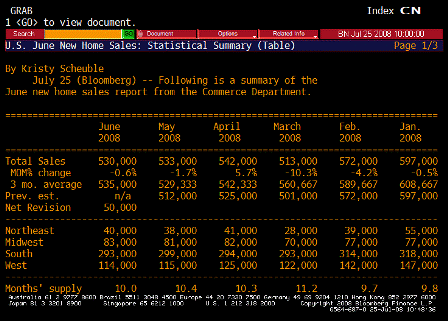
    New Home Sales TABLE 1 (Jun)

    The three month average has turned higher.

    [top][end]

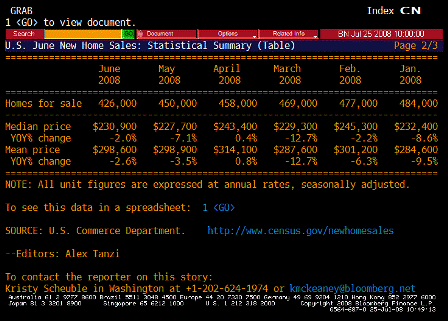
    New Home Sales TABLE 2 (Jun)

    • New home sales down 0.6% m/m and prices down 2% y/y

    But higher than expected at 530,000, and down from May because May was revised up to 533,000 from 512,000.

    Also, inventories down and prices up, and prices getting very close to being up year over year:

    New home sales fall but stronger than expected

    by Mark Felsenthal

    Sales of newly constructed U.S. single-family homes were stronger than expected in June, falling 0.6 percent to a 530,000 annual pace, a government report showed on Friday, providing a glimmer of hope for the beaten-down housing market.

    Economists polled by Reuters were expecting sales to slow to a 500,000 seasonally adjusted annual sales rate from a previously reported 512,000 pace in May. May’s sales rate was revised up to 533,000, the Commerce Department said.

    The inventory of homes available for sale shrank 5.3 percent to 426,000, the lowest since December 2004. The June sales pace put the supply of homes available for sale at 10 months’ worth.

    The median sales price rose to $230,900 from $227,700 from May, but was down 2 percent from a year earlier, the government said.


    [top]

Buy this book!


[Skip to the end]

Full Employment Abandoned

Shifting Sands and Policy Failures


by William Mitchell, Professor of Economics, Centre of Full Employment and Equity, University of Newcastle, Australia and Joan Muysken, Professor of Economics, CofFEE-Europe, University of Maastricht, The Netherlands

My review:

There are only 2 books that I know of that are ‘in paradigm’ and the other is Wray’s ‘Understanding Modern Money’ which I also highly recommend.

This new book by Bill Mitchell is also solidly ‘in paradigm’ and for those of you not all that interested in the details of unemployment per se I suggest beginning with ‘Part III’ which does an outstanding job of outlining the imperatives of non convertible currency which will serve you well in analyzing today’s markets. From monetary operations to fiscal measures, the mainstream economists and media continue to get it wrong. Bill lays down the fundamentals that can help you understand where the mainstream goes astray, and hopefully translate into you getting it right.

Regarding unemployment (aka the ‘output gap’ by today’s central bankers), it is readily acknowledge that inflation isn’t all that sensitive to changes in unemployment. In their words, “The good news is that the Phillips curve is flat. And the bad news is that the Phillips curve is flat.” The essence of what Bill proposes is that an employed labor bufferstock is a far superior price anchor than today’s labor bufferstock of unemployed. And this is one of those things that seems obvious and indeed is absolutely correct, yet entirely overlooked as a policy option.

So click and order a copy or two, jump to Part III, and then start at the beginning to get a leg up on where we are, how we got here, and what policy options are open- particularly a form of full employment that further supports output, growth, and price stability.

Then pass it around your office and send copies to your favorite members of Congress, thanks!

Order now: http://www.e-elgar.co.uk/Bookentry_Main.lasso?id=1188
 
 
Warren Mosler


[top][end]


Publisher’s Spiel:

“This book by William Mitchell and Joan Muysken is both important and timely. It deals with the issue of the abandonment of full employment as an objective of economic policy in the OECD countries. It argues persuasively that macroeconomic policy has been restrictive over the recent, and not so recent past, and has produced substantial open and disguised unemployment. But the authors show how a job guarantee policy can enable workers, who would otherwise be unemployed, to earn a wage and not depend on welfare support. If such a policy is fully supported by appropriate fiscal and monetary programmes, it can create a full employment with price stability, and which the authors label as a
Non-Accelerating-Inflation-Buffer Employment Ratio (NAIBER). This book is essential reading for any one wishing to understand how we can return to full employment as the normal state of affairs.”
-Philip Arestis, University of Cambridge, UK

Contents:

Part I: Full Employment: Changing Views and Policies

  1. The Full Employment Framework and its Demise
  2. Early Views on Unemployment and the Phillips Curve
  3. The Phillips Curve and Shifting Views on Unemployment
  4. The Troublesome NAIRU: The Hoax that Undermined Full Employment

Part II: Full Employment Abandoned: Shifting Sands and Policy Failures

  1. The Shift to Full Employability
  2. Inflation First: The New Mantra of Macroeconomics
  3. The Neglected Role of Aggregate Demand

Part III: The Urgency of Full Employment: Foundations for an Active Policy

  1. A Monetary Framework for Fiscal Policy Activism
  2. Buffer Stocks and Price Stability
  3. Conclusion: The Urgency of Full Employment References Index


[top]

FT: Letter to the editor


[Skip to the end]

Published letter to the editor in FT.

Expect public-sector deficits and oil prices to go on rising

by Prof Philip Arestis, Dr John McCombie and Mr Warren Mosler.

Sir, Public-sector deficits and crude oil prices will probably both continue rising. Chris Giles’ reports, “Treasury to reform Brown’s fiscal rules” and “Treasury sees storm clouds gathering” (July 18), recognise the inevitability of growing deficits due to economic weakness while also implying public-sector deficits are per se a “bad thing”.

What the articles fail to appreciate are three dimensions to the argument: the first is that public-sector deficits do not present a solvency issue, only an “inflation” issue. Second, public-sector deficits equal total non-government (domestic and foreign) savings of sterling financial assets and are the only source of non-government accumulation of sterling net financial assets. Third, public-sector deficits provide the net financial equity to the non-government sector that supports the private-sector credit structure.

It is the case that the public-sector deficit will increase in one of two ways. The “nice” way would be pro-actively with sufficient tax cuts or spending increases (depending on one’s politics) that support demand at desired levels. The “ugly” way is from a slowing of demand that reduces tax revenues and increases transfer payments. If, instead, the government tries to suppress the current deficit with any combination of tax increases or spending cuts, the resulting accelerated slowdown of the economy will then increase the deficit the “ugly” way.

In any case, the current “inflation” is the result of Saudi Arabia acting as swing producer as it sets the oil price at ever-higher levels and then supplies all the crude demanded at that price. Our institutional structure then passes these prices through the entire economy over time, and there is nothing interest rates or fiscal policy can do to change these dynamics.

The ability to set crude prices can only be broken by a sufficiently large supply response, such as in the early 1980s when net supplies increased by more than 15m barrels per day, helped considerably by the US deregulating natural gas production, which allowed substitution away from crude oil products.

In sum, the deficit will go up either the nice way or the ugly way, as it always does when markets work to grant the private sector the desired net financial assets, which can come only from government deficit spending. “Inflation” will continue higher as long as the Saudis remain price-setter and continue to post ever-higher prices to their refiners.

Philip Arestis,
University Director of Research,
Cambridge Centre for Economic and Public Policy

John McCombie,
Director,
Cambridge Centre for Economic and Public Policy

Warren Mosler,
Senior Associate Fellow,
Cambridge Centre for Economic and Public Policy,
University of Cambridge, UK


[top]

Bloomberg: Inflation weakening some currencies


[Skip to the end]

Interesting how reports of higher inflation have often meant stronger currencies in the short run due to higher anticipated rates from the CB.

Inflation, however, by definition means the currency buys less of most everything; therefore, inflation and a weakening currency are one and the same.

But it can take a long time for markets to discount this.

Emerging-Market Currency Rally Dies as Inflation Hits

by Lukanyo Mnyanda and Lester Pimentel

(Bloomberg) The five-year rally in emerging- market currencies is coming to an end as central banks from South Korea to Turkey struggle to contain inflation, say DWS Investments and Morgan Stanley.

The 26 developing-country currencies tracked by Bloomberg returned an average 0.86 percent in the past three months, down from 1.63 percent in the first quarter, 8.2 percent for all of 2007, and 30 percent annually since 2003. For the first time in seven years, investors are less bullish on emerging-market stocks than on U.S. equities, a Merrill Lynch & Co. survey showed last week.

Confidence in the Indian rupee is weakening after inflation accelerated at the fastest pace in 13 years, stoked by soaring food and energy prices. South Korea’s won will drop this year by the most since 2000, while Turkey’s lira will reverse its biggest gain since at least 1972, the median estimates of strategists surveyed by Bloomberg show.


[top]

NYT: Too big to fail?


[Skip to the end]

Too Big to Fail?


by Peter S Goodman

Using public money to spare Fannie and Freddie would increase the public debt, which now exceeds $9.4 trillion. The United States has been financing itself by leaning heavily on foreigners, particularly China, Japan and the oil-rich nations of the Persian Gulf.

This is ridiculous, of course. The US, like any nation with its own non-convertible currency, is best thought of as spending first, and then borrowing and/or collecting taxes.

Were they to become worried that the United States might not be able to pay up, that would force the Treasury to offer higher rates of interest for its next tranche of bonds.

Also ridiculous. Japan had total debt of 150% of GDP, 7% annual deficits, and were downgraded below Botswana, and they sold their 3 month bills at about 0.0001% and 10 year securities at yields well below 1% while the BOJ voted to keep rates at 0%. (Nor did their currency collapse.)

The CB sets the rate by voice vote.

And that would increase the interest rates that Americans must pay for houses and cars, putting a drag on economic growth.

As above.

For one thing, this argument goes, taxpayers — who now confront plunging house prices, a drop on Wall Street and soaring costs for food and fuel — will ultimately pay the costs. To finance a bailout, the government can either pull more money from citizens directly,

Yes, taxing takes money directly, and it’s contradictionary.

But when the government sells securities they merely provide interest bearing financial assets (treasury securities) for non-interest bearing financial assets (bank deposits at the Fed). Net financial assets and nominal wealth are unchanged.

or the Fed can print more money — a step that encourages further inflation.

This is inapplicable.

There is no distinction between ‘printing money’ and some/any other way government spends.

The term ‘printing money’ refers to convertible currency regimes only, where there is a ratio of bill printed to reserves backing that convertible currency.

Skip to next paragraph “They are going to raise the cost of living for every American,”

True, that’s going up!


[top]

2008-07-21 Weekly Credit Graph Packet


[Skip to the end]

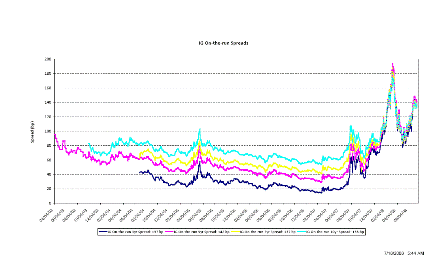
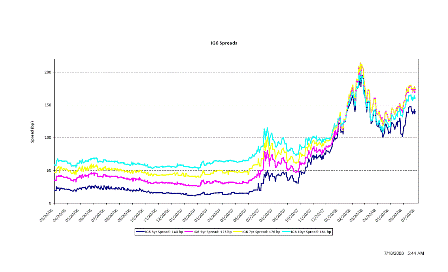
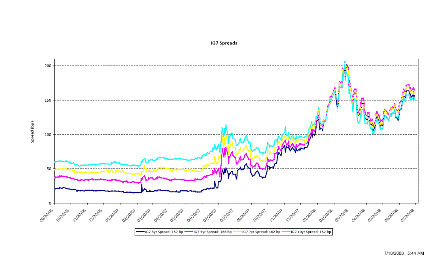
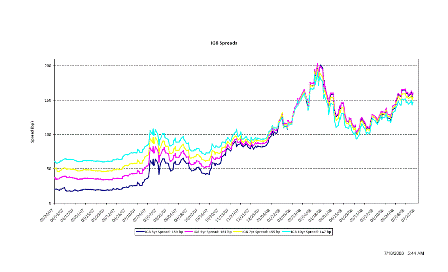
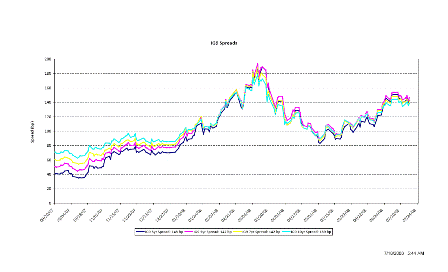
Looks and feels like spreads will be generally narrowing for a considerable period of time.

Bank earnings are better than expected with revenues growing nicely.

GDP, income, and spending being sustained by a growing government budget deficit, exports, and housing leveling off and no longer subtracting from growth.

‘Inflation’ continues with Saudi’s supporting prices and pass-throughs intensifying.


IG On-the-run Spreads (Jul 18)

[top][end]

IG6 Spreads (Jul 18)

[top][end]

IG7 Spreads (Jul 18)

[top][end]

IG8 Spreads (Jul 18)

[top][end]

IG9 Spreads (Jul 18)


[top]


[top]