ISM/Bernanke

I tend to agree with Karim and Fed Chairman Bernanke.
Modestly improving GDP growth with unemployment coming down very gradually until a consumer credit expansion takes hold.

Good for stocks, not so good for most of the people still struggling to survive, as the Obama administration continues to preside over what might be the largest transfer of wealth from bottom to top in the history of the world.

And no credible energy policy. We are completely at the mercy of the Saudis who can unilaterally hike prices any time they feel like it.


Karim writes:

  • ISM shows lift from inventories likely has run its course as inventory component crossed back above 50
  • But customer inventories remain low and employment index rises to second highest level since 2004
  • Going forward, private demand, not inventory rebuilding will drive manufacturing
  • Bernanke addressed this today (below) and seems to maintain his above consensus growth forecast


July June
Index 55.5 56.2
Prices paid 57.5 57.0
Production 57.0 61.4
New Orders 53.5 58.5
Inventories 50.2 45.8
Customer inventories 39.0 38.0
Employment 58.6 57.8
New export orders 56.5 56.0
Imports 52.5 56.5
  • “Business in July was strong, the best month since October 2008.” (Fabricated Metal Products)
  • “Slow economy has killed sales for new equipment orders.” (Machinery)
  • “Quoting activity and sales are slow, and backlog is dropping.” (Computer & Electronic Products)
  • “Business continues to be sluggish and has fallen slightly as the economic ills continue.” (Nonmetallic Mineral Products)
  • “Retailers are still unwilling to gamble on inventory.” (Printing & Related Support Activities)

Bernanke

While the support to economic activity from stimulative fiscal policies and firms’ restocking of their inventories will diminish over time, rising demand from households and businesses should help sustain growth. In particular, in the household sector, growth in real consumer spending seems likely to pick up in coming quarters from its recent modest pace, supported by gains in income and improving credit conditions. In the business sector, investment in equipment and software has been increasing rapidly, in part as a result of the deferral of capital outlays during the downturn and the need of many businesses to replace aging equipment. At the same time, rising U.S. exports, reflecting the expansion of the global economy and the recovery of world trade, have helped foster growth in the U.S. manufacturing sector.


To be sure, notable restraints on the recovery persist. The housing market has remained weak, with the overhang of vacant or foreclosed houses weighing on home prices and new construction. Similarly, poor economic fundamentals and tight credit are holding back investment in nonresidential structures, such as office buildings, hotels, and shopping malls.

Fed Bullard

It’s not just him, the all say ‘quantitative easing’ will ‘work’ when they should now have enough evidence and theory to know all it does is lower interest rates which are already plenty low with regards encouraging lending.

Might just be managing expectations but more likely they still actually believe it.

*DJ Fed’s Bullard: Worried About Possible Deflationary Outcome For US(DJ)
*DJ Bullard: Says More Quantitative Easing Will Work(DJ)
*DJ Bullard: Says Deflation Not Most Likely Economic Scenario(DJ)
*DJ Fed’s Bullard: Most Likely Scenario Is That Recovery Will Continue(DJ)
*DJ Bullard: Acknowledges Weaker US Data Over Last Two Months(DJ)
*DJ Bullard: Euro Zone Has Done Reasonable Job Containing Crisis(DJ)

Bullard/Fed


Karim writes:

Bullard

  • Definitely out there on his own. FRB would certainly not communicate policy shift through him
    • Also, everyone has different reasons why QE works. Most of the Fed leadership thinks just via interest rate channel and announcement effect. Bullard thinks through monetary channel, which makes him a minority.

GDP Data: Something for everyone; capex recovery intact; consumer spending sluggish; net exports a large drag; inventories an offset

  • Annualized gwth at 2.4%; Q1 revised from 2.7% to 3.7%; Prior data revised lower
  • Private consumption 1.6% vs 1.9% in Q1; Investment up 28.8% vs 29.1% in Q1
  • Business capex (equipment and software spending) up 21.9% vs 20.4% in Q1
  • Residential fixed investment (housing) up 21.9% (aided by expiring tax credit)
  • Exports and imports both up in double digits, but net exports a drag on growth of -2.78%
  • Inventories contribute 1.05%

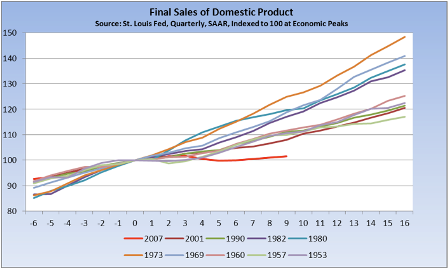
Final sales

Haven’t yet hit the ‘get a job buy a car’ accelerator.

Watch for car sales to be the indicator of more rapid growth.

Meantime, muddling through with modest growth remains an ok equity environment as fear of becoming the next Greece is turning us into the next Japan.

And, of course, we continue to underestimate the deflationary effect of the Fed’s zero rate policy which should be a good thing in that it allows us to have lower taxes for a given size govt.

Fed Minutes

The staff still expected that the pace of economic activity through 2011 would be sufficient to reduce the existing margins of economic slack, although the anticipated decline in the unemployment rate was somewhat slower than in the previous projection.


Karim writes:

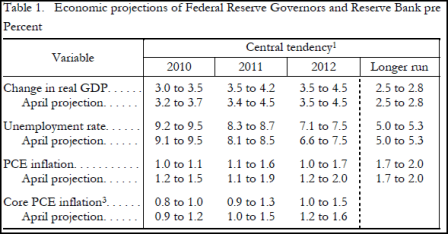
Staff still forecasting above trend growth, though not as firm as before. Activity indicators coming in as expected, with financial strains in May and June the cause for the revision.

Table below is average of FOMC members, not staff, but appears to have similar profile. Average expectations for 2011 growth at 3.85% from 3.95% prior..

A few participants cited some risk of deflation. Other participants, however, thought that inflation was unlikely to fall appreciably further given the stability of inflation expectations in recent years and very accommodative monetary policy. Over the medium term, participants saw both upside and downside risks to inflation.


Deflation talk still seems contained to a ‘few’ members.

Members noted that in addition to continuing to develop and test instruments to exit from the period of unusually accommodative monetary policy, the Committee would need to consider whether further policy stimulus might become appropriate if the outlook were to worsen appreciably.


This was only mention of QE2 – not very extensive.

Small banks being crushed by Fed’s game of musical chairs

Small banks, already penalized with a higher cost of funds than the large banks (link) have more recently been forced to contract due to ‘wholesale funding’ restrictions being imposed by the regulators.

Bank regulators distinguish between what they call ‘retail’ and ‘wholesale’ funding, and have set limits of small banks for ‘wholesale’ funding. This policy is meant to reduce the liquidity risk of a bank not being able to roll over its funding should depositors decide to take their dollars to another bank. The theory is that ‘retail’ deposits are ‘sticky’ and less likely to move to another bank, while ‘wholesale’ deposits are more likely to move. And the ‘better’ the ‘account relationship’ the more likely the funds are to stay with the bank. Oddly, when I inquired if the maturity of the deposit is a consideration the regulators responded ‘no.’ So that means a 10 year CD obtained through a broker is considered a wholesale deposit, which must be limited, while money market deposits from local depositors that can leave the next day are the core retail deposits required by the regulators for ‘stability.’

But apart from this obvious regulatory failure to recognize what’s more stable and what’s less stable for individual banks, there is also a highly problematic macro issue. In the banking system as a whole, loans create deposits, meaning that for each loan made by a bank (bank assets) there exists a bank deposit of the same amount originally created at the time of the loan as that bank’s liability. In short, for the banking system as a whole, loans equal deposits.

The problem is that money center banks attract more of these total deposits than the small banks in the normal course of business. That leaves the small banks short of deposits by an equal amount. This is easily resolved by the small banks needing funding borrowing the excess funds held by the large banks. And if the large banks decide to keep their excess funds at the Federal Reserve Bank the small banks can simply borrow from the Fed to cover their shortage. In any case the total funding of the banking system remains equal to the total loans outstanding, with the Fed acting as a ‘broker’ to facilitate system wide liquidity. However, when regulators restrict this ‘wholesale funding’ between banks, and also deem borrowings from the Fed ‘wholesale funding,’ they put powerful forces in place that force the small banks to either pay higher rates to attract deposits from the large banks, which is often impossible as large corporate customers can’t deal with small banks, or force the small banks to cut back on lending to reduce their dependence on wholesale funding.

The net result is a misguided regulatory policy that is both increasing the cost of funds to small banks and forcing small banks to cut back on lending.

The remedy is quite simple, have the Fed offer funding (fed funds) to all member banks at it’s target interest rate, which is the rate the Fed desires to in fact be the cost of funds for its banking system as a matter of public policy. In any case, bank borrowing and lending is rightly constrained by capital and other regulatory requirements, and not available funding, which is always attainable at a price. Using the liability side of banking for market discipline, as is currently the practice for small banks, is always evidence of a lack of understanding of banking fundamentals and counter to further public purpose.

Please distribute this to your favorite regulator, Congressman, and Fed official, thanks!

Baker on deficits

Overcoming the Debt Trap

By Dean Baker

The deficit hawk gang is again trying to take our children hostage with new threats of enormous debt burdens. As in the past, most of what they claim is very misleading, if not outright false.

Agreed.

First and foremost, the basis of the bulk of their horror story has nothing to do with spending being out of control, but rather a broken private health care system. If per person health care costs were comparable to the costs in any other wealthy country, we would be looking at long-term budget surpluses, not gigantic deficits. This would lead honest people to focus their energies on fixing the US health care system, but not the deficit hawk gang.

I’d guess the deficit would be much the same as it grew counter cyclically with the automatic stabilizers kicking in as the economy weakened to the point the deficit got large enough to where it provided the income and net financial assets needed to stabilize output and employment. Not that there isn’t much to be done to fix the US health care system.

But there is another part of their story that contains some truth. The government is borrowing large amounts of money right now to sustain demand in the wake of the collapse of private sector spending following the deflation of the housing bubble.

Yes, the government is spending large amounts to sustain demand, but that spending is not dependent on borrowing, though it is associated with borrowing.

If the deficit continues on the projected path, the country will substantially increase its debt burden over the course of the decade.

Yes, the deficit could go higher but ‘burden’ isn’t the right term. The national debt is the dollar savings of the ‘non government’ sectors, and as such lightens the financial burden of those sectors.

A higher debt burden will imply much larger transfers from taxpayers to bondholders in future years. This will require either higher taxes or cuts in other spending.

Not necessarily. Taxes function to regulate aggregate demand. So tax increases and/or spending cuts would be in order only should aggregate demand be deemed too high, evidenced by unemployment being too low. In that case, taxes increases and/or spending cuts would serve to cool demand, not to make payments on the debt. Also, the interest on the debt only alters demand if it gets spent, which does not necessarily happen. Japan has never spent a penny of their interest income, for example.

Alternatively, the government could run larger deficits.

The informed approach is, for a given amount of spending, to adjust taxes to the level that corresponds to desired levels of employment, whatever size deficit that might mean.

However, in a decade or so, if the economy is again near full employment, higher deficits will either lead to higher inflation if the Fed opts to accommodate the deficits, or higher interest rates if it targets a low rate of inflation. The latter could crimp investment and long-run growth.

Should the informed approach be taken, and taxes lowered and the deficit thereby increased to the level that coincides with full employment, yes, the government could then go too far and keep taxes too low and sustain excess demand that drives up prices. This would be the case whether the Fed ‘accommodated the deficits’ or not. And if the Fed did elect to implement policy to raise rates to slow inflation, the point would be to slow nominal spending without slowing real spending. And in any case there is no such thing as crowding out investment, as investment is a function of consumption, with demand driving prices to a level where investment is funded.

For these reasons, it is desirable to prevent the debt from reaching the levels now projected, even if the outcome may not be the disaster promised by the deficit hawks.

Nor is the outcome that promised by the deficit doves. US deficits incurred as a by product of fiscal balance that sustains full employment do not have negative side effects if managed by an informed government.

There is a simple way to avoid a sharp rise in the interest burden associated with a higher debt. The Federal Reserve Board can buy and hold the debt that is currently being issued by the Treasury to finance the deficit.

The Fed buying the debt is functionally the same as the Treasury not issuing it. And I have supported the Treasury not issuing anything longer than 3 month T bills for a long time, etc. More on that below.

The logic of this is straightforward. If the Fed holds the debt, then the interest on the debt is paid to the Fed. The Fed then returns the interest to the Treasury each year, meaning the net cost to the government is zero.

Not exactly. What that policy would do is add the deficit spending to bank reserve balances held at the Fed, which currently pay what for all practical purposes is the overnight rate of interest targeted by the Fed. The Fed controls the fed funds rate by offering and paying interest on the overnight balances held at the Fed. This rate is currently .25%. Interestingly, 3 month Treasury bills are purchased to yield only .14% for technical reasons. I do support the policy of the Treasury not issuing securities longer than 3 months, which will produce similar results. But in either case, should the Fed decide to hike rates the balances created by federal deficit spending will earn those rates under current institutional arrangements. One way to avoid all interest payments on deficit spending would be to increase required reserves for the banking system and not pay interest on them. That, however, becomes a ‘bank tax’ that is passed through to all borrowers, passing the interest rate burden on to them.

This is not slight of hand. The point is that the economy has a huge amount of idle resources in the form of unemployed workers and excess capacity. In this situation, the increased demand created by government spending does not have to come at the expense of existing demand. The economy can simply expand to fill the additional demand created by larger deficits.

This is 100% true and I fully support the policy of adjusting the fiscal balance to that which coincides with full employment, without consideration of the interest paid on balances created by deficit spending, as above.

While that may not be true in five or ten years, assuming the economy is again near full employment, right now deficits need not lead to either higher interest rates or higher inflation.

Again, fully agreed with the conclusion.

In fact, the financial markets and the “bond market vigilantes” should even support the decision to have the Fed purchase and hold the government debt being issued now to finance the deficit. This practice will lessen the future interest burden on the Treasury. In fact, interest should be seen as an entitlement like Social Security and Medicare since it is paid each year without new authorization by Congress. If the deficit hawks had any integrity they would be insisting that we should require the Fed to hold the government debt issued during this downturn. It is a sure fire way to substantially reduce entitlement spending.

Again, the Fed buying Tsy securities is functionally identical to and nothing more than the Treasury not issuing it in the first place. Nothing more.

Of course, no one ever accused deficit hawks of being consistent. Not only do they not advocate having the Fed buy and hold the debt, they don’t even want this policy discussed in their “everything is on the table” sessions. Keeping this simple solution off the table makes good sense if your concern is not deficit reduction, but rather cutting Social Security, Medicare and other important social programs.

Fortunately, the rest of us don’t have to be bound by the deficit hawks’ agenda. If Social Security and Medicare are on the table, then having the Fed hold the debt better be on the table; otherwise, this exercise is just a charade to cut the country’s most important social programs.

Social Security has no business being on the table even under current policy of issuing longer term Treasury securities, no matter how large the deficit might be, if there is excess capacity/unemployment. How could it possibly make sense to cut aggregate demand in the current environment? It’s not like our seniors are consuming scarce real resources and creating shortages for the rest of us.

This will be a great lie detector test. We will soon know whether the deficit hawks care about the interest burden on our children or just want to destroy the social safety net.

The doves are on the right side of this argument, but if they don’t get their act together on monetary operations and reserve accounting it looks like they will continue to go down to defeat with what are inherently winning hands, with all of us the losers.

M3 falling works for me

With sufficient deficit spending private credit isn’t needed at all to sustain growth and employment, so the shift from private sector credit growth (falling M3) to 3% growth sustained by deficits of 10% of gdp is perfectly sustainable.

In fact, I’d prefer, for a given size govt, lower taxes rather than higher private sector credit growth. And a larger trade deficit means we can have taxes that much lower still. And cut out much the military expenditures for Afghanistan and cut taxes that much more, thanks! etc!

Unfortunately 3% growth doesn’t close the output gap, but that’s another (very ugly) story, but with the same answer. Agg demand is about a trillion a year short of potential right now, hence my proposal for a full payroll tax (FICA) holiday to restore private sector sales, output, and employment.

US money supply plunges at 1930s pace as Obama eyes fresh stimulus

By Ambrose Evans-Pritchard

May 26 (Telegraph) — The M3 money supply in the United States is contracting at an accelerating rate that now matches the average decline seen from 1929 to 1933, despite near zero interest rates and the biggest fiscal blitz in history.

The M3 figures – which include broad range of bank accounts and are tracked by British and European monetarists for warning signals about the direction of the US economy a year or so in advance – began shrinking last summer. The pace has since quickened.

The stock of money fell from $14.2 trillion to $13.9 trillion in the three months to April, amounting to an annual rate of contraction of 9.6pc. The assets of insitutional money market funds fell at a 37pc rate, the sharpest drop ever.

“It’s frightening,” said Professor Tim Congdon from International Monetary Research. “The plunge in M3 has no precedent since the Great Depression. The dominant reason for this is that regulators across the world are pressing banks to raise capital asset ratios and to shrink their risk assets. This is why the US is not recovering properly,” he said.

The US authorities have an entirely different explanation for the failure of stimulus measures to gain full traction. They are opting instead for yet further doses of Keynesian spending, despite warnings from the IMF that the gross public debt of the US will reach 97pc of GDP next year and 110pc by 2015.

Larry Summers, President Barack Obama’s top economic adviser, has asked Congress to “grit its teeth” and approve a fresh fiscal boost of $200bn to keep growth on track. “We are nearly 8m jobs short of normal employment. For millions of Americans the economic emergency grinds on,” he said.

David Rosenberg from Gluskin Sheff said the White House appears to have reversed course just weeks after Mr Obama vowed to rein in a budget deficit of $1.5 trillion (9.4pc of GDP) this year and set up a commission to target cuts. “You truly cannot make this stuff up. The US governnment is freaked out about the prospect of a double-dip,” he said.

The White House request is a tacit admission that the economy is already losing thrust and may stall later this year as stimulus from the original $800bn package starts to fade.

Recent data have been mixed. Durable goods orders jumped 2.9pc in April but house prices have been falling for several months and mortgage applications have dropped to a 13-year low. The ECRI leading index of US economic activity has been sliding continuously since its peak in October, suffering the steepest one-week drop ever recorded in mid-May.

Mr Summers acknowledged in a speech this week that the eurozone crisis had shone a spotlight on the dangers of spiralling public debt. He said deficit spending delays the day of reckoning and leaves the US at the mercy of foreign creditors. Ultimately, “failure begets failure” in fiscal policy as the logic of compound interest does its worst.

However, Mr Summers said it would be “pennywise and pound foolish” to skimp just as the kindling wood of recovery starts to catch fire. He said fiscal policy comes into its own at at time when the economy “faces a liquidity trap” and the Fed is constrained by zero interest rates.

Mr Congdon said the Obama policy risks repeating the strategic errors of Japan, which pushed debt to dangerously high levels with one fiscal boost after another during its Lost Decade, instead of resorting to full-blown “Friedmanite” monetary stimulus.

“Fiscal policy does not work. The US has just tried the biggest fiscal experiment in history and it has failed. What matters is the quantity of money and in extremis that can be increased easily by quantititave easing. If the Fed doesn’t act, a double-dip recession is a virtual certainty,” he said.

Mr Congdon said the dominant voices in US policy-making – Nobel laureates Paul Krugman and Joe Stiglitz, as well as Mr Summers and Fed chair Ben Bernanke – are all Keynesians of different stripes who “despise traditional monetary theory and have a religious aversion to any mention of the quantity of money”. The great opus by Milton Friedman and Anna Schwartz – The Monetary History of the United States – has been left to gather dust.

Mr Bernanke no longer pays attention to the M3 data. The bank stopped publishing the data five years ago, deeming it too erratic to be of much use.

This may have been a serious error since double-digit growth of M3 during the US housing bubble gave clear warnings that the boom was out of control. The sudden slowdown in M3 in early to mid-2008 – just as the Fed talked of raising rates – gave a second warning that the economy was about to go into a nosedive.

Mr Bernanke built his academic reputation on the study of the credit mechanism. This model offers a radically different theory for how the financial system works. While so-called “creditism” has become the new orthodoxy in US central banking, it has not yet been tested over time and may yet prove to be a misadventure.

Paul Ashworth at Capital Economics said the decline in M3 is worrying and points to a growing risk of deflation. “Core inflation is already the lowest since 1966, so we don’t have much margin for error here. Deflation becomes a threat if it goes on long enough to become entrenched,” he said.

However, Mr Ashworth warned against a mechanical interpretation of money supply figures. “You could argue that M3 has been going down because people have been taking their money out of accounts to buy stocks, property and other assets,” he said.

Events may soon tell us whether this is benign or malign. It is certainly remarkable.

On Thu, May 27, 2010 at 12:04 PM, Marshall wrote:

Yes! For some odd reason there is a myth about the Great Depression that could not be more removed from the reality of the time. Most people believe the economy crashed between 1929 and 1932 and then remained depressed until the Second World War which finally mobilized the economy’s idle resources and brought about a full recovery. That’s complete bunk if you calculate the unemployment data correctly. Even leaving aside that fact, it is true that, once the Great Depression hit bottom in early 1933, it embarked on four years of economic expansion that constituted the biggest cyclical boom in U.S. economic history. For four years real GDP grew at a 12% rate and nominal GDP grew at a 14% rate. There was another shorter and shallower depression in 1937 CAUSED BY RENEWED FISCAL TIGHTENING. It was this second depression that has led to the misconception that the central bank was pushing on a string throughout all of the 1930s until the giant fiscal stimulus of the war time effort finally brought the economy up from depression. The financial dynamics of that huge economic recovery between 1933 and 1937 are extremely striking. Despite their insistence that changes in the stock of money were behind all the cyclical ups and downs in U.S. economic history, even Freidman and Schwartz in their “Monetary History of the United States” conceded that the money aggregates did not lead the U.S. economy out of the depression in 1932-1933. More striking, private credit seemingly had nothing to do with the take off of that economy. Industrial production off the 1932 low doubled by 1935. By contrast, bank credit to the private sector fell until the middle of 1935. Because of the collapse in nominal income during the depression, the U.S. private sector was more indebted than ever on the depression lows. Yet, somehow it took off and sustained its takeoff with no growth in private credit whatsoever. The 14% average annual increase in nominal GDP from early 1932 to 1935 resulted in huge private deleveraging because nominal income outran lagging private.

Fiscal policy is going to undergo a complete reversal as the $850 billion fiscal stimulus package wanes and the scheduled tax increases at the Federal level come into play early next year. It may be much worse if financially strapped state and local governments have to cut expenditures and raise taxes over the same time period – which is highly likely, especially as we get to the states’ budget year end which is mainly to June 30th. By then, if they haven’t got to their mandated balanced budgets, they’ll cut more staff off the payroll as that will temporarily get them to balance (from an accounting perspective). That will exacerbate the double dip, which is coming straight on schedule, as Randy predicted last year in his piece with Eric.

EU lends to itself to bail itself out – ECB remains sidelined

“While each component makes sense in its own narrow terms, the EU policy as a whole is madness for a currency union. Stephen Lewis from Monument Securities says Europe’s leaders have forgotten the lesson of the “Gold Bloc” in the second phase of the Great Depression, when a reactionary and over-proud Continent ground itself into slump by clinging to deflationary totemism long after the circumstances had rendered this policy suicidal. We all know how it ended.”

Ambrose Evans-Pritchard

The meeting took 14 hours and produced numbers large enough and rhetoric credible enough to trigger today’s short covering that might continue at least through half of tomorrow.

But all the actual announced funding comes from the same nations that are having the funding issues. There is no external funding of consequence of national govt borrowing needs coming any source other than the euro governments, nor can there be, as the the funding needs are in euro. And the ECB, the only entity that can provide the euro zone with the needed net financial assets, remains limited to ‘liquidity’ provision which does not address the core funding issue.

Yes, the funding needs have been move evenly distributed among the national governments. But even the financially strongest member, Germany, is structurally in need of continually borrowing increasing quantities of euro to roll over existing debt and fund continuing deficits, with no foreseeable prospects of even stabilizing its debt to GDP ratio or debt to revenue ratio. Adding this new financing burden only makes matters worse, and do the austerity measures now under way in all the member nations.

The one bright spot is the ‘whatever it takes’ language that presumably includes the only move that can make it work financially- actual funding of national govt. debt by the ECB either directly or indirectly through guarantees. But there can be no assurance, of course, that it’s just another bluff to buy time, hoping for a large enough increase in net exports which would be evidence of the rest of the world deciding to reduce its euro net financial assets via the purchase of goods and services from the euro zone.

And with a meaningful increase in exports likely to happen in a meaningful way only with a much lower euro, the terms and conditions of today’s announcements introduce conflicting forces. The austerity measures work to strengthen the euro to the extent they succeed, and to weaken it to the extent they result in increased national govt debt and changes in portfolio preferences.

My best guess is that market forces will soon be testing this new package and its core weaknesses.