Merkel’s Coalition Steps Up Calls for EU ‘Orderly Insolvencies’

It doesn’t get any more ominous than this.

This would insure an orderly default of the entire currency union.
Which is already in progress.

Germany is concerned that the Greek situation resulted in larger deficits for the other members, and wants something in place so defaults don’t result in this type of fiscal expansion for the rescuers.

If they are in fact looking seriously at this new proposal for a default friendly institutional structure its all coming to an end in a deflationary debt implosion, accelerated by their desire for the pro cyclical fiscal policy of smaller national government deficits.

The next event should be the bank runs that force a shut down of the payments system.

It’s a human tragedy that doesn’t have to happen. I’ve proposed two obvious and constructive fixes that are not even being considered. It’s almost like ‘they’ want this to happen, but I now have no idea who ‘they’ are or what ‘their’ motives are.

As always, feel free to distribute.

Merkel’s Coalition Steps Up Calls for EU ‘Orderly Insolvencies’

By Tony Czuczka

May 4 (Bloomberg) — German Chancellor Angela Merkel’s coalition stepped up calls for allowing the “orderly” default of euro-region member states to avoid any repeat of the Greek fiscal crisis.

The parliamentary leaders of the three coalition parties agreed in Berlin today to put a resolution to parliament alongside the bill on Greek aid calling for the European Union to revise rules for the euro to put pressure on countries that run deficits.

Merkel said in an interview with ARD television late yesterday that it’s time to learn lessons from the Greek bailout and raised the option of “an orderly insolvency” as a way to make sure creditors participate in any future rescue.

“We want to move from crisis management to crisis prevention,” Birgit Homburger, the parliamentary head of Merkel’s Free Democratic coalition partner, told reporters in Berlin after the coalition leaders meeting. “We have to do everything we can to ensure we never get into such a situation again.”

Volker Kauder, the floor leader of Merkel’s Christian Democrats, said that the European Commission, the EU’s executive body, must be able to better examine the finances of member states to avert any rerun of what happened in Greece.

“We quite urgently need something for the members of European Monetary Union that we also didn’t have during the banking crisis two years ago,” Finance Minister Wolfgang Schaeuble told reporters yesterday. “Namely the possibility of a restructuring procedure in the event of looming insolvency that helps prevent systemic contagion risks.”
Greece Bailout Plan Will Include Support Fund for Domestic Banks, EU Says…

The size Greece ‘needed’ implies the others will need numbers beyond euro zone capacity, especially as the Greek deal used up euro zone capacity.

So this means Greece is the last rescue possible- the rest are on there own.

They wanted to stop the contagion, but that would have had to be done by showing they could save Greece without weakening themselves, and in a manner that shows they can help any and all.

They didn’t do that.

Instead they showed the effort necessary save Greece was so large that they don’t have the means to save anyone larger than Greece.

So now they are performing without a net.

And, as Marshall put it, the austerity measures are likely to increase rather than decrease deficits, making it all that much worse.

This euro zone problem is not going away.

From: Marshall
Sent: Sunday, May 02, 2010 8:23 PM


Well, it’s early, but euro is weakening again in early FX trading in Australia and US bonds are much stronger. Still early, but that’s very telling. And frankly, as good as the data has “looked” in the US, I don’t believe it myself. The gasoline consumption numbers in California that I saw last week were terrible and California is a good lead indicator. I started getting bullish on the equity markets (or at least less bearish) in Jan. 2009 when the California housing data started to pick up. And regardless of whether Greece is “saved”, the events of the past few weeks have been profoundly DEFLATIONARY for the entire euro zone. How can the global economy not be affected by the downturn in the second most important economic bloc in the world?


Combine that with a legal and political attack against Wall Street that gives every indication of INTENSIFYING and I think you have to say that things are definitely changing for the worst at the margin.

Hey, the data post the Bear Stearns rescue looked pretty good for a while as well until the whole foundation came tumbling down. The termites never look like their making much progress until the structure suddenly collapses.

Then again, I’m usually more bearish than Warren, so take what I say with a grain of salt.

what is gong on with swap spreads this am?

Fed also re opening swap lines to ECB – looks ready to do more unsecured dollar lending to them and maybe others.

They look to be doing what they did last time around to keep libor down – lend unsecured to bad credits. High risk but it does get rates down.

On Fri, Apr 30, 2010 at 12:23 PM, Jason wrote:

Confluence of events..


Month end bid for treasuries
Goldman stock down 14 and financial CDS wider creating some fears for financial sector
Greece flight to quality concerns going into the weekend

Fed to begin expanding the Term deposit facility which will remove excess cash and remove downward pressure on term LIBOR

LIBOR quoted for Monday as 35.375 / 35.5 +1

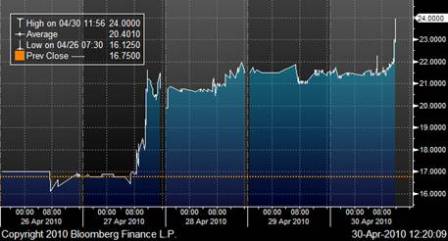
1y OIS-LIBOR 5 day chart:


Result

2y spreads leading the way wider +5 to 23.5

Still cheap though

Press Release
Release Date: April 30, 2010


For immediate release
The Federal Reserve Board has approved amendments to Regulation D (Reserve Requirements of Depository Institutions) authorizing the Reserve Banks to offer term deposits to institutions that are eligible to receive earnings on their balances at Reserve Banks. These amendments incorporate public comments on the proposed amendments to Regulation D that were announced on December 28, 2009.

Term deposits, which are deposits with specified maturity dates that are held by eligible institutions at Reserve Banks, will be offered through a Term Deposit Facility (TDF). Term deposits will be one of several tools that the Federal Reserve could employ to drain reserves when policymakers judge that it is appropriate to begin moving to a less accommodative stance of monetary policy. The development of the TDF is a matter of prudent planning and has no implication for the near-term conduct of monetary policy.

The amendments approved by the Board are a necessary step in the implementation of the TDF. As noted in the attached Federal Register notice, the Federal Reserve anticipates that it will conduct small-value offerings of term deposits under the TDF in coming months to ensure the effective operation of the TDF and to help eligible institutions to become familiar with the term-deposit program. More detailed information about the structure and operation of the TDF, including information on the steps necessary for eligible institutions to participate in the program, will be provided later.

The amendments will be effective 30 days after publication in the Federal Register, which is expected shortly.

It’s not too late for Greece

It remains my contention that Greece can dramatically upgrade its new securities simply by putting a provision in the default section that states that in the case of default the bearer, on demand, can use the securities at maturity value plus accrued interest to pay Greek government taxes. This makes the debt ‘money good’ for as long as there is a Greek government that levies taxes.

This would allow Greece to fund itself a low interest rates. It would also be an example for the rest of the euro zone and thereby ease the funding pressures on the entire region.

However, it would also introduce a new ‘moral hazard’ issue as this newly found funding freedom, if abused, could be highly inflationary and further weaken the euro.

Spread the word!

Claims/Eur Gwth Surprise?


Karim writes:
Initial claims fell 11k to 448k, lowest level in 1mth.
Anecdotes supporting further declines ahead:

  • VIACOM CEO SAYS ECONOMY IS GROWING STRONGER EACH DAY
  • Caterpillar CEO: “We enjoy hiring people and growing our business, and we’re delighted to see that opportunity coming back”

EU Sentiment and Manufacturing surveys for April out today and quite strong (except for Greece)

  • Of note is stock of inventories at all-time low while new orders and production are rising
  • Wouldn’t be surprised to see 5-6% GDP growth in Q2 for Europe; of course may not be sustainable due to fiscal issues,etc, but should still be a surprise

Yes, if the ECB, for example, simply guaranteed the national govt debt it would work reasonably well. The automatic stabilizers would get the deficits to as high as needed to restore growth and employment.

But that would introduce the moral hazard issue, as whoever ran the largest deficit would be the winner in real terms, in an inflationary race to the bottom.

So they don’t want to remove the ‘market discipline’ aspect even though a nation can become insolvent before the deficit has a chance to get high enough to turn things around.

Re: Run on European Banks?

>   
>   (email exchange)
>   
>   On Wed, Apr 28, 2010 at 8:23 AM, wrote:
>   
>   Given this view warren, do you think Natl Bk of Greece goes to zero here?
>   Or do you think Europe will do a “shock an awe” 100b package that makes
>   greek banks a buying opportunity?
>   

Wish I knew!

They might like to, but they still don’t have an answer to the moral hazard issue or popular support for a ‘bailout’

What’ they’d like to do is figure out a way to isolate Greece, hence the presumed proposals from yesterday, but those aren’t satisfying either.

And any major package weakens the others who have to fund it in the market place.

Nor do they have a way to enforce their austerity demands and keep them from being reversed once it’s known they’ve taken the position that it’s too risky to let any one nation fail.

They are still in a bind, and their austerity measures mean they don’t keep up with a world recovery

Also, a Greek restructure that reduces outstanding debt is a force that strengthens the euro as it reduces outstanding euro financial assets.

The negative is that it further reduces euro ‘savings desires’ and drives more portfolios to shift away from euro.

And domestic taxes are still payable in euro, so there is that fundamental support .

Again, could go either way from here.

Sometimes that’s how it is!

Run on the European banks?

When/if word gets out that depositors can lose, that contagion spreads across the euro zone with a general run on the banking system to actual cash, gold, and other currencies, which doesn’t create a cash shortage but drives the euro down further, and further weakens the credit worthiness of all the national govts.

As previously suggested, the endgame is a shut down of the payments system and a reorganization of the entire system with credible deposit insurance and central funding.

My proposal still seems the only one I’ve seen that makes any sense at all, and it’s still not even a consideration.

Europe-wide carnage we saw today.

This is not just about sovereign debt. This is about a concern about the banking system.

The word from S&P is that Greek debt holders will take a major haircut on their holdings, and that means serious problems for banks. (See the full list of victims here)

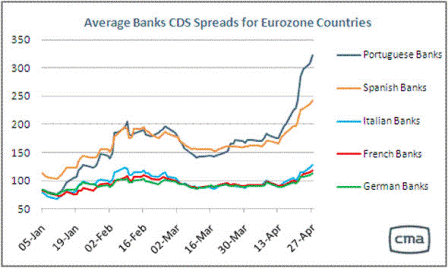
The surging CDS of Portuguese and Spanish banks is a major red flag.

From CMA Datavision:

SOVS Update

It’s all moving very quickly now.

The US 10 year is down over 25 bp from the highs, US stocks are leveling off as the dollar is looking up, hurting foreign earning translations as are rising risks of more serious trouble in the euro zone.

It’s also becoming more apparent that the austerity measures do not ‘fix’ anything but instead slow growth and cause the automatic stabilizers to keep the national gov. deficits high and growing, causing further credit deterioration.

While higher deficits are the answer for growth, at the same time they reduce already deteriorating creditworthiness.

The question is now whether the deficits get large enough to support the needed GDP growth that might restore credit worthiness before the loss of credit worthiness causes widespread defaults.

On Thu, Apr 22, 2010 at 6:35 AM, wrote:
EU release of budget deficit estimates for 2009 which were revised higher hurting the peripherals

Ref Entity 5y$ COD 5y/10y Coupon

Germany 35-39 1.5 4/5 25x
France 59-64 4 3/5 25x
Netherland 37-41 2 3/5 25x
Finland 26-30 1.5 3/5 25x
Norway 17-20 0.5 2/4 25x
Denmark 35-40 1.5 3/5 25x

Belgium 68-73 4.5 2/4 100x
Austria 66-70 4.5 2/4 100x
Sweden 36-40 2 3/5 100x

Greece 545-585 85 -120/-85 100x
Portugal 268-278 45.5 -22/-15 100x
Spain 178-188 23 -8/-3 100x
Italy 148-153 17.5 -1/3 100x
Ireland 175-180 24.5 -3/3 100x

USA €’s 38-41 0 2/4 25x
Switzerland 45-55 0 2/5 25x
UK 73-76 2 1/3 100x