
Re: CFTC reclassifies crude oil position


[Skip to the end]

(An email exchange)

>   (3) The reclassified trader is quite a special one:
>   
>      (a) The reclassified trader has interests in only a few
>   commodities (I have highlighted the reclassified ones in the
>   chart).
>   
>      (b) The trader is heavily focused on crude oil. The
>   reclassified positions include 330 million bbl of WTI contracts,
>   45 million bbl WTI calendar spread options, 20 million bbl of
>   crude oil calendar swap options, 15 million bbl of European style
>   crude oil options and about 15 million bbl of financial WTI crude
>   oil futures and options.
>   
>      (c) In some of these contracts, the trader’s reclassified
>   positions are enormous. For example, in the WTI contract, the
>   traders 330 million bbl of reclassified positions amounted to
>   about 11% of all the open interest in this contract. In the WTI
>   calendar spread options, the trader’s 45 million bbl position was
>   equivalent to about 35% of all open interest. So the trader was
>   a very big participant in these markets.
>   
>      (d) The trader has a few other reclassified interests, mostly
>   in natural gas, with little or no reclassified interest in electricity
>   derivatives or petroleum products such as RBOB gasoline. But
>   the reclassified positions in these markets are tiny in relation to
>   open interest and the trader does not appear to have been a
>   significant participant, at least from its reclassified positions.
>   
>   The CFTC has not revealed the identity of the reclassified trader
>   – which remains confidential. But given the scale of positions
>   which the CFTC has reclassified, there are only a few types of
>   institutions which could be running this type of book: oil
>   companies, refiners, distributors, merchants, banks, index funds
>   and swap dealers.
>   
>   
>   And the CFTC staff obviously examined the numbers and concluded
>   that “commercial hedging or risk-management activities did not
>   constitute a significant part of the overall trading activity”. In other
>   words, the CFTC concluded that this was all or almost all
>   speculative.
>   
>   Now we don’t have full information about the revisions going all
>   the way back to Jul 2007 for all the contracts. But we do have
>   information about the basic WTI position for this trader. Back in
>   Jul 2007, this trader had a position of about 180 million bbl that
>   has been reclassified. But by Jul 2008, this traders’ reclassified
>   position had grown to 330 million bbl. This traders’ positions
>   have been growing faster than the market as a whole so its
>   share of total open interest in the WTI contract has risen from
>   9.1% in Jul 2007 to a massive 11.5% in Jul 2008.
>   
>   The reclassification is so large it affects understanding of the
>   whole market. Under the old classification, non-commercial
>   traders accounted for about 38% of the total open interest in
>   the WTI contract. But now that one large trader has been
>   reclassified, non-commercial traders account for 49% of the
>   market — half rather than one third.
>   
>   Assuming that one individual trader did increase their already
>   large 180 million bbl position in the WTI spreads in Jul 2007 to as
>   much as 330 million bbl in Jul 2008, and that the additional
>   positions were not hedging an underlying exposure, it seems
>   impossible that the massive accumulation would not have
>   disturbed the market at least somewhat.
>   
>   It is interesting, though perhaps coincidental, to note that
>   crude oil prices peaked around Jul 4-14, a few days before the
>   CFTC announced its reclassification on Jul 18.
>   
>   These positions are so large that they clearly exceed the
>   NYMEX position limits by a substantial margin (no more than
>   20,000 contracts in all months; no more than 10,000 contracts
>   in any one month; and no more than 3,000 contracts in the last
>   three days of trading in the spot month). Presumably, the
>   holder of these positions has received a waiver from NYMEX and
>   the CFTC on the basis that it is hedging under the normal
>   hedging exemptions. But if the CFTC no longer believes that the
>   holder of these positions is using them for “hedging or risk
>   managing” to any significant extent, will they still be allowed to
>   qualify for the waiver (a question I am not qualified to answer).
>   
>   

thanks,

any idea who holds that large position?

A liquidation of this size is more than sufficient to drive down futures prices and even cause a liquidation of some portion of spot inventories.

The Saudis could keep prices high as this happens but that would make it obvious they are setting prices as swing producer.

So instead, as in Aug 06 during the Goldman liquidation, they instead lower their prices as futures prices fall, but with a small lag, until the liquidation is over.

They then go back to setting/hiking prices

Warren

>   
>   
>   The CFTC has published revised Commitment of Traders data
>   back to 3 Jul 2007 to take account of the reclassification of one
>   or more positions from the commercial to the non-commercial
>   category.
>   
>   CFTC has published both the original and the revised data for a
>   single point in time (15 Jul 2008) to help users understand the
>   impact of the change. It is has NOT published identical
>   historical data sets of both original and revised data. However,
>   I still have the complete data as originally reported — and of
>   course the revised numbers from the CFTC website. Comparing
>   the two series gives a fascinating insight into what the CFTC
>   has done (this is a little sneaky because I don’t think the CFTC
>   staff meant to identify the position of an individual trader quite
>   so publicly).
>   
>   (1) The revisions over the entire period from Jul 2007 onwards
>   affect just one very large participant in the crude oil market
>   each week (and presumably the same participant over time).
>   
>   (2) In each case, the positions seem to have been almost
>   entirely in the time spread. A large number of positions that
>   were originally reported as separate “long” and “short”
>   commercial positions are now being reported as a combined
>   non-commercial “spread” position with a small balance reported
>   as an non-commercial short position each week.
>   
>   (3) The attached chart gives some indication of the impact of
>   the reclassification back through Jul 2007 (as far back as the
>   CFTC staff have so far been able to recalculate the data). The
>   scale of the reclassified position is very large (see chart) and it
>   has been growing over time. The position which CFTC has
>   reclassified has grown from around 190,000 contracts in Jul
>   2007 to 320,000 contracts in Jul 2008. By the middle of Jul this
>   year, this one massive trader held spread positions equivalent to
>   about 25% of the entire market for non-commercial spread>   positions.
>   
>   (4) Interestingly, we can also look at the residuals — ie the
>   part of the commercial long-short position that was not
>   reclassified as a commercial spread position. The residual has
>   varied over time between about 1,000 contracts (1 million bbl)
>   and 11,000 contracts (11 million bbl) and every week it was a
>   residual short position rather than a long one. None of the
>   CFTC reclassifications affect the non-commercial long side of
>   the market at all. It doesn’t necessarily imply that this trader
>   was always short overall (they might have had offsetting long
>   positions somewhere else). But interestingly, those short
>   positions have been gradually cut over time (see chart)
>   although as of the middle of last month (15 Jul 2007) the
>   reclassified trader was still net short almost 4,000 lots (4 million
>   bbl).
>   
>   


[top]
Re: Resource allocation


[Skip to the end]

>   
>   On 8/3/08, Craig wrote:
>   
>   Ok. And the irony is as prices fall, demand increases again.
>   Until consuming governments get their head around that fact
>   and put some kind of floor under crude prices to incent
>   substitution (which may be beyond their thinking and/or impossible
>   politically), it seems like crude prices are gonna play rope-a-dope
>   with consumers.
>   
>   
>   Craig
>   
>   

Crude will be rationed as is everything else (scarcity, etc.).

The question is how. Ration by price or by other things?

Rationing by price is the most pervasive and means the wealthy (by definition) outbid the less wealthy for the available supply.

Make you wonder why the Democrats support higher prices, as that means they support their supporters going without while the wealthy drive any size SUV they want. Much like wondering why Obama supports Bernanke after Bernanke explained to Congress how he’s keeping inflation down by keeping a lid on inflation expectations after explaining the main component of inflation expectations is workers demanding higher wages, meaning Obama, Kennedy, and the rest of the left is praising Bernanke for doing a good job of suppressing wages.

Non-price rationing is less common but not unfamiliar, such as mandating cars get an average of 27 mpg, minimum efficiency standards for refrigerators, windows, etc. This takes an element of rationing by price away and results in the wealthy consuming less and leaving some for the less wealthy to consume a bit.

So seems to me the logical path for the Democrats would be something like my 30 mph speed limit for private transportation, which is ‘progressive’ and also drives the move towards public transportation with non price incentives as previously outlined. But there hasn’t even been any discussion of a progressive policy response. All seem highly regressive to me.

So I expect the world’s new and growing class of wealthy will continue to outbid our least wealthy for fuel and other resources.

Also, there may be limits to how high we want world consumption/burning of fuels for all the various ‘green’ reasons.

That would mean drilling and other production increases are out, as would be increased use of coal via the electric grid for electric cars.

And, again, it would be the world’s wealthy outbidding the less wealthy for consumption of the allowable annual fuel burn, as somehow allocation by price continues to rule.

Most paths keep coming down to the continuing combination of weakness and higher prices.

Warren

[top][end]


(comments from my brother, Seth, who was cc’d)

>   
>   I think democrats have lots of business and profits waiting
>   in govt subsidies for wind and solar. If oil prices fall that goes
>   away for now and they can’t produce on the subsidies for
>   them-cynical view but probably true
>   
>   There are also a lot of wealthy democrats and they want their
>   votes. Poor people all vote for democrats anyway-even with
>   declining lifestyles they are not going to McCain. So I think
>   Obama is pandering to the wealthy-it might be who he is-no
>   one really knows.
>   
>   With all of their green talk I have not seen any of them reduce
>   air travel, suv caravans or turn off the a/c in the capital. Just a
>   way to get votes and sound concerned. I saw a tv program
>   about how the chinese olympic swimming building is a green
>   sustainable building. It is 7 acres, pools, 25,000 people.
>   they finally said it uses about 25% less energy than a comparable
>   building would have. That is not green or sustainable, especially
>   since the building was not needed in the first place. I think “green”
>   is about making money, not the environment.
>   
>   
>   Seth
>   

I just can’t allow myself to be that cynical like you new yorkers!

:)

Warren

>   
>   
>   I think I am cynical usually, but this green thing drives me nuts
>   it started 30 years ago but is now all about money
>   when I see some lights turned off in Times Square (even in the
>   daytime) or the 5 huge spot lights on the CBS building lighting up
>   Katie Couric’s 50′ x 30′ poster which are on 24 hours a day turned
>   off, then I will believe it is about resources and not money.
>   there is a long way to go.
>   they advertise expensive green buildings here-I am not kidding-the
>   big thing is thermostats with timers on them and bamboo floors-didn’t
>   we have those 30 years ago??
>   
>   they talked about the oscar ceremony being green this year-the
>   celebrities were all giddy about it-what they did was use red
>   carpet made of recycled fibers????? what is that?
>   absolutely nothing-
>   anyway, time to calm down. too much excitement here
>   seth –
>   
>   

[top]

Re: Fed study on TAF


[Skip to the end]

>    
>    On Tue, Jul 29, 2008 at 4:05 AM, Andrea wrote:
>    
>    In case you haven’t seen this yet: A Fed study that finds that
>    Taf has lowered Libor.
>    
>    http://www.newyorkfed.org/research/staff_reports/sr335.html
>    
>    

right, thanks, as if they needed to fund a study to figure that out!

It’s like doing a study that shows the repo rate goes down when the fed lowers its ‘stop’ on repo.

(Too bad they didn’t use this study to show they should set a rate for the TAF and let quantity float, instead of setting a quantity and having an auction.)

It’s this kind of expense that gives govt. a govt. spending negative connotation.

all the best!

warren


[top]

Re: Oil as a % of global GDP

(an email exchange)

>   
>   On Sun, Jul 20, 2008 at 10:46 PM, Russell wrote:
>   
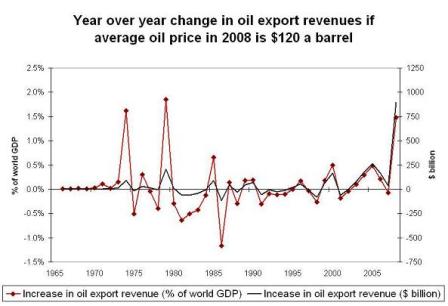
>   Brad Setser, at Follow the Money, presents a couple of graphs on changes in
>   oil export revenue: The Oil Shock of 2008.
>   
>   The following graph shows the Year-over-year change in oil exports as a
>   percent of world GDP (and in billions of dollars).
>   
>   

>   
>   Year-over-year change in oil exports
>   
>   This calculation assumes that the oil exporters will export about 45 million
>   barrels a day of oil.
>   
>   Each $5 increase in the average price of oil increases the oil exporters’
>   revenues by about $80 billion, so if oil ends up averaging $125 a barrel this year
>   rather than $120 a barrel, the increase in the oil exporters revenues would be
>   close to a trillion dollars.
>   
>   Assuming oil prices average $120 per barrel for 2008, the increase in 2008 will
>   be similar to the oil shocks of the ’70s.
>   
>   

Right, the notion that oil is a smaller % of GDP and therefore not as inflationary was flawed to begin with and now moot.

Two more thoughts for today:

First, the second Mike Masters sell-off may have run its course. The first was after his testimony in regard to passive commodity strategies which I agree probably serve no public purpose whatsoever. The second was last week as markets expect Congress to act to curb speculation this week, which they might. Crude isn’t a competitive market (Saudi’s are the swing producer) so prices won’t be altered apart from knee jerk reactions, but competitive markets such as gold can see lower relative prices if the major funds back off their passive commodity strategies.

Second, just saw a headline on Bloomberg that inflation is starting to hurt the value of some currencies.

Third, the Stern statement will continue to weigh on interest rate expectations up to the Aug 9 meeting.

Re: Sov CDS: ny open 15Jul08


[Skip to the end]

(an email exchange)

>    On Tue, Jul 15, 2008 at 11:03 AM, Mike wrote:
>
>    Should we be looking at selling protection on USTs for 20bps?
>

makes sense

And makes even more sense for the Fed to be selling it:

  1. free money (really sort of a tax for those who want to pay it, but whatever)
  2. assists market functioning


>
>
>    Sov CDS: ny open 15Jul08
>
>    Credit 5yr 10yrket Credit 5yr 10yr
>    Austria 12.5/15.5 17.0/18.5 Ireland 27.5/30.5 37.0/39.0
>    Belgium 19.0/22.0 26.5/29.0 Italy 41.0/43.0 51.5/53.5
>    Denmark 10.0/12.5 15.0/17.5 Nether 10.5/12.5 15.0/17.0
>    Finland 10.0/12.5 15.0/17.5 Portug 38.0/40.0 48.0/50.0
>    France 11.0/13.0 15.0/17.5 Spain 38.0/40.0 47.5/49.5
>    Germany 6.0/8.0 9.75/10.75 Sweden 10.5/12.5 15.0/17.0
>    Greece 51.0/53.0 61.5/63.5 UK 14.5/17.5 21.0/24.0
>    Iceland 250/290 240/300 US 14.5/18.5 19.0/25.0
>
>


[top]

Re: Demand destruction


[Skip to the end]

(an email exchange)

On Thu, Jun 19, 2008 at 10:38 PM, Russell wrote:
>   
>   
>   SUV sales may be falling off the cliff in the US, but in China, they are red hot.
>   Sales of the large vehicles in China rose by 40% in the first four months of this
>   year. That is twice the growth rate for the Chinese passenger car market.
>   
>   Its no surprise why: The costs of petrol and diesel in China is as much as 40%
>   cheaper than US levels (which are nearly half of European prices).
>   
>   China, the second-biggest fuel consumer after the U.S, has been encouraging
>   SUV purchases via subsidized fuel.
>   
>   That now appears to be changing: The Chinese government will “increase
>   gasoline and diesel prices by 1,000 yuan ($145.50) a ton, the National
>   Development and Reform Commission said,” according to a Bloomberg report.
>   This represents a 17% price increase for gasoline and 18% for diesel. China is
>   also scheduled to raise jet-fuel prices by 1,500 yuan a ton (~25%).
>   
>   The response in Crude futures was immediate: Crude Oil fell almost $5, spurring
>   gains in the broad averages.
>   
>   Demand Destruction is now clearly upon us. Its a cliche, but its true: The best
>   cure for high prices are high prices.
>   
>   

Yes, but…
   
This also means rationing by price which means only the world’s richest get to drive SUV’s and the lower income groups have to take the bus.
   
Distribution of consumption gets skewed towards the top.
   
Interesting that much of the political left wants higher prices to discourage consumption, as its counteragenda regarding their distributional desires.

[top]

Re: Some crude facts


[Skip to the end]

(an email exchange)

On Wed, Jun 18, 2008 at 4:24 PM, Bob wrote:
>   
>   Warren,
>   
>   Do you have any view as to why the Saudi feel a high current oil price is in
>   their best long-term interests?

Not sure it is. They may have a political agenda of destabilizing the west.

The other possibility is that they know they have the only excess capacity, and are trying to get the price up cool demand so that they have a bit more ‘slack’ to deal with real supply shocks.

>   Obviously they make more money in the short run with a higher price, but all oil
>   consuming countries will:
>   
>   1. Reduce consumption
>   
>   2. Legislate higher fuel economy requirements on new vehicles
>   
>   3. Accelerate development of alternative fuels (wind, solar, mining H3 from the
>   moon, etc.)
>   
>   4. Expand domestic production (given that high cost oil extraction methods are
>   viable)
>   
>   5. Expand domestic production (e.g., Bush & McCain seeking access to outer
>   continental shelf)

Yes, and that would mean Saudi exports would fall, which also might be a good thing for them if they plan on increasing domestic consumption.

>   I would assume the objective function (in an operations research sense) would
>   be to maximize the total revenue earned on the sale of all oil in their
>   possession.

Yes, though the current King is probably over 80 years old and may have other agendas, as above.

>   It would seem to me the current effort to push up the prices could be
>   short-sighted for it may backfire if it brings more supply online, generates
>   research which produces a breakthrough in alternative energy development, or
>   radically reduces demand.
>   
>   Bob
>   

Yes, might be the case. But sure seems like that’s what they are doing!

warren

[top]

RE: BOE letter


[Skip to the end]

(an interoffice email)

>
>   On Tue, Jun 17, 2008 at 7:58 AM, DV wrote:
>
>   Mervyn King was required this morning to write a letter to the
>   Chancellor explaining why inflation was greater then 3% in the UK
>   (released this morning at 3.2% vs. 3% previously). The letter follows
>   and was taken as dovish by the markets as it seemed to have more
>   emphasis on the weakening economy then additional upside inflation
>   risks.
>
>   DV
>

Letter to the Chancellor

The CPI inflation rate for May, to be published at 9:30 am tomorrow by the Office for National Statistics, is 3.1%. That is more than one percentage point above our target of 2%. Under the terms of the remit you have given us, I am, therefore, writing an open letter to you today on behalf of the Monetary Policy Committee. As requested by the National Statistician, in order to avoid conflict with the release of the official statistic, in this case the CPI, the Bank of England will publish this open letter at 10:30am.

Our remit specifies that an open letter should explain why inflation has moved away from the target, the period within which we expect inflation to return to the target, the policy action that the Committee is taking to deal with it, and how this approach meets the Government’s monetary policy objectives.

Why has inflation moved away from the target?
Inflation has risen sharply this year, from 2.1% in December to 3.3% in May. That rise can be accounted for by large and, until recently, unanticipated increases in the prices of food, fuel, gas and electricity. These components alone account for 1.1 percentage points of the 1.2 percentage points increase in the CPI inflation rate since last December. Those sharp price changes reflect developments in the global balance of demand and supply for food and energy.

In the year to May:

  • world agricultural prices increased by 60% and UK retail food prices by 8%.
  • oil prices rose by more than 80% to average USD123 a barrel and UK retail fuel prices increased by 20%.
  • wholesale gas prices increased by 160% and UK household electricity and gas bills by around 10%.

The global nature of these price changes is evident in inflation rates not only in the UK but also overseas, although the timing of their impact on consumer prices differs across countries. In May, HICP inflation in the euro area was 3.7% and US CPI inflation was 4.2%. As described in our May Inflation Report, inflation is likely to rise significantly further above the 2% target in the next six months or so.

The May Report set out three main reasons for this:

  • The increase in oil prices will continue to pass through to the costs faced businesses.
  • Rising wholesale gas prices are expected to lead utility companies to announce further tariff increases. There is considerable uncertainty about their size and timing.
  • The depreciation of sterling, which has fallen some 12% since its peak last July, has boosted the prices of imports and will add to the pressure on consumer prices.

The Committee’s central projection, described in its May Inflation Report, was for CPI inflation to rise to over 3 1/2%% later this year. But in the past month, oil prices have risen by about 15% and wholesale gas futures prices for the coming winter have increased by a similar amount. As things stand, inflation is likely to rise sharply in the second half of the year, to above 4%. I must stress, however, that there are considerable uncertainties, in both directions, around this, and any such projection is particularly sensitive to changes in domestic gas and electricity charges.

There are good reasons to expect the period of above-target inflation we are experiencing now to be temporary. We are seeing a change in commodity, energy and import prices relative to the prices of other goods and services. Although this clearly raises the price level, it is not the same as continuing inflation.

There is not a generalised rise in prices and wages caused by rapid growth in the amount of money spent in the economy. In contrast to past episodes of rising inflation, money spending is increasing at a normal rate. In the year to 2008 Q1, it rose by 5 1/2%, in line with the average rate of increase since 1997 – a period in which inflation has been low and stable. Moreover, in recent months the growth rate of the broad money supply has eased and credit conditions have tightened. This will restrain the growth of money spending in the future.

Over what period does the MPC expect inflation to return to the target?
It is possible that commodity prices will rise further in the coming months – oil prices have now been rising for four years. But in the absence of further unexpected increases in oil and commodity prices, inflation should peak around the end of the year and begin to fall back towards the 2% target. Nevertheless, each monthly rise in food, energy and import prices will, by pushing up the overall price level, affect the official twelve-month measure of inflation for a year. So CPI inflation is likely to remain markedly above the target until well into 2009.

I expect, therefore, that this will be the first of a sequence of open letters over the next year or so. The remit for the Monetary Policy Committee states that:

“The framework takes into account that any economy at some point can suffer from external events or temporary difficulties, often beyond its control. The framework is based on the recognition that the actual inflation rate will on occasions depart from its target as a result of shocks and disturbances. Attempts to keep inflation at the inflation target in these circumstances may cause undesirable volatility in output”.

The Committee believes that, if Bank Rate were set to bring inflation back to the target within the next 12 months, the result would be unnecessary volatility in output and employment. So the MPC is aiming to return inflation to the 2% target within its normal forecast horizon of around two years, when the present sharp rises in energy and food prices will have dropped out of the CPI inflation rate. Nevertheless, the Committee is concerned about the present and prospective period of above-target inflation. It is crucial that prices other than those of commodities, energy and imports do not start to rise at a faster rate.

That would happen if those making decisions about prices and pay began to expect higher inflation in the future and acted on that. It could also happen if employees respond to the loss of real spending power that results from higher commodity prices by bidding for more substantial pay increases. Pay growth has remained moderate. But surveys indicate that higher inflation has already had an impact on the public’s expectations of inflation. For that reason, the Committee believes that, to return inflation to the target, it will be necessary for economic growth to slow this year.

A slowdown is already in train. Moreover, as described in the Committee’s May Inflation Report, the prospective squeeze on real incomes associated with higher inflation, together with the reduced availability of credit, is likely to lead to a further slowing in activity this year. This will reduce pressure on the supply capacity of the economy and dampen increases in prices and wages. What policy action are we taking? Since December, Bank Rate has been reduced three times, to stand at 5%. When setting Bank Rate the Committee has faced a balancing act between two risks. On the upside, the risk that above-target inflation could persist explains why the Committee has not responded more aggressively to signs that the economy is slowing. On the downside, the risk is that the slowdown could be so sharp that inflation did not just return to the target but was pulled below. This explains why Bank Rate has been reduced at a time when inflation is above the target.

The MPC will discuss at its July meeting the implications of the latest inflation and other economic data for the balance of these risks. That analysis will be described in the minutes, published two weeks later, and a fully updated forecast will be presented in the August Inflation Report. The path of Bank Rate that will be necessary to meet the 2% target is uncertain. The MPC will continue to make its judgement about the appropriate level of Bank Rate month by month.

How does this approach meet the Government’s monetary policy objectives?
Over the past decade, inflation has been low and stable. Volatility in commodity, energy and import prices means that inflation will now be less stable but it does not mean that inflation will persist at a higher rate. The Committee will maintain price stability by ensuring that the rise in inflation is temporary and that it returns to the 2% target. In the short term, this commitment should give those setting prices and wages some confidence that inflation will be close to the target in the future. That will minimise the slowdown in economic activity that will be necessary to ensure that inflation does fall back. In the longer term, price stability, as our remit states, is “a precondition for high and stable levls of growth and employment”.

We have seen in the past how the need to reduce inflation from persistently high levels has required prolonged periods of subdued economic growth. The resulting instability in our economy deterred investment and contributed to poor economic performance over a longer period. The Monetary Policy Committee remains determined to set interest rates at the level required to bring inflation back to the 2% target, and I welcome the opportunity to explain our thinking in this open letter.

I am copying this letter to the Chairman of the Treasury Committee, through which we are accountable to Parliament, and will place it on the Bank of England’s website for public dissemination.

Thanks, seems the risk of crude rising continuously due to demand continues to be downplayed by the world’s central bankers even though it has been the case for several years, so they continue to pursue policies that in their models are designed to at least support demand.

I continue to suggest mainstream history will not be kind to them.


[top]

Re: Roach-Stagflation


[Skip to the end]

(an email exchange)

A few of things:

First, the rising wages in the 70’s led to bracket creep that put the budget in surplus in 1979 and resulted in a severe recession soon after.

This time around it is unlikely the inflation takes much of a dent out of the deficit so it’s more likely demand will be sustained to support prices. And, at least so far, Congress has acted to sustain demand and support prices with the latest fiscal package and more seemingly on the way.

Second, last time around the oil producers for the most part didn’t spend all that much of their new found revenues and thereby drained demand from the US economy. This time around they seem to be spending on infrastructure at a rate sufficient to drive our exports and keep gdp muddling through.

Third, I recall it was maybe the deregulation of nat gas that freed up a cheap substitute for electric utilities and unleashed a massive supply response as nat gas was substituted for crude at the elect power producers. After 1980 opec cut production by something like 15 million bpd to hold prices above 30 until they could cut no more without capping all their wells and the price tumbled to about 10 where it stood for a long time. This time around that kind of excess supply is nowhere in sight.

>
>   On Thu, Jun 12, 2008 at 11:59 PM, Russell wrote:
>
>   Stephan Roach is chairman of Morgan Stanley Asia, and pens
>   this missive for the FT, in which he contextualizes why the
>   Fed’s options are limited:
>
>   ”Fears of 1970s-style stagflation are back in the air. Global
>   bond markets are growing ever more nervous over this possibility,
>   and US and European central bankers are talking increasingly
>   tough about the perils of mounting inflation.
>
>   Yet today’s stagflation risks are very different from those that
>   wreaked such havoc 35 years ago. Unlike in that earlier period,
>   wages in the developed economies have been delinked from prices.
>   That all but eliminates the automatic indexation features of the
>   once dreaded wage-price spiral – perhaps the most insidious
>   feature of the “great inflation” of the 1970s. Moreover, as the
>   stunning surge of the US unemployment rate in May suggests,
>   slowing economic growth in the industrial economies is likely to
>   open up further slack in labour markets, thereby putting downward
>   cyclical pressure on wages over the next couple of years.
>
>   But there is a new threat to global inflation that was not present
>   in the 1970s. It is arising from the developing world, especially in
>   Asia, where price pressures are lurching out of control. For
>   developing Asia as a whole, consumer price index inflation hit 7.5
>   per cent in April 2008, close to a 9½-year high and more than double
>   the 3.6 per cent pace of a year ago. Sure, a good portion of the recent
>   acceleration in pricing is a result of food and energy – critically
>   important components of household budgets in poorer countries and
>   yet items that many analysts mistakenly remove to get a cleaner read
>   on underlying inflation. But even the residual, or “core”, inflation rate
>   in developing Asia surged to 3.8 per cent in April, more than double
>   the 1.8 per cent pace of a year ago…”
>
>

[top]