Repost of my press release from August 2010

Unfortunately it’s unfolding as feared.

MOSLER FOR SENATE

Tea Party’s Economic Agenda Would Cause Next Great Depression
Says Former Tea Party Democrat


Waterbury, CT – August 30, 2010, Warren Mosler, Independent candidate for US Senate, former Tea Party Democrat, and frequent speaker at Tea Party rallies, lashed out today at the political movement for its ill-thought demands to balance the budget which he contends is based on abject ignorance and counter to true Tea Party values. “The Tea Party’s demands to balance the budget and reduce the Federal deficit aren’t merely misguided, but dangerous, and would cause the worst depression in history,” stated Mosler, a financial expert with 37 years of experience in monetary operations. “I have been, and continue to be, a strong supporter of the core Tea Party values of lower taxes, limited government, competitive market solutions, and a return to personal responsibility. However, their proposals to balance the budget are the same suicidal policies that caused the 6 horrible depressions in the U.S. over the past 200 years. At the worst possible time to take money out of the economy, the Tea Party’s proposals would remove an estimated $1 trillion and cause the worst depression in world history, destroying tens of millions of jobs and ruining our children’s future.”

Explanation of the Modern Monetary System
Modern money, after the demise of the gold standard, is akin to a spreadsheet that simply works by computer. As Fed Chairman Bernanke explained on national television on 60 minutes, when the government spends or lends, it does so by adding numbers to private bank accounts. When it taxes, it marks those same accounts down. When it borrows, it simply shifts funds from a demand deposit (called a reserve account) at the Fed to a savings account (called a securities account) at the Fed. The money government spends doesn’t come from anywhere, and it doesn’t cost anything to produce. The government therefore cannot run out of money, nor does it need to borrow from the likes of China to finance anything. To better understand this, think about when a football team kicks a field goal; the number on the scoreboard goes from 0 to 3. Does anyone wonder where the stadium got those 3 points, or demand that the stadium keep a reserve of points in a “lock box”?

Moreover, government deficits ADD to our savings – to the penny – as a fact of accounting, not theory or philosophy. This means the Mosler payroll tax (FICA) holiday will directly increase incomes and savings, thus fixing the economy from the bottom up. For example, if the Mosler tax cut amounts to $20 billion per week, that will be the exact increase in income and savings for the rest of us as anyone in the Congressional Budget Office will confirm. For the Federal government, taxes don’t serve to collect revenue but are more like a thermostat that controls the temperature of the economy. When it is too hot, raising taxes will cool it down. And in this ice-cold economy, a very large tax cut is needed to warm the economy back up to operating temperature.

While Mosler fully supports the Tea Party desire to cut taxes, and recognizes the need to cut wasteful and unnecessary spending – in fact, his economic proposals will save the government hundreds of billions of dollars of unnecessary interest expense – he also recognizes that tax cuts have to be much larger than spending cuts in order to ensure that less money is taken out of the economy, and not more as the Tea Party is currently demanding.

About Warren Mosler
Warren Mosler is running as an Independent. His populist economic message features: 1) a full payroll tax (FICA) holiday so that people working for a living can afford to buy the goods and services they produce. 2) $500 per capita Federal revenue distribution for the states 3) An $8/hr federally funded job to anyone willing and able to work to facilitate the transition from unemployment to private sector employment. He has also pledged never to vote for cuts in Social Security payments or benefits. Warren is a native of Manchester, Conn., where his father worked in a small insurance office and his mother was a night-shift nurse. After graduating from the University of Connecticut (BA Economics, 1971), and working on financial trading desks in NYC and Chicago, Warren started his current investment firm in 1982. For the last twenty years, Warren has also been involved in the academic community, publishing numerous journal articles, and giving conference presentations around the globe. Mosler’s new book “The 7 Deadly Innocent Frauds of Economic Policy” is a non technical guide to the actual workings of the monetary system and exposes the most commonly held misconceptions. He also founded Mosler Automotive, which builds the Mosler MT900, the world’s top performance car that also gets 30 mpg at 55 mph.
Learn more at www.moslerforsenate.com


Media Contact:
Will Thompson
(267) 221-6056
will@hedgefundpr.net

Obama and McConnell

Stupid headline and stupid response.

Unemployment is a macro problem, and cutting spending does’t create jobs.

It’s the continuing saga of the blind leading the blind.

Looking for $31 billion in federal spending cuts this week.
And that’s just a down payment.

Obama: Shift From Foreign Oil Will Help Create More Jobs

April 2 (AP) — President Barack Obama says shifting the U.S. away from imported oil and toward cleaner forms of energy will add momentum to a trend that has led to 1.8 million new jobs in the past 13 months.

Obama used his weekly radio and Internet address Saturday to promote his ideas for bringing down gasoline prices by decreasing U.S. dependence on foreign oil. A blueprint he outlined in a recent speech calls for increasing domestic oil exploration and production, making cars and trucks more energy efficient and building vehicles that run on alternative fuels or electricity.

Noting that the U.S. doesn’t have enough oil reserves to meet its needs, he set a goal of reducing imports by one-third by 2025.

“By doing so, we’re going to make our economy less vulnerable to wild swings in oil prices,” Obama said. “We’re going to use cleaner sources of energy that don’t imperil our climate. And we’re going to spark new products and businesses all over the country by tapping America’s greatest renewable resource: our ingenuity.”

The address was Obama’s third in recent days on the issue. On Wednesday, he travels to the Philadelphia area to visit an arm of the Spanish company Gamesa, maker of giant turbines that generate electricity from wind.

Oil prices have climbed because of increasing demand in China and instability in some oil-producing countries in the Middle East. That, in turn, has pushed U.S. gasoline prices to new highs. The national average for a gallon of gas hit $3.619 on Friday, the highest price ever for this time of year, according to AAA and other sources. Prices have climbed 23.2 cents in the past month and more than 81 cents in the past year.

Senate Republican leader Mitch McConnell agreed with Obama on encouraging more domestic energy production. But he accused the administration of stifling that industry’s growth by canceling drilling leases, halting drilling off the Gulf Coast after last summer’s oil spill and increasing permit fees.

“As a result, thousands of U.S. workers have lost their jobs, as companies have been forced to move their operations overseas. That must end,” the Kentucky Republican said. “We must do more to find energy here at home, and the jobs that go with it.”

Obama said that sparking new products and businesses during a transition away from imported oil will help create jobs. The government reported Friday that 230,000 private sector jobs were created in March, bringing the total number created in the past 13 months to 1.8 million. The national unemployment rate also dipped to a two-year low of 8.8 percent last month.

“That’s a good sign,” Obama said. He recorded the address at a UPS shipping facility in suburban Maryland, where he examined all-electric and hybrid vehicles used by AT&T, Verizon, PepsiCo and other companies.

“But we have to keep up the momentum, and transitioning to a clean energy economy will help us do that,” Obama said.

House Speaker John Boehner, R-Ohio, focused his party’s weekly message on steps he said the government must take to encourage small businesses to create jobs. Among those steps are continuing to cut spending, blocking tax increases, reducing the bureaucracy and eliminating regulations. Boehner once owned a small plastics and packaging business in Ohio.

Boehner said Congress also needs to pass a bill funding the government through Sept. 30, when the budget year ends, and avoid a shutdown. The government’s authority to spend money expires next Friday.

“Washington’s inability to get spending under control is creating uncertainty for our job creators,” Boehner said. “It’s discouraging investment in small businesses and eroding confidence in our economy. To put it simply, the spending binge in Washington is holding our country back and keeping our economy from creating jobs.”

Charts that look like demand isn’t booming

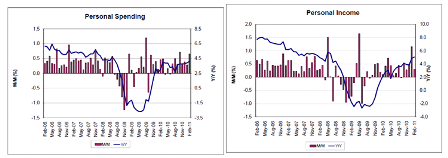
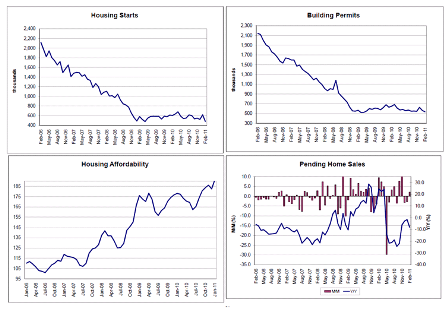
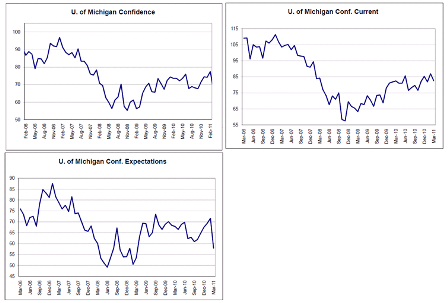
Charts that Say Demand Isn’t Doing Much of Anything

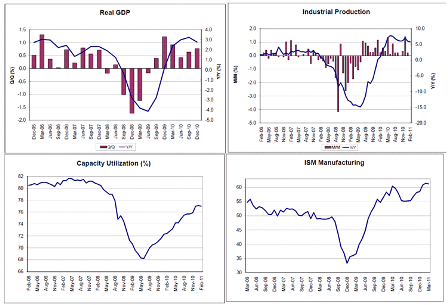
Yes, there’s modest top line growth, but not a lot of evidence anything more than that is likely to happen any time soon, especially with global post earthquake issues, US fiscal cutbacks of at least $31 billion as a ‘down payment’ next week, Japan showing no inclination to rebuild without ‘paying for it’, UK austerity kicking in for real this month, continued tightening in the euro zone, and China still fighting inflation with spending and lending cuts.

Q1 GDP now forecast with a 2 handle, and manufacturing, though sort of strong, is only about 11% of GDP and considerable slack remains.

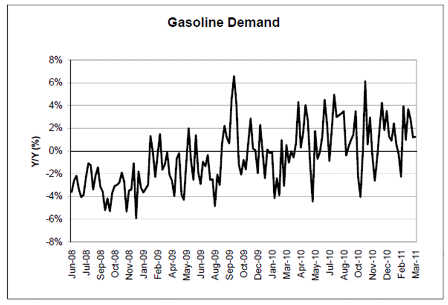
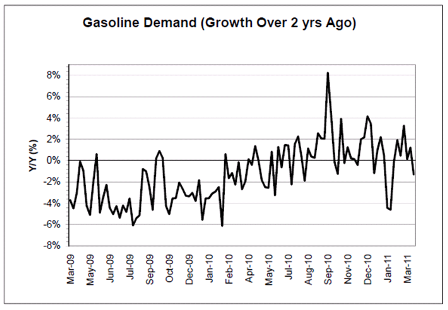
Given the more than 2 years of positive headline GDP growth, gasoline demand, previously a pretty good coincident indicator, is looking pretty flat.

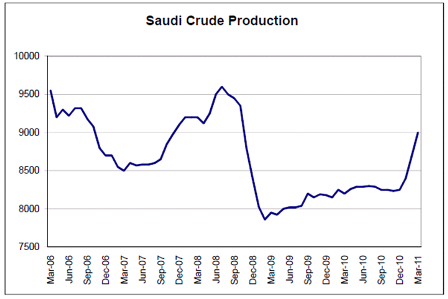
Saudi crude production has been increased to make up for lost Libyan output, and not due to an increase in world demand.

These series are doing ok, but no sign of accelerating demand. In fact the growth rates are less than they were when the output gap was a whole lot smaller in 06 and 07.

No sign of demand picking up here.

Consumer buying plans don’t look inspiring either, which makes sense with rising food and fuel prices.

With ‘normal’ credit conditions, govt deficits would be plenty high for us to be doing a lot better than this by now.

So given today’s credit conditions, seems to me govt deficits are far too small to see much progress on the demand side, and tightening fiscal at this point only makes that more so.

The Wall of Shame (cont.)

Today is year and in Japan,
which means the last few days could be mainly quarter end and year end maneuvers,
with a high probability of ‘buy the rumor sell the news’ types of unwinds coming up.

This would include the anticipation of another 200,000 new private sector jobs to be reported tomorrow am.
And the euro strength we’ve seen in front of the announced ECB rate hike next week.

There have been lots of promotional reasons to rush to get stocks on your books for year and/quarter end reporting,
as well as a bit of gold, silver, foods, and other commodities.

But fundamentally I see what’s going on below- a world heck bent on removing aggregate demand.

More noises from Japan on how they will pay for the rebuild, which looks to be a very modest appropriation tempered by fears of being at a fiscal tipping point.

UK austerity ratchets up April 1.

China still fighting inflation with further reduced spending and lending.

The euro zone demanding and getting austerity in return for funding, with signs in some members of austerity no longer bringing down deficits as revenues fall off from economic weakness. And no fiscal safety net if it does all go bad as markets have shown extreme reluctance to fund countercyclical deficits.

And food and fuel from monopoly pricing both eating into consumer demand and driving large segments of the world population into desperation.

Talk of Q1 US GDP down to maybe only +2%, housing still bumping along the bottom, and Q2 threatened by supply shortages due to the earthquake in Japan.

And the US debt ceiling showdown now possibly happing late next week as the deficit terrorists seal their congressional victory with the promised down payment on net spending cuts that won’t end there.

In fact, their army of support is now all but universal.

Everyone in DC and the mainstream media and economics profession agrees on the problem.

The only discussion is where the cuts should be, and who should pay more.

March 31, 2011
President Barack Obama
The White House
1600 Pennsylvania Avenue, NW
Washington, DC 20500
The Honorable John Boehner
Speaker of the House
1101 Longworth House Office Building
Washington, DC 20515
The Honorable Nancy Pelosi
House Minority Leader
235 Cannon House Office Building
Washington, DC 20515
The Honorable Harry Reid
Senate Majority Leader
522 Hart Senate Office Building
Washington, DC 20510
The Honorable Mitch McConnell
Senate Minority Leader
361-A Russell Senate Office Building
Washington, DC 20510

Dear President Obama, Speaker Boehner, Minority Leader Pelosi, Majority Leader Reid, and Minority Leader McConnell:


As you continue to work on our current budget situation, we are writing to let you know that we join with the 64 Senators who recently wrote that comprehensive deficit reduction measures are imperative, and to urge you to work together in support of a broad approach to solving the nation’s fiscal problems. As they said in their letter to President Obama:

“As you know, a bipartisan group of Senators has been working to craft a comprehensive deficit reduction package based upon the recommendations of the Fiscal Commission. While we may not agree with every aspect of the Commission’s recommendations, we believe that its work represents an important foundation to achieve meaningful progress on our debt. The Commission’s work also underscored the scope and breadth of our nation’s long-term fiscal challenges.

Beyond FY2011 funding decisions, we urge you to engage in a broader discussion about a comprehensive deficit reduction package. Specifically, we hope that the discussion will include discretionary spending cuts, entitlement changes and tax reform.

By approaching these negotiations comprehensively, with a strong signal of support from you, we believe that we can achieve consensus on these important fiscal issues. This would send a powerful message to Americans that Washington can work together to tackle this critical issue. Thank you for your attention to this matter.”

We agree with this letter and hope that you will work together to agree on a comprehensive, multi-year debt stabilization package.

Sincerely,
The Honorable Roger C. Altman
Former Assistant Secretary of the U.S.
Department of the Treasury; Founder
and Chairman, Evercore Partners

Barry Anderson
Former Acting Director, Congressional
Budget Office

Joseph Antos
Wilson H. Taylor Scholar in Health Care
and Retirement Policy, American
Enterprise Institute

The Honorable Martin Baily
Former Chairman, Council of Economic
Advisers

Robert Bixby
Executive Director, Concord Coalition

Charles Blahous
Research Fellow, Hoover Institute

Erskine Bowles
Former Co-Chair, National Commission
on Fiscal Responsibility and Reform

The Honorable Charles Bowsher
Former Comptroller General of the
United States

The Honorable John E. Chapoton
Former Assistant Secretary for Tax
Policy, U.S. Department of the Treasury

David Cote
Former Member, National Commission
on Fiscal Responsibility and Reform;
Chairman and CEO, Honeywell
International

Pete Davis
President, Davis Capital Investment
Ideas

John Endean
President, American Business
Conference

The Honorable Vic Fazio
Former Member of Congress

The Honorable Martin Feldstein
Former Chairman, Council of Economic
Advisers

The Honorable William Frenzel
Former Ranking Member, House
Budget Committee; Co-Chair,
Committee for a Responsible Federal
Budget

Ann Fudge
Former Member, National Commission
on Fiscal Responsibility and Reform;
Former CEO, Young & Rubicam Brands

William G. Gale
Senior Fellow, Brookings Institution William A. Galston
Senior Fellow and Ezra K. Zilkha Chair,
Brookings Institution

The Honorable Bill Gradison
Former Ranking Member, House
Budget Committee

The Honorable Judd Gregg
Former Chairman, Senate Budget
Committee

Ron Haskins
Senior Fellow, Brookings Institution

Kevin Hassett
Senior Fellow and Director of Economic
Policy Studies, American Enterprise
Institute

G. William Hoagland
Former Staff Director, Senate Budget
Committee

The Honorable Glenn Hubbard
Former Chairman, Council of Economic
Advisers; Dean, Columbia Business
School

David B. Kendall
Senior Fellow for Health and Fiscal
Policy, Third Way

The Honorable Bob Kerrey
Former Member of Congress

Donald F. Kettl
Dean, School of Public Policy,
University of Maryland

The Honorable Charles E.M. Kolb
President, Committee for Economic
Development

The Honorable Jim Kolbe
Former Member of Congress

Lawrence B. Lindsey
President and CEO, The Lindsey Group;
Former Director, National Economic
Council

Maya MacGuineas
President, Committee for a Responsible
Federal Budget

The Honorable N. Gregory Mankiw
Former Chairman, Council of Economic
Advisers

The Honorable Donald Marron
Director, Urban-Brookings Tax Policy
Center; Former Acting Director,
Congressional Budget Office

William Marshall
President, Progressive Policy Institute

The Honorable James T. McIntyre, Jr.
Former Director, Office of Management
and Budget

Olivia S. Mitchell
Economist

The Honorable William A. Niskanen
Chairman Emeritus and Distinguished
Senior Economist, Cato Institute; Former
Acting Chairman, Council of Economic
Advisers

The Honorable Jim Nussle
Former Director, Office of Management
and Budget; Former Chairman, House
Budget Committee; Co-Chair,
Committee for a Responsible Federal
Budget Michael E. O’Hanlon
Senior Fellow and Sydney Stein Jr.
Chair, Brookings Institution

The Honorable Paul O’Neill
Former Secretary of the U.S.
Department of the Treasury

Marne Obernauer, Jr.
Chairman, Beverage Distributors
Company

Rudolph G. Penner
Former Director, Congressional Budget
Office

The Honorable Timothy Penny
Former Member of Congress; Co-Chair,
Committee for a Responsible Federal
Budget

The Honorable Alice Rivlin
Former Director, Congressional Budget
Office; Former Director, Office of
Management and Budget; Former
Member, National Commission on
Fiscal Responsibility and Reform

The Honorable Charles Robb
Former Member of Congress

Diane Lim Rogers
Chief Economist, Concord Coalition

The Honorable Christina Romer
Former Chairwoman, Council of
Economic Advisers

The Honorable Robert E. Rubin
Former Secretary of the U.S.
Department of the Treasury

The Honorable Martin Sabo
Former Chairman, House Budget
Committee

Isabel V. Sawhill
Senior Fellow, Brookings Institution

Allen Schick
Distinguished University Professor,
University of Maryland

Sylvester J. Schieber
Former Chairman, Social Security
Advisory Board

Daniel N. Shaviro
Wayne Perry Professor of Taxation,
New York University School of Law

The Honorable George P. Shultz
Former Secretary of the U.S.
Department of the Treasury; Former
Secretary of the U.S. Department of
State; Former Secretary of the U.S.
Department of Labor

The Honorable Alan K. Simpson
Former Member of Congress; Co-Chair,
National Commission on Fiscal
Responsibility and Reform

C. Eugene Steuerle
Institute Fellow and Richard B. Fisher
Chair, Urban Institute

The Honorable Charlie Stenholm
Former Member of Congress; Co-Chair,
Committee for a Responsible Federal
Budget The Honorable Phillip Swagel
Former Assistant Secretary for
Economic Policy, U.S. Department of the
Treasury

The Honorable John Tanner
Former Member of Congress

John B. Taylor
Mary and Robert Raymond Professor of
Economics, Stanford University; George
P. Shultz Senior Fellow in Economics,
Hoover Institution
The Honorable Laura D. Tyson
Former Chairwoman, Council of
Economic Advisers; Former Director,
National Economic Council
The Honorable George Voinovich
Former Member of Congress

The Honorable Paul Volcker
Former Chairman, Federal Reserve
System

Carol Cox Wait
Former President, Committee for a
Responsible Federal Budget

The Honorable David M. Walker
Former Comptroller General of the
United States


The Honorable Murray L.
Weidenbaum
Former Chairman, Council of Economic
Advisers

The Honorable Joseph R. Wright, Jr.
Former Director, Office of Management
and Budget
Mark Zandi
Chief Economist, Moody’s Analytics

Japan Weighs Scrapping Company-Tax Cut, Lifting Sales Levies

More talk on ‘paying for’ the reconstruction.

Fearing they could be the next Greece will ensure they remain in the rut they’ve been in for most of the last two decades.

Global austerity continues to push Europe towards the tipping point of where cutting spending and increasing taxes starts raising deficits though economic weakness/automatic fiscal stabilizers.

China appears to be continuing to ‘tighten’ to fight inflation, even though growth has already slowed considerably.

The US govt seems heck bent on cutting spending even in this fragile recover, and with risks to overseas demand for our exports at risk from global austerity measures.

Crude went up very little with the NATO action in Libya, and seems to have stabilized at current levels of Brent. That means at some point (when delivery issues get sorted out) WTI converges to Brent.

It remains to be seen how much the earthquake in Japan will slow down world gdp in Q2 due to parts shortages.

It’s starting to look to me like the US needs current levels of federal deficit spending just to muddle through without a pickup in private sector credit expansion, which historically means housing and cars. I don’t see any signs of life in housing yet, and cars could soften some for Q2 due to parts issues.

The lack of understanding of monetary operations (along with burning up our food supply for motor fuel) is now driving global unemployment to the point of social unrest.

Another setback can only make things worse.

Japan Weighs Scrapping Company-Tax Cut, Lifting Sales Levies

By Kyoko Shimodoi and Toru Fujioka

March 29 (Bloomberg) — Japan’s ruling party is considering
abandoning a proposed corporate-tax cut and boosting levies on
individuals to help pay for earthquake reconstruction and reduce
the need to step up bond sales.

Vice Finance Minister Fumihiko Igarashi said yesterday the
government may scrap the planned 5 percentage-point reduction in
company tax rates, a step that the head of the nation’s largest
business lobby endorsed. The deputy chairman of the Democratic
Party of Japan’s tax committee, Ikkou Nakatsuka, said separately
in an interview: “We can’t avoid raising taxes as the great
earthquake may worsen an already dangerous fiscal situation.”


Increasing taxes would risk deepening the hit to economic
growth in the aftermath of the nation’s record earthquake and
ensuing tsunami on March 11. Some legislators have instead
advocated that the Bank of Japan buy debt directly from the
government to pay for the reconstruction.

“A tax increase will likely dampen personal consumption
when household sentiment has already cooled,” said Norio
Miyagawa, senior economist at Mizuho Securities Research and
Consulting Co. in Tokyo. He also said that “if the government
totally calls off a corporate tax cut, not temporarily abandons
it, it could accelerate the risk of the hollowing out of Japan”
as manufacturers shift operations abroad.

Toyota, Sony

Company earnings are likely to be impaired by the
catastrophe, which forced firms from Toyota Motor Corp. to Sony
Corp. to suspend factories in the devastated northeast and
elsewhere as supply chain and power disruptions spread. The
Nikkei 225 Stock Average fell 1.6 percent to 9,330.12 at 9:54
a.m. in Tokyo. It has lost about 11 percent since the temblor.


Prime Minister Naoto Kan may avoid a political cost from
the tax measures, as 67.5 percent of the public support higher
levies to fund reconstruction, according to an opinion poll
released by Kyodo News two days ago. A tax increase may help to
push back the possibility of a future fiscal crisis with public
debt already about twice the size of the $5 trillion economy.


The government estimates damage from the disaster, which
left more than 27,000 people dead or missing, at as high as 25
trillion yen ($306 billion).

Sales Tax Increase

Japanese government data released today suggested that the
economy was recovering in February before the quake struck this
month. The unemployment rate unexpectedly fell to 4.6 percent
from January’s 4.9 percent, according to the statistics bureau
in Tokyo. The number of available jobs rose to the highest level
in two years, and retail sales increased last month, the data
showed.


Goldman Sachs Group Inc. today said Japan’s economy will
shrink next quarter and lowered its growth forecast for the year
starting April 1 to 0.7 percent from 1.3 percent.


Finance Minister Yoshihiko Noda said today he believes
taxpayers are willing to help pay for the rebuilding.


To raise about 5 trillion yen a year for the reconstruction,
Nakatsuka has suggested a two-percentage point increase in the
sales tax rate, currently at 5 percent.


It would be the first increase since 1997, when the sales
levy was raised from 3 percent. The economy fell into a
recession after the increase and the then ruling Liberal
Democratic Party lost an election as a result. Mentioning a
possible increase in the tax was one reason Kan’s DPJ lost
control of the upper house in a national ballot last year.

Corporate Tax

Shinichiro Furumoto, a DPJ member and director-general of
the party’s fiscal committee, said a sales tax would be the
desirable option.


“Only the consumption tax imposes the burden equally among
citizens, from young to old and from men to women,” he said in
an interview last week.


To secure more funds, the government may forego the planned
reduction in the corporate tax rate, Igarashi told reporters
yesterday. The levy cut, which was supposed to begin in the year
starting April 1, would have decreased revenue by between 1.4
trillion yen and 2.1 trillion yen, according to calculations by
the Ministry of Finance.


The company tax rate in Tokyo is 40.69 percent, compared
with 28 percent in the U.K. and 25 percent in China, according
to the ministry’s data.


“If this will lead to a speedy reconstruction, personally
it’s fine with me if the tax reduction is scrapped,” Hiromasa
Yonekura, chairman of the business lobby Keidanren, told a news
conference yesterday

Budget Overhaul

The government will need to review its entire budgetary
spending and revenue plans when examining how to fund
reconstruction, Katsuya Okada, the No. 2 official of the DPJ
said yesterday.


Some other lawmakers in both the ruling and opposition
parties are against tax increases, saying such steps would
damage private demand already depressed by the disaster.


“There’s no way that taxes can be increased when there’s
deflation,” Kozo Yamamoto, a member of parliament with the
opposition Liberal Democratic Party, said in an interview last
week.


He instead called for a 20 trillion yen rebuilding program
financed by Bank of Japan debt purchases. A group of ruling-
party lawmakers submitted a similar proposal to Noda this month,
DPJ member Yoichi Kaneko said in a blog post.


The LDP’s leader, Sadakazu Tanigaki, appears to disagree
with Yamamoto’s views, as he said this month that he proposed to
Kan a temporary tax to help fund the relief effort.


Moody’s Investors Service said after the quake that Japan
may eventually reach a fiscal “tipping point” if investors
lose confidence in the soundness of public finances and demand a
risk premium on government bonds.


Japanese Economic and Fiscal Policy Minister Kaoru Yosano
said today the country is close to its limit in terms of the
amount of bonds it can sell.

Harvard’s Mankiw- a disgrace to the economics profession

CAUTION: BE SEATED WHEN READING

COMMENTS BELOW:

It’s 2026, and the Debt Is Due

By N. Gregory Mankiw

March 26 (NYT)

The following is a presidential address to the nation — to be delivered in March 2026.

My fellow Americans, I come to you today with a heavy heart. We have a crisis on our hands. It is one of our own making. And it is one that leaves us with no good choices.

For many years, our nation’s government has lived beyond its means.

A rookie, first year student mistake. Our real means are everything we can produce at full employment domestically plus whatever the rest of the world wants to net send us. The currency is the means for achieving this. Dollars are purely nominal and not the real resources.

We have promised ourselves both low taxes and a generous social safety net. But we have not faced the hard reality of budget arithmetic.

The hard reality is that for a given size government, there is a ‘right level’ of taxes that corresponds with full domestic employment, with the size of any federal deficit a reflection of net world dollar savings desires.

The seeds of this crisis were planted long ago, by previous generations. Our parents and grandparents had noble aims. They saw poverty among the elderly and created Social Security.

Yes, they decided they would like our elderly to be able to enjoy at least a minimum level of consumption of goods and services that made us all proud to be Americans.

They saw sickness and created Medicare and Medicaid. They saw Americans struggle to afford health insurance and embracedhealth care reform with subsidies for middle-class families.

Yes, they elected to make sure everyone had at least a minimum level of actual health care services.

But this expansion in government did not come cheap. Government spending has taken up an increasing share of our national income.

The real cost of this ‘expansion’ (which was more of a reorganization than an expansion of actual real resources consumed by the elderly and consumed by actual healthcare needs) may have consumed an increasing share of real GDP, but with continued productivity this would have been at most a trivial amount at current rates of expansion.

Today, most of the large baby-boom generation is retired. They are no longer working and paying taxes, but they are eligible for the many government benefits we offer the elderly.

Yes, they are consuming real goods and services produced by others. The important consideration here is the % of the population working and overall productivity which he doesn’t even begin to address.

Our efforts to control health care costs have failed. We must now acknowledge that rising costs are driven largely by technological advances in saving lives. These advances are welcome, but they are expensive nonetheless.

Still no indication of what % of real GDP he envisions going to health care and real consumption by the elderly.

If we had chosen to tax ourselves to pay for this spending, our current problems could have been avoided. But no one likes paying taxes. Taxes not only take money out of our pockets, but they also distort incentives and reduce economic growth. So, instead, we borrowed increasing amounts to pay for these programs.

At least he gives real economic growth a passing mention. However, what he seems to continuously miss is that real output is THE issue. Right now, with potential employment perhaps 20% higher than it currently is, the lost real output, which compounds continuously, plus the real costs of unemployment- deterioration of human capital, broken families and communities, deterioration of real property, foregone investment, etc. etc. etc.- are far higher than the real resources consumed by the elderly and actual health care delivery. Nor does he understand what is meant by the term Federal borrowing- that it’s nothing more than the shift of dollar balances from reserve accounts at the Fed to securities accounts at the Fed. And that repayment is nothing more than shifting dollar balances from securities accounts at the Fed to reserve accounts at the Fed. No grandchildren involved!!!

Yet debt does not avoid hard choices. It only delays them. After last week’s events in the bond market, it is clear that further delay is no longer possible. The day of reckoning is here.

This morning, the Treasury Department released a detailed report about the nature of the problem. To put it most simply, the bond market no longer trusts us.

For years, the United States government borrowed on good terms. Investors both at home and abroad were confident that we would honor our debts. They were sure that when the time came, we would do the right thing and bring spending and taxes into line.

But over the last several years, as the ratio of our debt to gross domestic product reached ever-higher levels, investors started getting nervous. They demanded higher interest rates to compensate for the perceived risk.

This is all entirely inapplicable. It applies only to fixed exchange rate regimes, such as a gold standard, and not to non convertible currency/floating exchange rate regimes. This is nothing more than another rookie blunder.

Higher interest rates increased the cost of servicing our debt, adding to the upward pressure on spending. We found ourselves in a vicious circle of rising budget deficits and falling investor confidence.

With our non convertible dollar and a floating exchange rate, the Fed currently sets short term interest rates by voice vote, and the term structure of interest rates for the most part anticipates the Fed’s reaction function and future Fed votes. Nor is there any operational imperative for the US Government to offer longer term liabilities, such as 5 year, 7 year, 10 year, and 30 year US Treasury securities for sale, which serve to drive up long rates at levels higher than otherwise. That too is a practice left over from gold standard days that’s no longer applicable.

As economists often remind us, crises take longer to arrive than you think, but then they happen much faster than you could have imagined. Last week, when the Treasury tried to auction its most recent issue of government bonds, almost no one was buying. The private market will lend us no more. Our national credit card has been rejected.

As above, the US Government is under no operational imperative to issue Treasury securities. US Government spending is not, operationally, constrained by revenues. At the point of all US govt spending, all that happens is the Fed, which is controlled by Congress, credits a member bank reserve account on its own books. All US Government spending is simply a matter of data entry on the US Governments own books. Any restrictions on the US government’s ability to make timely payment of dollars are necessarily self imposed, and in no case external.

So where do we go from here?

WE DON’T GET ‘HERE’- THERE IS NO SUCH PLACE!!!

Yesterday, I returned from a meeting at the International Monetary Fund in its new headquarters in Beijing. I am pleased to report some good news. I have managed to secure from the I.M.F. a temporary line of credit to help us through this crisis.

This loan comes with some conditions. As your president, I have to be frank: I don’t like them, and neither will you. But, under the circumstances, accepting these conditions is our only choice.

Mankiw’s display of ignorance and absurdities continues to compound geometrically.

We have to cut Social Security immediately, especially for higher-income beneficiaries. Social Security will still keep the elderly out of poverty, but just barely.

We have to limit Medicare and Medicaid. These programs will still provide basic health care, but they will no longer cover many expensive treatments. Individuals will have to pay for these treatments on their own or, sadly, do without.

We have to cut health insurance subsidies to middle-income families. Health insurance will be less a right of citizenship and more a personal responsibility.

We have to eliminate inessential government functions, like subsidies for farming, ethanol production, public broadcasting, energy conservation and trade promotion.

The only reason we would ever be ‘forced’ to make those cuts would be real resource constraints- actual shortages of land, housing, food, drugs, labor, clothing, energy, etc. etc. And yes, that could indeed happen. Those are the real issues facing us. But Mankiw is so lost in his errant understanding of actual monetary operations he doesn’t even begin to get to where he should have started.

We will raise taxes on all but the poorest Americans. We will do this primarily by broadening the tax base, eliminating deductions for mortgage interest and state and local taxes. Employer-provided health insurance will hereafter be taxable compensation.

He fails to recognize that federal taxes function to regulate aggregate demand, and not to raise revenue per se, again showing a complete lack of understanding of current monetary arrangements.

We will increase the gasoline tax by $2 a gallon. This will not only increase revenue, but will also address various social ills, from global climate change to local traffic congestion.

Ok, finally, apart from the revenue error, he’s got the rest of it sort of right, except he left out the part about that tax being highly regressive.

As I have said, these changes are repellant to me. When you elected me, I promised to preserve the social safety net. I assured you that the budget deficit could be fixed by eliminating waste, fraud and abuse, and by increasing taxes on only the richest Americans. But now we have little choice in the matter.

Due entirely to ignorance of actual monetary operations.

If only we had faced up to this problem a generation ago. The choices then would not have been easy, but they would have been less draconian than the sudden, nonnegotiable demands we now face. Americans would have come to rely less on government and more on themselves, and so would be better prepared today.

What I wouldn’t give for a chance to go back and change the past. But what is done is done. Americans have faced hardship and adversity before, and we have triumphed. Working together, we can make the sacrifices it takes so our children and grandchildren will enjoy a more prosperous future.

N. Gregory Mankiw is a professor of economics at Harvard.

And no small part of the real problem we face as a nation!

Feel free to repost and distribute

Plosser on ‘removing accomodation’

Plosser Speach

Some comments below:

Let me begin by noting that the economy has gained significant strength and momentum since late last summer and seems to be on a much firmer foundation going forward. Consumer spending continues to expand at a reasonably robust pace, and business investment, particularly on equipment and software, continues to support overall growth. Labor market conditions are improving. Firms are adding to their payrolls, which will result in continued modest declines in the unemployment rate. The residential and commercial real estate sectors remain weak but appear to have stabilized. Nevertheless, I do not believe that weakness in these sectors will prevent a broader economic recovery. Indeed, the nonresidential real estate sector is likely to improve as the overall economy gains ground.

If this forecast is broadly accurate, then monetary policy will have to reverse course in the not-too-distant future and begin to remove the massive amount of accommodation it has supplied to the economy.

No it won’t. As the Fed’s own Kohn and Carpenter have stated, there is no ‘monetary channel’ from reserves to anything else.

Failure to do so in a timely manner could have serious consequences for inflation and economic stability in the future.

Not true.

But what matters is that pretty much the entire FOMC believes it to be true and will act accordingly.
Market participants also believe it to be true and shift portfolios accordingly.

To avoid this outcome, the Fed must confront at least two challenges. The first is selecting the appropriate time to begin unwinding the accommodation. The second is how to use the available tools to move monetary policy toward a more neutral stance over time.

Looks to me like the current situation- 2 years of very modest gdp growth, high unemployment that is forecast to fall only slowly, and very little signs of private credit expanding- is telling us policy is already relatively neutral, given the circumstances.

First, monetary policy should operate using the federal funds rate as its policy instrument. Because the Fed can now pay interest on reserves, monetary policy could use the interest rate on reserves (IOR) as its instrument, establishing a floor for rates and allow reserves to be supplied in an elastic manner.3 However, targeting the federal funds rate is more familiar to both the markets and policymakers than is an administered rate paid on reserves. To make the funds rate the primary policy instrument, the target federal funds rate would be set above the rate paid on reserves and below the discount or primary credit rate that banks pay when they borrow from the Fed.

This means the that at the margin the NY Fed has to keep the banks net borrowed to keep the fed funds rate above the floor, and net long to keep it below the ceiling.

Good luck and who cares if the rate paid on reserves equals the fund funds rate?

This operating framework is sometimes referred to as a corridor or channel system and is used by a number of other central banks around the world.4 I have argued elsewhere that our goal should be to operate with a corridor system instead of a floor system,

Yes, this greatly simplifies life for the NY Fed trading desk, especially if you allow fed funds to trade at the floor rate. The should have done it a long time ago, like most other CB’s in the world. And while they are at it, they should also drop reserve requirements, like Canada did a while back, and get rid of that anachronism. (I recall being at a monetary conference in Canada, where a senior monetary crank- sorry, I mean senior mainstream economist- was on a rant about how dropping reserve requirements to 0 was going to be hyper inflationary.)

in part because it constrains the size of the balance sheet while the floor system does not.

Like the salesman who went on after he made the sale and discredited himself. This last part again reveals is anachronistic, gold standard understanding of monetary operations.

The second element of the environment follows from the first. To ensure that the funds rate constitutes a viable policy instrument and thus is above the interest rate on reserves, the volume of reserves in the banking system must shrink to the point where the demand for reserves is consistent with the targeted funds rate. This will require a significant reduction in the size of the Fed’s balance sheet, with reserve balances falling by $1.4 trillion to $1.5 trillion to about $50 billion.

Yes, pretty much the problem I described above.
So why would the fed funds rate not be ‘a viable policy instrument’ if it equaled the rate of interest the Fed payed on reserves?

My proposed strategy involves raising rates and shrinking the balance sheet concurrently and tying the pace of asset sales to the pace and size of interest rate increases.8

The important thing here is not the wisdom of the policy, but that these statements are in fact what the FOMC is likely to be doing.

The first element of the plan to exit and normalize policy would be to move away from the zero bound and stop the reinvesting program and allow securities to run off as they mature. Thus, we would raise the interest paid on reserves from 25 basis points to 50 basis points and seek to achieve a funds rate of 50 basis points rather than the current range of 0 to 25 basis points.

This indicates the fed funds rate and the interest paid on reserves would be roughly equal, which makes sense operationally.

We would also announce that between each FOMC meeting, in addition to allowing assets to run off as they mature or are prepaid, we would sell an additional specified amount of assets. These “continuous sales,” plus the natural run-off, imply that the balance sheet, and thus reserves, would gradually shrink between each FOMC meeting on an ongoing basis.

Again, good to know what they plan on doing. And it seems this time around the all seem pretty much to be on the same page. At least so far.

Now the remaining question is whether the employment outlook will improve sufficiently and core inflation measures stabilize sufficiently in the FOMC’s comfort zone for them to begin ‘removing accommodation’ as they call it.

I’d suggest that could be by Q4 if not for the global bias towards ‘fiscal responsibility’ along with the inflation fighting going on in China which threatens to keep output gaps wide and employment low.

And at least so far price pressures are mainly from crude oil, which the Fed (rightly) considers a ‘relative value story’ and from food prices, which are closely related to fuel prices through various bio fuels and fertilizer inputs. Wages and unit labor costs remain subdued and with productivity relatively high there are, so far, no signs of ‘pass through’ from food and fuel prices to core measures.

The second element of the plan would be to announce that at each subsequent meeting the FOMC will, as usual, evaluate incoming data to determine if the interest rate on reserves and the funds rate should rise or not. Monetary policy should be conditional on the state of the economy and the outlook. If the funds rate and interest on excess reserves do not change, the balance sheet would continue to shrink slowly due to run-off and the continuous sales. On the other hand, if the FOMC decides to raise rates by 25 basis points, it would automatically trigger additional asset sales of a specified amount during the intermeeting period. This approach makes the pace of asset sales conditional on the state of the economy, just as the Fed’s interest rate decisions are. If it were necessary to raise the interest rate target more, say, by 50 basis points, because the economy was improving faster and inflation expectations were rising, then the pace of conditional sales would also be doubled during the intermeeting period.10

Dean Baker: Krugman Is Wrong: The United States Could Not End Up Like Greece

Krugman Is Wrong: The United States Could Not End Up Like Greece

By Dean Baker

March 25 — It does not happen often, but it does happen; I have to disagree with Paul Krugman this morning. In an otherwise excellent column criticizing the drive to austerity in the United States and elsewhere, Krugman comments:

“But couldn’t America still end up like Greece? Yes, of course. If investors decide that we’re a banana republic whose politicians can’t or won’t come to grips with long-term problems, they will indeed stop buying our debt.”

Actually this is not right for the simple reason that the United States has its own currency. This is important because even in the worst case scenario, where the deficit in United States spirals out of control, the crisis would not take the form of the crisis in Greece.

Yes, precisely!

Greece is like the state of Ohio. If Ohio has to borrow, it has no choice but to persuade investors to buy its debt. Unless Greece leaves the euro (an option that it probably should be considering, at least to improve its bargaining position), it must pay the rate of interest demanded by private investors or meet the conditions imposed by the European Union/IMF as part of a bailout.

However, because the United States has its own currency it would always have the option to buy its own debt. The Federal Reserve Board could in principle buy an unlimited amount of debt simply by printing more money. This could lead to a serious problem with inflation, but it would not put us in the Greek situation of having to go hat in hand before the bond vigilantes.

This is also true under current institutional arrangements.

However, with regards to inflation, for all practical purposes the fed purchasing us treasury securities vs selling them to the public is inconsequential.

This distinction is important for two reasons. First, the public should be aware that the Fed makes many of the most important political decisions affecting the economy. For example, if the Fed refused to buy the government’s debt even though interest rates had soared, this would be a very important political decision on the Fed’s part to deliberately leave the country at the mercy of the bond market vigilantes. This could be argued as good economic policy, but it is important that the public realize that such a decision would be deliberate policy, not an unalterable economic fact.

True! And, again, for all practical purposes the decision is inconsequential with regards to inflation.

The other reason why the specifics are important is because it provides a clearer framing of the nature of the potential problem created by the debt. The deficit hawks want us to believe that we could lose the confidence of private investors at any moment, therefore we cannot delay making the big cuts to Social Security and Medicare they are demanding. However if we have a clear view of the mechanisms involved, it is easy to see that there is zero truth to the deficit hawks’ story.

Agreed!

Suppose that the bond market vigilantes went wild tomorrow and demanded a 10 percent interest rate on 10-year Treasury bonds, even as there was no change in the fundamentals of the U.S. economy. In this situation, the Fed could simply step in and buy whatever bonds were needed to finance the budget deficit.

Correct.

And this would result in additional member bank reserve balances at the Fed, with the Fed voting on what interest is paid on those balances.

Does anyone believe that this would lead to inflation in the current economic situation? If so, then we should probably have the Fed step in and buy huge amounts of debt even if the bond market vigilantes don’t go on the warpath because the economy would benefit enormously from a somewhat higher rate of inflation. This would reduce the real interest rate that firms and individuals pay to borrow and also alleviate the debt burden faced by tens of millions of homeowners following the collapse of the housing bubble.

However not to forget that the Fed purchases also reduce interest income earned by the economy, as evidenced by the Fed’s ‘profits’ it turns over to the treasury.

The other part of the story is that the dollar would likely fall in this scenario. The deficit hawks warn us of a plunging dollar as part of their nightmare scenario. In fact, if we ever want to get more balanced trade and stop the borrowing from China that the deficit hawks complain about, then we need the dollar to fall. This is the mechanism for adjusting trade imbalances in a system of floating exchange rates. The United States borrows from China because of our trade deficit, not our budget deficit.

True, but with qualifications.

China didn’t start out with any dollars. They get their dollars by selling things to us. When they sell things to us and get paid they get a credit balance in what’s called their reserve account at the Fed.

What we then call borrowing from China- China buying US treasury securities- is nothing more than China shifting its dollar balances from its Fed reserve account to its Fed securities account.

And paying back China is nothing more than shifting balances from their securities account at the Fed to their reserve account at the Fed.

Which account China keeps its balances in is of no further economic consequence,

And poses no funding risk or debt burden to our grandchildren.

Nor does it follow that the US is in any way dependent on China for funding.

Nor is balanced per se trade desirable, as imports are real economic benefits and exports real economic costs.

This also puts the deficit hawks’ nightmare story in a clearer perspective. Ostensibly, the Obama administration has been pleading with China’s government to raise the value of its currency by 15 to 20 percent against the dollar. Can anyone believe that China would suddenly let the yuan rise by 40 percent, 50 percent, or even 60 percent against the dollar? Will the euro rise to be equal to 2 or even 3 dollars per euro?

And, with imports as real economic benefits and exports as real economic costs, in my humble opinion, the Obama administration is negotiating counter to our best interests.

Also, inflation is a continuous change in the value of the currency, and not a ‘one time’ shift which is generally what happens when currencies adjust.

This story is absurd on its face. The U.S. market for imports from these countries would vanish and our exports would suddenly be hyper-competitive in their home markets. As long as we maintain a reasonably healthy industrial base (yes, we still have one), our trading partners have more to fear from a free fall of the dollar than we do. In short, this another case of an empty water pistol pointed at our head.

The deficit hawks want to scare us with Greece in order to push their agenda of cutting Social Security, Medicare and other programs that benefit the poor and middle class. This is part of their larger agenda for upward redistribution of income.

We should be careful to not give their story one iota of credibility more than it deserves. By implying that the United States could ever be Greece, Krugman commits this sin.

Agreed!

Addendum: In response to the Krugman post, which I am not sure is intended as a response to me, I have no quarrel with the idea that large deficits could lead to a serious problem with inflation at a point where the economy is closer to full employment. My point is that the problem with the U.S. would be inflation, not high interest rates, unless the Fed were to decide to allow interest rates to rise as an alternative to higher inflation.

Agreed!

Nor would today’s size deficits necessarily mean inflation should we somehow get to full employment.

It all depends on the ‘demand leakages’ at the time.

This point is important because the deficit hawk story of the bond market vigilantes is irrelevant in either case. In the first case, where we have inflation because we are running large deficits when the economy is already at full employment, the problem is an economy that is running at above full employment levels of output. The bond market vigilantes are obviously irrelevant in this picture.

In the second case, where the Fed allows the bond market vigilantes to jack up interest rates even though the economy is below full employment, the problem is the Fed, not the bond market vigilantes.

We have to keep our eyes on the ball. The deficit hawks pushing the bond market vigilante story are making things up, as Sarah Pallin would say, their arguments do not deserve to be treated seriously.

Agreed.

They should be unceremoniously refutiated!

Welcome to the 7th US depression, Mr. bond market

Looks to me like the lack of noises out of Japan means there won’t be a sufficient fiscal response to restore demand.

If anything, the talk is about how to pay for the rebuilding, with a consumption tax at the top of the list.

That means they aren’t going to inflate.
More likely they are going to further deflate.
Yes, the yen will go down by what looks like a lot, maybe even helped by the MOF, but I doubt it will be enough to inflate.

In fact, all the evidence indicates that Japan doesn’t don’t know how to inflate, nor does anyone else.

Worse, what they all think inflates, more likely actually deflates.

0 rate policies mean deficits can be that much higher without causing ‘inflation’ due to income channels and supply side effects.
There is no such thing as a debt trap springing to life.
Debt monetization is a meaningless expression with non convertible currency and floating fx.
QE mainly serves to further remove precious income from an already income starved economy.

Only excess deficit spending can directly support prices, output, and employment from the demand side, as it directly adds to incomes, spending, and net savings of financial assets.

The international fear mongering surrounding deficits and debt issues is entirely a chicken little story that’s keeping us in this depression (unemployment over 10% the way it was measured when the term was defined) that’s now taking a turn for the worse.

The euro zone is methodically weakening it’s ‘engines of growth’- its own (weaker) members being subjected to austerity measures that are reducing their deficit spending that paid for their imports from Germany. And now China, Japan, the US and others will be cutting imports as well.

UK fiscal austerity measures are accelerating on schedule.

The US is also working to tighten fiscal policy, particularly now that both sides agree that deficit reduction is in order, beaming as they make progress towards agreeing on the cuts.

The US had 6 depressions while on the gold standard, which followed the only 6 periods of budget surpluses.
And now, even with a floating fx policy and non convertible currency that allows for immediate and unlimited fiscal adjustments,
we have allowed the deflationary forces unleashed by the Clinton budget surpluses to result in this 7th depression.

We were muddling through with modest real growth and a far too high output gap and may have continued to do so all else equal.

But all else isn’t equal.

Collective, self inflicted proactive austerity has been working against growth, including China’s ‘fight against inflation.’

And now Japan’s massive disaster will be deflationary shock that, in the absence of a proactive fiscal adjustment, is highly likely to further reduce world demand.

Hopefully, the Saudis capitulate and follow the price of crude lower, easing the burden somewhat on the world’s struggling populations.
If so, watch for a strong dollar as well.

And watch for a lot more global civil unrest as no answers emerge to the mass unemployment that will likely get even worse. Not to mention food prices that may come down some, but will remain very high at the consumer level as we continue to burn up our food supply for motor fuel.

And it’s all only likely to get worse until the world figures out how its monetary system actually works.

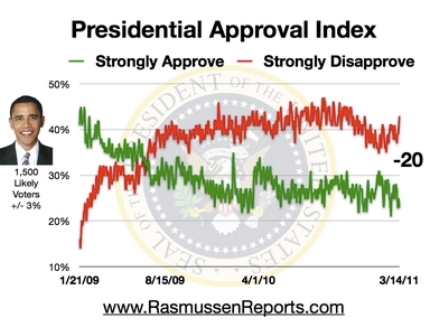
Presidential approval index

This is not looking good.

The economy is perceived to be at least modestly growing and improving.

The President is now perceived to be working with the opposition, first to extend the tax cuts at year end, and now with the spending cuts.

The President has kept us out of direct conflict in the latest round of disruptions.

So what’s the problem?

Gasoline is pushing $4/gallon and there’s no plan except to tax it so we don’t use so much?

They all believe we’ve run out of money, are dependent on borrowing from the likes of China, and could be the next Greece?

The rebels are losing in Libya and there seems to be nothing we can do about it?

Homes are still being lost by the hundreds of thousands?

Vast numbers of people owe more on their house than it’s worth?

People can’t find decent jobs?

The healthcare situation is worse than ever?

There is a perception that the President and Congress are insensitive to what people are going through?

There is no actual recovery plan, nor even any proposals that make sense?

There is a general feeling that America is in decline?