Fed Paper: “The Effect of the Term Auction Facility on the London Inter-Bank Offered Rate”


[Skip to the end]

Hardly need a study to figure that out!

This paper from the NY Fed was just released:

The Effect of the Term Auction Facility on the London Inter-Bank Offered Rate

Summary: This paper examines the effects of the Federal Reserve’s Term Auction

Facility (TAF) on the London Inter-Bank Offered Rate (LIBOR). The particular question investigated is whether the announcements and operations of the TAF are associated with downward shifts of the LIBOR; such an association would provide one indication of the efficacy of the TAF in mitigating liquidity problems in the interbank funding market. The empirical results suggest that the TAF has helped to ease strains in this market.


[top]

2008-07-22 US Economic Releases


[Skip to the end]


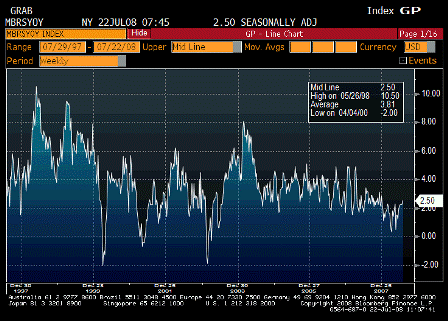
ICSC-UBS Store Sales YoY (Jul 15)

Survey n/a
Actual 2.5%
Prior 2.2%
Revised n/a

Still wiggling their way higher as fiscal kicks in.

[top][end]


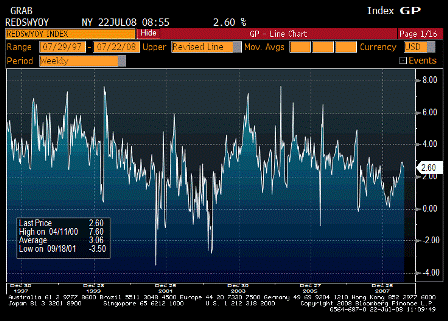
Redbook Weekly YoY (Jul 15)

Survey n/
Actual 2.6%
Prior 2.7%
Revised n/a

Also working its way higher.

[top][end]


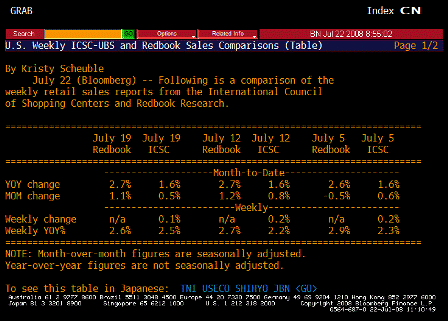
ICSC-UBS and Redbook Comparison TABLE (Jul 15)

[top][end]


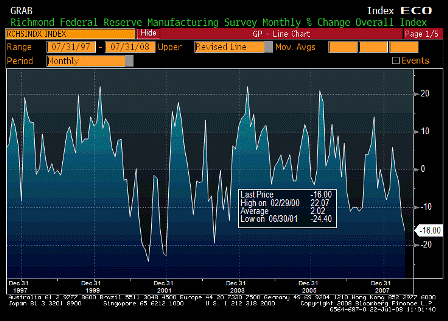
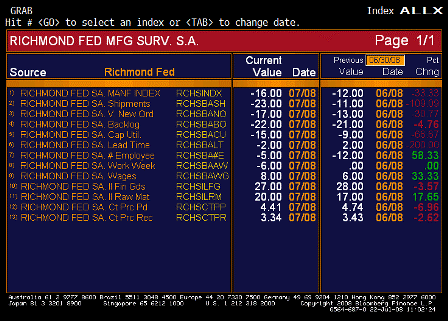
Richmond Fed Manufacturing Index (Jul)

Survey -9
Actual -16
Prior -12
Revised n/a

Big dip puts it back on its downtrend.

[top][end]

Richmond Fed Manufacturing Index ALLX (Jul)

Big drop in shipments,
interesting up tic in wages.

[top][end]


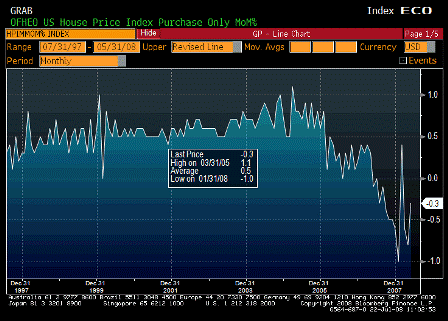
OFHEO House Price Index MoM (May)

Survey -0.8%
Actual -0.3%
Prior -0.8%
Revised n/a

Better than expected, still down, but seems to be falling at a slower rate.

[top][end]


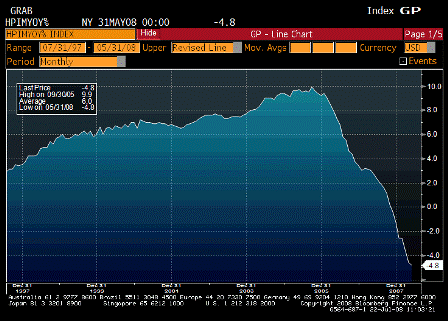
OFHEO House Price Index YoY (May)

Survey n/a
Actual -4.8%
Prior -4.6%
Revised n/a

Rate of decline seems to have diminished some. So far, year over year changes for this price range doesn’t seem that severe.

[top][end]


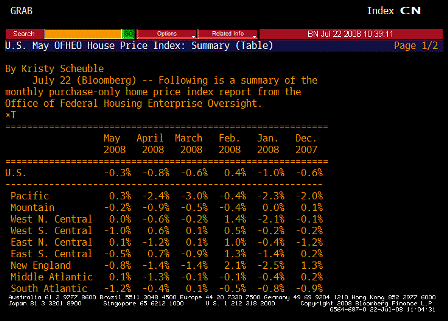
OFHEO House Price Index TABLE (May)

Several regions showing gains.

Unless commodities take a very large dive, the Fed needs an output gap in housing to keep a lid on overall prices.

[top][end]


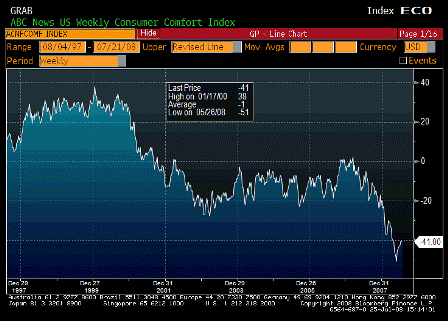
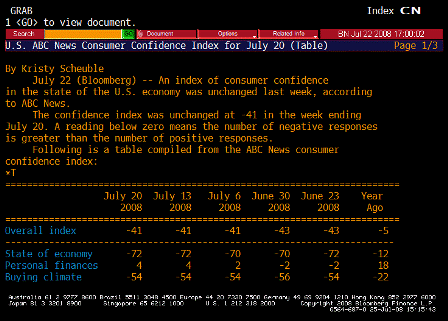
ABC Consumer Confidence (Jul 20)

Survey -42
Actual -41
Prior -41
Revised n/a

[top][end]


ABC Consumer Confidence TABLE (Jul 20)


[top]

AMEX/CAT


[Skip to the end]

Karim writes:

AMEX notes consumer spending slowed in latter part of quarter, suggesting effect of fiscal impulse waning. CAT driven by emerging market strength, states U.S. and Europe are two weakest regions, and expects rate cuts by Fed and ECB by year-end.

AMEX

  • Consumer spending slowed during the latter part of the quarter and credit indicators deteriorated beyond our expectations,” Mr Chenault said. The economic fallout was evident even among American Express’s prime customers.

CAT

  • CATERPILLAR SEES ECB CUTTING RATES AT LEAST 25BP BEFORE YR END
  • CATERPILLAR SEES NO SIGN OF RECOVERY IN NORTH AMERICAN HOUSING
  • CATERPILLAR ASSUMES AT LEAST ONE MORE RATE CUT LATER THIS YR
  • CATERPILLAR SEES ‘DIFFICULT’ FOR ECONOMY TO AVOID A RECESSION
  • CATERPILLAR SEES OIL PRICE AVG ABOUT 16% HIGHER IN LAST HALF
  • CATERPILLAR SAYS 2Q SALES/REVENUE UP 30% OUTSIDE NORTH AMERICA
  • Caterpillar Net Rises 34% as Asia, Mideast Building Lift Sales
  • Caterpillar Reports All-Time Record Quarter Driven by Strong Growth Outside North America
  • Right, weak domestic demand for sure. But note the last few lines that represent the booming exports even though domestic economies around the world are slowing.

    That’s what happens when they spend their accumulated hoard of USD here and spend less at home as they try to get rid of their USD hoards. This doesn’t stop until their holdings of USD fall to desired levels.

    I still see continued domestic weakness with GDP muddling through due to exports and government spending.

    And ever higher prices pouring in through the import/export channel.


    [top]

FT: Letter to the editor


[Skip to the end]

Published letter to the editor in FT.

Expect public-sector deficits and oil prices to go on rising

by Prof Philip Arestis, Dr John McCombie and Mr Warren Mosler.

Sir, Public-sector deficits and crude oil prices will probably both continue rising. Chris Giles’ reports, “Treasury to reform Brown’s fiscal rules” and “Treasury sees storm clouds gathering” (July 18), recognise the inevitability of growing deficits due to economic weakness while also implying public-sector deficits are per se a “bad thing”.

What the articles fail to appreciate are three dimensions to the argument: the first is that public-sector deficits do not present a solvency issue, only an “inflation” issue. Second, public-sector deficits equal total non-government (domestic and foreign) savings of sterling financial assets and are the only source of non-government accumulation of sterling net financial assets. Third, public-sector deficits provide the net financial equity to the non-government sector that supports the private-sector credit structure.

It is the case that the public-sector deficit will increase in one of two ways. The “nice” way would be pro-actively with sufficient tax cuts or spending increases (depending on one’s politics) that support demand at desired levels. The “ugly” way is from a slowing of demand that reduces tax revenues and increases transfer payments. If, instead, the government tries to suppress the current deficit with any combination of tax increases or spending cuts, the resulting accelerated slowdown of the economy will then increase the deficit the “ugly” way.

In any case, the current “inflation” is the result of Saudi Arabia acting as swing producer as it sets the oil price at ever-higher levels and then supplies all the crude demanded at that price. Our institutional structure then passes these prices through the entire economy over time, and there is nothing interest rates or fiscal policy can do to change these dynamics.

The ability to set crude prices can only be broken by a sufficiently large supply response, such as in the early 1980s when net supplies increased by more than 15m barrels per day, helped considerably by the US deregulating natural gas production, which allowed substitution away from crude oil products.

In sum, the deficit will go up either the nice way or the ugly way, as it always does when markets work to grant the private sector the desired net financial assets, which can come only from government deficit spending. “Inflation” will continue higher as long as the Saudis remain price-setter and continue to post ever-higher prices to their refiners.

Philip Arestis,
University Director of Research,
Cambridge Centre for Economic and Public Policy

John McCombie,
Director,
Cambridge Centre for Economic and Public Policy

Warren Mosler,
Senior Associate Fellow,
Cambridge Centre for Economic and Public Policy,
University of Cambridge, UK


[top]

Bloomberg: Inflation weakening some currencies


[Skip to the end]

Interesting how reports of higher inflation have often meant stronger currencies in the short run due to higher anticipated rates from the CB.

Inflation, however, by definition means the currency buys less of most everything; therefore, inflation and a weakening currency are one and the same.

But it can take a long time for markets to discount this.

Emerging-Market Currency Rally Dies as Inflation Hits

by Lukanyo Mnyanda and Lester Pimentel

(Bloomberg) The five-year rally in emerging- market currencies is coming to an end as central banks from South Korea to Turkey struggle to contain inflation, say DWS Investments and Morgan Stanley.

The 26 developing-country currencies tracked by Bloomberg returned an average 0.86 percent in the past three months, down from 1.63 percent in the first quarter, 8.2 percent for all of 2007, and 30 percent annually since 2003. For the first time in seven years, investors are less bullish on emerging-market stocks than on U.S. equities, a Merrill Lynch & Co. survey showed last week.

Confidence in the Indian rupee is weakening after inflation accelerated at the fastest pace in 13 years, stoked by soaring food and energy prices. South Korea’s won will drop this year by the most since 2000, while Turkey’s lira will reverse its biggest gain since at least 1972, the median estimates of strategists surveyed by Bloomberg show.


[top]

NYT: Too big to fail?


[Skip to the end]

Too Big to Fail?


by Peter S Goodman

Using public money to spare Fannie and Freddie would increase the public debt, which now exceeds $9.4 trillion. The United States has been financing itself by leaning heavily on foreigners, particularly China, Japan and the oil-rich nations of the Persian Gulf.

This is ridiculous, of course. The US, like any nation with its own non-convertible currency, is best thought of as spending first, and then borrowing and/or collecting taxes.

Were they to become worried that the United States might not be able to pay up, that would force the Treasury to offer higher rates of interest for its next tranche of bonds.

Also ridiculous. Japan had total debt of 150% of GDP, 7% annual deficits, and were downgraded below Botswana, and they sold their 3 month bills at about 0.0001% and 10 year securities at yields well below 1% while the BOJ voted to keep rates at 0%. (Nor did their currency collapse.)

The CB sets the rate by voice vote.

And that would increase the interest rates that Americans must pay for houses and cars, putting a drag on economic growth.

As above.

For one thing, this argument goes, taxpayers — who now confront plunging house prices, a drop on Wall Street and soaring costs for food and fuel — will ultimately pay the costs. To finance a bailout, the government can either pull more money from citizens directly,

Yes, taxing takes money directly, and it’s contradictionary.

But when the government sells securities they merely provide interest bearing financial assets (treasury securities) for non-interest bearing financial assets (bank deposits at the Fed). Net financial assets and nominal wealth are unchanged.

or the Fed can print more money — a step that encourages further inflation.

This is inapplicable.

There is no distinction between ‘printing money’ and some/any other way government spends.

The term ‘printing money’ refers to convertible currency regimes only, where there is a ratio of bill printed to reserves backing that convertible currency.

Skip to next paragraph “They are going to raise the cost of living for every American,”

True, that’s going up!


[top]

2008-07-21 Weekly Credit Graph Packet


[Skip to the end]

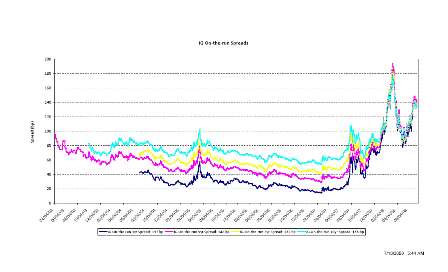
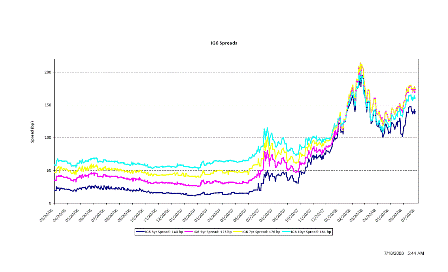
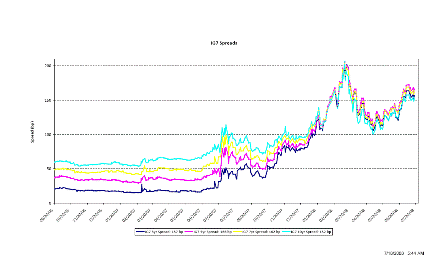
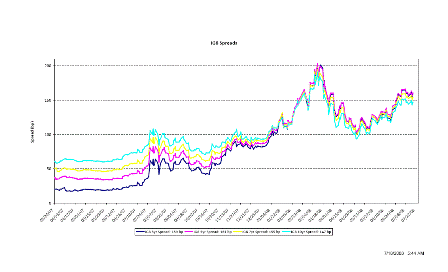
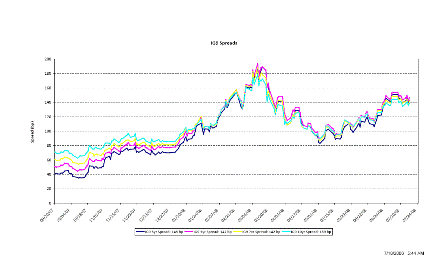
Looks and feels like spreads will be generally narrowing for a considerable period of time.

Bank earnings are better than expected with revenues growing nicely.

GDP, income, and spending being sustained by a growing government budget deficit, exports, and housing leveling off and no longer subtracting from growth.

‘Inflation’ continues with Saudi’s supporting prices and pass-throughs intensifying.


IG On-the-run Spreads (Jul 18)

[top][end]

IG6 Spreads (Jul 18)

[top][end]

IG7 Spreads (Jul 18)

[top][end]

IG8 Spreads (Jul 18)

[top][end]

IG9 Spreads (Jul 18)


[top]


[top]

Re: Oil as a % of global GDP

(an email exchange)

>   
>   On Sun, Jul 20, 2008 at 10:46 PM, Russell wrote:
>   
>   Brad Setser, at Follow the Money, presents a couple of graphs on changes in
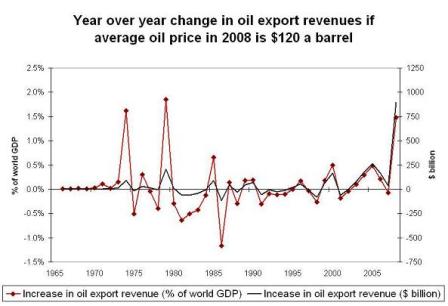
>   oil export revenue: The Oil Shock of 2008.
>   
>   The following graph shows the Year-over-year change in oil exports as a
>   percent of world GDP (and in billions of dollars).
>   
>   

>   
>   Year-over-year change in oil exports
>   
>   This calculation assumes that the oil exporters will export about 45 million
>   barrels a day of oil.
>   
>   Each $5 increase in the average price of oil increases the oil exporters’
>   revenues by about $80 billion, so if oil ends up averaging $125 a barrel this year
>   rather than $120 a barrel, the increase in the oil exporters revenues would be
>   close to a trillion dollars.
>   
>   Assuming oil prices average $120 per barrel for 2008, the increase in 2008 will
>   be similar to the oil shocks of the ’70s.
>   
>   

Right, the notion that oil is a smaller % of GDP and therefore not as inflationary was flawed to begin with and now moot.

Two more thoughts for today:

First, the second Mike Masters sell-off may have run its course. The first was after his testimony in regard to passive commodity strategies which I agree probably serve no public purpose whatsoever. The second was last week as markets expect Congress to act to curb speculation this week, which they might. Crude isn’t a competitive market (Saudi’s are the swing producer) so prices won’t be altered apart from knee jerk reactions, but competitive markets such as gold can see lower relative prices if the major funds back off their passive commodity strategies.

Second, just saw a headline on Bloomberg that inflation is starting to hurt the value of some currencies.

Third, the Stern statement will continue to weigh on interest rate expectations up to the Aug 9 meeting.