China inflation


[Skip to the end]

At some point the FDI isn’t enough to hold up the currency and it depreciates as costs of production for exports rise.

Time to cage inflation tiger, say experts

China Regulator Pledges to Control Illegal Inflows

China Property Sales Rise 75.5% to 4.4 Trillion Yuan

China Reserve Ratio Increase Not a Tightening Sign, Xinhua Says

Time to cage inflation tiger, say experts

By Wang Xiaotian and Xin Zhiming

Jan. 19 (China Daily) — Economy chugs along at good pace, but some red lights ahead

Even as China is set to achieve its targeted goal of 8 percent growth in gross domestic product (GDP) for 2009, economists have stressed that tackling high inflation should be the top priority for policymakers this year.

Inflation is likely to accelerate to more than 5 percent before the middle of this year and reach 8 percent in the second half, Erwin Sanft, head of mainland and Hong Kong equities research at BNP Paribas, was quoted by Bloomberg as saying yesterday.

China’s GDP will surpass the 8 percent year-on-year growth in 2009 and continue to surge in 2010, Yao Jingyuan, chief economist of National Bureau of Statistics, said on Sunday. That confirms the consensus forecast by economists, although none of them are willing to estimate the actual growth figures.

The statistics bureau is scheduled to release the economic data for 2009 on Thursday, but the growth trend has become entrenched since the third quarter of 2009, when GDP expanded by an impressive 8.9 percent year-on-year.

“There are no doubts about robust economic growth this year,” said Zhou Qiren, an economics professor at Peking University. Consumption and exports will continue to strengthen as the global economy gets back to near-normal growth, he said.

The country initiated a massive $586 billion stimulus package in late 2008 and launched a series of industry-friendly policies along with a loose monetary policy to pump prime the economy during the global financial crisis.

The strong surge in new bank lending, however, may have sowed seeds for inflation and other problems, such as asset bubbles. China’s new bank lending in 2009 nearly doubled to 9.59 trillion yuan ($1.40 trillion) over the previous year.

BNP Paribas said China’s inflation rate could touch 8 percent this year. That forecast exceeds most other estimates. Most Chinese economists feel that China would be able to rein in inflation to below 4 percent on average this year.

Li Yining, a senior economist at Peking University, said if inflation soars above 4 percent, the authorities would have to impose tighter measures to stem the growth. “It should be the warning line,” he said.

China’s central bank last week unexpectedly raised the proportion of deposits that commercial lenders must set aside as the country’s credit boom threatens to worsen inflation, which rose by 0.6 percent in November, the first year-on-year growth since last January.

The consumer price index (CPI), the main gauge of inflation, may rise 1.4 percent in December, according to economists surveyed by Bloomberg, intensifying worries that high inflation is coming back as the economy picks up.

Apart from raising banks’ reserve requirement ratio, the People’s Bank of China, the central bank, raised the three-month central bank bill issuing rate for the first time since August 2009 on Jan 7. Analysts see this as a prelude to a series of tightening monetary policies, including interest rate hikes.

“The central bank is likely to increase interest rates twice by 27 basis points this year after April,” said Dong Xian’an, chief macroeconomics analyst with Industrial Securities.

“Gone are the days when we can have economies with high growth rates and inflation as low as 2-3 percent,” he said. top


[top]

Proposal for the Eurozone


[Skip to the end]

I propose the ECB distribute 1 trillion euro to the national govts on a per capita basis.

The per capita criteria means it’s not a bailout and not a ‘reward for bad behavior.’

It would immediately adjust national government debt ratios substantially downward and ease credit fears.

If there is no undesired effect on aggregate demand/inflation/etc., which there should not be, it can be repeated as desired until national government. Finances are enhanced to the point where they can take local action to support aggregate demand as desired.


[top]

PIMCO on Japan


[Skip to the end]

>   
>   (email exchange)
>   
>   On Mon, Jan 11, 2010 at 9:43 AM, Wray, Randall wrote:
>   
>   This passage is particularly embarrassing:
>   Conventional wisdom holds that the most effective way to break a liquidity trap is with
>   fiscal policy, levering up and risking up the sovereign’s balance sheet to support
>   aggregate demand, when the private sector is delevering and de-risking. In general, we
>   have no quarrel with that. But what holds in general does not necessarily hold in
>   specific countries. And Japan is indeed an exception, because the central bank uniquely
>   has the ability to foster rising inflationary expectations, lower real long-term interest
>   rates, and a lower real exchange value for the yen, all keys to breaking out of her
>   liquidity trap.
>   
>   AND JUST HOW DO WE KNOW THAT??? THE BOJ HAS BEEN TRYING TO CREATE
>    INFLATIONARY EXPECTATIONS FOR 2 DECADES, WITH NO SUCCESS.
>   

Agreed.

And, of course the only risk associated with fiscal expansion is inflation which is what they are trying to accomplish.

If they think they have sufficient public goods and services and want domestic consumption and a shift towards inflation, the direct route of cutting domestic taxes, particularly on the lower income groups, will do the trick very quickly.

Someone ought to do the world a favor and tell them it’s up to the MoF and not the BoJ.

With global growth accelerating in the second half of 2009, policymakers and investors alike naturally turned to discussion and debate regarding central bank exit strategies from the extraordinary, conventional (near-zero policy rates) and unconventional (Quantitative/Credit Easing) accommodation needed to prevent the Great Recession from turning into Depression 2.0. Two key questions dominate: the how of exits and the when of exits.

The Federal Reserve has been exceedingly careful to distinguish between these two questions, providing detailed public discussion of the mechanics of exit, while stressing that economic fundamentals, notably below-target inflation in the context of huge resource slack, particularly labor markets, imply there is no urgent need to implement any exit for an extended period. Other central banks have provided similar guidance, with one major exception, the Bank of Japan (BoJ). And the reason is simple: Japan remains stuck in a deflationary liquidity trap, implying that not only would it be fundamentally wrong for the Bank of Japan to pull back from extraordinary accommodation, but that it should be even more extraordinary.

Thus, we were pleasantly surprised in December that the Bank of Japan publically acknowledged that it would “not tolerate a year-on-year rate of change in the CPI equal to or below 0 percent.” The BoJ’s path to anti-deflation redemption must start somewhere, and simply stating that its comfort zone for inflation does not include zero is a start. The fact of the matter is that the BoJ is trapped in a deflationary lacuna of its own making and can escape if it is willing to do the opposite of what central banks in other developed countries will eventually do in the matter of exit strategies. Simply put, the Bank of Japan needs to credibly commit to not exiting reflationary policies, even as other central banks proceed along that course.

Japan’s Liquidity Trap
An economy enters a liquidity trap when the monetary policy rate is pinned against zero, yet aggregate demand consistently falls short of aggregate supply potential. Such a state of affairs generates enduring economic slack, which in turn generates enduring deflation. That was a very real global risk a year ago, but was met head-on by BoJ’s sister central banks, in particular the Federal Reserve, whose mantra was “whatever it takes.” And while a relapse toward the fat tail risk of global deflationary pressures certainly still exists, that tail has been dramatically flattened by innovative, courageous, and explicitly reflationary policies. Not so for Japan, unfortunately: The country has been in a liquidity trap for almost two decades, with nominal GDP hovering near the levels of the early 1990s. And with a current output gap of 7-8% of its GDP, Japan faces perpetual deflation, unless and until the BoJ walks the reflationary walk.

To be sure, there are many, particularly in high-level policy positions in Japan, who argue that there is nothing more reflationary the BoJ can do, because the country’s liquidity trap is not a temporary one but rather a permanent one. The irony of the argument is that if it is followed, it is guaranteed to be “right,” or at least appear that way, as deflationary expectations remain entrenched and self-feeding. Yes, we recognize that Japan faces unique structural problems, most notably declining demographic growth. But neither in theory nor in practice does such a problem pre-ordain a permanent liquidity trap. It can be broken, if the BoJ were to become willing, in the famous words of Professor Krugman, to act responsibly irresponsible relative to monetary policy orthodoxy.

Conventional wisdom holds that the most effective way to break a liquidity trap is with fiscal policy, levering up and risking up the sovereign’s balance sheet to support aggregate demand, when the private sector is delevering and de-risking. In general, we have no quarrel with that. But what holds in general does not necessarily hold in specific countries. And Japan is indeed an exception, because the central bank uniquely has the ability to foster rising inflationary expectations, lower real long-term interest rates, and a lower real exchange value for the yen, all keys to breaking out of her liquidity trap. Yes, fiscal authorities in Japan can lever the sovereign’s balance sheet in a fashion that would make Keynes blush, but unless the monetary authority rejects orthodoxy, explicitly promising not to exit from reflationary policy, fiscal authorities’ stimulative efforts will be muted.

Krugman/Bernanke’s Prescriptions
Bank of Japan officials suggest that there is not much monetary policy can do, as evidenced by these comments in the minutes of its policy meeting on November 19-202 (our emphasis):

“A few members were of the opinion that the Bank should explain clearly to the public that the underlying cause of the continued decline in prices was the slack in the economy – in other words, the weakness in demand. These members added that to improve the situation it was essential to create an environment whereby final demand – specifically, business fixed investment and private consumption – could achieve self-sustaining growth, and for this purpose it was most important to alleviate households’ concerns about the future and underpin firms’ expectations of future economic growth.”

To be sure, there are indeed structural solutions besides resolutely reflationary monetary policy that would be helpful. For example, supply-side measures including increased immigration and child care facilities would be very helpful to mitigate Japan’s demographic trend. Likewise, a more flexible labor system would allow corporations to more quickly adjust employment to the levels sustainable in the New Normal, and allow them to invest for new opportunities emerging in Asia. Concurrently, accelerating Economic Partnership Agreements (EPA) would allow Japan Inc. to further benefit from Asia’s economic growth and to remain competitive. And the list goes on and on. So the BoJ does have a point: There needs to be many hands on the policy tiller.

But none of the non-monetary actions offers scope for what matters most: Breaking the private sector’s self-feeding deflationary expectations, while generating aggregate demand above the economy’s supply-side potential, lowering the output gap. Indeed, some desirable supply-side structural reforms would, on a cyclical horizon, actually increase the output gap. The unavoidable conclusion must be that reflationary monetary policy must be the workhorse to pull Japan out of its liquidity trap. For such an approach to be effective, it explicitly must not have an exit strategy, but the opposite: a promise to keep on keeping on, resisting all entreaties to pull back until inflation itself, not just inflationary expectations, is unleashed on the upside.

To its credit, the BoJ did adopt a commitment approach when it adopted Quantitative Easing (QE) in 2001, explicitly committing to a continuation of that regime until year-on-year change in the core CPI became positive in a “stable” manner. But when for a few months it appeared that “success” had been achieved in 2006, the BoJ exited QE. Whether or not it was a matter of a genuine policy mistake, made with the best intentions, or a policy mistake borne of a lack of will to be enduringly unorthodox is an open question. But the fact of the matter is that Japan slipped back into deflation soon thereafter. The missing ingredient was a commitment to not only resist pulling back from QE and avoiding rate hikes until inflation turned positive but to continue that policy even after inflation started moving up. And in terms of credibility, the cost has been high: Unless and until the BoJ commits credibly, backed by money-printing actions, to behaving “irresponsibly relative to orthodox, conventional thinking,” Japan will remain stuck in a liquidity trap.

If the BoJ needs academic footing to do what needs to be done, it could well follow then-Fed Governor Bernanke’s 2003 suggestion: Rather than targeting the inflation rate, the BoJ could target restoring the pre-deflation price level, meaning that deflationary sins are not forgiven. This way, Mr. Bernanke argued, the public would view reflationary increases in the BoJ’s balance sheet and the money stock as permanent, rather than something to be “taken back” at the earliest orthodox opportunity.

The BoJ: Time to Act Aggressively
Japan’s problem is deflation, not inflation as far as an eye can see. An “all-in” reflationary policy is what is needed.

Three concepts the BoJ could consider:

1. Explicitly promise there will be no exit from QE and no rate hikes until inflation is not just positive, but meaningfully positive. One way to do this would be to adopt a price level target rather than an inflation target, embracing the idea that past deflationary sins will not only not be forgiven but require even more aggressive reflationary atonement.

2. Buy unlimited amounts of the long-dated Japanese Government Bonds (JGBs) to pull down nominal yields, with an accord with the fiscal authority to absorb any future losses on JGBs, once reflationary policy has borne its fruits, generating a bear market in JGBs.

3. Working with the Ministry of Finance, sell unlimited amounts of Yen against other developed countries’ currencies, printing the necessary Yen.

Our read is that the BoJ has not concluded that such bold steps are required. But as Mr. Bernanke intoned,3 no country with a fiat currency, which borrows in its own currency in the context of a current account deficit, should ever willingly embrace deflation. It is to be fervently hoped that the Bank of Japan’s rhetorical reflationary thaw of December, declaring it will not “tolerate” zero or below inflation, will give way to active reflationary green shoots by spring.

Meanwhile, markets don’t wait. And if it becomes clear that the BoJ really does “get it,” the currency markets will be way out in front of the BoJ.

Paul McCulley
Managing Director


[top]

reuters post


[Skip to the end]


Mosler’s 11 steps to fix the economy

1. A full ‘payroll tax holiday’ where the US Treasury makes all FICA payments for us (15.3%). This will restore ’spending power’ and, by allowing households to make their mortgage payments, will fix banks from the bottom up. It may also keep prices down as competitive pressures may lead businesses to cut prices, passing on their tax savings to consumers even as sales increase.

2. A $500 per capita federal distribution to all the states to sustain employment in essential services, service debt, and reduce the need for state tax hikes. This can be repeated at perhaps 6 month intervals until GDP surpasses previous high levels at which point state revenues that depend on GDP would be restored.

3. A federally-funded $8/hr job and healthcare benefits for anyone willing and able to work. The economy will improve rapidly with my first two proposals and the private sector far more readily hires folks that are already employed. In 2001 Argentina implemented this proposal, putting to work 2 million people who had never held a ‘real’ job. Within 2 years, 750,000 of those 2 million were employed by the private sector.

4. Making banks utilities. The following are disruptive, serve no public purpose and should be done away with:

–Secondary market transactions
–Proprietary trading
–Lending against financial assets
–Business activities beyond approved lending and bank account services.
–Contracting in LIBOR. Fed funds should be used.
–Subsidiaries of any kind.
–Offshore lending.
–Contracting in credit default insurance.

5. Federal Reserve — The liability side of banking is the wrong place to impose market discipline.

The Fed should lend in the fed funds market to all member banks to ensure permanent liquidity. Demanding collateral from banks is disruptive and redundant, as the FDIC already regulates and supervises all bank assets.

6. The Treasury should issue nothing longer than 3 month bills. Longer term securities serve to keep long term rates higher than otherwise.

7. FDIC

–Remove the $250,000 cap on deposit insurance. Liquidity is no longer an issue when fed funds are available from the Fed.
–Don’t tax good banks for losses by bad banks. This serves only to raise interest rates.

8. The Treasury should directly fund the housing agencies to eliminate hedging needs while directly targeting mortgage rates at desired levels.

9. Homeowners being foreclosed should have the option to stay in their homes at fair market rents with ownership going to the government at the lower of the mortgage balance or fair market value of the home.

10. Remove ’self imposed constraints’ that are disruptive to operations and serve no public purpose.

–Dump the debt ceiling – Congress already votes on spending and taxes.
–Allow Treasury ‘overdrafts’ at the Fed rather than forcing it to sell notes and bonds. This is left over from the gold standard days and is currently inapplicable.

11. Federal taxes function to regulate aggregate demand, not to raise revenue per se, and therefore should be increased only to cool down an overheating economy, and not to ‘pay for’ anything.


[top]

Thoughts/Response to Bill Gross Piece


[Skip to the end]

Well stated and agreed!!!

A few highlights(mine), below:

On Thu, Jan 7, 2010 at 8:57 AM, Lando, Joseph wrote:

In a bit of a surprising philosophical shift, Bill Gross came out yesterday strongly bearish and firmly in the camp of the deficit hawks: Link . My reaction:

1. Any major tightening of financial conditions due to a spike in rates right now, particularly back-end rates, would just be met with more QE anyway. That much was certainly clear in the Fed Minutes yesterday.

2. Given a battle between the fundamental input of deflation and the technical factor of supply, deflation will win hands down. And though many seem to disagree, the data and the Fed and our own economists still think risks are tilted the other way. This input is making the 100-200bp difference in 10yr yields. Supply issues make the ‘1-2 standard deviations rich/cheap’ (speaking in Sudoku terms) differences of 20-30bps. Which wins?

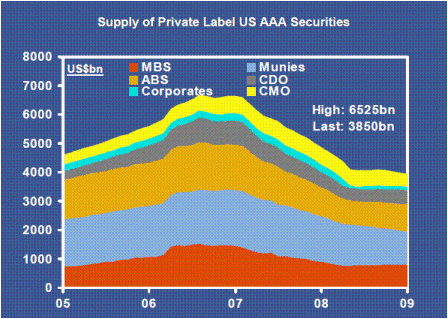
3. I actually think the technicals are the other way. New supply of private label AAA securities is down 1T MORE than Treasury supply is UP. De-levering is, BY DEFINTION, a reduction in the overall supply of investible term fixed income assets. Here’s a picture from a couple months ago from our Global Markets group.

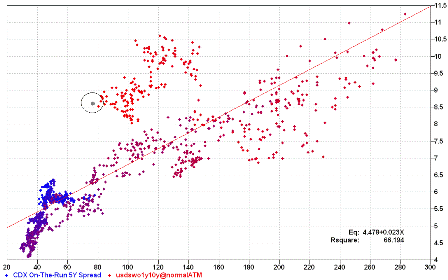
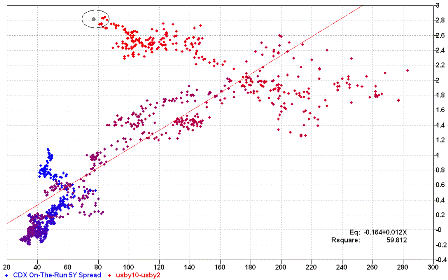
4. The yield curve is offering more yield enhancement than EITHER vol OR credit spread to the investment community. Not to mention Treasuries are 0% weighted (AND state/local tax-advantaged). Where do you think banks will turn to generate NIM? At some point, they will change their behavior. Look at CURVE vs both VOL and CREDIT regression below. Perhaps most notably…


5. The deficit hawk premise is flawed to begin with. Government buys a bridge, bridgebuilder buys a coat, coatmaker deposits or saves the money…it’s a closed loop in which deficit spending CREATES the precise funding for the deficit itself. All that moves around is DURATION as the need for 10yr savings or 30yr savings is swapped around vs the demand for say, overnight savings (like T-bills or banks reserves). Deficits in the US (unlike a Muni or a EU power or a Corporation) don’t have a problem funding. The ‘problem’ is if the Treasury wants to issue 30yr paper and people only really want 5yr paper. Actually, the market sells off when the sum of all borrowers’ duration is longer than the sum of all the lender’s preferences/liabilities. Not when there is a mismatch in AMOUNT. The AMOUNT is the same! Which takes us to…

6. Japan.

7. I also respectfully but strongly disagree with Gross’ interpretation of QE. The Fed has actually been swapping the bank and fixed-income universe OUT of their term treasuries and mortgages and into cash. By definition they have actually been crowding OUT overall NIM in the universe. And generating revenue for the Treasury. It’s actually an investor tax not a bailout. When they step away, those (and by parity zero-sum principles they are there) who were swapped out of their investments and into cash will swap back into term duration. Asset transfers themselves are zero sum. Additionally, in getting mortgage rates down, the Fed has been TEMPERING the pace of de-levering by ensuring mortgage refi’s can continue. They ‘made happen’ many of the mortgages that they bought. It’s a very self-regulating supply universe. If they slow down, there are just plain fewer mortgages being originated for people to buy, and the pace of overall deleveraging picks back up, and well…it’s not bearish, for sure.

8. Actually I hope 10s go to 4.25 because that just means there will be more to make in the big rally that I think starts in 6 weeks or so when the data turns back from fiscal stimulus withdrawal, and the Treasury’s ‘extension of average maturity’ program – what is TRULY the cause of the steepening of the yield curve – tapers off. For now, am only tactical in the back-end.

But that’s why we all have a market and life, as ever, will remain interesting in fixed income this year.


[top]

China Guides Bill Yields Higher


[Skip to the end]

I would expect the higher rates to support aggregate demand through the interest earned channels in the nations that hike rates.

Also, much of China’s lending by state owned/sponsored banks may be thinly disguised fiscal transfers that support demand. Cutting back by raising lending standards would then reduce demand. They apparently have a lot of excess capacity. The question is whether they increase demand to use it up, or slow down investment.

China Guides Bill Yields Higher, Seeking to Curb Record Lending

By Bloomberg News

Jan. 7 (Bloomberg) — China’s central bank sold three-month bills at a higher interest rate for the first time in 19 weeks after saying its focus for 2010 is controlling the record expansion in lending and curbing price increases.

Stocks fell across Asia and oil declined on concern growth will slow in China, the engine of the world economy’s recovery from its worst recession since World War II. The People’s Bank of China offered 60 billion yuan ($8.8 billion) of bills at a yield of 1.3684 percent, four basis points higher than at last week’s sale, according to a statement.

“It’s definitely a signal that the central bank is tightening liquidity,” said Jiang Chao, a fixed-income analyst in Shanghai at Guotai Junan Securities Co., the nation’s largest brokerage by revenue. “The rising yield is used to prevent excessive growth in bank lending.”

Premier Wen Jiabao said on Dec. 27 that last year’s doubling in new loans had caused property prices to rise “too quickly,” while surging commodity costs were increasing inflationary pressure. Guiding market rates higher may be a prelude to raising reserve requirements or benchmark interest rates, said Shi Lei, a Beijing-based analyst at Bank of China Ltd., the nation’s third-largest lender.

The MSCI Asia Pacific Index of regional stocks fell 0.5 percent and oil for February delivery slid 0.7 percent after 10 days of gains. Copper for three-month delivery dropped 0.7 percent. The Shanghai Composite Index fell 1.9 percent, led by Bank of China Ltd. and Industrial & Commercial Bank of China Ltd.

Tightening in Asia

“We expect some tightening of monetary policy in Asia in the first half,” said Norman Villamin, Singapore-based head of investment analysis for Asia Pacific at Citigroup Private Bank. “Markets will struggle to go higher.”

Australia’s central bank raised borrowing costs by a quarter percentage point on Dec. 1 to 3.75 percent after similar moves in November and October. The Bank of Korea, which meets tomorrow, will probably raise its benchmark rate one percentage point to 3 percent by end-2010, according to a Bloomberg survey of economists. By contrast, the Federal Reserve target rate is close to zero and policy makers last month discussed increasing asset purchases should the economy weaken.

Policy makers will seek “moderate” loan growth while managing inflation expectations, the People’s Bank said yesterday in a report on its annual work meeting. The government has told lenders to pace lending, while tightening mortgage rules for second-home purchases. Liu Mingkang, the top banking regulator, wrote in an opinion piece in Bloomberg News this week that “structural bubbles threaten to emerge” in the economy.

Bill Sales

Guotai Junan’s Jiang said the yield on benchmark one-year bills will climb in open-market operations next week. The central bank resumed sales of those bills on July 9 after an eight-month suspension to help drain cash from banks.

The central bank is set to withdraw 137 billion yuan from the financial market this week, the biggest since the week ended on Oct. 23, according to data compiled by Bloomberg News.

China’s one-year interest-rate swap, the cost of receiving a floating rate for 12 months, rose 10.5 basis points to 2.24 percent. A basis point is 0.01 percentage point.

The central bank kept the benchmark one-year lending rate at a five-year low of 5.31 percent last year after five reductions in the last four months of 2008. It may rise to 5.85 by the end of 2010, according to a Bloomberg News survey of 29 economists in November.

Lending Boom

“There’s no doubt that lending has been excessive and that explains why policy makers are starting to be more cautious about lending this year,” said Qu Hongbin, chief China economist for HSBC Holdings Plc in Hong Kong.

Qu estimates new loans will be limited to 7 trillion yuan in 2010. Banks extended an unprecedented 9.21 trillion yuan of loans in the first 11 months of 2009, compared with 4.15 trillion yuan a year earlier.

The People’s Bank said it would curb volatility in lending and monitor the property market, while reaffirming a “moderately loose” monetary policy. The statement contrasted with the start of 2009, when the central bank targeted “appropriate” increases in lending and said monetary policy would play “a more active role in promoting economic growth.”

Consumer prices climbed 0.6 percent in November from a year earlier, snapping a nine-month run of declines. The central bank is on alert for inflation after economic growth accelerated to 8.9 percent in the third quarter of 2009, the fastest in a year.

Property Prices

Housing Minister Jiang Weixin said yesterday that the nation will limit credit for some home purchases to reduce property-market speculation. Prices across 70 cities rose at the fastest pace in 16 months in November, gaining 5.7 percent from a year earlier, led by Shenzhen, Wenzhou and Jinhua.

The central bank didn’t state a 2010 target for growth in M2, the broad measure of money supply, after overshooting a 17 percent goal last year. The actual rate was more than 25 percent for most of 2009, rising to a record 29.7 percent in November.

“Growth will probably slow this year as tight credit will dampen the demand side,” said Zhang Ling, who helps oversee about $7.21 billion at ICBC Credit Suisse Asset Management Co. in Beijing. “That will dash investors’ hopes of another year of fast growth.”


[top]

FOMC Minutes


[Skip to the end]

The Fed has a dual mandate of full employment and price stability. Both are still moving the wrong way for a hike.

When they move it will likely be based on their forecasts, which remain well on the dovish side.


Karim writes:

Minutes generally more dovish than expected; staff raised forecast, but not by much.Inflation expected to drift lower.

Usual nonsense expressed by some members about effect of QE and deficits on inflation expectations.

STAFF

..the projected pace of real output growth in 2010 and 2011 was expected to exceed that of potential output by only enough to produce a very gradual reduction in economic slack.

…the staff continued to project that core inflation would slow somewhat from its current pace over the next two years. Moreover, the staff expected that headline consumer price inflation would decline to about the same rate as core inflation in 2010 and 2011.

FOMC

..some participants remained concerned about the economy’s ability to generate a self-sustaining recovery without government support. In particular, they noted the risk that improvements in the housing sector might be undercut next year as the Federal Reserve’s purchases of MBS wind down, the homebuyer tax credits expire, and foreclosures and distress sales continue. Though the near-term outlook remains uncertain, participants generally thought the most likely outcome was that economic growth would gradually strengthen over the next two years as financial conditions improved further, leading to more-substantial increases in resource utilization.

The weakness in labor markets continued to be an important concern to meeting participants, who generally expected unemployment to remain elevated for quite some time. The unemployment rate was not the only indicator pointing to substantial slack in labor markets: The employment-to-population ratio had fallen to a 25-year low, and aggregate hours of production workers had dropped more than during the 1981-82 recession. Although the November employment report was considerably better than anticipated, several participants observed that more than one good report would be needed to provide convincing evidence of recovery in the labor market. Participants also noted that the slowing pace of employment declines mainly reflected a diminished pace of layoffs; few firms were hiring. Moreover, the unusually large fraction of those individuals with jobs who were working part time for economic reasons, as well as the uncommonly low level of the average workweek, pointed to only a gradual decline in unemployment as the economic recovery proceeded. Indeed, many business contacts again reported that they would be cautious in their hiring, saying they expected to meet any near-term increase in demand by raising their existing employees’ hours and boosting productivity, thus delaying the need to add employees.

Most participants anticipated that substantial slack in labor and product markets, along with well-anchored inflation expectations, would keep inflation subdued in the near term, although they had differing views as to the relative importance of those two factors. The decelerations in wages and unit labor costs this year, and the accompanying deceleration in marginal costs, were cited as factors putting downward pressure on inflation. Moreover, anecdotal evidence suggested that most firms had little ability to raise their prices in the current economic environment. Some participants noted, however, that rising prices of oil and other commodities, along with increases in import prices, could boost inflation pressures going forward. Overall, many participants viewed the risks to their inflation outlooks as being roughly balanced. Some saw inflation risks as tilted to the downside, reflecting the quite elevated level of economic slack and the possibility that inflation expectations could begin to decline in response to the low level of actual inflation. But others felt that inflation risks were tilted to the upside, particularly in the medium term, because of the possibility that inflation expectations could rise as a result of the public’s concerns about extraordinary monetary policy stimulus and large federal budget deficits. Moreover, a few participants noted that banks might seek, as the economy improves, to reduce their excess reserves quickly and substantially by purchasing securities or by easing credit standards and expanding their lending. A rapid shift, if not offset by Federal Reserve actions, could give excessive impetus to spending and potentially result in expected and actual inflation higher than would be consistent with price stability. To keep inflation expectations anchored, all participants agreed that monetary policy would need to be responsive to any significant improvement or worsening in the economic outlook and that the Federal Reserve would need to continue to clearly communicate its ability and intent to begin withdrawing monetary policy accommodation at the appropriate time and pace.

Although members generally saw little risk that maintaining very low short-term interest rates could raise inflation expectations or create instability in asset markets, they noted that it was important to remain alert to these risks. All agreed that the path of short-term rates going forward would depend on the evolution of the economic outlook.


[top]

latest from PIMCO


[Skip to the end]

Some of governments’ mystery money showed up in sovereign budgets funded by debt sold to investors, but more of it showed up on central bank balance sheets as a result of check writing that required no money at all.

The US govt never has nor doesn’t have dollars. It necessarily spends by changing numbers up in bank accounts, and taxes and borrows by changing numbers down in bank accounts.

The latter was 2009’s global innovation known as “quantitative easing,” where central banks and fiscal agents bought Treasuries, Gilts, and Euroland corporate “covered” bonds approaching two trillion dollars. It was the least understood, most surreptitious government bailout of all, far exceeding the U.S. TARP in magnitude.

Agreed! To the extent the purchases were govt and agency securities it was not a bailout for the issuers. To the extent it allowed investors to make profits from the govt over paying for outstanding securities it could be considered a bailout. But I think that was minimal at best.

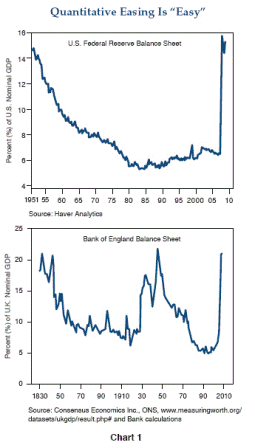
In the process, as shown in Chart 1, the Fed and the Bank of England (BOE) alone expanded their balance sheets (bought and guaranteed bonds) up to depressionary 1930s levels of nearly 20% of GDP. Theoretically, this could go on for some time,

Indefinitely. Better still, the tsy could simply stop issuing the securities in the first place, as Charles Goodhart has recommended for the UK. That would save the transactions expenses, which are not trivial.

but the check writing is ultimately inflationary

Not per se. Only to the extent the resultant lower rates are inflationary, and the jury is out on that. Note the Fed just turned $60 billion or so in profits over to the tsy. This is interest income the private sector did not earn because the Fed bought the securities.

Point is, QE removes interest income from the non govt sectors and is thereby a contractionary bias.

and central bankers don’t like to get saddled with collateral such as 30-year mortgages that reduce their maneuverability and represent potential maturity mismatches if interest rates go up.

None of that should matter to central bankers, but agreed it does (for the wrong reasons).

So if something can’t keep going, it stops – to paraphrase Herbert Stein – and 2010 will likely witness an attempted exit by the Fed at the end of March, and perhaps even the BOE later in the year.

It can keep going, but agreed it is likely to stop.


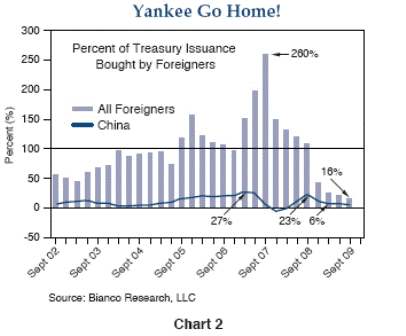
Here’s the problem that the U.S. Fed’s “exit” poses in simple English: Our fiscal 2009 deficit totaled nearly 12% of GDP and required over $1.5 trillion of new debt to finance it. The Chinese bought a little ($100 billion) of that, other sovereign wealth funds bought some more, but as shown in Chart 2, foreign investors as a group bought only 20% of the total – perhaps $300 billion or so. The balance over the past 12 months was substantially purchased by the Federal Reserve. Of course they purchased more 30-year Agency mortgages than Treasuries, but PIMCO and others sold them those mortgages and bought – you guessed it – Treasuries with the proceeds. The conclusion of this fairytale is that the government got to run up a 1.5 trillion dollar deficit, didn’t have to sell much of it to private investors, and lived happily ever – ever – well, not ever after, but certainly in 2009.

I submit it could have easily issued at least that many 3 mo bills if it wanted to but chose not to, again for the wrong reasons.

It also could have issue no securities and simply let the deficit spending sit as additional excess reserves in member bank accounts at the fed, which would be my first choice. Reserve balances are functionally nothing more than one day securities. I see no reason to issue further out the curve and thereby support the term structure of rates at higher levels.

Now, however, the Fed tells us that they’re “fed up,” or that they think the economy is strong enough for them to gracefully “exit,” or that they’re confident that private investors are capable of absorbing the balance.

Yes, in fact, it’s a non event, much like when Japan ‘exited’ from its 30t yen of excess reserves several years ago.

Not likely. Various studies by the IMF, the Fed itself, and one in particular by Thomas Laubach, a former Fed economist, suggest that increases in budget deficits ultimately have interest rate consequences and that those countries with the highest current and projected deficits as a percentage of GDP will suffer the highest increases – perhaps as much as 25 basis points per 1% increase in projected deficits five years forward.

Wonder how they explain Japan with far higher deficits than the us, less QE, and a 10 year JGB of only 1.30% vs 3.80% for the us. The term structure of rates is a function of the combination of anticipated central bank rate settings and technicals. (the three month eurodollar futures add up to the 10 year swap rate, convexity adjusted)

If that calculation is anywhere close to reality,

No reason to think they will be. They aren’t based on reality.

investors can guesstimate the potential consequences by using impartial IMF projections for major G7 country deficits as shown in Chart 3.
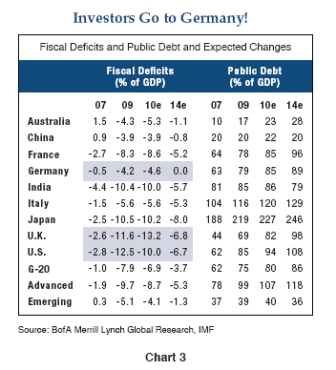


Using 2007 as a starting point and 2014 as a near-term destination, the IMF numbers show that the U.S., Japan, and U.K. will experience “structural” deficit increases of 4-5% of GDP over that period of time, whereas Germany will move in the other direction. Germany, in fact, has just passed a constitutional amendment mandating budget balance by 2016.

Hopefully they don’t actually do that as the recession could be severe enough to bring down the entire system of govt.

If these trends persist, the simple conclusion is that interest rates will rise on a relative basis in the U.S., U.K., and Japan compared to Germany over the next several years and that the increase could approximate 100 basis points or more. Some of those increases may already have started to show up – the last few months alone have witnessed 50 basis points of differential between German Bunds and U.S. Treasuries/U.K. Gilts, but there is likely more to come.

The fact is that investors, much like national citizens, need to be vigilant and there has been a decided lack of vigilance in recent years from both camps in the U.S. While we may not have much of a vote between political parties, in the investment world we do have a choice of airlines and some of those national planes may have elevated their bond and other asset markets on the wings of central bank check writing over the past 12 months.

Yes, govt policy, or lack of it, sets the term structure of rates. When it comes to the risk free rate, govt is necessarily price setter, as it is the monopoly supplier of reserves at the margin.

Downdrafts and discipline lie ahead for governments and investor portfolios alike. While my own Pollyannish advocacy of “check-free” elections may be quixotic, the shifting of private investment dollars to more fiscally responsible government bond markets may make for a very real outcome in 2010 and beyond.Additionally, if exit strategies proceed as planned, all U.S. and U.K. asset markets may suffer from the absence of the near $2 trillion of government checks written in 2009.

True!

It seems no coincidence that stocks, high yield bonds, and other risk assets have thrived since early March, just as this “juice” was being squeezed into financial markets. If so, then most “carry” trades in credit, duration, and currency space may be at risk in the first half of 2010 as the markets readjust to the absence of their “sugar daddy.”

True, the curve could steepen some. But at the same time, if the output gap remains high, and it becomes more likely the fed will be low for long, the term structure of rates could decline accordingly, as it did in Japan.

There’s no tellin’ where the money went?

Where it always goes. One account at the Fed is debited and another credited.

Not exactly, but it’s left a suspicious trail. Market returns may not be “so fine” in 2010.

William Gross
Managing Director


[top]

Evans-Pritchard Telegraph article


[Skip to the end]

There is no operational support for this scenario. Comments below:

Global bear rally will deflate as Japan leads world in sovereign bond crisis

By Ambrose Evans-Pritchard

Jan. 5 (Telegraph) —

Weak sovereigns will buckle. The shocker will be Japan, our Weimar-in-waiting. This is the year when Tokyo finds it can no longer borrow at 1pc from a captive bond market, and when it must foot the bill for all those fiscal packages that seemed such a good idea at the time. Every auction of JGBs will be a news event as the public debt punches above 225pc of GDP. Finance Minister Hirohisa Fujii will become as familiar as a rock star.

With non convertible currency this makes no sense. If deficit spending does generate excess demand and inflation short rates will rise if markets anticipate BOJ rate hikes as a BOJ reaction function to inflation.

Once the dam breaks, debt service costs will tear the budget to pieces.

That statement has no operational meaning. All payments in yen, dollars, sterling, etc. Are met in one way only- changing numbers upward in member bank reserve accounts. Operationally there is no ‘financial stress’ associated with this process.

Yes, excess deficit spending can cause the currency to fall and inflation, but to get out of a hole first you have to stop digging, and right now the currency is strong and deflation continues as the main concern.

The Bank of Japan will pull the emergency lever on QE.

A non event, apart from somewhat lower term rates.

The country will flip from deflation to incipient hyperinflation.

Not from QE. There is no channel from QE to the real economy, lending, or anything of consequence apart from (modestly) lower term rates.

The yen will fall out of bed, outdoing China’s yuan in the beggar-thy-neighbour race to the bottom.

Yes, excess deficit spending can cause the yen to fall and inflation to increase via the import/export channels.

By then China too will be in a quandary. Wild credit growth can mask the weakness of its mercantilist export model for a while, but only at the price of an asset bubble. Beijing must hit the brakes this year, or store up serious trouble. It will make as big a hash of this as Western central banks did in 2007-2008.

China will also reach political limits only when inflation becomes a political problem.


[top]

Monetary Policy and the Housing Bubble


[Skip to the end]

>   
>   (email exchange)
>   
>   On Tue, Dec 29, 2009 at 8:55 AM, wrote:
>   
>   Do you agree with their conclusion that monetary policy (low rates) didn’t affect housing
>   prices?

Yes, seems that way to me, too.

>   
>   I guess they did raise rates from 2003-06.
>   
>   Seems the very low short rates DID contribute to the ability to buy “more house” or qualify for
>   any house.
>   

Maybe some.

>   
>   For me it was the bush 2003 fiscal adjustment- spending increases, retro tax cuts, etc. that got
>   the deficit up to 200 billion by q303 which was about 8% of gdp annual. Then after a few years
>   the sub prime housing fraud started with loan officers on commission pushing fraudulent
>   appraisals and fraudulent income statements that turned the recovery into a mini boom that
>   actually didn’t get all that large before it crashed when the $trillion fraud was discovered.
>   

Fed: “Monetary Policy and the Housing Bubble”

Excerpt:
“Lessons
Our findings are both clear and limited in scope.

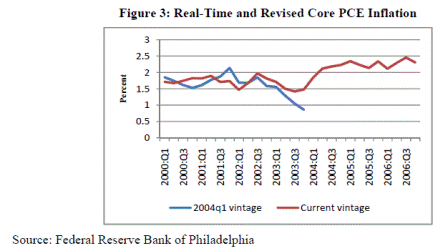
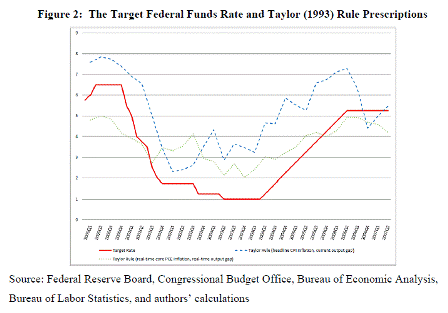
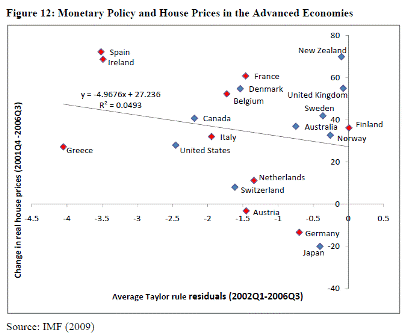
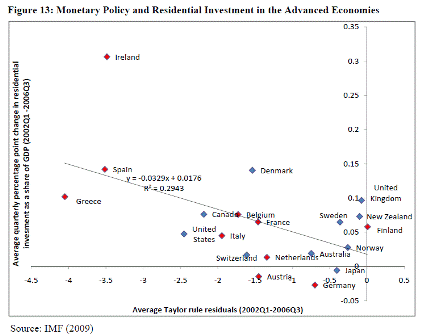
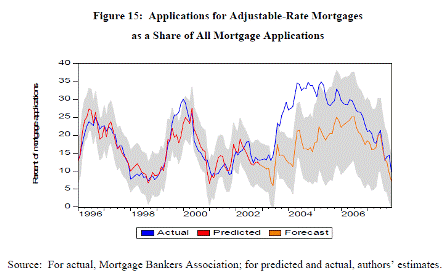
We find little evidence that the setting of U.S. monetary policy could have directly accounted for a substantial share of the strength in U.S. housing markets between 2003 and 2006. In particular, the rise in house prices or housing activity during this period was much faster than the pace consistent with the overall macroeconomic environment at that time.

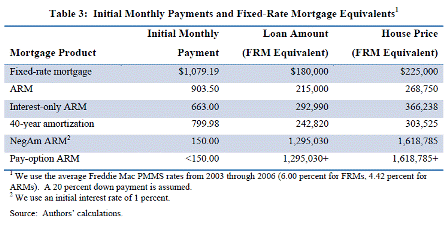
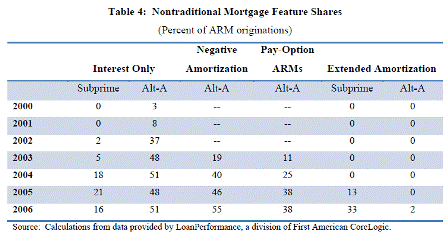
But we also find that housing-specific developments were unusual in this period—and not only with respect to prices and activity. The form of mortgage finance—the prevalence and nature of mortgages with adjustable rates versus fixed rates, the role of other “new” or exotic mortgage features, and the role of different types of lenders and securitization paths—all shifted during this period. These shifts undoubtedly fed on each other, with strong demand for housing and rising house prices spurring unsustainable evolution in the nature and perceived risks associated with mortgage innovations and vice versa. This finding is quite limited in that it describes developments but does not explain why such developments occurred.

Nonetheless, our clear finding that traditional channels of monetary policy accounted for little of the rise in housing markets and that housing-specific factors involved the interaction of shifts in demand and mortgage finance suggest two important lessons for policy and certainly for subsequent research. In particular, our discussion connects to the questions of whether monetary policy should “lean against the wind” in the face of asset price bubbles and of how complimentary financial policies (for example, macroprudential regulation) may interact with monetary policy.”


[top]