More on Greece and the euro

As previously discussed, all policies seem to be ‘strong euro’ first.

And the ‘success’ of the euro continues to be gauged by its ‘strength’.

The haircuts on the Greek bonds are functionally a tax that removes that many net euro financial assets. Call it an ‘austerity’ measure extending forced austerity to investors.

Other member nations will likely hold off on turning towards that same tax until after Greece is a ‘done deal’ as early noises could work to undermine the Greek arrangements, and take the ‘investor tax’ off the table.

Like most other currencies, the euro has ‘built in’ demand leakages that fall under the general category of ‘savings desires’. These include the demand to hold actual cash, contributions to tax advantaged pension contributions, contributions to individual retirement accounts, insurance and other corporate ‘reserves’, foreign central bank accumulations euro denominated financial assets, along with all the unspent interest and earnings compounding.

Offsetting all of that unspent income is, historically, the expansion of debt, where agents spend more than their income. This includes borrowing for business and consumer purchases, which includes borrowing to buy cars and houses. In other words, net savings of financial assets are increased by the demand leakages and decreased by credit expansion. And, in general, most of the variation is due to changes in the credit expansion component.

Austerity in the euro zone consists of public spending cuts and tax hikes, which have both directly slowed the economies and increased net savings desires, as the austerity measures have also reduced private sector desires to borrow to spend. This combination results in a decline in sales, which translates into fewer jobs and reduced private sector income. Which further translates into reduced tax collections and increased public sector transfer payments, as the austerity measures designed to reduce public sector debt instead serve to increase it.

Now adding to that is this latest tax on investors in Greek debt, and if the propensity to spend any of the lost funds of those holders was greater than 0, aggregate demand will see an additional decline, with public sector debt climbing that much higher as well.

All of which serves to make the euro ‘harder to get’ and further support the value of the euro, which serves to keep a lid on the net export channel. The ‘answer’ to the export dilemma would be to have the ECB, for example, buy dollars as Germany used to do with the mark, and as China and Japan have done to support their exporters. But ideologically this is off the table in the euro zone, as they believe in a strong euro, and in any case they don’t want to build dollar reserves and give the appearance that the dollar is ‘backing’ the euro.

And all of which works to move all the euro member nation deficits higher as the ‘sustainability math’ of all deteriorate as well, increasing the odds of the ‘investor tax’ expanding to the other member nations that continues the negative feedback loop.

Given the demand leakages of the institutional structure, as a point of logic prosperity can only come from some combination of increased net exports, a private sector credit expansion, or a public sector credit expansion.

And right now it looks like they are still going backwards on all three.
Greece

Comes back to the idea that resolving solvency issues in the euro zone doesn’t fix the economy.

And with negative growth the solvency math doesn’t work for any of the euro members.

And what’s with the ECB threatening to back away on liquidity support for the banking system?

So looks to me like the Greek resolution is not the end of the solvency issues, but that the focus simply moves on to the next weaker sister.

And, as previously discussed, the risk remains elevated that if Greece gets to haircut its obligations and gets funding, others will ask for the same, triggering a general, global, catastrophic financial meltdown.

My first order proposal remains an ECB distribution on a per capita basis to the euro member nations of maybe 10% of euro zone GDP per year to put the solvency issue behind them. Along with relaxed budget rules, maybe allowing deficits up to 6% of GDP annually, further supported by the ECB funding a transition job at a non disruptive wage to facilitate the transition from unemployment to private sector employment. I might also recommend deficits be increased by suspending VAT as a way to increase aggregate demand and lower prices at the same time.

Alternatively, the ECB could simply guarantee all national govt debt and rely on the growth and stability pact for fiscal discipline, which would probably require enhanced authorities.

And rather than trying to bring Greece’s deficit down to current target levels, they could instead relax the growth and stability pact limits to something closer to full employment levels. And, again, I’d look into suspending VAT to both increase aggregate demand and lower prices.

Meanwhile, elsewhere in today’s world news:

The likes of Ford adding to pension funds makes the point of the increasing and ongoing demand leakages putting a damper on GDP.

And oil prices have now crept up enough to materially cut into aggregate demand as well.

Nor are banks adding to capital to meet expanding demand for credit, which remains anemic.

Headlines:

Data Suggests Euro Zone May Slide Back Into Recession
German Manufacturing Slows as New Export Orders Fall
China’s Factory Activity Shrinks for Fourth Month
ECB Preparing to Close Liquidity Floodgates
Ford Pours $3.8 Billion Into Pension Plan
Oil Could Turn to Headwind as Dow Flirts With 13,000
UBS to Issue More Loss-Absorbing Capital
Iran ‘Winning’ on Oil Sanctions: Top Trader
Greek Bailout Puts Focus Back on Credit Default Swaps
Iran Fuels Oil-Price Rally—And Prices Could Keep Rising

GDP/Euro Lending Data

Good report!
Additional notations below:

Karim writes:
U.S. GDP growth in Q4 a bit weaker than expected at 2.8%

Perhaps the FOMC had word of this, explaining the unexpected dovishness?

1.9% of that growth accounted for by inventories. Other contributions: (consumer spending 2%, fixed investment 0.4%, government spending -0.9%, net exports -0.1%).

Rebuilding post earthquake supply lines probably now complete.
Govt spending continues weak, as revenues increase some and the federal deficit falls some.
Imports rise quickly with any increase in consumer spending.

In growth terms: (consumer spending 2%, fixed investment 3.3%, government spending -4.6%, exports 4.7% and imports 4.4%).

So stripping away inventories, growth was below trend. Plus savings rate fell back to 3.7% from 3.9%.

Domestic savings down with spending up indicates increasing consumer debt.
The question is whether this is ‘wanted’ as per increased desires to buy on credit,
or because the decline in govt deficit spending ‘forced’ more consumer debt for ‘essentials’

And, core PCE slowed from 2.1% to 1.1%.

Also explains FOMC dovishness as they see risk as asymmetrical, fearing deflation more than inflation.

In sum, will keep QE3 talk very much alive

And somewhat moot, even as Q1 GDP forecasts are being revised down some, as most don’t think QE matters much for the real economy.

What’s becoming understood is that while there is ‘more the Fed can do’
for all practical purposes there is nothing they can do to further support the real economy.

Euro money and lending data shockingly weak in December.

Might partially explain how some banks apparently got the balance sheet room to buy more national govt debt?

In particular, record single month decline in lending to the non-bank private sector (74bn). Of that, 37bn decline in lending to non-financial corporates and 8bn drop in lending to households.

This should be very supportive of additional ECB rate cuts over the next few months.

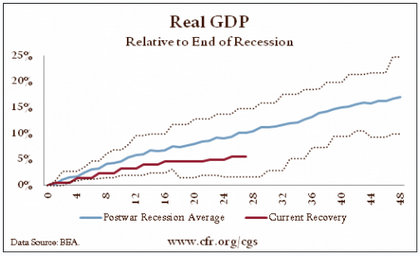
Council of Foreign Relations on recent recovery – looks like this recovery is the worst ever!

I may have mentioned that for the size govt we have we are grossly over taxed?
;)

ch


Real GDP is growing, but weakly compared with the postwar average recovery.

The recovery from the 1980 recession was even weaker at this stage, but that reflected a double-dip recession in 1981.

The economy would have to grow at a 7.6 percent annualized rate in order to catch up with the average postwar recovery by the end of 2012.

The consensus forecast for 2012 growth as reported by Bloomberg is 2.1 percent, up just slightly from a forecast of 2.0 percent as of last October.

ch


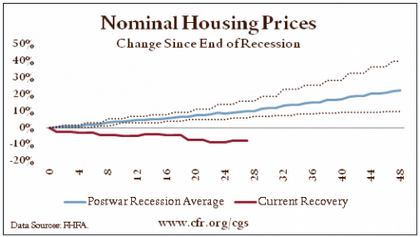
Soft home prices have been central to the weakness of the recovery.

The continued weakness of nominal home prices is a postwar anomaly.

ch


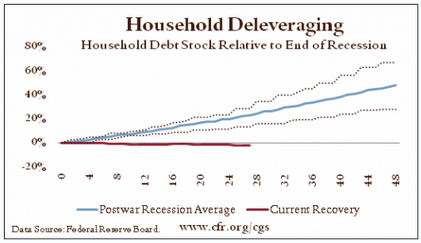
In every previous postwar recovery, the stock of household debt has risen as the recovery has begun.

In the current recovery, the collapse in home prices has severely damaged household balance sheets. As a result, consumers have avoided taking on new debt.

The result is weak consumer demand and, hence, a slow recovery.

ch


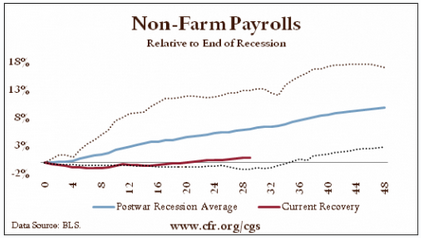
The slow recovery is obvious in the labor market, where job growth remains painfully sluggish compared to the average recovery.

The recent uptick at the end of the Current Recovery linev(red) is the result of encouraging payroll data announced on January 6th 2012.

ch


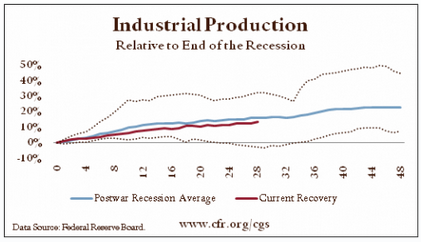
Because of the depth of the recent recession, one might expect stronger-than-average improvement in industrial production.

Despite the predicted snapback, the increase in industrial production during this recovery is actually slightly slower than in the average postwar case.

ch


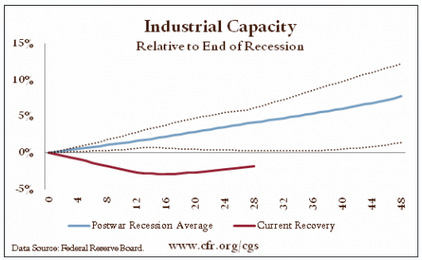
Capacity in manufacturing, mining, and electric and gas utilities usually grows steadily from the start of a recovery.

However, during the current recovery, investment has been so low that capacity is actually declining. Plants and machinery are depreciating faster than they are being installed.

ch


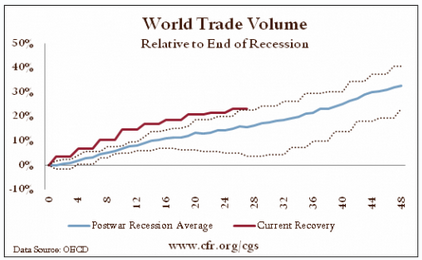
The growth in world trade exceeds even the best postwar experiences.

However, this reflects the depth of the fall during the recession.

ch


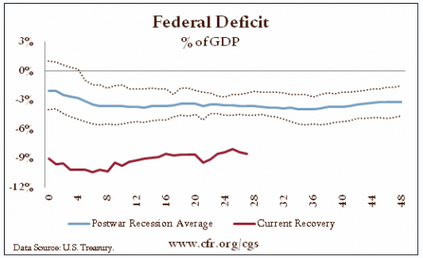
The federal deficit since the start of the recovery has been much higher than in previous postwar cases.

Although the deficit has shrunk slightly, its level creates significant challenges for policymakers and the economy.

ch


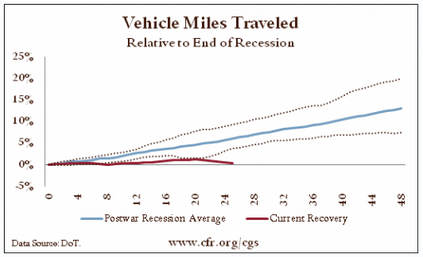
The traditional American enthusiasm for the road has been dulled by a combination of weak recovery and high fuel prices.

When compared to other postwar recessions, total vehicle miles traveled in this current recovery has not only lagged the average, but has registered no growth whatever.

the Fed and the dollar

Imagine being on the FOMC and in the mainstream paradigm

In 2008 you moved quickly to make sure the US would not become the next Japan

You cut rates to 0, even faster than Japan did.

You provided unlimited liquidity to the dollar money markets,
both home and abroad.

You did trillions of QE, sooner than Japan did.

You announced you expected rates to stay down for two years.

etc. etc. etc.

And what do you have to show for it, 3 years later?

GDP marginally positive, much like Japan
Inflation working its way lower to Japan-like levels, especially housing and wages.
Employment stagnant a la Japan.

And now, after 3 years of 0 rates, and trillions of QE, the dollar is going up, much like the yen did.
After the Fed has done all it could think of to reinflate, and then some.

And all just like MMT suspected.
And for what should be obvious reasons.

Housing Starts-GDP

It was pretty lonely forecasting those kinds of GDP numbers several months ago!

While the 8% budget deficit keeps it all muddling through at modest levels of growth, it’s still a far cry from being ‘acceptable’ in my book, as it’s just barely enough to reduce the output gap.

And letting FICA go up at year end or somehow paying for continuing the current level could trim quite a bit of Q1 aggregate demand.


Karim writes:

Even though the 9.3% rise in starts was led by a 25% gain in the volatile multi-family component, this still represents ‘news’ for GDP forecasts as most (including the Fed) did not assume any contribution to growth from this sector.

Some Q4 GDP estimates starting to move from 3.5% to 4%, and Q1 also now looks to be in the 3.5% area (assuming payroll tax cut is extended).

Although still likely, FOMC may have a lively debate on extending ‘conditional commitment’ beyond mid-2013.

Retail Sales/Empire/PPI/Evans- GDP remains firm

As previously discussed, GDP looks to be growing sequentially, and should do fine next year if fiscal policy doesn’t tighten.

But still not so good for people working for a living, pretty good for corporate earnings.

And risks remain- Europe, China, Super Committee, etc. etc.

And look for a relief rally if Europe all agrees the ECB writes the check,
followed by a sell off due to the austerity that accompanies it.


Karim writes:

Data confirms Q4 GDP growth tracking 3.25%.; slight boost to Q1 estimate; more like 2.75% vs 2.5% previously.

RETAIL SALES

  • Up 0.5% headline and 0.6% control group
  • Iphone 4s definitely helped as electronics sales rise 3.7% for the month, largest gain since 11/09

EMPIRE

  • Rises to 6mth high of 0.6 from -8.48 in October; but 0.6 still weak historically.
  • Also, new orders and employment component both soften in the month.

PPI

  • Pipeline pressures receding as -0.3% headline, -0.4% on consumer goods, -1.1% intermediate stage, and -2.5% crude stage

EVANS AND BULLARD

  • Evans advocating 3% inflation target and linking policy guidance to unemployment/inflation objective
  • Also acknowledges he is ‘sufficiently outside’ consensus at the Fed
  • Bullard rejects linking policy to numerical objectives and states would need to see evidence of deterioration in U.S. economy to support additional easing

A note from S&P’s John Chambers

This makes me sleep a lot better…

November 15, 2011

Dear Warren,

On Nov. 11-12, I spoke at the Caixin Summit 2011 in Beijing on the subject of who will solve the debt crisis. My comments pertained to the euro area and to the rest of the world, and I stated that, in Standard & Poor’s view:

  • External imbalances are as much at the root of the current crisis as fiscal imbalances;
  • Better coordination among international policymakers can help to attenuate these external imbalances;
  • Prior domestic economic reforms will facilitate coordination;
  • Generally, a high level of financial claims is more of a symptom of past failures to reform than the disease itself;
  • If international cooperation and economic reform come up short (which is not our base case), global growth could sputter, public and private sector indebtedness could remain high, and some speculative-grade sovereigns could resolve their fiscal difficulties through default.

Standard & Poor’s believes that what is taking place in the euro area, in several respects, is a microcosm of what is happening globally.

To read my full comments, please click here to access the article.

Please contact me with any comments or questions.
Sincerely,

John Chambers
Chairman of the Sovereign Ratings Committee

France Unveils New Budget Savings as Growth Slows

May as well call it the Sarcophagus plan.

It’s all they know how to do.
And again, like the carpenter said of his piece of wood,
no matter how many times I cut it it’s still too short.

France Unveils New Budget Savings as Growth Slows

By Alexandria Sagr

November 7 (Reuters) — France will announce about 8 billion euros of budget cuts and tax hikes for 2012 on Monday, imposing more pain on voters to protect its credit rating and curb its deficit in a gamble for President Nicolas Sarkozy six months from an election.

Sarkozy’s center-right government says extra savings are urgently needed to keep France’s finances from going off the rails, since it cut its growth forecast for next year to 1 percent from 1.75 percent last week.

The announcements could be make-or-break for Sarkozy as he tries to reassure financial markets and ratings agencies without costing him his re-election chances with French voters.

The measures, to be unveiled by Prime Minister Francois Fillon, come on top of 12 billion euros in savings announced just three months ago.

Le Monde newspaper said he would flag cuts totaling up to 17 billion euros by 2016.