NY manufacturing, Industrial Production, Housing index, Bundesbank comment

Nothing good here:

Empire State Mfg Survey
er-6-15-1
Highlights
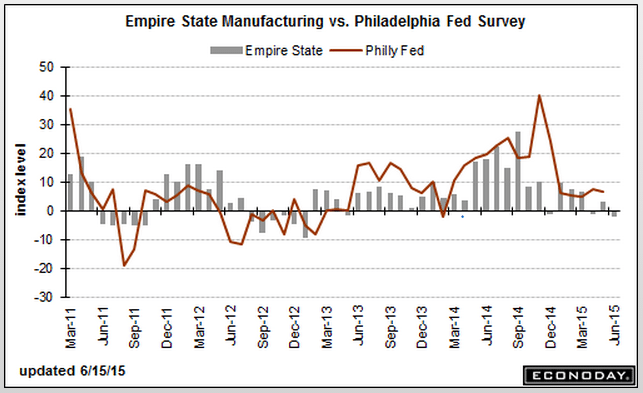
There’s no bounce at all in the Empire State manufacturing survey where the headline index sank to minus 1.98 in June, well below Econoday’s low-end forecast for 4.00 and the second negative reading in three months that pulls its second quarter average into the negative column at minus 0.03. This report was actually doing much better during the heavy weather and special factors of the first quarter when it averaged 8.21.

And new orders point to greater weakness ahead, at minus 2.12 in June for the third negative reading in four months. Shipments have been strong in this report, at 12.01 in June, but won’t stay strong very long given the weakness in orders. The six-month outlook reflects this concern, down nearly 4 points to 25.84 which is the lowest for this reading since February and the second lowest in 2-1/2 years.

Unfilled orders are always weak in this report, at minus 4.81 in today’s report which is actually the least negative reading since October last year. And employment does remain in the plus column at 8.65, up from 5.21 in May but well down from their recent peak in March at 18.56. Price readings show little change with output prices showing fractional upward pressure at 0.96 and input prices showing steady and mild pressure at 9.62 vs 9.38 in May which was the lowest reading in nearly 3 years.

The manufacturing sector is supposed to be building up steam, not losing steam. There are no special factors in the second quarter that can be blamed for the loss of momentum. Later this morning the industrial production report will offer definitive indications on national shipments during May. On Thursday, the Philly Fed, which has also been weak, will offer a second early look at conditions in June.
er-6-15-2

And another bit of bad news here:

Industrial Production
er-6-15-3
Highlights
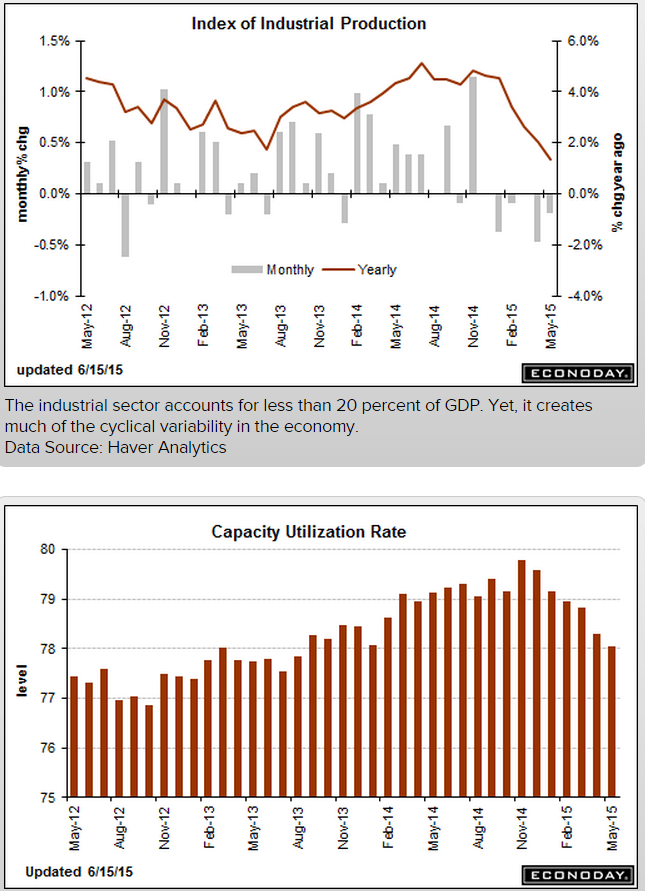
The hawks may have some good arguments at this week’s FOMC meeting but they won’t have anything convincing to say on the manufacturing sector which, instead of rebounding from a weak first quarter, appears to be slowing further. All the main numbers in today’s industrial production report are below low-end forecasts with the headline at minus 0.2 in May and April revised 2 tenths lower to minus 0.5. May is the fourth negative reading in the last six months with the other readings at no change. Capacity utilization fell 2 tenths to 78.1 percent which is the lowest rate since January 2014.

The manufacturing component fell 0.2 percent in May for the third negative reading in five months. Weakness in May was concentrated in consumer goods and construction supplies, the latter a disappointing indication for the housing sector. The mining component, at minus 0.3 percent, has really been hit hard by weakness in the energy sector but, in a plus, contraction here seems to be easing. The utilities component is positive but just barely at plus 0.2 percent.

Turning back to manufacturing, vehicles are actually a very big positive with a third outsized gain in a row, at plus 1.7 percent in May vs 2.0 percent and 4.0 percent in the two prior months. This reflects very strong consumer demand for cars and trucks underscoring unit vehicle sales which, in previously released data, are the strongest in 10 years. Excluding vehicles, however, the decline in May manufacturing slips another tenth to minus 0.3 percent. Another area of strength is capital goods which is showing life in the durable goods report and which here, tracked in the business equipment subcomponent, shows a 0.2 percent gain for May.

Otherwise, however, this report is surprisingly weak and echoes this morning’s equally surprisingly weak Empire State report for June. Though there are no separate readings on exports in either of this morning’s reports, weakness here appears to be pulling down the manufacturing sector.
er-6-15-4
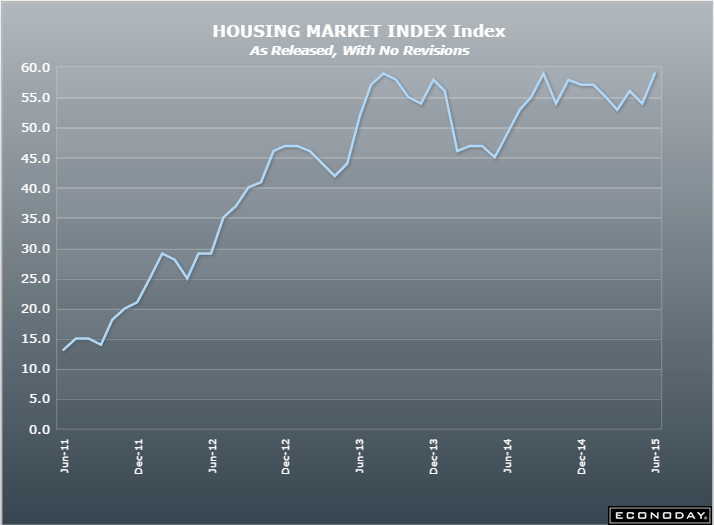
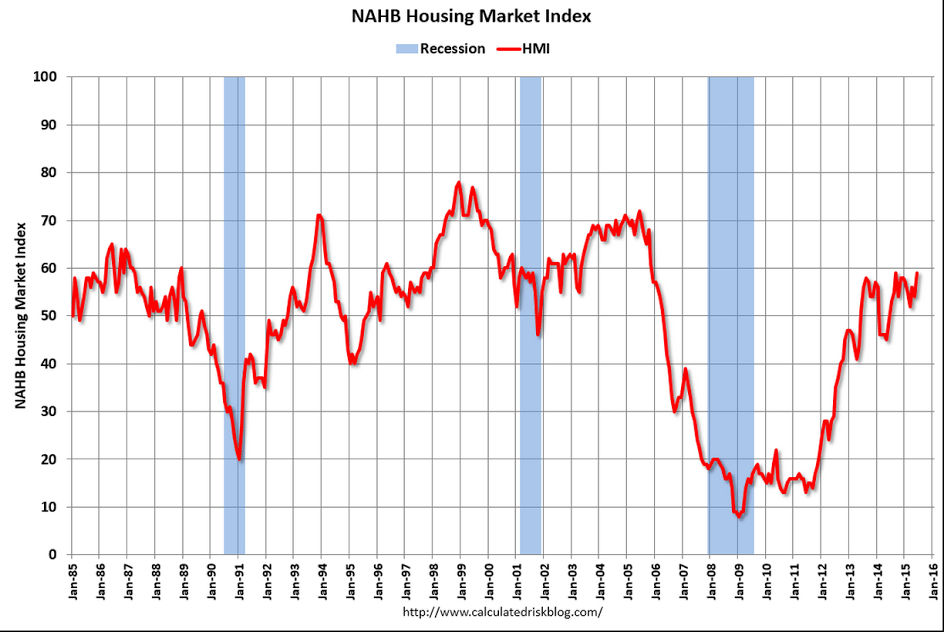
On a brighter note the remaining home builders are reporting that things are looking up some. But a few % pts gain in this sector which is now less than half of what it used to be isn’t going to drive overall growth:
er-6-15-5
er-6-15-6
And yes, this is the euro zone’s vulnerability and inevitable with an export surplus:

11:00:00 RTRS – GERMANY’S BUNDESBANK SAYS IF THE EURO APPRECIATES STRONGLY, DOWNSIDE RISKS FOR THE ECONOMY WOULD RESULT

Retail sales, business inventories, import/export chart

Sales up to higher gas prices is nothing to brag about:

Retail Sales
er-6-11-1
Highlights
The consumer showed a lot of life in May, driving up retail sales 1.2 percent with gains sweeping nearly all components. A leading component in the month was motor vehicle sales which jumped 2.0 percent, excluding which retail sales still rose a very strong 1.0 percent. Another component showing special strength was gasoline sales which got a boost from higher prices. Still, excluding both of these components, retail sales ex-auto ex-gas gained a very solid 0.7 percent. These results offset weakness in April, when total sales rose only 0.2 percent (upward revised from no change).

In contrast to weakness through most of the April report, there’s only one component showing contraction in May and that’s the usually solid health & personal care stores at minus 0.3 percent. Standouts on the plus side, apart from vehicles and gasoline, are building materials & garden equipment stores, up 2.1 percent, clothing & accessories stores, up 1.5 percent, and nonstore retailers, up 1.4 percent. Department stores, which sank a steep 2.9 percent in April, rebounded with a 0.8 percent gain.

The long awaited rebound from the soft first quarter is finally here. Today’s results will have forecasters upping their estimates for second-quarter GDP. These results will also be a key point of discussion, especially in arguments by the hawks, at next week’s FOMC meeting.

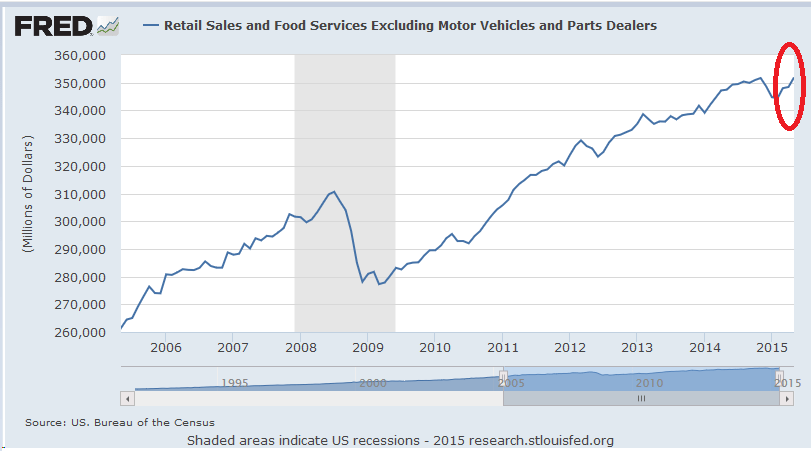
See the move up since the decline earlier in the year January? The analysts are looking at those last few months and calculating the growth rates of just that segment and saying that’s how fast the economy is growing, etc:
er-6-11-2
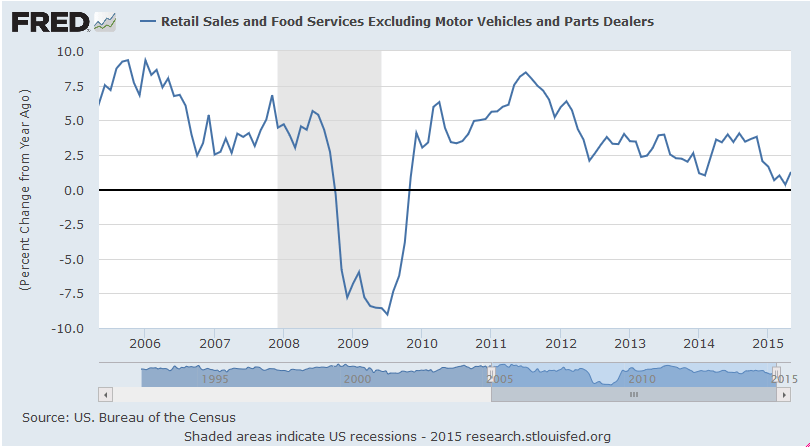
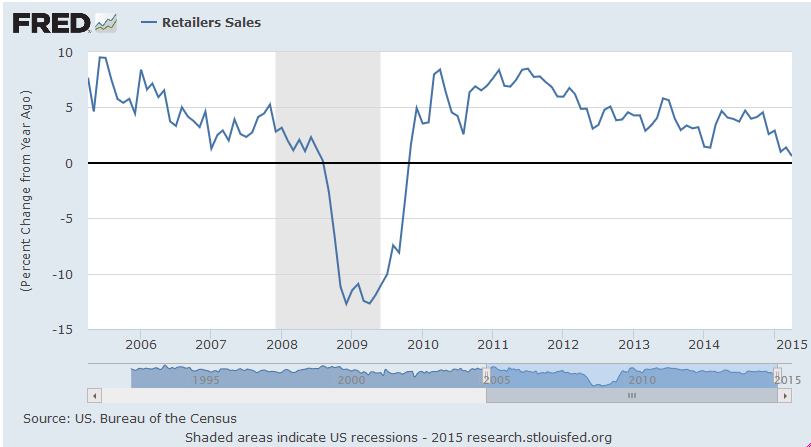
The % change year over year chart doesn’t look so good:
er-6-11-3
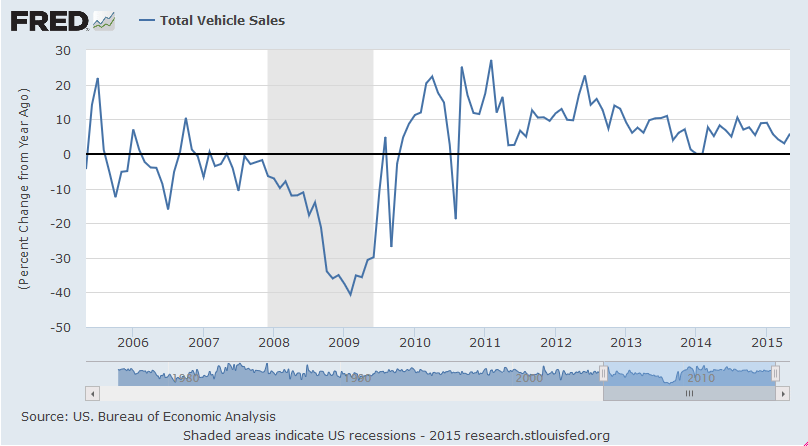
Same with vehicle sales. Yes, ‘new highs’ but the growth is slowing, which is what counts when calculating year over year growth of the economy:
er-6-11-4
er-6-11-5
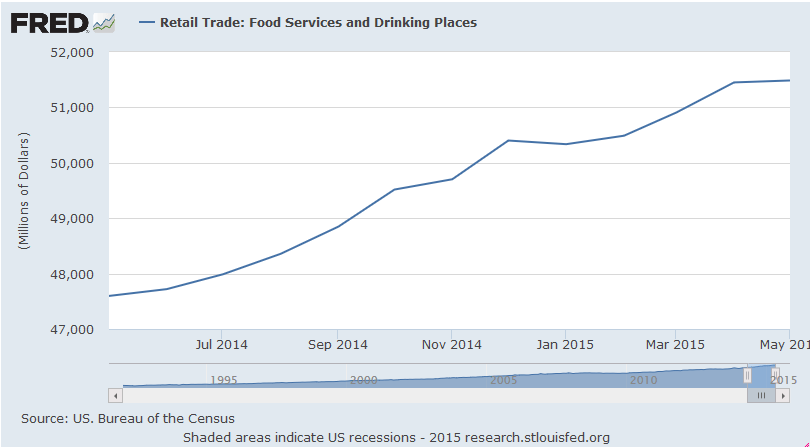
All the talk about this showing where the money saved on gas was being spent has dried up:
er-6-11-6
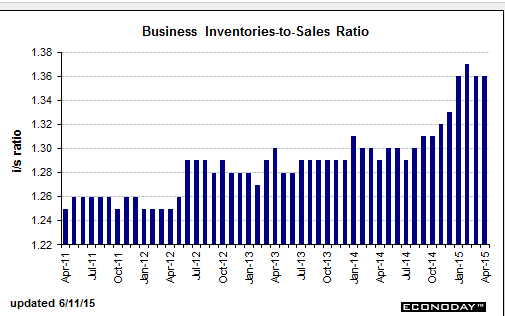
Inventories remain elevated. Unsold inventory most often leads to a slowdown in output:

Business Inventories
er-6-11-7
Highlights
Inventories are rising in line with sales, pointing to well-balanced strength for second-quarter GDP. Business inventories rose 0.4 percent in April, just below a strong 0.6 percent in business sales and leaving the stock-to-sales ratio unchanged at 1.36.

Of the report’s three components, retail shows a slight imbalance with inventories jumping 0.8 percent against only a 0.1 percent rise in sales that lifts the sector’s stock-to-sales ratio to 1.46 from 1.45. But this is likely to reverse in the May inventory report given the enormous strength in this morning’s retail sales report for May.

Looking at the other two components, inventories at wholesalers are a little leaner than they had been, at a stock-to-sales ratio of 1.29 vs 1.30, while manufacturers are a little less lean, at 1.35 vs 1.34.

er-6-11-8
er-6-11-9

Redbook retail sales, small business index, QE comment, wholesale trade, jolts

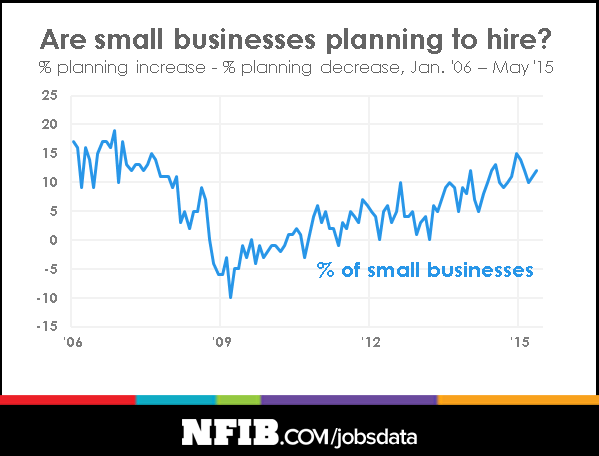
Getting worse instead better in Q2:
er-6-9-1
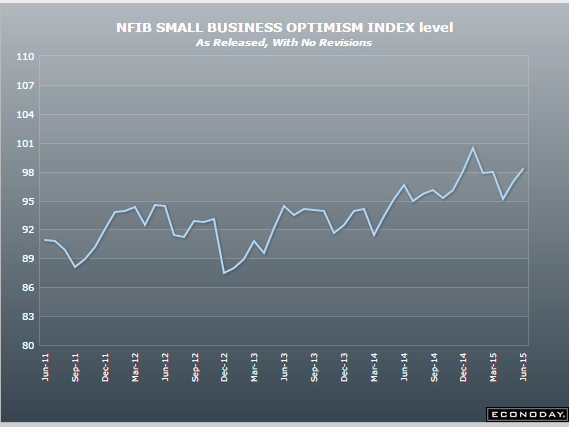
It’s up which is good, but not even back to q1 January high and below historic ‘good economy’ levels:

NFIB Small Business Optimism Index
er-6-9-2
Highlights
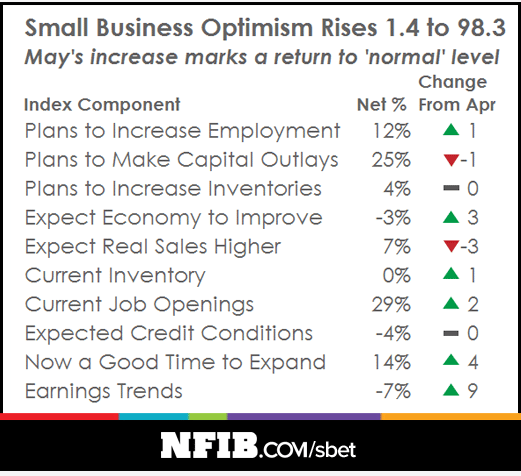
The small business optimism index came in well above expectations, at 98.3 for a very solid 1.4 point gain from April’s 96.9 and compared with the Econoday consensus for 97.2. The gain is centered right where small business owners need it the most, in earnings trends. The gain here in turn is lifting the small business outlook with more saying this is now a good time to expand. The outlook on the general economy is also up as are job readings. This report hints at the big second-quarter rebound that many have been expecting.
er-6-9-3
er-6-9-4

Calculated Risk:

From the National Federation of Independent Business (NFIB):Small business optimism level is finally back to a normal level

The Index of Small Business Optimism increased 1.4 points to 98.3 … May is the best reading since the 100.4 December reading but nothing to write home about. The 42 year average is 98.0 … Eight of the 10 Index components posted improvements.

er-6-9-5
er-6-9-6

QE comment:

This gets to the bottom it- if the total number of securities outstanding remains unchanged, QE has done nothing apart from removing about $100b of interest income from the economy each year and maybe some repricing of financial assets. That is, at the macro level portfolios can’t be increasing risky assets if the total isn’t increasing:

Antonin Jullier, global head of equity trading strategy at Citi, told CNBC Tuesday that the bond-buying policies implemented by central banks including the Federal Reserve and European Central Bank had had a detrimental effect.

“The lack of liquidity is coming from QE, it’s one of the consequences…it’s sucking it out,” he said.

The aggressive stimulus was “one-sided,” according to Jullier, who said it was increasing valuations of securities, but not producing more stock flotations or capital increases.

“The net inventory of securities has actually been flat for years now. So there are no new securities available,” he added, calling it a period of “de-equitization.”

Inventories up more than expected which adds to Q2 GDP, but it’s still an inventory build and the inventory/sales ratio is still too high historically, which doesn’t bode well for production. The sales growth is a positive but a small rebound from prior declines, which is good for Q2 vs /Q1, but it’s an April read with 2 months to go.

Wholesale Trade
er-6-9-7
Highlights
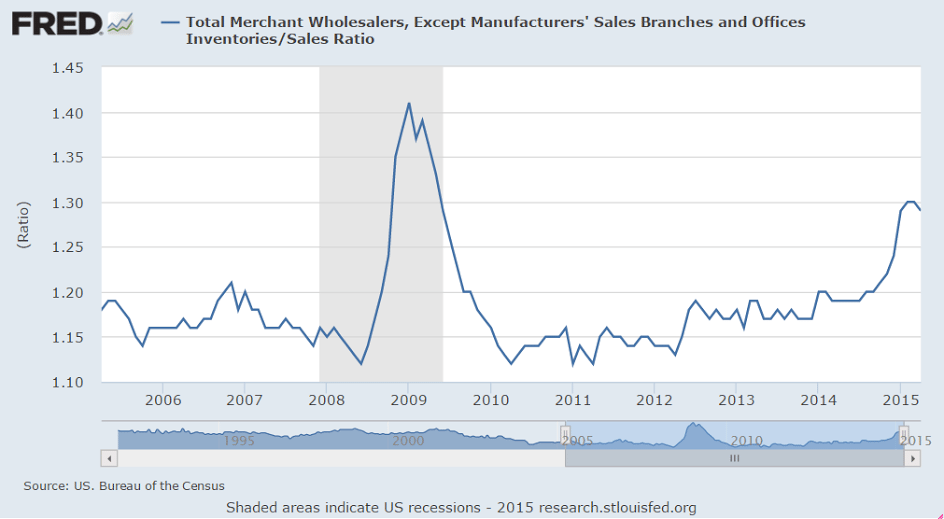
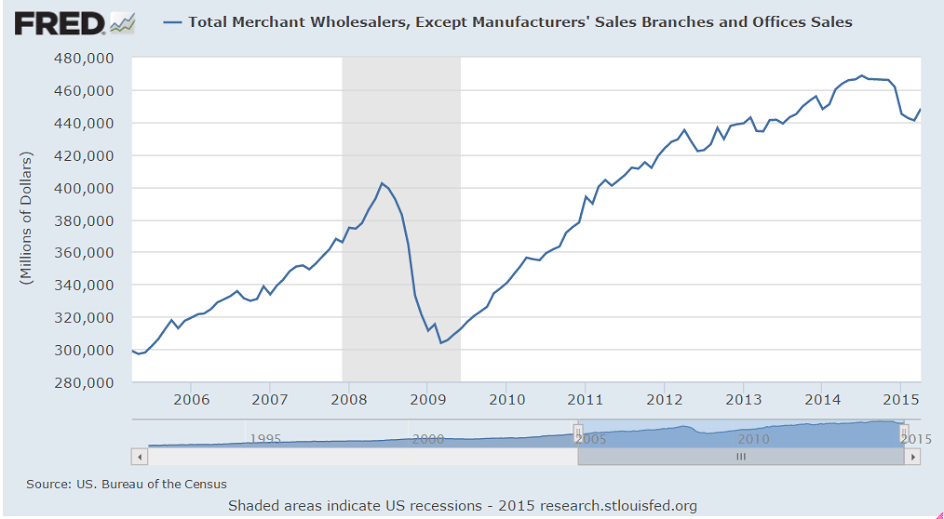
Inventories relative to sales lightened up in the wholesale sector during April with inventories up 0.4 percent but far below a giant 1.6 percent surge in sales. The stock-to-sales ratio edged down to 1.29 from 1.30. Autos, where sales have been strong, show a sizable decline in the stock-to-sales ratio as do farm products, furniture, computer equipment, and electrical goods. All these categories, like autos, show strong sales gains in the month.

Early indications on second-quarter inventories have been favorable with the risk of overhang, evident in the first quarter, now easing. Watch Thursday for the business inventories report which will round out related data for April.

er-6-9-8
er-6-9-9
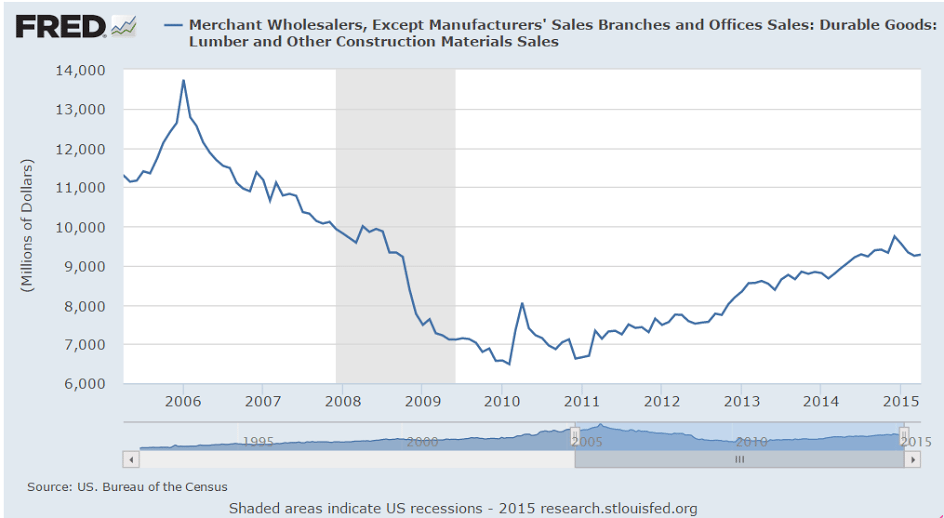
And this doesn’t say much for construction prospects:
er-6-9-10
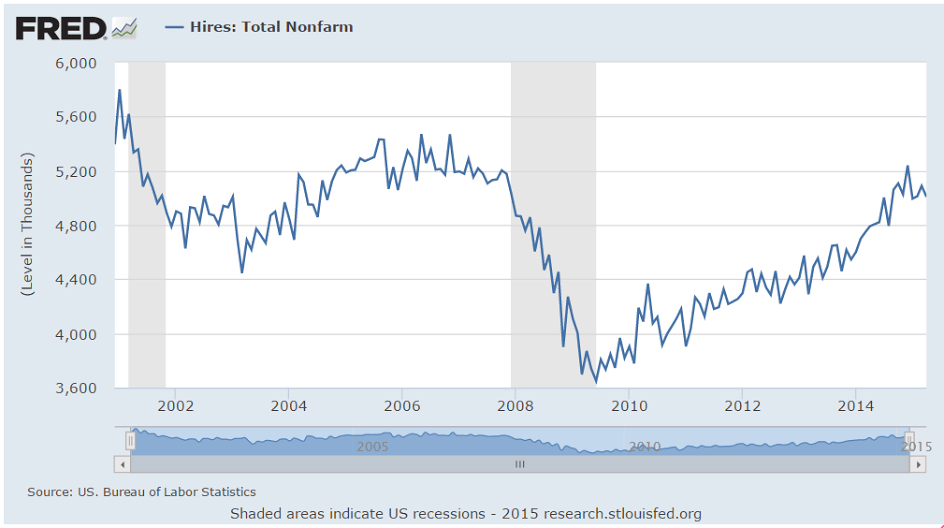
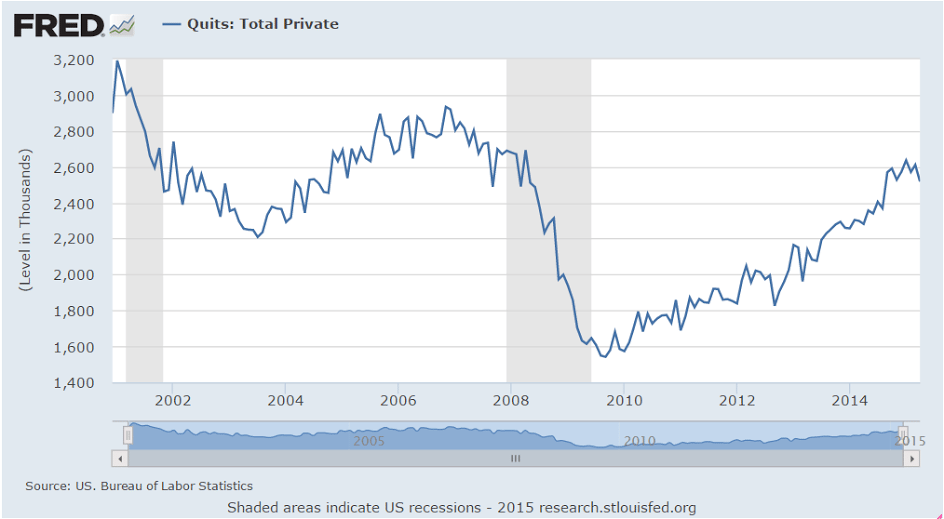
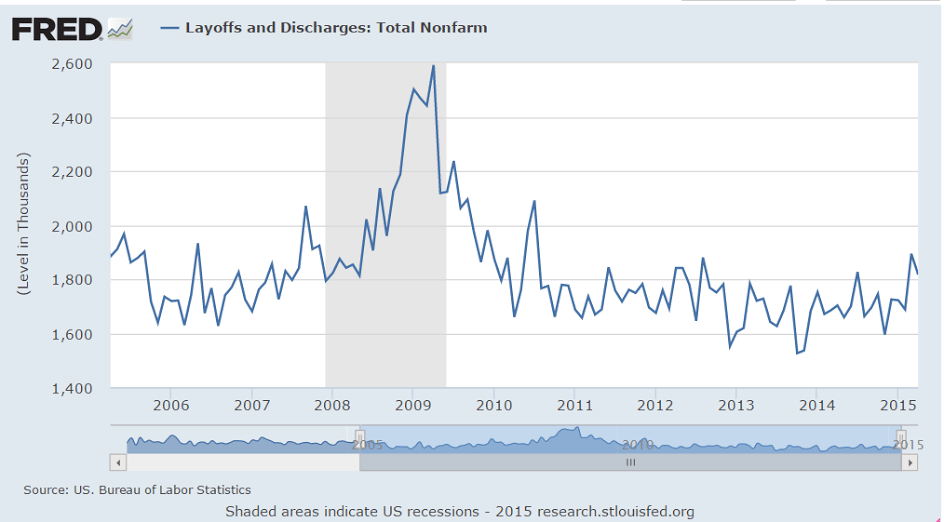
Another mixed bag with openings higher but actual hires pretty much flat as were quits:

Job Openings and Labor Turnover Summary

The number of job openings rose to 5.4 million on the last business day of April, the highest since the series began in December 2000, the U.S. Bureau of Labor Statistics reported today. The number of hires was little changed at 5.0 million in April and the number of separations was little changed at 4.9 million. …

Quits are generally voluntary separations initiated by the employee. Therefore, the quits rate can serve as a measure of workers’ willingness or ability to leave jobs. … There were 2.7 million quits in April, little changed from March.

Hires may have even peaked:

JOLTS
er-6-9-11
Highlights
The hawks have something to talk about with the April JOLTS report where job openings surged to 5.376 million, far above the Econoday consensus for 5.038 million and the high estimate at 5.050 million. This is the highest reading in the history of the series going back to 2000. Year-on-year, openings are up an eye-popping 22 percent!

And the report includes a big upward revision for March, to 5.019 million vs an initial 4.994 million. April’s job openings rate rose to 3.7 percent from 3.5 percent.

This report will boost talk among the hawks that slack in the labor market is evaporating and that employers will have to raise wages to fill positions. Other readings include a tick lower for the quits rate, to 1.9 percent, and a tick lower for the separations rate, to 3.5 percent from 3.6 percent.

er-6-9-12
er-6-9-13
And you can see how much of a lagging indicator this stuff can be:
er-6-9-14

Federal Deficit below last year

The budget deficit is now looking too small to sustain growth, as evidenced by the incoming data over the last 6 months. The problem is, as always, unspent income- aka demand leakages- must be offset by agents spending more than their incomes or the output goes unsold. And collapsing GDP growth and rising inventory ratios are telling me that’s it’s been happening ever since the price of oil collapsed, ending the shale related capex, with nothing yet stepping up to fill that spending gap.

At the same time, the Federal govt is going the other way as, reducing the amount that it’s spending in excess of taxation. Additionally, with the current tax structure, if there is any pick up in growth from private sector credit expansion it will cause the federal deficit to further decline, which will require that much more private sector deficit spending to support growth. That’s why the tax structure and transfer payment structure are called ‘automatic fiscal stabilizers’. And, of course, if the economy does stall, the Fed will get the blame for ending QE and more recently allowing longer term rates to rise…

CBO: Fiscal 2015 Federal Deficit through May about 10% below Last Year

Fed’s Beige Book

The sharp reduction in oil capex that was driving the economy has predictably shown up first in the oil states like Texas, Oklahoma, North Dakota, etc. Just as these states led on the way up, they are leading on the way down as well, with that weakness working its way to the other regions as the US continues to suffer from a general lack of aggregate demand. Though to a lesser degree, this is similar to the sub prime episode, where that housing expansion led the recovery, driving down the Federal deficit via the automatic fiscal stabilizers (tax revenues and transfer payments) as private sector deficit spending increased and did the heaving lifting. Then when that private sector deficit spending came to an end, sales and jobs collapsed, as the recession unfolded. Same for the .com era expansion and the S and L driven expansion prior to that, etc. Once the deficit spending falls short of the demand leakages the cycle ends.

Yes, debt levels are low enough for a consumer debt led rebound, but the private sector tends to be pro cyclical, and we see this happen only on the way up, pro cyclically, and not counter cyclically to rescue a slowdown already in progress.

Also, seems much like they did a few years ago, the Fed has engineered a spike in mortgage rates just as housing was beginning to show some signs of life, though admittedly not much. Traditionally housing has been the source of private sector deficit spending- borrowing to buy houses- but seems this time it isn’t going to happen. Nor are a few car loans going to move the needle, and in any case overall consumer spending growth seems to be fading.

Beige Book

Highlights
The second to last risk for a June rate hike has passed as the Beige Book, prepared by the Fed for its June 16-17 policy meeting, downgrades the strength of the economy slightly. Four of the Fed’s 12 districts are reporting slowing growth from the prior Beige Book, especially Dallas which is being hit hard by the energy sector.

Nevertheless, total employment is up slightly as are wages, but only slightly. Retail sales are also up as are residential and commercial construction. Manufacturing is described as steady with the exception, again, of Dallas and also Kansas City. The service sector is described as growing.

The pace of the nation’s economy is somewhere between moderate and modest with no signs of over heating. The only chance left now for a rate hike at the June meeting is Friday’s employment report which would not only have to show huge gains for May but also major upward revisions for April. The economy is not getting the big second-quarter boost that the hawks expected.

er-6-3-15

mtg purch apps, ADP, Trade, ISM, Atlanta Fed

Another setback, still up some year over year but all cash purchases are down quite a bit as well:

MBA Mortgage Applications
er-6-3-6
Highlights
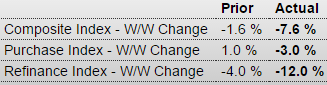
Application activity is sputtering with MBA’s composite index down a very steep 7.6 percent in the May 29 week for a 6th straight decline and the steepest decline since February. Purchase applications fell 3 percent in the week but are still up a respectable 14 percent year-on-year. Refinancing applications fell 12.0 percent in the week to their lowest level since May last year. Refinancing demand has been especially hurt by this year’s rise in interest rates though rates were down in the latest week, with the average 30-year mortgage for conforming loans ($417,000 or less) down 5 basis points to 4.02 percent.

Note the chart below, which doesn’t show much of a recovery from Q1:

ADP Employment Report
er-6-3-7
Highlights
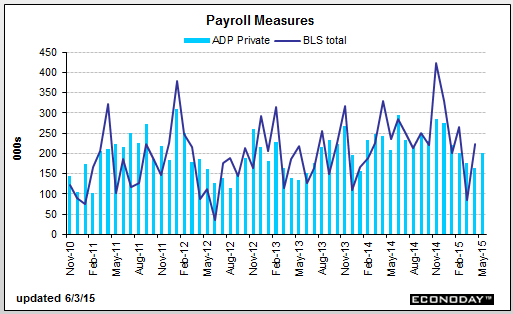
ADP estimates that private payrolls rose a moderate 201,000 in May which is right at the Econoday consensus for 200,000. For comparison, the consensus for private payroll growth in Friday’s employment report is a bit higher, at 215,000 with the low estimate at 185,000. ADP sometimes does and sometimes does not correctly anticipate the employment report having last month signaled weakness in what turned out to be a respectable report for April.
er-6-3-8

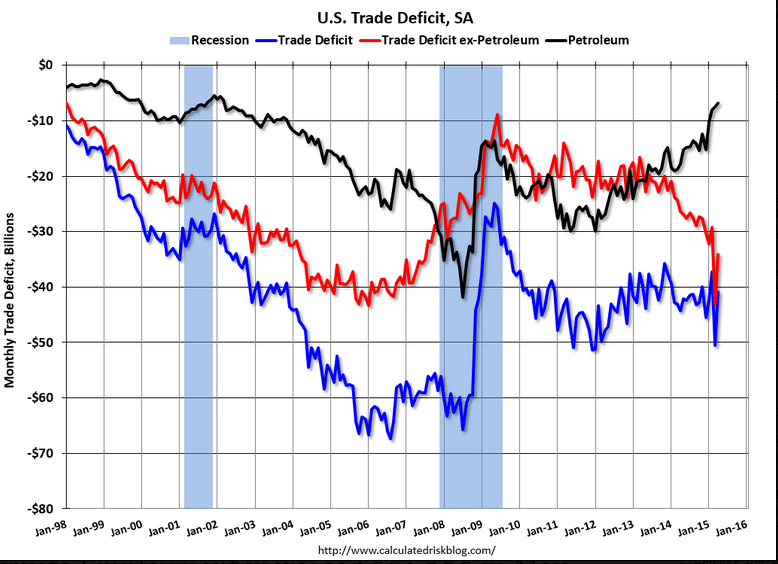
The chart shows how non petroleum imports continued to rise sharply, and the May auto sales report which includes imports looks to continue to support that up trend. Petroleum imports show a lot of month to month volatility so they could very well be up substantially for the rest of the quarter, as prices were higher and US production is being forecast to decline due to the sharp drop off in drilling. So look for the US trade gap to widen, partly because of the dollar strength and partly because of fading exports and rising oil imports due to domestic production declines. The trade flows are now working against the dollar and in favor of the euro, which is being supported by a large and growing trade surplus.

International Trade
er-6-3-9
Highlights
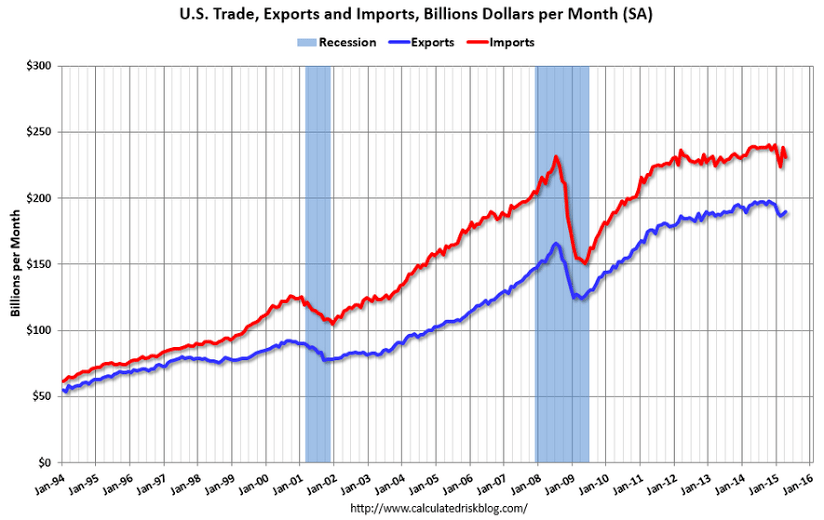
Second-quarter GDP looks to be getting a lift by a decline in imports, at least it will in April when the trade gap eased to $40.9 billion. The gap is on the low side of Econoday expectations and compares with March’s outsized revised gap of $50.6 billion which was distorted by a spike in imports tied to the resolution of the first-quarter port strike. Imports fell 3.3 percent in April to $230.8 billion at the same time that exports, in another positive for GDP, showed some life, up 1.0 percent to $189.9 billion.

Consumer goods show the strongest improvement on the import side, down $4.9 billion in the month and reflecting a $1.3 billion decline in cell phones as well as declines for apparel and furniture. Imports of capital goods, industrial supplies, and autos also fell. Imports of petroleum products rose $0.2 million to $15.4 billion, more than offset by a $0.9 billion rise in petroleum exports to $8.6 billion.

Strength in exports also includes capital goods, up $2.1 billion with civilian aircraft representing nearly half the total. Exports of industrial supplies and autos were also higher.

Another plus in the report is another gain for the nation’s services where the trade surplus rose to $19.8 billion from $19.4 billion in March.

Country data show a sharp easing in the gap with China, to $26.5 billion vs March’s $31.2 billion, and improvement with Mexico, to a gap of $4.4 billion vs $5.5 billion in March. The gap with Europe widened slightly to $13.3 from $12.7 billion while the gap with Japan was unchanged at $7.1 billion.

The decline in imports was of course expected given the special circumstances in March, but the gain for exports is very positive suggesting an easing in dollar-related troubles and perhaps pointing to some life in foreign demand. Today’s report includes annual revisions which increased deficits for 2013 and 2014.
er-6-3-10
er-6-3-11

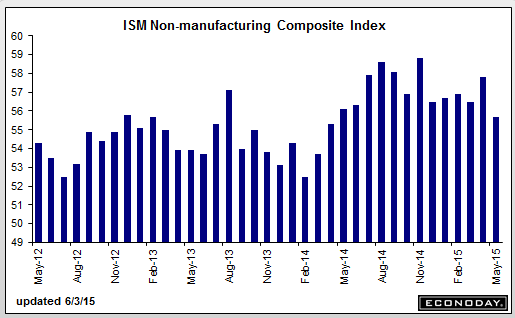
Again, the chart shows it’s not as strong as it was in q1, which means it’s contributing less growth in q2 than it did in q1, and it’s also no where near the strength of q2 2014:

ISM Non-Mfg Index
er-6-3-12

Highlights
The ISM non-manufacturing index for May, at 55.7, came in solid but at the low end of Econoday expectations to indicate the slowest rate of monthly growth since April last year. Key readings all slowed slightly but are still very constructive with new orders at 57.9 and business activity at 59.5. Employment also slowed, down 1.4 points to 55.3 which is still a respectable rate.

Other details include a jump in exports, up 6.5 points to 55.0 in a reading that underscores this morning’s big service-sector surplus in the April trade report. Supplier delivery times, which had been slowing all year, were unchanged in May suggesting, also like this morning’s trade report, that supply-chain distortions tied to the first-quarter port strike have unwound. Input prices, likely tied to higher fuel costs, show some pressure, up 5.8 points to a 55.9 reading that’s the highest since August last year.

A look at individual industries shows special strength for arts/entertainment/recreation and management & support services, the latter one of the strongest export industries for the nation. And in the latest hint of strength in the housing sector, both real estate and construction show strength. The only one of 18 industries to contract in the month was, once again, mining which is being hurt by low commodity prices.

The dip in employment won’t be boosting expectations for Friday’s employment report and the hawks at the Fed are certain to take note of the rise in prices. But in sum, this report is mostly positive and in line with the PMI services index released earlier this morning, both pointing to modest deceleration in what is otherwise the economy’s central strength – the service sector.
er-6-3-13

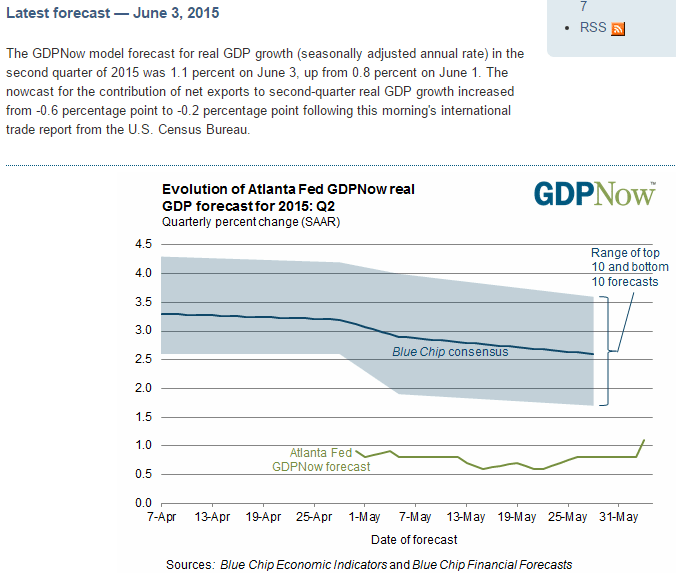
The Atlanta Fed GDP forecast for Q2 is up to 1.1% annualized, which would be a shockingly low follow up to Q1’s -.7. And, as above, there’s a good chance May’s trade number goes the other way, sending the GDP forecast back down:
er-6-3-14

Personal Income and outlays, ISM manufacturing, Construction spending, Atlanta Fed

Personal Income and Outlays
er-6-1-1
Highlights
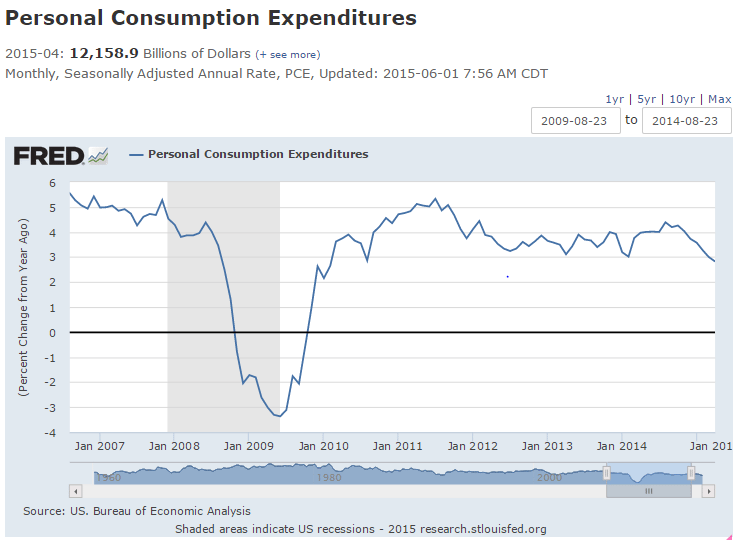
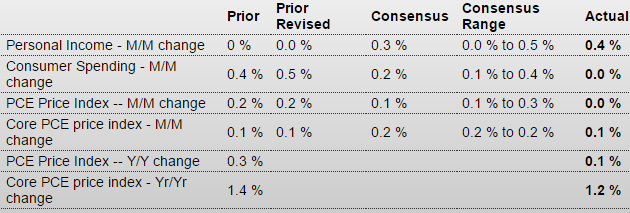
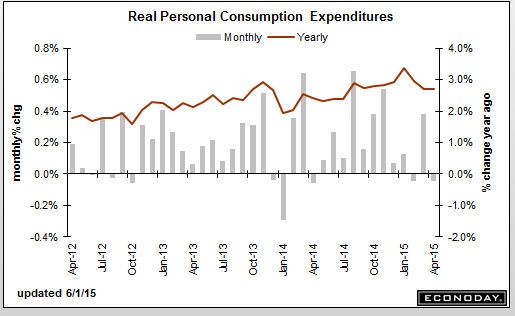
The consumer started off the second quarter slowly, putting income into savings and not spending. Consumer spending was unchanged in April with deep declines in spending on both durable and nondurable goods, down 0.7 percent and down 0.5 percent respectively, offset by another incremental increase in spending on services of plus 0.2 percent. Personal income, boosted by rents and dividends, rose a solid 0.4 percent though the gain for wages & salaries was less strong at 0.2 percent. The savings rate rose 4 tenths in the month to 5.6 percent.

Inflation readings are very tame with the price index unchanged in the month and the core up only 0.1 percent. The core rate, unlike April’s 1.8 percent core reading for the CPI where weightings on housing and medical costs are greater, is showing less pressure, down slightly to 1.2 percent. Overall prices are barely up at all year-on-year, at plus 0.1 percent.

The April retail sales report first signaled trouble for second-quarter spending that today’s report confirms. The consumer, the economy’s bread-and-butter right now given weakness in manufacturing, is sitting on their hands. This report pushes back the outlook for the Fed’s first rate hike.
er-6-1-2

Construction Spending +2.2% in April

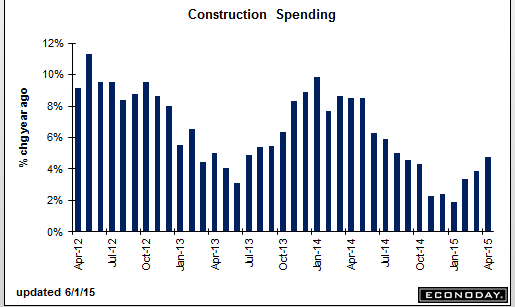
Seasonally adjusted annual rate of $1,006.1 billion, 2.2% above the revised March estimate of $984.0 billion. The April figure is 4.8% above the April 2014 estimate of $960.3 billion. During the first 4 months of this year, construction spending amounted to $288.7 billion, 4.1% above the $277.3 billion for the same period in 2014.

These surveys are ‘one company one vote’ and the drop in oil capex hurts a small number of the total initially even as GDP growth fades before it spreads to the rest, which could take a while as slowing employment gains reduce demand in general, etc. And note the continued reference to export softness, which is partly dollar related, but also a function of the drop in gobal oil capex.

ISM Mfg Index
er-6-1-3
Highlights
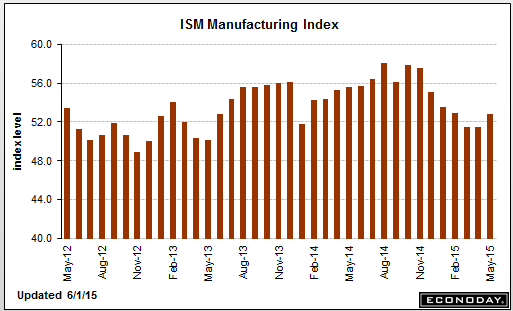
May was a modestly positive month for ISM’s manufacturing sample with the headline index rising 1.0 point to a better-than-expected 52.8 which is near Econoday’s high-end forecast. New orders are the highlight of the report, up 2.3 points to 55.8 which is the best reading of the year. Contraction in export orders has been pulling down total orders in many reports but exports were unchanged at 50.0 in this report.

Employment moved back over 50 to 51.7 for a 3.4 point gain while production looks solid at 54.5. Backlog orders, at 53.5, are back over 50 for the first time since February. Supplier deliveries show very little change, at 50.7 vs 50.1 in the prior report to suggest that snags tied to the first-quarter port slowdown have unwound. Price data show slightly lower costs for raw materials.

The 52.8 headline for this report may be better-than-expected but it’s still very soft. The manufacturing sector appears to be stumbling through the second quarter.
er-6-1-4

Up nicely, though mainly due to state and local govt increases. And more importantly, year over year growth a bit better but still very low.

Construction Spending
er-6-1-5
Highlights
Construction spending is showing life, up 2.2 percent in April which is well above Econoday’s consensus for plus 0.7 percent and Econoday’s high-end forecast of 1.6 percent. Spending on residential construction rose 0.6 percent with strong gains posted for both single-family and multi-family homes. The gain here is no surprise and follows April’s big surge in housing starts & permits.

Private non-residential spending looks very strong in this report, up 3.1 percent and led by gains out of the power and office sectors. Pubic spending is also strong led by an outsized gain for highways & streets and including a large gain for educational building. The gain in public spending came entirely from the state and local governments as federal construction spending declined for a second straight month.

Adding to the positive news are big upward revisions, to plus 0.5 percent from an initial reading of minus 0.6 percent for March and no change from minus 0.6 percent in February. This will help boost the next revision to first-quarter GDP. And construction should give a badly needed lift to second-quarter growth which isn’t getting much help from the consumer, evidenced by this morning’s personal income & outlays report, nor from manufacturing, underscored by mostly soft readings in both this morning’s PMI index and ISM index.
er-6-1-6

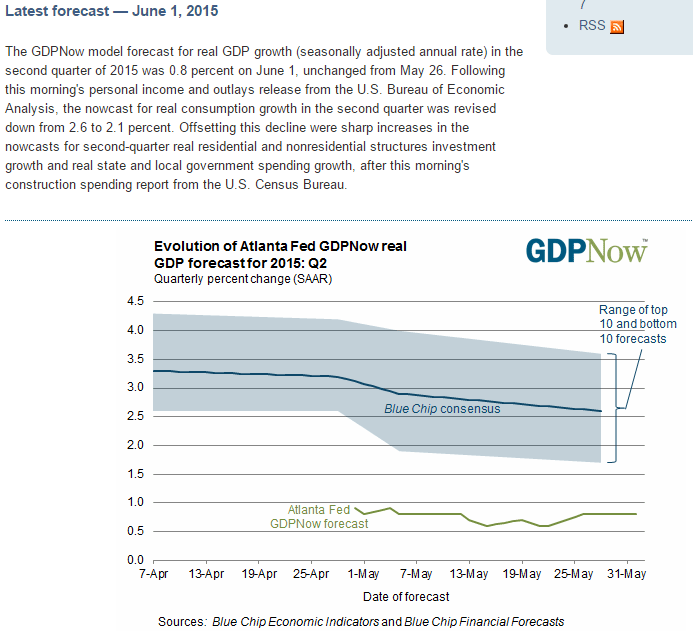
After factoring in today’s numbers the Atlanta Fed GDP forecast remains at .8% annualized for Q2:
er-6-1-7

macro update

At the beginning of 2013 the US let the FICA tax reduction and some of the Bush tax cuts expire and then in April the sequesters kicked totally some $250 billion of proactive deficit reduction. This cut 2013 growth from what might have been 4% to just over half that, peaking in Q3 and then declining to negative growth in Q1, due to the extremely cold winter. Forecasts were for higher growth in 2014 as the ‘fiscal headwinds’ subsided. GDP did resume after the weather improved, though not enough for 2014 to look much different from 2013. And with the fall in the price of oil in Q4 2014, forecasts for Q1 2015 were raised to about 4% based on the ‘boost to consumers’ from the lower oil prices. Instead, Q1 GDP was -.7%. The winter was on the cold side and the consumer had been saving instead of spending the savings from lower gas prices. And the forecasts for Q2 were for about 4% growth based on a bounce back and consumers now spending their gas savings. Most recently Q2 forecasts have been reduced with the release of Q2 data.

My narrative is that we learned the extent of capex chasing $90 in Q4 after the price fell in half. It seemed to me then that it had been that capex that kept 2013 growth as high as it was and was responsible for the bounce from Q1 2014 as well as the continued positive growth during 2014 up to the time the price of oil dropped and the high priced oil related capex came to a sudden end.

By identity if any agent spend less than his income another must have spent more than his income or the output would not have been sold. So for 2012 the output was sold with govt deficit spending where it had been, and when it was cut by some $250 billion in 2013 some other agent had to increase it’s ‘deficit spending’ (which can be via new debt or via depleting savings) or the output would have been reduced by that amount. Turns out the increase in oil capex was maybe $150 billion for 2013 and again in 2014, best I can tell, and this was sufficient to keep the modest growth going while it lasted. And when it ended in Q4 that spending (plus multipliers) ended as well, as evidenced by the sudden decline in GDP growth. And so far the Q2 numbers don’t look like they’ve increased much, if any, since Q1. And to do so will take an increase in ‘borrowing to spend’ that I can’t detect. Of course, I missed the surge in oil capex last year, so there could be something this year I’m missing as well.

When oil prices dropped I pointed out three things-

1. Income saved by buyers of oil equaled income lost by sellers, so the benefit to total spending was likely to be small and could be negative, depending on propensities to save and to spend on imports. And yes, some of the sellers of oil were ‘non residents’, but that was likely to reduce US exports, and cuts in global capex could reduce US exports as well.

2. Lost capex was a direct loss of GDP, plus multipliers, both domestically and globally.

3. Deflation in general is highly problematic for lenders, and tends to reduce private sector credit expansion in general.

To me this meant the drop in oil prices was an unambiguous negative. And in the face of universal expectations (including the Fed) that it was a positive, which can be further problematic.

Euro Zone

Forecasts are for modestly improving growth largely due to the weak euro driving exports. However, the euro is down from massive foreign CB selling, probably due to fears of ECB policy and the Greek saga. This technical selling drove the euro down and the euro area 19 member current account surplus up, absorbing the euro the portfolios were selling. Once the portfolio selling subsides- which it will as euro reserves are depleted and short positions reach maximums- the trade flows continue, which then drives the euro up until those trade flows reverse. In other words, the euro appreciates until net exports decline and the anticipated GDP growth fades. And there is nothing the ECB can do to stop it, as rate cuts and QE works only to the extent it frightens portfolio managers into selling, etc.

Also, ironically, a Greek default would fundamentally strengthen the euro as Greek bonds are nothing more than euro balances in the ECB system, and a default is a de facto ‘tax’ that reduces the holdings of euro net financial assets in the economy, making euro that much ‘harder to get’ etc.

Stephanie Kelton, Rail cars, Econintersect forecast, Italy comment, corp profits

Professor Kelton hit the ground running in January and has been making serious inroads!

This article has the usual misrepresentations, of course, but now Stephanie’s position gives her the opportunity to respond publicly and decisively.

U.S. Senate economist explains why deficits aren’t always evil: Walkom

By Thomas Walkom

Stephanie Kelton is part of a new generation of economists trying to figure out how things work in our grim, new world.

Rail Week Ending 23 May 2015: Contraction Worsens On Rolling Averages

(Econintersect) — Week 20 of 2015 shows same week total rail traffic (from same week one year ago) declined according to the Association of American Railroads (AAR) traffic data. Intermodal traffic improved year-over-year, which accounts for half of movements – but weekly railcar counts continues deep into contraction.


June 2015 Economic Forecast: Significant Decline In Our Economic Index

By Steven Hansen

(Econintersect) — Econintersect’s Economic Index continues to weaken. Most tracked sectors of the economy are relatively soft with most expanding well below rates seen since the end of the Great Recession. When data is this weak, it is not inconceivable that a different methodology could say the data is recessionary. The significant softening of our forecast this month was triggered by marginal declines in many data sets which are dancing closer and closer to zero growth.

The currency depreciation a while back took away real spending power as did the tax increase, shifting income from people to businesses, and helping exports as well:

Japan : Household Spending
er-5-28-1
Highlights
April household spending was down 1.3 percent from a year ago. This was the thirteenth consecutive month of decline. The retreat in spending began when the sales tax was increased from 5 percent to 8 percent in April 2014. Consumers went on a spending frenzy prior to the enactment of the increase and shut off the spending spigot when it was introduced. The weak consumption figures could threaten to keep inflation subdued in the months ahead, though recent commentary from the BoJ suggests the bank is optimistic about the economy’s resilience.

First they credit reforms and THEN oil and the euro:

Italy:

Early efforts with labor and bank reform show progress and Italy’s economy is showing signs of life, expanding 0.3 percent in the first quar ter – the first uptick since the third quarter of 2013 — as a weaker euro and lower oil prices help push the country out of its longest recession on record.

The economic figures tie with recent business confidence data and yet unemployment is still ticking higher – hitting 13 percent in March. As one Italian worker told me in Milan: “If recovery is happening, it isn’t happening fast enough.”
er-5-28-2

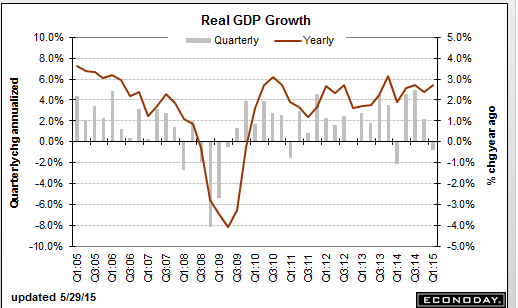
Revised lower as expected. The question is q2 which so far isn’t looking so good.

GDP
er-5-28-3

er-5-28-4

Comments on transport weakness, Draghi comments, Japan exports to US, new home sales,PMI and Fed indexes chart, Dallas Fed, Richmond Fed, Consumer confidence

Transport Is Saying Consumer Spending Should Slow Further

By Steven Hansen

When one analyzes the economy, there are always some sections which do better than others. When the economic growth is weak (like currently), several segments can be in contraction while others are expanding.

Everything but the needed fiscal relaxation:

ECB’s Draghi urges euro zone to unite for economic reform

May 23 (Reuters) — “The current situation in the euro area demonstrates that this delay could be dangerous,” ECB President Mario Draghi said while acknowledging progress had been made, for example with banking union. But private risks need to be shared within the euro zone, with financial integration improving access to credit for companies and leading to a complete capital markets union, Draghi said. Countries should observe common standards when implementing structural reforms but also take a country-specific approach, as part of a process of “convergence in the capacity of our economies to resist shocks and grow together”.

Looks like our trade deficit is still on the rise:

“Exports to the United States rose 21.4 percent in the year to April, keeping the pace of gains in the previous month with brisk shipments of cars and vehicle engines.”

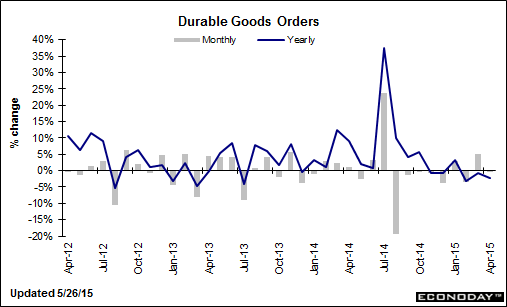
Chart not looking so good:

United States : Durable Goods Orders
er-5-26-1
er-5-26-2

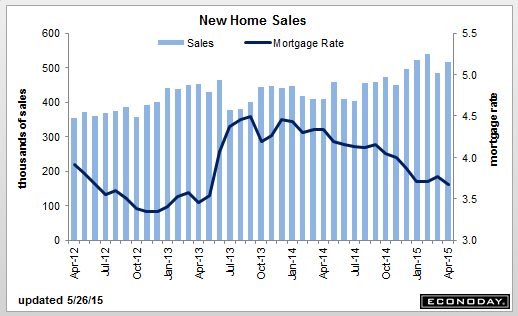
Up a bit after a dip in March but not much different from the Q1 average so hard to say Q2 is doing better than Q1 from this report:

United States : New Home Sales
er-5-26-3
Highlights
New home sales bounced back solidly in April, up 6.8 percent to a 517,000 annual rate that is on the high side of Econoday expectations. Strength is centered in the South which is the largest and important housing region and where sales rose 5.8 percent, this however fails to reverse the region’s 11.8 percent drop in the prior month.

Supply rose slightly in the month, to 205,000 new homes on the market, but supply relative to sales fell to 4.8 months from 5.1 month. Low supply should encourage builders to bring more homes on the market but at the same time low supply hurts current sales. Price readings are mostly favorable led by a 4.1 percent rise in the median price to $297,300 for a strong 8.3 percent year-on-year gain.

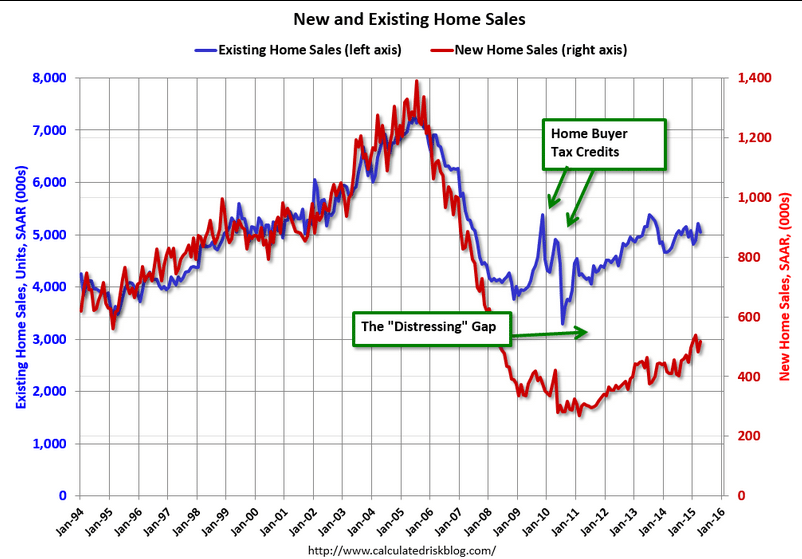
Readings in this report are always volatile month-to-month but the gains for April underscore the recent surge in housing starts & permits and help offset last week’s disappointing weakness in existing home sales. The housing sector is still trying to get off the ground but indications, taken together, are improving.
er-5-26-4
er-5-26-5

Again, doesn’t look like Q2 is doing any better than Q1 here either:

er-5-26-6

This is notable as my narrative is about the end of the energy capex that was chasing $100 oil that had been keeping total US GDP positive in 2014. This key indicator of that energy investment is showing the deep cuts have not stabilized but are continuing to take their toll, and the drop in total spending and income necessarily ripples out to the rest of the US and global economies. And note the continuing reports of weakness in exports, as the foreign sector drop in oil capex reduces their ability to import:

United States : Dallas Fed Mfg Survey
er-5-26-7

Highlights
Contraction in the energy sector continues to pull the Dallas Fed report into deeply negative ground, to a headline minus 20.8 vs minus 16.0 and minus 17.4 in the prior two months. Production shows a turn for the worse, at minus 13.5 vs April’s minus 4.7, as does employment, at minus 8.2 vs plus 1.8. New orders remain deeply negative, at minus 14.1 vs minus 14.0. Prices paid also fell further though the decline is easing, to minus 1.7 from minus 11.2.

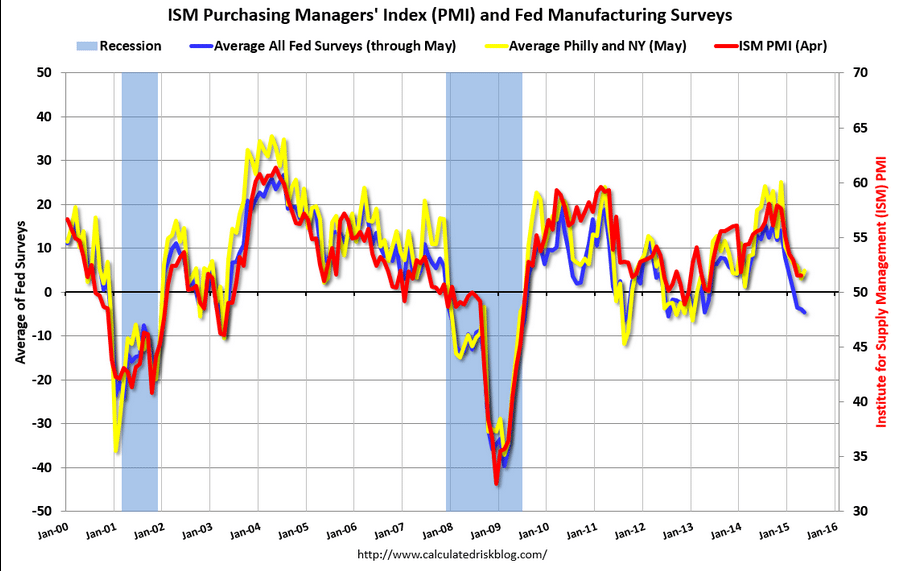
The regional Fed reports all point to another slow month for the manufacturing sector which is struggling with energy contraction, especially evident in this report, as well as weakness in exports.

Dallas Fed: Texas Manufacturing Activity Contracts Further

Texas factory activity declined again in May, according to business executives responding to the Texas Manufacturing Outlook Survey. … The general business activity index fell to -20.8 in May, its lowest reading since June 2009.

Labor market indicators reflected employment declines and shorter workweeks. The May employment index declined 10 points to -8.2, after rebounding slightly above zero last month. Twelve percent of firms reported net hiring, compared with 21 percent reporting net layoffs. The hours worked index fell from -5 to -11.6.

United States : Richmond Fed Manufacturing Index
er-5-26-8
Highlights
Regional Fed reports on the manufacturing sector continue to be soft with Richmond’s at only plus 1 for May following two prior months of declines. New orders, after three straight declines, did rise but only to plus 2. Backlog orders, however, remain deep in the negative column at minus 10.

Employment growth is down while shipments are in contraction for a 4th month. Price readings are flat except for wages which show a big 11-point gain to 20. Wage pressures are a trigger for an FOMC rate hike and this reading, though isolated, will get the attention of the hawks at the Fed.

First it was Empire State, then the Philly Fed, then Kansas City, all showing weakness this month and now including Richmond. Data from the Dallas Fed, also released this morning, is especially weak. The manufacturing sector is having a tough time gaining momentum, held down by weak exports and contraction in the energy sector.

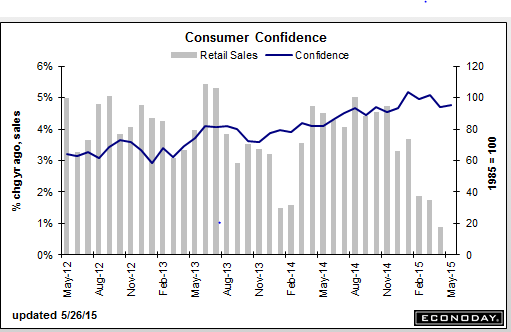
This is one man one vote, not one dollar one vote, and is another indicator where Q2 isn’t doing as well as Q1:
er-5-26-9