Again, just when you think you’ve heard it all:
*DJ Fed’s Duke: Financial Education Key To US Economy’s Health
*DJ Fed’s Duke Remarks Delivered At Boston Financial Education Conference

Again, just when you think you’ve heard it all:
*DJ Fed’s Duke: Financial Education Key To US Economy’s Health
*DJ Fed’s Duke Remarks Delivered At Boston Financial Education Conference
I’ve been letting most of the Fed commentary go by but had to post these:
*DJ Fisher: Need To Assure US Is Solvent, Cutting Back On Long-term Liabilities
*DJ Fed Fisher: Market Flooded With Too Much Money
Attached is a copy of a presentation that Warren delivered yesterday in Montreal.
We were extremely well received and Warren was a huge hit, mixing a concoction of high dose monetary economic realities with real life experiences and anecdotes from his long and lustrous career as a market wizard. The presentation was scheduled for 45 minutes but turned into 1hr20 minutes including Q&A.
Presentation link here.
So imagine the corn crop report comes out and it surprises on the upside at up 30%
What happens? The price of corn probably starts to fall. Commercial buyers back off, farmers rush to hedge, and, overall, players of all ilks try to reduce positions, get short, etc.
A few weeks later it’s further confirmed that the farmers are producing a massive bumper crop.
What happens? The same adjustments continue.
But what if that crop report was wrong? What if, in actual fact, there had been a crop failure? And market participants never do get that information?
What happens? Prices go down for a while as described above, but at some point they reverse, as sellers dry up, and as consumption overtakes actual supply price work their way higher, and then accelerate higher, even if no one ever actually figures out there was a crop failure.
QE is, in fact, a ‘crop failure’ for the dollar. The Fed’s shifting of securities out of the economy and replacing them with clearing balances removes interest income. And the lower rates from Fed policy also reduces interest paid to the economy by the US Treasury, which is a net payer of interest.
But the global markets mistakenly believed QE was producing a bumper crop for the dollar. They all believed, and some to the of panic, that the Fed was ‘printing money’ and flooding the world with dollars.
So what happened? The tripped overthemselves to rid them selves of dollars in every possible manner. Buying gold, silver, and the other commodities, buying stocks, selling dollars for most every other currency, selling tsy securities, etc. etc. etc. in what was, in most ways, all the same trade.
This went on for months, continually reinforced by the pervasive rhetoric that QE was ‘money printing’, and that the Fed was playing with fire and risking hyperinflation, with the US on the verge of suddenly/instantly becoming the next Greece and getting its funding cut off.
Not to mention Congress with it’s deficit reduction phobia.
So what’s happening now? While everyone still believes QE is a bumper crop phenomena, QE (and 0 rate policy in general) is none the less an ongoing crop failure, continuously removing $US net financial assets from the economy.
And so now that the speculators and portfolio shifters have run up prices of all they tripped over each other to buy, the anticipated growth in spending power-underlying aggregate demand growth needed to support those prices- isn’t there. And, to throw more water on the fire, the higher prices triggered supply side repsonse that have increased net supply along with a bit of ‘demand destruction’ as well.
Last week I suggested that higher crude prices were the last thing holding down the dollar, and that as crude started to fall I suggested its was all starting to reverse.
It’s now looking like it’s underway in earnest.
>
> (email exchange)
>
> On Fri, Apr 29, 2011 at 10:10 AM, Arthur Patten wrote:
>
> Warren, just came across this 2008 paper. Authors find that most of the volatility in
> standard inflation measures is due to relative price changes and that interest rates
> are positively correlated with inflation. On behalf of the authors, you’re welcome!
>
RELATIVE GOODS’ PRICES, PURE INFLATION, AND THE PHILLIPS CORRELATION
By Ricardo Reis and Mark W. Watson
August 2008
Department of Economics, Columbia University
Department of Economics and Woodrow Wilson School, Princeton University
Abstract (excerpts below): This paper uses a dynamic factor model for the quarterly changes in consumption goods’ prices to separate them into three independent components: idiosyncratic relative-price changes, a low-dimensional index of aggregate relative-price changes, and an index of equiproportional changes in all inflation rates, that we label “pure” inflation. The paper estimates the model on U.S. data since 1959, and it presents a simple structural model that relates the three components of price changes to fundamental economic shocks. We use the estimates of the pure inflation and aggregate relative-price components to answer two questions. First, what share of the variability of inflation is associated with each component, and how are they related to conventional measures of monetary policy and relative-price shocks? We find that pure inflation accounts for 15-20% of the variability in inflation while our aggregate relative-price index accounts most of the rest. Conventional measures of relative prices are strongly but far from perfectly correlated with our relative-price index; pure inflation is only weakly correlated with money growth rates, but more strongly correlated with nominal interest rates. Second, what drives the Phillips correlation between inflation and measures of real activity? We find that the Phillips correlation essentially disappears once we control for goods’ relative-price changes.
To which they respond ‘monetary policy works with a lag’
And to which I add, yes, it lags until the next fiscal adjustment kicks in.
;)
>
> But equities continue to peform relatively well.
>
Yes, they should be ok with any positive top line growth.
The risks that remain are a hard landing in China, a euro zone meltdown, and fiscal responsibility in the US and Japan.
I thought he did a AAA job within his paradigm.
The answers on the dollar were spot on- ultimately the dollar is worth what it can buy, so ‘low inflation’ is a strong dollar policy in the long term. It’s pretty much the purchasing power parity argument. Additionally, he said a strong economy helps the dollar, citing the capital inflow channel, probably a reference to China and other emerging market nations. And I might have added the fiscal tightening channel, as strong economies tend to cause federal deficits to fall via automatic fiscal stabilizers.
Interestingly, he did not mention specifically how higher oil prices, set by a foreign monopolist, continue to work against the dollar.
Nor how highly deflationary policies in other currencies tend to strengthen those currencies relative to the dollar.
And there was no mention of how portfolio shifting alters the dollar, which may be the largest driver currently.
Let me suggest, however, it would have been more nearly correct for him to have said the policy of low inflation and strong growth also happens to support the dollar, rather than imply a strong dollar was the policy variable.
He remains out of paradigm on the QE issue, still not realizing it’s entirely about price and not quantity, but that was to be expected.
The more dovish tone from the FOMC indicates some fundamental insecurity about the economy. Yes, they remain moderately optimistic, but probably continue to worry disproportionately about the downside risks. They see downside risks to demand everywhere from the euro zone and the UK, to Japan and China, and, though recognizing nothing of consequence has happened yet, they hear the fiscal sabre rattling from both the left and the right. And they see it’s unlikely for the housing channel to provide much support in the near future as it’s done in previous cycle.
Also, second chance to buy my 100oz gold bar at the current spot price of gold!
When I offered it for sale when gold was $1,200, no one wanted it so I still have it.
:)
Karim writes:
1) Extended period means a ‘couple of meetings’.
2) Q1 GDP weakness transitory (i.e., they didn’t alter the outlook for rest of f/cast period) due to
a. timing of defense outlays
b. timing of export shipments
c. weather
3) No fiscal measures that have been announced so far have altered their near-term outlook
4) Impact of Japan supply disruptions ‘moderate and temporary’
5) Strong and stable dollar in U.S. best interest
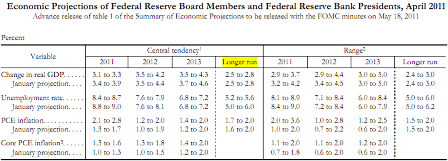
Also note that long term forecasts continue to assume ‘appropriate monetary policy’
This means the forecasts contain the assumption that the Fed can hit it’s long term goals for inflation and unemployment by adjusting ‘monetary policy’
In other words, the presumption of being able to hit their targets means the longer term forecasts are nothing more than the their targets.
This is in contrast with non Fed forecasters, who attempt to forecast actual results, which while they do incorporate assumptions about monetary policy, do not necessarily assume those Fed policy adjustments will be successful.
Karim writes:
LAST STATEMENT (MARCH) AND FORECASTS (JANUARY)
Federal Reserve Press Release
Release Date: March 15, 2011
For immediate release
Information received since the Federal Open Market Committee met in January suggests that the economic recovery is on a firmer footing, and overall conditions in the labor market appear to be improving gradually. Household spending and business investment in equipment and software continue to expand. However, investment in nonresidential structures is still weak, and the housing sector continues to be depressed. Commodity prices have risen significantly since the summer, and concerns about global supplies of crude oil have contributed to a sharp run-up in oil prices in recent weeks. Nonetheless, longer-term inflation expectations have remained stable, and measures of underlying inflation have been subdued.
Consistent with its statutory mandate, the Committee seeks to foster maximum employment and price stability. Currently, the unemployment rate remains elevated, and measures of underlying inflation continue to be somewhat low, relative to levels that the Committee judges to be consistent, over the longer run, with its dual mandate. The recent increases in the prices of energy and other commodities are currently putting upward pressure on inflation. The Committee expects these effects to be transitory, but it will pay close attention to the evolution of inflation and inflation expectations. The Committee continues to anticipate a gradual return to higher levels of resource utilization in a context of price stability.
To promote a stronger pace of economic recovery and to help ensure that inflation, over time, is at levels consistent with its mandate, the Committee decided today to continue expanding its holdings of securities as announced in November. In particular, the Committee is maintaining its existing policy of reinvesting principal payments from its securities holdings and intends to purchase $600 billion of longer-term Treasury securities by the end of the second quarter of 2011. The Committee will regularly review the pace of its securities purchases and the overall size of the asset-purchase program in light of incoming information and will adjust the program as needed to best foster maximum employment and price stability.
The Committee will maintain the target range for the federal funds rate at 0 to 1/4 percent and continues to anticipate that economic conditions, including low rates of resource utilization, subdued inflation trends, and stable inflation expectations, are likely to warrant exceptionally low levels for the federal funds rate for an extended period.
The Committee will continue to monitor the economic outlook and financial developments and will employ its policy tools as necessary to support the economic recovery and to help ensure that inflation, over time, is at levels consistent with its mandate.
Fisher headlines:
DJ Fed’s Fisher: Continued QE2 Buying Creating ‘Significant Risks’
The risks they envision do not exist.
DJ Fisher: Possible Fed Should Stop Short On QE2 Buying Goal
This would be the case only if they thought mortgage rates should be higher than otherwise.
DJ Fisher: Absolutely Opposed To Expanding QE2 Beyond Current Plan
Only if he is concerned mortgage rates are too low.
DJ Fisher: Firms May Soon Pass On Input Price Increases
This is about what’s called cost push inflation, vs demand pull inflation, and represents shifts in relative value.
DJ Fisher: See ‘Unpleasant’ Inflation Data On Horizon
DJ Fisher: More Fed Liquidity May Exacerbate Inflation Problem
What he calls inflation is not a function of what he calls Fed liquidity.
*DJ Fisher: See Signs Fed Bond Buying Creating Market Imbalances
Fed bond buying can cause financial market alterations but not imbalances.
There could in theory be real imbalances, for example a Fed induced housing shortage due to too low mortgage rates, but this is not the point he’s making.
DJ Fisher: US Government Must Get Fiscal House In Order
Here’s the big one. The FOMC seems to be on complete agreement that there is at least a long term deficit problem
They don’t seem to understand it’s about aggregate demand and not finance per se.
*DJ Fisher: Failure To Fix Deficit May Wound Economy’s Prospects
The make these kinds of statements without identifying the specific channels from deficit spending to the economy’s prospects. Nor are they ever questioned on this and pressed to identify said channels.
(The only one I’ve heard is the interest rate channel which always fails the test of close examination.)
This rhetoric from the FOMC is supportive of the position of both sides of the debate that the federal deficit is an immediate problem, with fears that the US could be the next Greece as proclaimed by Congressman Ryan appearing daily in the popular media, which elevates the real risk of proactive deficit reduction that could undermine the current modest levels of GDP growth and employment growth.