
Email exchange with Dan

On Thu, Apr 15, 2010 at 12:08 PM, wrote:
Hi Warren,

I must admit that your writing and thoughts have had a significant impact upon me. Interestingly—at least from where I sit—your Soft Currency Economics paper, which I have now read 5 or 6 times, has provided me with an odd peace of mind…not sure if that is a GOOD thing or not. :)

thanks!

KNOWING that—so long as trust and confidence in our fiat system remains—we are always able to mitigate, at least in some manner, the impact of global financial crises through the changing of numbers ‘upward’ in the accounts of men and of institutions, is somewhat akin, I’d imagine, to an alcoholic knowing that, no matter what, an endless supply of Johnny Walker Black always exists in his basement stash.

Actually, as long as we can enforce tax collections the currency will have value.

Problem is the currency can’t be eaten or drunk, so if the crops fail it won’t help much.
All we can insure is enough currency to pay people to work, not enough things to buy

OK, so maybe the analogy is a tad morose…but hence my funny feeling about my peace of mind.

So, my question of the week revolves around the U.S.’s apparent choice to monetize (again, if you will) the IMF coffers. I point to the following from Zerohedge:

“…As we reported a few days ago, the IMF massively expanded its last resort bailout facility (NAB) by half a trillion dollars, in which the US was given the lead role in bailing out every country that has recourse to IMF funding.

We buy SDR’s with dollars which the IMF then loans, so yes.

Yesterday, Ron Paul grilled Bernanke precisely on the nature of the expansion of the US role to the NAB: “The IMF has announced that they are going to open up the NAB which coincides with the crisis in Greece and Europe and how they are going to bailed out. The irony of this promise is that in the new arrangement Greece is going to put in $2.5 billion in. I think only a fiat monetary system worldwide can come up and have Greece help bail out Greece and be prepared to bail out even other countries.

Greece needs euros, so the IMF will sell SDR’s to the euro nations to fund Greece, not the US.

SDR’s are only bought with local currency.

But we are going from $10 to $105 billion… We are committing $105 billion to bailing out the various countries of the world, this does two thing I want to get your comments on one why does it coincide with Greece,

Coincidental.

what are they anticipating, why do they need $560 billion, do we have a lot more trouble, and when it comes to that time when we have to make this commitment, who pays for this, where does it come from?

Seems they anticipate more nations will be borrowing dollars from the IMF?

We buy them by crediting the IMF’s account at the Fed. If and when the IMF lends dollars we move those dollars from the IMF’s account to the account at the Fed for the borrowing nation.

Will this all come out of the printing press once again, as we are expected to bail out the world?

Short answer, yes. long answer above.

Are you in favor of this increase in the IMF funding and our additional commitment to $105 billion?”

No.

Bernanke, of course, washes his hands of any imminent dollar devaluation – it is all someone else’s responsibility to bail out life, the universe and everything else. Bernanke pushes on “I think in general having the IMF available to try to avoid crises is a good idea.”

2 problems. First the borrowers would probably be better off using local currency solutions rather than dollars, and second the IMF terms and conditions can and often do make things worse for the borrower.

Yet Paul pushes on “Where will this money come from? We are bankrupt too.” Indeed we are, but nobody cares – that is simply some other poor shumck’s problem…”

He’s flat out wrong about the US being bankrupt but that’s another story.

best,
warren

Warren, this strikes me as problematic. YES, we can add zeros to the end of accounts and thus ‘create’ more liquidity in the global economy. HOWEVER, at what point does the world choose not to believe that those numbers in those accounts have true value?

As long as we enforce dollar taxes the dollar will have value.

warren
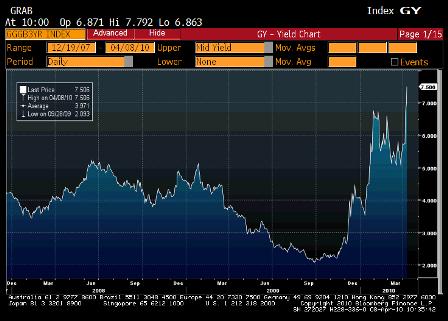
Upped my eurozone proposal to 20% of gdp

“”The backstop package for Greece and the ECB’s climb-down on its collateral rules set a bad precedent for other euro area states and make it more likely that the euro area degenerates into a zone of fiscal profligacy, currency weakness, and higher inflationary pressures over time,” said Joachim Fels, head of research, in a note to clients.””

I agree with the moral hazard theory, however I would counter by saying market is making it in practice impossible (even with backstops and colateral climbdown) for this endgame to occur given the cost/lack of funding it is offering to profligate states??

Yes, under current, limited thinking.

My proposal for the ECB to make an annual payment to each national gov. of 5% of total eurozone gdp on a per capita basis still looks to me as the only proposal that instantly repairs credit concerns and gets to all the problematic issues.

However there is no reason to not quadruple that original proposal to a 20% annual distribution.

Additionally, any nation not in compliance with ‘growth and stability’ requirements would risk losing its annual payment.

This would ensure that national debt to gdp ratios will fall for all member nations who comply with the rules.

It also means any nation who doesn’t comply with the rules risks losing its payment and will be ‘punished’ by markets
while nations in compliance getting their annual 20% payment will be secure in their ability to fund themselves.

Over time the 20% annual payment can be scaled down until it equals their self imposed rules for permissible annual deficits for the member nations as desired.

The 20% annual distribution does not foster increased government deficit spending, apart from removing the ramifications of default and risk of default. In contrast, it provides a powerful incentive to limit national govt deficits to desired levels.

This proposal dramatically strengthens the finances of the eurozone with incentives that are the reverse of what are called ‘moral hazard’ incentives.

This proposal is not yet even a consideration so until then anything short of a dramatic export boom where the rest of the world is willing to reduce its ‘savings’ of euro net financial assets by net spending on eurozone goods and services isn’t going to cut it.

>   
>   (email exchange)
>   
>   On Fri, Apr 16, 2010 at 7:44 AM, wrote:
>   
>   Talked to an ECB guy about this proposal. He says ECB will NEVER agree. Says they can’t
>   by law do what you are proposing as he claims it is “monetising” the debt and will be
>   ”inflationary”.
>   

That’s what happens when no one in charge and no one in the medial understands actual monetary operations.

>   
>   Down we go!
>   

The greece market is essentially shut. A new wave of stops-out

Greece dragging other peripherals weaker by 5-10 bps
Small bull steepening in swaps, 2s30s 1-1.5 steeper

Subject: The greece market is essentially shut. A new wave of stops-out

The greece market is essentially shut. A new wave of stops-out
getting triggered today in Greece. The tickets are all small
and electronic but all one way. The market is very illiquid
even in b/marks. In the HDAT the on the runs were quoted
in tiny at start of day now there is nothing – last looked like

GGB 4.3 03/12 (644.1bps vs core, +76.0)
GGB 6.1 08/15 (570.0bps vs core, +52.5)
GGB 6.25 6/20 (428.1bps vs core, +21.0)
GGB 4.6 09/40 (330.6bps vs core, +12.7)

the linker 2.3 30 is trading with 4points bid-offer now.

European Retail Sales Decline Most in Nine Months

‘market forces’ are driving national deficits higher via automatic stabilizers which drives the euro lower to the point exports rise sufficiently to turn the tide, but that needs to happen before the rising deficits result in defaults.

On Thu, Apr 8, 2010 at 6:04 AM, La-Toya Elizee wrote:

European Retail Sales Decline Most in Nine Months

Revamped ECB Lending Rules May Cause Greece Pain

German Factory Orders Unchanged After January Jump

French Trade Deficit Widened in February on Imports

Capital flight squeezes Greek banks

Italy needs deep reform, say employers

Spain’s Industrial Output Falls More Than Expected in February

Greek Banks Plead for More Aid in Debt Crisis

It’s all falling into place with the austerity measures taking their toll on the financial equity that supports the credit structure in a euro wide banking system that does not have credible deposit insurance.

Greek banks plead for more aid in debt crisis

By George Georgiopoulos and Harry Papachristou

Apr. 7 (Reuters) — Greek banks, hit by a series of credit rating downgrades linked to the country’s debt crisis, have asked the government for more financial support, Finance Minister George Papaconstantinou said on Wednesday.

“The banks have asked to use the remaining funds of the support plan,” he told reporters, referring to a package first agreed by the previous conservative government in 2008.

About 17 billion euros ($22.72 billion), mainly in state guarantees, remain in the 28 billion euro support scheme, launched to help Greek lenders cope with the global credit crisis.

The Central Bank of Greece said non-performing loans in the banking system rose further in the last quarter of 2009, bringing the full-year ratio to 7.7 percent.

The banks’ plea for extra help highlighted the problems facing the entire Greek economy, which is expected to contract by at least 2 percent this year, partly as a result of austerity measures imposed to slash a huge budget deficit.

IMF officials began talks in Athens on Wednesday on implementing the austerity plan, just as the latest market jitters over Greece’s ability to manage its debt mountain eased slightly, despite uncertainty over a euro zone rescue plan.

ECB rate hike discussion will compound funding issues

ECB’s Liikanen Says Interest Rates Won’t Stay Low

By Diana ben-Aaron

March 29 (Bloomberg) — European Central Bank Governing Council member Erkki Liikanen said interest rates won’t stay at the current level indefinitely, Maaseudun Tulevaisuus reported, citing an interview.

While low rates have eased the economic slowdown, households and businesses shouldn’t count on them forever, Liikanen was quoted as saying by the Helsinki-based newspaper. He declined to say when or by how much rates would increase.

“We decide the key central bank rate in the ECB council according to the requirements of the economic situation,” Liikanen said.

Rasmussen polls

65% Now Hold Populist, or Mainstream, Views

55% Favor Repeal of Health Care Bill

I find his polls as good as any. He shows 54% favor repeal of the new health care law, with 70% of seniors against the Medicare cuts.

The lack of understanding of the monetary system is taking an increasing both economically, politically and socially.

With almost 20% of the workforce unable to find full time work, and near record low capacity utilization in general, our leaders saw fit to raise taxes and cut spending which will lower demand and undermine their political careers to ‘pay for’ a very modest spending increase of about $100 billion a year, and with delays, of the perhaps additional $1 trillion of fiscal adjustment needed to get us back to full employment in a reasonable time frame.

Also, part of the rise in costs goes to insurance reserves which are a demand leakage.

The politics get uglier by the day, and from watching the news over the weekend the loudest health care protest seems to be over the expense and how it will add to the size of the deficit. Seems this means more ‘fiscal responsibility’ is on the way, including letting the tax cuts expire next year and maybe even a VAT which is an absurdity under any circumstances, apart from a desire to cut consumption.

Add to that the reality of the eurozone actually offering Greece nothing of value, opening the way for wider credit spreads spreading to the entire eurozone.
It also looks like their combined deficits are now large enough for the added non govt financial assets to now be driving down the euro independent of the credit issues. This continues until exports increase sufficiently for the automatic stabilizers to tighten fiscal balances. They aren’t anywhere near there yet.
Additionally, the dollar index chart is beginning to pick up a bid from commodities traders as well.

Text of Greek Deal

As before, this is in fact another statement that indicates no checks are to be written.

The purpose is probably the hope that it be read as a statement of support which will facilitate continued funding of Greek debt.

It is a clear statement that no funding is available until Greece fails to find funding elsewhere. However, understood but unstated, is that the process of finding funding is necessarily that of price discovery. Greece, like all borrowers, simply offers securities at ever higher rates until it finds the needed buyers. Failure, in theory, is defined as the rate reaching infinity with no buyers. At that time, the euro members would step in with a loan offer at a non concessional rate which would then presumably be infinity.

This makes no sense at all, of course. The statement is in fact a statement that Greece must first drive rates to infinity before euro zone member loans are available. In other words, it’s a statement that says Greece is on its own, and that they will stand by without taking action as observers of the standard market default process of Greek funding rates going into double and then triple digits as happens to all failed borrowers of externally managed currencies, including nations with fixed exchange rates.

“In this context, Euro area member states reaffirm their
willingness to take determined and coordinated action, if
needed,
to safeguard financial stability in the euro area as a
whole, as decided the 11th of February.

As part of a package involving substantial International
Monetary Fund financing and a majority of European financing,
Euro area member states, are ready to contribute to coordinated
bilateral loans.

This mechanism, complementing International Monetary Fund
financing, has to be considered ultima ratio, meaning in
particular that market financing is insufficient.
Any
disbursement on the bilateral loans would be decided by the euro
area member states by unanimity subject to strong conditionality
and based on an assessment by the European Commission and the
European Central Bank. We expect Euro-Member states to
participate on the basis of their respective ECB capital key.

The objective of this mechanism will not be to provide
financing at average euro area interest rates, but to set
incentives to return to market financing as soon as possible by
risk adequate pricing. Interest rates will be non-concessional,
i.e. not contain any subsidy element. Decisions under this
mechanism will be taken in full consistency with the Treaty
framework and national laws.”

backsliding on Greece

Merkel says aid for Greece not issue at EU summit

March. 21 (CNBC) —German Chancellor Angela Merkel says Greece does not need any financial help and that EU leaders should not make aid for the indebted country an issue at their summit in Brussels next week

Doesn’t get any clearer than that.

The moral hazard test is on.

If the eurozone uses uses its banks to buy each other’s debt behind the scenes or makes some other arrangements where financing ceases to be an issue, it may trigger a race to the bottom with regards to deficits and the euro, as the game will be ‘the national govt with the largest deficit wins.’ This is not a desired outcome.

But if they don’t move to ease financing imbalances, defaults will have the opposite, deflationary effects, and probably cause a freeze in the entire payments system.