ISM/Bernanke

I tend to agree with Karim and Fed Chairman Bernanke.
Modestly improving GDP growth with unemployment coming down very gradually until a consumer credit expansion takes hold.

Good for stocks, not so good for most of the people still struggling to survive, as the Obama administration continues to preside over what might be the largest transfer of wealth from bottom to top in the history of the world.

And no credible energy policy. We are completely at the mercy of the Saudis who can unilaterally hike prices any time they feel like it.


Karim writes:

  • ISM shows lift from inventories likely has run its course as inventory component crossed back above 50
  • But customer inventories remain low and employment index rises to second highest level since 2004
  • Going forward, private demand, not inventory rebuilding will drive manufacturing
  • Bernanke addressed this today (below) and seems to maintain his above consensus growth forecast


July June
Index 55.5 56.2
Prices paid 57.5 57.0
Production 57.0 61.4
New Orders 53.5 58.5
Inventories 50.2 45.8
Customer inventories 39.0 38.0
Employment 58.6 57.8
New export orders 56.5 56.0
Imports 52.5 56.5
  • “Business in July was strong, the best month since October 2008.” (Fabricated Metal Products)
  • “Slow economy has killed sales for new equipment orders.” (Machinery)
  • “Quoting activity and sales are slow, and backlog is dropping.” (Computer & Electronic Products)
  • “Business continues to be sluggish and has fallen slightly as the economic ills continue.” (Nonmetallic Mineral Products)
  • “Retailers are still unwilling to gamble on inventory.” (Printing & Related Support Activities)

Bernanke

While the support to economic activity from stimulative fiscal policies and firms’ restocking of their inventories will diminish over time, rising demand from households and businesses should help sustain growth. In particular, in the household sector, growth in real consumer spending seems likely to pick up in coming quarters from its recent modest pace, supported by gains in income and improving credit conditions. In the business sector, investment in equipment and software has been increasing rapidly, in part as a result of the deferral of capital outlays during the downturn and the need of many businesses to replace aging equipment. At the same time, rising U.S. exports, reflecting the expansion of the global economy and the recovery of world trade, have helped foster growth in the U.S. manufacturing sector.


To be sure, notable restraints on the recovery persist. The housing market has remained weak, with the overhang of vacant or foreclosed houses weighing on home prices and new construction. Similarly, poor economic fundamentals and tight credit are holding back investment in nonresidential structures, such as office buildings, hotels, and shopping malls.

State tax revenue increasing

This is another sign of growth creeping in.

The States will be fine with a bit more GDP growth, and if they maintain their equity allocations their pension funds will all recover when equity prices double over the next few years.

With strong productivity growth throughout the recession, there is a lot of catch up down the road as the ongoing 8%+ deficits fill the spending gaps and restore the financial equity that will also support a subsequent credit boom that begins with the ‘get a job buy a car’ accelerator.

Unfortunately we still haven’t addressed our energy consumption issues, and we remain highly vulnerable to arbitrary Saudi price hiking.

Nor have we taken sufficient measures to be able to grow GDP without a substantial corresponding increase in energy consumption in general.

But that’s another story, at least for the near term.


Tax Revenue Creeps Up, but Can’t Fill State Budget Gaps

July 27 (Reuters) – State tax revenue is improving, but only slightly, and may not be enough to end steep spending cuts or replace the loss of assistance from the federal stimulus plan that expires in December, according to a report Tuesday.

The National Conference of State Legislatures said states faced a collective budget gap of $83.9 billion when creating their budgets for fiscal 2011, which for most began on July 1.

Officials surveyed by the group, which represents state lawmakers, said revenue was beginning to pick up or at least slow its rate of decline. Nearly every state expects tax collections this fiscal year to surpass last year’s.

“For the first time in a long time we’re seeing some slight improvement in the state revenue situation,” Corina Eckl, the NCSL’s fiscal program director, said in a statement accompanying the report. “But glimmers of improvement are tarnished by looming problems.”

Claims/DGO

Still feels like modest GDP growth, positive but not enough to make much of a dent in unemployment, until the ‘hand off’ to growth from credit expansion from some other sector, which could be a while.

Risks remain external.

China has been a strong first half weak second half story for a while, and a weak second half after an only ok first half this year can be a problem.

Fiscal tightening around the world can also keep a lid on things.

And I still have that nagging feeling that a 0 rate policy requires higher budget deficits to sustain full employment than a policy of higher rates. That should be a good thing- means taxes can be that much lower- but with a govt that doesn’t understand its own monetary system and keeps fiscal too tight it’s a bad thing.

All seems to point to more of an L shaped, Japan like recovery than a V.


Karim writes:

Constructive data:

* Initial claims down 19k to 457k; Labor dept cited processing issues around Memorial Day holiday for elevated readings past couple of weeks

MKT NEWS:”A Labor analyst said the surge in the previous two weeks was apparently due to technical factors relating to the way new claims were distributed over the holiday and post-holiday weeks and to a pattern that departed from what the seasonal factors were prepared for.”

* Number receiving extended benefits at lowest since last December, suggesting some easing in ability to find a job

Durable goods orders ex-aircraft and defense up 2.1% last month and up 29% past 3mths at an annualized rate; Capex was the sector was the Fed was most upbeat on in their statement yesterday

Shipments ex-aircraft and defense up 1.6% m/m and 16.7% on a 3mth annualized rate

G20 rules out fiscal expansion

G20 Says Expansionary Fiscal Policy Not Sustainable

The G20 has dropped its support for fiscal expansion. The deficit hawks are prevailing. But why is that? We all either know or should know that operationally Federal spending is not constrained by revenues, as Chairman Bernanke stated last year, when asked on ’60 Minutes’ by Scott Pelley where the funds given to the banks came from :

“…we simply use the computer to mark up the size of the account that they have with the Fed.”

We know that when the Fed spends on behalf of the Treasury it simply credits a member bank or foreign government’s reserve account at the Fed.

We know that a US Treasury security is a credit balance in a securities account, also at the Fed.

We know that buying a Treasury security means US dollars (numbers on the Fed’s spreadsheet) shift from a Fed reserve account to a Fed securities account, which adds to the ‘national debt.’

We know that government deficits = ‘non government’ saving (net dollar financial assets) to the penny, as a matter of national income accounting.

And we know paying off the Treasury securities happens continuously when Treasury securities mature and the Fed simply shifts those US dollars from the securities account back to a Fed reserve account (including the interest).

So why should we care if US dollars are in a Fed reserve account or a Fed securities account?

We should not, yet most still do.

There are two featured sides to the argument, pro and con, deficit hawks and deficit doves. The deficit hawks aren’t the problem. They have no argument that makes any sense as a point of simple monetary operations. There is no such thing as the Federal Government running out of money, being dependent on foreigners or anyone else for funding to be able to spend, and the US is not the next Greece.

The problem is the deficit doves featured by the media don’t understand actual monetary operations and reserve accounting, and so they take the same ‘fundamentally wrong’ positions as the deficit hawks. The difference is nothing more than timing and degree. In effect, the media is showing only one side of the argument.

To be a credible media deficit dove, you agree deficits are ‘bad’ but in the long term, arguing that in the short term we need tax cuts or spending increases now, and deficit reduction later. You agree that deficits can be too high, but argue they have been higher, particularly in World War II, so current levels should be easily manageable, further agreeing there is a level that could not be manageable. You agree markets could be ‘unfriendly’ and a lack of confidence could translate into far higher interest rates, but argue that the current low rates for Treasury securities are the markets telling us that currently they do have confidence in the US and they are eager to fund current deficits. You agree that ‘bang for the buck’ matters and support tax cuts and spending increases based on higher ‘multipliers.’

The two ‘sides of the story’ are in fact on the same side, just with differing degrees. The media does not feature the true deficit dove story. Nor do any of the true doves have even a small piece of the administration’s ear, or the ear of anyone in Congress willing to speak out. There are maybe a hundred of them, including many senior economics professors. The nagging question is why this professional, highly educated, highly experienced collection of true doves, who happen to be correct and could get us back to full employment and prosperity in reasonably short order, does not get a fair hearing.

The answer may be credentials. My BA in Economics from the University of Connecticut in 1971 doesn’t cut it, nor the fact that the very large fund I managed was the highest rated firm for the time I ran it. And my net worth never getting anywhere near a billion hasn’t helped either. Seems billionaires get celebrity status and airtime for just about anything they want to say.

The same is true of the Economics professors who’ve got it right. Without being from and at the usual ‘top tier’ schools none can even get published in main stream economics journals, where submissions featuring obvious accounting realities are routinely rejected. In fact, any economist who states accounting identities and operational realities such as ‘deficits = savings’ or ‘loans create deposits’ or ‘Federal spending is not constrained by revenues’ is immediately labeled ‘heterodox’ and unworthy of serious mainstream consideration. Even the late Wynne Godley, who did have reasonable credentials as head of Cambridge Economics, and was the number one UK economics forecaster, was labeled ‘unorthodox’ because his mathematical models featured the deficits = savings accounting identity.

The breakthrough could happen at any time, in addition to economists at the ‘right schools’ or right financial sector firms, there are government officials with sufficient credentials to lead the breakthrough, including the head of the CBO and OMB, the Treasury Secretary and Fed Chairman, as well as former Fed officials, particularly from monetary operations.

Unfortunately Treasury Secretary Geithner, a potential hero due to the celebrity of his office, and the rest of the G20 are acting out the deficit hawk position, acting as if they do indeed believe the US has run out of money, is dependent on its creditors, and could be the next Greece. They speak as if they have no idea that the euro nations operate within a unique institutional structure that puts them in a ‘revenue constrained’ financial position similar to the US States, but with nothing equivalent to the US Treasury to run the countercyclical deficits for them. They speak as if they have no idea that the US, UK, Japan, and others with ‘normal’ central governments taxes function to regulate aggregate demand, and not to raise revenue per se. They act as if they don’t realize they can immediately make the fiscal adjustments- cut taxes and/or increase government spending- that will restore aggregate demand, employment, and output. In short, they act as if they were all still on the gold standard, an institutional arrangement where indeed government spending was constrained by revenues, and, as a consequence, the world witnessed repetitive, devastating deflationary depressions, far worse than what we’ve seen so far in this cycle.

The results of unnecessarily allowing a universal lack of aggregate demand to persist are already tragic, and if policy continues along the line of this weekend’s G20 results no relief is in sight, and it could all get a whole lot worse.

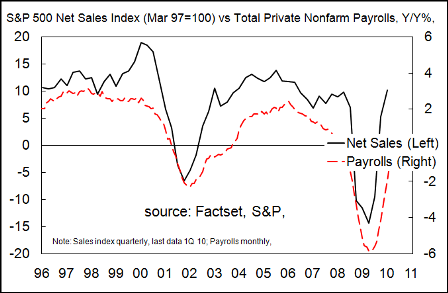
Service Sector ISM//NFP


Karim writes:

Similar to manufacturing, service sector ISM stabilizing at high levels; Large increase in backlogs also bodes well for future activity.

With employment index now also crossing the 50 level, adds to upside potential in NFP tomorrow; look for headline NFP up ~600k; with ex-census up ~225k.


May April
PMI 55.4 55.4
Activity 61.1 60.3
Prices Paid 60.6 64.7
New Orders 57.1 58.2
Backlogs 56.0 49.5
Employment 50.4 49.5
Export Orders 53.5 57.0
Imports 56.5 56.5

Anecdotes below seem to bode well for corporate profits: demand improving and costs controlled.

  • “Our business continues to grow. We are significantly above last year’s pace.” (Information)
  • “Business is steady right now — not the normal spring for construction, but improving.” (Construction)
  • “Outlook is still generally flat for the remainder of this year, with signs that orders and activity will be picking up.” (Professional, Scientific & Technical Services)
  • “Continuing our pattern of cautious optimism. Consumers appear to be coming out of hibernation and willing to spend. We expect that if this trend can remain solid, we’ll in turn spend additional dollars to support and drive sales activities.” (Retail Trade)
  • “Customers’ activity is improving in some parts of the country.” (Wholesale Trade)
  • “We continue to ‘staff to volume’ in order to control labor and supply costs.”(Health Care & Social Assistance)

Yes, looking like we’re modestly improving domestically with the risks mainly external including spillover weakness form China and the euro zone.

Export growth down a touch but not serious to this point.

latest Senatorial release

The JOBS candidate Warren Mosler announces his
Million Dollar Challenge to Senate CANDIDATES

Middletown, Conn. (June 2, 2010) – Warren Mosler, Independent candidate for US Senate, knows for a fact that, operationally, there is no such thing as the US government running out of dollars, being dependent on foreign borrowing, or potentially facing a solvency crisis like Greece, and he has pledged $1 million of his own money to any of his Senate opponents on the ballot who can prove him wrong.

“Those concerns are due to pure fear mongering from supposed experts. They have no factual basis, and they have become the true obstacles to the return of full employment and prosperity” said Mosler, who added “and there is absolutely no financial reason to cut Social Security or Medicare benefits.”

Many have also argued that the nation’s growing debt rules out further tax reductions, but Mosler says those assertions are blatantly untrue, proposing a full payroll tax (FICA) holiday for employees and employers that will add over $300/mo to the take home pay of someone earning $50,000 a year. This plan and similar initiatives will reintroduce the capital the economy needs to prosper and grow.

“We lost over 8 million private sector jobs primarily for one reason- sales collapsed,” said Mosler. “My full payroll tax (FICA) holiday for employees and employers boosts take home pay and helps lower prices to quickly restore those lost sales which brings back the lost jobs, fixing the economy the right way, the American way, from the bottom up.”

In the midst of our social and economic calamity, with the Republican and Democratic candidates offering no viable plans to restore full employment, Mosler, an expert in monetary operations, is uniquely qualified to quickly move America back to full employment and prosperity. He knows the American economy works best when people working for a living have enough take home pay to buy the goods and services they produce, with business competing for those consumer dollars.

Mosler congratulated candidates McMahon and Blumenthal on their convention victories, and looks forward to public debate on the urgent economic issues facing our nation and the world.

“We have seen Republicans and Democrats overseeing the devastatingly tragic loss of over 8 million jobs. And while lower income people working for a living struggle to survive, elites who contributed to our problems rake in billions from bailouts,” said Mosler. “It’s time the government focuses on getting its hand out of the pocket of the hard working Americans who make this country great.”

See www.moslerforsenate.com for details of Mosler’s ‘Right on the Money’ proposals and his $1 Million Challenge.

EU News

Pretty much all bad:

European Unemployment Unexpectedly Increases to 12-Year High

Trichet Says Fiscal Sustainability Fosters Confidence, Growth

By that he means the austerity measures/deficit cutting which only makes things worse.

Trichet Says ECB ‘Fiercely Independent,’ Stable Prices Mandate

Just doing his job.

Trichet sees need for ‘budgetary federation’

He’s sees this as a watchdog to keep deficits down.

Trichet Says ECB Won’t Tolerate Budget Indiscipline Any Longer

He’s concerned about the secondary mkt purchases of greek debt meaning even this very modest support is in question.

ECB’s Noyer Says Rating Firms Aggravating Crisis

Weber Says ECB Bond Purchases Musn’t Exceed ‘Tight Limits’

More talk on limiting ECB purchases.

ECB’s Stark Says Bank May Start Withdrawing Liquidity in July

Doesn’t matter but indicates their attitude.

Nowotny Sees No Risk of Double-Dip Recession due to Austerity

That’s the entire source of the risk of a double dip recession.

Bank of Italy: EU euro defense package can’t last

And calls for a return to the 3% deficit limits.

ECB: Banks Will Suffer Considerable Loan Losses In 2010, 2011

Bank deposits are insured only by the national govts that are already seeing their funding threatened.

ECB warns of ‘hazardous contagion’

True, but they have their channels totally confused.

Trichet Says Second-Quarter Growth May Be Better Than Expected

European Manufacturing Growth Slowed More Than Estimated in May

Germans, ECB Spar Over Bond Plan

After Debt Crisis, New Tension Between ECB, Germany

Survey suggests Germans are unhappy with Merkel

Merkel Says Budget Deficit Looks ‘Moderate’ Versus Spain, U.K.

Still doesn’t get how the UK comp isn’t applicable.

Hypo Real Estate gets more loan guarantees

Spain presses for labor market reform deal

Fitch downgrades Spain’s credit rating

European Loans Post First Annual Increase in Eight Months

German Unemployment Falls Twice as Much as Forecast

German Retail Sales Rose in April on Declining Unemployment

French New Car Sales Fall 12% in May, After 12 Monthly Gains

Italian Unemployment Climbs as Recovery Fails to Create Jobs

Madness continues

>   
>   (email exchange)
>   
>   On Thu, May 27, 2010 at 6:48 PM, Marshall wrote:
>   


UNEMPLOYMENT EXTENSION HUNG UP – Even after Democratic leadership scaled back its bill to reauthorize several domestic aid programs, reducing its impact on the federal budget deficit by $50 billion, conservative rank-and-file Democrats remain in their perpetual state of unhappiness. House leadership met shortly before press time to find a way forward, but all paths have major obstacles. Primarily, this one: Senate Finance Committee Chair Max Baucus tells HuffPost that he’s working out an agreement on what amendments could be offered by Republicans. But it comes at a high cost. The House had been planning to pass its bill and head out of town for the Memorial Day break. If any changes are made to the bill, it could languish over the break as programs and benefits expire. “We’re ready. Soon as the House sends it over. We will pass it,” Baucus said. “Gotta work out an agreement with the Republicans on votes. We’re going to have to work out some accommodation on amendments.”

Asked if the House would vote tonight, a brusque Steny Hoyer, leaving the leadership meeting for a floor vote, said: “We are STILL talking!” Chris Van Hollen said they were discussing possible changes with their members and could finish up before the break — but he didn’t say they’d vote tonight. Sandy Levin’s been working on Blue Dogs. Pelosi worked on Jared Polis, who’s been unhappy with the hedge fund loophole fix. The House is antsy to leave town. “Let’s go!” two separate members of Congress shouted on the floor, at least one of them a Democrat. “People are really tired,” one Dem told HuffPost. “What you’re seeing is the success of stubbornness.”

>   
>   CHANGE YOU CAN BELIEVE IN!!!
>   

And, of course, ironically cutting the benefits only adds to unemployment as it removes demand.

Instead, they should be suspending fica taxes to restore sales and paid work.