
Consumer credit up, Friday update

It doesn’t look to me like anything particularly bad has actually yet happened to the US economy.

The federal deficit is chugging along at maybe 9% of US GDP, supporting income and adding to savings by exactly that much, so a collapse in aggregate demand, while not impossible, is highly unlikely.

After recent downward revisions, that sent shock waves through the markets, so far this year GDP has grown by .4% in Q1 and 1.2% in Q2, with Q3 now revised down to maybe 2.0%. Looks to me like it’s been increasing, albeit very slowly. And today’s employment report shows much the same- modest improvement in an economy that’s growing enough to add a few jobs, but not enough to keep up with productivity growth and labor force growth, as labor participation rates fell to a new low for the cycle.

And, as previously discussed, looks to me like H1 demonstrated that corps can make decent returns with very little GDP growth, so even modestly better Q3 GDP can mean modestly better corp profits. Not to mention the high unemployment and decent productivity gains keeping unit labor costs low.

Lower crude oil and gasoline profits will hurt some corps, but should help others more than that, as consumers have more to spend on other things, and the corps with lower profits won’t cut their actual spending and so won’t reduce aggregate demand.

This is the reverse of what happened in the recent run up of gasoline prices.

Japan should be doing better as well as they recover from the shock of the earthquake.

Yes, there are risks, like the looming US govt spending cuts to be debated in November, but that’s too far in advance for today’s markets to discount.

A China hard landing will bring commodity prices down further, hurting some stocks but, again, helping consumers.

A euro zone meltdown would be an extreme negative, but, once again, the ECB has offered to write the check which, operationally, they can do without limit as needed. So markets will likely assume they will write the check and act accordingly.

A strong dollar is more a risk to valuations than to employment and output, and falling import prices are very dollar friendly, as is continuing a fiscal balance that constrains aggregate demand to the extent evidenced by the unemployment and labor force participation rates. And Japan’s dollar buying is a sign of the times. With US demand weakening, foreign nations are swayed by politically influential exporters who do not want to let their currency appreciate and risk losing market share.

The Fed’s reaction function includes unemployment and prices, but not corporate earnings per se. It’s failing on it’s unemployment mandate, and now with commodity prices coming down it’s undoubtedly reconcerned about failing on it’s price stability mandate as well, particularly with a Fed chairman who sees the risks as asymmetrical. That is, he believes they can deal with inflation, but that deflation is more problematic.

So with equity prices a function of earnings and not a function of GDP per se, as well as function of interest rates, current PE’s look a lot more attractive than they did before the sell off, and nothing bad has happened to Q3 earnings forecasts, where real GDP remains forecast higher than Q2.

So from here, seems to me both bonds and stocks could do ok, as a consequence of weak but positive GDP that’s enough to support corporate earnings growth, but not nearly enough to threaten Fed hikes.

Consumer borrowing up in June by most in 4 years

By Martin Crutsinger

May 25 (Bloomberg) — Americans borrowed more money in June than during any other month in nearly four years, relying on credit cards and loans to help get through a difficult economic stretch.

The Federal Reserve said Friday that consumers increased their borrowing by $15.5 billion in June. That’s the largest one-month gain since August 2007. And it is three times the amount that consumers borrowed in May.

The category that measures credit card use increased by $5.2 billion — the most for a single month since March 2008 and only the third gain since the financial crisis. A category that includes auto loans rose by $10.3 billion, the most since February.

Total consumer borrowing rose to a seasonally adjusted annual level of $2.45 trillion. That was 2.1 percent higher than the nearly four-year low of $2.39 trillion hit in September.
Payrolls

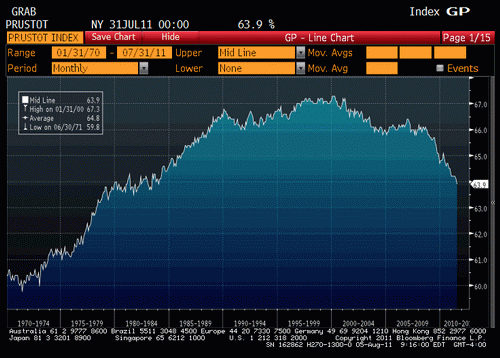
The labor force participation rate is falling roughly in line with productivity resulting in what I’ve been describing as an L shaped recovery as we remain grossly overtaxed for the size govt and credit conditions we currently have.

Editors note: this was originally posted without crediting Karim as the author of the comments below.

Karim writes:

Better than feared and most importantly, lending some consistency with other labor market indicators (claims, ADP, ISM).
Much of the details reversing last month’s across the board weakness.

  • Payrolls rise 117k: Private payrolls rise 154k
  • Net revisions +56k (June report revised from 18k to 46k)
  • Unemployment rate drops from 9.2% to 9.1%
  • Avg hourly earnings rise 0.4% (prior 2mths 0.0% and 0.4%)
  • Hours index rises 0.1% (-0.2% last mth)
  • Median duration of unemployment falls from 22.5 weeks to 21.2 weeks
  • U6 measure falls from 16.2% to 16.1%
  • Part rate falls from 64.1% to 63.9%
  • Diffusion index rises from 56.6 to 58.6 with the following industries all showing net change of 10k or more jobs on the month
  • Education, Construction, Manufacturing, Retail, Finance, Temp help

Claims in low 400s and ISM employment in low-to-mid 50s consistent with private payrolls in 100-150k/mth range.
Also with consistent with Fed forecast of modestly above trend gwth and slow decline in the unemployment rate.

A risk to the outlook going forward is the ‘financial accelerator’ factor as coined by Bernanke and Mishkin. Growth in H1 was at least associated with supportive financial conditions (basically credit spreads and equities). Too many more days like yesterday will offset whatever comfort they get from reports like today’s.

chart

More on Jobless Claims

From Goldman, this talk is making the rounds:

More on Jobless Claims

Some commentators are attributing the improvement in weekly claims to the fact that this year, the retooling of Auto plants have occurred over one week as opposed as the usual two weeks. This will imply a number in the region of 430,000 for next week.

President Obama and Chairman Bernanke believe in the Confidence Fairy

“RENACCI: I know some people have asked in previous questions, but do you put uncertainty as a — as a concern? I mean, again, being a business owner in the past, uncertainty will cause a lockup. And we could talk about, you know, the government cutting costs and cutting jobs, but the private sector small-business owners create almost 67 percent of our jobs. We have to give them the certainty so they can create jobs.

BERNANKE: Well, you’re not interested in my Ph.D. thesis of 32 years ago, but it was entitled, “Uncertainty and Investment,” and it was about how uncertainty can reduce investment spending, and I believe that, but there are many kinds of uncertainty. There’s the uncertainty about regulation and those sorts of things. But there’s also uncertainty about whether this is a durable recovery.

People don’t know whether to invest or to hire because they don’t know whether this is — whether the recovery is going to continue.

So I think part of what we can do — obviously, we want to address the regulatory, trade, tax environment, absolutely fiscal environment. We also want to do whatever we can to make the economy grow faster and make people more confident.

I think we’ll see a dynamic going forward If, in fact, the economy begins to pick up some, I think confidence will improve because people will have more certainty about the sense that this will be a durable recovery. I think that’s a very important thing to be looking for.”

Economy Faces a Jolt as Benefit Checks Run Out

When there is a lack of aggregate demand due to high ‘savings desires’ as the unemployed take jobs when benefits expire, it just means someone else loses a job, and then some, as govt deficit spending falls as well, further reducing aggregate demand. It also serves to drive down wages, as per the latest jobs report.

Economy Faces a Jolt as Benefit Checks Run Out

By Motoko Rich

July 11 (NYT) — An extraordinary amount of personal income is coming directly from the government.

Close to $2 of every $10 that went into Americans’ wallets last year were payments like jobless benefits, food stamps, Social Security and disability, according to an analysis by Moody’s Analytics. In states hit hard by the downturn, like Arizona, Florida, Michigan and Ohio, residents derived even more of their income from the government.

By the end of this year, however, many of those dollars are going to disappear, with the expiration of extended benefits intended to help people cope with the lingering effects of the recession. Moody’s Analytics estimates $37 billion will be drained from the nation’s pocketbooks this year.

In terms of economic impact, that is slightly less than the spending cuts Congress enacted to keep the government financed through September, averting a shutdown.

Unless hiring picks up sharply to compensate, economists fear that the lost income will further crimp consumer spending and act as a drag on a recovery that is still quite fragile. Among the other supports that are slipping away are federal aid to the states, the Federal Reserve’s program to pump money into the economy and the payroll tax cut, scheduled to expire at the end of the year.

“If we don’t get more job growth and gains in wages and salaries, then consumers just aren’t going to have the firepower to spend, and the economy is going to weaken,” said Mark Zandi, chief economist of Moody’s Analytics, a macroeconomic consulting firm.

Job growth has remained elusive. There are 4.6 unemployed workers for every opening, according to the Labor Department, and Friday’s unemployment report showed that employers added an anemic 18,000 jobs in June.

In Arizona, where there are 10 job seekers for every opening, 45,000 people could lose benefits by the end of the year, according to estimates from the state Department of Economic Security. Yet employers in the state have added just 4,000 jobs over the last 12 months.

Some other states will also feel a disproportionate loss of income unless hiring revives. In Florida, where nearly 476,000 people are collecting unemployment benefits, employers have added only 11,200 jobs in the last year. In Michigan, employers have added about 40,000 jobs since May 2010, but about 267,000 people are claiming jobless benefits.

Throughout the recession and its aftermath, government benefits have helped keep money in people’s wallets and, in turn, circulating among businesses. Total government payments rose to $2.3 trillion in 2010, from $1.7 trillion in 2007, an increase of about 35 percent.

While some of that growth was in Social Security and disability benefits as the population aged, the majority resulted from payments to people continuing to suffer from the recession, said Mr. Zandi. Unemployment benefits, including emergency and extended benefits, are more than three times their prerecession level, he said. The nearly 20 percent of personal income now provided by the government is close to a record high.

Approved by Congress last December, the final extension of jobless benefits — for a maximum of 99 weeks for each unemployed person — is scheduled to conclude at the end of this year. A handful of states, like Wisconsin and Arizona, have already cut off weeks 80 through 99 for their residents. Meanwhile, more of the long-term unemployed are bumping up against the 99-week limit.

Consumers account for an estimated 60 to 70 percent of the country’s economic activity, but two years into the official recovery, businesses are still complaining that people simply are not spending enough.

“Regardless of why people have less money to spend, it affects all retailers in all industries,” said Michael Siemienas, spokesman for SuperValu, which operates grocery chains including Cub Foods, Shop ’n Save and Save-A-Lot. Mr. Siemienas said that the number of SuperValu’s customers using electronic benefit transfers to pay bills had grown over the last year.

Because benefit payments tend to be spent right away to cover basic needs like food and rent, they provide a direct boost to consumer spending. In a study for the Labor Department, Wayne Vroman, an economist at the Urban Institute, estimated that every $1 paid in jobless benefits generated as much as $2 in the economy.

For many of the nearly 7.5 million people collecting unemployment benefits, those payments are keeping them afloat. Laura Metz, 42, was laid off from a clerical job paying $15.30 an hour at a home health care provider near her home in Commerce, Mich., nearly 15 months ago. She has been collecting $362 a week in unemployment insurance and about $50 a month in food stamps.

That covers the basics. But Ms. Metz stopped making her mortgage payments last year on the modest home she shares with her 19-year-old son. A program that allowed her to make a lower monthly payment has expired, and she is waiting to see if the lender will modify her loan. She can no longer make her student loan payments for her bachelor’s degree or master’s in business administration, and she has downgraded her Internet and cable service and cut back on car trips and snacks.

Ms. Metz, who has been applying for administrative jobs, has been shocked at the dearth of opportunities. A decade ago, when she applied for clerical jobs, “as soon as I walked up, there was a sign saying ‘We’re hiring,’ but it’s not like that now,” she said. “It’s really, really difficult.”

Businesses that rely heavily on low-income shoppers worry that their customers will have little to spend. Najib Atisha, who co-owns two small grocery stores in Detroit, said people receiving government assistance made up about a third of his customers downtown and as much as 60 percent at his store on the west side of the city.

“Of course, we’re hoping that things will turn around, but it’s always easier to lose jobs than it is to gain jobs,” Mr. Atisha said. “I think it’s going to take twice as long to rebound as it took to get where we are now.”

Some business groups argue that extending unemployment benefits has had deleterious effects on employers and potential workers.

“It’s having a chilling effect on hiring,” said Wendy Block, director of health policy and human resources at the Michigan Chamber of Commerce. “At one point, our unemployment taxes were just a blip on the balance sheet, but when you’re talking over $500 a head, this is significant.” Last year, Michigan spent $6.2 billion on jobless benefits, according to the National Employment Law Center.

Some economic studies show that people who collect unemployment benefits are less likely to look for or accept work until their benefits are close to running out.

“Unemployment insurance extends the typical amount of time that people will spend off the job and not looking for work,” said Chris Edwards, an economist at the Cato Institute, a libertarian organization.

In Michigan, Ms. Metz said that if all else failed, she would have to move in with her parents, who live on a fixed income. But she is determined to find work before her benefits run out and plans to expand her search to include light industrial manufacturing. “It’s getting close to the end,” she said. “And I got to do what I got to do.”

Obama links debt ceiling debate to unemployment

And when they agree to the deficit cuts, then unemployment will fall…

“The sooner we get this done, the sooner that the markets know that the debt limit ceiling will have been raised and that we have a serious plan to deal with our debt and deficit, the sooner that we give our businesses the certainty that will need in order to make additional investments to grow and hire,” Obama said.

He made his remarks just hours after the government reported anemic job growth for June and a new, higher unemployment rate of 9.2 percent.

Valance Weekly Economic Reports

When I look at the charts in general things do not look good, and today’s employment report looks like more of same as well.

The problem remains a massive lack of aggregate demand.

Valance Weekly Report

Highlights
US – Manufacturing confidence rebounds
EU – Consumer Prices held at 2.7% in June
JN – Q2 Tankan Survey weak; BoJ reports regional improvements
UK – Mfg PMI followed the global trend
CA – Real GDP stalled in April
AU – RBA held rates still but turned dovish
NZ – Business surveys were upbeat

Bernanke’s press conference

First, the Chairman’s comments along the lines of ‘addressing our long term deficit problem will lower the risk of interest rates spiking’ yet again clearly demonstrated our Fed Chairman remains lost in some kind of fixed exchange rate paradigm, and is steering things accordingly, both directly with Fed policy and indirectly with his advice to Congress, all of which continues to work to keep the output gap as high as it is.

Anyway, here’s my take on what’s happening, as per the Chairman:

Things have changed since QE2.

Job growth has increased, and unemployment is forecast to come down over time.

And inflation indicators have bottomed and turned up some, perhaps a bit too high short term, but are forecast to come back down to desired levels, given, as always assumed in Fed forecasts, appropriate monetary policy. And right now appropriate monetary policy means no more qe.

in other words, the room for further ‘monetary stimulus’ isn’t there.
it might interfere with the hoped for transient nature of recent cpi increases and not allow the cpi to come back in line with desired levels

that is, the Fed doesn’t see the risk/reward suggesting pushing any harder.

Which is exactly what China wanted to hear, but that’s another story.

Lastly, it was again stated the Fed hasn’t run out of bullets (as if it ever had any bullets), yet open options mentioned didn’t seem at all meaningful. And the Chairman maintained that because inflation is a monetary phenomena the Fed can always create inflation. Nice slogan, but talk is cheap, and so far the only inflation they’ve created is that of scaring portfolio managers out the dollar, which works until they cover their shorts in the broad sense, and that transitory inflation, as the Fed calls it, reverses.

None of this bodes well for aggregate demand.

My macro view remains the same-

because we fear becoming the next Greece, we continue to work turn ourselves into the next Japan.

Bernanke Admits Economy Slowing; No Hint of New Stimulus

In fact, no one on the FOMC has called for QE3, so it’s highly unlikely with anything short of actual negative growth.

So the question is, why the unamimous consensus?

I’d say it varies from member to member, with each concerned for his own reason, for better or for worse.

And I do think the odds of their being an understanding with China are high, particularly with China having let their T bill portfolio run off, while directing additions to reserves to currencies other than the $US, as well as evidence of a multitude of other portfolio managers doing much the same thing. This includes buying gold and other commodities, all in response to (misguided notions of) QE2 and monetary and fiscal policy in general. So the Fed may be hoping to reverse the (mistaken) notion that they are ‘printing money and creating inflation’ by making it clear that there are no plans for further QE.

Hence the ‘new’ strong dollar rhetoric: no more ‘monetary stimulus’ and lots of talk about keeping the dollar strong fundamentally via low inflation and pro growth policy. And the tough talk about the long term deficit plays to this theme as well, even as the Chairman recognizes the downside risks to immediate budget cuts, as he continues to see the risks as asymetric. The Fed believes it can deal with inflation, should that happen, but that it’s come to the end of the tool box, for all practical purposes, in their fight against deflation, even as they fail to meet either of their dual mandates of full employment and price stability to their satisfaction.

They also see downside risk to US GDP from China, Japan, and Europe for all the well publicized reasons.

And, with regard to statements warning against immediate budget cuts, I have some reason to believe at least one Fed official has read my book and is aware of MMT in general.

Bernanke Admits Economy Slowing; No Hint of New Stimulus

June 7 (Reuters) — Federal Reserve Chairman Ben Bernanke Tuesday acknowledged a slowdown in the U.S. economy but offered no suggestion the central bank is considering any further monetary stimulus to support growth.

He also issued a stern warning to lawmakers in Washington who are considering aggressive budget cuts, saying they have the potential to derail the economic recovery if cuts in government spending take hold too soon.

A recent spate of weak economic data, capped by a report Friday showing U.S. employers expanded payrolls by a meager 54,000 workers last month, has renewed investor speculation the economy could need more help from the Fed.

“U.S. economic growth so far this year looks to have been somewhat slower than expected,” Bernanke told a banking conference. “A number of indicators also suggest some loss in momentum in labor markets in recent weeks.”

He said the recovery was still weak enough to warrant keeping in place the Fed’s strong monetary support, saying the economy was still growing well below its full potential.

At the same time, Bernanke argued that the latest bout of weakness would likely not last very long, and should give way to stronger growth in the second half of the year. He said a recent spike in U.S. inflation, while worrisome, should be similarly transitory. Weak growth in wages and stable inflation expectations suggest few lasting inflation pressures, Bernanke said.

On the budget, Bernanke repeated his call for a long-term plan for a sustainable fiscal path, but warned politicians against massive short-term reductions in spending.

“A sharp fiscal consolidation focused on the very near term could be self-defeating if it were to undercut the still-fragile recovery,” Bernanke said.

“By taking decisions today that lead to fiscal consolidation over a longer horizon, policymakers can avoid a sudden fiscal contraction that could put the recovery at risk,” he said.

All Tapped Out?

The central bank has already slashed overnight interest rates to zero and purchased more than $2 trillion in government bonds in an effort to pull the economy from a deep recession and spur a stronger recovery.

With the central bank’s balance sheet already bloated, officials have made clear the bar is high for any further easing of monetary policy. The Fed’s current $600 billion round of government bond buying, known as QE2, runs its course later this month.

Sharp criticism in the wake of QE2 is one factor likely to make policymakers reluctant to push the limits of unconventional policy. They also may have concerns that more stimulus would face diminishing economic returns, while potentially complicating their effort to return policy to a more normal footing.

But a further worsening of economic conditions, particularly one that is accompanied by a reversal of recent upward pressure on inflation, could change that outlook.

The government’s jobs report Friday was almost uniformly bleak. The pace of hiring was just over a third of what economists had expected and the unemployment rate rose to 9.1 percent, defying predictions for a slight drop.

In a Reuters poll of U.S. primary dealer banks conducted after the employment data, analysts saw only a 10 percent chance for another round of government bond purchases by the central bank over the next two years. Dealers also pushed back the timing of an eventual rate hike further into 2012.

The weakening in the U.S. recovery comes against a backdrop of uncertainty over the course of fiscal policy and bickering over the U.S. debt limit in Congress, with Republicans pushing hard for deep budget cuts.

Fragility is Global

Hurdles to better economic health have emerged from overseas as well. Europe is struggling with a debt crisis, while Japan is still reeling from the effects of a traumatic earthquake and tsunami.

In emerging markets, China is trying to rein in its red-hot growth to prevent inflation.

Fed policymakers have admitted to being surprised by how weak the economy appears, but none have yet called for more stimulus.

In an interview with the Wall Street Journal, Chicago Federal Reserve Bank President Charles Evans, a noted policy dove, said he was not yet ready to support a third round of so-called quantitative easing. His counterpart in Atlanta, Dennis Lockhart, also said the economy was not weak enough to warrant further support.

While Boston Fed President Eric Rosengren told CNBC Monday the economy’s weakness might delay the timing of an eventual monetary tightening, the head of the Dallas Federal Reserve Bank, Richard Fisher, said the Fed may have already done too much.

Evans and Fisher have a policy vote on the Fed this year while Rosengren and Lockhart do not.