Australia jobless at 4-year high, revives rate cut risk

It’s good to be China’s coal mine, except China is now cutting it’s coal consumption.

And fear not, the new ‘conservative’ govt pledged to get the budget back in surplus.

They wouldn’t want to be left out of the global race to the bottom…

And note the participation rate is falling there as well…

Australia jobless at 4-yr high, revives rate cut risk

September 12 (Reuters) — Australia suffered a surprising drop in employment in August that pushed the jobless rate up to a four-year high of 5.8 per cent, a disappointingly soft report that revived the chance of a cut in interest rates and knocked the local dollar lower.

The currency skidded by almost one US cent as Thursday’s data from the Australian Bureau of Statistics showed employers shed a net 10,800 workers in August, well below forecasts of a 10,000 increase and a second straight month of losses.

The jobless rate was the highest since August 2009, when the economy was weathering the global financial crisis, and would have been even higher if not for an unexpected drop in the participation rate.

The local dollar was plucked off a six-month high of $0.9355 and unceremoniously dumped to $0.9260 following the data. Investors began to wager on another cut in interest rates, having almost abandoned thoughts of a move given recent better economic news from China and much of the developed world.

“It’s a bit of tempering of that optimism that emerged about the economic outlook in the last few weeks,” said Michael Blythe chief economist at Commonwealth Bank.

“It’s the old story that as long as the unemployment rate is trending up, as it is at the moment, then the RBA will still be thinking about interest rates each month and whether they need to cut them again.”

Notes from latest Merrill report

FYI, from Merrill:

Cliff notes Forgotten, but not over The sequester may be forgotten, but it’s not over. Contrary to popular belief, it appears that most of the impact on growth comes in 3Q, not 2Q. This is one reason our tracking model is pegging growth this quarter at just 1.6%. The Federal workforce is shrinking Federal payrolls have been shrinking since the first half of 2011, but the pace has picked up since the beginning of this year. This reflects some layoffs, but mainly hiring freezes, natural attrition and presumably some workers balking at accepting the shift to part-time employment. Thus, the sequester simply is accelerating a drop that was already in progress. Government wages are falling Aggregate income of government workers has been falling since the end of last year. This reflects not just the drop in employment, but recently reduced hours from the furloughs. In particular, the Department of Defense began furloughing 640k employees on July 8. Doing the math, cutting work by two days a month would cause income to drop by $6.5 bn at an annual rate. That alone could explain the 0.5% drop in government wages and salaries July, which was the biggest mom decline since February 1993. Sequester’s impact is not evenly spread Surveys suggest that most Americans feel unaffected by the sequester. However, regions with heavy concentrations of federal workers or government contractors are feeling the pain. Even as the national unemployment rate continues to drop, there has been a notable pick-up in unemployment in Maryland and Virginia since hitting cyclical lows in April. Anecdotal evidence suggests more pain is on the way The latest Fed Beige Book suggests more pain in the pipeline. In the September 4 edition, there were nine references to sequester or sequestration versus only one reference in the July release. Defense firms in the Kansas City and San Francisco districts reported “that the effects of the sequestration have already been passed through to actual reductions in production.” Meanwhile, defense firms in the Boston region were concerned “about the prospect of larger effects in the fourth quarter.”

NFP/Fed Chair Nomination Timing

Karim writes:

NFP Key Takeaways

  • Several sub-texts, mainly that the softer news was in prior months and that the better news was in the most recent month (August).

Yes, though August is subject to revision, and the underlying ‘private payroll’ growth, which lags fiscal adjustments, is now looking like it’s been hurt by the year end tax hikes and subsequent sequesters.

  • Net payroll revisions of -74k definitely the soft side of this report; with a 169k gain for August close to expectations.


Yes

  • The Income proxy at +0.7% for August (jobs x hours x wages) definitely the strong side of this report.


Yes, though Friday’s +.1 for personal income is more ‘macro’

  • The rise in the diffusion index from 55 to 59 also good news as job gains are more broad based.

Ok, fewer jobs but more spread out.

  • The U6 measure fell from 14% to 13.7%, and most other measures of underemployment also fell.
  • The Unemployment rate fell from 7.4% to 7.3% as the 312k drop in the labor force offset the 115k drop in the household survey
  • The Part rate is now at its lowest since 1978-which will most certainly fuel the structural vs cyclical debate

Yes, as it looks like un and under employed are transitioning to ‘out of the labor force’, and participation rates are falling for younger people as well and if you say half the drop in participation is cyclical you can add about 4% to the un and under employment rates.

  • This outcome shouldn’t effect tapering at the September FOMC meeting and if anything, may accelerate the pace of tapering given how close we are to the 7% unemployment rate level that Bernanke identified in June as being consistent with the end of QE.

Agreed. The Fed is heck bent on tapering. They don’t like QE as a tool. And Jackson Hole had presentations showing it doesn’t work with regards to output, employment, CPI, etc.

  • Its highly doubtful the part rate will influence the tapering decision as Bernanke knew full well in June that the part rate was on a long-term decline when he set the 7% level (the same as when the Fed set the 6.5% threshold last December). I expect a more nuanced discussion of the part rate in speeches and the minutes.
  • Recall, payrolls were averaging 90k/mth when the Fed set out on QE3.

And the term structure of rates was lower, questioning what QE actually accomplishes in that regard, as it’s still going full force at the moment.

  • Any decision not to taper or to draw out the taper next year would be more due to the signaling qualities of QE (they wont be hiking as long as they are buying).

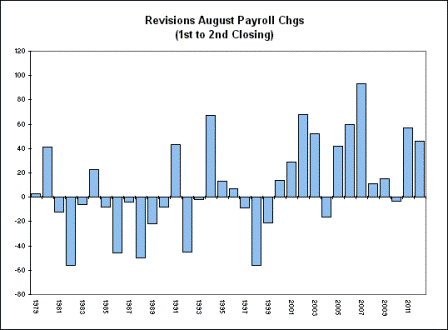
A few observers have also pointed out that August payrolls have had upward revisions in 11 of the past 13 years. This is possibly due to the earlier start of the school year over time, which may also have had an impact on the labor force dynamics. Chart below from SMR.


Full size image


New Fed Chair

  • Its increasingly expected that the nomination of the new Fed Chair will take place between the Sep 18 FOMC meeting and the Annual IMF/WB Meeting in DC on October 11-12.
  • I’d put the odds on Summers around 75%.


Confirmation is another story, of course. But seems his odds of confirmation should be better than, say, Jamie Dimon… ;)

private payrolls

This chart is private sector jobs as per the nfp payrolls report. Decide for yourself whether the govt. ‘getting out of the way’ is altering the ‘underlying strength’ of the private sector, thanks!

As for 2014, if we get there with positive growth from here, that implies credit expansion will be sufficient to generate that growth and feed the automatic stabilizers, will bring the deficit down further as a ‘price’ of that growth, which then requires that much more credit growth to sustain growth, until growth and the fiscal stabilizers do reverse, as they always do.


Full size image

Emerging Nations Save $2.9 Trillion Reserves in Rout

Smart not to intervene and use reserves.

And even the 19% isn’t as much as Japan’s recent approx. 25% drop, so they all remain stronger vs the yen. So the US now loses ‘competitiveness’ vs a whole mob of exporters cutting ‘real’ wages vs US, Canada, UK, and the Eurozone etc. As the ongoing global race to the bottom for real wages continues…

And maybe some day they’ll figure out that cutting rates supports a currency as it cuts interest paid by govt, making the currency ‘harder to get’.

And that exports are real costs and imports real benefits.

And that real standards of living are optimized by sustaining domestic full employment with fiscal adjustments.

Emerging Nations Save $2.9 Trillion Reserves in Rout

By Jeanette Rodrigues, Ye Xie and Robert Brand

September 4 (Bloomberg) — Developing nations from Brazil to India are preserving a record $2.9 trillion of foreign reserves and opting instead to raise interest rates and restrict imports to stem the worst rout in their currencies in five years.

Foreign reserves of the 12 biggest emerging markets, excluding China and countries with pegged currencies, fell 1.6 percent this year compared with an 11 percent slump after the collapse of Lehman Brothers Holdings Inc. in 2008, data compiled by Bloomberg show. The 20 most-traded emerging-market currencies have weakened 8 percent in 2013 as the Federal Reserve’s potential paring of stimulus lures away capital.

After quadrupling reserves over the past decade, developing nations are protecting their stockpiles as trade and budget deficits heighten their vulnerability to credit-rating cuts. Brazil and Indonesia boosted key interest rates last month to buoy the real and rupiah, while India is increasing money-market rates to try to support the rupee as growth slows. Central banks should draw on stockpiles only once currencies have depreciated enough to adjust for the trade and budget gaps, according to Canadian Imperial Bank of Commerce.

“If fundamentals are going against you, it’s not credible to defend a currency level — investors would rush for the exit when they see the reserves depleting,” said Claire Dissaux, managing director of global economics and strategy at Millennium Global Investment in London. “The central banks are taking the right measures, allowing the currencies to adjust.”

‘Fragile Five’
The South African rand, real, rupee, rupiah and lira, dubbed the “fragile five” by Morgan Stanley strategists last month because of their reliance on foreign capital for financing needs, fell the most among peers this year, losing as much as 19 percent.

Foreign reserves in the 12 developing nations including Russia, Taiwan, South Korea, Brazil and India, declined to $2.9 trillion as of Aug. 28, from $2.95 trillion on Dec. 31 and an all-time high of $2.97 trillion in May, data compiled by Bloomberg show. The holdings increased from $722 billion in 2002.

The figures don’t reflect the valuation change of the securities held in the reserves. China, which holds $3.5 trillion as the world’s largest reserve holder, is excluded to limit its outsized impact.

In the three months starting September 2008, reserves dropped 11 percent as Lehman’s collapse sent the real down 29 percent and the rupee 12 percent. India’s stockpile declined 16 percent during the period, while Brazil spent more than $14 billion in reserves in six months starting October, central bank data show.

‘Contagion Potential’
“Often, on the day of the intervention or its announcement, a currency will get a small bounce upward,” Bluford Putnam, chief economist at CME Group Inc., wrote in an Aug. 28 research report. “For the longer-term, however, market participants often return to a focus on the basic issues of rising risks and contagion potential.”

Putnam said “aggressive” short-term interest rate increases that “dramatically” raise the costs of going short a currency can work to stem an exchange-rate slide.

The Turkish and Indian central banks have developed tools to fend off market volatility while keeping their benchmark rates unchanged. Turkey adjusts rates daily and Governor Erdem Basci promised more “surprise” tools to defend the lira while vowing to keep rates unchanged this year. Since July, India has curbed currency-derivatives trading, restricted cash supply, limited outflows from locals and asked foreign investors to prove they aren’t speculating on the rupee.

Records Lows
India’s steps failed to prevent its currency from touching a record low of 68.845 per dollar on Aug. 28. The lira tumbled to an unprecedented 2.0730 the same day.

The rupee plummeted 8.1 percent in August, the biggest loss since 1992 and the steepest among 78 global currencies, according to data compiled by Bloomberg. The lira plunged 5.1 percent, the rand dropped 4.1 percent, the real fell 4.6 percent and the rupiah sank 5.9 percent, the data show.

The Indian currency rose 1.1 percent 67.0025 per dollar as of 1:46 p.m. in Mumbai today, while its Indonesian counterpart gained 0.3 percent to 11,409 versus the greenback. South Africa’s rand appreciated 0.8 percent to 10.2549 per dollar, while the Turkish lira strengthened 0.4 percent to 2.0505.

Interest-rate swaps show investors expect South Africa and India’s benchmark rate will increase by at least 0.25 percentage point, or 25 basis points, by year-end, according to data compiled by HSBC Holdings Plc. In Brazil, policy makers are forecast to raise the key rate by 100 basis points to 10 percent, and Turkey will lift the benchmark one-week repurchase rate by 200 basis points to 6.5 percent, the data show.

Turkey’s Babacan Warns Of Financial Turmoil


Turkey’s Babacan Warns Of Financial Turmoil

By Yasemin Congar

August 27 (Al Monitor) — Emerging markets will soon find themselves operating in a new world order. Few people are as painfully aware of this as Turkey’s Deputy Premier Ali Babacan.

A soft-spoken politician whose key positions in three successive Justice and Development Party (AKP) governments included a two-year stint as foreign minister, Babacan is currently the highest-ranking cabinet member responsible for the economy.

Needless to say, he was all ears when US Federal Reserve Chairman Ben Bernanke suggested on May 22 before the US Congress that it could begin to downsize its $85 billion-per-month bond-buying program.

Babacan had seen that coming. He warned Turkey repeatedly against overspending in 2012 — even at the risk of displeasing Prime Minister Recep Tayyip Erdogan — because he knew cheap loans would soon grow scarce.

Loans in lira are at whatever the CB wants them to be.

Indeed, the United States is getting ready to curtail the stimulus that has injected cash into emerging markets for the last four years.

QE isn’t about cash going anywhere, including not going to EM.

What they got was portfolio shifting that caused indifference rates to change.

Stocks plummeted at the news and national currencies fell against the dollar, with India, Brazil and Turkey all registering substantial losses.

Again, portfolio shifts reversing causing indifference levels to reverse.

Still, answering questions on live television on May 23, Babacan was as cool-headed as ever. First, he reminded the viewers that the European Central Bank and Bank of Japan would follow suit, thus making the impact of the Fed’s exit even stronger on Turkey. Then he said, “If they carry out these operations in an orderly and coordinated fashion, we will ride it out.”

Hope so. They need to focus on domestic full employment.

As Babacan would surely have known, that is a big if. Despite a recent call for coordination by the International Monetary Fund’s managing director, Christine Lagarde, sell-offs in emerging markets do not seem to be a major concern for the architects of the taper plan.

“We only have a mandate to concern ourselves with the interest of the United States,” Dennis Lockhart, president of the Atlanta Fed, told Bloomberg TV. “Other countries simply have to take that as a reality and adjust to us if that’s something important for their economies.”

In fact, adjustment is not a question of choice here. Emerging economies will have to find a way to continue funding growth and paying off debt without the liquidity infusion. It won’t be easy.

Can’t be easier. Lira liquidity for their banking system is always infinite.

It’s just a matter of the CB pricing it. I’d suggest a Japan like 0% policy and a fiscal deficit large enough to allow for full employment.

The looming exodus of cash and higher borrowing costs have already caused permanent damage in Turkey. The lira weakened dramatically on Aug. 23, with the dollar surpassing two liras for the first time in history.

That was not what caused the decline.

The decline was from portfolio managers changing their indifference levels between the lira and the dollar or euro, for example.

Turkey’s Central Bank dipped into its reserves, but a $350 million sale of foreign exchange reserves failed to calm the market.

A mistake. No reason to buy their own currency with $ reserves, which should only be used for ’emergency imports’, such as during wartime. All the intervention did was support monied interests shifting portfolios.

Babacan, for his part, has been referring to Bernanke’s May 22 speech as a turning point. The global economic crisis has entered a new phase since that day, he said. “We’ll all see the spillover effects and new faces of the crisis in the coming months.”

What they will mostly see is the effects of their policy responses if they keep doing what they’ve been doing.

He did not stop there. In his signature straight-shooting manner, he also signaled a downward revision. “It should not be surprising for Turkey to revise its growth rate below 4%. … We set our annual exports target at $158 million, but it looks difficult to reach this target as well.”

Which opens the door for a tax cut/spending increase/fiscal adjustment to sustain output and employment.

A politician who seldom walks and talks like a politician, Babacan has been a maverick of sorts in the government. He entered politics in 2001 when he joined Erdogan and others to found the AKP. At the time, he was a 34-year-old with a degree from the Kellogg School of Management and work experience as a financial consultant in Chicago. In 2002, he was appointed the state minister for economy and became the youngest member of the cabinet.

Today, Babacan still has the boyish looks that earned him the nickname “baby face,” and he still exhibits a distaste for populism.

Guess he doesn’t support high levels of employment. In that case they are doing the right thing.

The most significant feature of Turkey’s recent economic success is fiscal discipline, and no one in the government has been a stronger supporter of that than Babacan.

Yikes! Kellogg school turns out flakes… :(

Around this time last year, when a fellow cabinet member, Economy Minister Zafer Caglayan — equally hardworking, yet keener on instant gratification — criticized the Central Bank’s tight monetary policy, Babacan slammed him.

“We do not have the luxury of pressing the brakes,” Caglayan had said. Babacan’s response: “In foggy weather, the driver should not listen to those telling him to press the gas pedal.”

The weather is clear, the driver is blind.

In what came to be known as the “gas-break dispute,” Erdogan threw his weight behind Caglayan and criticized the statutorily independent Central Bank for keeping interest rates too high.

Agreed!

Last week, the Central Bank hiked its overnight lending rate for the second month in a row by 50 basis points to 7.75%. Erdogan and Caglayan watched quietly this time, hoping the raise would help prevent the lira from sliding further. It did not.

Of course not. It makes it weaker via the govt spewing out more in lira interest payments to the economy.

As Babacan’s proverbial fog is slowly lifting to reveal a slippery slope, I can’t help but wonder if he feels vindicated by the turn of events. Probably not, since the risk that awaits Turkey now is worse than a taper tantrum, and Babacan must know just how bad it can get.

The Fed’s decision exposed Turkey’s vulnerability.

Yes, ignorance.

Described by economist Erinc Yeldan as “a gradually deflating balloon, subject to erratic and irregular whims of the markets,” Turkey’s speculative growth over the last four years has been financed by running a large current account deficit, which in turn was funded with hot money that is no longer readily available.

Nonsensical doubletalk.

As Standard Bank analyst Timothy Ash pointed out last week, “It is a bit hard to recommend [buying the lira or entering] bond positions while inflation remains elevated, and the current account is still supersized at $55-60 billion, with that huge external financing requirement.”

Or, it’s hard selling the dollar or euro with their intense deflationary/contractionary policies…

Estimated at $205 billion, or a quarter of Turkey’s gross domestic product (GDP), the external financing requirement is huge, indeed.

There is no such thing.

“A more extreme measure of vulnerability would add the $140 billion of foreign-held bonds and shares,” Hugo Dixon wrote in his Reuters blog. “If this tries to flee, the lira could plunge.”

Huh???

Babacan admits that “Turkey might feel the negative effects of the Fed’s policy shift a bit higher than others … due to our already higher current account deficit.”

Turkey’s reliance on hot money to turn over its short-term external debt, which has been increasing more rapidly than the national income, is only the tip of the iceberg. What makes Turkey’s robust growth rates of 9% in 2010 and 8.5% in 2011 unrepeatable might be the disappearance of cheap loans. However, the real reason behind the unsustainability of such growth is structural.

Growth can be readily sustained with lira budget deficits and a 0 rate policy would help with price stability as well.

From insufficient capital accumulation and a low savings ratio to poor labor efficiency, the Turkish economy suffers chronic ills that can only be cured through radical reforms, including a major overhaul of the education system.

Education is good, but unemployment is the evidence the deficit is too small.

Again, Babacan knows it. Earlier this year, he commented on the government’s plan to increase the GDP per capita to $25,000 in 2023 by pointing out an anomaly:

“No other country in the world with an average education of only 6.5 years has a per capita income of $10,500. And no country with such an education level ever had an average income of $25,000. Without solving our education problem, our 2023 targets will remain a dream.”

Some say ignorance is bliss. Listening to Babacan makes me think they may be right. After 11 years, being part of a government that failed to do what you know should have been done cannot be much fun.

Comments on research report

From DB,
Comments below:

Commentary for friday: the second print on Q2 GDP growth showed a significant upward revision to +2.5% from +1.7% as previously reported. Recall that growth was only +1.1% in Q1.

After the 3rd downward revision

Given that the deflator was revised a tenth higher (0.8% vs. 0.7% as previously reported), the magnitude of the overall revision is even more impressive. Personal consumption was unrevised at +1.8% in Q2,

Down from 2.3% in Q1 if I recall correctly

While business fixed investment was only modestly softer (+4.4% vs. +4.6%). Residential investment was also reduced slightly (+12.9% vs. +13.4%). The big changes to Q2 growth were in inventories and international trade. Inventory accumulation was lifted to $62.6b from $56.7b as first reported, thereby adding 0.6 ppt to growth compared to 0.4 ppt previously.

The question is voluntary to restock from a Q1 dip or sales growth forecast, or involuntary due to lower than expected sales.

In terms of trade, firmer exports and softer imports drove net exports to improve; as a result, the original -0.8 ppt drag from trade was revised up to zero.

Question is whether exports can be sustained through Q3 as the dollar spike vs Japan and then the EM’s hurts ‘competitiveness’

The government drag on Q2 was revised to become slightly larger (-0.2 ppt vs. -0.1 ppt as first reported). Nonetheless, the federal government drag on economic activity has diminished significantly compared to the impact in Q1 (-0.7 ppt) and Q4 2012 (-1.2 ppt). A diminished drag from the public sector should enable overall GDP growth, which was +1.6% year-on-year in Q2, to close the gap with private sector growth, which was +2.5% over the same period.

I see it this way- the govt deficit spending is a net add of spending/income. So with the deficit dropping from 7% of GDP last year to maybe 3% currently, with maybe 2% of the drop from proactive fiscal initiatives, some other agent has to be spending more than his income to sustain sales/incomes etc. If not, output goes unsold/rising inventories and then unproduced. The needed spending to ‘fill the spending gap’ left by govt cutbacks can come from either domestic credit expansion or increased net exports (no resident credit expansion/savings reductions. I don’t detect the domestic credit expansion and net export growth/trade deficit reduction seems likely given the dollar spike and oil price spike?

If we achieve +3.0% growth in the current quarter and +3.5% in Q4, this will push the year-on-year rate to +1.7% in Q3 and +2.5% by yearend. (this is in line with the Fed’s central tendency forecasts, which are due to be updated at the september FOMC meeting.)

In order for our growth forecast to come to fruition, we will need to see a pickup in consumer spending,

Hard to fathom, as personal consumption has been slipping from 2.3 in Q1 to 1.8 in Q2, and walmart and the like sure aren’t seeing any material uptick in sales? Car sales are ok, but further gains from the June high rate seems doubtful as July has already posted a slower annual rate.

homebuilding and business investment relative to first half performance. The first two series are likely to be boosted by sturdier employment gains, and hence faster household income growth.

Seems early Q3 reports show falling mtg purchase applications, home sales falling month to month, and lots of anecdotals showing the spike in mtg rates has slowed things down. So growth from Q2 seems unlikely at this point?

We are confident that the pace of hiring will pick up in the relatively near term, because jobless claims continue to hold near cyclical lows.

New jobs dropped to 160,000 in july, and claims measure people losing their jobs, not new hires. Also, top line growth, the ultimate driver of employment, remains low, so assuming actual productivity hasn’t gone negative a spike in jobs is unlikely?

Given the usefulness of jobless claims as a payroll forecasting tool, it should come as little surprise that they are also significantly correlated with wage and salary growth. In fact, over the past 25 years, the current level of jobless claims has typically coincided with private wage and salary growth above 6% compared to 3.8% in Q2.

As above, claims may have correlated with all that in the past, but the causation isn’t there. Looks to me like claims are more associated with ‘time from the bottom’ as with time after the economy bottoms firings tend to slow, regardless of hiring?

Meanwhile, the third growth driver noted above—business investment—will largely depend on the corporate profit trend. Yesterday’s second print on GDP provided the first look at economy-wide corporate profits, which rose +3.9% in Q2 vs. -1.3% in Q1. Many analysts fretted the decline in profits in Q1, because they tend to drive business investment and hiring plans. We dismissed the Q1 weakness as a temporary development which occurred in lagged response to the growth slowdown in Q4 2012 and Q1 2013. The fact that profits are reaccelerating (+5.0% year-on-year versus +2.1% in Q1) is an encouraging development in this regard.

Profits also are a function of sales, which are a function of ‘deficit spending’ from either govt or other sectors, as previously discussed. And, again, i see no signs of ‘leaping ahead’ in any of those sectors.

Faster GDP growth through yearend should result in even stronger corporate profit growth.

Agreed! But didn’t he just say that the GDP growth would come from business investment that’s a function of profits (and in turn a function of sales/GDP)?

To be sure, the additional growth momentum now evident in the Q2 GDP results makes our 3% target for current quarter growth more easily attainable. –CR

I don’t see how inventory growth is ‘momentum’ and seems there are severe headwinds to Q3 net exports as drivers of growth?

And govt is there with a deficit of only 3% of GDP to help offset the relentless ‘unspent income’/demand leakages inherent in the global institutional structure.

New home sales hammered, prompting doubts about recovery

Down and both prior months revised down as well. And this was before mtg rates spiked, and before mass layoffs were announced by mortgage originators, etc. And ‘months supply’ rose to a somewhat ‘normal’ 5.2 months of supply at the current sales pace, taking some wind out of the ‘supply shortage’ story. And a measure of price declined from last month softening that story as well. All still up some from the same month last year, but the year over year gains are decelerating post fiscal tightening

It’s now hard to say housing has improved since the last Fed meeting.

The August employment report will be telling, as the initial report of July job increase dropped to 160,000. A lower number means that series would be worse than what the Fed was expecting as well

Two things:

First, this report and the revisions, like the revisions to Q1, fit the narrative that austerity works to slow the economy. And so do the ‘revised’ numbers such as Q1 GDP. It’s the 200+ year old identity that in a monetary economy the demand leakages (agents spending less then their incomes) have to be overcome by others spending more than their incomes, or the output doesn’t get sold. So last year’s growth included the govt spending maybe 7% more than it’s income for that GDP to be posted. And this year, through automatic and proactive measures, govt is limited to spending 3% more than it’s income. That means the difference has to come from other agents spending more than their incomes or that much output doesn’t get sold. Yes, that kind of private sector credit expansion is possible, but I sure don’t see any evidence of that kind of credit expansion. So I don’t see growth increasing until that does happen. It’s not about ‘the govt cuts subtracted from GDP, so when that effect passes growth resumes’ Instead, it’s ‘govt was adding 7%, and now it’s adding only 3%, and growth will cause that to fall further via the automatic stabilizers until the cycle ends.’ That’s why they are called ‘stabilizers’- they cause the deficit to grow in a down turn until they cause the deficit to get large enough to reverse the decline, and they cut net govt spending until it’s too small to support the credit structure and it all goes into reverse.

And, of course, no one of political consequence sees it that way, as Congress and most others continue to judge deficit reduction as success that will somehow
lead to prosperity. So I only see it getting worse.

Also, as previously discussed, I see growth of industrial production as a sign of duress. Globally, for the most part that kind of thing goes to the nation that can feed its workers the fewest calories, in a brutal race to the bottom. Like Japan’s recent currency depreciation initiative taking a 25% bite out of real wages followed by export growth, etc.

Second, the whole QE thing is ‘perverse’ in that it doesn’t actually do anything of further economic consequence but market participants, and the Fed, act as if it does matter for the macro economy. And it also has some what can be called ‘supply side’ effects as it shifts available private sector assets between reserves, tsy secs, and agency mortgage backed securities.

So, for example, if tapering is on, stocks fall as its presumed the reason stocks went up was QE, and tsy and mbs yields rise as the Fed will be buying fewer of those things. And mixed into all that is the notion that the Fed tapers because it thinks the economy is strong, which should be good for stocks, but also cause yields to rise, which is bad for stocks. So the entire thing is a confusion of reaction functions and misperceptions.

It’s all something like the Keynesian beauty contest but with all the judges legally blind.

So if it goes ‘tapering off’ due to weak employment numbers from a weakening economy, is that good for stocks because QE continues, or bad because the economy is faltering?

And it will result in lower yields for both reasons.

One last thing.
The Fed minutes stated, as they always do, is that one of the reasons supporting their ‘improving growth’ forecast is the positive effect from ‘monetary accommodation’ that, in my humble opinion, as in Japan that has done far more far longer than we have, has failed to materialize going 5 years now. And all they have it the counterfactual using the same methodology that shows how much worse it would have been otherwise .

Again, in my humble opinion, history will not be kind to any of these people.