
Starving the beast

How to fight back against Wall Street

Much like we killed the buffalo to defeat the American Indians, we can work to tame Wall Street by working to reduce its food supply. And a large part of that food supply is the US pension system. Created and sustained by the innocent fraud that savings funds investment in a ‘loans create deposits’ world, the powerful attraction of being able to accumulate ‘savings’ on a pre-tax basis has generated nearly $20 trillion in US pension assets in thousands of scattered plans, from the giant State retirement funds to the small corporate pension funds, to the various smaller individual retirement funds.

Before I get to the way we can eliminate these bloated whales being eaten alive by the sharks, let me first suggest a few ways to whales from becoming shark food. The first is to get back to ‘narrow investing’ and public purpose by creating a list of investments deemed legal for any government supported pension funds. And ‘government supported’ would include any funds that are in any way tax advantaged. Legal investments would be investments that are in line with further public purpose. Not a lot comes to mind. If the public purpose is safety for the investors government securities would be appropriate, as government securities are functionally government guaranteed annuities. New issue equities might make sense if portfolio managers were required to be sufficiently educated and tested to make sure they are up for the responsibility of deciding where new real investment is best directed. But that’s a major and impractical undertaking. And there is no public purpose in simply trading new issues for relatively short term gain with no longer term stake in the merits of the underlying business. Nor is there any public purpose to investing in the secondary equity markets. In fact, with the rules and corporate governance stacked against shareholders, there is public purpose to not investing in those markets. Nor are these my first choice for the institutions I’d want investing in corporate bonds. It makes more sense to utilize the 8,000 regulated and supervised Fed member banks, all of which already specialize in credit analysis. If there is public purpose to buying corporate bonds, better the banks perform that function and not the pension funds.

So it looks like the only investments that make sense are government securities. The problem there, however, is I’m also advocating the government stop issuing securities. So that would mean the only investments for pension funds that make sense from a public purpose point of view are insured, overnight bank deposits. And that would go a long way towards taking away Wall Street’s food supply, thereby greatly reducing the troubling kinds of activities that we’ve been witnessing. This drastic reduction in financial sector activity would make regulation and supervision of what’s left a lot less complex and far more effective, and at the same time work to stabilize the financial aspects of the real economy.

Longer term, with the recognition that we don’t need savings to have money for investment, we can change the tax laws that are fostering these problematic pools of savings, and let them wind down over time.

Racing to the bottom

Government is about public infrastructure for further public purpose. That includes the usual suspects such as the military and the legal system, but Federal public infrastructure also includes regulation to stop what are called ‘races to the bottom,’ which usually involve what are known as ‘fallacies of composition.’ The textbook example is the football game, where if one person stands up he can see better, but if all stand up not only is nothing is gained, and no one gets to sit and watch. Allowing anyone to stand to see better is what creates that race to the bottom, where all become worse off. A ‘no standing’ rule would be a regulation that supports the public purpose of preventing this race to the bottom.

Another example is pollution control. With no Federal regulation, the States find themselves in a race to the bottom where the State that allows the most pollution gets the most business. The need to attract business drives all the States to continuously lower their pollution standards resulting in minimal regulation and unthinkable national pollution. Again, Federal regulation that sets national minimum standards is what it takes to prevent this race to the bottom.

Insurance regulation has been at the State level, which was deemed too lax only after the failure of AIG, which was the end result of a race to the bottom the Federal Government should have addressed long ago. Discussion has now begun regarding national insurance regulatory standards.
Altman is back

America’s disastrous debt is Obama’s biggest test

By Roger Altman

April 21 (FT) — The global financial system is again transfixed by sovereign debt risks. This evokes bad memories of defaults and near-defaults among emerging nations such as Argentina, Russia and Mexico.

Yes, all fixed FX blowups.

But the real issue is not whether Greece or another small country might fail. Instead, it is whether the credit standing and currency stability of the world’s biggest borrower, the US, will be jeopardised by its disastrous outlook on deficits and debt.

This comp completely misses the fundamental difference between the two. The Fed is an arm of the US govt, while the ECB is not an arm of greece.

America’s fiscal picture is even worse than it looks. The non-partisan Congressional Budget Office just projected that over 10 years, cumulative deficits will reach $9,700bn and federal debt 90 per cent of gross domestic product – nearly equal to Italy’s.

Another apples/oranges comp. This is less than poor analysis.

Global capital markets are unlikely to accept that credit erosion. If they revolt, as in 1979,

There was no ‘revolt’ in regards to the US in 1979.

ugly changes in fiscal and monetary policy will be imposed on Washington. More than Afghanistan or unemployment, this is President Barack Obama’s greatest vulnerability.

His greatest vulnerability is listening to this nonsense, and not recognizing that taxes function to regulate aggregate demand, and not to raise revenue.

The unemployment rate is all the evidence needed, screaming there is a severe shortage of aggregate demand, and a payroll tax holiday would restore private sector sales by which employment immediately returns.

Instead, the admin is listening to this nonsense and working to take measures to tighten fiscal policy which will work to reduce aggregate demand.

How bad is the outlook? The size of the federal debt will increase by nearly 250 per cent over 10 years, from $7,500bn to $20,000bn. Other than during the second world war, such a rise in indebtedness has not occurred since recordkeeping began in 1792.

Point? Govt deficit spending adds back the demand lost because of ‘non govt’ savings desires for dollar financial assets.

The cumulative govt ‘debt’ equals and is the net financial equity- monetary savings- of the rest of us.

You could change the name on the deficit clock in nyc to the savings clock and use the same numbers.

It is so rapid that, by 2020, the Treasury may borrow about $5,000bn per year to refinance maturing debt and raise new money; annual interest payments on those borrowings will exceed all domestic discretionary spending and rival the defence budget. Unfortunately, the healthcare bill has little positive budget impact in this period.

That just means our net savings is rising and the interest payments are helping our savings rise.

In fact, treasury securities are nothing more than dollar savings accounts at the fed. Savers include us residents and non residents like the foreign countries that save in dollars.

Why is this outlook dangerous?

Because it leads to backwards policies by people who don’t get it.

Because dollar interest rates would be so high as to choke private investment and global growth.

There is no such thing.

First, rates are set by the fed.

Second, there is no imperative for the tsy to issue longer term securities or any securities at all.

Third, there is no econometric evidence high interest rates do that. In fact, because the nation is a net saver of the trillions called the national debt, higher rates increase interest income faster than the higher loan rates reduce it (bernanke, sacks, reinhart, 2004 fed paper).

It is Mr Obama’s misfortune to preside over this.

It’s his misfortune to be surrounded by people who don’t understand monetary operations. Otherwise we’d have been at full employment long ago.

The severe 2009-10 fiscal decline reflects a continuation of the Bush deficits and the lower revenue and countercyclical spending triggered by the recession. His own initiatives are responsible for only 15 per cent of the deterioration. Nonetheless, it is the Obama crisis now.

It’s the obama crisis because taxes remain far too high for the current level of govt spending and saving desires.

Now, the economy is too weak to withstand the contractionary impact of deficit reduction. Even the deficit hawks agree on that.

It’s too weak because the deficit is too small. And yes, making it smaller makes things worse.

In addition, Mr Obama has appointed a budget commission with a December deadline. Expectations for it are low and no moves can be made before 2011.

Yes, and then to cut social security and medicare!!!!

Yet, everyone already knows the big elements of a solution. The deficit/GDP ratio must be reduced by at least 2 per cent, or about $300bn in annual spending. It must include spending cuts, such as to entitlements,

Here you go!!!!!!!!!!!!!!

and new revenue. The revenues must come from higher taxes on income, capital gains and dividends or a new tax, such as a progressive value added tax.

Yes, all working to cut aggregate demand and weaken the economy.

It will be political and financial factors that determine which of three budget paths America now follows.

Yes, the backwards understanding by our leaders.

The first is the ideal. Next year, leaders adopt the necessary spending and tax changes, together with budget rules to enforce them, to reach, for example, a truly balanced budget by 2020. President Bill Clinton achieved a comparable legislative outcome in his first term. But America is more polarised today, especially over taxes.

Clinton was ‘saved’ by the unprecedented increase in private sector debt chasing impossible balance sheets of the dot com boom, which was expanding at 7% of GDP, driving the expansion even as fiscal was allowed to go into a 2% surplus, which drained that much financial equity, and ending in a crash when incomes weren’t able to keep up.

The second possible course is the opposite: government paralysis and 10 years of fiscal erosion. Debt reaches 90 per cent of GDP. Interest rates go much higher, but the world’s capital markets finance these needs without serious instability.

Japan is well over 200% (counting inter govt holdings) with the 10 year JGB at 1.35%. Interest rates are primarily a function of expectations of future fed rate settings, along with a few technicals.

History suggests a third outcome is the likely one: one imposed by global markets.

There is no history that suggests that, just misreadings of history.

Yes, there may be calm in currency and credit markets over the next year or two. But the chances that they would accept such a long-term fiscal slide are low. Here, the 1979 dollar crash is instructive.

A dollar crash, whatever that means, is a different matter from the funding issues he previously implied.

The Iranian oil embargo, stagflation and a weakening dollar were roiling markets. Amid this nervousness, President Jimmy Carter submitted his budget, incorporating a larger than expected deficit. This triggered a further, panicky fall in the dollar that destabilised markets. This forced Mr Carter to resubmit a tighter budget and the Fed to raise interest rates. Both actions harmed the economy and severely injured his presidency.

The problem was the policy response to the ‘dollar crash.’ rates went up because the fed raised them with a vote. Market forces aren’t a factor in the level of rates per se. They are part of the Fed’s reaction function, which is an entirely different matter.

America’s addiction to debt poses a similar threat now. To avoid an imposed and ugly solution, Mr Obama will have to invest all his political capital in a budget agreement next year. He will be advised that cutting spending and raising taxes is too risky for his 2012 re-election. But the alternative could be much worse.

So it’s all about avoiding a dollar crash?

So why are we pressing china to revalue their currency upward which means reducing the value of the dollar? Can’t have it both ways?

Altman was in the Clinton admin confirms they were in the ‘better lucky than good’ category.

Feel free to distribute, thanks.

Ruml 1946

Note the US was back on gold internationally after Bretton Woods:

The Bretton Woods Conference took place in July 1944, but did not become operative until 1959, when all the European currencies became convertible. Under this system, the IMF and the IBRD were established. The IMF was developed as a permanent international body. The summary of agreements states, “The nations should consult and agree on international monetary changes which affect each other. They should outlaw practices which are agreed to be harmful to world prosperity, and they should assist each other to overcome short-term exchange difficulties.” Wikipedia

So Ruml’s analysis didn’t apply until after 1971 when the US finally dropped convertibility.

Might be why Ruml’s points didn’t gain any traction back then.

Email exchange with Dan

On Thu, Apr 15, 2010 at 12:08 PM, wrote:
Hi Warren,

I must admit that your writing and thoughts have had a significant impact upon me. Interestingly—at least from where I sit—your Soft Currency Economics paper, which I have now read 5 or 6 times, has provided me with an odd peace of mind…not sure if that is a GOOD thing or not. :)

thanks!

KNOWING that—so long as trust and confidence in our fiat system remains—we are always able to mitigate, at least in some manner, the impact of global financial crises through the changing of numbers ‘upward’ in the accounts of men and of institutions, is somewhat akin, I’d imagine, to an alcoholic knowing that, no matter what, an endless supply of Johnny Walker Black always exists in his basement stash.

Actually, as long as we can enforce tax collections the currency will have value.

Problem is the currency can’t be eaten or drunk, so if the crops fail it won’t help much.
All we can insure is enough currency to pay people to work, not enough things to buy

OK, so maybe the analogy is a tad morose…but hence my funny feeling about my peace of mind.

So, my question of the week revolves around the U.S.’s apparent choice to monetize (again, if you will) the IMF coffers. I point to the following from Zerohedge:

“…As we reported a few days ago, the IMF massively expanded its last resort bailout facility (NAB) by half a trillion dollars, in which the US was given the lead role in bailing out every country that has recourse to IMF funding.

We buy SDR’s with dollars which the IMF then loans, so yes.

Yesterday, Ron Paul grilled Bernanke precisely on the nature of the expansion of the US role to the NAB: “The IMF has announced that they are going to open up the NAB which coincides with the crisis in Greece and Europe and how they are going to bailed out. The irony of this promise is that in the new arrangement Greece is going to put in $2.5 billion in. I think only a fiat monetary system worldwide can come up and have Greece help bail out Greece and be prepared to bail out even other countries.

Greece needs euros, so the IMF will sell SDR’s to the euro nations to fund Greece, not the US.

SDR’s are only bought with local currency.

But we are going from $10 to $105 billion… We are committing $105 billion to bailing out the various countries of the world, this does two thing I want to get your comments on one why does it coincide with Greece,

Coincidental.

what are they anticipating, why do they need $560 billion, do we have a lot more trouble, and when it comes to that time when we have to make this commitment, who pays for this, where does it come from?

Seems they anticipate more nations will be borrowing dollars from the IMF?

We buy them by crediting the IMF’s account at the Fed. If and when the IMF lends dollars we move those dollars from the IMF’s account to the account at the Fed for the borrowing nation.

Will this all come out of the printing press once again, as we are expected to bail out the world?

Short answer, yes. long answer above.

Are you in favor of this increase in the IMF funding and our additional commitment to $105 billion?”

No.

Bernanke, of course, washes his hands of any imminent dollar devaluation – it is all someone else’s responsibility to bail out life, the universe and everything else. Bernanke pushes on “I think in general having the IMF available to try to avoid crises is a good idea.”

2 problems. First the borrowers would probably be better off using local currency solutions rather than dollars, and second the IMF terms and conditions can and often do make things worse for the borrower.

Yet Paul pushes on “Where will this money come from? We are bankrupt too.” Indeed we are, but nobody cares – that is simply some other poor shumck’s problem…”

He’s flat out wrong about the US being bankrupt but that’s another story.

best,
warren

Warren, this strikes me as problematic. YES, we can add zeros to the end of accounts and thus ‘create’ more liquidity in the global economy. HOWEVER, at what point does the world choose not to believe that those numbers in those accounts have true value?

As long as we enforce dollar taxes the dollar will have value.

warren

April 28 Conference

Looks like it’s on and I’ll be there.
All invited to attend. Will get details later today and tomorrow.
Will be getting a press release out as well.

Fighting Back Against the Drive to Slash Entitlements

By Ian Welsh

April 14 — Back when I was at FDL I had a chat with the Peterson Foundation folks. They struck me as sincere, but off-balance. To the extent that Social Security is in deficit at all any problems are decades out (which they admitted), and while Medicare has issues, the simplest and easiest way to cut medical costs overall is single payer, something they won’t push. More to the point, somehow “entitlements” always get mentioned first, and not things like Defense spending.

But the folks at the Fiscal Sustainability Teach-In Conference have a broader point: that fiscal sustainability, according to Modern Monetary Theory, isn’t based on debt-to-gdp, or how much the private sector will lend. The government can spend a lot more if it needs to, and doing so is a good idea if it leads to full employment and gets economic growth going again. They are having a free counter-Fiscal Summit on April 28th, the same day as the Peterson foundation has its summit.

There’s going to be some interesting speakers and topics at the summit, so if you can make it to DC, it’ll probably be worth going:

– What Is Fiscal Sustainability? (Team Leader: Professor Bill Mitchell, Research Professor in Economics and Director of the Centre of Full Employment and Equity (CofFEE), at the University of Newcastle, NSW Australia, and blogger at billyblog.)

– Are There Spending Constraints on Governments Sovereign in their Currency? (Team Leader: Stephanie Kelton, Assistant Professor of Macroeconomics, Finance, and Money and Banking, University of Missouri, Kansas City, and blogger at New Economics Perspectives)

– The Deficit, the Debt, the Debt-To-GDP ratio, the Grandchildren and
Government Economic Policy; (Team Leader: Warren Mosler, International Consulting Economist, Independent Candidate for the US Senate in Connecticut, and blogger at moslereconomics.com)

– Inflation and Hyper-inflation (Team Leader: Marshall Auerback, International Consulting Economist, blogger at New Deal 2.0 and New Economic Perspectives); and

– Policy Proposals for Fiscal Sustainability (Team leaders: L. Randall Wray, Professor of Economics, University of Missouri, Kansas City, and Pavlina Tcherneva, Assistant Professor of Economics at Franklin and Marshall College, and bloggers at New Economic Perspectives)

My alternative proposal on trade with China

We can have BOTH low priced imports AND good jobs for all Americans

Attorney General Richard Blumenthal has urged US Treasury Secretary Geithner to take legal action to force China to let its currency appreciate. As stated by Blumenthal: “By stifling its currency, China is stifling our economy and stealing our jobs. Connecticut manufacturers have bled business and jobs over recent years because of China’s unconscionable currency manipulation and unfair market practices.”

The Attorney General is proposing to create jobs by lowering the value of the dollar vs. the yuan (China’s currency) to make China’s products a lot more expensive for US consumers, who are already struggling to survive. Those higher prices then cause us to instead buy products made elsewhere, which will presumably means more American products get produced and sold. The trade off is most likely to be a few more jobs in return for higher prices (also called inflation), and a lower standard of living from the higher prices.

Fortunately there is an alternative that allows the US consumer to enjoy the enormous benefits of low cost imports and also makes good jobs available for all Americans willing and able to work. That alternative is to keep Federal taxes low enough so Americans have enough take home pay to buy all the goods and services we can produce at full employment levels AND everything the world wants to sell to us. This in fact is exactly what happened in 2000 when unemployment was under 4%, while net imports were $380 billion. We had what most considered a ‘red hot’ labor market with jobs for all, as well as the benefit of consuming $380 billion more in imports than we exported, along with very low inflation and a high standard of living due in part to the low cost imports.

The reason we had such a good economy in 2000 was because private sector debt grew at a record 7% of GDP, supplying the spending power we needed to keep us fully employed and also able to buy all of those imports. But as soon as private sector debt expansion reached its limits and that source of spending power faded, the right Federal policy response would have been to cut Federal taxes to sustain American spending power. That wasn’t done until 2003- two long years after the recession had taken hold. The economy again improved, and unemployment came down even as imports increased. However, when private sector debt again collapsed in 2008, the Federal government again failed to cut taxes or increase spending to sustain the US consumer’s spending power. The stimulus package that was passed almost a year later in 2009 was far too small and spread out over too many years. Consequently, unemployment continued to rise, reaching an unthinkable high of 16.9% (people looking for full time work who can’t find it) in March 2010.

The problem is we are conducting Federal policy on the mistaken belief that the Federal government must get the dollars it spends through taxes, and what it doesn’t get from taxes it must borrow in the market place, and leave the debts for our children to pay back. It is this errant belief that has resulted in a policy of enormous, self imposed fiscal drag that has devastated our economy.

My three proposals for removing this drag on our economy are:

1. A full payroll tax (FICA) holiday for employees and employers. This increases the take home pay for people earning $50,000 a year by over $300 per month. It also cuts costs for businesses, which means lower prices as well as new investment.

2. A $500 per capita distribution to State governments with no strings attached. This means $1.75 billion of Federal revenue sharing to the State of Connecticut to help sustain essential public services and reduce debt.

3. An $8/hr national service job for anyone willing and able to work to facilitate the transition from unemployment to private sector employment as the pickup in sales from my first two proposals quickly translates into millions of new private sector jobs.

Because the right level of taxation to sustain full employment and price stability will vary over time, it’s the Federal government’s job to use taxation like a thermostat- lowering taxes when the economy is too cold, and considering tax increases only should the economy ‘over heat’ and get ‘too good’ (which is something I’ve never seen in my 40 years).

For policy makers to pursue this policy, they first need to understand what all insiders in the Fed (Federal Reserve Bank) have known for a very long time- the Federal government (not State and local government, corporations, and all of us) never actually has nor doesn’t have any US dollars. It taxes by simply changing numbers down in our bank accounts and doesn’t actually get anything, and it spends simply by changing numbers up in our bank accounts and doesn’t actually use anything up. As Federal Reserve Chairman Bernanke explained in to Scott Pelley on ’60 minutes’ in May 2009:

(PELLEY) Is that tax money that the Fed is spending?
(BERNANKE) It’s not tax money. The banks have– accounts with the Fed, much the same way that you have an account in a commercial bank. So, to lend to a bank, we simply use the computer to mark up the size of the account that they have with the Fed.

Therefore, payroll tax cuts do NOT mean the Federal government will go broke and run out of money if it doesn’t cut Social Security and Medicare payments. As the Fed Chairman correctly explained, operationally, spending is not revenue constrained.

We know why the Federal government taxes- to regulate the economy- but what about Federal borrowing? As you might suspect, our well advertised dependence on foreigners to buy US Treasury securities to fund the Federal government is just another myth holding us back from realizing our economic potential.


Operationally, foreign governments have ‘checking accounts’ at the Fed called ‘reserve accounts,’ and US Treasury securities are nothing more than savings accounts at the same Fed. So when a nation like China sells things to us, we pay them with dollars that go into their checking account at the Fed. And when they buy US Treasury securities the Fed simply transfers their dollars from their Fed checking account to their Fed savings account. And paying back US Treasury securities is nothing more than transferring the balance in China’s savings account at the Fed to their checking account at the Fed. This is not a ‘burden’ for us nor will it be for our children and grand children. Nor is the US Treasury spending operationally constrained by whether China has their dollars in their checking account or their savings accounts. Any and all constraints on US government spending are necessarily self imposed. There can be no external constraints.


In conclusion, it is a failure to understand basic monetary operations and Fed reserve accounting that caused the Democratic Congress and Administration to cut Medicare in the latest health care law, and that same failure of understanding is now driving well intentioned Americans like Atty General Blumenthal to push China to revalue its currency. This weak dollar policy is a misguided effort to create jobs by causing import prices to go up for struggling US consumers to the point where we buy fewer Chinese products. The far better option is to cut taxes as I’ve proposed, to ensure we have enough take home pay to be able to buy all that we can produce domestically at full employment, plus whatever imports we want to buy from foreigners at the lowest possible prices, and return America to the economic prosperity we once enjoyed.

US Taxes

From the articles of Confederation, March 1st, 1781.
We had the right tax, but the wrong way to implement it:

VIII.

All charges of war, and all other expenses that shall be incurred for the common defense or general welfare, and allowed by the United States in Congress assembled, shall be defrayed out of a common treasury, which shall be supplied by the several States in proportion to the value of all land within each State, granted or surveyed for any person, as such land and the buildings and improvements thereon shall be estimated according to such mode as the United States in Congress assembled, shall from time to time direct and appoint.

The taxes for paying that proportion shall be laid and levied by the authority and direction of the legislatures of the several States within the time agreed upon by the United States in Congress assembled.

Response to Dem debate

I arrived in Connecticut to begin a ‘listening tour’ before making the decision to run in the Democratic primary for United States Senate. Tonight I listened carefully to the Democratic candidates as they put forth their agendas for restoring the US economy and both fell far short of the mark. Neither had a credible economic agenda, and what they did propose- tax increases- would only make matters worse.

Making sure that people working for a living are paid enough to be able to buy the goods and services they produce has long been a core economic value of the Democratic party. And what drives the lion’s share of business, both large and small, is the competition to attract the consumer’s dollars by producing the goods and services working people want. Unfortunately, the current situation is clearly one where people working for a living are not taking home enough money to buy what business is desperately trying to sell. Consequently, business has been contracting and laying people off, which makes matters even worse.

The Republican response has traditionally been to give tax cuts and other monetary incentives to business rather than to the people doing the work. That does not result in new hires for the businesses, as business only hire when orders and sales pick up. Instead, it results in higher profits with the hope that those profiting will hire more domestic help and more gardeners, and produce a few jobs that way, which is known as trickle-down economics.

So while, in addition to tax hikes, both Democratic candidates for US Senate proposed tax relief, it was for small businesses- the traditional Republican approach, and indeed, the approach of the Obama administration. Note that last week’s jobs bill featured a $5,000 payroll tax reduction for businesses, and not for employees. In contrast, I have long been proposing a full ‘payroll tax holiday’ where a couple earning a combined $100,000 per year would see their take home pay rise by over $650 per month. That would be enough to fix the economy as people could then make their mortgage payments and car payments, and even do a little shopping. This is the Democratic approach which also gives businesses what they really need- people with enough money to spend to buy their products. It’s people with money to spend that creates the backlog of orders which then quickly results in the millions of new jobs we need to restore our economy to full employment levels and prosperity. The payroll tax holiday also reduces costs for business. In a competitive environment this translates into a combination of both lower prices and better cash flow for business that can be used for the new investment the recession has long delayed.

The reason the Democrats don’t propose this kind of tax cut is because they can’t answer the question of ‘how are you to replace the lost revenues.’ And, in fact the Obama administration has currently put Medicare and social security cuts on the table to ‘pay for’ what they’ve already spent. What both Democratic candidates are displaying is a failure to understand the difference between the function of Federal taxation and State and local government taxation. I grew up on the money desk at Banker’s Trust on Wall St. in the 1970’s, ran my own investment funds and securities dealer for 15 years, currently own a small Florida bank, and visit the Fed (Federal Reserve Bank) regularly to discuss monetary policy and monetary operations. I know how the payment system works, as does the Fed’s operations staff.

What we all know is that when Federal taxes are paid, all the Fed does is change the numbers down in our bank accounts. For example, if you have $5,000 in your bank account, and you pay a Federal tax of $1,000, all the Fed does is change the 5 on your bank statement to a 4, so you then have only $4,000 in your account. With online banking you can watch exactly that happen on your computer screen. The Fed doesn’t ‘get’ anything. It just changes the numbers in your account. And when the Federal government spends, it just changes numbers up in our bank accounts. It doesn’t ‘use up’ anything. In fact, the Federal government (unlike State and local governments and the rest of us who do need money in our accounts to be able to spend) never has nor doesn’t have dollars. Think if it as the score keeper for the dollar. When a touchdown is scored and 6 points go up on the scoreboard, does anyone ask where he stadium got those 6 points? Can the stadium run out of points to post on the score board? Of course not!

So why then does the Federal government tax, when it doesn’t get actual revenue (it just changes numbers down in our accounts) and it does not use up anything when it spends (it just changes numbers up in our accounts)? The fact is, taxes function to regulate the economy by controlling our take home pay. If taxes are too low, the result is excessive spending and the strong upward pressure on prices we call inflation. If we are over taxed, as we are today, and the Federal government is taking too much out of our paychecks, the result is a drop off in sales by businesses, and rising unemployment. Federal taxes are like the thermostat. If the economy is too hot (something I have never seen in my 37 years in the financial markets), they can be raised to cool it down. And when the economy goes ice cold, like it is now, my full payroll tax holiday is in order. The Federal government’s job is to keep the economy just right by keeping taxes low enough so people working for a living can afford to buy the goods and services they are capable of producing.

That’s what fiscal responsibility is all about. But until our politicians understand the difference between State finances and Federal finances, the will continue to fail to make sure our take home pay is high enough to sustain the high levels of output and employment that are the hallmarks of American prosperity.

Let me conclude with a word about China. It was stated in the Democratic debates and not disputed that the US was borrowing $4 billion from China to pay for the war in Afghanistan. However, close examination of monetary operations shows this is not at all as it seems. China has what amounts to a checking account at the Federal Reserve Bank. China gets its dollars by selling goods and services to the US, and those dollars are paid into that checking account at the Fed. And US Treasury securities are nothing more than fancy names for savings accounts at the Fed. So when China buys US Treasury securities, all the Fed does is shift China’s dollars from its checking account at the Fed to a savings account at the Fed. And when those Treasury securities become due and payable, all the Fed does is shift the dollars in the savings accounts (plus interest) back to China’s checking account at the Fed. That’s it. Debt paid. And it happens exactly this way every week as billions of Treasury securities are purchased and mature. And this process has no connection to Federal government spending for the war or anything else. Spending is always nothing more than the Fed changing numbers up in people’s bank accounts, no matter what China might be doing with their Fed accounts. That’s why the ‘national debt,’ which is nothing more than dollars in savings accounts at the Fed, has never created a financial problem, and never will, either for us or for our children. Yet the administration, the media, and the two Democratic candidates for US Senate from Connecticut have the story completely wrong as well, which results in proposals which are bad for Connecticut and bad for America.

America is grossly overtaxed and needs a full payroll tax holiday NOW to stop the bleeding and restore the American dream. The only thing standing in the way of economic prosperity is a lack of understanding of our monetary system.

Sincerely,
Warren Mosler

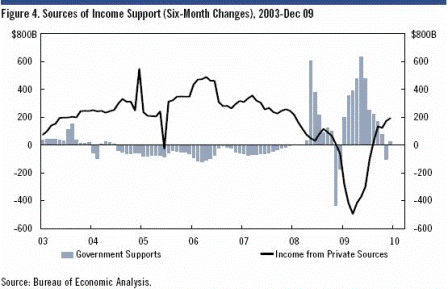
Private vs Govt Sources of Personal Income

Good chart.

Note how the deficit as a % of GDP began trailing off midway through 06 and brought income from private sources (which for the most part are driven by private sector debt increases) down with it. And how the latest increase in deficit spending has begun to restore it.

As always, taxes function to regulate agg demand and, in fact, don’t actually raise revenue for the federal govt that never has nor doesn’t have any dollars.

It taxes by changing numbers down in our accounts and doesn’t actually get anything, and spends by changing numbers up in our accounts and doesn’t use up anything.

On Tue, Feb 23, 2010 at 9:59 AM, wrote:

Interesting chart from Citi Econ. 6mth rate of change in Income via Govt Support (essentially unemployment benefits, social security, medicare, etc) and Income from Private Sources (mostly wage and salary income, but also corp pension contributions, rental income, interest income, etc).