
The Influence of the Sub Prime Fiasco on the Last Business Cycle

I recently sent this with regard to the question of how high the deficit might need to be for full employment, as per my earlier post showing we may be needing ever lower taxes for a given size govt (a higher deficit) for full employment:

The federal surplus years of the late 90’s were supported by the private sector willing and able to borrow to both fund consumption and fund impossible and often fraudulent .com business plans. Private sector debt was growing at about 7% of gdp into y2k, with 2% of gdp being eaten up by the federal surplus, and the other 5% and more by other demand leakages/net savings of financial assets- trade deficit, pension fund contributions and asset appreciation, etc.

This unsustainable process bled us dry and shortly after y2k it all went bad. Near 0 rates and a small ‘stimulus’ did nothing to close the output gap. Finally, in 2003, Bush came through with a then massive fiscal adjustment that got the deficit up to about 8% of gdp (annualized) for q3 03 which was enough to turn things around, and the economy improved enough to not cost him the election.

But it was pretty modest growth, like today, until it picked up to a respectable pace with the agg demand created by what was later to be recognized as the housing fraud. The borrowing to buy housing binge was the consumer debt expansion that drove gdp growth for the year or so before it was discovered.

After the frauds were discovered, maybe in mid 06 or so, the new borrowing to buy housing fell off. With that support from aggregate demand pulled, there was no longer enough demand to sustain employment and home prices, which leveled off and began to fall, undermining the asset side of the banking system. The 170 billion stimulus in the first half of 08 worked to support demand, allow people to make mtg payments, etc. and gdp returned to about +2.5% in q2 08.

However, the fall in real estate values took down Bear and Lehman, and the fed failed to adequately support the liability side of its banking system (that is, provide continuous liquidity regardless, and do the deed on the asset side- wiping out shareholders and other capital including bond holders to absorb losses, liquidate insolvent firms no one wants to buy, put people in jail, etc. etc. but NEVER allow even the implication of a liquidity crisis. This was done during the s and l crisis which prevented that from spilling over to the real economy the way this one did.) Around July/aug 2008, in fact, is when I began calling for a full payroll tax holiday as the right response to a financial crisis like the one we were in. The real economy needed the people who were working for a living armed with enough income to make their payments (if the wanted to) and do their normal shopping from income rather than credit which the banking system was failing to provide. That simple keystroke could have prevented the entire real sector collapse, and the financial sector could have been left to more or less fend for itself and hopefully come through in a greatly reduced fashion.

So my point is, the mtg fraud first accelerated the economy, and then when that support was pulled the economy collapsed when govt was not forthcoming with a fiscal adjustment to replace the lost aggregate demand.

That is, the sub prime fiasco first added support to gdp that would not have been there, and then that support was removed when the frauds were discovered.

I see the real lesson to be learned as the govt always has the means and even responsibility to make immediate fiscal adjustments to support demand. In other words, make sure there are enough consumer spending dollars for business to compete for.

And, at the same time, to not support moral hazard by letting companies (particularly financial institutions) fail and investors take all the losses first during organized insolvency proceedings.

If govt. had done this in mid 08- provide the continuous liquidity to the banking system and suspend all FICA contributions- it all would have been much different. The fall in housing prices and new construction would not have been nearly as severe, delinquencies and foreclosures would have been much lower, far fewer banks would have failed, car sales would not have fallen nearly as far and the car companies would not have needed bailouts, and so on down the line. Note that even the crash of 1987 did not take out the real economy, even though it followed the then staggering losses from the s and l crisis, as bank liquidity was never allowed to be in question.
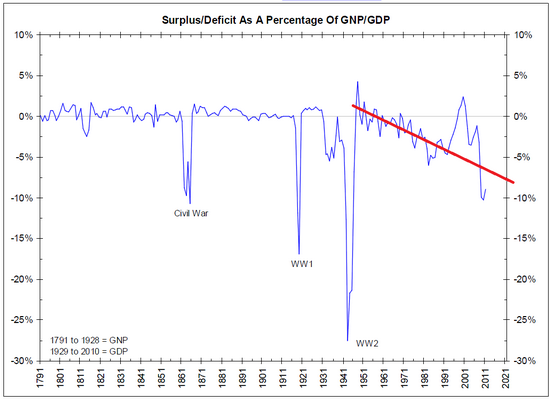
Full Employment Deficit

Wondering if something like the red line I drew might be some kind of approximation of what the ‘neutral’/full employment deficit needs to be.

The reason would be the ‘demand leakages’ that seem to grow geometrically due to tax advantages, such as funds being added to and compounding in pension funds, insurance reserves, CB reserves, etc etc etc?

If so, with the mainstream valuing lower deficits, and real limits to private sector credit expansion, seems the output gap is a whole less likely to narrow to full employment type of levels.

And the Fed could be low forever, much like Japan.

graph

Howard Dean Comments

It’s by far my #1 concern for next year.

Seth Mosler wrote:
Howard dean-major liberal, progressive–msnbc-need budget cuts now and tax increases on everyone including middle class to balance budget
cut soc sec and medicare
should start in 2011 to save our children
we have no choice
and bonds keep going down
these guys are all nuts

Comments on Robert J. Shiller Article

Glenn wrote:
Warren – would you care to comment on the ny times article by Robert Shiller?
http://www.nytimes.com/2010/12/26/business/26view.html?_r=1

He’s correct on all counts, including the point that the multiplier might not be 1.

In fact, a 1 multiplier requires all of our demand leakages (pension/ira type contributions, insurance reserves, other corporate reserves, demand for actual cash in circulation, net foreign demand to accumulate $ financial assets, etc. etc. etc.) to be offset by enough non govt sector debt expansion to make up for those ‘savings’ desires.

Sometimes that happens. In the late 90’s the domestic sector was increasing it’s ‘borrowing to spend’ by maybe 7% of gdp per year, more than offsetting the 2% or so govt surplus as well as the foreign sector savings desires. But that was unsustainable as domestic debt is ultimately limited by income, and it all came apart not long after y2k. And a few years ago we had an ok expansion going also driven by private sector debt expansion which also proved unsustainable and came to an abrupt end when the debt turned out to be largely fraudulent mtg lending, etc.

So today, with a highly subdued lending infrastructure, including regulatory over reach by bank regulators, seems to me a balanced budget expansion approach is high risk at best. The outcome could easily be a public sector expansion more than matched by a private sector setback.

However, the larger point is why not just do the spending without a tax increase? That’s sure to increase aggregate demand, and if demand pull inflation does ensue, and unemployment gets ‘too low’ (whatever that means), etc. taxes can always then be raised to cool demand.

The answer can only be that the author either doesn’t understand actual monetary operations and the monetary system fundamentally, or is afraid to say so?

Unfortunately, the ‘headline progressives’ continue to be
THE problem, imho.

A quick read of ‘The 7 Deadly Innocent Frauds’ might help:

https://moslereconomics.com/?p=8662/

I tried to connect with him when I was running for the US Senate in CT with no response.

Also, the economy did pretty well after World War II largely helped by the Marshall plan which was, functionally, a form of govt. deficit spending. We loaned Europe about $15 billion (back when that was a lot of money) to buy stuff from us, if I recall correctly. And enough of the war time deficit spending was held by soldiers coming home and others who spent from their savings for a while.

ECONOMIC VIEW
Stimulus, Without More Debt
 

THE $858 billion tax package signed into law this month provides some stimulus for our ailing economy. With the unemployment rate at 9.8 percent, more will certainly be needed, yet further deficit spending may not be a politically viable option.
 

Instead, we are likely to see a big fight over raising the national debt ceiling, and a push to reverse the stimulus we already have.
 

In that context, here’s some good news extracted from economic theory: We don’t need to go deeper into debt to stimulate the economy more.
 

For economists, of course, this isn’t really news. It has long been known that Keynesian economic stimulus does not require deficit spending. Under certain idealized assumptions, a concept known as the “balanced-budget multiplier theorem” states that national income is raised, dollar for dollar, with any increase in government expenditure on goods and services that is matched by a tax increase.
 

The reasoning is very simple: On average, people’s pretax incomes rise because of the business directly generated by the new government expenditures. If the income increase is equal to the tax increase, people have the same disposable income before and after. So there is no reason for people, taken as a group, to change their economic behavior. But the national income has increased by the amount of government expenditure, and job opportunities have increased in proportion.
 

During the Great Depression, there was a debate about “pump priming” — about whether the government had to go into debt to stimulate the economy. John Maynard Keynes, who originated the Keynesian theory in 1936, liked to emphasize that the deficit-spending multiplier was greater than 1, because the income generated by deficit spending also induces second and third rounds of expenditure. If the government buys more goods and services and there is no tax increase, people will spend much of the income that they earned from these sales, which in turn will generate more income for others, who will spend much of it too, and so on.
 

In contrast, the balanced-budget multiplier theory says that there are no extra rounds of expenditure. You get just one round of spending — meaning that the multiplier is 1.0 — but sometimes that is enough.
 

Paul Samuelson, an economist at M.I.T., first drew national attention to the balanced-budget multiplier in 1943 , seven years after Keynes introduced his theory. The multiplier was an immediate consequence of the Keynes theory, but Keynes didn’t articulate it himself.
 

Economists embraced this multiplier because it seemed to offer a solution to a looming problem: a possible repeat of the Great Depression after wartime stimulus was withdrawn, and when new rounds of deficit spending might be impossible because of the federal government’s huge, war-induced debt.
 

It turns out that this worry was unfounded. The Depression did not return after the war. But in the early 1940s, economists justifiably saw the possibility as their biggest concern. Their discussions have been mostly forgotten because they didn’t have much relevance for public policy — until now, that is, when we again have a huge federal debt and a vulnerable economy.
 

Of course, the balanced-budget theorem is only as good as its assumptions. Other possible repercussions could make its multiplier something other than 1.0. The number could be less, for example, if people cut consumption because of psychological reactions to higher taxes. Alternatively, it could be greater if income-earning people who are taxed more cut their consumption less than newly employed people increase their spending. We can’t be sure what will happen.
 

Researchers haven’t pinned down the deficit-spending multiplier either, even though that has been the focus of their efforts. In fact, a recent survey article on the effects of government stimulus by Alan Auerbach at the University of California, Berkeley, and two of his colleagues has found that “the range of mainstream estimates for multiplier effects is almost embarrassingly large.” Last month, a Congressional Budget Office study revealed similar uncertainty. The trouble comes in estimating how people will react in generating those subsequent rounds of spending.
 

But the balanced-budget multiplier is simpler to judge: If the government spends the money directly on goods and services, that activity goes directly into national income. And with a balanced budget, there is no clear reason to expect further repercussions. People have jobs again: end of story.
 

What kind of jobs? Building highways and improving our schools are just two examples — as cited in 1944 by Henry Wallich, an enthusiast of balanced-budget stimulus who would later become a Yale economist and a Federal Reserve Board governor.
 

AT present, however, political problems could make it hard to use the balanced-budget multiplier to reduce unemployment. People are bound to notice that the benefits of the plan go disproportionately to the minority who are unemployed, while most of the costs are borne by the majority who are working. There is also exaggerated sensitivity to “earmarks,” government expenditures that benefit one group more than another.
 

Another problem is that pursuing balanced-budget stimulus requires raising taxes. And, as we all know, today’s voters are extremely sensitive to the very words “tax increase.”
 

But voters are likely to accept higher taxes eventually, as they have done repeatedly in the past. It would be a mistake to consider the present atmosphere as unchangeable. It’s conceivable that an effective case will be made in the future for a new stimulus package, if more people come to understand that a few years of higher taxes and government expenditures could fix our weak economy and provide benefits like better highways and schools — without increasing the national debt.

Pre Christmas update

The good news is the US budget deficit still looks to be plenty large to support modest top line growth.

And as the deficit continuously adds to incomes and savings, the financial burdens ratios continue to fall, and the stage is set for a ‘borrow to spend’, ‘get a job buy a car’, ‘it’s cheaper to own than to rent’ good old fashioned credit expansion.

But most all of that good news may already be discounted by the higher term structure of interest rates and the latest stock market rally.

And there are troubling near term and medium term risks out there that don’t seem at all priced in.

The rise in crude prices is particularly troubling.

Net demand isn’t up, and Saudi production remains relatively low.

So the Saudis are supporting higher prices for another reason. Maybe it’s the wiki leaks, or maybe they just had a bad night in London.

No way to tell, but they are hiking prices, and there’s no way to tell when they will stop.

Crude prices are already up enough to be a substantial tax on US consumers that has probably more than offset whatever aggregate demand might have been added by the latest tax package.

Might explain the weaker than expected holiday retail sales?

Congress will soon have a deficit terrorist majority, with many pledged to a balanced budget amendment.

And the world seems to be leaning towards fiscal tightening pretty much everywhere.

The unemployment benefits program has been extended but benefits still expire after 99 weeks, and less in many states.

Net state spending continues to decline as state and local govs continue to reduce their deficits and capital expenditures.

Catchup in the funding of unfunded pension liabilities will continue to be a drag on demand.

A federal pay freeze has been proposed.

The Fed’s 0 rate policy and qe continue to reduce net interest income earned by the economy.

Bank regulators continue to impose policies that work against small bank lending.

Seems some income has likely been accelerated into this quarter from next year over prior concerns of taxes rising, distorting q4 earnings to the upside and maybe lowering q1 earnings a bit?

Euro zone muddles through with very weak domestic demand, and curves perhaps flattening as markets start to believe the ECB will fund it all indefinitely?

China slows as a result of fighting inflation?

Same with Brazil?

Maybe India as well?

Commodity price slump with demand flattening?

Fed low forever?

Stocks in a long term trading range like Japan?

US term structure of interest rates gradually flattens to Japan like levels?

Relatively weak demand gradually brings on alternatives to over priced crude?

Merry Christmas!!!

Australia

I don’t follow it at all closely but in general they have been following a policy of budget surpluses and relying on increasing levels of private sector debt to sustain aggregate demand.

That’s not sustainable, even for China’s coal mine, and especially with China showing signs of slowing down.

Retailers cry poor as sales drop sharply during Christmas period

By Nick Gardner and Brittany Stack

December 19 — MAJOR store bosses claim Australia is experiencing a retail recession, with the quietest and slowest Christmas shopping period in 20 years.

Rising utility bills, mortgage rates and rents have decimated families’ disposable incomes, forcing many retailers to start Boxing Day sales one month in advance in a bid to entice shoppers, reported The Daily Telegraph.

Harvey Norman boss Gerry Harvey said there would be “blood on the streets” in the retail sector because business is so bad, the worst since the recession of the early 1990s.

“It’s a crisis, the worst in 20 years,” he said.

“There is a recession in retail right now. Boxing Day sales have had to come early because retailers need to sell something to pay their staff.”

The news comes as the Government announced an inquiry into the future of the retail sector to examine issues of competition, and the $1000 GST and duty-free threshold on overseas shopping.

Australian retailers and shopping centre owners have formed an alliance to try to persuade the government to abolish the $1000 GST-free threshold. They plan to spend millions on an advertising campaign to try to have imported goods subject to tax and import duty. Mr Harvey is not alone in his bleak outlook.

David Jones and Myer are offering discounts of up to 40 per cent across all departments in their Sydney stores, saying it was the toughest environment for years.

“Retail is challenging right now and to drive people into stores we are offering significant discounting,” Myer spokesman Mitch Catlin said.

“Every retailer is doing it. It is the best final week I can remember for consumers going into Christmas.”

David Jones described its sales as “patchy”.

Retailers traditionally make up to a third of their annual profits in December, but sales are down across the board as stores battle plummeting sales, shrinking profit margins and increased competition from overseas websites.

Russell Zimmerman, executive director of the Australian Retailers’ Association, said he’d never seen tougher conditions in 30 years.

“We’ve had 43 per cent of our retailers reporting sales figures for the period from December 5 to 11 at below last year’s levels. To have so many suffering falling sales is terrible.”

He said consumers have been affected not only by rate rises and higher utility bills but also spooked by events overseas. “They’re seeing economies such as Greece and Ireland in crisis and they’re getting worried,” Mr Zimmerman said.

He predicted retail sales of $39.9 billion, a 3.5 per cent rise on last year or about half the usual increase. He said this may force retailers to cut staff hours or cut back on casual workers. “We’re hoping for a good last week into Christmas,” he said.

post boat ride recap and a reader’s questions answered

After my brief recap is my response to a very good and typical inquiry I thought I’d pass along.

Meanwhile, the tax cuts were extended, and perhaps a bit of restriction removed, eliminating that source of risk of a sharp contraction that could have happened otherwise.

With the 2%, 1 year reduction in FICA taxes for individuals, arguably traceable to my efforts, there was some consideration of declaring victory and moving on, but I’m feeling more the opposite.

First, it’s tiny and at the macro level the propensity to spend of the recipients is trivial.

And it probably doesn’t even offset the drag from prices for imported crude and products.

And it may just be an interim step in letting the next Congress ‘pay for it’ with Social Security cuts.

The large increase in ‘spending cutters’ are about to take their seats in Washington, with many pledged to kick things off with a $250 billion spending cut, and then balance the Federal budget, along with what could be a majority ready to pass the doomsday bill for a balanced budget amendment to the US constitution.

And a President who seems to think that’s all a good idea as well.

And my nagging feeling that a 0 interest rate policy is highly deflationary, meaning that for a given size govt we need even lower taxes than otherwise, remains.

Lastly, for this post, China has been a first half/second half story, with much of their economic year front loaded into the first half, and they have apparently capped state sponsored lending, which could mean a relatively weak first half, or worse.

The euro zone is forecasting lower growth for next year as austerity bites and the ECB’s job becomes more problematic, as slower growth will slow the ‘fiscal improvement.’

And the recent extreme absurdity of the ECB raising more capital serves to highlight the risk of having incompetents in control.

Reader’s Questions:

I continue to review your book. A question or thought I come back to a lot lately is what is the long term implication of national debt.


– Should the federal deficit and associated payments be taken completely out of the budget discussion?

Yes, especially in conjunction with a permanent 0 interest rate policy and the tsy selling nothing longer than 3 mo bills.

That seems to be what is implied on page 32, when you state that “Nor is the financing of deficit spending of any consequence”. I take that whole section to mean that in any year the ability to consume output is not impacted by prior consumption and spending rather it is impacted by the current economic environment and ability to pay, and that payment on the national debt is not an issue (just moving money from one account to another).

Right. And potential consumption is always what goods and services we are physically capable of producing.

I understand that, but does value (rather than money) get added to the economic system when the transfers are made?

Yes, what’s called ‘nominal value’ is added- net financial assets such as tsy bonds, reserves at the fed, and cash are equal to the deficit spending.

Does it have any impact on inflation or taxation?

Not the deficit per se. Govt spending can drive up/support prices if the spending is on a ‘quantity basis’ vs a price constrained basis.

For example, if the govt offers a job to anyone willing and able to work that pays $8/hour and leave the wage at that level it won’t drive up wages.

But if it decides to hire, say, 5 million people and pay what it takes to get them to work it can drive up wages.

The first example is spending on a ‘price rule’ that says $8 max

The second is spending on a quantity rule that says we pay what it takes to get 5 million workers.

I guess the simple question is if we ran deficits every year forever would pricing or wages be impacted and if so how?

The spending and taxing will have the impact. The deficit is the difference between the two and equal to new savings of financial assets added to the economy. If the deficit spending matches ‘savings desires’ that means the spending and taxing are ‘in balance’ with regards to over all pricing pressures.

Is there a national security concern by having foreign governments having huge deposits in our currency? What if China, or whoever, just started selling their positions in dollars purposely to drive down the dollar’s value, accepting the risk that it would have on its own economy?

There is the risk that China might do that.

But also note that we are currently trying to force China to adjust its currency upward, which is a downward adjustment of the dollar. So at the current time driving the dollar down is actually a national policy objective, albeit one I don’t agree with.

Also, the level of one’s currency doesn’t alter the real wealth of the nation. With imports always real benefits and exports always real costs, the challenge is to optimize ‘real terms of trade’ which means get the most imports for any given level of exports. Here, again, we are going the wrong way as a nation, attempting to increase exports to proactively get our trade gap lower.

I guess what I am trying to reconcile is that if everything has a consequence, I don’t understand what consequence deficit spending has on the long term.

It allows available savings to be added to the economy.

For a given size of govt, there is a level of taxes which keeps the real economy in balance.

Over taxing is evidenced by unemployment/excess capacity, and under taxing is evidenced by excess spending that’s causing inflation.

My assumption, based on history is that there is no consequence. My hunch is that the deficit spending is what pushes the economy along

Yes, though I like to say it’s about removing the restriction of over taxation that allows the economy to move on it’s ‘natural’ course of some sort, of course massively influenced by the rest of our institutional structure.

and supports increases in pricing, which translates into inflation. Even at 2% per year after 100 years prices would be whatever 2% compounded annually over 100 years amounts to. And, in essence that is of no consequence.

Right, while ‘a’ dollar buys less than it used, all ‘the’ dollars are buying a lot more that’s being consumed. That is, real GDP is far higher than 100 years ago.

DJ Moody’s:US Rating Could Be Negatively Affected by Tax-Cut Extension

Just in case you thought Moody’s knew anything about sovereign debt.

And how about those Democrats are using deficit terrorist rhetoric to try to fight back against the Republicans.

*DJ Moody’s Says US Sovereign Debt Rating Stable For Now
*DJ Moody’s:US Sovereign Debt Rating Stable Following Tax-Cuts Decision
*DJ Moody’s:US Rating Could Be Negatively Affected Over Longer Term By Tax-Cut Extension

DJ Moody’s Says US Sovereign-Debt Rating Stable For Now
12/07/10 12:51

NEW YORK (Dow Jones)–Moody’s Investors Service said Tuesday that the United States’ top sovereign-debt rating is stable for now, but could be negatively affected by the extension of tax cuts and if the government can’t get its growing debt under control.


Moody’s senior credit officer Steven Hess said the country’s stable outlook wouldn’t be affected by Monday’s deal to extend current tax rates for two years, reduce the payroll tax for a year, and extend unemployment benefits.


He was speaking in a telephone interview with Dow Jones Newswires Tuesday.
Moody’s rates the debt of the world’s biggest economy at Aaa, its highest rating. The stable outlook means that rating is unlikely to be changed in the next one to two years.


However, Hess said the country’s outlook could worsen if the tax cuts are extended further and no other measures, such as spending cuts, are taken to get the ballooning deficit under control.


If the current tax cuts are extended again, “clearly that makes the long-term outlook more negative” for the U.S. rating, Hess said.

Fiscal Package

Yes, at the better end of expectations, but still a small net tax increase as of year end. No actual relief for anyone.

And that’s best case. They haven’t actually passed it yet.

Austerity still going strong in the euro zone and the UK.

And China still working on slowing things down to fight inflation.

Oil prices are up which will slow things down some but not generate enough inflation for the Fed to care.

So doesn’t look like anything out there to move the needle on growth or inflation enough to get the Fed to hike any time soon.


Karim writes:

Definitely at the better end of expectations, for both the tax cuts and the unemployment benefits…

(CNN) — President Barack Obama presented congressional Democratic leaders Monday with a proposed deal with Republicans that would extend Bush-era tax cuts for two years and unemployment benefits for 13 months while also setting the estate tax at 35% for two years on inheritances worth more than $5 million, a senior Democratic source told CNN.

The deal also includes a temporary 2% reduction in the payroll tax to replace Obama’s “making work pay” tax credit from the 2009 economic stimulus package for lower-income Americans, the senior Democratic source said.

As currently crafted, the deal would prohibit amendments by either party, according to the source, who spoke on condition of not being identified by name.

euro update and why no one is leaving (yet)

As before, all that’s been done in euro land is highly deflationary.

No new euro will be spent by any govt as a result of the latest goings ons.

In fact, it’s more austerity.

And the ECB continues to do just enough to keep it all muddling through (including dictating that the new facilities be set up and activated) as it dictates terms and conditions.

And with euro zone gdp still growing (modestly) austerity still has room to slow growth before it sends it into reverse.

So why isn’t there more clamor to leave?

Simple, it’s not obvious that the currency arrangements per se are the problem.

Inflation is reasonably low, and interest rates are low, so (to the uninformed, non MMT world) how can that be the problem?

For most, the problem is obvious- same old story- their corrupt, worthless, self serving govts grossly over spent, dished it out to their banker buddies, insiders, etc., on most everything they were involved in, and now the entire nation is paying the price.

And thank goodness there were market forces in place to shut them down and stop them from turning it all into a Weimar scenario!

And this time at least they haven’t had the usual massive inflation where everyone loses their purchasing power, including those still working.

For example, those in Spain with savings can buy a lot more house than before.

The ‘good’ (prudence is considered a virtue) have sort of been rewarded.

etc.

And look how good Germany has it.

Unemployment down to 7%, driven by exports, no inflation, and they have near total fiscal domination/control (via the ECB) over the other members where they get to force austerity.

What more could they ask for?

It’s their dream come true.

So it could soon be back to strong euro, slowing growth, muddling through, until they push too far.

But even negative growth is sustainable without insolvency for as long as the ECB keeps funding it all.