
Japan intervention comments

Market Color

Short~medium term JGB rallied due to additional monetary ease expectation related to unsterilized FX intervention money.

First, intervention in this direction- buying dollars- does ‘work’ and is infinitely sustainable.
It’s a political decision, much like the ECB buying national govt. debt. There is no nominal limit.

Second, the only reason they stopped was political pressure from the US, with the then Treasury secretary resorting to name calling like ‘currency manipulator’ and ‘outlaw.’ Otherwise the yen probably would not have been allowed to go under 100.

Third, their institutional structure functions to support the classic export led growth model- suppress domestic demand with consumption type taxes, relatively tight fiscal given institutionally driven savings desires, etc.

Fourth, this strategy causes the currency to strengthen and requires the govt. buy dollars to sustain desired levels of exports and employment.

Net exports necessarily equal net domestic holdings of foreign currency. Think of it this way. If Japan sells something to the US, and we pay for it in dollars, they have two choices. Either hold the dollars, in which case nothing more happens in the real economies and Japan has net exported and the US net imported. Or buy something in the US or any other nation with the dollars and import it to Japan in which case there are no net exports.

Japanese government started FX intervention last night with JY100bn in Tokyo and continued their effort in overseas and ended up with selling JY2trn in total. Many market participants are now saying that it will lead to monetary ease since BOJ will not absorb this JY2trn from the market and this is one of the main reasons for JGB rally today. However, I don’t think it will cause any such impact since government issues T-Bill for that amount (JY2trn) anyway.

When the BOJ buys dollars for the MOF, and pays for them with yen, that adds yen deposits to the domestic economy, thereby increasing the yen net financial assets held domestically. That’s an inflationary bias which is what they are trying to do.

In the first instance those newly added yen sit as yen balances in member accounts at the BOJ. And since they earn no interest the marginal cost of funds is 0, which happens to be where the BOJ wants it anyway.

‘Sterilizing’ is simply offering alternative interest bearing accounts such as JGB’s to the holders of the clearing balances. This would need to be done if the BOJ wanted higher rates. Or, the BOJ could simply pay interest on clearing balances if it wanted higher rates.

But the quantity of balances per se is of no ‘monetary’ consequence. As I like to say, for central banking it’s necessarily about price (interest rates) and not quantities.

So with rates already at 0, there is no more ‘monetary easing’ possible. The only ‘monetary easing’ the BOJ can do at this point is bring longer rates down some, but there isn’t much scope for that either. And they probably know by now lowering long term rates does nothing of major consequence for the real economy.

The question now is how far they will go. They’d probably like the yen back to north of 100 vs the dollar, and will move slowly to see how much political pressure they get from the US as they move in that direction. In fact, they may already be getting political pressure. I don’t know either way.

With political pressure building for China to adjust their currency upward as the US elections approach, this move by Japan might attract more attention than otherwise.

The irony/tragedy for the US is, of course, we should welcome all such moves, open ourselves for virtually unlimited imports from anywhere in the world (with sufficient quality control restrictions- no poison dog food, contaminated wall board, etc.), and enjoy the tax cut that comes along with it so we have sufficient purchasing power to be able to buy all of our own domestic output at full employment plus whatever the rest of the world wants to net export to us.

And apparently that’s a LOT right now. So with current policy of grossly overtaxing us for the size govt. we currently have, the losses of grossly over taxing ourselves may be north of 30% of US gdp, which is a staggering loss for us, and gone forever.

The only thing between what we have now and unimaginable prosperity remains the space between the ears of our policy makers, etc.

Please feel free to distribute, plagiarize, post anywhere, whatever!

*Rinban Result*

*upto 1yr to maturity (310bn)

Highest: +0.1bp
Average: +0.3bp
Allocation: 27.7%

* 1yr~10yr to maturity (250bn)

Highest: +1.5bp
Average: +2.1bp
Allocation: 19.0%
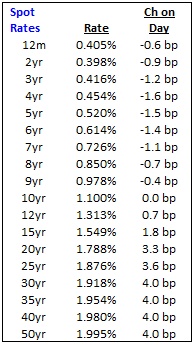
table

7 more weeks until Nov 2

The election is November 2.

All contributions I receive are used to promote my message above and beyond what I was going to spend anyway.

And, in a recent development, the actual number of people donating is suddenly a criteria to get into the televised debates.

For that purpose a $25 donation counts the same as a $2,400 donation which is the max allowed.

So if you’re interested in making a contribution please do so by clicking here

(If you have a problem with the link let me know asap!)

Thanks again to all of you who have already done so- you have been heard!
MMT is all over the internet, and quickly being recognized in academic and financial circles

Most of the talk of a payroll tax holiday can be traced directly to our efforts,

And the ideas that:

Federal taxes function to regulate demand, and not to fund expenditures,

The US, UK, Japan, etc. are not the next Greece

Social security isn’t broken

The only thing we owe China is a bank statement

Federal borrowing is nothing more than shifting dollars from reserve accounts to securities accounts

etc. etc.

are gaining substantial traction,
though clearly are not yet in the mainstream media the way the payroll tax holiday is.

Anyway, I’m standing by to act as your agent.

The maximum contribution to Mosler for Senate is $2,400 per person,
but additional donations up to a max of $5,000 per person are allowed to the Indendent Party of Connecticut,
where all donations will go to support the same message, as all of our candidates have read ‘The 7 Deadly Innocent Frauds’
and are ‘onboard’ with using any donations to support that message.

And no worries to those who don’t contribute for any reason- completely understood!!!
If you do something, it’s for yourself, your family, the world, etc, but not for me!
(I take what the market gives me. If I don’t get into the debates I get to do something more fun those nights.
If I do get in, it’s your fault…)

This email is for information purposes only, not active solicitation!

And again, thanks very much to all who’ve contributed in any amount,
and especially those that have done their part to spread the word.

Best!
Warren

Fears Grow over the Fate of Irish Economy, Banks

The two external shocks of the summer were China, which historically has had second half slowdowns due to State lending front loaded to the first half, and the euro zone which became a ward of the ECB. China’s growth has slowed some, but not collapsed, and the ECB has continued its support of euro member solvency and funding capability in the short term markets.

There was no credible deposit insurance for the euro zone banks until the ECB ‘wrote the check’ by buying national govt debt in the secondary markets. It’s not the most efficient way to do things, but it does work to facilitate national govts being able to fund themselves, though mainly in the very short term markets (I still see my per capita distribution proposal as the better policy response). And that ability of the member nations to fund themselves means they can write the check for deposit insurance as needed.

The ECB also imposed ‘terms and conditions’ along with funding assistance, and as long as Ireland is in compliance, the ECB is for the most part responsible for the outcomes, so it seems logical the ECB will continue its support, perhaps changing its terms and conditions if not pleased with the outcomes. Additionally, the ECB will continue to supply liquidity directly to the banks, again, as with Ireland complying with the terms and conditions the ECB is now responsible for the outcomes.

But there is no question it is all a precarious brew, and there is no telling what might result in the ECB withdrawing support, so at this time steep yield curves for euro member nations due to credit risk make perfect sense.

Also, Europe and the rest of the world would like nothing more than to increase net exports to the US.

It’s all a golden opportunity for a decade or more of unparalleled US prosperity if we knew enough to again become the ‘engine of growth’ and implement the likes of a full payroll tax (FICA) holiday to provide Americans working for a living enough spending power to buy both everything we could produce at full employment and all the rest of the world wants to net sell us.

Unfortunately the deficit myths continue to cast a wet blanket over domestic demand as our leaders continue to let us down.

And with maybe 100 new Congressmen on the way, with most supporting a balanced budget and a balanced budget amendment which already has maybe 125 votes, there’s more than enough fiscal responsibility looming to create a true depression.

Hopefully their tax cutting agenda outweighs their balanced budget agenda.

And hopefully we get some kind of energy policy to decouple GDP growth from a spike in energy consumption.

Fears Grow over the Fate of Irish Economy, Banks

By Patrick Allen

September 8(CNBC) — The fate of the Irish economy is back in focus for investors across the world, after the former Celtic Tiger extended guarantees to its banking industry and depositors and with the spread on Irish bonds hitting record highs.

The country is also waiting for a decision from the European Commission on the fate of Anglo Irish, the troubled bank that was nationalized two years ago; uncertainty on whether Anglo Irish will be wound down or allowed to survive has weighed on sentiment towards the country.

Ireland is an example of a Western economy adjusting to both the banking crisis and, crucially, the emergence of Asia, Amit Kara, an economist at Morgan Stanley, said.

“Ireland has taken steps to overcome the hangover from the credit boom, but a successful outcome requires the economy to become more competitive and also, and more crucially, a global economic recovery,” Kara said.

He is confident the Irish economy will be able to roll over debt in the coming weeks and sees the chance for Irish debt to outperform the likes of Spain.

“Though Ireland faces serious long-term challenges, its liquidity position is healthy and its banks should have sufficient ECB-eligible collateral to significantly offset the funding impact of upcoming debt redemptions,” Kara explained.

“Given the underperformance of recent weeks, we see scope for Irish bonds to regain some ground against Portugal and Spain in particular, once the initial round of government-guaranteed bond redemptions has taken place over the first two weeks of September,” he added.

What is on Ireland’s Books?

The Irish banking system remains hooked on European Central Bank funding and investors are also worried about the risks posed by the scale of liabilities following Ireland’s decision to guarantee the country’s lenders.

Press Release

MOSLER FOR SENATE

Tea Party’s Economic Agenda Would Cause Next Great Depression
Says Former Tea Party Democrat


Waterbury, CT – August 30, 2010, Warren Mosler, Independent candidate for US Senate, former Tea Party Democrat, and frequent speaker at Tea Party rallies, lashed out today at the political movement for its ill-thought demands to balance the budget which he contends is based on abject ignorance and counter to true Tea Party values. “The Tea Party’s demands to balance the budget and reduce the Federal deficit aren’t merely misguided, but dangerous, and would cause the worst depression in history,” stated Mosler, a financial expert with 37 years of experience in monetary operations. “I have been, and continue to be, a strong supporter of the core Tea Party values of lower taxes, limited government, competitive market solutions, and a return to personal responsibility. However, their proposals to balance the budget are the same suicidal policies that caused the 6 horrible depressions in the U.S. over the past 200 years. At the worst possible time to take money out of the economy, the Tea Party’s proposals would remove an estimated $1 trillion and cause the worst depression in world history, destroying tens of millions of jobs and ruining our children’s future.”

Explanation of the Modern Monetary System
Modern money, after the demise of the gold standard, is akin to a spreadsheet that simply works by computer. As Fed Chairman Bernanke explained on national television on 60 minutes, when the government spends or lends, it does so by adding numbers to private bank accounts. When it taxes, it marks those same accounts down. When it borrows, it simply shifts funds from a demand deposit (called a reserve account) at the Fed to a savings account (called a securities account) at the Fed. The money government spends doesn’t come from anywhere, and it doesn’t cost anything to produce. The government therefore cannot run out of money, nor does it need to borrow from the likes of China to finance anything. To better understand this, think about when a football team kicks a field goal; the number on the scoreboard goes from 0 to 3. Does anyone wonder where the stadium got those 3 points, or demand that the stadium keep a reserve of points in a “lock box”?

Moreover, government deficits ADD to our savings – to the penny – as a fact of accounting, not theory or philosophy. This means the Mosler payroll tax (FICA) holiday will directly increase incomes and savings, thus fixing the economy from the bottom up. For example, if the Mosler tax cut amounts to $20 billion per week, that will be the exact increase in income and savings for the rest of us as anyone in the Congressional Budget Office will confirm. For the Federal government, taxes don’t serve to collect revenue but are more like a thermostat that controls the temperature of the economy. When it is too hot, raising taxes will cool it down. And in this ice-cold economy, a very large tax cut is needed to warm the economy back up to operating temperature.

While Mosler fully supports the Tea Party desire to cut taxes, and recognizes the need to cut wasteful and unnecessary spending – in fact, his economic proposals will save the government hundreds of billions of dollars of unnecessary interest expense – he also recognizes that tax cuts have to be much larger than spending cuts in order to ensure that less money is taken out of the economy, and not more as the Tea Party is currently demanding.

About Warren Mosler
Warren Mosler is running as an Independent. His populist economic message features: 1) a full payroll tax (FICA) holiday so that people working for a living can afford to buy the goods and services they produce. 2) $500 per capita Federal revenue distribution for the states 3) An $8/hr federally funded job to anyone willing and able to work to facilitate the transition from unemployment to private sector employment. He has also pledged never to vote for cuts in Social Security payments or benefits. Warren is a native of Manchester, Conn., where his father worked in a small insurance office and his mother was a night-shift nurse. After graduating from the University of Connecticut (BA Economics, 1971), and working on financial trading desks in NYC and Chicago, Warren started his current investment firm in 1982. For the last twenty years, Warren has also been involved in the academic community, publishing numerous journal articles, and giving conference presentations around the globe. Mosler’s new book “The 7 Deadly Innocent Frauds of Economic Policy” is a non technical guide to the actual workings of the monetary system and exposes the most commonly held misconceptions. He also founded Mosler Automotive, which builds the Mosler MT900, the world’s top performance car that also gets 30 mpg at 55 mph.
Learn more at www.moslerforsenate.com


Media Contact:
Will Thompson
(267) 221-6056
will@hedgefundpr.net

Europe Loan Growth Accelerates as Economy Recovers

Europe Loan Growth Accelerates as Economy Recovers

By Christian Vits

Aug. 26 (Bloomberg) — Loans to households and companies in Europe grew at the fastest pace in 13 months in July after the economic recovery gathered steam.

Loans to the private sector rose 0.9 percent from a year earlier after growing an annual 0.5 percent in June, the European Central Bank in Frankfurt said today. That’s the strongest increase since June 2009. M3 money supply, which the ECB uses as a gauge of future inflation, increased an annual 0.2 percent in July, the same rate recorded in the previous month.

Strengthening global demand helped Europe’s economy expand 1 percent in the second quarter, the fastest pace in four years.

Economic growth may slow as governments reduce spending to tackle bloated budget deficits and the global recovery shows signs of losing momentum. Orders for durable goods in the U.S.

increased less than forecast in July, a sign one of the few remaining bright spots in the economy is cooling, while China’s industrial output rose the least in 11 months.

This is what the Fed calls the ‘hand off’ with private sector demand increasing via credit expansion as growth causes public sector deficits to fall.

Growth can go on for many years until the public sector deficits get too small to provide the income and financial equity needed to support the increasing private sector debt needed to sustain GDP growth.

Much of Europe got to higher levels of govt deficit spending than the US, before market forces triggered the funding crisis. The ECB has now stepped in to facilitate funding and at the same time implement the widely advertised austerity measures.

With modest growth deficits will start trending down on their own, as revenues increase and transfer payments (including interest payments) moderate, as private sector credit expansion replaces public sector debt as described above.

markets looking grim

>   
>   (email exchange)
>   
>   On Tue, Aug 24, 2010 at 8:32 AM, Seth wrote:
>   
>   stocks look bad
>   looks like another panic
>   

It doesn’t look good technically.

Must be coming out of europe with gold up/euro down dynamic, etc.

Insiders there must be bailing.

Maybe they know something we don’t, or maybe they are wrong.

History is no help as in the past it’s been both.

Austerity is trimming growth there a bit around the edges, but deficits remain reasonably high, so GDP’s are probably at least muddling through, with overall growth probably positive.

The ECB keeps the short term funding channels open for the member nations, but that may not be fully appreciated yet.

On a mark to market basis bank capital is probably below requirements, and they may not realize that doesn’t have to matter to the real economy for as long as the ECB continues to fund them.

Lower crude oil prices support consumption of other things. With US crude oil product consumption up and Saudi output rising, demand must be ok. Maybe Saudis are worried and want lower prices to help world growth as well. Hard to ever say what they are actually up to. They may see the Iraqi production coming on stream and are trying to engineer an increase in demand. Again, no way to tell what they are up to.

The lower 10 year rates reflects expectations of ‘low for longer’ from the Fed due to high unemployment and falling rates of inflation as measured by the Fed. And the possibility of more QE that could flatten the curve further.

There is also the notion that there’s nothing left that the Fed can do of any consequence regarding aggregate demand, and Congress thinks it’s run out of money, which means flying without a net. That increases the weight of the downside in the balance of risks.

If markets and Congress knew that fiscal policy had no nominal limit and deficit spending was not dependent on being able to borrow from the likes of China to be paid by our grandchildren, the balance of risks would be viewed very differently. But they don’t know that.

With the elections coming and California reverting to vouchers again, the time is right for my per capita revenue sharing. But it’s not even a consideration.

Q3 and Q4 GDP estimates are looking more like 1.5%, and Q2 looks to be revised down toward 1% Friday. Not a double dip but no drop in unemployment either as productivity might be at least that high. That’s worse politically than it is for equities, and adds support for a ‘second stimulus’ type of reaction. But that’s way down the road. More likely it causes most of the expiring tax cuts to be extended.

Thursday’s claims can make a big difference as well. The jump to 500,000 last week added an element of fear internationally.

Also, in thin summer markets technicals often cause exaggerated moves. Volume is very low, and a given size buying or selling causes larger moves to find someone willing to take the other side, and momentum type traders can easily overwhelm investors.

China reduces long term treasuries by record amount

Notice US Tsy yields fell to their lows even with China reducing holdings.
The fear mongerers will just tell us to thank goodness someone else came in to replace them, and that without the Fed buying it’s all over for the US, etc.
To which I say, it’s just a reserve drain, get over it!
And if you don’t understand that, try educating yourself before you sound off.

Interesting they are letting overseas banks invest in their bond markets.
Maybe a move to help strengthen their currency?
They can see the $ reserves aren’t coming in as before?
Or overseas banks bought their way in, looking to profit?
Or the next generation western educated Chinese thinks an expanded financial sector is a prerequisite to growth?
In any case, looks like another western disease has spread to China.

China Headlines,
China Threatened By Export Risk After Eclipsing Japan

China Reduces Long-Term Treasuries by Record Amount

China Economic Index Rises, Conference Board Says

China to Let Overseas Banks Invest in Bond Market

China Lags Behind on Key Measures After Surpassing Japan: Govt

Foreign Investment in China Climbs for 12th Month

Yuan Gains Most Since June as China Favors Greater Volatility

China Copper Consumption Growth to Slow, Antaike Says

Hong Kong Jobless Rate Slides to Lowest in 19 Months

Singapore Exports Cool as Government Predicts Slowing Demand

China Reduces Long-Term Treasuries by Record Amount

By Wes Goodman and Daniel Kruger

August 17(Bloomberg) — China cut its holdings of Treasury notes and bonds by the most ever, raising speculation a plunge in U.S. yields has made government securities unattractive.

The nation’s holdings of long-term Treasuries fell in June for the first time in 15 months, dropping by $21.2 billion to $839.7 billion, a U.S. government report showed yesterday. Two- year yields headed for a fifth monthly decline in August, falling today to a record 0.48 percent.

Two-year rates will rise to 0.85 percent by year-end as the U.S. economy rebounds in 2010 from a contraction in 2009, according to Bloomberg surveys of financial companies. Reports today will show improvement in housing and manufacturing, signs of stability even as growth is less than expected, analysts said.

“Buying now is a big risk,” said Hiroki Shimazu, an economist in Tokyo at Nikko Cordial Securities Inc., a unit of Japan’s third-largest publicly traded bank. “I don’t recommend it. The economy is stable.”

Investors who purchased two-year notes today would lose 0.4 percent if the yield projection is correct, according to data compiled by Bloomberg.

The economy will expand at a 2.55 percent rate in the last six months of 2010, according to the median of 67 estimates in a Bloomberg survey taken July 31 to Aug. 9, down from the 2.8 percent pace projected last month.

Housing, Production

China’s overall Treasury position fell for a second month in June to $843.7 billion.

“This may have been opportunistic,” said James Caron, head of U.S. interest-rate strategy at Morgan Stanley in New York, one of 18 primary dealers that trade with the Federal Reserve. “Look at the level of yields. If you’ve held a lot of Treasuries, you’ve done well.”

The People’s Bank of China on June 19 ended a two-year peg to the dollar, saying it would allow greater “flexibility” in the exchange rate. The currency has since strengthened 0.5 percent.

The central bank limits appreciation by selling yuan and buying dollars, a policy that has contributed to its accumulation of the world’s largest foreign-exchange reserves and led to the build-up of its Treasury holdings.

Domestic Investors

Treasury yields fell as U.S. investors increased their holdings to 50.5 percent, the biggest share of the debt since August 2007 at the start of the financial crisis, amid signs that a recovery from the longest contraction since the Great Depression has lost momentum.

U.S. reports last week showed retail sales increased in July less than economists forecast and inflation held at a 44- year low.

The two-year note yielded 0.50 percent as of 12:19 p.m. in Tokyo. The 0.625 percent security due in July 2012 traded at a price of 100 7/32, according to data compiled by Bloomberg.

China, with $2.45 trillion in foreign-exchange reserves, turned bullish on Europe and Japan at the expense of the U.S.

The nation has been buying “quite a lot” of European bonds, said Yu Yongding, a former adviser to the People’s Bank of China who was part of a foreign-policy advisory committee that visited France, Spain and Germany from June 20 to July 2. Japan’s Ministry of Finance said Aug. 9 that China bought 1.73 trillion yen ($20.3 billion) more Japanese debt than it sold in the first half of 2010, the fastest pace of purchases in at least five years.

Diversification Strategy

“Diversification should be a basic principle,” Yu, president of the China Society of World Economy, said in an interview last week, adding a “top-level Chinese central banker” told him to convey to European policy makers China’s confidence in the region’s economy and currency. “We didn’t sell any European bonds or assets. Instead we bought quite a lot.”

China held 10 percent of the $8.18 trillion of outstanding Treasury debt as of July. Investors in Japan hold the second- largest position in Treasuries with $803.6 billion of the securities, or 9.8 percent. Total foreign holdings rose 1.2 percent to a record $4.01 trillion, the Treasury said. China’s holdings peaked in July 2009 at $939.9 billion.

China needs a strong U.S. dollar, said Kenneth Lieberthal, a senior fellow specializing in China at the Brookings Institution, a research group on Washington.

“I don’t think we’re going to see any massive flight from China’s holdings of U.S. debt,” Lieberthal said on Bloomberg Television. “That would be self defeating and they well recognize that.”

China to Let Overseas Banks Invest in Bond Market

August 17 (Bloomberg) — China will let overseas financial institutions invest yuan holdings in the nation’s interbank bond market in a pilot program to spur currency flows from abroad.

The People’s Bank of China will start with foreign central banks, clearing banks for cross-border yuan settlement in Hong Kong and Macau, and other international lenders involved in trade settlement, according to a statement on its website today.

“It’s a big boost for the offshore renminbi market,” said Steve Wang, a credit strategist for Bank of China International Securities Ltd. in Hong Kong. It “would allow offshore holders of yuan to invest the money directly in China rather than going through middlemen. It’s a step in the right direction that really opens the domestic securities market.”

The move comes as China seeks to broaden the use of its currency. The nation approved use of the yuan to settle cross- border trade with Hong Kong in June 2009, part of a drive to reduce reliance on the U.S. dollar. The popularity of that program was limited by the investments available in the currency.

Each overseas bank needs a special account at a local lender for debt transaction clearing, according to the regulations, which come into effect from today. Overseas banks must first apply for investment quotas on the interbank market, the central bank said. Foreign central banks should disclose funding sources and investing plans in their applications, according to the central bank.

There were a total 14.3 trillion yuan ($2.1 trillion) of bonds on the interbank market as of June, including debt issued by the central government, banks and companies, the central bank said July 30. That amount accounted for 97 percent of total debt outstanding.

Yuan Deposit Growth

Yuan deposits in Hong Kong climbed 4.8 percent in June to a record as China ended a two-year peg against the dollar. Currently, trade is the main way for offshore holders of yuan to return money to China, Wang said.

The program is a step forward to internationalization of the renminbi, said Dariusz Kowalczyk, a currency strategist at Credit Agricole CIB in Hong Kong. The Chinese currency, the yuan, is also known as the renminbi.

“By opening the new avenue to invest Chinese yuan funds, the currency will become more attractive and may come under further upward pressure in the offshore market in Hong Kong,” Kowalczyk said. “Foreign central banks may decide to begin the process of diversifying their reserves into Chinese yuan.”

China buying euros

China shifting towards euro buying might indicate they want to beef up exports to the eurozone.

And China probably knows with the credit issues in Europe the last thing the euro zone can do is discourage them from buying euro national govt debt.

Wouldn’t even surprise me if China cut a deal with the ECB to backstop any credit issues before buying as well.

If so, it’s a nominal wealth shift from the euro zone to China as the euro zone national govts pay them a risk premium and then the ECB guarantees the debt.

China is even buying yen, highlighted below, indicating they may be trying to slow imports from Japan and maybe even increase exports to Japan as well.

And Japan my already be quietly buying $US financial assets as indicated by their rising holdings of US Treasury securities.

Looks like a floating exchange rate version of the gold standard ‘beggar they neighbor’ trade wars may be brewing.

This would be an enormous benefit for the US if we knew how to use fiscal policy to sustain domestic demand at full employment levels.

China Favors Euro to Dollar as Bernanke Shifts Course

By Candice Zachariahs and Ron Harui

August 16 (Bloomberg) — China, whose $2.45 trillion in foreign-exchange reserves are the world’s largest, is turning bullish on Europe and Japan at the expense of the U.S.

The nation has been buying “quite a lot” of European bonds, said Yu Yongding, a former adviser to the People’s Bank of China who was part of a foreign-policy advisory committee that visited France, Spain and Germany from June 20 to July 2. Japan’s Ministry of Finance said Aug. 9 that China bought 1.73 trillion yen ($20.1 billion) more Japanese debt than it sold in the first half of 2010, the fastest pace of purchases in at least five years.

“Diversification should be a basic principle,” Yu said in an interview, adding a “top-level Chinese central banker” told him to convey to European policy makers China’s confidence in the region’s economy and currency. “We didn’t sell any European bonds or assets, instead we bought quite a lot.”

China’s position may make it harder for the greenback to rebound after falling as much as 10 percent from this year’s peak in June as measured by the trade-weighted Dollar Index. The nation cut its holdings of U.S. government debt by $72.2 billion, or 7.7 percent, through May from last year’s record of $939.9 billion in July 2009, according to the Treasury Department, which releases new data today.

U.S. Concerns

Concern the U.S. economy is faltering was underscored by the Federal Reserve on Aug. 10. Chairman Ben S. Bernanke said the central bank will reinvest principal payments on its mortgage holdings into Treasury notes to prevent money from being drained out of the financial system, its first expansion of measures to spur growth in more than a year.

“The pace of economic recovery is likely to be more modest in the near term than had been anticipated,” the Federal Open Market Committee said in a statement after meeting in Washington. “The Committee will keep constant the Federal Reserve’s holdings of securities at their current level.”

Asian central banks holding some 60 percent of the world’s foreign-exchange reserves are turning away from the dollar. Concerned about weakening U.S. growth and the Treasury’s record borrowing, they are switching toward euro assets to safeguard reserves, driving gains in the 16-nation currency. South Korea, Malaysia and India reduced their holdings of Treasuries, U.S. government data show.

Cutting Treasuries

The allocations to dollars in official foreign-exchange reserves declined in the first three months of the year, to 61.5 percent from 62.2 percent in the final quarter of 2009, the International Monetary Fund said June 30.

The yen’s share was 3.1 percent, up from 3 percent, The euro’s was 27.2 percent, little changed from 27.3 percent, even after the currency tumbled 5.7 percent versus the dollar during the first quarter on speculation that nations including Greece will struggle to rein in their budget deficits.

“Short of concerns of a default, the investor community in terms of big reserve managers will probably be forced to invest in the euro zone,” said Dwyfor Evans, a strategist in Hong Kong at State Street Global Markets LLC, part of State Street Corp. which has $19 trillion under custody and $1.8 trillion under management. “They can’t be putting all of their eggs in one basket, which is U.S. Treasuries.”

Dollar Index

The Dollar Index’s 5.2 percent drop in July, the biggest decline in 14 months, failed to dissuade most foreign-exchange forecasters from predicting the greenback will strengthen against the euro and yen by December.

The dollar traded at $1.2817 per euro as of 7:13 a.m. in New York from $1.2754 last week, when it rose 4.1 percent. The greenback was at 85.60 yen after falling to 84.73 yen on Aug. 11, the weakest since July 1995.

The U.S. currency will climb to $1.23 per euro by Dec. 31 and to 92 yen, based on median estimates of strategists and economists in Bloomberg surveys. Economists forecast U.S. growth will be 3 percent this year, compared with 1.2 percent for the region sharing the euro and 3.4 percent for Japan.

“There’s no sign of panic or urgency from the Fed and that supports our view that this is a temporary soft patch and the U.S. economy will fight its way through,” said Gareth Berry, a Singapore-based currency strategist at UBS AG, the world’s second-largest foreign-exchange trader. UBS forecasts the dollar will rise to $1.15 per euro and 95 yen in three months.

Slower Growth

Japan’s economy expanded at the slowest pace in three quarters, missing the estimates of all economists polled, the Cabinet Office said today in Tokyo. Gross domestic product rose an annualized 0.4 percent in the three months ended June 30, compared with the median estimate in a Bloomberg survey for annual growth of 2.3 percent.

Slowing purchases of Treasuries by Asian nations haven’t hindered President Barack Obama’s ability to finance a projected record budget deficit of $1.6 trillion in the year ending Sept. 30. Investor demand for the safest investments compressed yields on benchmark 10-year Treasury notes to a 16-month low of 2.65 percent today, even after the U.S.’s publicly traded debt swelled to $8.18 trillion in July.

U.S. mutual funds, households and banks in May boosted their share of America’s debt to 50.2 percent, the first time domestic investors owned more Treasuries than foreign holders since the start of the financial crisis in August 2007.

‘Concrete Steps’

Chinese Premier Wen Jiabao urged the U.S. in March to take “concrete steps” to reassure investors about the safety of dollar assets. The nation, which is the largest overseas holder of Treasuries, trimmed its stockpile of U.S. debt to $867.7 billion in May, from $900.2 billion in April and a record $939.9 billion in July 2009.

Increases to its holdings made between June 2008 and June 2009 amid the global financial crisis were mostly in short-term securities, signaling a “lack of confidence” in the U.S. ability to reduce its debt, UBS said in a research note Aug. 9.

“China has confidence in Europe’s economy, in the euro, and the euro area,” Yu said. A member of the state-backed Chinese Academy of Social Sciences, Yu was selected by the official China Daily to question Treasury secretary Timothy F. Geithner during his June 2009 visit to Beijing about risks the U.S.’s budget deficit will undermine the value of its debt.

Chinese Purchases

Chinese purchases of Europe’s bonds come in the wake of measures taken by European policy makers to allay concern the sovereign-debt crisis will threaten the single-currency union. In May, they announced a loan package worth as much as 750 billion euros ($956 billion) to backstop euro-area governments.

That month, foreign investors were net buyers of euro-zone debt as the 16-nation currency plummeted by the most since January 2009. Foreigners purchased 37.4 billion euros of bonds and notes after buying 49.7 billion euros in April, the latest data from the European Central Bank show.

China’s concern is mirrored by neighboring central banks that are building up foreign-exchange reserves as they sell local currencies to maintain the competiveness of exporters, according to Faros Trading LLC, which conducts currency transactions on behalf of hedge funds and institutional clients.

Indonesia’s central bank and Thailand’s prime minister said in the past month they are watching the performance of their nation’s currencies amid speculation gains will curb exports. Taiwan’s dollar has depreciated in the final minutes of trading on most days in the past four months as policy makers bought dollars, according to traders familiar with the central bank’s operations who declined to be identified. Exports account for about two-thirds of Taiwan’s gross domestic product.

‘Rapidly Diversifying’

“Asian central banks, other than China, don’t want to be caught holding all of the dollars when China is rapidly diversifying,” said Brad Bechtel, a Connecticut-based managing director with Faros Trading. “When sentiment shifts and people start getting very bearish on the euro again, beware central banks might be aggressively buying euros on the other side.”

The yen has climbed 8.4 percent against the dollar this year. China bought a net 456.4 billion yen of Japanese debt in June, after purchasing 735.2 billion yen in May, which was the largest in records dating from 2005, according to Japan’s Ministry of Finance data.

“China’s policy of steady and relatively rapid accumulation of foreign-exchange reserves means they have to be invested somewhere,” said Greg Gibbs, a currency strategist at Royal Bank of Scotland Group Plc in Sydney. “It is easy to imagine that given the low yields in the U.S. and the debt crisis in Europe, China is now willing to invest more of these reserves in the yen.”

Lowe’s misses, but sales and earnings rise

Negative headline for a slight miss, and 3.8% top line growth and double digit earnings growth year over year.

And that is in Q2 where GDP growth was probably only 1% or so, and still looking a bit higher for Q3, supported by ongoing 8%+ federal budget deficits.

Not a good economy for sure, as shockingly high unemployment continues and the federal govt does nothing to further support aggregate demand, because they all believe the myth that the federal govt has run out of money and in order to spend have to borrow from the likes of China and leave the debts for our children to pay back.

Lowe’s results miss estimates

August 16th (Reuters) — Home improvement chain Lowe’s Cos missed quarterly profit and sales estimates as benefits from the homebuyer tax credit and cash for appliances programs waned.

Net income rose to $832 million, or 58 cents a share, in the second quarter ended July 30 from $759 million, or 51 cents a share, a year earlier.

Analysts on average were expecting 59 cents a share, according to Thomson Reuters I/B/E/S.

Sales rose 3.8 percent to $14.36 billion, but missed the average estimate of $14.52 billion.

China Seen Robbing Consumers With Low Interest Rates

Looks like someone’s catching on to the interest rate channel. And Bloomberg is reporting it.

(Bloomberg never reported it when I communicated with them.)

China Seen Robbing Consumers With Low Interest Rates

Aug 6 (Bloomberg) — Peking University professor Michael
Pettis was discussing declining bank-deposit returns when a
student interrupted with a story about her aunt that may stymie
China’s plan to boost consumer spending.

“To send her son to university in six years it means she
must replace each yuan in lost income with one from her wages,”
the student said, according to Pettis.

The government’s policy of keeping interest rates low to
reduce the burden of soaring municipal debt is costing savers as
much as 1.6 trillion yuan ($236 billion) a year in lost income
on bank deposits, according to Pettis, former head of emerging
markets at Bear Stearns Cos. To make up the shortfall, savers
have to set aside a larger proportion of wages, undermining
China’s efforts to counter slower export growth with consumer
spending at home.

“Consumption is already at a dangerously low level,” said
Pettis, author of the “The Volatility Machine,” a 2001 book
that examines financial crises in emerging markets. “If it
doesn’t begin to rise very quickly, China has a problem because
household consumption will continue to drop as a share of GDP.”

Emphasis on exports and investments have caused domestic
consumption to fall to 35 percent of gross domestic product, the
lowest of any major economy, from 45 percent a decade ago,
Societe Generale AG says.

Pettis isn’t alone in being skeptical about a consumer boom
in China. Yale University finance professor Chen Zhiwu and Huang
Yasheng at the Massachusetts Institute of Technology also
predict constrained consumer spending.

State Controlled

Chen estimates the state controls 70 percent of the
nation’s assets and says most of its profits don’t flow to
consumers. On an inflation-adjusted basis government income
surged more than tenfold in the past 15 years while disposable
urban income increased less than three times, he said.

Pettis said the drag on consumer spending from depressed
deposit rates may help slash China’s annual economic expansion
to between 5 and 7 percent a year through 2020, from an average
of about 10 percent in the past decade.

The Group of 20 nations has urged China to boost domestic
consumer spending to help offset reduced consumption from debt-
strapped consumers in the U.S. and Europe. If Chinese shoppers
fail to take over that mantle as the government’s 4 trillion
yuan in stimulus wanes, then the nation may have to fall back on
exports for growth. That would revive trade disputes with the
U.S., which is battling 9.5 percent unemployment, said Huang.

Trade Tensions

“I do not see how trade tensions can be avoided,” said
Huang, a professor at MIT’s Sloan School of Management in
Cambridge, Massachusetts, and author of “Capitalism with
Chinese Characteristics: Entrepreneurship and the State.”
“Even in the best-case scenario I do not see household
consumption replacing investment as a driver of growth in the
foreseeable future.”

China’s leaders have vowed to boost consumption’s share of
GDP since at least 2006 — so far to no avail. The ratio of
consumption in China’s economy is about half that of the U.S.,
and about 60 percent of both Europe and Japan, according to
Credit Agricole CIB.

China’s past development has created an “irrational
economic structure” and “uncoordinated and unsustainable
development is increasingly apparent,” said Vice Premier Li
Keqiang in a June article in the government-owned Qiu Shi
magazine. Long-term dependence on investment and exports for
growth “will grow the instability of the economy,” he said.

Low Rates

Pettis computes the 1.6 trillion yuan in lost returns to
savers by comparing the difference between China’s nominal
deposit and growth rates to those in other emerging markets.
That calculation indicates China’s deposit rates should be at
least 4 percentage points higher, he said.

“The government maintains a cap on deposit rates, which
helps prop up bank profits, but only by spreading the cost to
households in the form of artificially low interest returns,”
said Mark Williams, an economist at Capital Economics Ltd. in
London who worked at the U.K. Treasury as an adviser on China
from 2005 to 2007.

China has left interest rates unchanged since December 2008,
even as countries from Malaysia to Taiwan, South Korea and India
raised them. The central bank sees little need for an imminent
increase, the International Monetary Fund said in a staff report
on July 29 after consultation with the Chinese government.

China’s inflation, near a two-year high of 2.9 percent in
June, is also eroding household savings. That may cause people
to spend less and save more to cover rising costs of healthcare,
pensions and children’s education, said Pettis. The one-year
deposit rate is 2.25 percent.

Lost Returns

In June 2009 savers earned a real return on one-year
deposits of 3.95 percent. That slumped to a negative 0.65
percent in June this year, indicating lost returns to savers of
1.8 trillion yuan annually compared with a year earlier. Pettis
estimates China’s household deposits account for 60 percent of
total deposits, or about 40 trillion yuan.

Chinese investors have few appealing options. Capital
controls inhibit citizens from investing overseas. A crackdown
on property speculation may cause property prices to fall as
much as 30 percent in the next 12 months, according to Barclays
Capital. The Shanghai Composite Index, up 0.1 percent as of the
11:30 a.m. local time break in trading, has slumped about 20
percent this year.

Pettis said the 3.06 percentage-point spread between
deposit and lending rates that is set by the central bank will
help banks pay for potential bad loans after an 18-month lending
boom that was almost as big as the U.K.’s gross domestic product.

Bad Loans

“Evidence is mounting that the lending spree not only has
created bad loans but is now constraining monetary policy,”
said Huang.

Concern about potential losses in the financial system may
deepen after China’s banking regulator decided to conduct stress
tests of the nation’s lenders. The tests include a worst-case
scenario of property prices falling as much as 60 percent in
cities where they have risen significantly, a person with
knowledge of the matter said.

Banks could be saddled with bad loans of more than $400
billion, said Jim Walker, chief economist at Hong Kong-based
Asianomics Ltd.

Some economists argue that surging retail-sales figures and
rising wages show China’s shift to greater consumer spending is
on track. Dariusz Kowalczyk at Credit Agricole CIB in Hong Kong
estimates consumption will account for 47 percent of GDP within
10 years.

Retail sales rose 18 percent in the first half of 2010 to
7.3 trillion yuan. Citigroup Inc. says wages in the unskilled
labor market may double over the next five years.

Middle Class

“Disposable income levels are growing, the middle class is
growing and urbanization is alive and strong,” said Andy Mantel,
Hong Kong-based managing director of Pacific Sun Investment
Management Ltd.’s consumer-focused Mantou Fund, which invests
mainly in Greater China equities. “That would be positive for
the next five to 10 years.”

Mantou’s holdings include companies like Fujian-based fruit
and vegetable producer China Green (Holdings) Ltd. whose new
drinks line is “higher quality than has been available on the
market,” said Mantel. “People these days are willing to pay a
bit extra for better products.”

Hong Kong-based Nomura Holdings Inc. analyst Emma Liu
expects China Green’s stock to rise more than 20 percent over
the next year to HK$10.8 ($1.4).

Investor’s Picks

Rising rural incomes prompted Shanghai-based River Fund
Management to buy shares this year in Qingdao-based Qingdao
Haier Co. Ltd. and Zhuhai-based Gree Electric Appliances Inc.,
two of China’s biggest makers of air conditioners.

“People nowadays are not only replacing their old air-
conditioners, but upgrading from low-end to high-end ones,”
said fund manager Zhang Ling. “This will continue over the next
10 years.”

Driven by government subsidies for consumer products
including cars and refrigerators, retail sales rose 16 percent
in 2009 after adjusting for consumer price changes, the most
since 1986.

China supplanted the U.S. as the world’s largest auto
market last year as vehicle sales jumped 46 percent. Households
borrowed 2.5 trillion yuan, almost four times more than a year
earlier.

Even as sales rise, the hope that China was at “a turning
point” for the role of consumer spending in the economy may
have been premature, said Nicholas Lardy, a senior fellow at the
Peterson Institute for International Economics in Washington.

‘More Unbalanced’

The economy is “still becoming slightly more unbalanced”
toward investment, said Glenn Maguire, chief Asia Pacific
economist at Societe Generale in Hong Kong. “Until consumption
grows faster than fixed-asset investment for a sustained period,
the economy will remain unbalanced.”

Urban fixed-asset investment surged 25.5 percent in the
first half to 9.8 trillion yuan. Another 29.6 trillion yuan is
needed to finish outstanding fixed-asset projects, said Sun
Mingchun, an economist with Nomura Holdings Inc. in Hong Kong.

To achieve sustained rebalancing, China should allow a
stronger currency that boosts household purchasing power,
improve pension and healthcare coverage and gradually allow
markets to determine interest rates, the IMF report said.

“I never believed the hype that China was turning the
corner on rebalancing growth toward consumption,” said Huang.
“The main political agenda is not to let GDP growth slip and
that means continued investment growth.”