The Center of the Universe

St Croix, United States Virgin Islands

MOSLER'S LAW: There is no financial crisis so deep that a sufficiently large tax cut or spending increase cannot deal with it.
Archive for the 'Currencies' Category

Issuers vs Users of a Currency

Posted by WARREN MOSLER on 23rd May 2012

Interview with The Norwich Bulletin, Oct 6, 2010

Posted in Currencies, Deficit, Government Spending | 10 Comments »

Quick update

Posted by WARREN MOSLER on 17th May 2012

US economy muddling through, growing modestly, particularly given the output gap, but growing nonetheless.

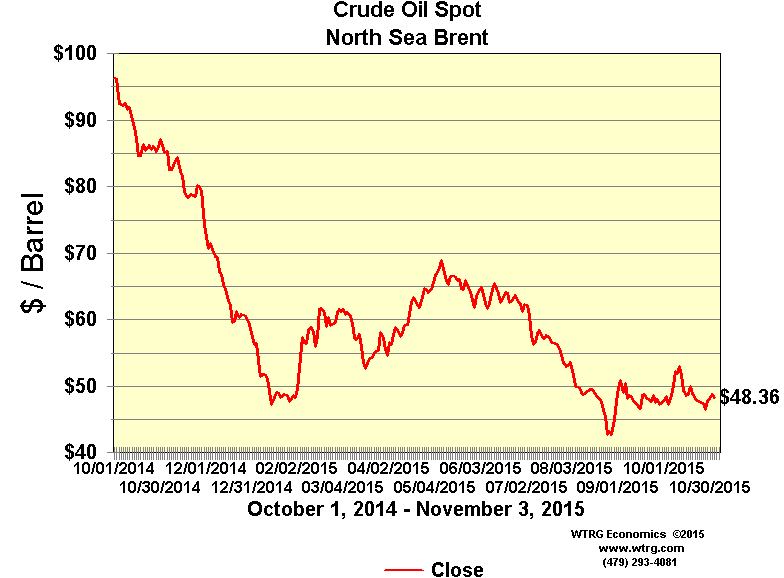
Lower crude prices should also help some.

I had guessed the Saudis would hold prices at the $120 Brent level, given their output of just over 10 million bpd showed strong demand
and their capacity to increase to their stated 12.5 million bpd capacity remains suspect. And so with the Seaway pipeline now open (last I heard)
to take crude from Cushing to Brent priced markets I’d guessed WTI would trade up to Brent.

But what has happened is the Saudi oil minister started making noises about lower prices and when ‘market prices’ started selling off the Saudis ‘followed’ by lowering their posted prices, sustaining the myth that they are ‘price takers’ when in reality they are price setters.

So to date, contrary to my prior guess, both wti and brent have sold off quite a bit, and cheaper imported crude is a plus for the US economy. Which is also a plus for the $US, as a lower import bill makes $US ‘harder to get’ for foreigners.

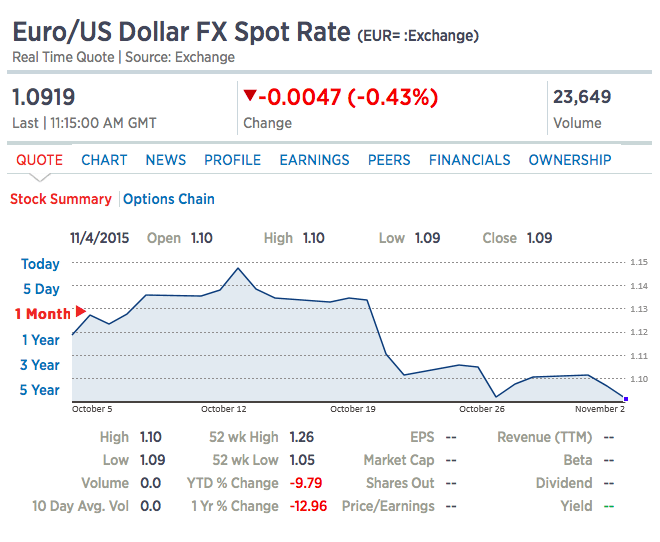
But the trade for quite a while has been strong dollar = weak US stocks due to export pricing/foreign earnings translations, and also because US stocks have weakened on signs of euro zone stress, which has been associated with a weaker euro. So when things seem to be looking up for the euro zone, the euro tends to go up vs the dollar, with US stocks doing better with any sign of ‘improvement’ in the euro zone.

It’s all a tangled case of cross currents, which makes forecasting anything particularly difficult.

Not to mention possible dislocations from the whale, which may or may not have run their course, etc.

And then there’s the news from Greece.

First, they made a full bond payment yesterday of nearly 500 million euro to bond holders who did not accept the PSI discounts. This is confounding for the obvious reasons, signals it sends, moral hazard, credibility, etc. etc. But it’s also a sign the politicians are doing what they think it takes to keep the euro going as the currency of the euro zone. Same goes for the decision to fund Greece as per prior agreements even when there is no Greek govt to talk to, and lots of signs any new govt may not honor the arrangements.

Even if that means tricking private investors out of 100 billion, rewarding those who defy them, whatever. Tactics may be continuously reaching new lows but all for the end of keeping the euro as the single currency.

It also means that while, for example, 10 year Spanish yields may go up or down, the intention is for Spain, one way or another, to fund itself, even if short term. Doesn’t matter.

And more EFSF type discussions. The plan may be to start using those types of funds as needed, keeping the ECB out of it for that much longer, regardless of where longer term bonds happen to trade.

As for the euro zone economy, yes, growth is probably negative, but if they hold off on further fiscal adjustments, the 6%+ deficit they currently are running for the region is probably, at this point, enough to muddle through around the 0 growth neighborhood. The upside isn’t much from there, as with limited private sector credit growth opportunities, and substantial net export growth unlikely, and strong ‘automatic stabilizers’ any growth could be limited by those automatic fiscal stabilizers. Not to mention that this type of optimistic scenario likely strengthens the euro and keeps a lid on net exports as well.

And sad that this ‘bullish scenario’ for the euro zone means their massive output gap doesn’t even begin to close any time soon.

For the US, this bullish scenario has similar limitations, but not quite as severe, so the output gap could start to narrow some and employment as a percentage of the population begin to improve. But only modestly.

The US fiscal cliff is for real, but still far enough away to not be a day to day factor. And it at least does show that fiscal policy does work, at least according to every known forecaster with any credibility, which might open the door to proactive fiscal? Note the increasing chatter about how deficits don’t seem to drive up interest rates? And the increasing chatter about how the US, Japan, UK, etc. aren’t like the euro zone members with regards to interest rates?

Same in the euro zone, where discussion is now common regarding how austerity doesn’t work to grow their economies, with the reason to maintain it now down to the need to restore solvency. This is beginning to mean that if they solved the solvency riddle some other way they might back off on the austerity. And now there is a political imperative to do just that, so things could move in that direction, meaning ECB support for member nation funding, directly or indirectly, which removes the ‘ponzi’ aspect.

Posted in Currencies, Deficit, ECB, Employment, Equities, EU, Germany, Government Spending, Greece, Inflation, Oil, Political | 30 Comments »

People who reject free lunches are fools: Liquidity trap – part II

Posted by WARREN MOSLER on 20th April 2012

Fiscal and monetary policy in a liquidity trap – part II

By Martin Wolf

Output is produced by work.
Work is a cost, not a benefit.
It is in that sense that there is no free lunch.

Might fiscal expansion be a free lunch? This is the question addressed in a thought-provoking paper “Fiscal Policy in a Depressed Economy”, March 2012, by Brad DeLong and Larry Summers, the most important conclusion of which is obvious, but largely ignored: the impact of fiscal expansion depends on the context. *

In normal times, with resources close to being fully utilised, the multiplier will end up very close to zero; in unusual times, such as the present, it could be large enough and the economic benefits of such expansion significant enough to pay for itself.

‘Paying for itself’ implies there is some real benefit to a lower deficit outcome vs a higher deficit outcome. With the govt deficit equal to the net financial assets of the non govt sectors, ‘Paying for itself’ implies there is a real benefit to the non govt sectors have fewer net financial assets.

In a liquidity trap fiscal retrenchment is penny wise, pound foolish.

I would say it’s penny foolish as well, as it directly reduces net financial assets of the non govt sectors with no economic or financial benefit to either the govt sector or the non govt sectors.

Indeed, relying on monetary policy alone is the foolish policy: if it worked, which it probably will not, it does so largely by expanding stretched private balance sheets even further.

Agreed.

As the authors note: “This paper examines the impact of fiscal policy in the context of a protracted period of high unemployment and output short of potential like that suffered by the United States and many other countries in recent years. We argue that, while the conventional wisdom rejecting discretionary fiscal policy is appropriate in normal times, discretionary fiscal policy where there is room to pursue it has a major role.”

There are three reasons for this.

1. First, the absence of supply constraints means that the multiplier is likely to be large.

Why is a large multiplier beneficial?

A smaller multiplier means the fiscal adjustment can be that much larger.

That is, the tax cuts and/or spending increases (depending on political preference) can be that much larger with smaller multipliers.

It is likely to be made even bigger by the fact that fiscal expansion may well raise expected inflation and so lower the real rate of interest, when the nominal rate is close to zero.

However the ‘real rate of interest’ is defined. Most would think CPI, which means the likes of tobacco taxes move the needle quite a bit.

And with the MMT understanding that the currency itself is in fact a simple public monopoly, and that any monopolist is necessarily ‘price setter’, the ‘real rate of interest’ concept doesn’t have a lot of relevance.

2. Second, even moderate hysteresis effects of such fiscal expansion, via increases in the likely level of future output, have big effects on the future debt burden.

Back to the errant notion of a public sector debt in its currency of issue being a ‘burden’.

3. Finally, today’s ultra-low real interest rates at both the short and long end of the curve, suggest that monetary policy is relatively ineffective, on its own.

Most central bank studies show monetary policy is always relatively ineffective.

The argument is set out in a simple example. “Imagine a demand-constrained economy where the fiscal multiplier is 1.5, and the real interest rate on long-term government debt is 1 per cent. Finally, assume that a $1 increase in GDP increased tax revenues and reduces spending by $0.33. Assume that the government is able to undertake a transitory increase in government spending, and then service the resulting debt in perpetuity, without any impact on risk-premia.

“Then the impact effect of an incremental $1.00 of spending is to raise the debt stock by $0.50. The annual debt service needed on this $0.50 to keep the real debt constant is $0.005. If reducing the size of the current downturn in production by $1.50 avoids a 1 per cent as large fall in future potential output – avoids a fall in future potential output of $0.0015 – then the incremental $1.00 of spending now augments future tax-period revenues by $0.005. And the fiscal expansion is self-financing.”

This is a very powerful result.

Yes, it tells you that the ‘automatic fiscal stabilizers’ must be minded lest the expansion reduce the govt deficit and, by identity, reduce the net financial assets of the non govt sectors to the point of aborting the economic recovery. Which, in fact, is how most expansion cycles end.

For the non govt sectors, net financial assets are the equity that supports the credit structure.

So when a recovery driven by a private sector credit expansion (which is how most are driven), causes tax liabilities to increase and transfer payments to decrease (aka automatic fiscal stabilizers)- reducing the govt deficit and by identity reducing the growth of private sector net financial assets- private sector/non govt leverage increases to the point where it’s unsustainable and it all goes bad again.

It rests on the three features of the present situation: high multipliers; low real interest rates; and the plausibility of hysteresis effects.

A table in the paper (Table 2.2) shows that at anything close to current real interest rates fiscal expansion is certain to pay for itself even with zero multiplier and hysteresis effects: it is a “no-brainer”.

And, if allowed to play out as I just described, the falling govt deficit will also abort the expansion.

Why is this? It is because the long-term real interest rate paid by the government is below even the most pessimistic view of the future growth rate of the economy. As I have argued on previous occasions, the US (and UK) bond markets are screaming: borrow.

The bond markets are screaming ‘the govt. Will never get its act together and cause the conditions for the central bank to raise rates.’

Of course, that is not an argument for infinite borrowing, since that would certainly raise the real interest rate substantially!

Infinite borrowing implies infinite govt spending.

Govt spending is a political decision involving the political choice of the ‘right amount’ of real goods and services to be moved from private to public domain.

Yet, more surprisingly, the expansion would continue to pay for itself even if the real interest rate were to rise far above the prospective growth rate, provided there were significantly positive multiplier and hysteresis effects.

I’d say it this way:
Providing increasing private sector leverage and credit expansion continues to offset declines in govt deficit spending.

Let us take an example: suppose the multiplier were one and the hysteresis effect were 0.1 – that is to say, the permanent loss of output were to be one tenth of the loss of output today. Then the real interest rate at which the government could obtain positive effects on its finances from additional stimulus would be as high as 7.4 per cent.

Thus, state the authors, “in a depressed economy with a moderate multiplier, small hysteresis effects, and interest rates in the historical range, temporary fiscal expansion does not materially affect the overall long-run budget picture.” Investors should not worry about it. Indeed, they should worry far more about the fiscal impact of prolonged recessions.

They shouldn’t worry about the fiscal impact in any case. The public sector deficit/debt is nothing more than the net financial assets of the non govt sectors. And these net financial assets necessarily sit as balances in the central bank, as either clearing balances (reserves) or as balances in securities accounts (treasury securities). And ‘debt management’ is nothing more than the shifting of balances between these accounts.

(and there are no grandchildren involved!)
(and all assuming floating exchange rate policy)

Are such numbers implausible? The answer is: not at all.

Multipliers above one are quite plausible in a depressed economy, though not in normal circumstances. This is particularly true when real interest rates are more likely to fall, than rise, as a result of expansion.

The ‘multipliers’ are nothing more than the flip side of the aggregate ‘savings desires’ of the non govt sectors. And the largest determinant of these savings desires is the degree of credit expansion/leverage.

Similarly, we know that recessions cause long-term economic costs. They lower investment dramatically: in the US, the investment rate fell by about 4 per cent of gross domestic product in the wake of the crisis. Businesses are unwilling to invest, not because of some mystical loss of confidence, but because there is no demand.

Again, we know that high unemployment has a permanent impact on workers, both young and old. The US, in particular, seems to have slipped into European levels of separation from the labour force: that is to say, the unemployment rate is quite low, given the sharp fall in the rate of employment. Workers have given up. This is a social catastrophe in a country in which work is effectively the only form of welfare for people of working age.

Not to mention the lost real output which over the last decade has to be far higher than the total combined real losses from all the wars in history.

Indeed, we can see hysteresis effects at work in the way in which forecasters, including official forecasters, mark down potential output in line with actual output: a self-fulfilling prophecy if ever there was one. This procedure has been particularly marked in the UK, where the Office for Budget Responsibility has more or less eliminated the notion that the UK is in a recession. Yet such effects are not God-given; they are man-chosen. They are the product of fundamentally misguided policies.

This is an important paper. It challenges complacent “do-nothingism” of policymakers, let alone the “austerians” who dominate policy almost everywhere. Policy-makers have allowed a huge financial crisis to impose a permanent blight on economies, with devastating social effects. It makes one wonder why the Obama administration, in which prof Summers was an influential adviser, did not do more, or at least argue for more, as many outsiders argued.

The private sector needs to deleverage.

It’s no coincidence that with a relatively constant trade deficit, private sector net savings, as measured by net financial $ assets, has increased by about the amount of the US budget deficit.

In other words, the $trillion+ federal deficits have added that much to domestic income and savings, thereby reducing private sector leverage.

However, as evidenced by the gaping output gap, for today’s credit conditions, it’s been not nearly enough.

The government can help by holding up the economy. It should do so. People who reject free lunches are fools.

Posted in Bonds, CBs, Currencies, Deficit, Government Spending, Interest Rates | 39 Comments »

Fiscal and monetary policy in a liquidity trap

Posted by WARREN MOSLER on 19th April 2012

Not bad, but let’s take it up to the next level.

Comments below:

Fiscal and monetary policy in a liquidity trap

By Martin Wolf

With floating fx, it’s always a ‘liquidity trap’ in that adding liquidity to a system necessarily not liquidity constrained is moot.

Part 1

What is the correct approach to fiscal and monetary policy when an economy is depressed and the central bank’s rate of interest is close to zero? Does the independence of the central bank make it more difficult to reach the right decisions? These are two enormously important questions raised by current circumstances in the US, the eurozone, Japan and the UK.

With floating fx, it’s always about a fiscal adjustment, directly or indirectly.

Broadly speaking, I can identify three macroeconomic viewpoints on these questions:
1. The first is the pre-1930 belief in balanced budgets and the gold standard (or some other form of a-political money).

Yes, actual fixed fx policy, where the monetary system is continuously liquidity constrained by design.

2. The second is the religion of balanced budgets and managed money, with Milton Friedman’s monetarism at the rules-governed end of the spectrum and independent inflation-targeting central banks at the discretionary end.

Yes, the application of fixed fx logic to a floating fx regime.

3. The third demands a return to Keynesian ways of thinking, with “modern monetary theory” (in which monetary policy and central banks are permanently subservient to fiscal policy) at one end of the policy spectrum, and temporary resort to active fiscal policy at the other.

MMT recognizes the difference in monetary dynamics between fixed and floating fx regimes.

In this note, I do not intend to address the first view, though I recognise that it has substantial influence, particularly in the Republican Party. I also do not intend to address Friedman’s monetarism, which has lost purchase on contemporary policy-makers, largely because of the views that the demand for money is unstable and the nature of money ill-defined. Finally, I intend to ignore “modern monetary theory” which would require a lengthy analysis of its own.

This leaves us with the respectable contemporary view that the best way to respond to contemporary conditions is via fiscal consolidation and aggressive monetary policy, and the somewhat less respectable view that aggressive fiscal policy is essential when official interest rates are close to zero.

Two new papers bring light from the second of these perspectives. One is co-authored by Paul McCulley, former managing director of Pimco and inventor of the terms “Minsky moment” and “shadow banking”, and Zoltan Pozsar, formerly at the Federal Reserve Bank of New York and now a visiting scholar at the International Monetary Fund.* The other is co-authored by J. Bradford DeLong of the university of California at Berkeley, and Lawrence Summers, former US treasury secretary and currently at Harvard university. **

Unfortunately, and fully understood, is the imperative for you to select from ‘celebrity’ writers regardless of the quality of the content.

The paper co-authored by Mr McCulley and Mr Pozsar puts the case for aggressive fiscal policy. The US, they argue, is in a “liquidity trap”: even with official interest rates near zero, the incentive for extra borrowing, lending and spending in the private sector is inadequate.

An output gap is the evidence that total spending- public plus private- is inadequate. And yes, that can be remedied by an increase in private sector borrowing to spend, and/or a fiscal adjustment by the public sector towards a larger deficit via either an increase in spending and/or tax cut, depending on one’s politics.

The explanation for this exceptional state of affairs is that during the credit boom and asset-price bubble that preceded the crisis, large swathes of the private sector became over-indebted. Once asset prices fell, erstwhile borrowers were forced to reduce their debts. Financial institutions were also unwilling to lend. They needed to strengthen their balance sheets. But they also confronted a shortage of willing and creditworthy borrowers.

Yes, for any reason if private sector spending falls short of full employment levels, a fiscal adjustment can do the trick.

This raises an interesting question:

Is it ‘better’, for example, to facilitate the increase in spending through a private sector credit expansion, or through a tax cut that allows private sector spending to increase via increased income, or through a government spending increase?

The answer is entirely political. The output gap can be closed with any/some/all of those options.

In such circumstances, negative real interest rates are necessary, but contractionary economic conditions rule that out.

I see negative nominal rates as a tax that will reduce income and net financial assets of the non govt sectors, even as it may increase some private sector credit expansion. And the reduction of income and net financial assets works to reduce the credit worthiness of the non govt sectors reducing their ability to borrow to spend.

Instead, there is a danger of what the great American economist, Irving Fisher called “debt deflation”: falling prices raise the real burden of debt, making the economic contraction worse.

Yes, though he wrote in the context of fixed fx policy, where that tends to happen as well, though under somewhat different circumstances and different sets of forces.

A less extreme (and so more general) version of the idea is “balance-sheet recession”, coined by Richard Koo of Nomura. That is what Japan had to manage in the 1990s.

With floating fx they are all balance sheet recessions. There is no other type of recession.

This is how the McCulley-Pozsar paper makes the point: “deleveraging is a beast of burden that capitalism cannot bear alone. At the macroeconomic level, deleveraging must be a managed process: for the private sector to deleverage without causing a depression, the public sector has to move in the opposite direction . . . by effectively viewing the balance sheets of the monetary and fiscal authorities as a consolidated whole.

Correct, in the context of today’s floating fx. With fixed fx that option carries the risk of rising rates for the govt and default/devaluation.

“Fiscal austerity does not work in a liquidity trap and makes as much sense as putting an anorexic on a diet. Yet ‘diets’ are the very prescriptions that fiscal ‘austerians’ have imposed (or plan to impose) in the US, UK and eurozone. Austerians fail to realise, however, that everyone cannot save at the same time and that, in liquidity traps, the paradox of thrift and depression are fellow travellers that are functionally intertwined.”

Agreed for floating fx. Fixed fx is another story, where forced deflation via austerity does make the maths work, though most often at an impossible social cost.

Confronted by this line of argument, austerians (a term coined by Rob Parenteau, a research associate at the Levy Economics Institute of Bard College), make three arguments:

1. additional borrowing will add heavily to future debt and so be an unreasonable burden on future generations;
2. increased borrowing will crowd out private borrowing;
3. bond investors will stop buying and push yields up.

Which does happen with fixed fx policy.

In a liquidity trap, none of these arguments hold.

With floating fx, none of these hold in any scenario.

Experience over the last four years (not to mention Japan’s experience over the past 20 years) has demonstrated that governments operating with a (floating) currency do not suffer a constraint on their borrowing. The reason is that the private sector does not wish to borrow, but wants to cut its debt, instead. There is no crowding out.

Right, because floating fx regimes are by design not liquidity constrained.

Moreover, adjustment falls on the currency, not on the long-term rate of interest.

Right, and again, unlike fixed fx.

In the case of the US, foreigners also want to lend, partly in support of their mercantilist economic policies.

Actually, they want to accumulate dollar denominated financial assets, which we call lending.

Note that both reserve balances at the Fed and securities account balances at the Fed (treasury securities) are simply dollar deposits at the Fed.

Alas, argue Mr McCulley and Mr Pozsar, “held back by concerns borne out of these orthodoxies, . . . governments are not spending with passionate purpose. They are victims of intellectual paralysis borne out of inertia of dogma . . . As a result, their acting responsibly, relative to orthodoxy, and going forth with austerity may drag economies down the vortex of deflation and depression.”

Right. Orthodoxy happens to be acting as if one was operating under a fixed fx regime even though it’s in fact a floating fx regime.

Finally, they note, “the importance of fiscal expansion and the impotence of conventional monetary policy measures in a liquidity trap have profound implications for the conduct of central banks. This is because in a liquidity trap, the fat-tail risk of inflation is replaced by the fat-tail risk of deflation.”

The risk of excess aggregate demand is replaced by the risk of inadequate aggregate demand.

And the case can be made that lower rates reduce aggregate demand via the interest income channels, as the govt is a net payer of interest.

In this situation, we do not need independent central banks that offset – and so punish – fiscally irresponsible governments. We need central banks that finance – and so encourage – economically responsible (though “fiscally irresponsible”) governments.

Not the way I would say it but understood.

When private sector credit growth is constrained, monetisation of public debt is not inflationary.

While I understand the point, note that ‘monetisation’ is a fixed fx term not directly applicable to floating fx in this context.

Indeed, it would be rather good if it were inflationary, since that would mean a stronger recovery, which would demand swift reversal of the unorthodox policy mix.

The conclusion of the McCulley-Pozsar paper is, in brief, that aggressive fiscal policy does work in the unusual circumstances of a liquidity trap, particularly if combined with monetisation. But conventional wisdom blocks full use of the unorthodox tool kit. Historically, political pressure has destroyed such resistance. Political pressure drove the UK off gold in 1931. But it also brought Hitler to power in Germany in 1933. The eurozone should take note.

Remarkably, in the circumstances of a liquidity trap, enlarged fiscal deficits are likely to reduce future levels of privately held public debt rather than raise them.

As if that aspect matters?

The view that fiscal deficits might provide such a free lunch is the core argument of the paper by DeLong and Summers, to which I will turn in a second post.

Free lunch entirely misses the point.

Why does the size the balances in Fed securities accounts matter as suggested, with floating fx policy?

Posted in Bonds, Currencies, Deficit, Fed, Government Spending, Inflation, Interest Rates | 36 Comments »

Yen Drops Versus Peers as Tankan Fuels Easing Speculation

Posted by WARREN MOSLER on 2nd April 2012

Right!
Lower rates!
More QE!

Be patient, monetary policy works with a lag
It’s only been 20 years
Hyper inflation is just around the corner…

Yen Drops Versus Peers as Tankan Fuels Easing Speculation

April 2 (Bloomberg) — The yen weakened versus all of its major peers after a Bank of Japan (8301) report showed that sentiment failed to improve at the nation’s largest companies, stoking prospects the central bank will boost monetary stimulus.

The Japanese currency slid against the dollar and euro as signs that manufacturing is improving in the U.S. and China, the world’s two biggest economies, undermined demand for haven assets. The euro remained higher after a quarterly gain versus the greenback as European governments called for a bigger global financial emergency fund after engineering a firewall to fight the region’s debt crisis.

“The worse-than-expected Tankan survey seems to be fueling talk that the BOJ will ease policy further,” Lee Wai Tuck, a currency strategist at Forecast Pte in Singapore, said about the central bank’s quarterly sentiment survey. “This is probably leading to selling of the yen.”

The yen lost 0.4 percent to 83.18 per dollar as as of 10:19 a.m. in Tokyo. It slid 0.4 percent to 110.97 per euro. Europe’s 17-nation currency was little changed at $1.3341 after rising 3 percent versus the greenback in the three months ended March 31.

The Tankan index for Japan’s largest manufacturers was unchanged last quarter from minus 4 in December, the BOJ said today in Tokyo. That was less than the median estimate of minus 1 in a Bloomberg News survey of economists. A negative number means pessimists outnumber optimists.

BOJ Meetings

BOJ policy board members are scheduled to meet April 9-10 and April 27 this month. The central bank held off from expanding asset purchases at its meeting in March as it monitored improvements in the economy. In February, it expanded bond purchases by 10 trillion yen ($120 billion) and set a 1 percent inflation goal in February.

The Institute for Supply Management’s factory index for the U.S. probably rose to 53 last month from 52.4 in February, according to the median estimate of economists surveyed by Bloomberg before the figures are released today.

An index of Chinese manufacturing climbed to 53.1 last month, the highest since March 2011, the logistics federation and the National Bureau of Statistics said yesterday. The measure has a pattern of rising each March.

Posted in Currencies, Inflation | 9 Comments »

MMT inspired euro fix

Posted by WARREN MOSLER on 20th March 2012

Spend in euro denominated tax credits.

Central banks pay ecb rates on said deposits charged to issuer.

Eurachma
Esceuro
Passeuro
Punteuro
Leuro

All perfectly legal under current institutional arrangements

Posted in Currencies, ECB, EU | 32 Comments »

Japan to purchase 65 billion yuan in China government debt

Posted by WARREN MOSLER on 13th March 2012

Part of the general move of the current govt to exit deflation via weakening the yen, as previously discussed. Look for Japan to be increasing total fx reserves, and in multiple currencies. The only thing that might stop them is being called on it by the US Treasury secretary.

Japan to purchase 65 billion yuan in China government debt

By Stanley White

March 13 (Reuters) — Japan said on Tuesday it had received approval from China’s government to purchase 65 billion yuan ($10.3 billion) in Chinese government debt in a move that can help Japan diversify its reserves away from the dollar and strengthen economic ties between the two Asian countries.

The timing of purchases hasn’t been set yet as Japan still needs to make some administrative preparations, but Japan is likely to start with a small amount and then increase purchases, Japan’s Finance Minister Jun Azumi said.

Japan will also consider the impact on financial markets when it decides the timing of its purchases, Azumi said.

China said on Monday it would continue its purchases of Japanese government debt but would reduce purchases when the yen is rising as China and Japan, holders of the largest and second-largest currency reserves, look to limit exposure to the dollar.

“We feel this is an appropriate amount when considering our mutual goal of strengthening economic cooperation between Japan and China,” Azumi told reporters.

Japan and China agreed at a summit in December to facilitate trade between the yen and the yuan as part of a broader push to strengthen economic cooperation.Japan said on Tuesday it had received approval from China’s government to purchase 65 billion yuan ($10.3 billion) in Chinese government debt in a move that can help Japan diversify its reserves away from the dollar and strengthen economic ties between the two Asian countries.

The timing of purchases hasn’t been set yet as Japan still needs to make some administrative preparations, but Japan is likely to start with a small amount and then increase purchases, Japan’s Finance Minister Jun Azumi said.

Japan will also consider the impact on financial markets when it decides the timing of its purchases, Azumi said.

China said on Monday it would continue its purchases of Japanese government debt but would reduce purchases when the yen is rising as China and Japan, holders of the largest and second-largest currency reserves, look to limit exposure to the dollar.

“We feel this is an appropriate amount when considering our mutual goal of strengthening economic cooperation between Japan and China,” Azumi told reporters.

Japan and China agreed at a summit in December to facilitate trade between the yen and the yuan as part of a broader push to strengthen economic cooperation.

Posted in China, Currencies, Japan | 6 Comments »

strong dollar not good for stocks

Posted by WARREN MOSLER on 6th March 2012

As previously discussed. It’s all part of the overall deflationary scenario from the US federal budget deficit being too small:

Merck said sales in the latest period were reduced between 1 percent and 2 percent due to currency translation.

For the rest of the year, currency is expected to trim between 2 percent and 3 percent from its sales.

Posted in Currencies, Deficit, Government Spending | 12 Comments »

GEI article is up

Posted by WARREN MOSLER on 27th February 2012

Eurozone: How to Drive an Economy in Reverse

By Warren Mosler

February 27 — The situation in Greece brings me back to the conclusion that merely resolving solvency issues in the Eurozone doesn’t fix the economy. Solvency must not be an issue, but if there is negative growth, solvency math simply doesn’t work for any of the Euro members.

Without growth in the Eurozone the resolution (for now) of the Greek crisis will simply result in the focus moving on to one of the next weaker sisters. As this happens the risk remains that other countries in trouble will ask for haircuts on their debt (similar to Greece) as part of their rescue. And that could trigger a general, global, catastrophic financial meltdown.

Follow up:
Monetary and Fiscal Expansion are Needed

My first order proposal remains an ECB distribution on a per capita basis to the euro member nations of maybe 10% of euro zone GDP per year to put the solvency issue behind them. Along with relaxed budget rules, maybe allowing deficits up to 6% of GDP annually, further supported by the ECB funding a transition job at a non disruptive wage to facilitate the transition from unemployment to private sector employment. I might also recommend deficits be increased by suspending VAT as a way to increase aggregate demand and lower prices at the same time.

Alternatively, the ECB could simply guarantee all national government debt and rely on the growth and stability pact for fiscal discipline, which would probably require enhanced authorities.

And rather than trying to bring Greece’s deficit down to current target levels, they could instead relax the growth and stability pact limits to something closer to full employment levels. And, again, I’d look into suspending VAT to both increase aggregate demand and lower prices.

Strong Euro First

However, all policies seem to be ‘strong euro’ first. And the ‘success’ of the euro continues to be gauged by its ‘strength’.

The haircuts on the Greek bonds are functionally a tax that removes that many net euro financial assets. Call it an ‘austerity’ measure extending forced austerity to investors.

Other member nations will likely hold off on turning towards that same tax until after Greece is a ‘done deal’ as early noises could work to undermine the Greek arrangements, and take the ‘investor tax’ off the table.

Like most other currencies, the euro has ‘built in’ demand leakages that fall under the general category of ‘savings desires’. These include the demand to hold actual cash, contributions to tax advantaged pension contributions, contributions to individual retirement accounts, insurance and other corporate ‘reserves’, foreign central bank accumulations of euro denominated financial assets, along with all the unspent interest and earnings compounding.

Offsetting all of that unspent income (private savings) is, historically, the expansion of debt, where agents spend more than their income. This includes borrowing for business and consumer purchases, which includes borrowing to buy cars and houses. In other words, net savings of financial assets are increased by the demand leakages and decreased by credit expansion. And, in general, most of the variation is due to changes in the credit expansion component.

Austerity in the euro zone consists of public spending cuts and tax hikes, which have both directly slowed the economies and increased net savings desires, as the austerity measures have also reduced private sector desires to borrow to spend. This combination results in a decline in sales, which translates into fewer jobs and reduced private sector income. Which further translates into reduced tax collections and increased public sector transfer payments, as the austerity measures designed to reduce public sector debt instead serve to increase it.

Now adding to that is this latest tax on investors in Greek debt, and if the propensity to spend any of the lost funds of those holders was greater than zero, aggregate demand will see an additional decline, with public sector debt climbing that much higher as well.

All of this serves to make the euro ‘harder to get’ and further support the value of the euro, which serves to keep a lid on the net export channel. The ‘answer’ to the export dilemma would be to have the ECB, for example, buy dollars as Germany used to do with the mark, and as China and Japan have done to support their exporters. But ideologically this is off the table in the euro zone, as they believe in a strong euro, and in any case they don’t want to build dollar reserves and give the appearance that the dollar is ‘backing’ the euro.

Three Reverse Thrusters in Use

This works to move all the euro member nation deficits higher as the ‘sustainability math’ of all deteriorate as well, increasing the odds of the ‘investor tax’ expanding to the other member nations – and that continues the negative feedback loop.

Given the demand leakages of the institutional structure, as a point of logic, prosperity can only come from some combination of increased net exports, a private sector credit expansion, or a public sector credit expansion.

And right now it looks like they are still going backwards on all three. And with the transmission in reverse, pressing the accelerator harder only makes you go backwards that much faster.

Posted in Bonds, CBs, Currencies, EU, Government Spending, Greece | 11 Comments »

More on Greece and the euro

Posted by WARREN MOSLER on 23rd February 2012

As previously discussed, all policies seem to be ‘strong euro’ first.

And the ‘success’ of the euro continues to be gauged by its ‘strength’.

The haircuts on the Greek bonds are functionally a tax that removes that many net euro financial assets. Call it an ‘austerity’ measure extending forced austerity to investors.

Other member nations will likely hold off on turning towards that same tax until after Greece is a ‘done deal’ as early noises could work to undermine the Greek arrangements, and take the ‘investor tax’ off the table.

Like most other currencies, the euro has ‘built in’ demand leakages that fall under the general category of ‘savings desires’. These include the demand to hold actual cash, contributions to tax advantaged pension contributions, contributions to individual retirement accounts, insurance and other corporate ‘reserves’, foreign central bank accumulations euro denominated financial assets, along with all the unspent interest and earnings compounding.

Offsetting all of that unspent income is, historically, the expansion of debt, where agents spend more than their income. This includes borrowing for business and consumer purchases, which includes borrowing to buy cars and houses. In other words, net savings of financial assets are increased by the demand leakages and decreased by credit expansion. And, in general, most of the variation is due to changes in the credit expansion component.

Austerity in the euro zone consists of public spending cuts and tax hikes, which have both directly slowed the economies and increased net savings desires, as the austerity measures have also reduced private sector desires to borrow to spend. This combination results in a decline in sales, which translates into fewer jobs and reduced private sector income. Which further translates into reduced tax collections and increased public sector transfer payments, as the austerity measures designed to reduce public sector debt instead serve to increase it.

Now adding to that is this latest tax on investors in Greek debt, and if the propensity to spend any of the lost funds of those holders was greater than 0, aggregate demand will see an additional decline, with public sector debt climbing that much higher as well.

All of which serves to make the euro ‘harder to get’ and further support the value of the euro, which serves to keep a lid on the net export channel. The ‘answer’ to the export dilemma would be to have the ECB, for example, buy dollars as Germany used to do with the mark, and as China and Japan have done to support their exporters. But ideologically this is off the table in the euro zone, as they believe in a strong euro, and in any case they don’t want to build dollar reserves and give the appearance that the dollar is ‘backing’ the euro.

And all of which works to move all the euro member nation deficits higher as the ‘sustainability math’ of all deteriorate as well, increasing the odds of the ‘investor tax’ expanding to the other member nations that continues the negative feedback loop.

Given the demand leakages of the institutional structure, as a point of logic prosperity can only come from some combination of increased net exports, a private sector credit expansion, or a public sector credit expansion.

And right now it looks like they are still going backwards on all three.

Posted in Credit, Currencies, Deficit, ECB, EU, Exports, GDP, Greece | 21 Comments »

Greece

Posted by WARREN MOSLER on 22nd February 2012

Comes back to the idea that resolving solvency issues in the euro zone doesn’t fix the economy.

And with negative growth the solvency math doesn’t work for any of the euro members.

And what’s with the ECB threatening to back away on liquidity support for the banking system?

So looks to me like the Greek resolution is not the end of the solvency issues, but that the focus simply moves on to the next weaker sister.

And, as previously discussed, the risk remains elevated that if Greece gets to haircut its obligations and gets funding, others will ask for the same, triggering a general, global, catastrophic financial meltdown.

My first order proposal remains an ECB distribution on a per capita basis to the euro member nations of maybe 10% of euro zone GDP per year to put the solvency issue behind them. Along with relaxed budget rules, maybe allowing deficits up to 6% of GDP annually, further supported by the ECB funding a transition job at a non disruptive wage to facilitate the transition from unemployment to private sector employment. I might also recommend deficits be increased by suspending VAT as a way to increase aggregate demand and lower prices at the same time.

Alternatively, the ECB could simply guarantee all national govt debt and rely on the growth and stability pact for fiscal discipline, which would probably require enhanced authorities.

And rather than trying to bring Greece’s deficit down to current target levels, they could instead relax the growth and stability pact limits to something closer to full employment levels. And, again, I’d look into suspending VAT to both increase aggregate demand and lower prices.

Meanwhile, elsewhere in today’s world news:

The likes of Ford adding to pension funds makes the point of the increasing and ongoing demand leakages putting a damper on GDP.

And oil prices have now crept up enough to materially cut into aggregate demand as well.

Nor are banks adding to capital to meet expanding demand for credit, which remains anemic.

Headlines:

Data Suggests Euro Zone May Slide Back Into Recession
German Manufacturing Slows as New Export Orders Fall
China’s Factory Activity Shrinks for Fourth Month
ECB Preparing to Close Liquidity Floodgates
Ford Pours $3.8 Billion Into Pension Plan
Oil Could Turn to Headwind as Dow Flirts With 13,000
UBS to Issue More Loss-Absorbing Capital
Iran ‘Winning’ on Oil Sanctions: Top Trader
Greek Bailout Puts Focus Back on Credit Default Swaps
Iran Fuels Oil-Price Rally—And Prices Could Keep Rising

Posted in Bonds, Currencies, Deficit, ECB, Employment, GDP, Germany, Government Spending, Greece, Political, Proposal | 12 Comments »

Stephanie Kelton’s response to WaPo MMT article

Posted by WARREN MOSLER on 21st February 2012

It was very nice to see Dylan Matthews, who is a young journalist and not an economist, recognize the growing influence of MMT. The piece does get a number of things wrong (perhaps inevitably, given the sheer volume of work we have produced over the last 10-15 years). We’ll be working to clear things up on our various websites (including: new economic perspectives and via our Twitter feed @deficitowl). We hope readers will not jump to erroneous conclusions about MMT. We have gotten a great deal right over the years (the S&P downgrade, the Eurozone debt crisis, QE, US interest rates, inflation, etc.). While the Austrians screamed, “Zimbabwe”, we explained that QE is nothing but an asset swap and that idle reserves — whatever their magnitude — will not “chase” any goods. And while “Keynesians” worried about the impact that large deficits would have on US interest rates, we calmly explained the flaws in the loanable funds framework and insisted that rates would remain low as long as the Fed was committed to low rates (as the Bank of Japan has shown for decades). And while Nobel laureates, like Robert Mundell, were espousing the virtues of a common currency in Europe, we warned that the new design would put bond markets in charge of government policies. At some point, being right should actually count for something.

Posted in CBs, Currencies, Inflation | 9 Comments »

MMT in Washington Post

Posted by WARREN MOSLER on 21st February 2012

Modern Monetary Theory, an unconventional take on economic strategy

By Dylan Matthews

February 18 (Bloomberg) — About 11 years ago, James K. “Jamie” Galbraith recalls, hundreds of his fellow economists laughed at him. To his face. In the White House.

It was April 2000, and Galbraith had been invited by President Bill Clinton to speak on a panel about the budget surplus. Galbraith was a logical choice. A public policy professor at the University of Texas and former head economist for the Joint Economic Committee, he wrote frequently for the press and testified before Congress.

What’s more, his father, John Kenneth Galbraith, was the most famous economist of his generation: a Harvard professor, best-selling author and confidante of the Kennedy family. Jamie has embraced a role as protector and promoter of the elder’s legacy.

But if Galbraith stood out on the panel, it was because of his offbeat message. Most viewed the budget surplus as opportune: a chance to pay down the national debt, cut taxes, shore up entitlements or pursue new spending programs.

He viewed it as a danger: If the government is running a surplus, money is accruing in government coffers rather than in the hands of ordinary people and companies, where it might be spent and help the economy.

“I said economists used to understand that the running of a surplus was fiscal (economic) drag,” he said, “and with 250 economists, they giggled.”

Galbraith says the 2001 recession — which followed a few years of surpluses — proves he was right.

A decade later, as the soaring federal budget deficit has sharpened political and economic differences in Washington, Galbraith is mostly concerned about the dangers of keeping it too small. He’s a key figure in a core debate among economists about whether deficits are important and in what way. The issue has divided the nation’s best-known economists and inspired pockets of passion in academic circles. Any embrace by policymakers of one view or the other could affect everything from employment to the price of goods to the tax code.

In contrast to “deficit hawks” who want spending cuts and revenue increases now in order to temper the deficit, and “deficit doves” who want to hold off on austerity measures until the economy has recovered, Galbraith is a deficit owl. Owls certainly don’t think we need to balance the budget soon. Indeed, they don’t concede we need to balance it at all. Owls see government spending that leads to deficits as integral to economic growth, even in good times.

The term isn’t Galbraith’s. It was coined by Stephanie Kelton, a professor at the University of Missouri at Kansas City, who with Galbraith is part of a small group of economists who have concluded that everyone — members of Congress, think tank denizens, the entire mainstream of the economics profession — has misunderstood how the government interacts with the economy. If their theory — dubbed “Modern Monetary Theory” or MMT — is right, then everything we thought we knew about the budget, taxes and the Federal Reserve is wrong.

Keynesian roots

“Modern Monetary Theory” was coined by Bill Mitchell, an Australian economist and prominent proponent, but its roots are much older. The term is a reference to John Maynard Keynes, the founder of modern macroeconomics. In “A Treatise on Money,” Keynes asserted that “all modern States” have had the ability to decide what is money and what is not for at least 4,000 years.

This claim, that money is a “creature of the state,” is central to the theory. In a “fiat money” system like the one in place in the United States, all money is ultimately created by the government, which prints it and puts it into circulation. Consequently, the thinking goes, the government can never run out of money. It can always make more.

This doesn’t mean that taxes are unnecessary. Taxes, in fact, are key to making the whole system work. The need to pay taxes compels people to use the currency printed by the government. Taxes are also sometimes necessary to prevent the economy from overheating. If consumer demand outpaces the supply of available goods, prices will jump, resulting in inflation (where prices rise even as buying power falls). In this case, taxes can tamp down spending and keep prices low.

But if the theory is correct, there is no reason the amount of money the government takes in needs to match up with the amount it spends. Indeed, its followers call for massive tax cuts and deficit spending during recessions.

Warren Mosler, a hedge fund manager who lives in Saint Croix in the U.S. Virgin Islands — in part because of the tax benefits — is one proponent. He’s perhaps better know for his sports car company and his frequent gadfly political campaigns (he earned a little less than one percent of the vote as an independent in Connecticut’s 2010 Senate race). He supports suspending the payroll tax that finances the Social Security trust fund and providing an $8 an hour government job to anyone who wants one to combat the current downturn.

The theory’s followers come mainly from a couple of institutions: the University of Missouri-Kansas City’s economics department and the Levy Economics Institute of Bard College, both of which have received money from Mosler. But the movement is gaining followers quickly, largely through an explosion of economics blogs. Naked Capitalism, an irreverent and passionately written blog on finance and economics with nearly a million monthly readers, features proponents such as Kelton, fellow Missouri professor L. Randall Wray and Wartberg College professor Scott Fullwiler. So does New Deal 2.0, a wonky economics blog based at the liberal Roosevelt Institute think tank.

Their followers have taken to the theory with great enthusiasm and pile into the comment sections of mainstream economics bloggers when they take on the theory. Wray’s work has been picked up by Firedoglake, a major liberal blog, and the New York Times op-ed page. “The crisis helped, but the thing that did it was the blogosphere,” Wray says. “Because, for one thing, we could get it published. It’s very hard to publish anything that sounds outside the mainstream in the journals.”

Most notably, Galbraith has spread the message everywhere from the Daily Beast to Congress. He advised lawmakers including then-House Speaker Nancy Pelosi (D-Calif.) when the financial crisis hit in 2008. Last summer he consulted with a group of House members on the debt ceiling negotiations. He was one of the handful of economists consulted by the Obama administration as it was designing the stimulus package. “I think Jamie has the most to lose by taking this position,” Kelton says. “It was, I think, a really brave thing to do, because he has such a big name, and he’s so well-respected.”

Wray and others say they, too, have consulted with policymakers, and there is a definite sense among the group that the theory’s time is now. “Our Web presence, every few months or so it goes up another notch,” Fullwiler says.

A divisive theory

The idea that deficit spending can help to bring an economy out of recession is an old one. It was a key point in Keynes’s “The General Theory of Employment, Interest and Money.” It was the chief rationale for the 2009 stimulus package, and many self-identified Keynesians, such as former White House adviser Christina Romer and economist Paul Krugman, have argued that more is in order. There are, of course, detractors.

A key split among Keynesians dates to the 1930s. One set of economists, including the Nobel laureates John Hicks and Paul Samuelson, sought to incorporate Keynes’s insights into classical economics. Hicks built a mathematical model summarizing Keynes’s theory, and Samuelson sought to wed Keynesian macroeconomics (which studies the behavior of the economy as a whole) to conventional microeconomics (which looks at how people and businesses allocate resources). This set the stage for most macroeconomic theory since. Even today, “New Keynesians,” such as Greg Mankiw, a Harvard economist who served as chief economic adviser to George W. Bush, and Romer’s husband, David, are seeking ways to ground Keynesian macroeconomic theory in the micro-level behavior of businesses and consumers.

Modern Monetary theorists hold fast to the tradition established by “post-Keynesians” such as Joan Robinson, Nicholas Kaldor and Hyman Minsky, who insisted Samuelson’s theory failed because its models acted as if, in Galbraith’s words, “the banking sector doesn’t exist.”

The connections are personal as well. Wray’s doctoral dissertation was advised by Minsky, and Galbraith studied with Robinson and Kaldor at the University of Cambridge. He argues that the theory is part of an “alternative tradition, which runs through Keynes and my father and Minsky.”

And while Modern Monetary Theory’s proponents take Keynes as their starting point and advocate aggressive deficit spending during recessions, they’re not that type of Keynesians. Even mainstream economists who argue for more deficit spending are reluctant to accept the central tenets of Modern Monetary Theory. Take Krugman, who regularly engages economists across the spectrum in spirited debate. He has argued that pursuing large budget deficits during boom times can lead to hyperinflation. Mankiw concedes the theory’s point that the government can never run out of money but doesn’t think this means what its proponents think it does.

Technically it’s true, he says, that the government could print streams of money and never default. The risk is that it could trigger a very high rate of inflation. This would “bankrupt much of the banking system,” he says. “Default, painful as it would be, might be a better option.”

Mankiw’s critique goes to the heart of the debate about Modern Monetary Theory —?and about how, when and even whether to eliminate our current deficits.

When the government deficit spends, it issues bonds to be bought on the open market. If its debt load grows too large, mainstream economists say, bond purchasers will demand higher interest rates, and the government will have to pay more in interest payments, which in turn adds to the debt load.

To get out of this cycle, the Fed?— which manages the nation’s money supply and credit and sits at the center of its financial system — could buy the bonds at lower rates, bypassing the private market. The Fed is prohibited from buying bonds directly from the Treasury — a legal rather than economic constraint. But the Fed would buy the bonds with money it prints, which means the money supply would increase. With it, inflation would rise, and so would the prospects of hyperinflation.

“You can’t just fund any level of government that you want from spending money, because you’ll get runaway inflation and eventually the rate of inflation will increase faster than the rate that you’re extracting resources from the economy,” says Karl Smith, an economist at the University of North Carolina. “This is the classic hyperinflation problem that happened in Zimbabwe and the Weimar Republic.”

The risk of inflation keeps most mainstream economists and policymakers on the same page about deficits: In the medium term — all else being equal — it’s critical to keep them small.

Economists in the Modern Monetary camp concede that deficits can sometimes lead to inflation. But they argue that this can only happen when the economy is at full employment — when all who are able and willing to work are employed and no resources (labor, capital, etc.) are idle. No modern example of this problem comes to mind, Galbraith says.

“The last time we had what could be plausibly called a demand-driven, serious inflation problem was probably World War I,” Galbraith says. “It’s been a long time since this hypothetical possibility has actually been observed, and it was observed only under conditions that will never be repeated.”

Critics’ rebuttals

According to Galbraith and the others, monetary policy as currently conducted by the Fed does not work. The Fed generally uses one of two levers to increase growth and employment. It can lower short-term interest rates by buying up short-term government bonds on the open market. If short-term rates are near-zero, as they are now, the Fed can try “quantitative easing,” or large-scale purchases of assets (such as bonds) from the private sector including longer-term Treasuries using money the Fed creates. This is what the Fed did in 2008 and 2010, in an emergency effort to boost the economy.

According to Modern Monetary Theory, the Fed buying up Treasuries is just, in Galbraith’s words, a “bookkeeping operation” that does not add income to American households and thus cannot be inflationary.

“It seemed clear to me that .?.?. flooding the economy with money by buying up government bonds .?.?. is not going to change anybody’s behavior,” Galbraith says. “They would just end up with cash reserves which would sit idle in the banking system, and that is exactly what in fact happened.”

The theorists just “have no idea how quantitative easing works,” says Joe Gagnon, an economist at the Peterson Institute who managed the Fed’s first round of quantitative easing in 2008. Even if the money the Fed uses to buy bonds stays in bank reserves — or money that’s held in reserve — increasing those reserves should still lead to increased borrowing and ripple throughout the system.

Mainstreamers are equally baffled by another claim of the theory: that budget surpluses in and of themselves are bad for the economy. According to Modern Monetary Theory, when the government runs a surplus, it is a net saver, which means that the private sector is a net debtor. The government is, in effect, “taking money from private pockets and forcing them to make that up by going deeper into debt,” Galbraith says, reiterating his White House comments.

The mainstream crowd finds this argument as funny now as they did when Galbraith presented it to Clinton. “I have two words to answer that: Australia and Canada,” Gagnon says. “If Jamie Galbraith would look them up, he would see immediate proof he’s wrong. Australia has had a long-running budget surplus now, they actually have no national debt whatsoever, they’re the fastest-growing, healthiest economy in the world.” Canada, similarly, has run consistent surpluses while achieving high growth.

To even care about such questions, Galbraith says, marked him as “a considerable eccentric” when he arrived from Cambridge to get a PhD at Yale, which had a more conventionally Keynesian economics department. Galbraith credits Samuelson and his allies’ success to a “mass-marketing of economic doctrine, of which Samuelson was the great master .?.?. which is something the Cambridge school could never have done.”

The mainstream economists are loath to give up any ground, even in cases such as the so-called “Cambridge capital controversy” of the 1960s. Samuelson debated post-Keynesians and, by his own admission, lost. Such matters have been, in Galbraith’s words, “airbrushed, like Trotsky” from the history of economics.

But MMT’s own relationship to real-world cases can be a little hit-or-miss. Mosler, the hedge fund manager, credits his role in the movement to an epiphany in the early 1990s, when markets grew concerned that Italy was about to default. Mosler figured that Italy, which at that time still issued its own currency, the lira, could not default as long as it had the ability to print more liras. He bet accordingly, and when Italy did not default, he made a tidy sum. “There was an enormous amount of money to be made if you could bring yourself around to the idea that they couldn’t default,” he says.

Later that decade, he learned there was also a lot of money to be lost. When similar fears surfaced about Russia, he again bet against default. Despite having its own currency, Russia defaulted, forcing Mosler to liquidate one of his funds and wiping out much of his $850 million in investments in the country. Mosler credits this to Russia’s fixed exchange rate policy of the time and insists that if it had only acted like a country with its own currency, default could have been avoided.

But the case could also prove what critics insist: Default, while technically always avoidable, is sometimes the best available option.

Posted in Bonds, CBs, Currencies, Government Spending | 10 Comments »

Greek options

Posted by WARREN MOSLER on 8th February 2012

There is probably not much voter support for returning to the drachma.

The voters would probably rather have the Germans run their finances than their own leaders.

They’ve seen past drachma financial dramas, with interest rates spiking for everyone, not just the govt, rampant inflation, and a collapsing currency as well as high unemployment.

With the euro none of that happened, so it’s not obvious the currency is the problem.

What does seem obvious to them is that their leaders are the problem.

So I expect the austerity measures to pass, as the alternative is 0 deficit spending.

And if discounts are ‘granted’ the politics quickly move towards same for the rest of the euro member nations.

Posted in Currencies, Deficit, ECB, Employment, Greece | 18 Comments »

Japan Adopts Stealth Intervention as Yen Gains Hurt Growth

Posted by WARREN MOSLER on 7th February 2012

Japan traditionally bought $ and built it’s fx reserves to support its exporters.

It was finally Tsy Sec. Paulson who shamed them into suspending their $ purchases by calling Japan, China, and others ‘outlaws’ and ‘currency manipulators’ in what was then, functionally, an attempt at a ‘weak dollar’ policy.

The current administration, however, is on the defensive with regards to the dollar, under attack from political adversaries for allowing the Fed to ‘print money’ and ‘debase the currency’ even as the dollar has been reasonably strong.

So Japan has been testing the waters first with an announced ‘one time’ intervention in response to the earthquake, which didn’t attract the name calling of the prior US administration, and now with the announcement of ongoing intervention.

Seems to me its highly unlikely the US administration will respond negatively which would support their opposition’s ‘currency debasing’ labeling. So I expect Japan to continue to sell yen in an orderly fashion at least until they strike a US nerve.

Japan Adopts Stealth Intervention as Yen Gains Hurt Growth

By Monami Yui and Shigeki Nozawa

Feb 7 (Bloomberg) — Japan used so-called stealth intervention in November as the government sought to stem yen gains that hammered earnings at makers of exports ranging from cars to electronics.

Finance Ministry data released today showed Japan conducted 1.02 trillion yen ($13.3 billion) worth of unannounced intervention during the first four days of November, after selling a record 8.07 trillion yen on Oct. 31, when the yen climbed to a post World War II high of 75.35 against the dollar. The currency’s strength has eroded profits at exporters such as Sharp Corp. and Honda Motor Co., just as faltering global growth undermines demand.

“Japan has clearly shown its intention to stop a further appreciation of the yen, and there is a high chance” for more yen selling, said Hideki Shibata, a senior strategist for rates and foreign exchange at Tokai Tokyo Research Center Co. “Caution against intervention has increased in markets.”

November’s unannounced yen sales were the most effective strategy to weaken the currency, said a Japanese official who spoke to reporters in Tokyo today on condition of anonymity. Finance Minister Jun Azumi said he won’t rule out any options to curb the yen’s appreciation and that he will take action whenever necessary.

Exporting ‘Nearly Impossible’

His comment came a week after Sharp, Japan’s largest maker of LCD panels, forecast its worst annual loss since its founding a century ago, with its president saying exporting is “nearly impossible” with the strong yen. Panasonic Corp., Japan’s biggest appliance maker, forecast a 780 billion yen loss, the worst since the Osaka-based company was established in 1918.

Honda, the nation’s third-largest automobile maker, forecast on Jan. 31 net income for the 12 months ending March will decline to a three-year low of 215 billion yen. The company estimates its operating income is cut by 15 billion yen for every one yen gain against the dollar.

The Bank of Japan last month lowered its forecast for economic growth to 2 percent in the year starting in April from an October estimate of 2.2 percent, citing a slowdown overseas and the stronger yen.

The U.S. Treasury Department criticized Japan in a December report for unilaterally selling its currency in August and October, saying the Asian nation should focus on steps to “increase the dynamism of the domestic economy.” Intervention is an option if the yen moves excessively, Naoyuki Shinohara, a deputy managing director at the International Monetary Fund, said in an interview in Tokyo on Feb. 3.

U.S. Criticism

“Coming under growing criticism from overseas, Japan couldn’t openly intervene in the markets,” said Junichi Ishikawa, an analyst in Tokyo at IG Markets Securities Ltd. “Japan had to choose stealth intervention from the very few options to deal with increasing pressure within the country.”

Intervention is defined as “stealth” when it’s done without any finance ministry announcement, he said.

The yen sale in October was the biggest intervention on a monthly basis in data going back to 1991, while sales totaled 14.3 trillion yen in 2011, the third-largest annual amount, ministry data also showed.

No New Tactics

“We do not believe that the intervention over a period of several days by Japanese authorities signals a significant shift in tactics compared to previous interventions,” Osamu Takashima, Issei Suzuki and Todd Elmer, foreign-exchange strategists at Citibank Japan Ltd. in Tokyo, wrote in a note to clients today. “Investors may be inclined to sell into any renewed bout of intervention on USDJPY on a breakdown beneath recent range lows.”

The first intervention of 2011 was a 692.5 billion yen sale on March 18, when the Bank of Japan led a coordinated effort with Group of Seven nations to counter a jump in the yen after a record earthquake struck Japan a day earlier, stoking speculation companies would repatriate overseas assets to pay for rebuilding. Current Prime Minister Yoshihiko Noda, who was finance minister at the time, ordered the nation’s central bank to intervene again unilaterally on Aug. 4.

The yen reached 76.03 per dollar on Feb. 1, the strongest since Oct. 31. It traded at 76.72 as of 2:33 p.m. today in Tokyo.

Posted in Currencies, Japan | 4 Comments »

Bristol Pound currency can be used for tax payment

Posted by WARREN MOSLER on 6th February 2012

This will work- can be used to pay local taxes:

‘Bristol Pound’ currency to boost independent traders

By Dave Harvey

Feb 5 (BBC) — The Euro is in trouble, the world’s financial system is in turmoil. Is this the perfect time for cities to go it alone, and print their own money?

A group of independent traders in Bristol are launching their own currency, with the backing of the council and a credit union.

The “Bristol Pound” will be printed in notes, and also traded electronically.

There are other local currencies in the UK, but this is the first which can be used to pay local business taxes.

Ciaran Mundy, the director of the Bristol Pound, explained the concept behind the currency.

“Big companies just hoover up money from a local area,” he told me.

“Money goes into their financial system and typically out into London and into the offshore sector.”

Corporate challenge
But by definition, Bristol pounds must stay in the city. Spend a tenner in a Bristol bakery, and they must use it to pay their suppliers or staff. In turn, those companies will have to use the money within the local economy.

“We’ll be driving more business to independent traders, and ensuring the diversity of our city, which is one of the things people love about Bristol,” Mr Mundy said.

Already more than 100 firms are signed up. A family bakery, the Tobacco Factory Theatre, the Ferry company, dozens of small cafes – even Thatcher’s Cider will accept Bristol pounds.

So how will it work?

They will print notes in £1, £5, £10 and £20 denominations. A Bristol pound will be worth exactly £1 sterling.

People will open an account with the Bristol Credit Union, which is administering the scheme, and for every pound sterling they deposit, they will be credited one Bristol pound.

This money can then either be cashed, or used electronically to pay bills online or even with a mobile phone.

Since the money is held by the credit union, which has FSA backing, it will have the same protection as any other deposit account. The standard government scheme guarantees up to £85,000 per person.

Bristolians are being challenged to help design the new notes. The organisers have already created a logo, and produced security features to counter forgery.

There is a silver hologram design, a gold foil strip with serial numbers embedded, and other features which are impossible to reproduce.

But whose face should be on the notes? That is down to Bristolians.

Small change?
“Bristol’s own currency should reflect the values and the lives of people who live here,” explained the designer, Adele Graham.

“We’re open to any suggestions. It could be famous people, but it can be any design at all which Bristolians feel represents their city.”

Local people can submit their ideas on the Bristol Pound’s website. The competition will run until the end of February, and the notes will be launched in May.

But will the Bristol Pound really take off?

Most local currencies have remained small. The Totnes Pound was the first to launch, in Devon in 2006, and has 70 traders involved.

Eighteen months ago Stroud, in Gloucestershire, starting printing its own currency, but to date no more than 30 firms are taking the money.

Bristol’s organisers point to two key differences: online banking, and council support.

Since the scheme is run by a bona fide financial institution, the Bristol Credit Union, traders can pay each other large amounts of money at the click of a button.

Also unique is the ability to pay local business rates in local currency. The council leader, Councillor Barbara Janke, is fully behind the scheme.

She told me: “This is a chance to demonstrate the economic resilience of the city.

“We want to make it as easy as possible for people to use the Bristol Pound.”

‘No real boost’
Paying business rates in Bristol pounds means firms need not worry about being stuck with thousands of pounds they can’t spend, if their own suppliers refuse them.

Naturally, there are sceptics. Will people find it inconvenient to carry two kinds of notes in their pockets? Will it be more than a gimmick?

Interestingly, it is the prospect of success that worries some the most.

Ben Yearsley understands money. Big money. He is an investment strategist at Hargreaves Lansdown, the Bristol finance house which looks after £22bn of people’s savings.

He points out that the scheme will do nothing to help Britain’s economic recovery.

“This won’t boost spending,” he explained. “It will merely move money from one sector to another, from national firms to local ones.”

And if the Bristol Pound really works, Mr Yearsley worries that big national firms may be put off.

“A lot of people work for the national companies, and you may actually cause an increase in unemployment. Worse, there may be a brake on investment in the city.”

But the organisers think he worries too much.

Stephen Clarke, a local lawyer who is working for the new currency for nothing, said: “This is not an attack on national chains.

“We just want to preserve our local independents, and you can see how hard it is for them at the moment.”

Whenever local shops close down, and supermarkets or chain stores open, there are complaints about “cloned high streets” and “chain store Britain”.

Well, now if people really want to support independents, they can quite literally put their money where their mouth is.

Posted in Currencies, UK | 38 Comments »

Fin Min Azumi: To Take Decisive Forex Steps If Needed

Posted by WARREN MOSLER on 31st January 2012

With the aggressive fx policies of former Treasury Secretary Paulson fading, the Swiss not being tongue lashed as a currency manipulator and international outlaw for selling their currency, and the euro member nations seeking all the ‘help’ they can get:
I’m watching for other nations seeking export led growth, like Japan, resuming prior policies of keeping their real wages ‘competitive’ by buying the currencies of their target markets.

Japan’s Fin Min Azumi To Take Decisive Forex Steps If Needed

Jan 25 (Dow Jones) — Japan’s finance minister issued a fresh warning Tuesday that he will take “decisive steps” if speculators push the yen up too sharply, after the Japanese currency rose to its strongest level in around three months overnight.

“There is no change in my stance” on foreign exchange issues, Jun Azumi said at a news conference after a regular Cabinet meeting. “If there is excessive volatility or really speculative movement, I will be vigilant against it, and I will take decisive steps if necessary.”
The phrase “decisive steps” is a Japanese code for currency-market intervention.

But Azumi added that Japan’s economy “isn’t necessarily in a bad shape.” He voiced hopes that Europe’s debt crisis would ease, helping Japanese stock markets stabilize.

The yen briefly surged to Y76.21 Monday, as investors fleeing Europe’s debt crisis took shelter in Japan’s currency despite warnings from Japanese policymakers that yen strength was unwarranted.

Posted in Currencies | 6 Comments »

from a primary dealer

Posted by WARREN MOSLER on 20th January 2012

Preface. I generally subscribe to the view that in free currencies, deficits are mostly self-funding, and ‘enormous’ deficits needn’t be accompanied by higher yields. Government builds a bridge, pays the bridgebuilder, who pays the grocer, who eventually either buys the Treasury or deposits in a bank whose reserves are fungible vs T-bills via the intermediating Fed. Government dissavings and private sector savings are equal and offsetting, as long as the Central Bank has a working spreadsheet and an interest rate target. Yields are just a function of duration needs of savers vs borrowers, but the AMOUNTS always match up. Likewise, I don’t believe that the creation of bank reserves is inflationary or hyper-inflationary; bank lending is capital – not reserve – constrained. Loan officers don’t check the vaults. There is always enough. I continue to marvel at the armies of deficit vigilantes who take aim at Treasuries and JGBs, armed with Gold Standard thinking or even the latest Reinhart/Rogoff, only to retreat 2-3 year later. It didn’t work shorting US Treasuries in 2009-2010 for the ‘money supply’ or ‘deficit spike,’ and that roadside is stacked with corpses. Even the Home Run deficit vigilante hitters who nailed Europe this year (and Europe is, for now, operating as a quasi-Gold standard and an entirely different set of risks) offset those gains with losses betting the other way on the US, UK, and Japan. It’s evident in the returns.

Posted in Bonds, Currencies, Deficit, Fed, Government Spending, Inflation, Interest Rates | 21 Comments »

the Fed and the dollar

Posted by WARREN MOSLER on 9th January 2012

Imagine being on the FOMC and in the mainstream paradigm

In 2008 you moved quickly to make sure the US would not become the next Japan

You cut rates to 0, even faster than Japan did.

You provided unlimited liquidity to the dollar money markets,
both home and abroad.

You did trillions of QE, sooner than Japan did.

You announced you expected rates to stay down for two years.

etc. etc. etc.

And what do you have to show for it, 3 years later?

GDP marginally positive, much like Japan
Inflation working its way lower to Japan-like levels, especially housing and wages.
Employment stagnant a la Japan.

And now, after 3 years of 0 rates, and trillions of QE, the dollar is going up, much like the yen did.
After the Fed has done all it could think of to reinflate, and then some.

And all just like MMT suspected.
And for what should be obvious reasons.

Posted in Currencies, Fed, GDP, Japan | 18 Comments »

We WON!!! MMT got everything right…EVERYTHING!!!

Posted by WARREN MOSLER on 23rd December 2011

We WON!!! MMT got everything right…EVERYTHING!!!

Posted in Credit, Currencies, Deficit, Fed, Government Spending | 45 Comments »