quick look at the 489 billion euro LTRO

When it comes to CB liquidity operations, as previously discussed, it’s about price- interest rates- and not quantities of funds. In other words, the LTRO is an ECB tool that assists in setting the term structure of euro interest rates. It helps the ECB set the term cost of funds for its banking system, with that cost being passed through to the economy on a risk adjusted basis, with the banking system continuing to price risk.

So what does locking in their funds via LTRO do for most banks? Not much. Helps keep interest rate risk off the table, but they’ve always had other ways of doing that. It takes away some liquidity risk, but not much, as the banks haven’t been euro liquidity constrained. And banks still have the same constraints due to capital and associated risks.

To it’s credit, the ECB has been pretty good on the liquidity front all along. I’d give it an A grade for liquidity vs the Fed where I’d give a D grade for liquidity. Back in 2008 the ECB was quick to provide unlimited euro liquidity to its member banks, while the Fed dragged its feet for months before expanding its programs sufficiently to ensure its member banks dollar liquidity. And the FDIC did the unthinkable, closing WAMU for liquidity rather than for capital and asset reasons.

But while liquidity is a necessary condition for banking and the economy under current institutional arrangements, and while aggregate demand would further retreat if the CB failed to support bank liquidity, liquidity provision per se doesn’t add to aggregate demand.

What’s needed to restore output and employment is an increase in net spending, either public or private. And that choice is more political than economic.

Public sector spending can be increased by simply budgeting and spending. Private sector spending can be supported by cutting taxes to enhance income and/or somehow providing for the expansion of private sector debt.

Unfortunately current euro zone institutional structure is working against both of these channels to increased aggregate demand, as previously discussed.

And even in the US, where both channels are, operationally, wide open, it looks like FICA taxes are going to be allowed to rise at year end and work against aggregate demand, when the ‘right’ answer is to suspend it entirely.


Housing Starts-GDP

It was pretty lonely forecasting those kinds of GDP numbers several months ago!

While the 8% budget deficit keeps it all muddling through at modest levels of growth, it’s still a far cry from being ‘acceptable’ in my book, as it’s just barely enough to reduce the output gap.

And letting FICA go up at year end or somehow paying for continuing the current level could trim quite a bit of Q1 aggregate demand.


Karim writes:

Even though the 9.3% rise in starts was led by a 25% gain in the volatile multi-family component, this still represents ‘news’ for GDP forecasts as most (including the Fed) did not assume any contribution to growth from this sector.

Some Q4 GDP estimates starting to move from 3.5% to 4%, and Q1 also now looks to be in the 3.5% area (assuming payroll tax cut is extended).

Although still likely, FOMC may have a lively debate on extending ‘conditional commitment’ beyond mid-2013.

Japan To Buy Chinese Govt Bonds Under Bilateral Pact

This is peculiar.
This supports the yuan vs the yen,
supporting Japan’s exports to China.

Could be more evidence of China’s inflation concern?

Japan To Buy Chinese Govt Bonds Under Bilateral Pact

TOKYO (Nikkei) — Japan will likely purchase yuan-denominated bonds issued by the Chinese government under a proposed bilateral currency and financial agreement, The Nikkei learned Monday.

Japanese and Chinese officials are working out plans to have the pact signed when their leaders meet for a summit this coming Sunday. The agreement will be pillared on the purchase of Chinese government bonds using Japan’s foreign exchange fund special account, along with the joint establishment of a green investment fund.

Japan seeks to diversify its forex fund special account, which now focuses on dollar investments. It also aims to strengthen economic cooperation with China by supporting that nation’s efforts to turn the yuan into a more international currency.

The bond purchases may total up to 10 billion dollars’ worth, or roughly 780 billion yen, with buying carried out in stages through the special account.

The Chinese government counts Japanese government bonds among its foreign-currency reserves. Through cross-holding of bonds, Japan and China will be better poised to exchange information on financial developments in the bond market and elsewhere.

The Japanese government also plans to aid Chinese efforts to nurture an offshore market for yuan-denominated transactions.

The proposed joint fund for environmental investment would feature the participation of the Japan Bank for International Cooperation and private-sector companies from the Japanese side. Details of the fund’s size and investment percentages are to be fleshed out in the near future.

Thailand and Nigeria are among the countries that hold yuan-denominated government bonds through their central banks. Tokyo and Beijing believe that having a developed nation like Japan maintain a certain amount of yuan-denominated holdings may help lift the Chinese currency’s standing on the international stage.

China’s government bond offerings totaled 1.4 trillion yuan in 2009, up 55% on the year.

Such issuances have recently increased in Hong Kong. Overseas investors can acquire government bonds issued on the mainland, but regulations — including a ceiling on purchase amounts — remain strict. top

China Bond Purchases Could Help Ties: Finance Minister

Japan To Buy Chinese Govt Bonds Under Bilateral Pact

TOKYO (NQN) — Finance Minister Jun Azumi on Tuesday confirmed a report that Japan is considering buying Chinese government bonds, arguing that such purchases will offer the two countries significant advantages while strengthening bilateral economic ties.

At a news conference after a Cabinet meeting, Azumi said Japan should hold yuan-denominated bonds as a means of strengthening diplomatic relations.

Azumi said no official decisions have been made on the matter, and that Tokyo will discuss the issue at a future Japan-China summit. He also suggested that the two nations may be able to strike an agreement when Prime Minister Yoshihiko Noda visits China.

Draghi leaves door open on PSI?

Reads to me like PSI discussion might come back after a firewall and bank recap is in place?

FT: And the fifth answer is that the idea of introducing private sector involvement (PSI) in eurozone bail-outs was, in retrospect, a mistake?

Mario Draghi: The ideal sequencing would have been to first have a firewall in place, then do the recapitalization of the banks, and only afterwards decide whether you need to have PSI. This would have allowed managing stressed sovereign conditions in an orderly way. This was not done. Neither the EFSF was in place, nor were banks recapitalized, before people started suggesting PSI. It was like letting a bank fail without having a proper mechanism for managing this failure, as it had happened with Lehman.

comments on the new long term ECB funding policy for member banks

The talk is that the new ECB longer term euro funding policy will mean euro member banks will suddenly start buying member nation euro debt and thereby ease the funding issue.

That doesn’t make sense to me. I see the 20 billion euro/wk bond purchases as possibly being enough to stabilize things, but not this.

Here’s my take:

So even if a bank officer now wants to buy, say, Italian debt out to 3 years because he can get ECB funding for that term, he probably has to go to an investment committee, so it is unlikely to happen overnight.

And the investment committees go something like this.

Investment officer:

‘now that we can get 3 year term funding from the ECB, i recommend we add to our italian debt position and make a 3% spread, which is a 30% return on equity’

committee responses:

‘why does the availability of term funding alter our current policy of reducing holdings to reduce credit risk?
what are the regulatory limits?
will the regulators allow us to own more?
what about the risk of downgrade which could force a sale?
what about repo haircuts if prices fall?
what if it’s decided Italy is unsustainable and the euro ministers vote on private sector haircuts?
how will taking on this risk affect our ability to raise capital?’

etc.

While banks may indeed buy more euro member nation debt due to the availability of the new term funding, I don’t think that new funding is enough to cause them to make that decision.

I do think the term funding will be used by banks with problems obtaining term funding to lock in the term cost of funds.

Cost of Tax Cut: Another $17 a Month on Most Mortgages

While it’s relatively small potatoes, it’s misguided. Without a proactive fiscal adjustment/larger deficit, the economy can’t do much more than muddle through without an increase in private sector credit expansion. And traditionally housing has been a substantial source of credit expansion. So, given their presumed desire for lower unemployment, hiking the price of housing credit- the only actual change come Jan 1 as FICA deduction are only not going to increase-seems counter productive.

In other words, the only change from Q4 to Q1 is the fee hike.

Cost of Tax Cut: Another $17 a Month on Most Mortgages

By

Dec 17 (Reuters) — Who is paying for the two-month extension of the payroll tax cut working its way through Congress? The cost is being dropped in the laps of most people who buy homes or refinance beginning next year.

The typical person who buys a home or refinances starting on Jan. 1 would have to pay roughly $17 more a month for their mortgage, thanks to a fee increase included in the payroll tax cut bill that the Senate passed Saturday. The White House said the fee increases would be phased in gradually.

The legislation provides a two-month extension of a payroll tax cut and long-term unemployment benefits that would otherwise expire on Jan. 1. It would also delay for two months a cut in Medicare reimbursements for doctors that is scheduled to take effect on New Year’s Day. The House is expected to act on the bill early next week. Two more months of the Social Security tax cut amounts to a savings of about $165 for a worker making $50,000 a year.

To cover its $33 billion price tag, the measure increases the fee that the government-backed mortgage giants, Fannie Mae and Freddie Mac, charge to insure home mortgages. That fee, which Senate aides said currently averages around 0.3 percentage point, would rise by 0.1 percentage point under the bill.

For the holder of a typical $200,000 mortgage, that means their monthly housing payment would be about $17 higher.

The 0.1 percentage point increase will also apply to people whose mortgages are backed by the Federal Housing Administration, which typically serves lower-income and first-time buyers.

The higher fee would not apply to people who currently have mortgages unless they refinance beginning next year.

Because of the weak housing market and the huge numbers of foreclosures in the last few years, private insurers have not competed strongly for business with Fannie Mae and Freddie Mac, which have the backing of the federal government. As a result, about 9 in 10 new home mortgages are backed by Fannie Mae, Freddie Mac and the FHA.

President Obama and many congressional Democrats and Republicans want to curb Fannie Mae’s and Freddie Mac’s dominance in the mortgage market. Obama earlier this year proposed raising the mortgage guarantee fees they charge as one way to do that.

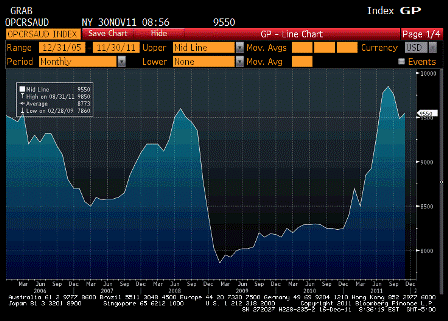
Saudi production

The Saudis are the only producer with excess capacity, which puts them in the position of swing producer.

They post prices and then let their refiners buy as much as they want at their posted prices.

They have no choice but to be price setter, but they also don’t want anyone to know they are simply setting prices, so they talk around it and have obviously done a good pr job in that regard.

So after production spiked due to lost Libyan output, production now seems be falling back to prior levels as Libya comes back online.

There are other things affecting supply and demand as well, also altering Saudi production accordingly.

The Saudis lose control of price on the upside only when they don’t have sufficient productive capacity to meet demand. And they lose control on the downside when they can’t cut sufficiently to address a fall in net demand.

Looks to me like they will remain in that catbird seat for quite a while.

And if they keep prices relatively stable there will not likely be a 70’s style global inflation problem.

oil

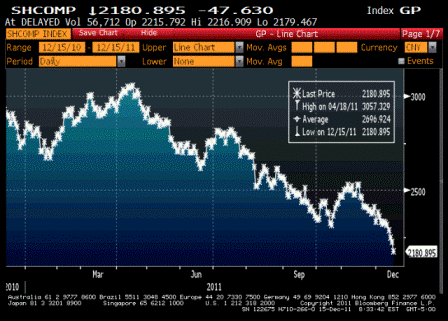
Chart of Shanghai Composite Equity Index – China

Best I can tell the jury is still out as to whether China is going through
the ‘hard landing’ scenario that began when modest first half state lending was
followed by lower second half state lending, all to control inflation.

Note the recent social unrest that could be inflation linked.
All we know is the regime change risk was sufficient for them to cut back on growth.
And so far not much sign of anything of consequence in the pro growth direction,
which means the political concerns over inflation are still there.

The currency could also be heading south fundamentally due to inflation.
Net fx reserves may be down to minimum levels
after factoring in their dollar debt that has been indirectly supporting the yuan.
And with foreign direct investment tapering off,
that source of currency support seems to have subsided.

While slower growth in China hurts some US companies,
lower resource costs for the US are consumer friendly.

If gold has lost enough of it’s bid from central bankers,
it could be headed back to it’s marginal cost of production, 1980’s style,
which is where it goes without global central bank accumulation.
I recall the buyers earlier this year included the Greek and Mexican central banks,
as well as the central bank of Bangladesh.
I suppose with high unemployment,
govt figures it might as well put people to work in the gold mines? Whatever!
Anyway, the final leg up for this cycle may have been the spike after Chavez
opted to take delivery of his gold, which he now has,
debunking the speculation that it wasn’t there to be delivered.

Next is whether Congress lets the FICA cuts expire and take maybe 1% off of Q1 GDP.
The President just said he wouldn’t veto the Republican plan, so they may work something out.
But with their bent on ‘paying for it’ no telling what the final result will be.

China headlines:

China’s Manufacturing May Contract a Second Month
Foreign Direct Investment in China Falls as Factories Slow
China Money Rate Rises Most in 2 Weeks
Yuan Forwards Fall for an Eighth Day as Manufacturing May Shrink
Chinese Cut Back on London Luxury Homes as Stock Losses Bite
China Money Supply Growth Slows to Weakest Pace in Decade
China Affirms Property Curbs Amid ‘Grim’ Outlook
China’s Stocks Fall to Lowest in 33 Months on Economic Concerns

ch equity

ECB Wants New Capital Rules Amid Credit Crunch Fears

It’s supports the notion that they understand that for govt debt to go down with the current institutional structure they need private sector debt (and/or exports) to increase.

However with the private sector necessarily pro cyclical (which is what Minsky boils down to),
at best this policy will keep mainly keep things from getting worse than otherwise.

ECB Wants New Capital Rules Amid Credit Crunch Fears

December 15 (MNI) — The European Central Bank, fearful of a looming credit crunch, is pushing regulators to alter new recapitalization rules in a way that will dissuade banks from shrinking their balance sheets to reach the 9% core tier 1 ratio required by the middle of next year, well-placed Eurosystem sources told Market News International.

In late October, the European Banking Authority (EBA) said it was requiring the region’s biggest banks to establish an exceptional and temporary buffer: the ratio of their highest quality capital to the assets on their balance sheet, weighted for risk, must reach 9% by the end of June 2012.

Eurosystem central bank officials as well as some EU governments are concerned that this new capital requirement could lead to a massive deleveraging by banks in Europe, which would entail selling off assets and significantly tightening conditions for lending.

There is widespread fear that such a development would depress loans to households and businesses. Some say it is already partly to blame for the big selloff in sovereign government bonds last month that led to sharply higher borrowing costs for Italy and Spain.

The original idea behind the EBA directive was that banks would need to maintain a constant 9% ratio over the entire period during which the requirement was in force. They could do so either by raising new capital — a big challenge in current market conditions — or by dumping assets and not acquiring new ones, which turned out to be the easier route.

“If you combine [asset] disposals with an aggressive fiscal tightening, you are creating the conditions for a sharp contraction,” a Eurozone central banker warned. He projected that the combined hit on GDP from fiscal tightening and bank retrenchment could be as much as two full percentage points. “That means a recession next year,” he said.

In recent public comments, ECB President Mario Draghi expressed concern about the potentially pernicious impact of bank deleveraging to meet the new capital targets. “We want to make absolutely sure that this process does not aggravate the credit tightening that is going on now,” the ECB president said. “It is important that banks raise capital, but not in a way that affects lending.”

Sources said that under a new proposal intended to address this problem, banks would be required not to reach a 9% ratio but to raise a specified, fixed amount of capital by the mid-2012 deadline.

Based on figures banks provided to the EBA as of end-September, the regulators would calculate the amount of capital a bank would have needed to hit the 9% capital ratio at that time. Banks would then be required to raise that level of capital regardless of what they had done with their assets since then or what they might do with them in the future.

Because banks would be required to raise the same amount of core tier one capital regardless of subsequent balance sheet moves, they would no longer have the same incentive to dump assets as a means of meeting the capital requirement.

A senior EU source said that a recent letter from the chairman of the EBA and the Polish EU presidency had noted that bank deleveraging was hurting the recovery, and it laid out a plan by which the 9% ratio would be calculated on the basis of risk-weighted assets on banks’ books as of September 30.

If the plan is approved, “you won’t see a change to the actual ratios or the sums [to be raised], but there will be a clarification that this should not be achieved through asset disposal,” this source said. “It should slow the aggressive [asset] disposal, which many people think is killing any chance of an upswing.”

After releasing new figures last Thursday on the total capital shortfall of European banks, totaling E114.7 billion, the EBA told banks to raise the money from investors, retained earnings and lower bonuses. Banks may only sell assets if the disposals do not limit overall lending to the economy, the EBA said.

However, it is not clear how bank regulators and supervisors would enforce this and whether there would be a level playing field, a well-placed Eurosystem source said. A new EBA requirement of the type now being discussed could address this issue, he said.

The decision on whether to switch from a capital ratio to a fixed amount of capital that each bank must raise lies in the hands of supervisors and regulators. It is too early to tell whether regulators will adopt the recommendation, since deliberations are still going on, another Eurosystem source said.

In its own effort to ensure the Eurozone’s economy won’t be starved for credit, the ECB last week announced a radical set of new liquidity measures, including a looser collateral framework and refinancing operations with a maturity of three years.