Obama Trickle down policies would make Reagan blush


[Skip to the end]

Looking for more of the same with the preponderance of ‘top down’ initiatives.

Wall street banks dividing up tens of billions in bonuses, as fees and net interest margins remain wide, helped by income lost by ‘savers’ due to fed rate cuts, while unit labor costs plunge with productivity high and wages stagnating.

Negative headline CPI means no social security increase, unemployment near 10% and jobs still being lost, foreclosures running at record levels, and mortgage delinquencies continuing to climb.

And now with real GDP growing at maybe 3% and lower income groups still going backwards, a larger chunk of the output has to be going to the top.

Wealthy U.S. Shoppers Boost Spending 29%

By Cotten Timberlake

Oct. 16 (Bloomberg) — Spending in the U.S. on luxury goods and services spurted 29 percent in the third quarter from the previous three months, as consumers with the highest incomes unleashed pent-up demand, according to Unity Marketing.

Spending among 1,067 consumers with average annual income of $228,800 rose to $18,826 each in the three months ended in September from $14,554 a quarter earlier, the Stevens, Pennsylvania-based luxury-market research firm said today. Shoppers cut spending by 3.2 percent in the second quarter and spent $13,429 in the third quarter of 2008.

The increase was driven by consumers with the highest income levels, starting at $250,000 a year, said Pam Danziger, Unity’s Marketing’s president. Spending was strongest in the home, travel and dining segments, she said. The wealthy curbed purchasing earlier this year because of Wall Street job cuts, lower home values and volatile financial markets.

“No question that this quarter’s spending increase is good news for luxury marketers,” Danziger said in a telephone interview today. “Many affluent consumers returned after sitting on the sidelines for a year. However, the richest are few in number, 2.5 million households, so competition will be fierce to win their attention.”

MasterCard Report

U.S. luxury sales rose 3.4 percent to $891 million in September from a year earlier, the first such gain since August 2008, according to figures provided today by credit-card company MasterCard in its SpendingPulse report. Last month, those sales fell 13 percent from the previous year.

The luxury category covers apparel, leather goods and department-store sales at the highest 10 percent of prices. SpendingPulse measures retail sales across all payment forms, including cash and checks.

United Marketing said purchases increased in all but three of the 22 product and service categories it tracks.

The highest-income group spent an average of $43,111 in the latest quarter and the lowest-income group tracked, with earnings of $100,000 to $149,999, spent $10,423. The three categories that didn’t gain were fashion accessories, fashion apparel and art, Danziger said.

Gains in confidence among luxury consumers, meanwhile, slowed, Unity Marketing said.

The researcher’s luxury confidence index rose 1.6 points to 75.9, after jumping 18.6 points to 74.3 in the previous quarter. That index peaked at 113.2 at the end of March 2006. Its low was 40.3 in September 2008. It started at 100 in January 2004.

The findings were based on a survey conducted among adults aged 24 to 70 with income of at least $100,000 from Oct. 2 to Oct. 7. Unity Marketing does not calculate a margin of error. It plans to publish the survey results Oct. 19.


[top]

LatAm News


[Skip to the end]

In general, Latin America seems to continue to be doing the right thing with fiscal policy including state sponsored lending and finance programs that are quasi fiscal transfers as well.

Highlights

Brazil’s August Retail Sales Rise 4.7% From Year-Ago
Brazil to Extend Tax Cut on Appliance Purchases, Folha Says
Peru GDP Will Rebound Stronger Than Peers, Morgan Stanley Says
Chilean Banks Relax Credit Conditions in 3Q, Central Bank Says


[top]

U.K.


[Skip to the end]

Waiting to see if Brown gets any credit for his fiscal policies which in fact are responsible for stopping the slide.

As in the US, monetary policy has been contractionary with lower rates hurting demand from savers and borrowers gaining
little or nothing, and lenders replenishing lost reserves.

And QE per se does nothing apart from altering the term structure of rates and modestly reducing bank earnings.

  • British house prices rise again in August
  • City regulator seeks to deflate financial sector with global tax
  • U.K. Retail Sales Index Falls, Outlook Improves, CBI Says
  • U.K. Business Investment Fell Most Since 1985 in Second Quarter
  • U.K. Two-Year Notes Rise as Chinese Curbs Boost Safety Demand
  • U.K. Population Hits 61.4 Mln; Immigration Eases


[top]

more weak July data


[Skip to the end]

>   
>   (email exchange)
>   
>   On Wed, Aug 19, 2009 at 9:38 AM, Morris Smith wrote:
>   
>   Really lousy economic data continues about July
>   

Yes, looking awful from a lot of angles.

This latest govt. attack on bank capital, especially small banks, might be biting deeper than the media is on to.

Amazon (AMZN-Hold)

Yesterday, comScore released July online retail data, showing total online spending falling by 7% y/y including a 5% y/y decline in non-travel spending. This data, combined with soft July retail and same-store-sales (SSS) and a weak outlook from Wal-Mart (WMT-Not Rated), reinforces our opinion that consumer spending may be slower to recover than anticipated. We reiterate our Hold rating on Amazon (AMZN) and our $83 per share price target.

comScore reported that July non-travel spending declined by 5% y/y, a sequential deceleration from the 1% y/y decline experienced in June and below the 4% y/y decline witnessed in May. Key category results were somewhat soft, with only Books & Magazines growing by 4% y/y and Consumer Electronics up 5% y/y.

eMarketer released data from the National Retail Federation (NRF) at the end of July indicating that nearly 50% of participating consumers were cutting spending on back-to-school supplies. Additionally, only 22% of respondents said that they would purchase back-to-school supplies on the web, down from 25% a year ago, with 75% opting to shop at traditional discount retailers.

July SSS fell 5% y/y, with the large majority of retailers posting greater than expected declines. The US Census Bureau reported that July total retail sales were flat sequentially but down 8% y/y, with sales down 9% y/y from May through July.

We now estimate that the impact on US eCommerce sales will be a 4% y/y decline in 3Q09 versus a 2% y/y decline in 2Q09, with low single digit growth in 4Q09. Ecommerce spending may decline by 1% y/y in 2009. This lack of consumer demand recovery represents a bit of an overhang on stocks like Amazon.

Amazon’s stock carries a premium valuation to other ecommerce, retail, Internet stocks and the S&P 500 Index, trading at 50x 2009E EPS and 21x 2009E OIBDA. The S&P 500 Index trades at 16x 2009E EPS of $60. Our ecommerce peer group averages 23x 2009E EPS and 10x OIBDA. Using a PEG ratio of 2.0x or 50x our 2009E EPS of $1.65, which equates to 21x our estimated 2009 OIBDA of $1.7 billion, our price target is $83 per share. We rate Amazon.com a Hold.

Orbitz (OWW-Buy)

We are reiterating our Buy on Orbitz (OWW) and raising our price target from $6 to $8 per share. We anticipate that Orbitz will be able to grow EBITDA by 20% y/y in 2009 and could nearly triple free cash flow through increased transaction volume growth and a sustainable cost savings program.

Transaction volumes improved 22% sequentially in Q2, helping to offset the removal of bookings fees on single-carrier flights, resulting in a better-than-expected gross bookings decline of 12% y/y. The removal of booking fees has stimulated consumer demand and shifted share from airlines to online travel agents (OTAs) like Orbitz. We expect further improvement in Q3, forecasting gross bookings to decline by 10% y/y. Q4 may only show a mid-single digit y/y decline in gross bookings, given an easier comparison and some potential price stabilization.

Despite the capacity cuts made last September, all of the major airlines have increasingly turned to the OTAs to shed excess inventory and generate revenue. Given the poor outlook published by the International Air Transport Association (IATA) for the global airline industry ($5 billion in losses, and normal traffic growth not returning until 2011), we anticipate that this trend will continue and may be very difficult to reverse.

Looking forward, Orbitz has committed to expanding its under-indexed hotel business globally. We believe that both Europe and Asia remain growth opportunities for Orbitz. Despite both Priceline (PCLN-Buy) and Expedia (EXPE- Buy) already establishing meaningful franchises on both continents, Orbitz should be able to capture a fair share of the rapidly growing international hotel market.

The cost savings program implemented in 1Q09, reducing expenditures by $40 million to 45 million annually, has driven EBITDA growth of 28% y/y through 1H09. Debt leverage has fallen from 5x to 4x based on our recently raised 2009E OIBDA of $160 million. Interest coverage has improved from 2x to 3x. Free cash flow is also forecast to nearly triple from $0.31 in 2008 to $0.88 in 2009.

Orbitz trades at 10x our 2010E EPS of $0.50, below a market P/E multiple of 14x. Our domestic e-Travel group reflects an average 2010E EPS trading multiple of 14x. Using a PEG of 1.1 or 16x 2010E EPS of $0.50, our 12-month price target is $8 per share. We rate Orbitz a Buy.

Yahoo (YHOO-Hold)

Recent data support our concerns about a sustained slowdown in online advertising. We continue to believe online advertising will remain muted in the third quarter as there has been no evidence of an advertising recovery to date. Yahoo remains vulnerable to declining fundamentals and a long complex integration process with Microsoft. We maintain our Hold rating.

Yesterday, comScore reported that July e-commerce non-travel spending declined 5% y/y and 6% sequentially. This was the largest monthly annual decline in 2009. We do not believe this bodes well for an online advertising recovery in the third quarter, particularly when combined with the University of Michigan’s preliminary consumer confidence sentiment number for the month of August, which showed a continued decline from July.

Yahoo continues to experience a continuous search market share loss in the US. According to comScore, Yahoo’s US search share stood at 19.3% in July, which represents a consistent monthly decline from 21.0% in January.

Data suggests Yahoo’s search ad coverage is down significantly y/y and dropped materially month/month in July. Ad coverage data coincides with a poor July e-commerce report.

This news does not bode well for Google, which also experienced a sequential decline in ad coverage during July. Google also saw a slight US search market share loss to Bing in July to 64.7% from 65.0% in June.

Our channel checks and the comScore data do not support Yahoo’s commentary at last week’s investor conference, where the Company remarked that it saw “green shoots” in ad sales and saw near-term ad budgets coming back. In addition, this commentary is inconsistent with Yahoo’s weak third quarter guidance.

Yahoo continues to battle departures amongst its executive team. Last week, Yahoo’s VP of West Coast sales announced his departure after three years at the Company. Yahoo also recently lost its VP of sales in New England and Canada.

We maintain our cautious view of the online advertising space as we forecast no growth in online advertising during 2009. Yahoo trades at 7x 2009E OIBDA, which is fairly valued in our view, particularly given expectations of a long drawn-out integration process with Microsoft and our concerns about Yahoo’s strategy and growth.


[top]

Hong Kong recovery ‘made in China’


[Skip to the end]

Yes, this further supports the notion that some of the world economic improvement was due indirectly to ‘one time’ inventory building and additions to capacity in China, including the eurozone, where exports nudged France and Germany to positive GDP reports.

Hong Kong Climbs Out of Recession as Trade Improves

August 14 (Bloomberg) — Hong Kong climbed out of a yearlong recession as trade improved, adding to signs that the global economy is recovering.

Gross domestic product rose a seasonally adjusted 3.3 percent in the second quarter from the previous three months, after dropping 4.3 percent in the first quarter, the government
said today. The median estimate in a Bloomberg News survey of seven economists was for a 1.2 percent gain.

The Hang Seng Index has gained 84 percent from this year’s low in March as China’s record lending and 4 trillion yuan ($585 billion) stimulus package help the city, which is a hub for
trade and finance. Hong Kong’s government raised its forecast for this year’s GDP to a contraction of between 3.5 percent and 4.5 percent today from a previous estimate of a 5.5 percent to
6.5 percent decline.

“This rebound has largely been ‘Made in China,’” said Brian Jackson, a senior strategist at Royal Bank of Canada in Hong Kong. “Exports to the mainland have picked up, while easy
liquidity conditions there have contributed to recent gains in Hong Kong’s asset prices, providing a strong boost to Hong Kong consumers.”

The economy shrank 3.8 percent in the second quarter from a year earlier, after a 7.8 percent drop in the previous three months. The first-quarter contraction from the previous three
months was the worst since data began in 1990.

Singapore Retail Sales Post Smaller Drop as Recession Recedes

By Stephanie Phang

August 14 (Bloomberg) — Singapore’s retail sales fell the least in three months in June as the nation emerged from its worst recession since independence 44 years ago and an annual island-wide sale supported spending.

The retail sales index dropped 8.2 percent from a year earlier after sliding a revised 10.4 percent in May, the Statistics Department said today. The median estimate of 11 economists surveyed by Bloomberg News was for a 9.2 percent decline. Adjusted for seasonal factors, sales rose 2.3 percent from May.

Singapore’s economy expanded for the first time in a year last quarter as manufacturing and services improved. The government raised its 2009 export forecast this week as policy makers around the world predict the worst of the global recession is past after pledging about $2 trillion in stimulus measures and cutting interest rates.

“We should generally expect gradual improvement in retail sales from hereon,” said Kit Wei Zheng, an economist at Citigroup Inc. in Singapore. He cited “firmer signs of a turnaround in labor markets, and perhaps some positive spillovers on confidence from the buoyant property and equity markets.”

Singapore’s benchmark stock index has climbed 49 percent this year and home sales by developers including Frasers Centrepoint Ltd. rose 9.1 percent in June from May, according to the Urban Redevelopment Authority.

Singapore employers fired fewer workers last quarter, cutting 5,500 jobs compared with 12,760 in the first three months of the year, the Ministry of Manpower said July 31. The seasonally adjusted unemployment rate held at 3.3 percent.


[top]

Retail Sales/Claims/Import Prices/Walmart


[Skip to the end]


Karim writes:
Data supportive of the ‘low for long’ camp:

Retail Sales

  • One of biggest misses in awhile; -0.1% vs expex of +0.8%
  • Ex-autos -0.6%
  • Control group -0.2%
  • Look for early markdowns of Q3 GDP estimates

Claims

  • Initial claims up 4k to 558k
  • Continuing down 141k (prior week revised up 33k); net of extended and emergency claims -11k

Import Prices

  • -0.7% m/m and -19.3% y/y (record drop)
  • Ex-petroleum -0.2% m/m and -7.3% y/y

Walmart- Beats earnings estimates but misses on revenue

  • “We are acclerating our focus on reducing our expenses”-CEO
  • WAL-MART CEO SAYS THERE IS A `NEW NORMAL’ IN CONSUMPTION
  • WAL-MART CEO SAYS PEOPLE ARE SAVING MORE, CONSUMING LESS
  • WAL-MART U.S. COMP SALES IN 2Q BELOW PLAN
  • WALMART REDUCED U.S. INVENTORIES FASTER THAN SALES DECLINE


[top]

EU Daily | ECB sees ‘turning point’ in lending conditions


[Skip to the end]

Yes, central banks have finally managed to restore a degree of ‘market functioning’ after full year or more of ‘extraordinary measures’ which mainly served to demonstrate a lack of understanding of basic monetary operations.

Note that only after automatic stabilizers began to reverse the slide at year end did the lending environment begin to recover as well.

  • ECB sees ‘turning point’ in lending conditions
  • European Retail Sales Fall for 14th Straight Month, PMI Shows 2009
  • German Unemployment Total Rose in July as Job Cuts Continued
  • German July Retail Sales Decline at Slowest Pace in 14 Months
  • Ifo Sees More Jobs Lost Among German Machinery Makers, FTD Says
  • French Retail Sales Post Sharpest Drop in Four Months, PMI Says
  • Italy’s Retail Sales Fall as Job Cuts, Recession Curb Spending
  • Italian Banks Agree on One-Year Loan Moratorium, MF Reports
  • Spanish Consumer Prices Dropped by Record 1.4 Percent in July
  • Spain’s Recession Eased in Second Quarter, Central Bank Says
  • German Bonds Decline as Stocks Advance, Italy Auctions Debt


[top]

Retail/PPI


[Skip to the end]

Karim writes:

Retail sales weaker than expected (especially in light of fact that May/June were peak months for consumer provisions in stimulus package)

  • 0.6% headline; 0.3% ex-autos; -0.2% ex-autos and gasoline

PPI

  • Headline up 1.8%; 0.5% core; driven by 3.4% gain in light truck prices; ex-vehicles, core unch
  • Intermediate stage (1.9%/0.4%) and crude (4.6%/2.6%) largely driven by energy prices that have since reversed


[top]

2009-05-13 USER


[Skip to the end]

Karim writes:

Falling wage and salary income and rising savings rate continuing to take a toll on consumer spending.

Recent pick-up in gas prices also likely hurting discretionary spending.

  • April retail sales -0.4% and -0.5% ex-autos (expectations +0.2%)
  • March ex-autos revised from -0.9% to -1.2%
  • April, Ex-gas, -0.2%
  • April, Control group (feeds into PCE component of GDP), -0.3%
  • Need a very sharp rebound in May/June to prevent Q2 PCE from being negative due to combined March/April weakness.
  • Downside risks to Q2 GDP now as low as -5%

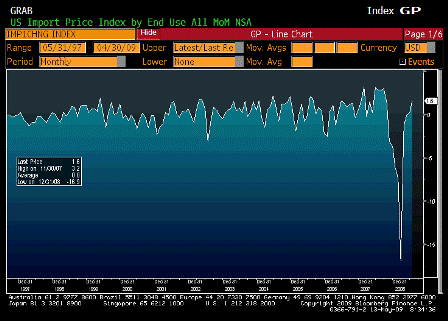
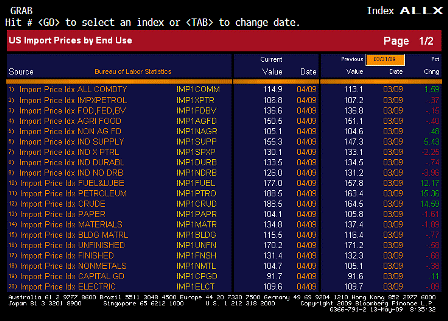
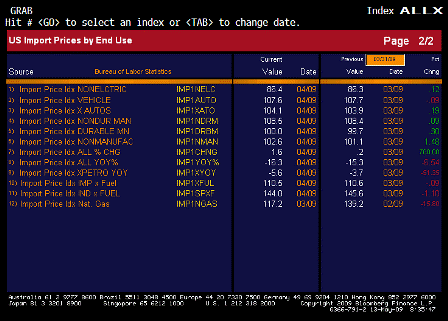
Import prices up 1.6%, -0.4% ex-petroleum and -0.5% from China


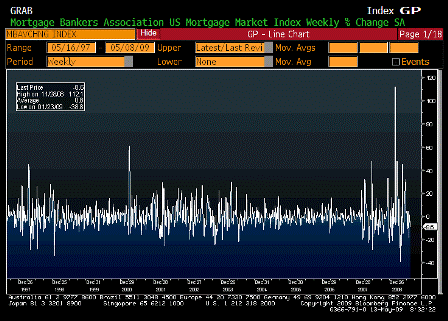
MBA Mortgage Applications (May 8)

Survey n/a
Actual -8.6%
Prior 2.0%
Revised n/a

[top][end]

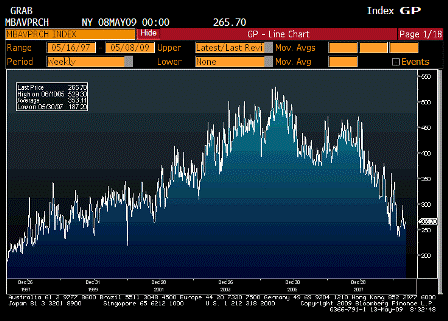
MBA Purchasing Applications (May 8)

Survey n/a
Actual 265.70
Prior 264.30
Revised n/a

[top][end]

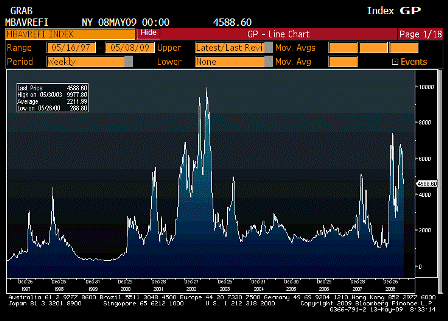
MBA Refinancing Applications (May 8)

Survey n/a
Actual 4588.60
Prior 5169.30
Revised n/a

[top][end]


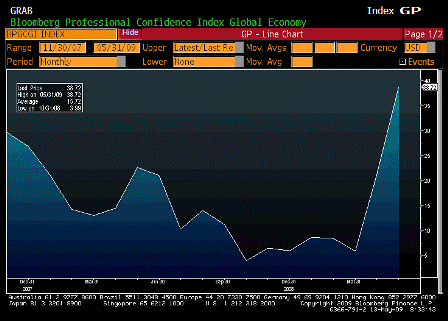
Bloomberg Global Confidence (May)

Survey n/a
Actual 38.72
Prior 21.20
Revised n/a

[top][end]


Import Price Index MoM (Apr)

Survey 0.6%
Actual 1.6%
Prior 0.5%
Revised 0.2%

[top][end]

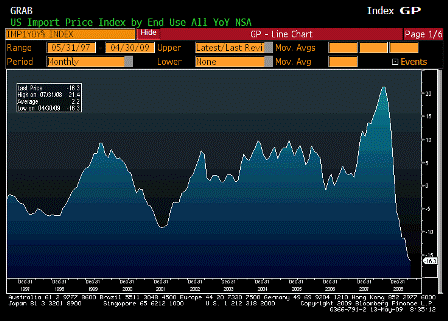
Import Price Index YoY (Apr)

Survey -16.8%
Actual -16.3%
Prior -14.9%
Revised -15.3%

[top][end]

Import Price Index ALLX 1 (Apr)

[top][end]

Import Price Index ALLX 2 (Apr)

[top][end]


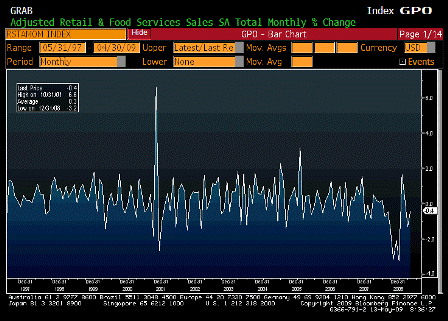
Advance Retail Sales MoM (Apr)

Survey 0.0%
Actual -0.4%
Prior -1.1%
Revised -1.3%

[top][end]

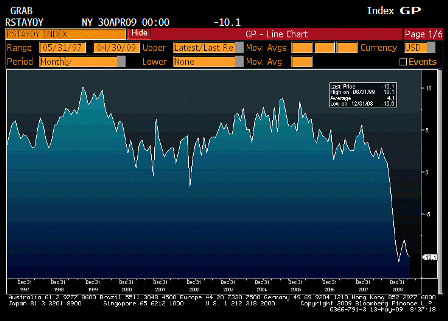
Advance Retail Sales YoY (Apr)

Survey n/a
Actual -10.1%
Prior -9.6%
Revised n/a

[top][end]

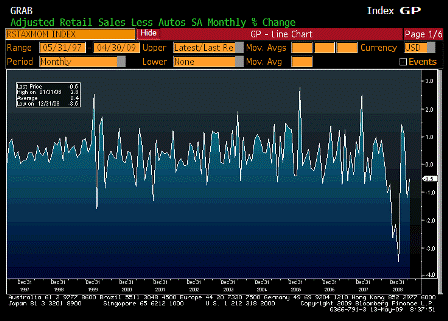
Retail Sales Less Autos (Apr)

Survey 0.2%
Actual -0.5%
Prior -0.9%
Revised -1.2%

[top][end]


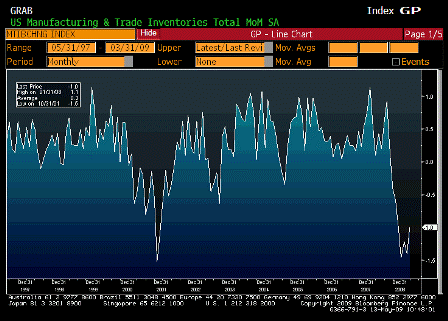
Business Inventories MoM (Mar)

Survey -1.1%
Actual -1.0%
Prior -1.3%
Revised -1.4%

[top][end]

Business Inventories YoY (Mar)

Survey n/a
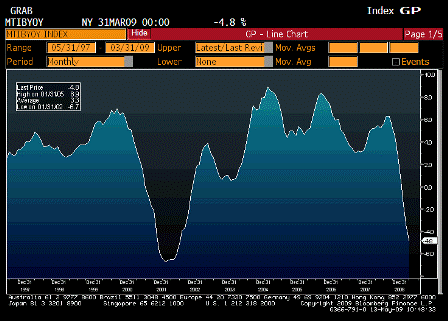
Actual -4.8%
Prior -3.6%
Revised n/a


[top]