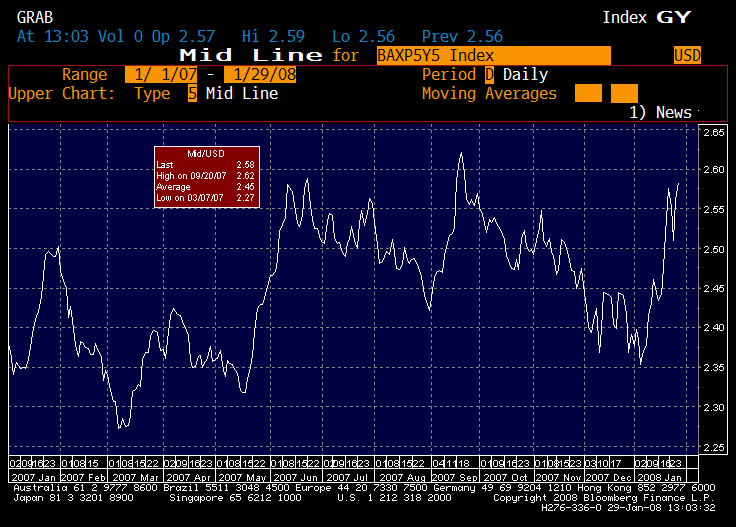
Stagflation

Yes, the below analysis has also been the Fed’s position, up until this week’s speeches.

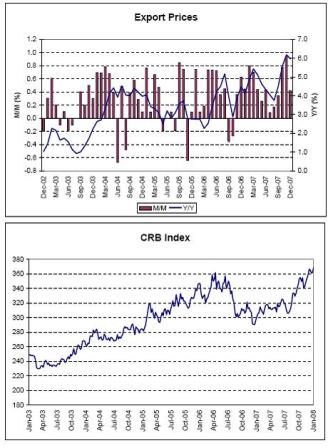
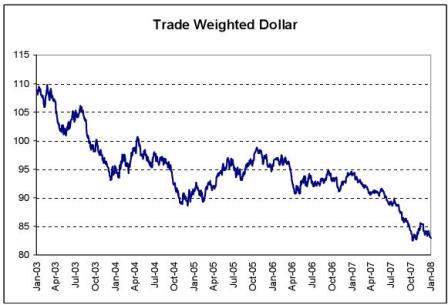
It’s been about a crude/food/$ negative supply shock, supported by Saudis/Russians acting as swing producer and biofuels linking crude prices to food prices.

The fed has called the price hikes relative value stories that they don’t want turning into an inflation story. They feel they have room to cut rates as long as expectations stay well anchored, which includes wage demands but other things as well.

Yellen the dove, along with the hawks, now saying inflation expectations are showing signs of elevating, and saying energy costs are being passed through to core inflation is a departure from previous Fed rhetoric and may signal they are at or near their limits regarding ff cuts (data dependent, of course).

Also, Bernanke pushing Congress and the President to add to the deficit could also be a sign he is reaching his inflation tolerance regarding lowering the FF rate. The mainstream belief is that inflation is a function of monetary policy, not fiscal policy.

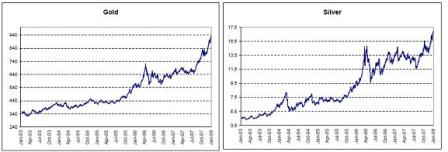
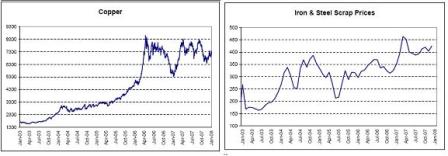
Now with the ECB perhaps throwing in the towel on inflation as well, look at how the commodities are responding. ‘Cost push inflation’ is ripping, and the perception is the CB’s around the world will act to sustain demand, including pushing for larger fiscal deficits.

Difficult to explain why so many have stagflation on the brain It is difficult to explain why so many folks still have stagflation or inflation on the brain just because wheat prices have soared to new highs. We have to distinguish between relative and absolute pricing. Not only that, but unlike the 1970s, the current ‘inflation’ backdrop is much more narrowly confined. The key is the labor market. And here we have a 4-quarter growth rate in unit labor costs of a mere 1% in 4Q (a three-year low), which compares to 4% heading into the 2001 downturn. In other words, as far as the labor market is concerned, inflation is less of a threat to the economy than it was at this same stage of the cycle seven years ago. In fact, heading into the 1990 recession, the trend in ULC was also 4% – the Fed sliced the funds rate from almost 10% to 3% that cycle, for crying out loud. In fact, scouring more than 50 years’ worth of data, at no time in the past has the year-to-year trend in unit labor costs been as low as it is today heading into an official recession. Make no mistake, deflation is going to emerge as the next major macro theme.


♥

Yellen on inflation

SF Fed president Yellen on inflation, from yesterday’s speech in Hawaii:

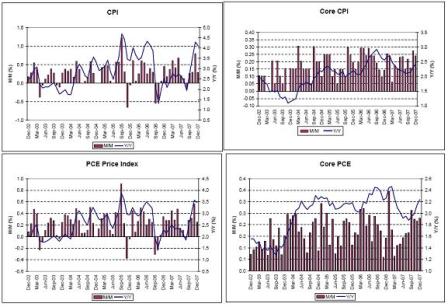
Now let me turn to inflation. The recent news has been disappointing. Over the past three months, the personal consumption expenditures price index excluding food and energy, or the core PCE price index—one of the key measures included in the FOMC’s quarterly forecasts—has increased by 2.7 percent, bringing the increase over the past 12 months to 2.2 percent. This rate is somewhat above what I consider to be price stability.

Yellen is the most dovish Fed president and not currently a voting member. Notable that 2.2% core PCE is clearly above her comfort zone.

I expect core inflation to moderate over the next few years, edging down to around 1¾ percent under appropriate monetary policy.

Appropriate monetary policy is a requirement to bring inflation down.

Such an outcome is broadly consistent with my interpretation of the Fed’s price stability mandate. Moreover, I believe the risks on the upside and downside are roughly balanced. First, it appears that core inflation has been pushed up somewhat by the pass-through

Up until now, the Fed has taken comfort that ‘pass through’ was not happening. This is what brings core up to headline, something the Fed has previously believed was not happening.

of higher energy and food prices and by the drop in the dollar. However, recently, energy prices have turned down in response to concerns that a slowdown in the U.S. will weaken economic growth around the world, and thereby lower the demand for energy.

Meaning an upturn in energy prices will do the reverse. Seems inflation is now a function of energy prices. This is a change from energy prices weakening demand and causing deflation. Now, it is passing through and causing core inflation.

Another factor that could restrain inflationary pressures is the slowdown in the U.S. economy. This can be expected to create more slack in labor and goods markets, a development that typically has been associated with reduced inflation in the past.

Yes. This is the remaining dove position. Previous speeches this week by the hawks have expressed concerns that economic weakness and slack in the labor markets will not bring down core inflation.

This is the problem of the trade-off between unemployment and inflation. Seems that the applicable historical data now shows that it takes ever larger moves in unemployment to move the inflation needle in either direction.

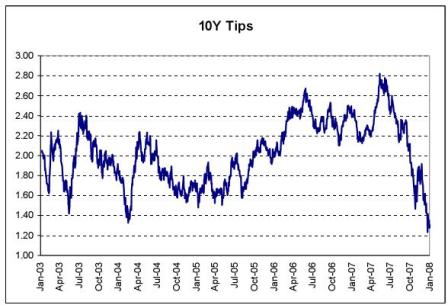
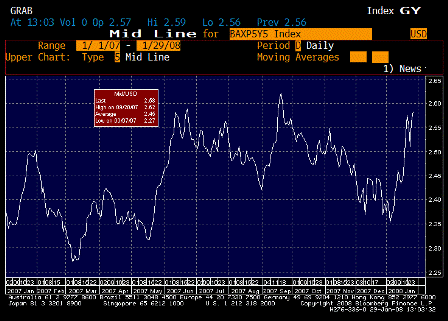
A key factor for inflation going forward is inflation expectations. These appear to have become well-anchored over the past decade or so as the Fed’s inflation resolve has gained credibility. Very recently, far-dated inflation compensation—a measure derived from various Treasury yields—has risen, but it’s not clear whether this rise is due to higher inflation expectations or to changes in the liquidity of those Treasury instruments or inflation risk. Going forward, we will need to monitor inflation expectations carefully to ensure that they do indeed remain well anchored.

All speeches have now stated that there are signs inflation expectations may be elevating.

There are two schools of thought on this at the Fed. The majority will state that when expectations begin to rise, it is too late. The minority say you can let them rise a ‘little bit’, but then they must take decisive action.

Since August, the Fed forecasts have been projecting that economic weakness will bring down prices. With both hawks and doves now acknowledging that this my not be the case, it could be the official Fed forecasts have elevated their near- and medium-term inflation forecasts.

The long-term Fed inflation forecast will remain the same, as it indicates what their long-term inflation target is. But also in the forecasts is what Yellen called the ‘appropriate monetary policy’ to achieve that target.

This could mean the official forecasts now have higher interest rates built into their forecasting model.

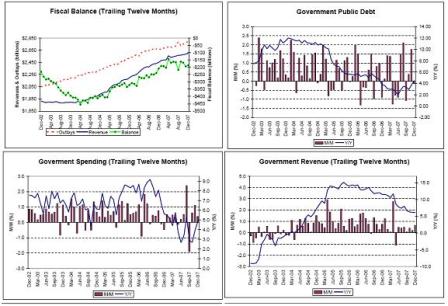
And more so now that Congress passed the fiscal package today. Private forecasts are saying it will add maybe 1% of GDP by Q2 and may double that in Q3. At a minimum, this will help support domestic gasoline demand. (And raising the mortgage cap won’t hurt either.)

My twin themes that began in Q2 2006 remain:

  1. Weakening domestic demand due to the government deficit being too small, but supported by strong exports due to non-residents’ reduced desire to accumulate $US financial assets and now some additional support to demand from today’s fiscal package.
  1. Rising prices are due to Saudis/Russians acting as swing producer and setting price at ever higher levels until demand falls below their pain thresholds.

For the last five months, I have been underestimating the Fed’s inflation tolerance. They all firmly believe that price stability is a necessary condition for optimal long-term growth and employment.

And they all do not want a relative-value story to turn into an inflation story as happened in the 1970s.

The Fed is data dependent; the question is which data.

At some point, it becomes the inflation data, and at that point, the Fed is way behind the inflation curve.

For example, rates are up to 7.25% in Australia and their inflation is 1% lower than ours.

Bernanke spends next week. The fixed exchange rate types of deflationary risks he has feared have not materialized.

It is looking more like the 1970s than the 1930s.

If Bernanke confirms inflation expectations have been elevating, the easing cycle may be over.

No matter how weak the economy may get in the near term.


Re: 1st step for ECB

(an interoffice email)

I’m thinking they had to do something about the euro.

the eurozone exporters can be very convincing

warren

On Feb 7, 2008 10:41 AM, Karim wrote:
>
>
>
> Is taking hikes off the table, so:
>
> 1) No mention of acting ‘pre-emptively’
>
> 2) No one voted to hike (or cut) at meeting
>
> 3) Trichet: “I never subscribed to theory of decoupling’
>
> 4) Downside risks to growth now ‘confirmed’
>
>
>
> All the usual references to preventing 2nd round effects not new, 1-4 above
> is.


♥

Plosser Speech

Plosser is perhaps the most hawkish Fed president.

Look for a dove to speak soon to soften this stance?

(intro remarks deleted)

The FOMC and Monetary Policy Objectives

In conducting monetary policy, the FOMC seeks to foster financial conditions, including growth of money and credit and a level of
short-term interest rates, consistent with achieving two goals: price stability and maximum sustainable economic growth.

Note this general policy statement:

I believe that the most important contribution the Fed can make to sustained economic growth and employment rests on credibly committing to and achieving long-run price stability. In fact, without a credible commitment to maintaining price stability, the Fed’s ability to promote sustainable growth would be seriously undermined. Moreover, price stability is not only an important element in achieving sustained economic growth, it is also critical in promoting financial stability.

That is the mainstream view, and the view the Fed has presented to Congress over the years regarding how it complies with its dual mandate: get price stability right and markets function to promote optimum long-term growth and employment.

The primary tool for implementing monetary policy is the federal funds rate,

(SNIP)

It is important to recognize that the influence of changes in the FOMC’s targeted funds rate on inflation and economic growth occurs with a lag, so by necessity the FOMC must be forward-looking in setting an appropriate funds rate target. It must forecast future economic growth and inflation based on available economic data and financial conditions, including a particular path for the fed funds rate.

(SNIP)

A change in the economic outlook is what was at work in the last two weeks when the FOMC decided to reduce its target fed funds rate in two steps to its current level of 3 percent.

Let me elaborate on recent economic and financial conditions and my current outlook for the economy and inflation.

The Outlook
Since last August, financial and economic conditions have deteriorated. As that occurred, policymakers revised downward their forecasts for 2008 economic growth. This took place in several steps as new data were released and, in turn, led the FOMC to lower the federal funds rate in a series of steps.

By last September, we had already seen a cumulative deterioration in the housing sector during the earlier part of 2007. In addition, the disruptions in financial markets in August caused by the problems in the subprime mortgage market raised the risk of potential adverse effects on the broader economy from a further tightening of credit conditions. As a result, I lowered my projection of economic growth for the fourth quarter of 2007 and the first half of 2008. In particular, the adjustment to my forecast involved pushing back the turnaround in residential construction, as low demand for homes meant it would take longer than expected for the economy to work off the inventories of new and existing homes for sale. The continuing high prices of oil and other commodities also suggested the potential for some slowing in the pace of economic activity, as well as hinting at increasing inflationary pressures — a point I will return to later. As the outlook changed, the FOMC lowered the fed funds rate target by 50 basis points in September, and then by another 25 basis points in both October and early December.

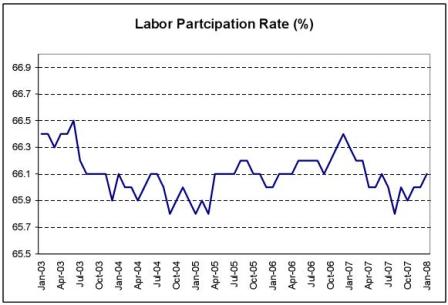
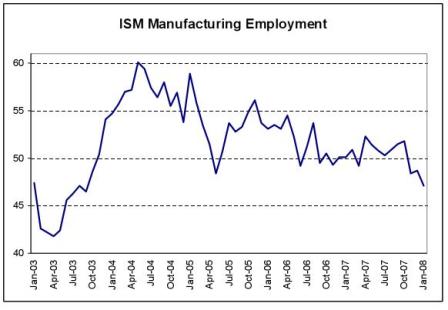
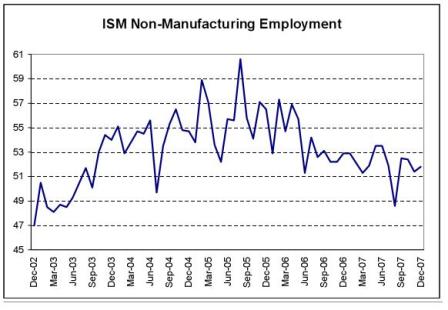
Since the Committee’s meeting in early December, the economic data have indicated that the deterioration in the housing market has continued unabated. Although that by itself was discouraging, other economic indicators also showed signs of an economy that was weakening. The renewed widening of some credit spreads in financial markets, along with weaker figures for retail sales, manufacturing activity, and job growth in December, led many forecasters in early January to further mark down their forecasts for 2008. The sharp rise in December’s unemployment rate, which was released in early January, also heightened many economists’ concerns about the economy’s health. What’s more, the Philadelphia Reserve Bank’s closely watched manufacturing survey recorded a surprisingly steep decline in industrial activity in January, to a level not seen since the last recession.

Although the economy’s resilience to past shocks makes me cautious about making changes to my outlook based on just one or two pieces of economic news, the string of weaker than anticipated numbers released in late December and in January had a cumulative effect on my own assessment of the 2008 outlook. While I would not be very surprised if the economy bounces back more quickly than many forecasters are now projecting, I am now, nevertheless, anticipating a weaker first half of 2008 than I did in October. This downward revision to the economic outlook is what led me to conclude that a substantially lower level of interest rates was needed to support the process of returning the economy to its trend rate of growth. Consequently, I believe the recent reductions in the federal funds rate were a necessary and appropriate recognition of this changed outlook.

The ongoing housing correction and the volatility and uncertainty in the credit markets are significant near-term drags on the economy and I expect growth in the first half of the year to be quite weak, around 1 percent. As conditions in the housing and financial markets begin to stabilize, I expect growth to improve in the second half of the year and to move back to trend, which I estimate is around 2.7 percent, in 2009. Overall, I am now anticipating economic growth in 2008 of near 2 percent.

Confirming ‘trend’ GDP at 2.7%.

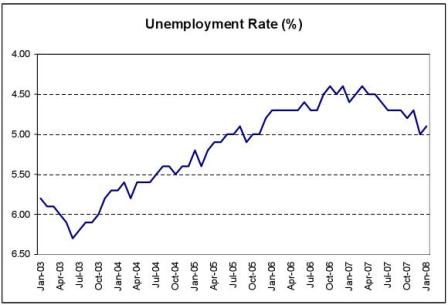
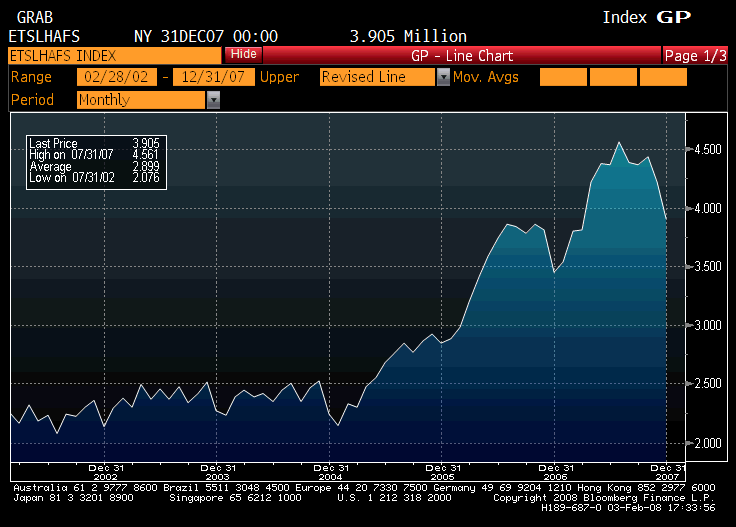
Given the slowdown in economic growth this year, payroll employment will rise more slowly than last year and will remain below trend for much of the year before picking up in 2009. Slower job growth will also lead to an unemployment rate near 5-1/4 percent in 2008, after fluctuating between 4‑1/2 and 5 percent in 2007.

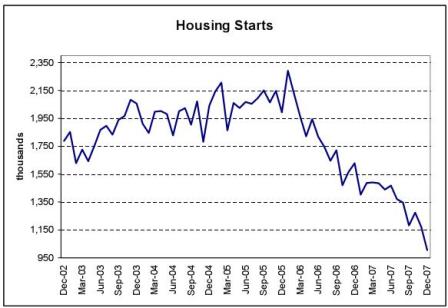
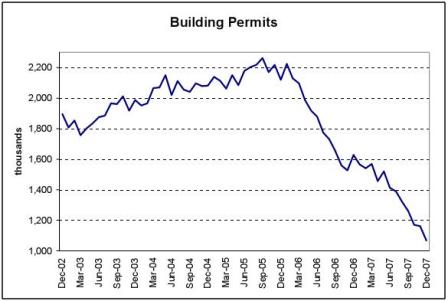
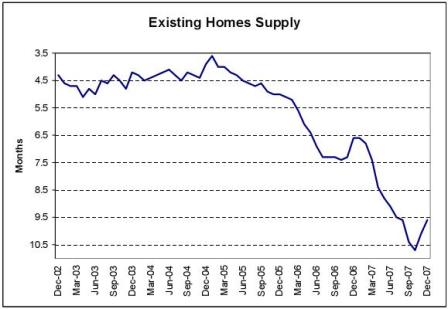
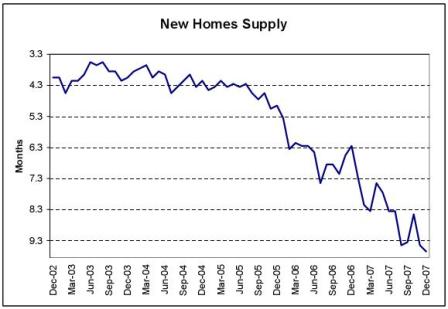
Two adjustments will continue to be needed to help work down the large number of unsold homes: further cuts in construction and declines in housing prices. I expect the decline in housing starts will bottom out in the middle of this year, but starts are likely to then be quite flat through the end of 2009 as the inventory of unsold homes is reduced gradually.

Interesting how long he thinks starts will stay around one million.

Of course, as was the case in 2007, how quickly housing bottoms out remains one of the main uncertainties surrounding any forecast in today’s environment. It seems that ever since last spring, the turnaround in housing was always six months away. Well, nine months later, it is still six months away. Simply having housing stop contracting will help economic growth. In 2007 the decline in residential construction took 1 percentage point off real GDP growth, which turned out to be 2.5 percent for the year (4th quarter to 4th quarter). Once residential construction stops declining, it will cease subtracting from overall growth. But housing is unlikely to make a positive contribution to economic growth until 2009.

Business investment should continue to increase this year, but at a slower pace than in 2007. Outside of autos and housing, there isn’t a large inventory overhang in the economy to be worked off. This is actually good news. Recessions are often preceded by periods of large inventory accumulation and much of the decline in production during recessions reflects a working off of an inventory imbalance. The absence of such an inventory overhang is encouraging.

The biggest component of GDP is consumer spending. With slower growth of employment and personal income in the first half of 2008, and as the decline in the value of homes and equities diminishes households’ net worth, consumer spending is likely to grow more slowly before picking up again in 2009.

One piece of good news has been the growth in exports. The trade sector supported economic growth last year as domestic demand weakened in the U.S. while foreign growth remained strong. The declining dollar also helped fuel a rebound in our exports. The net export component of GDP should continue to improve this year, although more slowly than it did in 2007 because we are likely to see somewhat slower growth among our major trading partners this year.

Inflation
Let me now turn to the outlook for inflation. Unfortunately, I expect little progress to be made in reducing core inflation this year or next, and I am skeptical that slower economic growth will help.

My understanding is the Fed was forecasting weakness that would bring down inflation.

All you have to do is recall the 1970s when we experienced both high unemployment and high inflation to appreciate that slow economic growth and lower inflation do not necessarily go hand in hand. I anticipate that core inflation (which excludes the prices of food and energy) is likely to remain in the 2 to 2‑1/2 percent range in 2008, which is above the range I consider to be consistent with price stability. If oil prices stabilize near their current levels, I expect headline, or total, inflation to decrease to around the 2 to 2‑1/2 percent range in 2008.

That is not a welcome forecast for the FOMC. They don’t want to conduct policy that lets core get that high.

(SNIP)

As the FOMC’s January 30 statement said, it will be necessary to continue to monitor inflation developments carefully. Most measures of inflation, including the core CPI and core PCE price measures, accelerated in the second half of 2007 compared to the first half. With inflation creeping up, we have to be particularly alert for rising inflation expectations. It is important that inflation expectations remain stable. If those expectations become unhinged, they could rapidly fuel inflation.

Again, that is the mainstream view. The expectations operator is key to a relative value story turning into an inflation story, as they say.

Moreover, as we learned from the experience of the 1970s, once the public loses confidence in the Fed’s commitment to price stability, it is very costly to the economy for the Fed to regain that confidence. The painful period of the early 1980s was the price the economy paid to restore the credibility of the Fed’s commitment — we certainly do not wish to go through that process again.

The mainstream often states it this way: ‘The real cost of bringing down inflation once expectations elevate is far higher than the cost of a near term recession.’

Fortunately, so far inflation expectations have not changed very much. But they bear watching because there are some signs that they, too, are edging higher. These may be early warning signs of a weakening of our credibility, and we must be very careful to avoid that.

The Fed is divided here. Most say that if expectations begin to elevate, it could be too late -the inflation cat is out of the bag- so, that much be avoided at all costs. Others say you can let them elevate a little bit, but must then act quickly to bring inflation down.

Monetary Policy Going Forward

(SNIP)

Over the course of the last five months, as forecasts for economic growth have been revised downward, the FOMC has lowered the fed funds rate by 225 basis points — from 5.25 percent to 3 percent. Taking expected inflation into account, the level of the federal funds rate in real terms — what economists call the real rate of interest — is now approaching zero. That is clearly an accommodative level of real interest rates. The last time the level of real interest rates was this low was in 2003-2004. But that was a different time with a different concern — deflation — and we were intentionally seeking to prevent prices from falling. Recently we have had reason to be worried about rising inflation, not declining prices.

This is a very strong statement – real interest rates are near zero, which was maybe appropriate given deflation fears in 2004, but he says not that is not the issue.

The FOMC’s reductions in the federal funds rate have been proactive in responding to evolving economic conditions that led to the deterioration in the outlook for economic growth. My inclination to alter monetary policy depends on whether the accumulation of evidence based on the data between now and our next meeting causes me to revise my forecast further. Weaker than expected data might lead to a downward revision, while stronger than expected data may lead to an upward revision to the forecast.

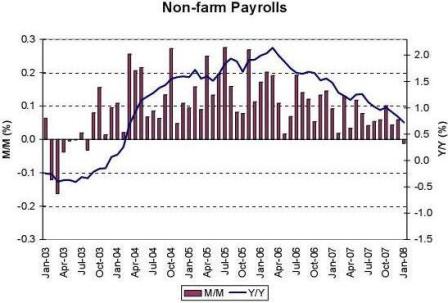
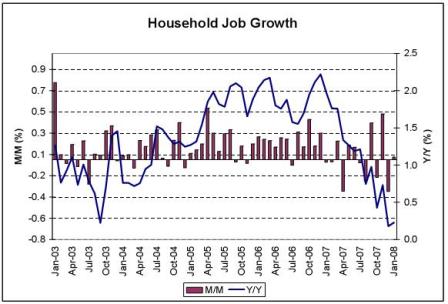
To make this point concrete, last Friday the Bureau of Labor Statistics reported that the economy lost 17,000 jobs in January. This was not an encouraging number. However, it was consistent with my forecast of weak employment growth in the first quarter of this year. Thus, by itself, it does not lead to a substantive revision to my forecast. We must look at the accumulation of data from a variety of sources to assess how the outlook may have changed relative to what was expected.

The payroll number did not change his forecast.

I also want to note that in early January there was much concern when the BLS reported only 18,000 jobs were created in December. Yet in the employment report last Friday that preliminary number was revised up to 82,000. Thus, we have to realize that economic data are subject to revision, and we have to be very careful not to rely on any one statistic or data series in assessing current economic conditions or our outlook.

Looks like he recognized January may be also revised up as December and August were.

There are those who have expressed the view that in times of economic weakness, the Fed must not worry about inflation and should focus its entire effort on restoring economic growth by dramatically driving interest rates down as far and as rapidly as possible. To borrow a line attributed to that famous, or perhaps infamous, Union Admiral David Farragut at the Battle of Mobile Bay, it is sort of a “damn the torpedoes, full speed ahead” approach to policy. But the Fed has a dual mandate for a reason. Price stability is a necessary component for achieving sustained economic growth. Ignoring price stability during times of economic weakness risks undermining our ability to achieve economic growth over the long run. It fuels higher inflation down the road and risks inappropriate risk taking and recurring boom/bust cycles. This would be counterproductive.

Again, this is the mainstream view.

Although it might be tempting to think that monetary policy is the solution to most, if not all, economic ills, this is not the case. I think it is particularly important, for example, to recognize that monetary policy cannot solve all the problems the economy and financial system now face. It cannot solve the bad debt problems in the mortgage market. It cannot re-price the risks of securities backed by subprime loans. It cannot solve the problems faced by those financial firms at risk of being given lower ratings by rating agencies because some of their assets are now worth much less than previously thought. The markets will have to solve these problems, as indeed they will. But it will take some time. However, the Fed can and should help by offsetting some of the restraint created by tightening credit conditions and the sharp reduction in housing investment. The Fed can and should also promote the orderly functioning of financial markets.

Going forward, then, my approach to making monetary policy decisions will be to look at incoming information and ask whether it is consistent with my outlook and the achievement of the Fed’s dual mandate. My outlook for 2008 already incorporates the fact that we will be receiving quite a few weak economic numbers in the first half of the year. However, to the extent that economic conditions evolve differently than expected, we will need to be prepared to incorporate those changing conditions into our policy decisions in a manner that is consistent with our dual mandate.

He uses the term ‘dual mandate’ to stress the importance of price stability.

Conclusion
In conclusion, my own forecast for economic activity has been revised downward since last October as economic conditions have evolved. I believe the recent reductions in the level of the federal funds rate target will be supportive of the economic adjustment process and a return to trend growth near the end of this year and on into 2009. The Fed has been aggressive in making this adjustment in rates, which will mitigate some, but not all, of the problems the economy and financial markets are facing. Some problems will simply take time for the financial markets to work out.

Seems his opinion is that unless the economy weakens more than currently forecast, the Fed is done.

In taking aggressive action in supporting the economy’s eventual return to its trend growth rate, I continue to believe we must not lose sight of the other part of the Fed’s dual mandate – which is price stability. We cannot be confident that a slow-growing economy in early 2008 will by itself reduce inflation.

The FOMC has been banking on this happening, Plosser is not so sure.

I am also convinced that we need to keep our eye on both headline as well as core inflation in assessing how well we are doing in achieving our goal of price stability.

Going forward, monetary policy decisions will depend on how the economy unfolds and whether further changes in the economic outlook are necessary.

Again, let me thank Philip Jackson and the Rotary Club for inviting me to return to speak here in Birmingham.


FOMC preview

My guess is the GDP forecast the Fed is now getting from it’s staff is not a downgrade from previous forecasts, and may even be an upgrade due to:

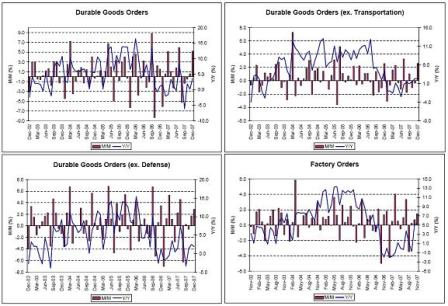
  • The blowout durable goods numbers
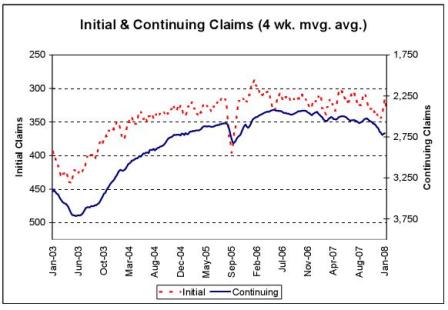
  • The drops in claims following the high unemployment number
  • The private forecasts on average show 65,000 new jobs and unemployment falling to 4.9 on Friday
  • Anecdotal reports from big cap old line corps show no recession in sight
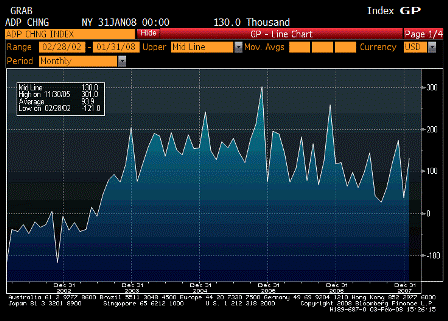
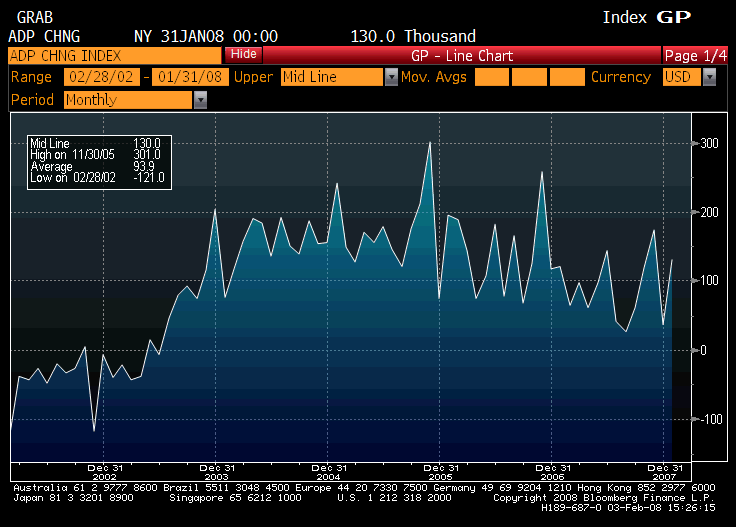
  • But still data dependent with ADP, GDP, and deflator tomorrow am

Yes, it has been about domestic demand, but they now realize exports have taken up the slack and are holding up employment and real gdp, as well as contributing to inflation.

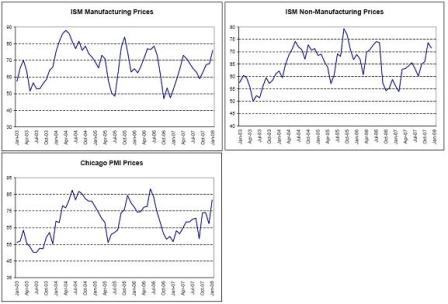
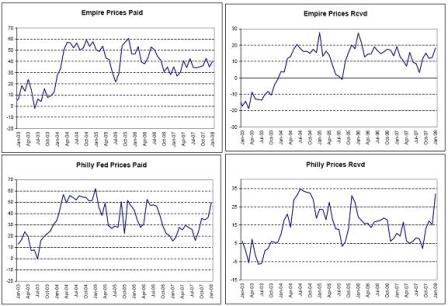
Staff inflation report will show deterioration of both headline CPI and core measures, along with tips fwd breakevens moving higher and survey info showing elevating prices paid and received. And food/fuel/import and export prices all trending higher, risking core converging to headline CPI.

Higher crude prices are now attributed to higher US demand by the markets and the Fed.

Many ‘financial conditions’ have eased:

  • LIBOR has come down over 150 bp since the Dec 18 meeting even as FF are down only 75. mtg rates way down as well, and at very low levels.
  • Commercial mortgage rates somewhat higher, but from very low levels previously
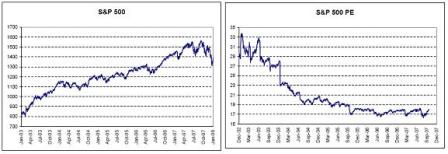
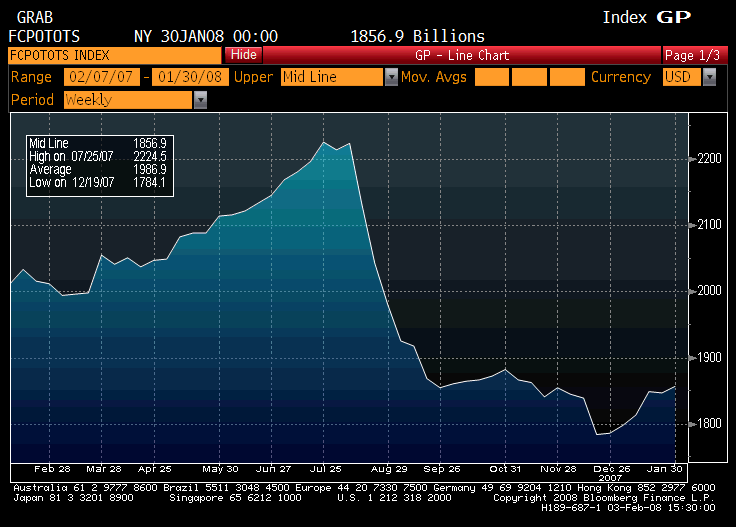
  • Equities have firmed up since the soc gen liquidations (and look very cheap to me)

The last bit of system risk is from a downgrade of the monolines and that risk seems to be diminishing.

The ratings agencies have been reviewing them intensely for 6 months, and both the capital of the monolines and the credit quality of the insured bonds must still be adequate for the AAA rating. And in any case the risk is to go to AA, not to junk, meaning that credit per se isn’t the issue at all. The issue is forced selling by those who can’t legally hold insured bonds if the rating drops. That’s a very different issue.

Wouldn’t surprise me that if tomorrows numbers are as expected, and the fed cuts 50, markets start to look at that as possibly the last move, and reprice accordingly, with FF futures trading closer to a 3% trough than a 2% trough.

An unchanged decision may also result in a near 3% FF futures trough, with a couple of 25 cuts priced in.


♥

Nobel economist Joseph Stiglitz warns of 1930 STYLE LIQUIDITY TRAP

US Slides into Dangerous 1930s ‘Liquidity Trap’

The Daily Telegraph’s Ambrose Evans-Pritchard details interesting insights from Joseph Stiglitz.

No, common errors.

The United States is sliding towards a dangerous 1930s-style “liquidity trap”

Probably not – rare with floating exchange rates.

that cannot easily be stopped by drastic cuts in interest rates, Nobel economist Joseph Stiglitz has warned.

That part is true. Interest rates don’t matter much. It was the TAF that narrowed FF/LIBOR, for example, not rate cuts.

“The biggest fear is that long-term bond rates won’t come down in line with short-term rates. We’ll have the reverse of what we’ve seen in recent years, and that is what is frightening the markets,” he told the Daily Telegraph, while trudging through ice and snow in Davos.

Hardly the biggest fear.

Also, note that when the curve went negative, the media flashed recession warnings. When it went positive, they didn’t report the opposite.

“The mechanism of monetary policy is ineffective in these circumstances.

Fed and ECB research shows changes in interest rates don’t do much in any case.

I’m not saying it won’t work at all: it will help the banking system but the credit squeeze is going to go on because nobody trusts anybody else. The Fed is pushing on a string,” he said.

This is very different from the early 1930s.

The grim comments came as markets continued to suffer wild gyrations, reacting to every sign of contagion spreading to Europe, Asia, and emerging markets.

Wall Street has begun to stabilize on talk of a rescue for the embattled bond insurers, MBIA and Ambac.

Another issue that interest rates have nothing to do with.

The Fed’s 75 basis point rate cut allows the banks to replenish their balance sheet by borrowing at short-term rates and lending longer term, playing the credit ‘carry trade’,

Banks are not allowed to take that kind of interest rate risk. The regulators have strict ‘gap’ limits for banks and monitor it on a regular basis.

hence the 9pc rise in the US financials index yesterday. But confidence remains fragile.

I think that was on the monoline rumors as well as prospects for strong earnings. And they were sold down to very low levels previously.

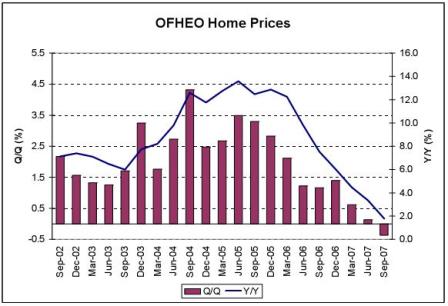
Professor Stiglitz, former chair of the White House Council of Economic Advisers, said it takes far too long for monetary policy to work its magic. This will not gain much traction in the midst of a housing crash.

True. Not much is a very strong function of interest rates.

“People have been drawing home equity out of the houses at a rate of $700bn or $800bn a year. It’s been a huge boost to consumption, but that game is now up.

Most studies don’t show much of a wealth effect or ‘cash out’ effect. The Fed has a three cents on the dollar rule of thumb on the way up, maybe less on the way down.

House prices are going to continue falling,

Maybe.

and lower rates won’t stop that this point,” he said.

As above.

“As a Keynesian,

Keynes wrote in the context of the gold standard of the time, though it probably wasn’t his first choice of regimes.

I’d say the biggest back for the buck in terms of immediate stimulus would be unemployment assistance and tax rebates for the poor. That will feed through quickly, but set against the magnitude of the problem, even a fiscal stimulus package of $150bn is not going to be enough,” he said

Enough for what? It’s about 1% of GDP. If exports are strong, GDP may be running at 2% or more without the fiscal package.

And it will add demand when demand is already enough to drive up CPI faster than the Fed likes.

(Way less inflationary and way more beneficial to offer a job at a non disruptive wage to anyone willing and able to work to sustain full employment by ‘hiring off the bottom’ rather than simply adding to demand as planned.)

“The distress is going to be very severe. Around 2m people have lost all their savings,” he did.

How does he know that? Guessing from his projections of home prices?

NASDAQ president Bob Greifeld expressed a rare note of optimism at the World Economic Forum, predicting a swift rally as the double effects of the monetary and fiscal boost lift spirits.

“I think the stimulus package that’s been proposed by the President, to the extent that this is passed in rapid fashion by Congress, has the ability to forestall a recession,” he said.

True, and if there wasn’t going to be a recession, it will magnify the expansion and inflation.

“At the moment, our business is doing better than it ever has because the volumes have been incredibly high. So, it’s been very good for us,” he said.

No recession there.

There were scattered signs of improvement across the world today, with Germany’s IFO confidence index defying expectations with a slight rise in January. Japan’s quarterly export volume held up better than expected.

Recession is currently mostly an expectation, not a current condition.

Even so, the global downturn may already have acquired an unstoppable momentum, requiring months or even years to purge the excesses from the bubble.

Precious few signs of a real economic downturn yet. Just some possible weakening.

Professor Stiglitz blamed the whole US economic establishment for failing to regulate the housing and credit markets adequately, allowing huge imbalances to build up.

Institutional structure provided incentives for lender fraud that resulted in a lot of aggregate demand from high risk borrowers getting credit for a while.

“The Federal Reserve and the Bush Administration didn’t want to hear anything about these problems. The Fed has finally got around to closing the stable door (on subprime lending), but the after the horse has already bolted,” he said.

Whatever that means.


♥

Refi madness

Homeowners rushing to refinance mortgages

Federal Reserve’s surprise rate cut sparked a refinancing boom

This week’s surprise rate cut by the Federal Reserve not only held Wall Street and investors in thrall, it’s also kicked into high gear a rush by homeowners across the country to refinance their mortgages at today’s lower rates.

Thirty-year fixed-rate mortgages now carry an average interest rate of 5.57 percent, down from 5.75 percent last week and from 6.32 percent a year ago, according to a Bankrate.com national survey. That’s bringing them within shouting distance of the historic low of 5.21 percent set in June 2003, when the housing sector was expanding quickly and there was a stampede of mortgage refinancings.

(snip)

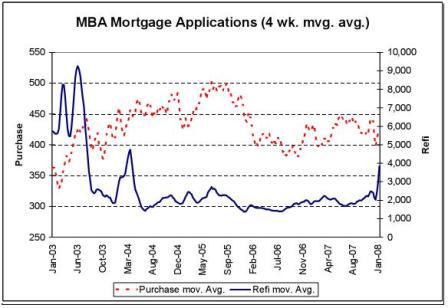
The Mortgage Bankers Association said refinancings last week reached their highest levels since April, 2004. The trade group’s Market Composite Index, a measure of mortgage loan application volume, rose 8.3 percent from the previous week’s level.

David Motley, president of Fort Worth-based Colonial National Mortgage, which originates loans in all 50 states, is expecting an even larger applications surge this week and beyond.

“For the last six to eight months all people have heard about is the subprime crunch,” he said. “There is an incorrect impression that because of the subprime mess regular people can’t get a loan or a refinancing right now.”

Seems the door is wide open now and seems a lot of potential defaults analysts were predicting may not happen.

Refinancing rush

The rush to refinance could get a further boost from the government’s tentative economic stimulus package. The package would allow government-sponsored Fannie Mae and Freddie Mac to buy mortgages worth as much as $729,750, up from a prior cap of $417,000 limit. This would make refinancing more feasible for some owners of expensive mortgages.

Yes, the government measures are all coming to bear from a variety of angles.

Colonial National’s Motley noted that mortgage rates were attractive before this week’s Fed action, but “the Fed move got everyone’s attention and people are now looking at rates again,” he said, adding that refinancing funds are “readily available to many Americans.”

Even so, experts say that securing refinancings at terms they want may prove difficult for owners whose homes have slumped in value.

Joe Dougherty, a media relations officer for RAND Corp. said his family’s four-bedroom colonial home in Haymarket, Va., was appraised at $500,000 several years ago, but he fears it is now worth only $450,000.

Dougherty hopes to refinance two home loans he holds on the house. He would like to combine them into a single 30-year fixed-rate mortgage and has discussed his situation with a loan officer friend. Dougherty’s calculations indicate a lower valuation that would nix the deal he wants, but he has scheduled a home appraisal.

What to do with stimulus rebate?

There also are fears that many banks, stung by losses on home loans to subprime borrowers, have adopted lending standards that will be too tough or taxing to meet. This is particularly worrisome for those whose credit scores have been hurt by heavy use of credit cards in recent years.

But for owners with good credit, the issue now may be more one of timing.

And that’s still the majority.

“I’m definitely interested in refinancing my mortgage, but I wonder if I should wait until after the Fed meeting next week,” said Matt Schmidt, a market specialist with Computer Task Group Inc. in Buffalo, N.Y. who bought a $150,000 Lewiston, N.Y., home three years ago.

Schmidt noted that the Fed, which holds a two-day meeting starting Tuesday, has signaled it is disposed to further rate cuts that could send mortgage rates still lower. So he doesn’t want to refinance too soon if even better rates will be available shortly.

This is very common.. When the Fed pauses, these people pull the trigger.

Also, the bond rally caused a lot of mortgage securities to shorten and hedges got bought in.

A sell off in bonds will have the reverse effect, and with the increased low coupon production, the convexity selling could be a lot more severe than the buying was on the way down.


♥

The Fed’s next move

If I were a mainstream economist and on the FOMC (I’m not either, they are both), and world equity markets were firm going into the meeting next week with the monoline issue put to bed, I’d opt for no cut.

That would be expected to rally the $, take down gold and most other commodities, and be taken as a strong move to ‘keep expectations well anchored’ before they had a chance to elevate.

Equities might sell off initially, but be encouraged with the knowledge the Fed was keeping inflation under control, and therefore not get involved into a prolonged, rate hiking fight against inflation down the road.

Also, confidence in the economy would be conveyed, as the no cut decision would be taken as a statement from the Fed that the economy didn’t need further rate cuts.