Vice Chair Kohn comment and today’s opening

Recent comment by Fed Vice Chair Donald Kohn:

If longer-term inflation expectations were to become unmoored–whether because of a protracted period of elevated headline inflation or because the public misinterpreted the recent substantial policy easing as suggesting that monetary policy makers had a greater tolerance for inflation than previously thought–then I believe that we would be facing a more serious situation.

This could be telling. It hasn’t been said before by any FOMC member, and it was voluntary, in that no one asked the question.

It is something he is trying to communicate.

The FOMC sees inflation expectations showing signs of elevating, and is wondering whether it is at least partially responsible.

Their ‘theory’ had told them there was an inflation price to pay for cutting into a triple negative supply shock if it went so far as to allow inflation expectations to accelerate.

Credit spreads are in substantially from the wides, GDP isn’t collapsing and forecasts are for modest improvements.

Fiscal rebates are kicking in, being spent, and supporting prices.

Inflation is ripping, and now has the full attention of the FOMC.

Oil 130+

Dollar down

Stocks down a touch

Interest rates up a touch

Excerpt from Kohn’s speech

My expectations for moderating inflation and limited spillover effects from commodity price increases depend critically on the continued stability of inflation expectations.

The FOMC has never wavered on this all important aspect of monetary policy – they firmly believe inflation expectations are what causes a relative value story to turn into an inflation story.

In that regard, year-ahead inflation expectations of households have increased this year in response to the jump in headline inflation. Of greater concern, some measures of longer-term inflation expectations appear to have edged up. If longer-term inflation expectations were to become unmoored–whether because of a protracted period of elevated headline inflation or because the public misinterpreted the recent substantial policy easing as suggesting that monetary policy makers had a greater tolerance for inflation than previously thought–then I believe that we would be facing a more serious situation.

If inflation expectations come unmoored for any reason, inflation is thought to follow.

And here he expresses concern that inflation expectations may be rising due to a public perception that the Fed easings mean the Fed has a greater inflation tolerance.

Governor Kohn is clearly concerned that the Fed’s actions since August may be causing inflation expectations to elevate, and his statement further implies that it will take actual ‘action’ on the part of the Fed to dispel the notion that they are more tolerant of inflation.

Markets will not believe the Fed will take action on inflation until after they actually do it, but that the Fed will respond to weakness regardless of inflation. This was expressed by today’s price action. With crude hitting $129 EDs a year out are 8 bps lower in yield.

Q&A for Warren B


[Skip to the end]

Hi Warren,

Do you think there is any chance that the Fed ever puts us into a steeply inverted curve, say something like 10% short rates with 6% long rates? Hard to imagine that happening with the housing market weak, but what do you think?

Very high probability – I’d say 85% chance if, as I expect, crude stays here or goes higher. maybe a lot higher.

Hiking causes inflation to accelerate via the cost structure of business, so when they start hiking, inflation accelerates. Guaranteed!

Only a major supply response will break the inflation. Like pluggable hybrids in 5-10 years or cutting the national speed limit to 30mph, which is highly doubtful.


[top]

Fed Speak: Yellen the Dove


[Skip to the end]

There have been a lot of Fed speakers; so, I’ve selected a few comments on Yellen’s speech, as she has been deemed the most dovish Fed bank president.

Note the shift in rhetoric from ‘market functioning’ to inflation.

Of course, the FOMC’s idea of getting tough and fighting inflation has been to only cut 25 basis points.

Data dependent, this seems to be changing.

It could be the signs of passthrough from headline to core CPI or signs inflation expectations are elevating (as per their recent comments).

They also seem to have lost confidence in their inflation forecasts and may not be giving their future inflation indicators the same weight as in the past 6 months.

Fed’s Yellen: Funds rate been cut enough for now

by Ros Krasny

(Reuters) – San Francisco Federal Reserve Bank President Janet Yellen said on Wednesday that the federal funds rate has been lowered far enough for now after months of aggressive central bank rate cuts.

The Fed’s key monetary policy tool ‘has come way down,’ Yellen said while critiquing presentations on the economy at a symposium for college students organized by the San Francisco Fed and the Pacific Northwest Regional Economic Conference.

Yellen said the Fed continues to grapple with difficult policy choices but restated that high inflation was a worry. ‘The 1970s were a horrible period. If there’s one thing that has to be very high priority, we don’t want to go back to a period that is anything like that,’ she said.


[top]

Re: WSJ: Greg Ip’s Article

right, it’s a way to keep the ff rate from falling below target, but does nothing for ‘liquidity’ that’s not already being done.

seems fomc maybe still struggling with ‘monetary operations’


From: Adam
Sent: Tuesday, April 29, 2008 3:59 AM
To: a
Subject: CS: DEF WORTH A READ – GREG IP ARTICLE THAT PROPOSES ANOTHER FED INNOVATION – ALL EXPLAINED BELOW


Greg Ip’s piece in the WSJ received some attention today. The piece is titled “ Fed to Consider Paying Interest To Commercial Banks on Reserves” and states that the Fed will discuss this proposal at todays meeting. There is no suggestion that the Fed are about to immediately change the current standard policy of paying zero per-cent for reserve balances, but given that the press had a very good lead on the introduction of the TSLF and PDCF it’s prudent to pay attention. (http://online.wsj.com/article/SB120941973079950909.html?mod=economy_lead_story_lsc)

The reason for changing policy and paying interest on reserve balances is not at first obvious, but is in fact a simple way for the Fed to solve the problem of increasing cash liquidity in the banking system without driving down the Fed effective rate. As the Fed take illiquid asset-backed securities from banks they hand over cash in return. As banks get zero interest on reserve balances that are left with the Fed they quickly seek to place their newly raised cash out into the market, earning a coupon on their investment instead of earning nothing on a reserve balance. As the Fed pay nothing it is in every banks interest to lend any excess balances at rates greater than zero, and what typically happens is that the cash market rate falls dramatically as cash rich banks try and find bids, offering at lower and lower rates until we get close to zero. This is an unwelcome development from the Fed’s perspective as the effective Fed Funds rate that results is often significantly lower than the official Fed target rate. By injecting large amounts of cash liquidity into the system the Fed may actually undermine their own target rate.

Paying a coupon on reserve balances would allow the Fed to inject as much cash via asset-backed repo as they like without needing to worry about driving down the Fed effective cash rate. The Fed would effectively sterilize their own cash injection by placing a guaranteed fixed rate floor on reserve funds, and ensuring that something close to the Fed Funds target rate was achieved. This would mean that the Fed could continue to increase the amount of repo’s that they are willing to undertake and to upsize the auctions without concerns about the effects of huge amounts of excess cash

sloshing around in the system.

Some thoughts to go along with this:

  • Great care needs to be taken in setting guaranteed cash levels. Sometimes unexpected consequences result. Central banks like the RBA and RBNZ  have long operated a cash system which guarantees a floor on overnight rates at a margin below the target rate. This ensures that cash generally trades close to the target rate, or slightly rich to it. Generally local market participants prefer to hold an excess of long balances in the knowledge that cash shortages often occur, but they have a defined downside guarantee. In New Zealand’s case the RBNZ found that banks were hoarding cash to such an extent that the short dated market traded significantly above the OCR target because the banks had a 25bp downside guarantee. It wasn’t until the RBNZ reduced the guaranteed floor substantially that rates traded much closer to target.


Banks that get cash from the Fed via the PDCF currently seek to off-load that cash to the street, effectively spreading liquidity to all elements of the banking system, and discouraging the holding of very short term balances which will end of earning 0% if they are not on-lent. If the Fed’s guaranteed rate is not far enough below the FF target rate Banks will simply recycle any excess back to the Fed rather than taking unsecured interbank credit risk. This may leave the smaller regional Banks without direct Fed access short of cash, forcing them to pay a premium instead of getting funds at a discount. The challenge of course is that if the rate is set too far below the Fed Fund’s Target rate the Fed will have the same problem of the effective daily rate printing substantially beneath target. An appropriate margin that the Fed should pay on reserves is likely to be around 50bp below the target rate. This will prevent the Fed effective rate from collapsing, but the 50bp penalty will also incentivise banks to find alternative borrowers wherever possible

Changing Tides

I’ve been thinking that when the Fed turns its attention to inflation it will find itself way behind that curve, which it is by any mainstream standard, and that the curve then gets negative from a year or two out as markets anticipate rate hikes followed by falling inflation and rate cuts.

Didn’t know exactly how it would get from here to there, how long it would take or exactly when it would happen.

I never thought the Fed would let it go this far. Especially Governor Kohn, who has been through this before in the 1970s with Burns, Miller, and Volcker. This FOMCs inflation tolerance lasted a lot longer than I expected, even with a weak economy and perceived systemic risk.

Won’t be long before the mainstream comes down hard on this FOMC for letting the inflation cat out of the bag with a high risk, untested, counter theory strategy of aggressively cutting into a triple negative supply shock. The mainstream will see it as a ‘hail Mary’ move. If it works, fine, if not it was a foolish error with a major price to pay to fix it.

Maybe they just got what will turn out to be overconfident in their inflation fighting ability. Kind of a ‘we know how to do that and can do it anytime’ attitude.

Wrong. They will soon find out it is not so easy.

Maybe they got confused and saw the tail risk as that of the gold standard era when there were real supply side constraints to money to deal with.

Also, they probably blamed the whole 1970’s thing on labor unions; so, maybe they got blind sided this time because they thought without unions wages would be ‘well contained’ and therefore there would be no inflation.

Wrong on that score as well. It was about oil before, and it is about oil now.

And the fact is, they have no tools for fighting inflation. They think they do (hiking rates), but higher rates just make it worse by raising costs and jacking up rentier incomes. (Incomes of savers who do not work or produce = more demand and no supply)

The inflation broke in the early 80’s only because of a supply response of about 15 million barrels of crude per day that buried OPEC and caused prices to collapse for almost 20 years. (And even during the 20 years of low oil prices and falling imported prices inflation still averaged around 3%.)

That kind of supply response is not going to happen in the near future. I expect the Saudis to keep hiking and inflation to keep getting worse no matter what the Fed does. It is payback time for them from being humiliated in the 1980s, and they are also at ideological war with us whether we know it or not.

Markets might have a false start or two with the interest rate response and flattening curve, just to not make it too easy.

Also, as before, there could be an equity pullback when it is sensed the Fed is going to seriously fight inflation with hikes designed to keep a sufficient output gap to bring inflation increases down.

And along the way everything goes up, including housing prices, during a major cost push inflation. Even with low demand. Just look at all the weak emerging market nations that have had major inflations with weak demand, high rates, etc. etc.

Money (USD)

My take on the USD:

It was at a level based on foreigners wanting to accumulate $70 billion per month which also = the US trade gap (accounting identity).

Most of that desire to accumulate came from foreign CBs trying to support their exporters, oil producers accumulating USD financial assets, and foreign portfolios allocating some percentage of assets to USD assets.

Paulson cut off the CBs calling the currency manipulators and outlaws.

Bush cut off the oil producers by being perceived to be conducting a holy war.

Bernanke scared off the portfolio managers with what looks to them like an ‘inflate your way out of debt’ policy.

And US pension funds are diversifying out of USD into passive commodities and foreign securities.  Looks to me like the desire to accumulate USD overseas is falling towards zero rapidly.

This means they sell us less and buy more of our goods, services, and our real assets.

Volumes’ of non oil imports are falling and of oil imports are flat.

The dollar has gotten low enough for the trade gap to fall from over $70 billion to under $60 billion per month (February was an aberration IMHO).

The dollar will ‘adjust’ until it corresponds with a trade gap that = desired foreign accumulation of USD financial assets.

I see no reason to think the trade gap should not go to zero.

The USD probably has not traded down enough to reflect the zero desire to accumulate USD abroad.

The ECB has serious ideological issues regarding buying of USD.  Not the least of which they don’t want to give the impression that the USD is ‘backing’ the euro, which would be the appearance if they collected USD reserves.

The ECB has an inflation problem, and they believe the strong euro has kept it from being much worse.

The policy ‘shift’ might be the process of ending of US rate cuts at the next meeting by cutting less than expected.

This might first mean only a 25 basis point cut when the market prices in 50 basis points, followed by no cut when markets price in 25 basis points, for example.

This would firm the USD and soften the commodities near term, as after the last 75 basis point cut when markets were pricing 100 basis points.

But this does not change the foreign desires to accumulate USD as direct intervention by the ECB would, for example.

So the adjustment process that gets us to a zero trade gap will continue.

And it will continue to drive up headline CPI with core not far behind.

And US GDP will muddle through in the 0% to +2% range with weak private sector consumption being supported by exports, US government consumption, and moderate investment.

FOMC

Karim Basta:

  1. Further cut to gwth outlook
  2. Financial conditions tighter and housing getting worse
  3. Inflation receives greater concern than prior statement
  4. Conclusion: downside risks predominant and ‘timely’ means another intermeeting cut on the table.

Agreed, further comments below:

Release Date: March 18, 2008

For immediate release

The Federal Open Market Committee decided today to lower its target for the federal funds rate 75 basis points to 2-1/4 percent.

Could have been 100 as anticipated by the markets. Fed shaded its cut to the low side of the priced in expectations.

Recent information indicates that the outlook for economic activity has weakened further. Growth in consumer spending has slowed

Implies there is still some growth, not negative yet.

and labor markets have softened.

Looking unrevised February payroll number, not the lower unemployment rate. In January they looked at the higher unemployment rate. Unemployment has subsequently gone from 5.0% to 4.9% to 4.8% (rounded).

Financial markets remain under considerable stress,

They went a long way to relieve stress over the weekend.

and the tightening of credit conditions and the deepening of the housing contraction are likely to weigh on economic growth over the next few quarters.

Housing starts were revised up, and other indicators indicate it may have bottomed.

Inflation has been elevated, and some indicators of inflation expectations have risen.

This was noted in several Fed intermeeting speeches.

The Committee expects inflation to moderate in coming quarters, reflecting a projected leveling-out of energy and other commodity prices and an easing of pressures on resource utilization.

They continue to make this projection even after being completely wrong for many meetings.

Still, uncertainty about the inflation outlook has increased.

That’s why – their forecasts have proven unreliable, and crude/food continues to rise as the USD continues to fall.

It will be necessary to continue to monitor inflation developments carefully.

Only ‘monitor’? No action planned.

Today’s policy action, combined with those taken earlier, including measures to foster market liquidity, should help to promote moderate growth over time and to mitigate the risks to economic activity. However, downside risks to growth remain. The Committee will act in a timely manner as needed to promote sustainable economic growth and price stability.

Intermeeting action is on the table, for both growth and price stability.

Voting for the FOMC monetary policy action were: Ben S. Bernanke, Chairman; Timothy F. Geithner, Vice Chairman; Donald L. Kohn; Randall S. Kroszner; Frederic S. Mishkin; Sandra Pianalto; Gary H. Stern; and Kevin M. Warsh. Voting against were Richard W. Fisher and Charles I. Plosser, who preferred less aggressive action at this meeting.

Wonder how much less aggressive?

In a related action, the Board of Governors unanimously approved a 75-basis-point decrease in the discount rate to 2-1/2 percent. In taking this action, the Board approved the requests submitted by the Boards of Directors of the Federal Reserve Banks of Boston, New York, and San Francisco.

Mar 15 update

The question for the Fed: Will further rate cuts help or hurt the credit crisis?

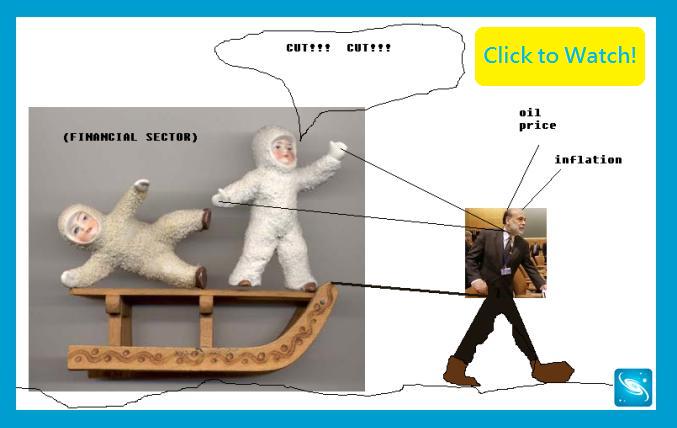
The Fed has been cutting to support the financial sector, and address risks (as they see them) of financial sector issues spilling over to the real sector.

How does the Fed see rate cuts helping the financial sector?

Lower payments for borrowers assist in servicing/refinancing outstanding debt and facilitate continued ‘borrowing to spend.’

However, in this cycle, it seems that rate cuts have been instrumental in the USD decline that correlates with rising gasoline/food/import prices.

‘Well anchored’ wages mean consumers are spending more on food/energy and have less for other goods and services.

And less for debt service, as evidenced by rising delinquencies and the (still mainly subprime, but starting to spread) deteriorating credit quality of consumer loan portfolios.

Yes, exports are increasing dramatically, supporting GDP, keeping the output gap reasonably low, but not increasing income for debt service where that is needed.

So the question for the Fed is, on balance, will further rate cuts help or hurt the credit crisis?

Will further cuts ‘ease financial conditions’ via interest rate channels?

Or will further cuts ‘tighten financial conditions’ via the current fx/inflation/debt service income channel?

And, even if those potential outcomes for the credit crisis are approximately equal, does the nod go to not cutting for reasons of residual inflation issues?

So far, not a single ‘real economy’ company has had problems beyond a slowdown in earnings and concern over future earnings. And slowdowns in sales have all been related to consumers being hurt by higher food and energy prices.

This implies the falling dollar/higher import prices is what has hurt the companies that have been subject to consumer weakness.

This implies Fed policy designed to protect the real economy from from potential spillover from the financial sector crisis has, as a side effect, done direct damage to the real economy.

And, of course, this is only relevant for the Fed if it comes up for discussion at the meeting on Tuesday.

Close friends tell me it probably won’t.