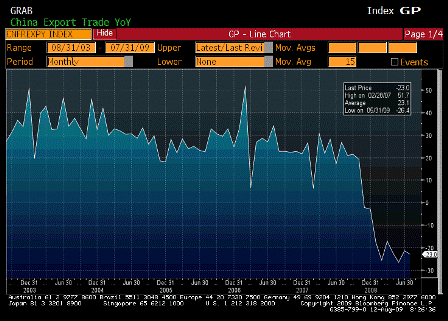
Trade/FOMC Preview/China Exports/Stimulus hangups


[Skip to the end]


Karim writes:

Trade: Exports up 2%, Imports up 2.3%. Imports ex-petroleum down 1% and consumer goods imports down 4.8%. Sector strength mainly in industrial goods (restocking), but indicators of final demand still look weak.

Don’t look for dramatic changes to FOMC statement; major focus will be on Treasury purchase language.

1) Econ assessment will turn slightly more positive; May mention signs of a nascent recovery, though underlying demand likely to remain weak for the foreseeable future. Inflation will remain subdued.

2) Exceptionally low FF rate for an ‘extended period’ will remain. I’d expect this phrase to be dropped about 3-4mths before they’d actually hike, with the first move possibly being a hike in the rate they pay banks on excess reserves.

3) Likely to indicate that Treasury purchases will not continue once the $300bn level has been reached, though they may restart the program in the future if needed. Language on other credit easing programs to stay intact.

China’s export model showing little bounce (latest data last night)

Some hangups with the stimulus package (courtesy of American General Contractors):

“President Barack Obama’s stimulus spending has run into a problem: A shortage of General Electric Co. water filters,” Bloomberg News reported on Thursday. “GE makes them in Canada. Under the program’s ‘Buy American’ rules, that means the filters can’t be used for work paid for by the $787 billion fund. Contractors are searching the U.S. in vain for filters as well as bolts and manhole covers needed to build wastewater plants, sewers and water pipes financed by the economic stimulus. As officials wait for federal waivers to buy those goods outside the U.S., water projects from Maine to Kansas have been delayed….the Environmental Protection Agency, which administers the water funding, has granted six waivers and has 29 petitions pending….The rules affect water projects most because highways and bridges have been constructed under Buy American regulations for the past 30 years, and not much stimulus money has been spent so far on public housing and schools, said Chris Braddock, the U.S. Chamber of Commerce’s associate director for procurement.”

“Gun-shy [school] administrators might undermine a federal stimulus program that encourages school construction by helping districts pay down debt,” the (Wisconsin) Daily Reporter reported on Monday. “Some district leaders say they gladly are accepting a piece of $125 million in no-interest bonds but are reluctant to invest the savings in new projects. ‘The climate out there is terrible and with the cuts made in the state budget, it’s just really difficult right now,’ said John Whalen, president of the Sun Prairie Area School District Board of Education. ‘I don’t anticipate this will encourage us to do more projects,’ he added. The district received $23 million in federal bonding, more than any other district in the state, though the bonding did not encourage additional construction. Sun Prairie used it to help pay off the $30 million it put on taxpayers for construction of a new high school and conversion of the old high school into a middle school. Both schools are scheduled to open in fall 2010. While Sun Prairie stands pat, other districts might jump at the opportunity. The School District of La Crosse received $6.6 million in bonds to help pay off debt from $18.5 million in expansion, renovation and upgrade projects.”


[top]

Zombie Economy: European Industrial Production Unexpectedly Declines


[Skip to the end]

Looks to me like the world hit a ‘soft spot’ in July, maybe due to the winding down of China’s suspected ‘inventory building.’

CPI’s continue to fall in the Eurozone indicating continuing domestic demand weakness.

Strong productivity gains are not being matched with fiscal adjustments to sustain output and employment, as evidenced by a continuing rise in unemployment and a widening of the output gap.

I like the term Zombie economy as the world continues to unknowingly rely on ‘automatic stabilizers’ for a very ugly means of fiscal adjustment.

Meanwhile, as unemployment continues to rise, they wait, with blind certainty for the mythical ‘kicking in of billions’ by Central Banks to somehow take effect, and be so powerful, that they are spending their time debating irrelevant ‘exit strategies’ from this non event for aggregate demand.

Right now there is no hope for further US fiscal adjustment, barring a major economic setback. President Obama has pledged not to sign a health care bill that is not ‘revenue neutral’ and it’s all but certain marginal tax rates will rise next year.

And the increased expenditures for ‘shovel ready’ projects, merits of the projects aside, are being offset by forced cut backs by States that continue to face revenue shortages due to the fall in GDP.

Banks that have been sustained by wide net interest margins that offset lingering loan losses are now seeing portfolios run off, as those with positive cash flow (corporations with flat sales and consumers in foxholes still worried about job losses) are paying down debt and net new lending languishes.

  • European Industrial Production Unexpectedly Declines
  • Liikanen Says Next Months Will Show If Euro Area Through Worst
  • French Consumer Prices Fall for Third Month on Energy, Retail
  • European Government Bonds Extend Gain After BOE Inflation Report


[top]

Social Security commentary published


[Skip to the end]

Social Security: Another Case of Innocent Fraud?

By Mathew Forstater and Warren Mosler

August 6th — In his recent book, The Economics of Innocent Fraud, John Kenneth Galbraith surveys a number of false beliefs that are being perpetuated among the American people about how our society operates: innocent (and sometimes not-so-innocent) frauds. There is perhaps no greater fraud being committed presently—and none in which the stakes are so high—as the fraud being perpetrated regarding government insolvency and Social Security. President Bush uses the word “bankruptcy” continuously. And the opposition agrees there is a solvency issue, questioning only what to do about it.
Fortunately, there is a powerful voice on our side that takes exception to the notion of government insolvency, and that is none other than the Chairman of the Federal Reserve. The following is from a transcript of a recent interview with Fed Chairman Alan Greenspan:

    RYAN… do you believe that personal retirement accounts can help us achieve solvency for the system and make those future retiree benefits more secure?

    GREENSPAN: Well, I wouldn’t say that the pay-as-you-go benefits are insecure, in the sense that there’s nothing to prevent the federal government from creating as much money as it wants and paying it to somebody. The question is, how do you set up a system which assures that the real assets are created
    which those benefits are employed to purchase. (emphasis added)

For a long time we have been saying there is no solvency issue (see C-FEPS Policy Note 99/02 and the other papers cited in the bibliography at the end of this report). Now with the support of the Fed Chairman, maybe we can gain some traction.

Let us briefly review, operationally, government spending and taxing. When government spends it credits member bank accounts. For example, imagine you turn on your computer, log in to your bank account, and see a balance of $1,000 while waiting for your $1,000 Social Security payment to hit. Suddenly the $1,000 changes to $2,000. What did the government do to make that payment? It did not hammer a gold coin into a wire connected to your account. It did not somehow take someone’s taxes and give them to you. All it did was change a number on a computer screen. This process is operationally independent of, and not operationally constrained by, tax collections or borrowing.

That is what Chairman Greenspan was telling us: constraints on government payment can only be self-imposed.

And what happens when government taxes? If your computer showed a $2,000 balance, and you sent a check for $1,000 to the government for your tax payment, your balance would soon change to $1,000. That is all—the government changed your number downward. It did not “get” anything from you. Nothing jumped out of the government computer into a box to be spent later. Yes, they “account” for it by putting information in an account they may call a “trust fund,” but this is “accounting”—after the fact record-keeping—and has no operational impact on government’s ability to later credit any account (i.e., spend!).

Ever wonder what happens if you pay your taxes in actual=2 0cash? The government shreds it. What if you lend to the government via buying its bonds with actual cash? Yes, the government shreds the cash. Obviously, the government doesn’t actually need your “funds” per se for further operational purpose.

Put another way, Congress ALWAYS can decide to make Social Security payments, previous taxing or spending not withstanding, and, operationally, the Fed can ALWAYS process whatever payments Congress makes. This process is not revenue constrained. Operationally, collecting taxes or borrowing has no operational connection to spending. Solvency is not an issue. Involuntary government bankruptcy has no application whatsoever! Yet “everyone” agrees—in all innocence—that there is a solvency problem, and that it is just a matter of when. Everyone, that is, except us and Chairman Greenspan, and hopefully now you, the reader, as well!

So if solvency is a non-issue, what are the issues? Inflation, for one. Perhaps future spending will drive up future prices. Fine! How much? What are the projections? No one has even attempted this exercise. Well, it is about time they did, so decisions can be made on the relevant facts.

The other issue is how much GDP we want seniors to consume. If we want them to consume more, we can award them larger checks, and vice versa. And we can do this in any year. Yes, it is that simple. It is purely a political question and not one of “finance.”

If we do want seniors to participate in the future profitability of corporate America, one option (currently not on the table) is to simply index their future Social Security checks to the stock market or any other indicator we select—such as worker productivity or inflation, whatever that might mean.

Remember, the government imposes a 30% corporate income tax, which is at least as good as owning 30% of all the equity, and has at least that same present value. If the government wants to take a larger or smaller bite from corporate profits, all it has to do is alter that tax—it has the direct pipe. After all, equity is nothing more than a share of corporate profits. Indexation would give the same results as private accounts, without all the transactional expense and disruption.

Now on to the alleged “deficit issue” of the private accounts plan. The answer first—it’s a non-issue. Note that the obligation to pay Social Security benefits is functionally very much the same as having a government bond outstanding—it is a government promise to make future payments. So when the plan is enacted the reduction of future government payments is substantially offset” by future government payments via the new bonds issued. And the funds to buy those new bonds come (indirectly) from the reductions in the Social Security tax payments—to the penny. The process is circular. Think of it this way. You get a $100 reduction of your Social Security tax payment. You buy $100 of equities. The person who sold the equities to you has your $100 and buys the new government bonds. The government has new bonds outstanding to him or her, but reduced Social Security obligations to you with a present value of about $100. Bottom line: not much has changed. One person has used his or her $100 Social Security tax savings to buy equities and has given up about $100 worth of future Social Security benefits (some might argue how much more or less than $100 is given up, but the point remains). The other person sold the equity and used that $100 to buy the new government bonds. Again, very little has changed at the macro level. Close analysis of the “pieces” reveals this program is nothing but a “wheel spin.”

Never has so much been said by so many about a non-issue. It is a clear case of “innocent fraud.” And what has been left out? Back to Chairman Greenspan’s interview—what are we doing about increasing future output? Certainly nothing in the proposed private account plan. So if we are going to take real action, that is the area of attack. Make s ure we do what we can to make the real investments necessary for tomorrow’s needs, and the first place to start for very long term real gains is education. Our kids will need the smarts when the time comes to deal with the problems at hand.

References

•Galbraith, John Kenneth, 2004, The Economics of Innocent Fraud: Truth for Our Time, Boston: Houghton Mifflin.

•Wray, L. Randall, 1999, “Subway Tokens and Social Security,” C-FEPS Policy Note 99/02, Kansas City, MO: Center for Full Employment and Price Stability, January, (http://www.cfeps.org/pubs/pn/pn9902.html).

•Wray, L. Randall, 2000, “Social Security: Long-Term Financing and Reform,” C-FEPS Working Paper No. 11, Kansas City, MO: Center for Full Employment and Price Stability, August, (http://www.cfeps.org/pubs/wp/wp11.html).

•Wray, L. Randall and Stephanie Bell, 2000, “Financial Aspects of the Social Security ‘Problem’,” C-FEPS Working Paper No. 5, Kansas City, MO: Center for Full Employment and Price Stability, January, (ht tp://www.cfeps.org/pubs/wp/wp5.html).


[top]

China wanting to buy TIPS


[Skip to the end]

This is another blunder by the Obama administration due to not understanding the monetary system.

We don’t need China or any other investor to ‘buy the debt’ yet we think we do and think they are in a position to ‘demand’ anything.

Issuing/selling CPI indexed govt debt is functionally external debt. With we owe ‘real’ wealth rather than strictly nominal wealth, and are subject to nearly the same risks as if we were borrowing real goods and services and had to pay them back in kind.

The lack of understanding of the monetary system is getting more costly by the day.

U.S., in Nod to China, to Sell More TIPS

By Rob Copeland and Maya Jackson Randall

August 6 (WSJ) — The Treasury Department, responding to growing demand from China and other investors, will boost the sale of inflation-protected bonds that hold their value as consumer prices rise.

“We continue to hear growing demand for the product,” Treasury Deputy Assistant Secretary for Federal Financing Matt Rutherford said at a news conference announcing the plan on Wednesday.

The decision to increase sales of Treasury Inflation-Protected Securities, or TIPS, is part of a broader effort to ensure there is enough demand for Treasury bonds to help the U.S. finance its swelling budget deficit. The Treasury already has issued a record amount of debt in the past year, and the department said Wednesday it will sell a record $75 billion next week.

In particular, Treasury officials need to ensure demand from China, the largest holder of U.S. government debt. Last week’s auctions of fixed-rate notes saw lukewarm demand from China and other investors. Chinese officials had indicated they want inflation-protected securities, especially as the U.S. economy starts to recover.

“Inflation is the No. 1 worry,” said Marc Chandler, global head of currency strategy for Brown Brothers Harriman & Co. “This is the government saying, ‘We will take that inflation risk away from you.'”

Even with an increase, TIPS would remain a fraction of the overall market for Treasurys. Of the $6.66 trillion of government bonds issued between Oct. 1, 2008 and June 30 of this year, just $44 billion were TIPS.

The Treasury could easily sell as much as $10 billion more, said Jeffrey Elswick, director of fixed income at Frost Investment Advisors LLC. But those extra sales mightn’t be such great news for existing owners of inflation-protected notes. If the Treasury continues to ramp up TIPS sales, it will “cheapen” the bonds of existing investors, said Don Martin, a financial planner with Mayflower Capital in Los Altos, Calif.

The value of the securities fell after the announcement, sending the gap between TIPS and comparable nominal notes to a two-month high. The gap ended at 1.93 percentage points, signaling that investors expect annualized inflation of 1.93% over the next decade.

The Treasury also said it may issue 30-year TIPS in place of 20-year TIPS.


[top]

U.K. Daily – Consumer Confidence Rose to the Highest in a Year in July


[Skip to the end]

So does Brown become the hero for his fiscal adjustments or the King for low rates and quantitative easing?

I do not even want to know…

  • U.K. Services Index Rose to Highest Since February 2008 in July
  • UK retailers say inflation at 6-month low
  • UK house prices up 1.1 pct in July
  • U.K. Consumer Confidence Rose to the Highest in a Year in July
  • King to Halt Gilt Purchases on Economy, Dealers Say
  • U.K. Factory Production Unexpectedly Jumped in June by 0.4%


[top]

PCE


[Skip to the end]

Yes, these numbers look to throw a wet blanket on global market psychology. The better than expected earnings season is pretty much fully discounted, and month end/month beginning allocations are behind us.

June was a weak month for government spending that seems to have been reversed in July (from Mike Norman), which accounts for the lower ‘savings rate,’ but those numbers won’t show up for a while.

And the talk by the administration, Congress, and all the critics regarding ‘fiscal responsibility’ and tax increases has functioned to make the point a ‘second stimulus’ is out of the questions without some kind of collapse.

Inflation remains in check with the large output gap keeping a lid on wages and relatively stable crude oil prices keeping costs under control.


Karim writes:

  • Weakness in personal income (-1.3%) a bit more than expected, largely reflecting end of government transfers to households
  • But wage and salary income also still very weak, down 0.4% and down every month this year.
  • Yr/Yr personal income down 3.4% and wage and salary income down 4.7%
  • Drop on personal savings rate from 6.2% to 4.6% largely reflects weakness in income described above
  • Revisions in PCE Deflator reflect same as occurred in GDP data last week: YR/YR Deflator through May now -0.3% vs 0.1% and Core Deflator now 1.6% vs 1.8%.
  • For June, headline deflator rose 0.546% and fell 0.4% Yr/Yr; Core Deflator rose 0.161% and 1.5% Yr/Yr.

Putting aside July auto sales, hard to see meaningful rebound in consumer spending (70% of GDP) with these income numbers; record string of decline in labor income


[top]

Taking a side on commercial real estate


[Skip to the end]

Today’s news- rising oil/declining dollar means costs of materials and replacement costs rising.

The only inflation risk comes with rising oil costs which are back up over 71 dollars this am, up from low 60’s last week.

Rising consumption overseas in general seems to be driving up prices here as we compete with a billion new consumers for scarce resources.

Commercial Real Estate – Make Up Your Own Mind

By Malay Bansal


[top]

TIPS 5 year 5 years fwd

This used to be one of the Fed’s major concerns as they are steeped in inflation expectations theory.

It could still signal a need to keep a modestly positive ‘real rate’ though the large ‘output gap’ is telling them otherwise.

History says they’ll put most of the weight on the output gap, though a negative real rate is problematic for most FOMC members.

Should core inflation measures go negative, they will be a lot more comfortable with the current zero rate policy.

Interesting that the employment cost was just reported up 1.8% which shows how little it went down even in the face of
a massive rise in unemployment.

NY Fed’s Dudley tees off on reserve-driven inflation view


[Skip to the end]

Dudley almost has it.

NY Fed’s Dudley tees off on reserve-driven inflation view

As Dudley notes, the fears of higher inflation expressed in that survey are likely being influenced by the Fed’s balance sheet expansion, which has of necessity increased excess reserves.

The argument that large amounts of excess reserves will fuel credit expansion and eventually inflation goes back to Karl Brunner’s formulation of the money multiplier hypothesis. According to this schema, holding excess reserves – which historically earned zero interest – would entail lost returns relative to holding earning assets. To avoid this cost, banks would seek to lend out excess reserves, thereby increasing credit, economic activity, and price pressures. As Dudley notes, this logic breaks down when reserves become earning assets, as they have since last fall when the Fed began paying interest on reserves.

He is wrong on that part. It does not matter if they are earning assets or not. In no case does reserve availability have anything to do with lending. It is about price, not quantity.

This counter-argument doesn’t excuse the Fed from responsibility for controlling inflation. The Fed still needs to set interest on excess reserves (IOER) rate consistent with a cost of capital that will promote price stability and sustainable growth. As Dudley points out, the IOER rate is effectively the same as the funds rate.

Just my theory, but seems to me they have this part backwards. The way I read it, it is lower interest rates that promote price stability.

In addition to the foregoing argument, Dudley also makes a novel and clever point

Hardly!!!

about the argument that excess reserves on bank balance sheets are ‘dry tinder:’ “Based on how monetary policy has been conducted for several decades, banks have always had the ability to expand credit whenever they like. They don’t need a pile of ‘dry tinder’ in the form of excess reserves to do so. That is because the Federal Reserves has committed itself to supply sufficient reserves to keep the fed funds rate at its target. If banks want to expand credit and that drives up the demand for reserves, the Fed automatically meets that demand in its conduct of monetary policy. In terms of the ability to expand credit rapidly, it makes no difference whether the banks have lots of excess reserves or not.”

Got that part right, except the Fed has no choice but to allow that to happen.

While the meat of Dudley’s talk centered on conceptual issues regarding bank reserves, he also made some remarks on the economy and policy. On the economy, Dudley sees recovery driven by three forces – fiscal stimulus, an inventory swing, and a rebound in housing and auto sales – but remaining subdued by historical standards for four reasons – a waning of support to personal incomes, ongoing adjustment to lower household wealth, weak structures investment, and a response to monetary policy easing that should be more constrained than in the past. Because the recovery is expected to be subdued, Dudley remarked that concern about when the Fed exits its very accommodative policy stance is “very premature.”

Here he still implies there are grounds for concern when in fact it is a non event.

Just as Dudley gave little indication that policy would be tightened anytime soon, he also reinforced the perception that an expansion of asset purchases is highly unlikely. He did so by noting that there are three costs to purchasing assets: a misperception of the intent of asset purchases that could increase inflation expectations,

He is still in the inflation expectations camp.

a reduction in bank leverage ratios from higher reserve balances which could slow credit growth,

Yes, as I have previously stated, quantitative easing is best understood as a bank tax.
Glad to see that aspect here.

and added interest rate risk on the Fed balance sheet.

Like I said above, he’s almost got it.


[top]

Quantitative easing


[Skip to the end]

Monetary policy in a period of financial chaos:

The political economy of the Bank of Canada in extraordinary times

Presented at the Political Economy of Central Banking conference,

Toronto, May 2009

Marc Lavoie and Mario Seccareccia

Department of Economics

University of Ottawa

July 2009


“Although quantitative easing is now referred to as an unconventional monetary policy tool, the purchase of government securities is, in fact, the conventional textbook approach to monetary policy…. In practice, most central banks have chosen to conduct monetary policy by targeting the price of liquidity because the relationship between the amount of liquidity provided by the central bank and monetary aggregates on the one hand, and between monetary aggregates and aggregate demand and inflation on the other, are not very stable.” (Bank of Canada, 2009b, p. 26).

The Bank of Canada thus feels compelled to recall that monetary aggregates are very badly correlated with price inflation, and that base money is also very badly correlated with the money supply. To provide excess bank reserves, as recommended by Monetarists, central banks must decline to sterilize its liquidity creating financial operations or it must conduct open market operations by purchasing assets. As pointed out by Deputy Governor John Murray (2009), “All quantitative easing is, by definition, ‘unsterilized’. Although this is correctly viewed as unconventional, it closely resembles the way monetary policy is described in most undergraduate textbooks, and is broadly similar to how it was conducted in the heyday of monetarism”. Murray misleadingly insinuates that such a technique has been implemented before, namely during the 1975-1982 monetarist experiment in Canada. What can really be said is that quantitative easing is an attempt to put in practice what academics have been preaching in their textbooks for decades from their ivory towers. It is merely monetarism but in reverse gear. While monetarist policy of the 1970s was implemented to reduce the rate of inflation, current monetarist quantitative easing is being applied to generate an increase in the rate of inflation.

As a result, the claims of quantitative easing are just as misleading as the claims of monetarism of the 1970s and early 1980s. Bank of Canada officials claim that “The expansion of the amount of settlement balances available to [banks] would encourage them to acquire assets or increase the supply of credit to households and businesses. This would increase the supply of deposits” (Bank of Canada, 2009b, p. 26), adding that quantitative easing injects “additional central bank reserves into the financial system, which deposit-taking institutions can use to generate additional loans” (Murray, 2009). In our opinion, these statements are misleading and indeed completely wrong. They rely on the monetarist causation, endorsed in all neoclassical textbooks, which goes from reserves to credit and monetary aggregates. It implies that banks wait to get reserves before granting new loans. This has been demonstrated to be completely false in the world of no compulsory reserves in which we live since 1994. In any event, even before 1994, as argued by a former official at the Bank of Canada, the task of central banks is precisely to provide the amount of base money that banks require (Clinton, 1991). Banks do not wait for new reserves to grant credit. What they are looking for are creditworthy borrowers.

Quantitative easing is an essentially useless channel. It assumes that credit is supply-constrained. It assumes that banks will grant more loans because they have more settlement balances. Both of these assumptions are likely to be false, at least in Canada. With the possible exception of its impact on the term structure of interest rates, the only effect of quantitative easing might be to lower interest rates on some assets relative to the target overnight rate, as these assets are being purchased by the central bank through its open market operations. It is doubtful that the amplitude of these interest rate changes will have any impact on private borrowing or on the exchange rate. Indeed, in Japan, which has had experience with zero interest rates for many years, quantitative easing was pursued relentlessly between 2001 and 2004, but with no effect, as “the expansion of reserves has not been associated with an expansion of bank lending” (MacLean, 2006, p. 96). Indeed, officials at the Bank of Japan did not themselves believe that quantitative easing could on its own be of any help, but they tried it anyway as a result of the pressure and advice of international experts. As Ito (2004, p. 27) notes in relation to the Bank of Japan, “Given that the interest rate is zero, no policy measures are available to lift the inflation rate to positive territory… The Bank did not have the tools to achieve it”.


[top]