Quick update

US economy muddling through, growing modestly, particularly given the output gap, but growing nonetheless.

Lower crude prices should also help some.

I had guessed the Saudis would hold prices at the $120 Brent level, given their output of just over 10 million bpd showed strong demand
and their capacity to increase to their stated 12.5 million bpd capacity remains suspect. And so with the Seaway pipeline now open (last I heard)
to take crude from Cushing to Brent priced markets I’d guessed WTI would trade up to Brent.

But what has happened is the Saudi oil minister started making noises about lower prices and when ‘market prices’ started selling off the Saudis ‘followed’ by lowering their posted prices, sustaining the myth that they are ‘price takers’ when in reality they are price setters.

So to date, contrary to my prior guess, both wti and brent have sold off quite a bit, and cheaper imported crude is a plus for the US economy. Which is also a plus for the $US, as a lower import bill makes $US ‘harder to get’ for foreigners.

But the trade for quite a while has been strong dollar = weak US stocks due to export pricing/foreign earnings translations, and also because US stocks have weakened on signs of euro zone stress, which has been associated with a weaker euro. So when things seem to be looking up for the euro zone, the euro tends to go up vs the dollar, with US stocks doing better with any sign of ‘improvement’ in the euro zone.

It’s all a tangled case of cross currents, which makes forecasting anything particularly difficult.

Not to mention possible dislocations from the whale, which may or may not have run their course, etc.

And then there’s the news from Greece.

First, they made a full bond payment yesterday of nearly 500 million euro to bond holders who did not accept the PSI discounts. This is confounding for the obvious reasons, signals it sends, moral hazard, credibility, etc. etc. But it’s also a sign the politicians are doing what they think it takes to keep the euro going as the currency of the euro zone. Same goes for the decision to fund Greece as per prior agreements even when there is no Greek govt to talk to, and lots of signs any new govt may not honor the arrangements.

Even if that means tricking private investors out of 100 billion, rewarding those who defy them, whatever. Tactics may be continuously reaching new lows but all for the end of keeping the euro as the single currency.

It also means that while, for example, 10 year Spanish yields may go up or down, the intention is for Spain, one way or another, to fund itself, even if short term. Doesn’t matter.

And more EFSF type discussions. The plan may be to start using those types of funds as needed, keeping the ECB out of it for that much longer, regardless of where longer term bonds happen to trade.

As for the euro zone economy, yes, growth is probably negative, but if they hold off on further fiscal adjustments, the 6%+ deficit they currently are running for the region is probably, at this point, enough to muddle through around the 0 growth neighborhood. The upside isn’t much from there, as with limited private sector credit growth opportunities, and substantial net export growth unlikely, and strong ‘automatic stabilizers’ any growth could be limited by those automatic fiscal stabilizers. Not to mention that this type of optimistic scenario likely strengthens the euro and keeps a lid on net exports as well.

And sad that this ‘bullish scenario’ for the euro zone means their massive output gap doesn’t even begin to close any time soon.

For the US, this bullish scenario has similar limitations, but not quite as severe, so the output gap could start to narrow some and employment as a percentage of the population begin to improve. But only modestly.

The US fiscal cliff is for real, but still far enough away to not be a day to day factor. And it at least does show that fiscal policy does work, at least according to every known forecaster with any credibility, which might open the door to proactive fiscal? Note the increasing chatter about how deficits don’t seem to drive up interest rates? And the increasing chatter about how the US, Japan, UK, etc. aren’t like the euro zone members with regards to interest rates?

Same in the euro zone, where discussion is now common regarding how austerity doesn’t work to grow their economies, with the reason to maintain it now down to the need to restore solvency. This is beginning to mean that if they solved the solvency riddle some other way they might back off on the austerity. And now there is a political imperative to do just that, so things could move in that direction, meaning ECB support for member nation funding, directly or indirectly, which removes the ‘ponzi’ aspect.

CH Daily | China to lower reserve requirement ratio

The discount rate cut doesn’t actually do anything for the economy- growth or inflation- but does show their concern.

And the relatively low Q1 state lending is showing the actual continuing policy constraint.

As previously discussed, China has what they consider an inflation problem, and there are precious few, if any, examples of inflation fights that didn’t cause hard landings.

Ch Headlines:

China to lower reserve requirement ratio
Q1 GDP slows in 29 provinces, regions
China 2012 Growth Forecast Cut to 8.1%, Citigroup Says
China 2012 Growth Outlook Revised to 8% From 8.2%, JPMorgan Says
China Growth Seen at 13-Year Low by Pimco as Banks Cut Forecast

Japan Will Follow Europe With a Debt Crisis: Kyle Bass

Yet another legacy bites the dust:

Japan Will Follow Europe With a Debt Crisis: Kyle Bass

By Jeff Cox

May 10 (CNBC) — Japan is about to join Europe in the debt crisis ranks, with the two regions offering the best opportunities for investors to bet against, hedge fund manager Kyle Bass said.

While the world’s attention has been focused on sovereign debt issues in Greece and elsewhere, Japan will emerge as a problem area as well as the European developments accelerate, Bass told attendees at the Skybridge Alternatives, or SALT, conference.

“Greece will circle the drain and be ungovernable in the next 30 to 60 days,” said Bass, founder of Heyman Capital and famous for presciently shorting subprime mortgage bonds before the industry collapsed. “Japan is in the crosshairs of the market…I’ve never seen more mispriced optionality in my entire life.”

The Bank of Japan, the nation’s equivalent of the U.S. Federal Reserve, is effectively monetizing the national debt by buying up 50 trillion yen-worth of Japanese Government Bonds, commonly referred to as JGBs in the marketplace, Bass said.

There are a number of perils commonly associated with the strategy of a central bank trying to print its way out of a debt crisis, not the least of which is inflation and lack of confidence in stability of debt, though Bass did not mention specific threats.

However, he said it’s easy to see a crisis coming.

“The fact of the matter is this is no longer an exercise in quantitative analysis,” he said. “It’s a question of when, not if.”

An aging Japanese population and entitlement culture are primary factors contributing to the national debt problem. Bass used disgraced money manager Bernie Madoff to make a point.

“Madoff taught us something,” Bass said. “You can make promises for a long time as long as you don’t have to live up to them.”

European Central Bank Leveraged Like Lehman: Author

Obviously neither the author nor CNBC understands the fundamental difference between the issuer of the euro and the users of euro.

In fact, the ECB as per the treaty has no capital requirement, nor does it have any particular use for capital.

However, a general belief has been expressed by various higher ups to the effect that negative ECB capital would somehow be inflationary, and therefore the current imperative for the ECB to have sufficient capital, whatever that means.

So the presumption is any losses the ECB realizes will be ‘matched’ by capital calls to the member nations. Hence the reluctance by the ECB to give Greece, for example, any discounts on the Greek bonds in the ECB’s porfolio.

European Central Bank Leveraged Like Lehman: Author

By Patrick Allen

May 10 (CNBC) — The European Central Bank is indebted to the hilt and is beginning to look like one of the banks it has done so much to save, according to author Satyajit Das.

Having subsidized the European banking industry with its 1 trillion euro ($1.29 trillion) long-term refinancing operation (LTRO), funds that were distributed at well below market prices, the central bank is leveraged to levels Bear Stearns and Lehman Brothers might have felt comfortable with in early 2007.

“If the European Financial Stability Fund was a collateralized debt obligation, the ECB increasingly resembles a highly leveraged bank. The ECB balance sheet is now around euro 3 trillion, an increase of about 30 percent just since Mario Draghi took office in November 2012,” said Das in notes sent to CNBC before an interview on “Squawk Box Europe” on Thursday.

PSI/Bond tax- the 800 lb gorilla?

Greece did it, and sanctioned by the EU. They cut their deficit by 100 billion euro by decree, by what was called ‘private sector involvement’ which was, functionally, a bond tax.

Instead of another 100 billion of public sector service cuts and tax hikes on the population, they just taxed the holders of Greek bonds. And ostensibly nothing ‘bad’ happened, apart from a few banks changing a few numbers down on their books. Nor did the euro go down or inflation go up or anything else ‘monetary’ go wrong.

Pretty tempting for a new socialist govt in any euro member nation?
No more austerity, just a bond tax instead?
If Greece doesn’t have to pay, why do we?

But, so far, not a word from any of them.
The silence is deafening.
The risk very real.

April Job Data – ‘Mixed’//Fed Implications


Karim writes:

Highlights

  • April Payrolls rise 115k, below expectations.
  • March revised from 120k to 154k and February from 240k to 259k
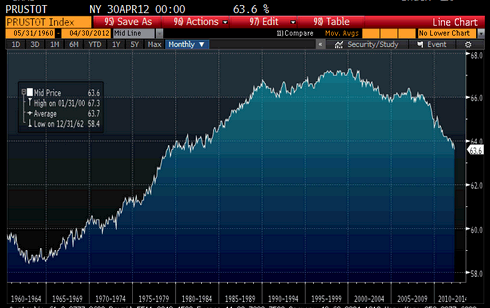
  • Unemployment rate falls to new cycle low of 8.1% (already close to Fed’s year-end forecast of 7.8-8.0%) though due to drop in Participation Rate from 63.8% to 63.6%.
  • A lot of volatility in the job data, making it difficult to divine the broader trend:

    • Manufacturing employment growth slows from 41k to 16k (vs rise in ISM employment component)
    • Leisure/Hospitality slows from 52k to 12k
    • Retail rises from -21k to +29k
    • Temp help rises from -9k to +21k
  • Income equation on the weak side as no growth in average hourly earnings and index of aggregate hours up just 0.1%
  • Diffusion index slows from 64.7 to 56.8, but still well within expansion zone.
  • Median duration of unemployment falls from 19.9 weeks to 19.4 weeks, a new cycle low.

Conclusion

  • The Fed would most certainly have liked to see better headline job growth, but I don’t think this report is enough to push them into additional easing for the following reasons:
    • Data is volatile and the net revisions were significant
    • Unemployment rate continues to fall
    • Inflation right at target
    • Financial conditions (equities and credit spreads) remain loose.
    • Structural issues continue to wane

Agreed on the conclusion. It will take a lot to get the Fed to do any more QE. Not the least reason being most of them know it doesn’t actually do anything apart from getting a lot of people scared and angry, including our esteemed politicians, for example, ready to make a propaganda show out of what they like to call ‘money printing.’

Of more concern, Bill Mitchell mentioned the drop in public sector employment may be dragging us down to negative growth. He may be right, as those paychecks are probably very ‘high multiple’ and require larger federal deficits to make up for the lost aggregate demand.

Actual multiples- propensities to spend out of income- are variable and hard to get a handle on, and therefore generally must be ‘reacted to’ with fiscal adjustments.

Unfortunately, however, all political forces are currently aligned towards deficit reduction.

And note the labor force participation rate is heading back to about where it was before women entered the labor force.

2nd hand memo to clients

From an email I received.
And, of course, the global mainstream agrees.
The slow motion train wreck continues.

Main message: A policy deal may be brewing. The possibility may emerge that PM Noda would offer a BoJ Law change in return for LDP support for the tax hike bills.

The main opposition party, the LDP, has already drafted and begun deliberations on a bill to revise the BoJ Law. Meanwhile, the ruling DPJ’s committee on countermeasures for the strong yen has also discussed the same topic. These deliberations suggest that a deal may be possible between the two parties.

The content of both proposals is reportedly very close to that of the bill submitted in 2010 by Your Party – i.e. setting an inflation target and making the tenure of BoJ leadership dependent on not deviating too much from the target.

The outcome of Friday’s BoJ meeting will be important. If BoJ disappoints markets and the Diet, the forces in all parties that favor such a law change may accelerate their efforts.

Once the potential for a deal is clear, PM Noda may propose the deal to the LDP: “Pass my tax hikes, and I’ll support your BoJ Law revision.” If PM Noda were to make this proposal, I believe that the LDP would accept.

Should such a deal pass, the impact on the equity market would likely be highly positive. In my talks with clients, they put far more weight on the BoJ than on the tax hike.

People who reject free lunches are fools: Liquidity trap – part II

Fiscal and monetary policy in a liquidity trap – part II

By Martin Wolf

Output is produced by work.
Work is a cost, not a benefit.
It is in that sense that there is no free lunch.

Might fiscal expansion be a free lunch? This is the question addressed in a thought-provoking paper “Fiscal Policy in a Depressed Economy”, March 2012, by Brad DeLong and Larry Summers, the most important conclusion of which is obvious, but largely ignored: the impact of fiscal expansion depends on the context. *

In normal times, with resources close to being fully utilised, the multiplier will end up very close to zero; in unusual times, such as the present, it could be large enough and the economic benefits of such expansion significant enough to pay for itself.

‘Paying for itself’ implies there is some real benefit to a lower deficit outcome vs a higher deficit outcome. With the govt deficit equal to the net financial assets of the non govt sectors, ‘Paying for itself’ implies there is a real benefit to the non govt sectors have fewer net financial assets.

In a liquidity trap fiscal retrenchment is penny wise, pound foolish.

I would say it’s penny foolish as well, as it directly reduces net financial assets of the non govt sectors with no economic or financial benefit to either the govt sector or the non govt sectors.

Indeed, relying on monetary policy alone is the foolish policy: if it worked, which it probably will not, it does so largely by expanding stretched private balance sheets even further.

Agreed.

As the authors note: “This paper examines the impact of fiscal policy in the context of a protracted period of high unemployment and output short of potential like that suffered by the United States and many other countries in recent years. We argue that, while the conventional wisdom rejecting discretionary fiscal policy is appropriate in normal times, discretionary fiscal policy where there is room to pursue it has a major role.”

There are three reasons for this.

1. First, the absence of supply constraints means that the multiplier is likely to be large.

Why is a large multiplier beneficial?

A smaller multiplier means the fiscal adjustment can be that much larger.

That is, the tax cuts and/or spending increases (depending on political preference) can be that much larger with smaller multipliers.

It is likely to be made even bigger by the fact that fiscal expansion may well raise expected inflation and so lower the real rate of interest, when the nominal rate is close to zero.

However the ‘real rate of interest’ is defined. Most would think CPI, which means the likes of tobacco taxes move the needle quite a bit.

And with the MMT understanding that the currency itself is in fact a simple public monopoly, and that any monopolist is necessarily ‘price setter’, the ‘real rate of interest’ concept doesn’t have a lot of relevance.

2. Second, even moderate hysteresis effects of such fiscal expansion, via increases in the likely level of future output, have big effects on the future debt burden.

Back to the errant notion of a public sector debt in its currency of issue being a ‘burden’.

3. Finally, today’s ultra-low real interest rates at both the short and long end of the curve, suggest that monetary policy is relatively ineffective, on its own.

Most central bank studies show monetary policy is always relatively ineffective.

The argument is set out in a simple example. “Imagine a demand-constrained economy where the fiscal multiplier is 1.5, and the real interest rate on long-term government debt is 1 per cent. Finally, assume that a $1 increase in GDP increased tax revenues and reduces spending by $0.33. Assume that the government is able to undertake a transitory increase in government spending, and then service the resulting debt in perpetuity, without any impact on risk-premia.

“Then the impact effect of an incremental $1.00 of spending is to raise the debt stock by $0.50. The annual debt service needed on this $0.50 to keep the real debt constant is $0.005. If reducing the size of the current downturn in production by $1.50 avoids a 1 per cent as large fall in future potential output – avoids a fall in future potential output of $0.0015 – then the incremental $1.00 of spending now augments future tax-period revenues by $0.005. And the fiscal expansion is self-financing.”

This is a very powerful result.

Yes, it tells you that the ‘automatic fiscal stabilizers’ must be minded lest the expansion reduce the govt deficit and, by identity, reduce the net financial assets of the non govt sectors to the point of aborting the economic recovery. Which, in fact, is how most expansion cycles end.

For the non govt sectors, net financial assets are the equity that supports the credit structure.

So when a recovery driven by a private sector credit expansion (which is how most are driven), causes tax liabilities to increase and transfer payments to decrease (aka automatic fiscal stabilizers)- reducing the govt deficit and by identity reducing the growth of private sector net financial assets- private sector/non govt leverage increases to the point where it’s unsustainable and it all goes bad again.

It rests on the three features of the present situation: high multipliers; low real interest rates; and the plausibility of hysteresis effects.

A table in the paper (Table 2.2) shows that at anything close to current real interest rates fiscal expansion is certain to pay for itself even with zero multiplier and hysteresis effects: it is a “no-brainer”.

And, if allowed to play out as I just described, the falling govt deficit will also abort the expansion.

Why is this? It is because the long-term real interest rate paid by the government is below even the most pessimistic view of the future growth rate of the economy. As I have argued on previous occasions, the US (and UK) bond markets are screaming: borrow.

The bond markets are screaming ‘the govt. Will never get its act together and cause the conditions for the central bank to raise rates.’

Of course, that is not an argument for infinite borrowing, since that would certainly raise the real interest rate substantially!

Infinite borrowing implies infinite govt spending.

Govt spending is a political decision involving the political choice of the ‘right amount’ of real goods and services to be moved from private to public domain.

Yet, more surprisingly, the expansion would continue to pay for itself even if the real interest rate were to rise far above the prospective growth rate, provided there were significantly positive multiplier and hysteresis effects.

I’d say it this way:
Providing increasing private sector leverage and credit expansion continues to offset declines in govt deficit spending.

Let us take an example: suppose the multiplier were one and the hysteresis effect were 0.1 – that is to say, the permanent loss of output were to be one tenth of the loss of output today. Then the real interest rate at which the government could obtain positive effects on its finances from additional stimulus would be as high as 7.4 per cent.

Thus, state the authors, “in a depressed economy with a moderate multiplier, small hysteresis effects, and interest rates in the historical range, temporary fiscal expansion does not materially affect the overall long-run budget picture.” Investors should not worry about it. Indeed, they should worry far more about the fiscal impact of prolonged recessions.

They shouldn’t worry about the fiscal impact in any case. The public sector deficit/debt is nothing more than the net financial assets of the non govt sectors. And these net financial assets necessarily sit as balances in the central bank, as either clearing balances (reserves) or as balances in securities accounts (treasury securities). And ‘debt management’ is nothing more than the shifting of balances between these accounts.

(and there are no grandchildren involved!)
(and all assuming floating exchange rate policy)

Are such numbers implausible? The answer is: not at all.

Multipliers above one are quite plausible in a depressed economy, though not in normal circumstances. This is particularly true when real interest rates are more likely to fall, than rise, as a result of expansion.

The ‘multipliers’ are nothing more than the flip side of the aggregate ‘savings desires’ of the non govt sectors. And the largest determinant of these savings desires is the degree of credit expansion/leverage.

Similarly, we know that recessions cause long-term economic costs. They lower investment dramatically: in the US, the investment rate fell by about 4 per cent of gross domestic product in the wake of the crisis. Businesses are unwilling to invest, not because of some mystical loss of confidence, but because there is no demand.

Again, we know that high unemployment has a permanent impact on workers, both young and old. The US, in particular, seems to have slipped into European levels of separation from the labour force: that is to say, the unemployment rate is quite low, given the sharp fall in the rate of employment. Workers have given up. This is a social catastrophe in a country in which work is effectively the only form of welfare for people of working age.

Not to mention the lost real output which over the last decade has to be far higher than the total combined real losses from all the wars in history.

Indeed, we can see hysteresis effects at work in the way in which forecasters, including official forecasters, mark down potential output in line with actual output: a self-fulfilling prophecy if ever there was one. This procedure has been particularly marked in the UK, where the Office for Budget Responsibility has more or less eliminated the notion that the UK is in a recession. Yet such effects are not God-given; they are man-chosen. They are the product of fundamentally misguided policies.

This is an important paper. It challenges complacent “do-nothingism” of policymakers, let alone the “austerians” who dominate policy almost everywhere. Policy-makers have allowed a huge financial crisis to impose a permanent blight on economies, with devastating social effects. It makes one wonder why the Obama administration, in which prof Summers was an influential adviser, did not do more, or at least argue for more, as many outsiders argued.

The private sector needs to deleverage.

It’s no coincidence that with a relatively constant trade deficit, private sector net savings, as measured by net financial $ assets, has increased by about the amount of the US budget deficit.

In other words, the $trillion+ federal deficits have added that much to domestic income and savings, thereby reducing private sector leverage.

However, as evidenced by the gaping output gap, for today’s credit conditions, it’s been not nearly enough.

The government can help by holding up the economy. It should do so. People who reject free lunches are fools.

Fiscal and monetary policy in a liquidity trap

Not bad, but let’s take it up to the next level.

Comments below:

Fiscal and monetary policy in a liquidity trap

By Martin Wolf

With floating fx, it’s always a ‘liquidity trap’ in that adding liquidity to a system necessarily not liquidity constrained is moot.

Part 1

What is the correct approach to fiscal and monetary policy when an economy is depressed and the central bank’s rate of interest is close to zero? Does the independence of the central bank make it more difficult to reach the right decisions? These are two enormously important questions raised by current circumstances in the US, the eurozone, Japan and the UK.

With floating fx, it’s always about a fiscal adjustment, directly or indirectly.

Broadly speaking, I can identify three macroeconomic viewpoints on these questions:
1. The first is the pre-1930 belief in balanced budgets and the gold standard (or some other form of a-political money).

Yes, actual fixed fx policy, where the monetary system is continuously liquidity constrained by design.

2. The second is the religion of balanced budgets and managed money, with Milton Friedman’s monetarism at the rules-governed end of the spectrum and independent inflation-targeting central banks at the discretionary end.

Yes, the application of fixed fx logic to a floating fx regime.

3. The third demands a return to Keynesian ways of thinking, with “modern monetary theory” (in which monetary policy and central banks are permanently subservient to fiscal policy) at one end of the policy spectrum, and temporary resort to active fiscal policy at the other.

MMT recognizes the difference in monetary dynamics between fixed and floating fx regimes.

In this note, I do not intend to address the first view, though I recognise that it has substantial influence, particularly in the Republican Party. I also do not intend to address Friedman’s monetarism, which has lost purchase on contemporary policy-makers, largely because of the views that the demand for money is unstable and the nature of money ill-defined. Finally, I intend to ignore “modern monetary theory” which would require a lengthy analysis of its own.

This leaves us with the respectable contemporary view that the best way to respond to contemporary conditions is via fiscal consolidation and aggressive monetary policy, and the somewhat less respectable view that aggressive fiscal policy is essential when official interest rates are close to zero.

Two new papers bring light from the second of these perspectives. One is co-authored by Paul McCulley, former managing director of Pimco and inventor of the terms “Minsky moment” and “shadow banking”, and Zoltan Pozsar, formerly at the Federal Reserve Bank of New York and now a visiting scholar at the International Monetary Fund.* The other is co-authored by J. Bradford DeLong of the university of California at Berkeley, and Lawrence Summers, former US treasury secretary and currently at Harvard university. **

Unfortunately, and fully understood, is the imperative for you to select from ‘celebrity’ writers regardless of the quality of the content.

The paper co-authored by Mr McCulley and Mr Pozsar puts the case for aggressive fiscal policy. The US, they argue, is in a “liquidity trap”: even with official interest rates near zero, the incentive for extra borrowing, lending and spending in the private sector is inadequate.

An output gap is the evidence that total spending- public plus private- is inadequate. And yes, that can be remedied by an increase in private sector borrowing to spend, and/or a fiscal adjustment by the public sector towards a larger deficit via either an increase in spending and/or tax cut, depending on one’s politics.

The explanation for this exceptional state of affairs is that during the credit boom and asset-price bubble that preceded the crisis, large swathes of the private sector became over-indebted. Once asset prices fell, erstwhile borrowers were forced to reduce their debts. Financial institutions were also unwilling to lend. They needed to strengthen their balance sheets. But they also confronted a shortage of willing and creditworthy borrowers.

Yes, for any reason if private sector spending falls short of full employment levels, a fiscal adjustment can do the trick.

This raises an interesting question:

Is it ‘better’, for example, to facilitate the increase in spending through a private sector credit expansion, or through a tax cut that allows private sector spending to increase via increased income, or through a government spending increase?

The answer is entirely political. The output gap can be closed with any/some/all of those options.

In such circumstances, negative real interest rates are necessary, but contractionary economic conditions rule that out.

I see negative nominal rates as a tax that will reduce income and net financial assets of the non govt sectors, even as it may increase some private sector credit expansion. And the reduction of income and net financial assets works to reduce the credit worthiness of the non govt sectors reducing their ability to borrow to spend.

Instead, there is a danger of what the great American economist, Irving Fisher called “debt deflation”: falling prices raise the real burden of debt, making the economic contraction worse.

Yes, though he wrote in the context of fixed fx policy, where that tends to happen as well, though under somewhat different circumstances and different sets of forces.

A less extreme (and so more general) version of the idea is “balance-sheet recession”, coined by Richard Koo of Nomura. That is what Japan had to manage in the 1990s.

With floating fx they are all balance sheet recessions. There is no other type of recession.

This is how the McCulley-Pozsar paper makes the point: “deleveraging is a beast of burden that capitalism cannot bear alone. At the macroeconomic level, deleveraging must be a managed process: for the private sector to deleverage without causing a depression, the public sector has to move in the opposite direction . . . by effectively viewing the balance sheets of the monetary and fiscal authorities as a consolidated whole.

Correct, in the context of today’s floating fx. With fixed fx that option carries the risk of rising rates for the govt and default/devaluation.

“Fiscal austerity does not work in a liquidity trap and makes as much sense as putting an anorexic on a diet. Yet ‘diets’ are the very prescriptions that fiscal ‘austerians’ have imposed (or plan to impose) in the US, UK and eurozone. Austerians fail to realise, however, that everyone cannot save at the same time and that, in liquidity traps, the paradox of thrift and depression are fellow travellers that are functionally intertwined.”

Agreed for floating fx. Fixed fx is another story, where forced deflation via austerity does make the maths work, though most often at an impossible social cost.

Confronted by this line of argument, austerians (a term coined by Rob Parenteau, a research associate at the Levy Economics Institute of Bard College), make three arguments:

1. additional borrowing will add heavily to future debt and so be an unreasonable burden on future generations;
2. increased borrowing will crowd out private borrowing;
3. bond investors will stop buying and push yields up.

Which does happen with fixed fx policy.

In a liquidity trap, none of these arguments hold.

With floating fx, none of these hold in any scenario.

Experience over the last four years (not to mention Japan’s experience over the past 20 years) has demonstrated that governments operating with a (floating) currency do not suffer a constraint on their borrowing. The reason is that the private sector does not wish to borrow, but wants to cut its debt, instead. There is no crowding out.

Right, because floating fx regimes are by design not liquidity constrained.

Moreover, adjustment falls on the currency, not on the long-term rate of interest.

Right, and again, unlike fixed fx.

In the case of the US, foreigners also want to lend, partly in support of their mercantilist economic policies.

Actually, they want to accumulate dollar denominated financial assets, which we call lending.

Note that both reserve balances at the Fed and securities account balances at the Fed (treasury securities) are simply dollar deposits at the Fed.

Alas, argue Mr McCulley and Mr Pozsar, “held back by concerns borne out of these orthodoxies, . . . governments are not spending with passionate purpose. They are victims of intellectual paralysis borne out of inertia of dogma . . . As a result, their acting responsibly, relative to orthodoxy, and going forth with austerity may drag economies down the vortex of deflation and depression.”

Right. Orthodoxy happens to be acting as if one was operating under a fixed fx regime even though it’s in fact a floating fx regime.

Finally, they note, “the importance of fiscal expansion and the impotence of conventional monetary policy measures in a liquidity trap have profound implications for the conduct of central banks. This is because in a liquidity trap, the fat-tail risk of inflation is replaced by the fat-tail risk of deflation.”

The risk of excess aggregate demand is replaced by the risk of inadequate aggregate demand.

And the case can be made that lower rates reduce aggregate demand via the interest income channels, as the govt is a net payer of interest.

In this situation, we do not need independent central banks that offset – and so punish – fiscally irresponsible governments. We need central banks that finance – and so encourage – economically responsible (though “fiscally irresponsible”) governments.

Not the way I would say it but understood.

When private sector credit growth is constrained, monetisation of public debt is not inflationary.

While I understand the point, note that ‘monetisation’ is a fixed fx term not directly applicable to floating fx in this context.

Indeed, it would be rather good if it were inflationary, since that would mean a stronger recovery, which would demand swift reversal of the unorthodox policy mix.

The conclusion of the McCulley-Pozsar paper is, in brief, that aggressive fiscal policy does work in the unusual circumstances of a liquidity trap, particularly if combined with monetisation. But conventional wisdom blocks full use of the unorthodox tool kit. Historically, political pressure has destroyed such resistance. Political pressure drove the UK off gold in 1931. But it also brought Hitler to power in Germany in 1933. The eurozone should take note.

Remarkably, in the circumstances of a liquidity trap, enlarged fiscal deficits are likely to reduce future levels of privately held public debt rather than raise them.

As if that aspect matters?

The view that fiscal deficits might provide such a free lunch is the core argument of the paper by DeLong and Summers, to which I will turn in a second post.

Free lunch entirely misses the point.

Why does the size the balances in Fed securities accounts matter as suggested, with floating fx policy?

BOJ’s Shirakawa: Fully Committed To Asset Purchases To Meet 1% Inflation Target

Right, they’ve only been doing it for a couple of decades, monetary policy works with a lag…

BOJ’s Shirakawa: Fully Committed To Asset Purchases To Meet 1% Inflation Target

By Chana R. Schoenbergrand and Stephen L. Bernard

April 18 (Dow Jones) — The Bank of Japan remains determined to purchase more assets to meet its 1% inflation target, the central bank’s governor, Masaaki Shirakawa, said Wednesday night in New York.
“The Bank of Japan is fully committed to continuing powerful monetary easing through various measures, including maintaining the policy interest rate at practically zero and purchasing financial assets, until the current goal of year on year CPI inflation at 1% is deemed to be achievable,” Shirakawa said in his speech to the Foreign Policy Association.

But Shirakawa warned of the potential mismatch between what markets expect and what central banking policies can deliver.