FOMC

Karim Basta:

  1. Further cut to gwth outlook
  2. Financial conditions tighter and housing getting worse
  3. Inflation receives greater concern than prior statement
  4. Conclusion: downside risks predominant and ‘timely’ means another intermeeting cut on the table.

Agreed, further comments below:

Release Date: March 18, 2008

For immediate release

The Federal Open Market Committee decided today to lower its target for the federal funds rate 75 basis points to 2-1/4 percent.

Could have been 100 as anticipated by the markets. Fed shaded its cut to the low side of the priced in expectations.

Recent information indicates that the outlook for economic activity has weakened further. Growth in consumer spending has slowed

Implies there is still some growth, not negative yet.

and labor markets have softened.

Looking unrevised February payroll number, not the lower unemployment rate. In January they looked at the higher unemployment rate. Unemployment has subsequently gone from 5.0% to 4.9% to 4.8% (rounded).

Financial markets remain under considerable stress,

They went a long way to relieve stress over the weekend.

and the tightening of credit conditions and the deepening of the housing contraction are likely to weigh on economic growth over the next few quarters.

Housing starts were revised up, and other indicators indicate it may have bottomed.

Inflation has been elevated, and some indicators of inflation expectations have risen.

This was noted in several Fed intermeeting speeches.

The Committee expects inflation to moderate in coming quarters, reflecting a projected leveling-out of energy and other commodity prices and an easing of pressures on resource utilization.

They continue to make this projection even after being completely wrong for many meetings.

Still, uncertainty about the inflation outlook has increased.

That’s why – their forecasts have proven unreliable, and crude/food continues to rise as the USD continues to fall.

It will be necessary to continue to monitor inflation developments carefully.

Only ‘monitor’? No action planned.

Today’s policy action, combined with those taken earlier, including measures to foster market liquidity, should help to promote moderate growth over time and to mitigate the risks to economic activity. However, downside risks to growth remain. The Committee will act in a timely manner as needed to promote sustainable economic growth and price stability.

Intermeeting action is on the table, for both growth and price stability.

Voting for the FOMC monetary policy action were: Ben S. Bernanke, Chairman; Timothy F. Geithner, Vice Chairman; Donald L. Kohn; Randall S. Kroszner; Frederic S. Mishkin; Sandra Pianalto; Gary H. Stern; and Kevin M. Warsh. Voting against were Richard W. Fisher and Charles I. Plosser, who preferred less aggressive action at this meeting.

Wonder how much less aggressive?

In a related action, the Board of Governors unanimously approved a 75-basis-point decrease in the discount rate to 2-1/2 percent. In taking this action, the Board approved the requests submitted by the Boards of Directors of the Federal Reserve Banks of Boston, New York, and San Francisco.
Mar 15 update

The question for the Fed: Will further rate cuts help or hurt the credit crisis?

The Fed has been cutting to support the financial sector, and address risks (as they see them) of financial sector issues spilling over to the real sector.

How does the Fed see rate cuts helping the financial sector?

Lower payments for borrowers assist in servicing/refinancing outstanding debt and facilitate continued ‘borrowing to spend.’

However, in this cycle, it seems that rate cuts have been instrumental in the USD decline that correlates with rising gasoline/food/import prices.

‘Well anchored’ wages mean consumers are spending more on food/energy and have less for other goods and services.

And less for debt service, as evidenced by rising delinquencies and the (still mainly subprime, but starting to spread) deteriorating credit quality of consumer loan portfolios.

Yes, exports are increasing dramatically, supporting GDP, keeping the output gap reasonably low, but not increasing income for debt service where that is needed.

So the question for the Fed is, on balance, will further rate cuts help or hurt the credit crisis?

Will further cuts ‘ease financial conditions’ via interest rate channels?

Or will further cuts ‘tighten financial conditions’ via the current fx/inflation/debt service income channel?

And, even if those potential outcomes for the credit crisis are approximately equal, does the nod go to not cutting for reasons of residual inflation issues?

So far, not a single ‘real economy’ company has had problems beyond a slowdown in earnings and concern over future earnings. And slowdowns in sales have all been related to consumers being hurt by higher food and energy prices.

This implies the falling dollar/higher import prices is what has hurt the companies that have been subject to consumer weakness.

This implies Fed policy designed to protect the real economy from from potential spillover from the financial sector crisis has, as a side effect, done direct damage to the real economy.

And, of course, this is only relevant for the Fed if it comes up for discussion at the meeting on Tuesday.

Close friends tell me it probably won’t.

2008-03-14 US Economic Releases

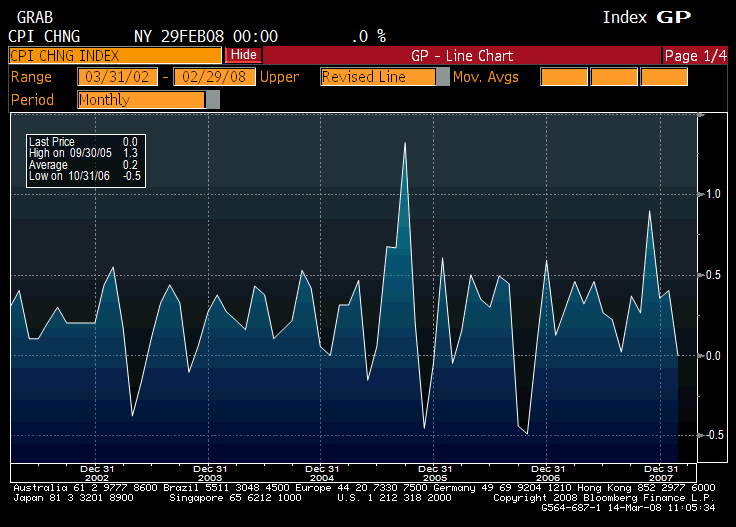
2008-03-14 Consumer Price Index MoM

Consumer Price Index MoM (Feb)

Survey 0.3%
Actual 0.0%
Prior 0.4%
Revised n/a

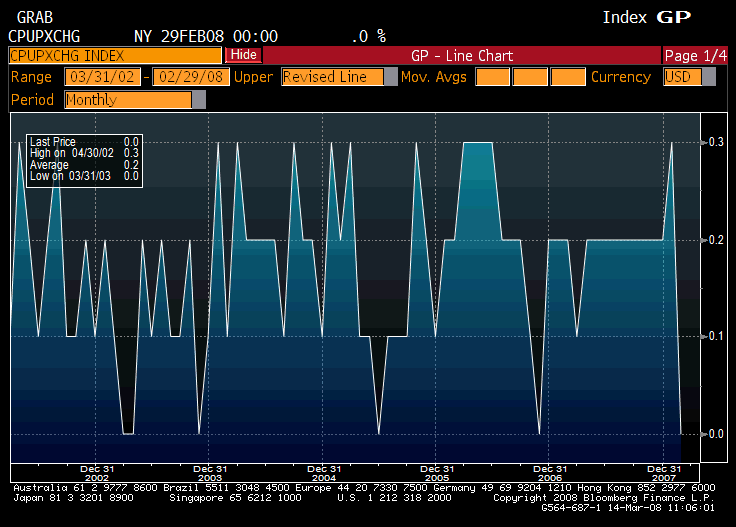
2008-03-14 CPI Ex Food & Energy MoM

CPI Ex Food & Energy MoM (Feb)

Survey 0.2%
Actual 0.0%
Prior 0.3%
Revised n/a

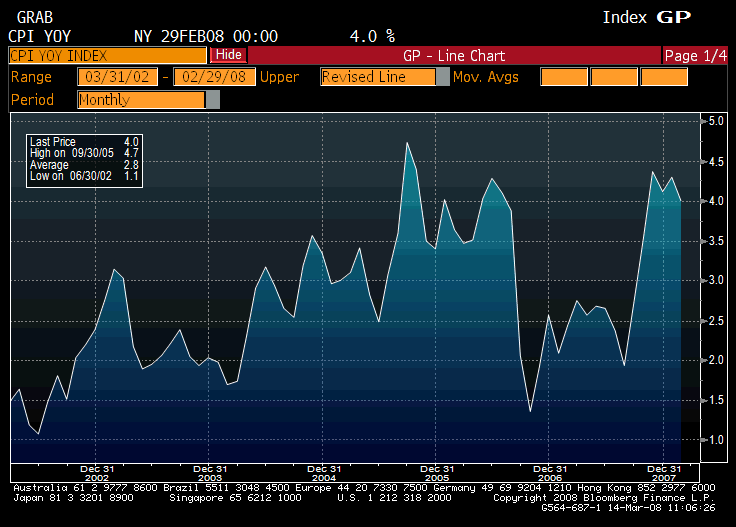
2008-03-14 Consumer Price Index YoY

Consumer Price Index YoY (Feb)

Survey 4.3%
Actual 4.0%
Prior 4.3%
Revised n/a

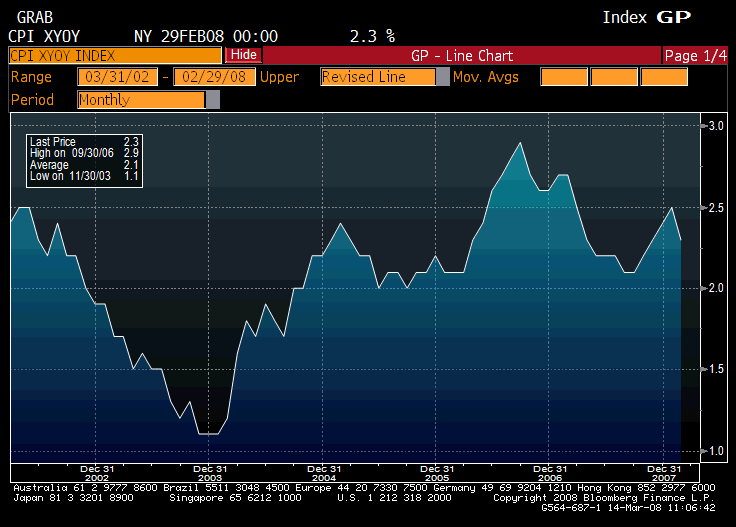
2008-03-14 CPI Ex Food & Energy YoY

CPI Ex Food & Energy YoY (Feb)

Survey 2.4%
Actual 2.3%
Prior 2.5%
Revised n/a

The calm during the storm.  March numbers are already being forecast at up 0.7% for headline CPI.

The individual components have been volatile.

Also, gasoline prices fell 2%.  Retail sales of gasoline was reported down 1% earlier this week.  Together this implies physical demand (gallons sold) went up.


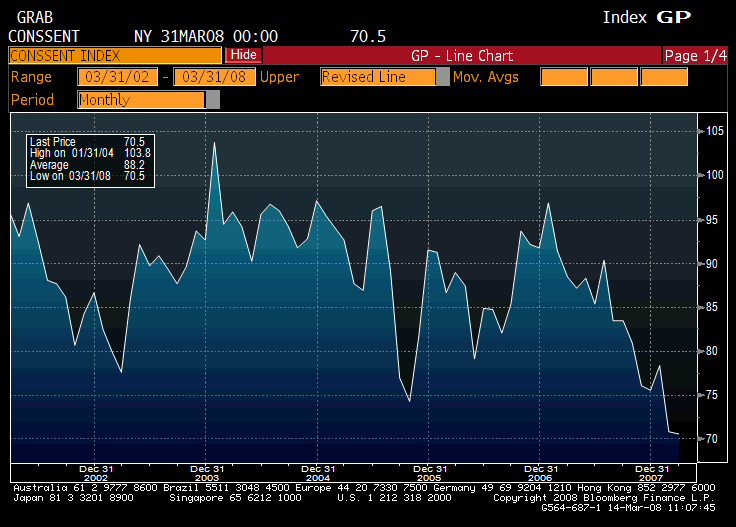
2008-03-14 U. of Michigan Confidence

U. of Michigan Confidence (Mar P)

Survey 69.5
Actual 70.5
Prior 70.8
Revised n/a

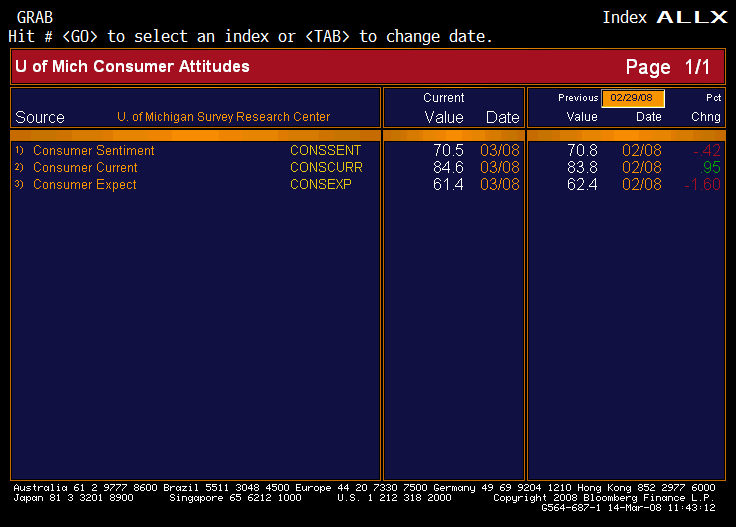
2008-03-14 U. of Michigan TABLE

Current conditions improved, expectations fell.

Inflation expectations one year forward rose from 3.6% to 4.5% which complicates the Fed’s decision on Tuesday.  The 5 year number fell from 3.0% to 2.9% which is somewhat of an offset.

2008-03-13 US Economic Releases

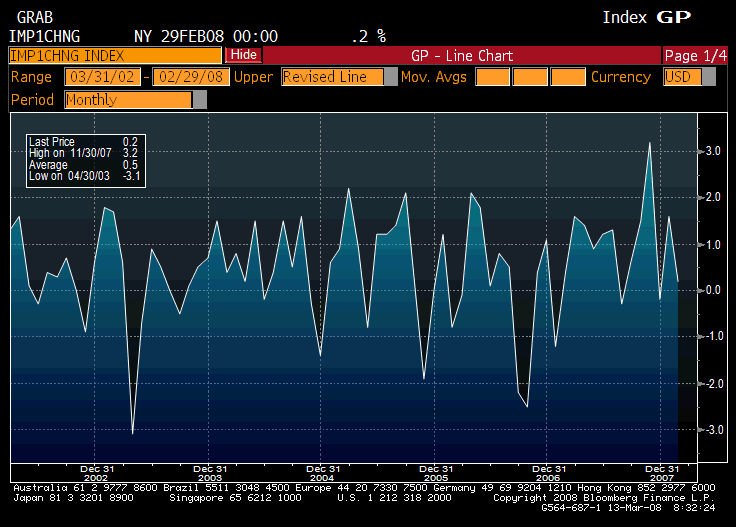
2008-03-13 Import Price Index MoM

Import Price Index MoM (Feb)

Survey 0.8%
Actual 0.2%
Prior 1.7%
Revised 1.6%

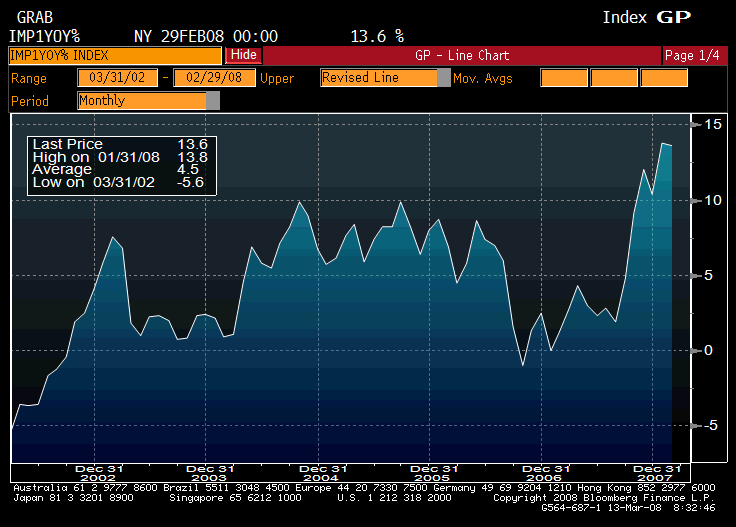
2008-03-13 Import Price Index YoY

Import Price Index YoY (Feb)

Survey n/a
Actual 13.6%
Prior 13.7%
Revised 13.8%

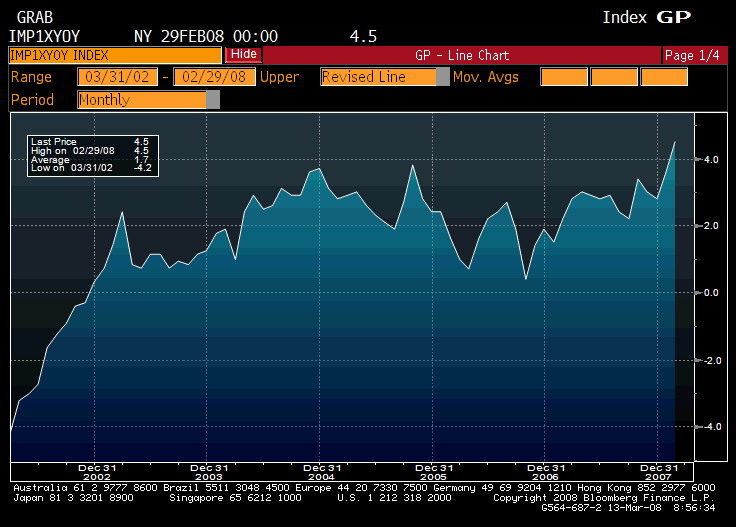
2008-03-13 Import Prices Ex Petroleum YoY

Import Prices Ex Petroleum YoY

Survey n/a
Actual 4.5%
Prior 3.6%
Revised n/a

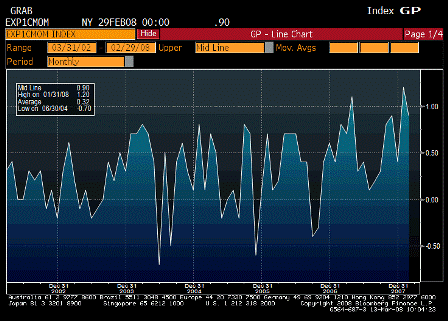
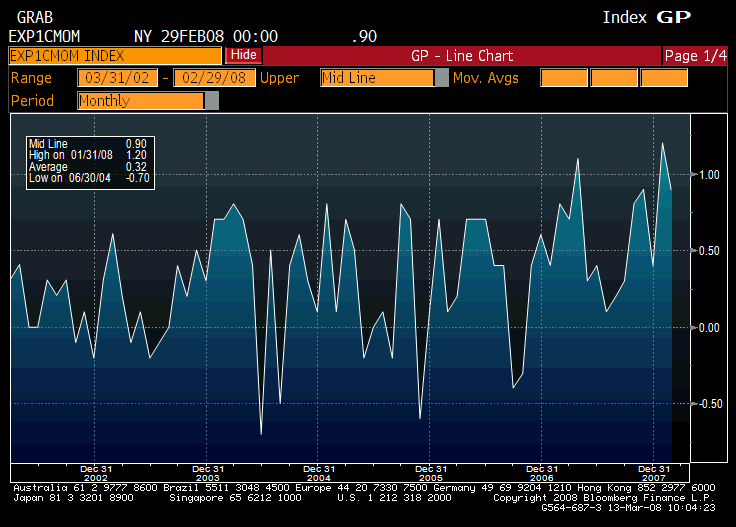
2008-03-13 Exports MoM

Exports MoM (Feb)

Survey n/a
Actual 0.9%
Prior 1.2%
Revised n/a

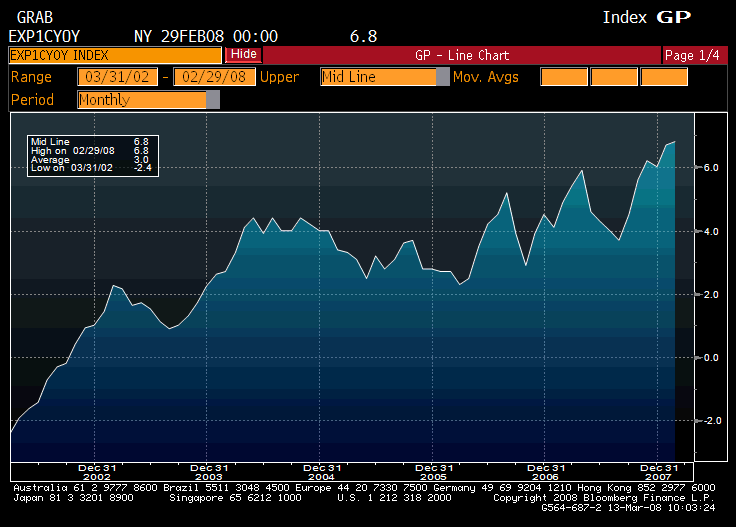
2008-03-13 Exports YoY

Exports YoY (Feb)

Survey n/a
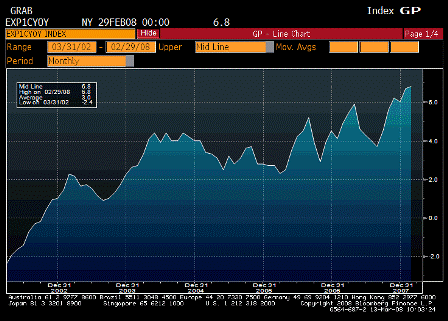
Actual 6.8%
Prior 6.7%
Revised n/a

Inflation ripping via the ‘weak dollar’ channel.

Note: non-petroleum imports up 0.6%.


2008-03-13 Advance Retail Sales

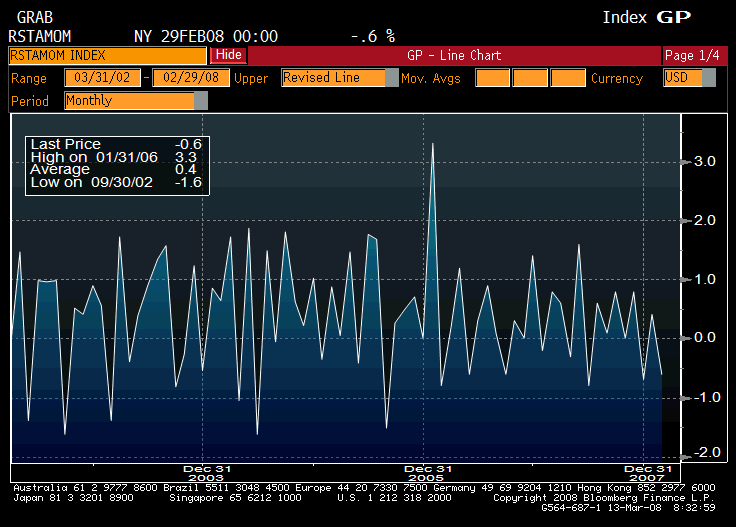
Advance Retail Sales (Feb)

Survey 0.2%
Actual -0.6%
Prior 0.3%
Revised 0.4%

2008-03-13 Retail Sales Less Autos

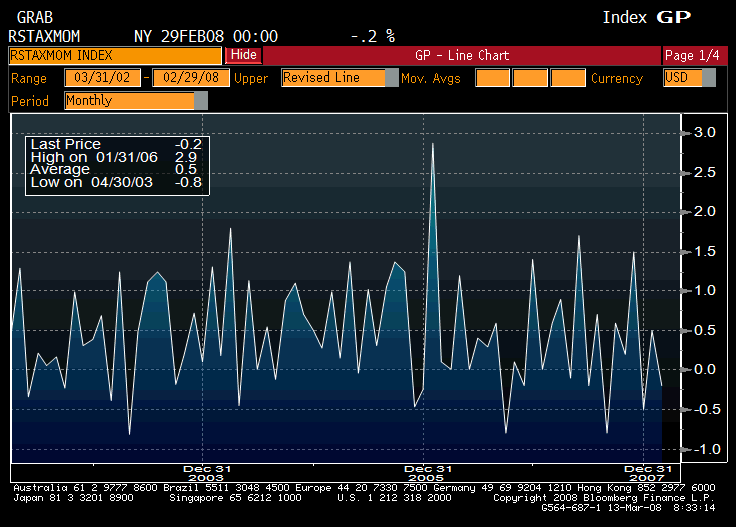
Retail Sales Less Autos (Feb)

Survey 0.2%
Actual -0.2%
Prior 0.3%
Revised 0.5%

Retail sales soft, but not in collapse. That’s what an export economy looks like: domestic sales soft, while exports pick up the slack and support GDP, real terms of trade, and standards of living deteriorate.


2008-03-13 Initial Jobless Claims

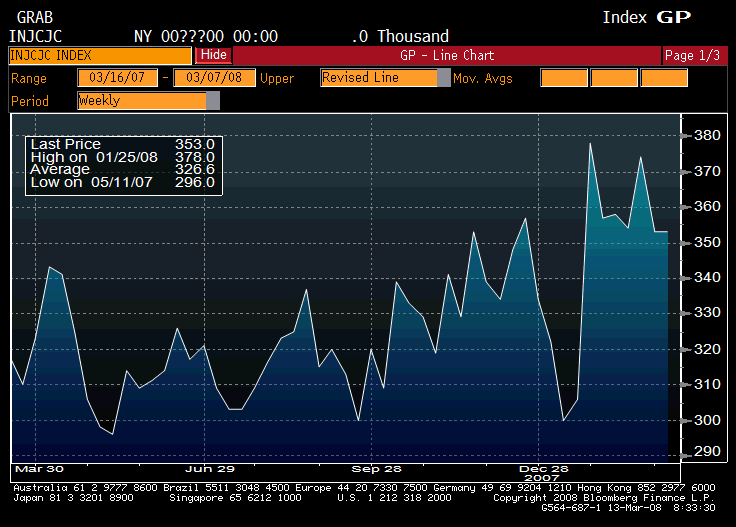
Initial Jobless Claims (Mar 8)

Survey 357K
Actual 353K
Prior 351K
Revised 353K

Leveling off – nowhere near recession levels yet.

Would need to be 400K+.


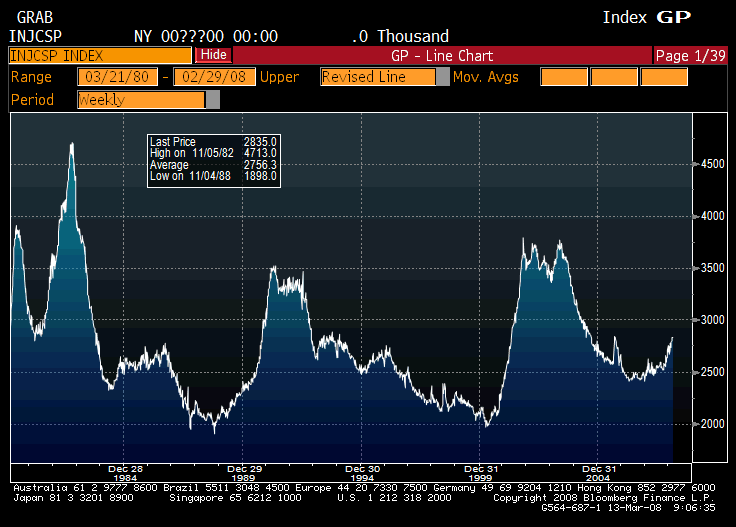
2008-03-13 Continuing Claims since 1980

Continuing Claims (Mar 1)

Survey 2835K
Actual 2835K
Prior 2831K
Revised 2828K

Moving a bit higher, but still far below recession levels.


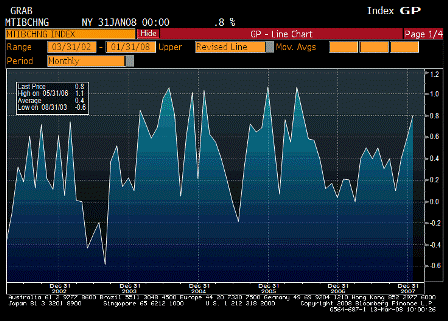
2008-03-13 Business Inventories

Business Inventories (Jan)

Survey 0.5%
Actual 0.8%
Prior 0.6%
Revised 0.7%

Up some, but still much lower than prior to other recessions.

Comments on 8:30 numbers

Retail sales weak today, but exports up over 16% earlier this week, and jobless claims now settling in around 350,000 – far from recession levels. That’s what export economies look like.

Meanwhile, non oil import prices up 0.6%, and export prices up 0.9%.

US GDP growth may be hovering around zero, but no collapse yet.

Meanwhile, Bush/Bernanke/Paulson engineered USD collapse/inflation/export boom is underway and accelerating.

It was like yelling fire in a crowded theater.

The world was happily accumulating over $700 billion per year in financial assets, and had a total of over $2 trillion, when our leadership yelled ‘fire’ and caused a reverse stampede.

Imports are real benefits and exports are real costs, and now we’re paying the price.

Dow Jones: No mof intervention

The MOF would have bought USD long ago if Paulson hadn’t gone around branding any CB a ‘currency manipulator’ and an international outlaw.

The USD is in freefall and is now the major source of inflation.

And maybe the Fed as seen the connection?

MOF Frets Over Yen, But No Hint Of Intervention

by Takeshi Takeuchi

(Dow Jones) Japanese currency authorities expressed alarm about the dollar’s fall close to the Y100-mark for the first time since 1995 but didn’t offer any clues about whether or when they might take any countermeasures.

Finance Minister Fukushiro Nukaga and his vice minister on currency affairs, Naoyuki Shinohara, separately voiced caution after the dollar fell to Y100.19 in the mid-day Tokyo session.

Nukaga said it is “a shared perception among the G7 (Group of Seven industrialized countries) that excessive exchange rate moves are undesirable,” while Shinohara also noted “excessive foreign exchange moves are undesirable.”

The two point men for Japan’s currency policy also said they will “continue closely watching foreign exchange markets,” a code phrase that shows their displeasure about current dollar/yen moves.

Neither of them, however, commented on whether they are considering taking countermeasures against the dollar’s rapid fall against the yen.

But Shinohara repeated the word “excessive” a few times in exchanges with reporters, suggesting the ministry’s level of caution has been at least raised in response to the imminent possibility of the dollar’s break below the Y100-mark.

In the past, finance ministry officials usually stepped up their currency rhetoric in stages before intervening. Their remarks on yen strength often changed from “rapid” to “a bit sharp” to “brutal,” while they also threatened “appropriate action” as an advance warning before intervening.

Bloomberg: Budget deficit to rise in Italy

Countercyclical budget deficit growth could bring on a national credit crisis in the Eurozone that makes the current US situation look like child’s play.

This is their vulnerability that came with the Maastricht Treaty and has yet to be tested.

Italy Halves Growth Forecast, Sees Deficit Rising

by Flavia Krause-Jackson

(Bloomberg) The Italian government cut its 2008 economic growth forecast by more than half, as slumping confidence and rising prices threaten to brake expansion to the slowest among the 15 nations that share the euro.

The $2.2 trillion economy, Europe’s fourth-biggest, will grow 0.6 percent this year, the Rome-based Finance Ministry said today in a statement. That’s down from a forecast of 1.5 percent in December and would be the weakest rate of growth since 2005.

Italy may be the first and only country in the euro region to enter a recession this year and may have contracted in the fourth quarter, according to Morgan Stanley economist Vladimir Pillonca. Growth is slowing just as rising food and energy prices are fueling inflation and sapping consumer and business confidence.

“If you add to the mix an international situation that is now weaker than expected, this creates a real mess in a country where productivity was already declining,” said Luigi Speranza, an economist at NP Paribas SA in London.

Italy’s budget deficit will rise to 2.4 percent of gross domestic product, more than the 2.2 percent formerly predicted though still under the European Union ceiling of 3 percent. The shortfall narrowed last year to 1.9 percent of gross domestic product, the least since 2000, the Rome-based national statistics office said Feb. 29. That’s about half the 2006 deficit of 3.4 percent.

Fed policy changes

The Fed continues to show a deficiency in understanding monetary operations with the latest moves. While steps in the right direction, a better understanding of monetary operations would have meant funding ANY member bank asset at the FF rate and establishing an unlimited term lending facility for Treasury securities.

Meanwhile they seem to be trying to minimize further rate cuts and instead trying to target areas of illiquidity as per Friday and today’s announcements. They may have reached their inflation tolerance with crude at $109, the dollar continuously falling, and inflation expectations elevating.

Somewhat more troubling is the eurozone seemingly wanting dollar lines from the Fed. Not sure why, but borrowing external currency isn’t ordinarily a good sign.