GDP miss ‘just’ govt

This plays to investors who think a drop in govt spending is good for the private sector as it ‘gets govt out of the way’ and ‘opens the door’ for that much more private sector growth in short order.

While this could be sort of but not necessarily true at full employment, it is of course not true in any case with with today’s excess capacity.

Seems they forget that today, cuts in govt spending immediately translate into cuts in private sector sales, which are the driver of private sector output and employment.

Yes, private sector credit expansion has (had?) begun to ‘kick in’, somewhat more than replacing the decline in govt deficit spending from the ‘automatic fiscal stabilizers’ of slowing transfer payments and rising revenues from higher incomes. The causation was from more ‘borrowing to spend’ in the economy to less deficit spending.

And that all can accelerate and continue for many years before, left alone, the deficit gets too small (and shrinking) to support the growing private sector credit expansion, as it all becomes unsustainable and implodes.

But at any point during that credit expansion, a pro active dose of govt deficit reduction can remove sufficient income to restrict the private sector’s credit expansion. People who may have borrowed to buy a house or a car, for example, suddenly losing their jobs and those purchases not happening, etc.

So the idea that 3% GDP is a ‘given’ due to private sector credit expansion and therefore a proactive tax hike and spending cut of maybe 1.25% of GDP will lower that to 1.75% growth misses that dynamic, as it presumes the proactive fiscal adjustments don’t throw a monkey wrench into the credit expansion dynamics. Like what’s been happening in the euro zone.

—– Original Message —–
At: Apr 26 2013 07:39:34

The miss was mostly a result of government declining, again. This is really the surprise. Trade was also a drag, but from a surprise perspective government is the winner. In all, gov subtracted a chunky 0.8ppts from the topline – meaning if you add it back Q1 would have printed 3.3%.

Having said that, this a rearview mirror report and what we already know about the handoff to Q2 is that it was weak. Indeed, we are looking for a rather paltry 1% outcome here in Q2.

Finally, in terms of today’s report, no underlying detail is inconsistent with our thinking about the handoff to Q2.

Asia Insights: China: Why GDP growth has weakened despite strong credit growth – 25 Apr 2013

So some was gross, not net, and some unspent:

Nomura: Asia Insights: China: Why GDP growth has weakened despite strong credit growth

  • Economic growth in China has weakened surprisingly despite rapid credit growth in H2 2012 and Q1 2013.
  • We believe a large part of the new credit supply in Q1 did not go into the real economy. For example, at least 20% of urban construction bond issuance was used to pay off expiring bank loans.
  • Recent policy signals suggest credit growth will slow in Q2. We reiterate our view that economic growth will slow in Q2, while the market consensus expects a rebound.

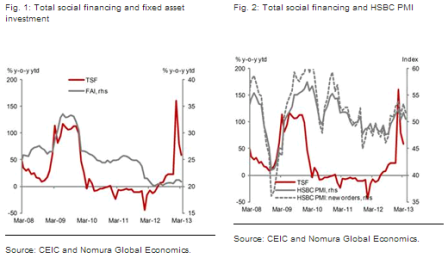
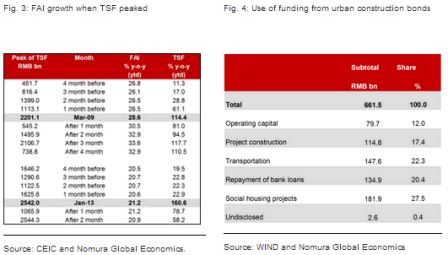
We had expected economic growth in China to rise in Q1 because of very strong credit growth, but GDP growth surprisingly slowed to 7.7% from 7.9% in Q4 2012, and economic activity in Q2 has started on a weak note. This is very different to what happened in 2009, when growth in total social financing picked up from 26.6% y-o-y in Q4 2008 to 114% in Q1 2009 and 121% in Q2 2009, growth in fixed asset investment moved up from 26.8% y-o-y in Q4 2008 to 28.6% in Q1 2009, the HSBC PMI rose to 44.8 from 40.9, and the new orders component in the HSBC PMI jumped to 43.6 from 36.1 (Figures 1, 2 and 3).

But in 2013 it is a very different story. Total social financing rose to an historical high and jumped by 160.6% y-o-y in January and by 58.2% y-o-y in Q1, but fixed asset investment (FAI) growth only picked up slightly to 21.2% y-o-y in January and February, and then slowed to 20.9% in March. GDP growth slowed to 7.7% y-o-y in Q1. The flash HSBC PMI weakened in April despite favorable seasonal factors it has only dropped once in April once during the past seven years. The new orders component of the flash HSBC PMI has dropped as well.

Many investors ask us the same question: where has all the money gone? We believe a large part of the new credit supply in Q1 did not go into the real economy. We do not have comprehensive information, but we provide the following two pieces of evidence. First, we collected public information on the 370 largest issues of urban construction debt that took place in 2012, and found that at least 20% of the money raised was used to repay debt (Figure 4). It is not surprising to us as many infrastructure investments projects are not yet profitable. Therefore, local government financing vehicles need to continue borrowing new funds for debt financing.

Another piece of evidence comes from a recent government policy announcement. According to a Chinese newspaper, First Financial Daily, the National Development and Reform Commission (NDRC) issued a policy notice at the end of March to ensure the funds raised for public housing construction in the bond market are not used for other purposes. We believe this policy may be triggered by cases where some funds were misused. Indeed, risks of such events have been mentioned repeatedly in government documents.

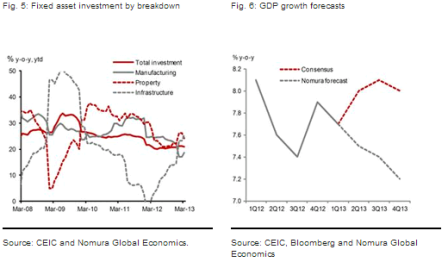
Why didnt money flow into the real economy? We think it is partly because the underlying demand for investment is weak. FAI growth for the manufacturing industry has been on a downward trend since 2011 and dropped sharply in Q1 2013 despite strong infrastructure FAI growth, which should have generated some positive spillover effects for manufacturers (Figure 5). The over-capacity problem in the manufacturing industry has been exacerbated by aggressive policy easing in 2009 and 2012.

We reiterate our view that economic growth will slow to 7.5% in Q2 as credit growth weakens (Figure 6). The consensus expects growth to recover to 8% in Q2, but recent policy signals suggest policy tightening has started and will adversely affect growth. In particular, the government has investigated several high profile corruption cases in the bond market in the past few days, and the Peoples Bank of China held a meeting on 24 April with commercial banks to clean up irregular activities in the bond market, according to a Chinese newspaper Economic Information. This initiative will likely lead to a slowdown in bond issuance and growth in total social financing in the coming months.


Full size image


Full size image


Full size image

Super Seccareccia on R&R

Dear all,
I am amazed at how much media coverage since yesterday this study criticizing the Reinhart-Rogoff work is getting thanks largely, apparently, to the Roosevelt Institute research support which I think is great (see below)! Needless to say, I am convinced that there was hardly any error from some incompetent research assistant but that it was most likely an exercise in data mining and selective use of data series that are rampant and that practically all economists engage in … not to mention the causality issue in interpreting the statistical evidence to which many now are also referring.

What bothers me about this is to suggest that the rejection of austerity is predicated on the basis of faulty data series. We know that, regardless of the amount of empirical evidence that one has to disprove a theory, unless there is a coherent alternative that is espoused and around which political forces can coalesce, the theory will remain intact and the proponents of austerity will continue to spew their toxic ideas and implement their destructive measures worldwide. That is why Krugman and his disciples will not get very far with this, since they do not have a coherent alternative to some loanable funds theory. All of them subscribe to some notion of debt stability as being a constraint ultimately on public spending and thus on economic growth. Hence, instead of 90% debt/GDP ratio, they may find some other higher ratio, say, 150% and they will then have to say that Greece and Japan must now still implement austerity measures! The problem here is that they are stuck in a faulty and misleading paradigm that must eventually lead them to austerity. The only viable framework that is truly a paradigm shift is the broad circuitist cum MMT framework. Unless we can get that through to the media, all of this interesting debate over data series will not go anywhere …. much like the conclusions last year on the IMF fiscal multipliers being larger than originally assumed has hardly changed anything in preventing governments from continuing to apply austerity measures internationally.


But there is some hope because at least there is a shake-up in the profession! As Alain undoubtedly would say: Ce n’est qu’un dbut, continuons le combat!

All the best,
Mario Seccareccia

Reinhart-Rogoff data errors found!

If true, this is very bad:

Researchers Finally Replicated Reinhart-Rogoff, and There Are Serious Problems.

By Mike Konczal

April 16 (Bloomberg) — In 2010, economists Carmen Reinhart and Kenneth Rogoff released a paper, “Growth in a Time of Debt.” Their “main result is that…median growth rates for countries with public debt over 90 percent of GDP are roughly one percent lower than otherwise; average (mean) growth rates are several percent lower.” Countries with debt-to-GDP ratios above 90 percent have a slightly negative average growth rate, in fact.

This has been one of the most cited stats in the public debate during the Great Recession. Paul Ryan’s Path to Prosperity budget states their study “found conclusive empirical evidence that [debt] exceeding 90 percent of the economy has a significant negative effect on economic growth.” The Washington Post editorial board takes it as an economic consensus view, stating that “debt-to-GDP could keep rising and stick dangerously near the 90 percent mark that economists regard as a threat to sustainable economic growth.”

Is it conclusive? One response has been to argue that the causation is backwards, or that slower growth leads to higher debt-to-GDP ratios. Josh Bivens and John Irons made this case at the Economic Policy Institute. But this assumes that the data is correct. From the beginning there have been complaints that Reinhart and Rogoff weren’t releasing the data for their results (e.g. Dean Baker). I knew of several people trying to replicate the results who were bumping into walls left and right – it couldn’t be done.

In a new paper, “Does High Public Debt Consistently Stifle Economic Growth? A Critique of Reinhart and Rogoff,” Thomas Herndon, Michael Ash, and Robert Pollin of the University of Massachusetts, Amherst successfully replicate the results. After trying to replicate the Reinhart-Rogoff results and failing, they reached out to Reinhart and Rogoff and they were willing to share their data spreadsheet. This allowed Herndon et al. to see how how Reinhart and Rogoff’s data was constructed.

They find that three main issues stand out. First, Reinhart and Rogoff selectively exclude years of high debt and average growth. Second, they use a debatable method to weight the countries. Third, there also appears to be a coding error that excludes high-debt and average-growth countries. All three bias in favor of their result, and without them you don’t get their controversial result. Let’s investigate further:

Selective Exclusions. Reinhart-Rogoff use 1946-2009 as their period, with the main difference among countries being their starting year. In their data set, there are 110 years of data available for countries that have a debt/GDP over 90 percent, but they only use 96 of those years. The paper didn’t disclose which years they excluded or why.

Herndon-Ash-Pollin find that they exclude Australia (1946-1950), New Zealand (1946-1949), and Canada (1946-1950). This has consequences, as these countries have high-debt and solid growth. Canada had debt-to-GDP over 90 percent during this period and 3 percent growth. New Zealand had a debt/GDP over 90 percent from 1946-1951. If you use the average growth rate across all those years it is 2.58 percent. If you only use the last year, as Reinhart-Rogoff does, it has a growth rate of -7.6 percent. That’s a big difference, especially considering how they weigh the countries.

Unconventional Weighting. Reinhart-Rogoff divides country years into debt-to-GDP buckets. They then take the average real growth for each country within the buckets. So the growth rate of the 19 years that England is above 90 percent debt-to-GDP are averaged into one number. These country numbers are then averaged, equally by country, to calculate the average real GDP growth weight.

In case that didn’t make sense let’s look at an example. England has 19 years (1946-1964) above 90 percent debt-to-GDP with an average 2.4 percent growth rate. New Zealand has one year in their sample above 90 percent debt-to-GDP with a growth rate of -7.6. These two numbers, 2.4 and -7.6 percent, are given equal weight in the final calculation, as they average the countries equally. Even though there are 19 times as many data points for England.

Now maybe you don’t want to give equal weighting to years (technical aside: Herndon-Ash-Pollin bring up serial correlation as a possibility). Perhaps you want to take episodes. But this weighting significantly reduces the average; if you weight by the number of years you find a higher growth rate above 90 percent. Reinhart-Rogoff don’t discuss this methodology, either the fact that they are weighing this way or the justification for it, in their paper.

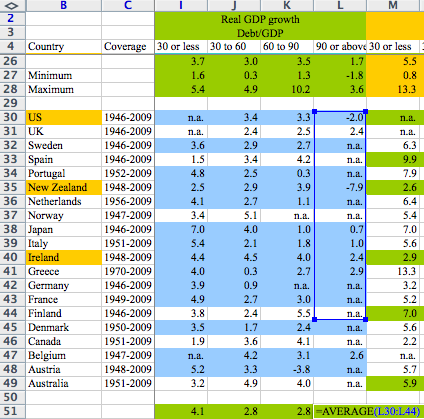
Coding Error. As Herndon-Ash-Pollin puts it: “A coding error in the RR working spreadsheet entirely excludes five countries, Australia, Austria, Belgium, Canada, and Denmark, from the analysis. [Reinhart-Rogoff] averaged cells in lines 30 to 44 instead of lines 30 to 49…This spreadsheet error…is responsible for a -0.3 percentage-point error in RR’s published average real GDP growth in the highest public debt/GDP category.” Belgium, in particular, has 26 years with debt-to-GDP above 90 percent, with an average growth rate of 2.6 percent (though this is only counted as one total point due to the weighting above).

Being a bit of a doubting Thomas on this coding error, I wouldn’t believe unless I touched the digital Excel wound myself. One of the authors was able to show me that, and here it is. You can see the Excel blue-box for formulas missing some data:


This error is needed to get the results they published, and it would go a long way to explaining why it has been impossible for others to replicate these results. If this error turns out to be an actual mistake Reinhart-Rogoff made, well, all I can hope is that future historians note that one of the core empirical points providing the intellectual foundation for the global move to austerity in the early 2010s was based on someone accidentally not updating a row formula in Excel.

So what do Herndon-Ash-Pollin conclude? They find “the average real GDP growth rate for countries carrying a public debt-to-GDP ratio of over 90 percent is actually 2.2 percent, not -0.1 percent as [Reinhart-Rogoff claim].” Going further into the data, they are unable to find a breakpoint where growth falls quickly and significantly.

This is also good evidence for why you should release your data online, so it can be probably vetted. But beyond that, looking through the data and how much it can collapse because of this or that assumption, it becomes quite clear that there’s no magic number out there. The debt needs to be thought of as a response to the contigent circumstances we find ourselves in, with mass unemployment, a Federal Reserve desperately trying to gain traction at the zero lower bound, and a gap between what we could be producing and what we are. The past guides us, but so far it has failed to provide an emergency cliff. In fact, it tells us that a larger deficit right now would help us greatly.

Global growth and US oil and product imports

A while back I’d written about how the global economy had become leveraged to net exports to the US, which has turned out to be the case. And now with US imports of crude and products falling, another leg of this process seems to be underway, and in a world where no one runs high enough deficits to sustain domestic demand at reasonable levels.

A rough guess is 15x leverage? A US trade deficit of $500 billion is sustaining about $7.5 trillion in global ‘equity value’? More?

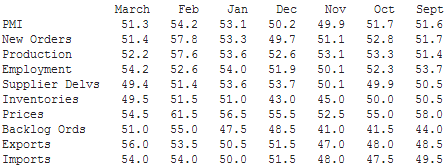
ISM


Karim writes:

It looks like the inventory rebuild has peaked,

Agreed, pay back from Q4 caution might have masked underlying weakness from tightening fiscal which intensifies some into Q2 as sequesters kick in, driving the deficit down to maybe 5% of GDP. The lesson of Japan may be that with 0 rates and QE, 5% might not be enough for anything more than stagnation.

but demand related indicators (employment, exports, imports) holding up.
The employment index is now at a 9mth high.

Contrasting Eur/U.S. Data/Forecasts


Karim writes:

The single most important economic indicator in Europe was released today, the Composite PMI.

For March, it was expected to increase to 48.2 from 47.5; it fell to 46.5, the lowest level since November.

In the U.S.:

  • 4-week average of initial claims fell to a 5yr low
  • Existing single family home sales up 8.9% y/y and multi-family units up 22% y/y
  • FHFA new home prices up 6.5% y/y and NAR measure up 11.5% y/y
  • Philly Fed bounced 14 points in March and the Flash PMI (national measure) rose from 54.3 to 54.9 in March.

So, latest NowCasting forecasts:

Europe: Q1 -0.8% and Q2 revised from +0.1% to -1.05% after todays data
U.S.: Q1 +2.6% and Q2 revised from 2.8% to 3.4% over the past week (they will not account for sequester hit as forecast simply based on incoming data flow).

Euro PMI (white) vs U.S. ISM Mfg (orange) and Services (yellow): link

Thaler’s Corner 19th Februaryy 2013: Positive Currency Wars!

The usual excellent post!

Positive Currency Wars!

19 February 2013


Financial markets are today being buffeted about by a slew of highly complex and changing influences. As readers may recall, at end-January (Thaler’s Corner 31/01: Too Cloudy), we advised people to favor Risk Off positions (references 2725 Euro Stoxx and 141.85 Bund), but this morning we returned to a neutralization of asset allocation biases (references 2635 and 142.85).

Not only do European markets seem to have lagged too far behind their American and Japanese peers, but, above all, I consider the current jitters about currency wars to be completely off the wall!

That said, there are still dark clouds hovering over Europe, mainly the eurozone, which is why we have yet to join the clan of the optimists.

Let us examine the macroeconomic situation area-by-area.

United States

The Fed is pursuing its easy money policies, the target QE, and I do not see them ending these policies any time soon. Despite the prevailing conventional wisdom, these policies are not boosting inflation at all, quite the contrary!

By continuously removing treasuries and MBS from the private sector via its QE asset-purchasing program and by replacing them with base money reserves, the Fed is in reality absorbing the interest that the private sector would have received on these bonds, as base money does not pay a coupon! The best illustration of the absorption carried out by the government is the amount of profits earned and transferred to the Treasury, a total of €335 billion since 2009!

This QE program functions like a tax, or more specifically, a savings tax somewhat like the French ISF or wealth tax (except that it is not at all progressive). It is nonetheless “progressive” in that it has helped the federal government, among others.

The 0% interest rate policy is certainly supposed to help reignite the American economy by making its easier for investment projects to achieve profitability, but at a time when the private sector feels overloaded with debt (deleveraging), its “inflationist” aspect is limited to the value of financial assets.

As long as US government budget policy remains frankly expansionist, with cumulative deficits totaling over $5 trillion since 2009, this deflationist aspect of the QE has little importance. However, not only have US budget deficits been trending downwards since 2009 (at a record high of $1.415 trillion), falling from 10.4% to 6.7% of GDP, but the latest budget measures raise concerns that the trend will accelerate.

In the first place, the hike in the payroll tax has had a direct impact on the American consumer. This 2% decrease in take-home income, for which employees were hardly prepared, led Wal-Mart Vice President Jerry Murray to declare February sales figures to be a “total disaster”:

“In case you haven’t seen a sales report these days, February MTD (month-to-date) sales are a total disaster. The worst start to a month I have seen in my seven years with the company. Where are all the customers? And where’s their money?”

Moreover, if sequester negotiations between Congress and the White House do not lead to a deal by the beginning of March, the ensuing decline in spending would represent about 1% of GDP and thus a new tightening of budget policy.

In contrast, the real estate market continues to give encouraging signs of a rebound. I will provide you the stats fresh February 22nd publication date.

The yen’s decline (currency wars) is a positive factor, which I will examine in the conclusion.

Europe

The eurozone is the world’s weakest economic zone, with the economic outlook as desperate as ever. The zone is suffering from an unfortunate mix of pro-cyclical budgetary policies and monetary policy, which refuses to use all the means available to counter recessive austerity.

Aside from their crazy devotion to Ricardian theories, supporters of “expansionist austerity” do not seem to take into account that the rare examples of such policies being successful are with very open small economies who, boasting their own currency, devalue their money and cut interest rates while defaulting on or restructuring foreign debt!

As for the distressed eurozone countries, which mainly trade with their neighbors, they not only lack their own currency and thus the possibility of devaluation, but also, in addition, suffer from a euro that remains high compared to the currencies of its trading partners!

And that’s leaving aside monetary policy and how its non-transmission to peripheral countries is making their economies even worse.

In addition, there are the problems specific to the zone, as exemplified by the Cypriot turmoil, the Italian elections, the protest movements in Spain and Portugal and the painful establishment of a common banking solution, etc.

But a ray of hope may be on the horizon, with the restructuring plan of the Promissory Notes just established by Ireland. Without going into the highly technical details, you can believe me when I say that this is the closest thing to fiscal financing ever carried out by a central bank on the eurozone or even in a developed country!

Quite simply, the Irish state has issued very long-term bonds, at very low interest rates, directly into the capital of the restructured bank, which then refinances it with the Irish central bank. The state thus skirts appealing to markets; this is monetary financing, albeit indirectly so. In any case, it would have had a hard time raising capital on such good terms with the public.

And Mario Draghi’s apparent nod to this operation, limiting himself to stating the ECB board had unanimous taken note of the deal, augurs well! We will not be surprized to hear the screams of alarm from Mr Weidmann and the Bundesbank, but they seem to have definitely lost control.

In short, while the euro’s rise is a drag on European exporters in the short term, reflecting more far more restrictive monetary and budgetary policies than those of our trading partners, this is also a case of the tree hiding the forest, as I will explain in the case of the Land of the Rising Sun.

Japan

This is where things are really going to play out!

The latest comments by Japanese government officials suggest that the next BoJ President will not only be a lot more dovish than his predecessors but that he will also work much more closely with the government.

Such coordination is absolutely necessary in times of deflation when the country has been faced with 0 Lower Bound for so many years. Check out the excellent paper written by Paul McCulley and Zoltan Pozsar on this topic in MG.

If a country in the midst of severe deflation/recession, like Japan, whose trade balance has deteriorated so abruptly since 2011, does not have the right to use all the tools at its disposal to pull itself out of this quagmire, who does?

I would farther than the prevailing discourse, with its focus on Japanese-style quantitative easing, and say flat out that the country should electronically print money!

Screams of a Weimer situation aside, such an approach would technically change little, since it would amount to injecting the budget deficit into the economy in the form of Monetary Financing instead of JGBs (Bonds Financing), which are nearly identical to cash (floor rate and possibility of going through the repo market).

In contrast, one thing is for sure: the fears generated by such an announcement would be enough to send the yen back to 110 vis-à-vis the dollar, which is in no way catastrophic. Bear in mind that this parity averaged 118.40 between the two shocks of 1987 and 2008!

These jitters would also fuel inflationist expectations, which is precisely the goal of a country in which the latest statistics show the economy stuck in deflation.

But the main reason I say that such a monetary and budgetary turnabout by Japan would be good for the rest of the world is that one of its main goals is to reignite domestic consumption, a natural corollary of easier monetary conditions and higher inflationist expectations.

And that would also benefit its foreign trading partners!

We are not witnessing so much a race to competitive devaluation (currency wars) as a race to more accommodative monetary policies, under the impulsion of the Fed and the BoJ, not to mention the BoE and the SNB, among others.

And all this will end up influencing the ECB, which, if it does not change its policies, will end up with a euro climbing toward 140 against the yen and 1.45 against the dollar. Let’s not forget that in 2007-2008, the euro was trading at 170 against the yen and 1.60 against the dollar, mainly due to the ECB’s intransigence, with the results we all know.

As Mr Draghi has declared that he will take the euro’s level into consideration, not as a target, but as a variable in monetary policy, we can only hope that it will continue to appreciate and thus force our central banks to carry out its own Copernican revolution and enter into concertation with the world’s central banks managing modern currencies.

In conclusion, thanks to these monetary hopes stemming from the Japanese initiatives, I have decided to put between parentheses the still heavy clouds, cited above, and advise clients this morning to abandon the Risk Off bias to capture profits offered by the last market shifts and to, at minimum, put ourselves in a position of maximum reactivity.