LDP Plans for ‘X-Day’ Japan Bond Crash It Blames on Kan Spending

So seems they see the fear mongering about the deficit work to get politicians elected in the US and are trying same in Japan.

This kind of near universal ignorance will only make things worse, of course.

The only hope is that somehow an understanding of actual monetary operations takes over but so far no signs of any inroads at the political level or in mainstream economics.

LDP Plans for ‘X-Day’ Japan Bond Crash It Blames on Kan Spending

By Sachiko Sakamaki and Takashi Hirokawa

December 22 (Bloomberg) — Japan’s opposition said Prime Minister Naoto Kan’s spending plans are increasing the risk that the nation’s 858 trillion yen ($10.2 trillion) government debt market, the world’s largest, will collapse.

“We’re approaching a danger zone where bond prices could plunge,” Yoshimasa Hayashi, the Liberal Democratic Party’s shadow finance minister said in a Dec. 20 interview at his office in Tokyo. “It’s very important to be implementing a fiscal rehabilitation plan by 2012,” when baby boomers born after the war will start receiving state pensions, he said.

Surging bond yields would force the government to devote more funds to service debt, undermining Kan’s stimulus efforts. He has pledged to balance the budget by 2020 and pared back the campaign promises that helped his party end the LDP’s half century of almost unbroken rule. Japan’s total debt burden jumped 85 percent during the LDP’s last 10 years in power.

The opposition is working on what it calls the “X-Day” project, to fend off a potential bond market rout, said Hayashi, 49, a former Economy Minister.

“There are many worrisome spending initiatives” in Kan’s budget proposals, such as raising childcare allowances and handouts for farmers, Hayashi said. The government has yet to explain how it will finance a planned 5 percent cut in corporate taxes, which will cost at least 1.5 trillion yen.

Kan aims to freeze annual budget spending at 71 trillion yen for the next three years and cap bond sales at 44 trillion yen in the 12 months starting April 1, the same as this year’s record level.

Risks to Economy

Bank of Japan Governor Masaaki Shirakawa yesterday warned about risks to the economy from rising bond yield. Benchmark 10- year yields rose more than 40 basis points in the past two months to as high as 1.279 percent. The 10-year, 1.2 percent Japanese government bond was recently trading at 1.145.

Japan’s Finance Ministry forecasts long-term debt in the year ending March 31, 2011, will reach 868 trillion yen, about 180 percent of gross domestic product. Household assets rose 0.3 percent in the third quarter to 1,442 trillion yen from a year earlier, according to the Bank of Japan.

The narrowing gap is especially alarming for Japan, where more than 90 percent of public debt is held by domestic investors.

Hayashi said the gap between the two will shrink as an aging population forces the government to spend more on social security and families use up more savings.

China Frets About Spreading EU Debt Woes

Yes, they want to support the euro with their fx reserves to support their exports to that region, but there is no equivalent of US Treasury securities that they can hold.

It’s as if they could only buy US state municipal debt, and not Treasury secs, Fed deposits, and other direct obligations of the US govt with their dollars.

So the only way they can support exports to the euro zone is to take the credit risk of the available investments.

Now add to that their inflation problems.

The traditional export model is to suppress domestic demand with some type of tight fiscal policy, and then conduct fx purchases of the currency of the target export zone.

The euro zone does the tight fiscal but can’t do the fx buying, so the policy fails as the currency rises to the point net exports don’t increase.

China does the fx buying, but has also recently used state lending and deficit spending to increase domestic demand, which increases domestic prices/inflation, including labor, which works to weaken the currency and retard net exports.

So China fighting inflation and the euro zone fighting insolvency both look to keep aggregate demand down for 2011.

And I don’t see the deficit terrorists about to take their seats in the US Congress doing anything to increase aggregate demand either.

So all that and the Fed still failing to make much headway on either of its dual mandates, 30 year 0 coupon tsy’s at about 4.75% (and libor + as well) look like a pretty good place for a pension fund to get some duration and lay low, at least until there’s some visibility from the new US Congress.

China Frets About Spreading EU Debt Woes

By Langi Chiang

December 21 (Reuters) — China urged European authorities to back their tough talk with action on Tuesday by showing they can contain the euro zone’s simmering debt problems and pull the bloc out of its crisis soon.

China, which has invested an undisclosed portion of its $2.65 trillion reserves in the euro, said it backed steps taken by European authorities so far to tackle the region’s debt problems, but made clear it would like to see the measures having more effect.

“We are very concerned about whether the European debt crisis can be controlled,” Chinese Commerce Minister Chen Deming said at a trade dialogue between China and the European Union.

“We want to see if the EU is able to control sovereign debt risks and whether consensus can be translated into real action to enable Europe to emerge from the financial crisis soon and in a good shape,” he said.

Concerns that Europe’s debt problems will spread beyond euro zone’s periphery to engulf bigger economies such as Spain and Italy have weighed on global financial markets this year and taken a toll on the euro.

In part to protect its investments, China has repeatedly expressed its support for the single currency.

In October, Premier Wen Jiabao promised to buy Greek government bonds once Greece returned to debt markets, in a show of support for the country whose debt burden pushed the euro zone into a crisis and required an international bailout.

Australia

I don’t follow it at all closely but in general they have been following a policy of budget surpluses and relying on increasing levels of private sector debt to sustain aggregate demand.

That’s not sustainable, even for China’s coal mine, and especially with China showing signs of slowing down.

Retailers cry poor as sales drop sharply during Christmas period

By Nick Gardner and Brittany Stack

December 19 — MAJOR store bosses claim Australia is experiencing a retail recession, with the quietest and slowest Christmas shopping period in 20 years.

Rising utility bills, mortgage rates and rents have decimated families’ disposable incomes, forcing many retailers to start Boxing Day sales one month in advance in a bid to entice shoppers, reported The Daily Telegraph.

Harvey Norman boss Gerry Harvey said there would be “blood on the streets” in the retail sector because business is so bad, the worst since the recession of the early 1990s.

“It’s a crisis, the worst in 20 years,” he said.

“There is a recession in retail right now. Boxing Day sales have had to come early because retailers need to sell something to pay their staff.”

The news comes as the Government announced an inquiry into the future of the retail sector to examine issues of competition, and the $1000 GST and duty-free threshold on overseas shopping.

Australian retailers and shopping centre owners have formed an alliance to try to persuade the government to abolish the $1000 GST-free threshold. They plan to spend millions on an advertising campaign to try to have imported goods subject to tax and import duty. Mr Harvey is not alone in his bleak outlook.

David Jones and Myer are offering discounts of up to 40 per cent across all departments in their Sydney stores, saying it was the toughest environment for years.

“Retail is challenging right now and to drive people into stores we are offering significant discounting,” Myer spokesman Mitch Catlin said.

“Every retailer is doing it. It is the best final week I can remember for consumers going into Christmas.”

David Jones described its sales as “patchy”.

Retailers traditionally make up to a third of their annual profits in December, but sales are down across the board as stores battle plummeting sales, shrinking profit margins and increased competition from overseas websites.

Russell Zimmerman, executive director of the Australian Retailers’ Association, said he’d never seen tougher conditions in 30 years.

“We’ve had 43 per cent of our retailers reporting sales figures for the period from December 5 to 11 at below last year’s levels. To have so many suffering falling sales is terrible.”

He said consumers have been affected not only by rate rises and higher utility bills but also spooked by events overseas. “They’re seeing economies such as Greece and Ireland in crisis and they’re getting worried,” Mr Zimmerman said.

He predicted retail sales of $39.9 billion, a 3.5 per cent rise on last year or about half the usual increase. He said this may force retailers to cut staff hours or cut back on casual workers. “We’re hoping for a good last week into Christmas,” he said.

post boat ride recap and a reader’s questions answered

After my brief recap is my response to a very good and typical inquiry I thought I’d pass along.

Meanwhile, the tax cuts were extended, and perhaps a bit of restriction removed, eliminating that source of risk of a sharp contraction that could have happened otherwise.

With the 2%, 1 year reduction in FICA taxes for individuals, arguably traceable to my efforts, there was some consideration of declaring victory and moving on, but I’m feeling more the opposite.

First, it’s tiny and at the macro level the propensity to spend of the recipients is trivial.

And it probably doesn’t even offset the drag from prices for imported crude and products.

And it may just be an interim step in letting the next Congress ‘pay for it’ with Social Security cuts.

The large increase in ‘spending cutters’ are about to take their seats in Washington, with many pledged to kick things off with a $250 billion spending cut, and then balance the Federal budget, along with what could be a majority ready to pass the doomsday bill for a balanced budget amendment to the US constitution.

And a President who seems to think that’s all a good idea as well.

And my nagging feeling that a 0 interest rate policy is highly deflationary, meaning that for a given size govt we need even lower taxes than otherwise, remains.

Lastly, for this post, China has been a first half/second half story, with much of their economic year front loaded into the first half, and they have apparently capped state sponsored lending, which could mean a relatively weak first half, or worse.

The euro zone is forecasting lower growth for next year as austerity bites and the ECB’s job becomes more problematic, as slower growth will slow the ‘fiscal improvement.’

And the recent extreme absurdity of the ECB raising more capital serves to highlight the risk of having incompetents in control.

Reader’s Questions:

I continue to review your book. A question or thought I come back to a lot lately is what is the long term implication of national debt.


– Should the federal deficit and associated payments be taken completely out of the budget discussion?

Yes, especially in conjunction with a permanent 0 interest rate policy and the tsy selling nothing longer than 3 mo bills.

That seems to be what is implied on page 32, when you state that “Nor is the financing of deficit spending of any consequence”. I take that whole section to mean that in any year the ability to consume output is not impacted by prior consumption and spending rather it is impacted by the current economic environment and ability to pay, and that payment on the national debt is not an issue (just moving money from one account to another).

Right. And potential consumption is always what goods and services we are physically capable of producing.

I understand that, but does value (rather than money) get added to the economic system when the transfers are made?

Yes, what’s called ‘nominal value’ is added- net financial assets such as tsy bonds, reserves at the fed, and cash are equal to the deficit spending.

Does it have any impact on inflation or taxation?

Not the deficit per se. Govt spending can drive up/support prices if the spending is on a ‘quantity basis’ vs a price constrained basis.

For example, if the govt offers a job to anyone willing and able to work that pays $8/hour and leave the wage at that level it won’t drive up wages.

But if it decides to hire, say, 5 million people and pay what it takes to get them to work it can drive up wages.

The first example is spending on a ‘price rule’ that says $8 max

The second is spending on a quantity rule that says we pay what it takes to get 5 million workers.

I guess the simple question is if we ran deficits every year forever would pricing or wages be impacted and if so how?

The spending and taxing will have the impact. The deficit is the difference between the two and equal to new savings of financial assets added to the economy. If the deficit spending matches ‘savings desires’ that means the spending and taxing are ‘in balance’ with regards to over all pricing pressures.

Is there a national security concern by having foreign governments having huge deposits in our currency? What if China, or whoever, just started selling their positions in dollars purposely to drive down the dollar’s value, accepting the risk that it would have on its own economy?

There is the risk that China might do that.

But also note that we are currently trying to force China to adjust its currency upward, which is a downward adjustment of the dollar. So at the current time driving the dollar down is actually a national policy objective, albeit one I don’t agree with.

Also, the level of one’s currency doesn’t alter the real wealth of the nation. With imports always real benefits and exports always real costs, the challenge is to optimize ‘real terms of trade’ which means get the most imports for any given level of exports. Here, again, we are going the wrong way as a nation, attempting to increase exports to proactively get our trade gap lower.

I guess what I am trying to reconcile is that if everything has a consequence, I don’t understand what consequence deficit spending has on the long term.

It allows available savings to be added to the economy.

For a given size of govt, there is a level of taxes which keeps the real economy in balance.

Over taxing is evidenced by unemployment/excess capacity, and under taxing is evidenced by excess spending that’s causing inflation.

My assumption, based on history is that there is no consequence. My hunch is that the deficit spending is what pushes the economy along

Yes, though I like to say it’s about removing the restriction of over taxation that allows the economy to move on it’s ‘natural’ course of some sort, of course massively influenced by the rest of our institutional structure.

and supports increases in pricing, which translates into inflation. Even at 2% per year after 100 years prices would be whatever 2% compounded annually over 100 years amounts to. And, in essence that is of no consequence.

Right, while ‘a’ dollar buys less than it used, all ‘the’ dollars are buying a lot more that’s being consumed. That is, real GDP is far higher than 100 years ago.

DJ Moody’s:US Rating Could Be Negatively Affected by Tax-Cut Extension

Just in case you thought Moody’s knew anything about sovereign debt.

And how about those Democrats are using deficit terrorist rhetoric to try to fight back against the Republicans.

*DJ Moody’s Says US Sovereign Debt Rating Stable For Now
*DJ Moody’s:US Sovereign Debt Rating Stable Following Tax-Cuts Decision
*DJ Moody’s:US Rating Could Be Negatively Affected Over Longer Term By Tax-Cut Extension

DJ Moody’s Says US Sovereign-Debt Rating Stable For Now
12/07/10 12:51

NEW YORK (Dow Jones)–Moody’s Investors Service said Tuesday that the United States’ top sovereign-debt rating is stable for now, but could be negatively affected by the extension of tax cuts and if the government can’t get its growing debt under control.


Moody’s senior credit officer Steven Hess said the country’s stable outlook wouldn’t be affected by Monday’s deal to extend current tax rates for two years, reduce the payroll tax for a year, and extend unemployment benefits.


He was speaking in a telephone interview with Dow Jones Newswires Tuesday.
Moody’s rates the debt of the world’s biggest economy at Aaa, its highest rating. The stable outlook means that rating is unlikely to be changed in the next one to two years.


However, Hess said the country’s outlook could worsen if the tax cuts are extended further and no other measures, such as spending cuts, are taken to get the ballooning deficit under control.


If the current tax cuts are extended again, “clearly that makes the long-term outlook more negative” for the U.S. rating, Hess said.

Fiscal Package

Yes, at the better end of expectations, but still a small net tax increase as of year end. No actual relief for anyone.

And that’s best case. They haven’t actually passed it yet.

Austerity still going strong in the euro zone and the UK.

And China still working on slowing things down to fight inflation.

Oil prices are up which will slow things down some but not generate enough inflation for the Fed to care.

So doesn’t look like anything out there to move the needle on growth or inflation enough to get the Fed to hike any time soon.


Karim writes:

Definitely at the better end of expectations, for both the tax cuts and the unemployment benefits…

(CNN) — President Barack Obama presented congressional Democratic leaders Monday with a proposed deal with Republicans that would extend Bush-era tax cuts for two years and unemployment benefits for 13 months while also setting the estate tax at 35% for two years on inheritances worth more than $5 million, a senior Democratic source told CNN.

The deal also includes a temporary 2% reduction in the payroll tax to replace Obama’s “making work pay” tax credit from the 2009 economic stimulus package for lower-income Americans, the senior Democratic source said.

As currently crafted, the deal would prohibit amendments by either party, according to the source, who spoke on condition of not being identified by name.

euro update and why no one is leaving (yet)

As before, all that’s been done in euro land is highly deflationary.

No new euro will be spent by any govt as a result of the latest goings ons.

In fact, it’s more austerity.

And the ECB continues to do just enough to keep it all muddling through (including dictating that the new facilities be set up and activated) as it dictates terms and conditions.

And with euro zone gdp still growing (modestly) austerity still has room to slow growth before it sends it into reverse.

So why isn’t there more clamor to leave?

Simple, it’s not obvious that the currency arrangements per se are the problem.

Inflation is reasonably low, and interest rates are low, so (to the uninformed, non MMT world) how can that be the problem?

For most, the problem is obvious- same old story- their corrupt, worthless, self serving govts grossly over spent, dished it out to their banker buddies, insiders, etc., on most everything they were involved in, and now the entire nation is paying the price.

And thank goodness there were market forces in place to shut them down and stop them from turning it all into a Weimar scenario!

And this time at least they haven’t had the usual massive inflation where everyone loses their purchasing power, including those still working.

For example, those in Spain with savings can buy a lot more house than before.

The ‘good’ (prudence is considered a virtue) have sort of been rewarded.

etc.

And look how good Germany has it.

Unemployment down to 7%, driven by exports, no inflation, and they have near total fiscal domination/control (via the ECB) over the other members where they get to force austerity.

What more could they ask for?

It’s their dream come true.

So it could soon be back to strong euro, slowing growth, muddling through, until they push too far.

But even negative growth is sustainable without insolvency for as long as the ECB keeps funding it all.

Time for England to complete the conquest of Ireland

The UK conquest of Ireland began in 1169.

It’s time to finish the job.

All they have to do is offer the following:

Ireland converts all its public debt to sterling.

The UK Treasury takes over the responsibility for all of Ireland’s existing public debt.

(Ireland gets a clean start with no Irish govt. debt and not interest payments)

Ireland taxes and spends in sterling only and has a balanced budget requirement.

Ireland can borrow only for capital expenditures.

The UK Treasury guarantees all existing insured euro bank deposits in Irish banks.

Only sterling deposits are insured for new deposits.

Ireland runs a mirror tax code to the UK and keeps all of its tax revenues.

The UK agrees to fund Ireland’s with a pro rata/per capita share of any UK deficit spending.

St. Patrick’s Day is declared a UK national holiday and everyone over 21 gets a beer voucher.

European Debt/GDP ratios – the core issue

Review:

Financially, the euro zone member nations have put themselves in the position of the US States.

Their spending is revenue constrained. They must tax or borrow to fund their spending.

The ECB is in the position of the Fed. They are not revenue constrained. Operationally, they spend by changing numbers on their own spread sheet.

Applicable history:

The US economy’s annual federal deficits of over 8% of gdp, Japan’s somewhere near there, and the euro zone is right up there as well.

And they are still far too restrictive as evidenced by the unemployment rates and excess capacity in general.

So why does the world require high levels of deficit spending to achieve fiscal neutrality?

It’s the deadly innocent fraud, ‘We need savings to have money for investment’ as outlined in non technical language in my book.

The problem is that no one of political consequence understands that monetary savings is nothing more than the accounting record of investment.

And, therefore, it’s investment that ’causes’ savings.

Not only don’t we need savings to fund investment, there is no such thing.

But all believe we do. And they also believe we need more investment to drive the economy (another misconception of causations, but that’s another story for another post).

So the US, Japan, and the euro zone has set up extensive savings incentives, which, for all practical purposes, function as taxes, serving to remove aggregate demand (spending power). These include tax advantaged pension funds, insurance and other corporate reserves, etc.

This means someone has to spend more than their income or the output doesn’t get sold, and it’s business that goes into debt funding unsold inventory. Unsold inventory kicks in a downward spiral, with business cutting back, jobs and incomes lost, lower sales, etc. until there is sufficient spending in excess of incomes to stabilize things.

This spending more than income has inevitably comes from automatic fiscal stabilizers- falling revenues and increased transfer payments due to the slowdown- that automatically cause govt to spend more than its income.

And so here we are:

The stabilization at the current output gap has largely come from the govt deficit going up due to the automatic stabilizers, though with a bit of help from proactive govt fiscal adjustments.

Note that low interest rates, both near 0 short term rates and lower long rates helped down a bit by QE, have not done much to cause consumers and businesses to spend more than their incomes- borrow to spend- and support GDP through the credit expansion channel.

I’ve always explained why that always happened by pointing to the interest income channels. Lower rates shift income from savers to borrowers, and the economy is a net saver. So, overall, lower rates reduce interest income for the economy. The lower rates also tend to shift interest income from savers to banks, as net interest margins for lenders seem to widen as rates fall. Think of the economy as going to the bank for a loan. Interest rates are a bit lower which helps, but the economy’s income is down. Which is more important? All the bankers I’ve ever met will tell you the lower income is the more powerful influence.

Additionally, banks and other lenders are necessarily pro cyclical. During a slowdown with falling collateral values and falling incomes it’s only prudent to be more cautious. Banks do strive to make loans only to those who can pay them back, and investors do strive to make investments that will provide positive returns.

The only sector that can act counter cyclically without regard to its own ability to fund expenditures is the govt that issues the currency.

So what’s been happening over the last few decades?

The need for govt to tax less than it spends (spend more than its income) has been growing as income going to the likes of pension funds and corporate reserves has been growing beyond the ability of the private sector to expand its credit driven spending.

And most recently it’s taken extraordinary circumstances to drive private credit expansion sufficiently for full employment conditions.

For example, In the late 90’s it took the dot com boom with the funding of impossible business plans to bring unemployment briefly below 4%, until that credit expansion became unsustainable and collapsed, with a major assist from the automatic fiscal stabilizers acting to increase govt revenues and cut spending to the point of a large, financial equity draining budget surplus.

And then, after rate cuts did nothing, and the slowdown had caused the automatic fiscal stabilizers had driven the federal budget into deficit, the large Bush proactive fiscal adjustment in 2003 further increased the federal deficit and the economy began to modestly improve. Again, this got a big assist from an ill fated private sector credit expansion- the sub prime fraud- which again resulted in sufficient spending beyond incomes to bring unemployment down to more acceptable levels, though again all to briefly.

My point is that the ‘demand leakages’ from tax advantaged savings incentives have grown to the point where taxes need to be lot lower relative to govt spending than anyone seems to understand.

And so the only way we get anywhere near a good economy is with a dot com boom or a sub prime fraud boom.

Never with sound, proactive policy.

Especially now.

For the US and Japan, the door is open for taxes to be that much lower for a given size govt. Unfortunately, however, the politicians and mainstream economists believe otherwise.

They believe the federal deficits are too large, posing risks they can’t specifically articulate when pressed, though they are rarely pressed by the media who believe same.

The euro zone, however has that and much larger issues as well.

The problem is the deficits from the automatic stabilizers are at the member nation level, and therefore they do result in member nation insolvency.

In other words, the demand leakages (pension fund contributions, etc.) require offsetting deficit spending that’s beyond the capabilities of the national govts to deficit spend.

The only possible answer (as I’ve discussed in previous writings, and gotten ridiculed for on CNBC) is for the ECB to directly or indirectly ‘write the check’ as has been happening with the ECB buying of member nation debt in the secondary markets.

But this is done only ‘kicking and screaming’ and not as a matter of understanding that this is a matter of sound fiscal policy.

So while the ECB’s buying is ongoing, so are the noises to somehow ‘exit’ this policy.

I don’t think there is an exit to this policy without replacing it with some other avenue for the required ECB check writing, including my continuing alternative proposals for ECB distributions, etc.

The other, non ECB funding proposals could buy some time but ultimately don’t work. Bringing in the IMF is particularly curious, as the IMF’s euros come from the euro members themselves, as do the euro from the other funding schemes. All that the core member nations funding the periphery does is amplify the solvency issues of the core, which are just as much in ponzi (dependent on further borrowing to pay off debt) as all the rest.

So what we are seeing in the euro zone is a continued muddling through with banks and govts in trouble, deposit insurance and member govts kept credible only by the ECB continuing to support funding of both banks and the national govts, and a highly deflationary policy of ECB imposed ‘fiscal responsibility’ that’s keeping a lid on real economic growth.

The system will not collapse as long as the ECB keeps supporting it, and as they have taken control of national govt finances with their imposed ‘terms and conditions’ they are also responsible for the outcomes.

This means the ECB is unlikely to pull support because doing so would be punishing itself for the outcomes of its own imposed policies.

Is the euro going up or down?

Many cross currents, as is often the case. My conviction is low at the moment, but that could change with events.

The euro policies continue to be deflationary, as ECB purchases are not yet funding expanded member nation spending. But this will happen when the austerity measures cause deficits to rise rather than fall. But for now the ECB imposed terms and conditions are keeping a lid on national govt spending.

The US is going through its own deflationary process, as fiscal is tightening slowly with the modest GDP growth. Also the mistaken presumption that QE is somehow inflationary and weakens the currency has resulted in selling of the dollar for the wrong reasons, which seems to be reversing.

China is dealing with its internal inflation which can reverse capital flows and result in a reduction of buying both dollars and euro. It can also lead to lower demand for commodities and lower prices, which probably helps the dollar more than the euro. And a slowing China can mean reduced imports from Germany which would hurt the euro some.

Japan is the only nation looking at fiscal expansion, however modest. It’s also sold yen to buy dollars, which helps the dollar more than the euro.

The UK seems to be tightening fiscal more rapidly than even the euro zone or the US, helping sterling to over perform medium term.

All considered, looks to me like dollar strength vs most currencies, perhaps less so vs the euro than vs the yen or commodity currencies. But again, not much conviction at the moment, beyond liking short UK cds vs long Germany cds….

Happy turkey!

(Next year in Istanbul, to see where it all started…)

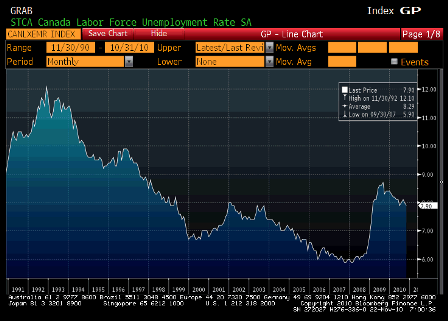
Canadian success story…

Doesn’t look like Canada was all that immune from the crisis to me?

Ok, their banks didn’t fail or need data transfered from one account at the Bank of Canada to another to keep them open for business.

So what? Look what happened to unemployment- real life for real people.

And it’s still a good 2% higher than it was only a couple of years or so ago.

And we are in a resource boom.

Yes, unemployment benefits are said to be generous, so out of work people maybe don’t suffer as much financially as in other places. But taking them at their word, and if history is any guide, they would take a job at reasonable pay and produce useful output if there were jobs available.

Yes, their federal budget deficit remains too small/ unemployment too high.
And they aspire to sustaining a federal budget surplus and high net export revenues, which, if successful, means reduced real terms of trade and a standard of living lower than otherwise.

My proposal- offer a national service job to anyone willing and able to work that pays a bit more than unemployment, and then cut taxes or increase public spending (depending on politics/needs) until that pool of labor in that national service job gets down to maybe 3% of the labor force, which will also coincide with a pretty good measure of what the current full employment deficit is.