Beware of ‘Debt Bomb’ and $70-$80 crude : Prince Alwaleed

So how would the fact that even the world’s largest investors don’t even begin to understand the monetary system
fit into the various theories about markets efficiently allocating capital, etc?

And note that he also did just say on CNBC the Saudi’s objective is $70-80 for crude.
So even though he’s probably not the decision maker, seems he does understand how a monopolist sets price.

Raise Ceiling but Beware of ‘Debt Bomb’: Prince Alwaleed

By Jeff Cox

May 20 (CNBC) &#8212 Saudi Prince Alwaleed bin Talal called on US lawmakers to raise the debt ceiling, while also warning that steps must be taken to control government spending.

The renowned investor and philanthropist, and nephew of King Abdullah, also rejected the notion that the US could delay payments on its bonds for several days as has been suggested by Rep. Paul Ryan and hedge fund manager Stanley Druckenmiller.

“We in the outside world, outside the United States, believe the United States is not giving much care and attention to this time bomb that you have right now here,” bin Talal said in a CNBC interview.

“You need some structural changes in the United States,” he added. “You can’t go forever with $1 trillion in arrears. That’s the thing.”

Germany- falling deficit and slowing growth

I agree, without private sector credit expansion (falling nominal savings rate) or rising exports these two go together over time:

German Economic Growth Will Likely Slow, Finance Ministry Says

By Brian Parkin

May 19 (Bloomberg) &#8212 The pace of Germany’s economic growth will probably slow by mid-year after jumping 1.5 percent in the first quarter, the Finance Ministry said in its monthly report. Economic growth “may be somewhat slower during the rest of the year,” the ministry said. While business confidence has declined, “it remains at a high level” and unemployment, at a 19-year low last month, will continue to profit from growing domestic demand, the ministry said. Germany’s Economy Ministry sees growth of 2.6 percent this year. Tax revenue for the federal government and states jumped 8.9 percent in the first quarter compared with last year, led by sales tax, the ministry said. Federal and state tax revenue in April grew 3.4 percent compared with a year ago, it said.

Bundesbank Says German Deficit May Fall Below 2% This Year

Brian Parkin and Jana Randow

May 20 (Bloomberg) &#8212 Tax revenue growth and spending cuts will probably help German Chancellor Angela Merkel’s government push down the budget deficit, setting an example for fiscal discipline in Europe, the Bundesbank said.

Germany’s budget shortfall could drop below 2 percent of gross domestic product this year, the Frankfurt-based central bank said in its monthly report published today.

“This notably mirrors a clear structural improvement, although the ongoing cyclical recovery is also making an important contribution,” the Bundesbank said.

The German government may be able to cut its spending gap to some 30 billion euros ($43 billion) from the 48 billion euros in the budget, the Bundesbank said. New tax forecasts that show revenue soaring over earlier estimates through 2014 may further help to push down the federal deficit beyond 2011, it said.

“A federal deficit of 30 billion euros seems achievable” this year, the Bundesbank said. “In subsequent years, this improved situation will be perpetuated,” boosting the chances of the government adhering to its target of balancing the federal budget by 2015, it said.

Poll: Public opposed to raising debt ceiling

Poll: Public opposed to raising debt ceiling

By Jordan Fabian

May 13 — The public remains opposed to raising the nation’s debt ceiling as lawmakers struggle to develop a plan to hike the legal borrowing limit, a new poll released Friday shows.

Forty-seven percent say they don’t want their member of Congress to vote to raise the limit, compared to 19 percent who do. Thirty-four percent say they don’t know enough to say, according to a Gallup poll.

Philadelphia Fed survey, existing home sales, leading indicators all disappoint

Typical street review of today’s numbers from Goldman.

As suspected, look for continued downward revisions to initial 4% Q2 estimates.

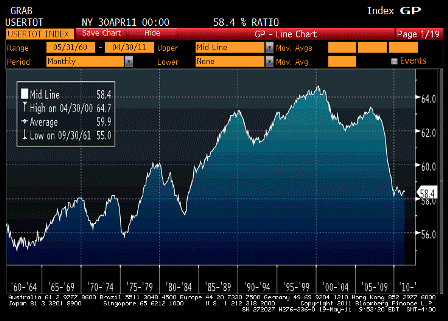
And note the graph below showing employment as a % of the population.
The economy continues to be demand constrained at very low levels.
(That is, for the size govt we have, we are grossly over taxed.)

There could be as many as 30 million additional people gainfully employed in a good economy.
And a general prosperity far beyond what anyone might imagine.

But not to be with Congress, mistakenly fearful of the US facing a financial crisis like Greece,
moving forward with their death by 1000 cuts agenda.

USA: Philadelphia Fed Survey – Another Decline

Actual: 3.9
Previous: 18.5
Consensus: 20.0
Released: 19 May 2011 at 10:00 (New York time)

Another Decline
BOTTOM LINE: More signs of slower growth from the Philly Fed index and existing home sales.

US-MAP
Existing home sales -2 (2, -1)
Philadelphia Fed index -12 (4, -3)

KEY NUMBERS:
Existing home sales -0.8% in Apr (mom) vs. GS +2.0%, median forecast +2.0%.
Philadelphia Fed index +3.9 in May vs. GS +22.0, median forecast +20.0.
Leading indicators -0.3% in Apr (mom) vs. median forecast +0.1%.

MAIN POINTS:
1. The Philadelphia Fed’s monthly manufacturing survey weakened sharply for the second month in a row. The headline index of “general business activity” fell to 3.9, from 18.5 in April and 43.4 in March. This still suggests factory sector growth, but only barely. Most of the detailed activity indexes also weakened – the new orders index fell to 5.4 from 18.8, the shipments index to 6.5 from 29.1, and the unfilled orders index to -7.8 from 12.9 – with the exception of employment, which rose to 22.1 from 12.3 in April. (We have no information on how much of the drop in the Philly survey over the past two months could have been related to supply chain issues associated with the Japanese earthquake, but this is not a region with an especially high concentration of vehicle manufacturing.) Price pressures eased a little but remain high in historical terms.

2. Existing home sales declined by 0.8% mom in April to an annualized rate of 5.05 million units. Consensus forecasts had expected a moderate increase. Home sales dropped in three of the four Census regions during the month, with the largest declines in the Northeast. The number of homes currently offered for sales was about unchanged after seasonal adjustment, at about 3.7 million units (the months supply of homes increased, but this was likely due to seasonal variation). The median sales price of existing homes increased by about 0.5% mom on a seasonally-adjusted basis-an encouraging turn after several months of weakness. Existing home sales prices are down 5% year-over-year.

3. Rounding out the weaker-than-expected data, the index of leading economic indicators fell by 0.3% mom in April. The consensus had expected a 0.1% increase.

Warren’s latest presentation

Attached is a copy of a presentation that Warren delivered yesterday in Montreal.

We were extremely well received and Warren was a huge hit, mixing a concoction of high dose monetary economic realities with real life experiences and anecdotes from his long and lustrous career as a market wizard. The presentation was scheduled for 45 minutes but turned into 1hr20 minutes including Q&A.

Presentation link here.

U.S. May Assess National Security Risk of Debt to China

I suspect China knows all this and is playing us for complete fools.

From Bill Black:

I’m sorry, but this passes even my ability — while in Ireland — to apply Irish humor and simply chuckle at such surpassing stupidity. Seriously, the Chairman of House Armed Services — faced with all the real threats to security (plus all the frenzied fears that beset national security considerations and all the stupid wars we wage) — decides that what he wants to talk about and legislate against is the mythical national security threat posed by China giving us lots of goods in return for small portraits of dead politicians printed on increasingly garish paper (or, more commonly, electromagnetic bits of data). Does he think the PRC has embedded nanotechnology nukes in the crud they sell to WallMart? That concern would at least be a form of paranoia we are familiar with and could treat. Reporters have to start asking for comments on these ravings. Printing them without any analysis or alternative views by someone who is qualified to explain why this claim is equivalent to my poor Aunt who believed that the dentist, on behalf of the CIA, bugged her tooth creates “moral panics” and disastrous policies. (For an example of hucksters deliberately generating “moral panics” listen to: “The Music Man” song about “Trouble in River City”).

U.S. May Assess National Security Risk of Debt to China

By Roxana Tiron

May 25 (Bloomberg) — A senior U.S. House lawmaker is pressing top military and intelligence officials to formally assess the national security risks posed by the U.S. debt owed to China.

The chairman of the U.S. House Armed Services Committee, Representative Howard P. “Buck” McKeon, a California Republican, is asking the Congressional Budget Office to determine and make public the total amount of accrued interest the U.S. has paid China over the last five years on federal debt. Once that is complete, the U.S. defense leaders must assess the national security risks, according to his draft legislation.

McKeon’s request comes as his committee this week is writing the 2012 defense authorization bill, which sets military policy and funding targets for the fiscal year starting Oct. 1. The U.S. and China today will wrap up a two-day strategic and economic dialog in Washington.

“This year’s annual defense authorization bill will help Congress truly understand how much leverage China might have over the United States because of our debt, as well as the national security implications associated with the federal government’s out-of-control spending,” McKeon said in an e-mail statement.

Washington Talks

The chief of the general staff for the Chinese People’s Liberation Army will visit the U.S. May 15-22, as the Obama administration seeks to improve military ties with China to match economic and political contacts. General Chen Bingde will tour U.S. military bases and hold talks with his American counterpart, Navy Admiral Mike Mullen, the chairman of the Joint Chiefs of Staff. It will be the first visit of a PLA chief to the U.S. since 2004, according to Mullen’s spokesman, Navy Captain John Kirby.

Mullen has repeatedly said that the U.S. debt is a national security issue.

Part of the national security assessment, mandated in legislation written by McKeon, would be a “discussion of any options available to China for deterring United States military freedom of action in the Western Pacific as a result of its creditor status,” according to a draft of the legislation.

China held $1.15 trillion in Treasuries at the end of February, more than any other country. Vice Finance Minister Zhu Guangyao said on May 6 that China is paying “close attention” to U.S. efforts to reduce its budget deficit.

QE2: Captain, your ship is sinking

So imagine the corn crop report comes out and it surprises on the upside at up 30%
What happens? The price of corn probably starts to fall. Commercial buyers back off, farmers rush to hedge, and, overall, players of all ilks try to reduce positions, get short, etc.

A few weeks later it’s further confirmed that the farmers are producing a massive bumper crop.

What happens? The same adjustments continue.

But what if that crop report was wrong? What if, in actual fact, there had been a crop failure? And market participants never do get that information?

What happens? Prices go down for a while as described above, but at some point they reverse, as sellers dry up, and as consumption overtakes actual supply price work their way higher, and then accelerate higher, even if no one ever actually figures out there was a crop failure.

QE is, in fact, a ‘crop failure’ for the dollar. The Fed’s shifting of securities out of the economy and replacing them with clearing balances removes interest income. And the lower rates from Fed policy also reduces interest paid to the economy by the US Treasury, which is a net payer of interest.

But the global markets mistakenly believed QE was producing a bumper crop for the dollar. They all believed, and some to the of panic, that the Fed was ‘printing money’ and flooding the world with dollars.

So what happened? The tripped overthemselves to rid them selves of dollars in every possible manner. Buying gold, silver, and the other commodities, buying stocks, selling dollars for most every other currency, selling tsy securities, etc. etc. etc. in what was, in most ways, all the same trade.

This went on for months, continually reinforced by the pervasive rhetoric that QE was ‘money printing’, and that the Fed was playing with fire and risking hyperinflation, with the US on the verge of suddenly/instantly becoming the next Greece and getting its funding cut off.

Not to mention Congress with it’s deficit reduction phobia.

So what’s happening now? While everyone still believes QE is a bumper crop phenomena, QE (and 0 rate policy in general) is none the less an ongoing crop failure, continuously removing $US net financial assets from the economy.

And so now that the speculators and portfolio shifters have run up prices of all they tripped over each other to buy, the anticipated growth in spending power-underlying aggregate demand growth needed to support those prices- isn’t there. And, to throw more water on the fire, the higher prices triggered supply side repsonse that have increased net supply along with a bit of ‘demand destruction’ as well.

Last week I suggested that higher crude prices were the last thing holding down the dollar, and that as crude started to fall I suggested its was all starting to reverse.

It’s now looking like it’s underway in earnest.

Australia’s Budget Will Make ‘Substantial’ Savings, Swan Says

The names of the nations change but the out of paradigm values are universal:

Australia’s Budget Will Make ‘Substantial’ Savings, Swan Says

By Gemma Daley

May 8 (Bloomberg) — Australia’s budget will make “substantial” savings after revenue was crimped by a record exchange rate, the nation’s costliest natural disasters and Japan’s earthquake, Treasurer Wayne Swan said.

Swan, who delivers the budget to Parliament tomorrow, said yesterday the deficit in the government’s finances will widen in the fiscal year ending June 30 before increased mining revenue and an improving economy help bring about a surplus in 2012-13.

Prime Minister Julia Gillard’s administration has revealed the budget will tighten welfare payments to get people back into the workforce and cut 1,000 jobs in the civilian defense industry in the next three years. The government also aims to stop high-income earners receiving a subsidy for having private health insurance.

MMT presentation in Ireland

MMT Conference

MMT will inform a number of economic policies to be presented and debated in a conference entitled “Lessons from the Crisis: Money, Taxes and Saving in a Changing World” co-hosted by Smart Taxes, (Fiscal Policy for Sustainability Network) and TASC (Think Tank for Action on Social Change) on the 9th May 2011 at Croke Park, Dublin. There will be a public lecture at 6pm in the Westwood House Hotel in Galway at 6pm on Wednesday 11th May.

Galbraith on federal debt sustainability

Is The Federal Debt Unsustainable?

By Professor James K. Galbraith

Excerpt

A more prosaic problem with the runaway-inflation scenario is that the “nonpartisan, professional” economic forecasters of the Congressional Budget Office (CBO), whose work is often cited as the benchmark proof of an “unsustainable path,” do not expect it to happen. The CBO baseline resolutely asserts that inflation will stay where it is now: around 2 percent. So one can’t logically cite the inflation threat and the CBO baseline at the same time. So far as I know, the CBO does not trouble itself to model the exchange value of the dollar.

What the CBO does warn is that, under their assumptions, the ratio of US federal debt (held by the public) to GDP will rise relentlessly, passing 200 percent by 2035 and 300 percent by midcentury. Correspondingly, net interest payments on that debt would rise to exceed 20 percent of GDP. This certainly seems worrisome, and the CBO warns about “investor confidence” and “crowding out” without actually building these things into their model. Indeed, in their model this remarkable and unprecedented ratio of debt to GDP goes right along with steady growth, full employment, and low inflation, world without end! Why one should care about mere financial ratios if they produce such good—and, according to the CBO model— “sustainable” results is another mystery the CBO does not explain.