
FT: Bank Struggles to gauge if QE is taking effect


[Skip to the end]

>   
>   On Thu, Aug 20, 2009 at 4:11 AM, Marshall wrote:
>   
>   Maybe the BofE is having problems because it is looking at this through the wrong
>   monetary paradigm. All QE is doing is switching one form of debt term structure
>   for another, not actually contributing to aggregate demand. If they figured that
>   out, they wouldn’t be “struggling” here.
>   

True, hopefully this is what it takes, globally, to finally recognize with a non convertible currency the direction of causation is from loans to deposits and reserves, and that at the macro level banking is in no case reserve constrained, for all practical purposes.

And from there it hopefully follows that govt. spending is in no case inherently revenue constrained. But I suppose that could take another hundred years at the current pace of discovery.

>   >   
>   >   I would make it even simpler. QE per se does NOTHING to contribute to aggregate
>   >   demand and should therefore be stopped and replaced by fiscal policy which does
>   >   contribute to aggregate demand. Ironically, the last BOE minutes showed King
>   >   voted for increasing QE purchases beyond what most other MPC members were
>   >   prepared to support, yet this is the same guy who has railed against the
>   >   government’s “excessive” spending.
>   >   
>   >   But, you’re right. At the current pace of discovery, we might not get there until
>   >   our grandchildren are 6 feet under.
>   >   

Bank struggles to gauge if QE is taking effect

By Norma Cohen

August 20 (FT) — The Bank of England’s monetary policy committee appears united in the conviction that its unconventional approach to boosting Britain’s economy has -further to run.

But by how much, for how longand, crucially, knowing when enough is enoughare much thornier questions, judging by the debate revealed in the minutes of its latest meeting this month.

After the Bank announced its surprise move to increase the gilts purchase programme to £175bn – raising the authorised amount by a further £25bn – most analysts chalked it up as an “insurance” measure, an added fillip just in case the massive cash injections to date fell short of what was needed.

But now it emerges that the MPC is deeply concerned about whether the nascent recovery suggested by a range of recent economic indicators is sustainable – particularly since there is little evidence that the £125bn spent between March and the end of July has delivered additional lending.

“The aim of the MPC’s programme of asset purchases was to boost nominal spending to ensure that it was consistent with meeting the inflation target in the medium term,” the minutes noted. That is another way of saying that the MPC wants to offset the collapse in demand by making money cheaply and easily available, hoping that households and businesses will spend it and ward off a deflationary spiral.

Yes, not realizing funding is always easily available to the banking system at the policy rate.

However, just how the gilts purchases would achieve that is the subject of much debate. Judging the efficacy of the programme is equally problematic. After all, the MPC is engaged in a policy untested in the UK, or indeed in almost any other developed economy.

By one key measure, there is little sign that the purchases, known as quantitative easing, are having any effect. There is little sign that the M4 money supply – the broadest measure of money flowing through the economy – is expanding.

Brian Hilliard, an economist at Société Générale, said that in theory QE ought to be effective. “If you are a monetarist, a deficiency of nominal spending can be righted by injecting a given sum,” he said. Through various channels, that money should work its way through the economy and help boost demand for goods and services.

If anyone knows him, please send this along. There are no ‘various channels.’

The minutes note that an expansion in money supply would help the MPC determine when or whether QE was working. However, the committee acknowledges that there is “unlikely to be a simple, straightforward mapping between asset purchases, monetary growth and nominal spending”. That may be one way of explaining the fact that, despite huge cash injections, M4 showed only insipid growth between the first and second quarters of 2009.

Not true either. That can come from increased borrowing due to govt. deficit spending, technical shifts in liabilities, and other things unrelated to QE.

Michael Saunders, an economist at Citigroup, noted the reference in the minutes to a pick-up in broad money growth in the second quarter – to a 3.7 per cent annualised rate from a 3.3 per cent rate in the first quarter. The growth, he said, amounted to a quarterly expansion in M4 of roughly £1.8bn. “So £125bn of QE has caused broad money growth to accelerate by £1.8bn. That’s a pretty poor rate of return,” he argued.

He could use an email as well.

It didn’t even cause that. And it’s not a ‘rate of return’ because it isn’t an investment.

Equally, it is not clear how the MPC is deciding how much money it should inject into the economy. In the minutes of its March meeting, the MPC estimated that since the UK’s output gap – the shortfall between what the economy could produce and what it is actually producing – was about 5 per cent of gross domestic product, an equivalent amount should be injected through QE. In round numbers, that amounted to £75bn, the sum initially authorised.

As if there was some channel for that to actually happen.

One disclosure that emerges from the minutes of this month’s meeting is that the MPC has abandoned that numerical equation. There is no discussion within them on how to judge the additional sums needed for QE. The impact of a cash injection of £175bn, compared with the £200bn favoured by Mr King, is not spelt out.

Mr. King needs this emailed to him as well. He seems further off the mark than any of the others.

There is general agreement that looking at money supply alone to gauge the success of QE may produce too narrow a perspective. A recent analysis of the Bank’s QE programme by the International Monetary Fund concluded that, by many measures, it was having beneficial effects, but it also noted that there was uncertainty on how to judge such success.

“The significant uncertainty surrounding the transmission of QE – explicitly acknowledged by the MPC – would seem to caution against relying too much on any such numerical assumptions,” the IMF concluded.

And another email to the IMF, thanks!

Bernanke seems to at least recognize that the channel of consequence is the adjustment of long term interest rates, and not the quantity of reserves, though the FOMC hesitates to fully go there by setting a target term structure of rates and letting the quantity of reserves adjust.


[top]
ECB statements


[Skip to the end]

ECB’s Stark Says Economy May Recover Sooner Than Forecast

Stark Says State Debt May Boost Long-Term Market Rates, BZ Says

*ECB’S STARK SEES `NO BIG PROBLEMS’ UNWINDING ASSET PURCHASES

*ECB’S STARK COMMENTS IN INTERVIEW WITH BOERSEN-ZEITUNG

*ECB’S STARK SAYS RISING GOVT DEBT MAY BOOST LONG-TERM MKT RATES

*STARK SAYS ECB CONSIDERS RISK OF DEFLATION `VERY SMALL’

*ECB’S STARK SAYS MUST NOT OVERESTIMATE SIZE OF OUTPUT GAP

Higher levels of unemployment will be needed for long term price stability

*ECB’S STARK SAYS POTENTIAL GROWTH RATE HAS PROBABLY DECLINED

Higher levels of unemployment will be needed for price stability

*ECB’S STARK SAYS OUTPUT GAP MAY BE SMALLER THAN SOME THINK

Higher levels of unemployment will be needed for price stability.

*ECB’S STARK SAYS MUST BE CAUTIOUS ABOUT INFLATION OUTLOOK

*STARK: STIMULUS, INVENTORIES WON’T CREATE SUSTAINABLE GROWTH

*ECB’S STARK SAYS ECONOMY MAY RESUME GROWTH SOONER THAN EXPECTED

*ECB’S STARK SEES SIGNS ECONOMY IS STABILIZING

*ECB’S STARK SAYS RATES ARE `APPROPRIATE’


Karim writes:

Stark is also engaging in classic Fed bashing; knowing full-well that the output gap is the key driver of the Fed’s inflation model while the ECB looks at a broader series of measures and places much more emphasis on monetary aggregates


[top]

Trade/FOMC Preview/China Exports/Stimulus hangups


[Skip to the end]


Karim writes:

Trade: Exports up 2%, Imports up 2.3%. Imports ex-petroleum down 1% and consumer goods imports down 4.8%. Sector strength mainly in industrial goods (restocking), but indicators of final demand still look weak.

Don’t look for dramatic changes to FOMC statement; major focus will be on Treasury purchase language.

1) Econ assessment will turn slightly more positive; May mention signs of a nascent recovery, though underlying demand likely to remain weak for the foreseeable future. Inflation will remain subdued.

2) Exceptionally low FF rate for an ‘extended period’ will remain. I’d expect this phrase to be dropped about 3-4mths before they’d actually hike, with the first move possibly being a hike in the rate they pay banks on excess reserves.

3) Likely to indicate that Treasury purchases will not continue once the $300bn level has been reached, though they may restart the program in the future if needed. Language on other credit easing programs to stay intact.

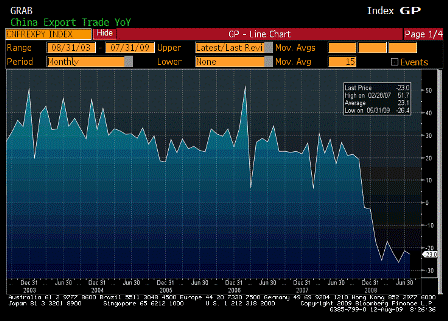
China’s export model showing little bounce (latest data last night)

Some hangups with the stimulus package (courtesy of American General Contractors):

“President Barack Obama’s stimulus spending has run into a problem: A shortage of General Electric Co. water filters,” Bloomberg News reported on Thursday. “GE makes them in Canada. Under the program’s ‘Buy American’ rules, that means the filters can’t be used for work paid for by the $787 billion fund. Contractors are searching the U.S. in vain for filters as well as bolts and manhole covers needed to build wastewater plants, sewers and water pipes financed by the economic stimulus. As officials wait for federal waivers to buy those goods outside the U.S., water projects from Maine to Kansas have been delayed….the Environmental Protection Agency, which administers the water funding, has granted six waivers and has 29 petitions pending….The rules affect water projects most because highways and bridges have been constructed under Buy American regulations for the past 30 years, and not much stimulus money has been spent so far on public housing and schools, said Chris Braddock, the U.S. Chamber of Commerce’s associate director for procurement.”

“Gun-shy [school] administrators might undermine a federal stimulus program that encourages school construction by helping districts pay down debt,” the (Wisconsin) Daily Reporter reported on Monday. “Some district leaders say they gladly are accepting a piece of $125 million in no-interest bonds but are reluctant to invest the savings in new projects. ‘The climate out there is terrible and with the cuts made in the state budget, it’s just really difficult right now,’ said John Whalen, president of the Sun Prairie Area School District Board of Education. ‘I don’t anticipate this will encourage us to do more projects,’ he added. The district received $23 million in federal bonding, more than any other district in the state, though the bonding did not encourage additional construction. Sun Prairie used it to help pay off the $30 million it put on taxpayers for construction of a new high school and conversion of the old high school into a middle school. Both schools are scheduled to open in fall 2010. While Sun Prairie stands pat, other districts might jump at the opportunity. The School District of La Crosse received $6.6 million in bonds to help pay off debt from $18.5 million in expansion, renovation and upgrade projects.”


[top]

Social Security commentary published


[Skip to the end]

Social Security: Another Case of Innocent Fraud?

By Mathew Forstater and Warren Mosler

August 6th — In his recent book, The Economics of Innocent Fraud, John Kenneth Galbraith surveys a number of false beliefs that are being perpetuated among the American people about how our society operates: innocent (and sometimes not-so-innocent) frauds. There is perhaps no greater fraud being committed presently—and none in which the stakes are so high—as the fraud being perpetrated regarding government insolvency and Social Security. President Bush uses the word “bankruptcy” continuously. And the opposition agrees there is a solvency issue, questioning only what to do about it.
Fortunately, there is a powerful voice on our side that takes exception to the notion of government insolvency, and that is none other than the Chairman of the Federal Reserve. The following is from a transcript of a recent interview with Fed Chairman Alan Greenspan:

    RYAN… do you believe that personal retirement accounts can help us achieve solvency for the system and make those future retiree benefits more secure?

    GREENSPAN: Well, I wouldn’t say that the pay-as-you-go benefits are insecure, in the sense that there’s nothing to prevent the federal government from creating as much money as it wants and paying it to somebody. The question is, how do you set up a system which assures that the real assets are created
    which those benefits are employed to purchase. (emphasis added)

For a long time we have been saying there is no solvency issue (see C-FEPS Policy Note 99/02 and the other papers cited in the bibliography at the end of this report). Now with the support of the Fed Chairman, maybe we can gain some traction.

Let us briefly review, operationally, government spending and taxing. When government spends it credits member bank accounts. For example, imagine you turn on your computer, log in to your bank account, and see a balance of $1,000 while waiting for your $1,000 Social Security payment to hit. Suddenly the $1,000 changes to $2,000. What did the government do to make that payment? It did not hammer a gold coin into a wire connected to your account. It did not somehow take someone’s taxes and give them to you. All it did was change a number on a computer screen. This process is operationally independent of, and not operationally constrained by, tax collections or borrowing.

That is what Chairman Greenspan was telling us: constraints on government payment can only be self-imposed.

And what happens when government taxes? If your computer showed a $2,000 balance, and you sent a check for $1,000 to the government for your tax payment, your balance would soon change to $1,000. That is all—the government changed your number downward. It did not “get” anything from you. Nothing jumped out of the government computer into a box to be spent later. Yes, they “account” for it by putting information in an account they may call a “trust fund,” but this is “accounting”—after the fact record-keeping—and has no operational impact on government’s ability to later credit any account (i.e., spend!).

Ever wonder what happens if you pay your taxes in actual=2 0cash? The government shreds it. What if you lend to the government via buying its bonds with actual cash? Yes, the government shreds the cash. Obviously, the government doesn’t actually need your “funds” per se for further operational purpose.

Put another way, Congress ALWAYS can decide to make Social Security payments, previous taxing or spending not withstanding, and, operationally, the Fed can ALWAYS process whatever payments Congress makes. This process is not revenue constrained. Operationally, collecting taxes or borrowing has no operational connection to spending. Solvency is not an issue. Involuntary government bankruptcy has no application whatsoever! Yet “everyone” agrees—in all innocence—that there is a solvency problem, and that it is just a matter of when. Everyone, that is, except us and Chairman Greenspan, and hopefully now you, the reader, as well!

So if solvency is a non-issue, what are the issues? Inflation, for one. Perhaps future spending will drive up future prices. Fine! How much? What are the projections? No one has even attempted this exercise. Well, it is about time they did, so decisions can be made on the relevant facts.

The other issue is how much GDP we want seniors to consume. If we want them to consume more, we can award them larger checks, and vice versa. And we can do this in any year. Yes, it is that simple. It is purely a political question and not one of “finance.”

If we do want seniors to participate in the future profitability of corporate America, one option (currently not on the table) is to simply index their future Social Security checks to the stock market or any other indicator we select—such as worker productivity or inflation, whatever that might mean.

Remember, the government imposes a 30% corporate income tax, which is at least as good as owning 30% of all the equity, and has at least that same present value. If the government wants to take a larger or smaller bite from corporate profits, all it has to do is alter that tax—it has the direct pipe. After all, equity is nothing more than a share of corporate profits. Indexation would give the same results as private accounts, without all the transactional expense and disruption.

Now on to the alleged “deficit issue” of the private accounts plan. The answer first—it’s a non-issue. Note that the obligation to pay Social Security benefits is functionally very much the same as having a government bond outstanding—it is a government promise to make future payments. So when the plan is enacted the reduction of future government payments is substantially offset” by future government payments via the new bonds issued. And the funds to buy those new bonds come (indirectly) from the reductions in the Social Security tax payments—to the penny. The process is circular. Think of it this way. You get a $100 reduction of your Social Security tax payment. You buy $100 of equities. The person who sold the equities to you has your $100 and buys the new government bonds. The government has new bonds outstanding to him or her, but reduced Social Security obligations to you with a present value of about $100. Bottom line: not much has changed. One person has used his or her $100 Social Security tax savings to buy equities and has given up about $100 worth of future Social Security benefits (some might argue how much more or less than $100 is given up, but the point remains). The other person sold the equity and used that $100 to buy the new government bonds. Again, very little has changed at the macro level. Close analysis of the “pieces” reveals this program is nothing but a “wheel spin.”

Never has so much been said by so many about a non-issue. It is a clear case of “innocent fraud.” And what has been left out? Back to Chairman Greenspan’s interview—what are we doing about increasing future output? Certainly nothing in the proposed private account plan. So if we are going to take real action, that is the area of attack. Make s ure we do what we can to make the real investments necessary for tomorrow’s needs, and the first place to start for very long term real gains is education. Our kids will need the smarts when the time comes to deal with the problems at hand.

References

•Galbraith, John Kenneth, 2004, The Economics of Innocent Fraud: Truth for Our Time, Boston: Houghton Mifflin.

•Wray, L. Randall, 1999, “Subway Tokens and Social Security,” C-FEPS Policy Note 99/02, Kansas City, MO: Center for Full Employment and Price Stability, January, (http://www.cfeps.org/pubs/pn/pn9902.html).

•Wray, L. Randall, 2000, “Social Security: Long-Term Financing and Reform,” C-FEPS Working Paper No. 11, Kansas City, MO: Center for Full Employment and Price Stability, August, (http://www.cfeps.org/pubs/wp/wp11.html).

•Wray, L. Randall and Stephanie Bell, 2000, “Financial Aspects of the Social Security ‘Problem’,” C-FEPS Working Paper No. 5, Kansas City, MO: Center for Full Employment and Price Stability, January, (ht tp://www.cfeps.org/pubs/wp/wp5.html).


[top]

NY FED – Shadow Financial Market


[Skip to the end]

The findings add support to my proposal to ban banks from all secondary markets

Federal Reserve Bank of New York
Staff Reports
The Shadow Banking System:
Implications for Financial Regulation
Tobias Adrian
Hyun Song Shin
Staff Report no. 382
July 2009

This paper presents preliminary findings and is being distributed to economists and other interested readers solely to stimulate discussion and elicit comments. The views expressed in the paper are those of the authors and are not necessarily reflective of views at the Federal Reserve Bank of New York or the Federal Reserve System. Any errors or omissions are the responsibility of the authors.

The Shadow Banking System: Implications for Financial Regulation
Tobias Adrian and Hyun Song Shin
Federal Reserve Bank of New York Staff Reports, no. 382
July 2009
JEL classification: G28, G18, K20

Abstract
The current financial crisis has highlighted the growing importance of the “shadow banking system,” which grew out of the securitization of assets and the integration of banking with capital market developments. This trend has been most pronounced in the United States, but it has had a profound influence on the global financial system. In a market-based financial system, banking and capital market developments are inseparable: Funding conditions are closely tied to fluctuations in the leverage of market-based financial intermediaries. Growth in the balance sheets of these intermediaries provides a sense of the availability of credit, while contractions of their balance sheets have tended to precede the onset of financial crises. Securitization was intended as a way to transfer credit risk to those better able to absorb losses, but instead it increased the fragility of the entire financial system by allowing banks and other intermediaries to “leverage up” by buying one another’s securities. In the new, post-crisis financial system, the role of securitization will likely be held in check by more stringent financial regulation and by the recognition that it is important to prevent excessive leverage and maturity mismatch, both of which can undermine financial stability.


[top]

TIPS 5 year 5 years fwd

This used to be one of the Fed’s major concerns as they are steeped in inflation expectations theory.

It could still signal a need to keep a modestly positive ‘real rate’ though the large ‘output gap’ is telling them otherwise.

History says they’ll put most of the weight on the output gap, though a negative real rate is problematic for most FOMC members.

Should core inflation measures go negative, they will be a lot more comfortable with the current zero rate policy.

Interesting that the employment cost was just reported up 1.8% which shows how little it went down even in the face of
a massive rise in unemployment.

Excellent NY Fed staff report on qantitative easing


[Skip to the end]

This should be more than enough to dismiss concerns of reserves influencing lending, apart from price.

Hope they do a full public relations effort on this.

A touch weak on fully dismissing the ‘money multiplier’ but certainly 99% ‘there:’

NY Fed Staff report:

“The general idea here should be clear: while an individual bank may be able to decrease the level of reserves it holds by lending to firms and/or households, the same is not true of the banking system as a whole. No matter how many times the funds are lent out by the banks, used for purchases, etc., total reserves in the banking system do not change. The quantity of reserves is determined almost entirely by the central bank’s actions, and in no way reflect the lending behavior of banks.”


[top]

Bernanke Feared a Second Great Depression – WSJ.com


[Skip to the end]

The great depression was the last US gold standard depression.

A gold standard is fixed exchange rate policy characterized by a continuous constraint on the supply side of the currency.

Interest rates are endogenous, and even the treasury must first borrow before it can deficit spend, and in doing so compete with other borrowers for funds from potential lenders who have the option to convert their currency into gold. Therefore interest rates always represent indifference rates between holding securities and holding the gold.

With non convertible currency the central bank is left to set interest rates as holders of the currency no longer have the option to convert the currency into gold. Without conversion rights, there are no supply side constraints on credit expansion, and government can therefore offer the credible deposit insurance necessary to sustain the functioning of the payments system.
Bernanke failed to recognize this and therefore saw systemic risks that weren’t there, and also failed to act in line with the tools available to the Fed that would not have been available under the previous gold standard. The most obvious is unsecured lending to member banks, as I have been proposing for a number of years.

With today’s non convertible currency and floating exchange rate policy the fiscal ‘automatic stabilizers’ functioned as they always have during previous recessions, and as the deficit got above 5% of GDP at year end it was enough to reverse the downward spiral and turn things around.

This could not have happened under a gold standard. Before the deficit got anywhere near that large it would have driven up interest rates at an accelerating pace and the gold while the national gold reserves were being rapidly depleted.

We’ve seen this happen most recently with Argentina in 2001 and Russia in 1998 where similar fixed exchange rate regimes had similar outcomes.

We’ve also seen failures of logic regarding how the FDIC handled banking system stresses. The FDIC can simply ‘take over’ any bank it deems insolvent, and then decide whether to continue operations, sell off the assets, replace management, etc. This can be done and has been done in an orderly manner without ‘business interruption.’

The alternative in this cycle- having the treasury ‘add capital’- in my opinion was a major error for a variety of reasons.

When a bank loses capital, there is then less private capital left to lose before the FDIC starts taking losses. When the treasury buys capital in the banks, the amount of private capital remains the same. All that changes is that should subsequent losses exceed the remaining private capital, the treasury rather than the FDIC takes the loss. For all practical purposes both are government agencies, so for all practical purposes this changes nothing regarding risk to government. The FDIC could have just as easily accomplished the same thing by allowing the banks in question to continue to operate but under the same terms and conditions set by the treasury (not that those would have been my terms and conditions).

Instead, substantial political capital was burned and numerous accounting issues and interagency issues confused and distorted including ‘adding to the federal deficit’ when there was nothing that altered aggregate demand.

We have paid a high price for financial leaders being completely out of paradigm and in this way over their heads.

Bernanke Feared a Second Great Depression

By Sudeep Reddy

July 27 (WSJ) — Federal Reserve Chairman Ben Bernanke on Sunday said he engineered the central bank’s controversial actions over the past year because “I was not going to be the Federal Reserve chairman who presided over the second Great Depression.”

Speaking directly to Americans in a forum to be shown on public television this week, Mr. Bernanke pushed back against Kansas City area residents who suggested he and other government officials were too eager to help big financial institutions before small businesses and common Americans.

“Why don’t we just let the behemoths lay down and then make room for the small businesses?” asked Janelle Sjue, who identified herself as a Kansas City mother.

“It wasn’t to help the big firms that we intervened,” Mr. Bernanke said, diving into a discourse on the damage to the overall economy that can result when financial firms that are “too big to fail” collapse.

“When the elephant falls down, all the grass gets crushed as well,” Mr. Bernanke said. He described himself as “disgusted” with the circumstances that led him to rescue a couple of large firms, and called for new laws that would allow financial firms other than banks to fail without going into bankruptcy.

Mr. Bernanke appeared stoic at times as he sought to explain his actions during the financial crisis at the town-hall-style meeting with 190 people at the Federal Reserve Bank of Kansas City hosted by the NewsHour’s Jim Lehrer. But he also joked with the crowd, saying “economic forecasting makes weather forecasting look like physics.” He quipped that he could face malpractice charges if he offered investment advice — although he then recommended that a questioner practice diversification and avoid trying to time the stock market.

The hourlong session was the latest unusual forum where the Fed chairman has explained his actions in recent months, including bailouts and massive lending. Mr. Bernanke appeared before the National Press Club in February, agreed to an interview with CBS’s “60 Minutes” in March and took questions on camera from Morehouse College students in April.

Sunday’s setting offered the former Princeton economics professor a chance to speak outside of congressional testimony and speeches to economists, as his tenure leading the central bank faces increasing scrutiny. With just six months left in his term as chairman, Mr. Bernanke will learn in the coming months whether President Barack Obama will reappoint him to another four-year term or replace him.

Mr. Bernanke repeatedly used the frustrations voiced by people in the room to show his limited options during the crisis and reiterate the need for a regulatory overhaul.

David Huston, who called himself a third-generation small-business owner, said he was “very frustrated” to see “billions and billions of dollars” sent to large financial firms and called the government approach “too big to fail, too small to save.”

“Small businesses represent the lifeblood of small cities, large cities and our American economy,” he said, and they are “getting shortchanged by the Federal Reserve, the Treasury Department and Congress.”

Mr. Bernanke responded that “nothing made me more frustrated, more angry, than having to intervene” when firms were “taking wild bets that had forced these companies close to bankruptcy.”

More than 20 people asked questions of the Fed chairman, on topics ranging from bailouts to mortgage-regulation practices to the Fed’s independence, a topic that drew the most forceful tone from the Fed chairman. Mr. Bernanke suggested that a movement by lawmakers to open the Fed’s monetary-policy operations to audits by the Government Accountability Office is misunderstood by the public.

Congress already can look at the Fed’s books and loans that could be at risk for taxpayers, he said. Under the proposed law, the GAO would also be able to subpoena information from Fed officials and make judgments about interest-rate decisions based on requests from Congress.

“I don’t think that’s consistent with independence,” he said. “I don’t think people want Congress making monetary policy.”

After appearing before lawmakers three times last week, Mr. Bernanke broke little new ground in explaining the state of the economy. He said the Fed’s expected economic growth rate of 1% in the second half of the year would fall short of what is needed to bring down unemployment, which he sees peaking sometime next year.

“The Federal Reserve has been putting the pedal to the metal,” he says. “We hope that’s going to get us going next year sometime.”


[top]

Grayson on Fed swap lines


[Skip to the end]

Grayson has this completely wrong. There was credit risk only for the unsecured lending.

There was no currency risk.

The swap lines are nothing more than unsecured dollar loans to the foreign CB’s.

Congress seems not capable of informed criticism.

And judging from the movement of the dollar since the swaps began, Grayson said, it looks like the U.S. could have taken a $100 billion dollar loss because the value of the foreign currency held by the U.S. depreciated in value by roughly one-fifth. Bernanke told Grayson that it was a “coincidence” that the dollar appreciated substantially after the half-trillion dollar swap project got underway in September. The Fed website maintains that the transactions are without risk because the exchange rates are locked in.

Link


[top]