FOMC Statement

Also note that long term forecasts continue to assume ‘appropriate monetary policy’

This means the forecasts contain the assumption that the Fed can hit it’s long term goals for inflation and unemployment by adjusting ‘monetary policy’

In other words, the presumption of being able to hit their targets means the longer term forecasts are nothing more than the their targets.

This is in contrast with non Fed forecasters, who attempt to forecast actual results, which while they do incorporate assumptions about monetary policy, do not necessarily assume those Fed policy adjustments will be successful.


Karim writes:

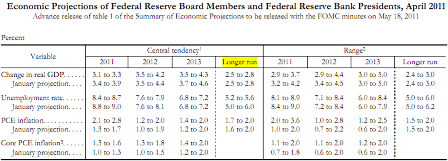
  • Mid-point of 2012 Core PCE forecast now 1.55%! Rates wont be 25bps in that event
  • 2011 GDP growth shaved lower by 0.3% (now 3.25%)
  • 2012 GDP growth lower by 0.1% (now 3.85%)
  • Unemployment rate lower by 0.35% in 2011 (now 8.55% by Q4) and lower by 0.1% next year (now 7.75%).

LAST STATEMENT (MARCH) AND FORECASTS (JANUARY)

Federal Reserve Press Release
Release Date: March 15, 2011
For immediate release

Information received since the Federal Open Market Committee met in January suggests that the economic recovery is on a firmer footing, and overall conditions in the labor market appear to be improving gradually. Household spending and business investment in equipment and software continue to expand. However, investment in nonresidential structures is still weak, and the housing sector continues to be depressed. Commodity prices have risen significantly since the summer, and concerns about global supplies of crude oil have contributed to a sharp run-up in oil prices in recent weeks. Nonetheless, longer-term inflation expectations have remained stable, and measures of underlying inflation have been subdued.

Consistent with its statutory mandate, the Committee seeks to foster maximum employment and price stability. Currently, the unemployment rate remains elevated, and measures of underlying inflation continue to be somewhat low, relative to levels that the Committee judges to be consistent, over the longer run, with its dual mandate. The recent increases in the prices of energy and other commodities are currently putting upward pressure on inflation. The Committee expects these effects to be transitory, but it will pay close attention to the evolution of inflation and inflation expectations. The Committee continues to anticipate a gradual return to higher levels of resource utilization in a context of price stability.

To promote a stronger pace of economic recovery and to help ensure that inflation, over time, is at levels consistent with its mandate, the Committee decided today to continue expanding its holdings of securities as announced in November. In particular, the Committee is maintaining its existing policy of reinvesting principal payments from its securities holdings and intends to purchase $600 billion of longer-term Treasury securities by the end of the second quarter of 2011. The Committee will regularly review the pace of its securities purchases and the overall size of the asset-purchase program in light of incoming information and will adjust the program as needed to best foster maximum employment and price stability.

The Committee will maintain the target range for the federal funds rate at 0 to 1/4 percent and continues to anticipate that economic conditions, including low rates of resource utilization, subdued inflation trends, and stable inflation expectations, are likely to warrant exceptionally low levels for the federal funds rate for an extended period.

The Committee will continue to monitor the economic outlook and financial developments and will employ its policy tools as necessary to support the economic recovery and to help ensure that inflation, over time, is at levels consistent with its mandate.

MBA’s index of loan requests for home purchases tumbled 13.6 percent

This is disturbing, along with still weak housing price indicators, and the ongoing downward revisions to GDP forecasts, as aggregate demand remains under international attack on all fronts.

On the govt side, China is cutting demand to fight inflation, with India and Brazil presumed to be doing same. Austerity measures continue to bite in the UK and the euro zone, and are looming in the US.

On the private credit expansion side, regulatory over reach continues to restrict lending by the US banking system, and particularly with the small banks. This limits both bank and non bank lending, as the non bank lending is most often at least indirectly dependent on bank lending.

Additionally, the rising costs of food and fuel are taking purchasing power from those with the higher propensities to consume and shifting it to those with far lower propensities to consume.

And, of course, ongoing QE continues to remove interest income from the economy, as does the shift of interest income from savers to bank and other lender net interest margins, in a process that has yet to reach the national debate as a point of discussion.

Other commodity prices also continue to rise as hoarding from pension funds and the like via passive commodity strategies continues to expand globally.

This sends price signals that increase supply, which means human beings are being mobilized to produce stockpiles of gold, silver, and other metals and commodities not to ever be used for real consumption, but to forever remain as ‘reserves’ to index financial performance as demanded by current institutional structures. This is a monumental waste of human endeavor as well as the real resources, including energy, that are committed to this process.

So at the macro level we are removing teachers from what have become over crowded classrooms, removing nurses from neglected patients, and removing workers from building, repairing, and maintaining our homes and other infrastructure, to send them to either the unemployment lines or the gold mines.

And because they think at any moment we can suddenly become the next Greece, both sides agree with the necessity and urgency of promoting this policy.

Mortgage Applications Fell Last Week: MBA

April 27 (Reuters) — Applications for U.S. home mortgages fell last week as higher insurance premiums for government-insured loans sapped demand, an industry group said Wednesday.

The Mortgage Bankers Association said its seasonally adjusted index of mortgage application activity, which includes both refinancing and home purchase demand, fell 5.6 percent in the week ended April 22.

“Purchase applications fell last week, driven primarily by a sharp decrease in government purchase applications as new, higher Federal Housing Administration premiums went into effect,” Michael Fratantoni, MBA’s vice president of research and economics, said in a statement.

The decline reverses a recent increase in government purchase applications, which was likely due to borrowers trying to beat the deadline, Fratantoni said.

The MBA’s seasonally adjusted index of loan requests for home purchases tumbled 13.6 percent, while the gauge of refinancing applications slipped 0.6 percent.

Fixed 30-year mortgage rates averaged 4.80 percent in the week, easing from 4.83 percent the week before.

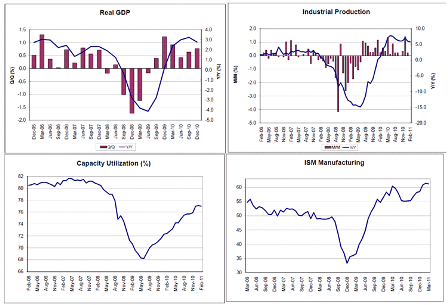
Charts that look like demand isn’t booming

Charts that Say Demand Isn’t Doing Much of Anything

Yes, there’s modest top line growth, but not a lot of evidence anything more than that is likely to happen any time soon, especially with global post earthquake issues, US fiscal cutbacks of at least $31 billion as a ‘down payment’ next week, Japan showing no inclination to rebuild without ‘paying for it’, UK austerity kicking in for real this month, continued tightening in the euro zone, and China still fighting inflation with spending and lending cuts.

Q1 GDP now forecast with a 2 handle, and manufacturing, though sort of strong, is only about 11% of GDP and considerable slack remains.

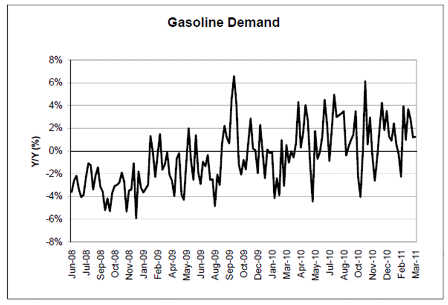
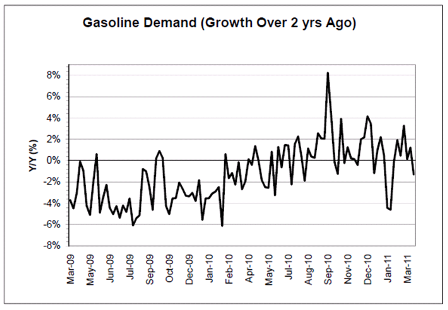
Given the more than 2 years of positive headline GDP growth, gasoline demand, previously a pretty good coincident indicator, is looking pretty flat.

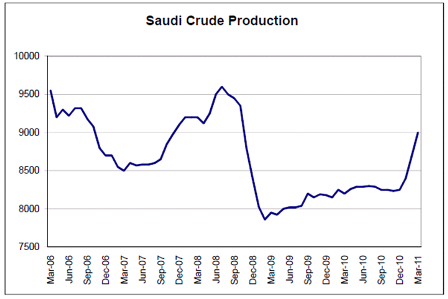
Saudi crude production has been increased to make up for lost Libyan output, and not due to an increase in world demand.

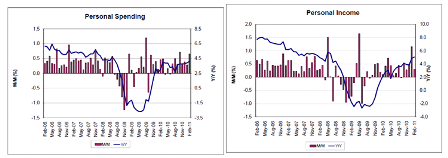
These series are doing ok, but no sign of accelerating demand. In fact the growth rates are less than they were when the output gap was a whole lot smaller in 06 and 07.

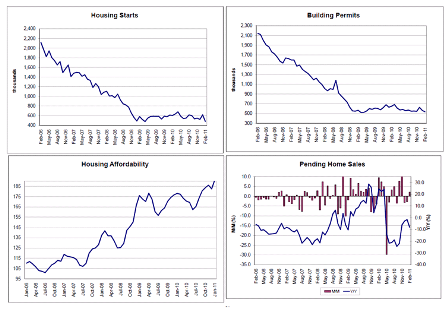
No sign of demand picking up here.

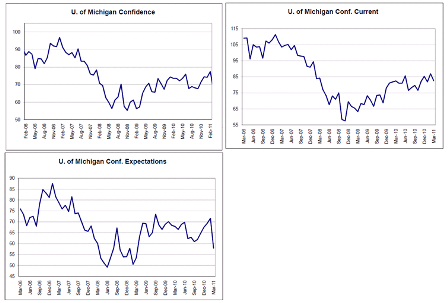
Consumer buying plans don’t look inspiring either, which makes sense with rising food and fuel prices.

With ‘normal’ credit conditions, govt deficits would be plenty high for us to be doing a lot better than this by now.

So given today’s credit conditions, seems to me govt deficits are far too small to see much progress on the demand side, and tightening fiscal at this point only makes that more so.

Employment report

From Goldman:

There were a few modest weak spots in the report. First, average hourly earnings were unchanged for a second month. Second, the average work week failed to increase. Although this was expected by the consensus, worker hours remain below pre-recession levels and should be gradually rising over time. Third, the average duration of unemployment rose to a new high of 39.0 weeks (note that a methodological change at the start of this year lifted the mean duration of unemployment). Fourth, diffusion indexes reflecting the proportion of sectors with rising employment were generally soft.

And it’s rear view mirror

The Wall of Shame (cont.)

Today is year and in Japan,
which means the last few days could be mainly quarter end and year end maneuvers,
with a high probability of ‘buy the rumor sell the news’ types of unwinds coming up.

This would include the anticipation of another 200,000 new private sector jobs to be reported tomorrow am.
And the euro strength we’ve seen in front of the announced ECB rate hike next week.

There have been lots of promotional reasons to rush to get stocks on your books for year and/quarter end reporting,
as well as a bit of gold, silver, foods, and other commodities.

But fundamentally I see what’s going on below- a world heck bent on removing aggregate demand.

More noises from Japan on how they will pay for the rebuild, which looks to be a very modest appropriation tempered by fears of being at a fiscal tipping point.

UK austerity ratchets up April 1.

China still fighting inflation with further reduced spending and lending.

The euro zone demanding and getting austerity in return for funding, with signs in some members of austerity no longer bringing down deficits as revenues fall off from economic weakness. And no fiscal safety net if it does all go bad as markets have shown extreme reluctance to fund countercyclical deficits.

And food and fuel from monopoly pricing both eating into consumer demand and driving large segments of the world population into desperation.

Talk of Q1 US GDP down to maybe only +2%, housing still bumping along the bottom, and Q2 threatened by supply shortages due to the earthquake in Japan.

And the US debt ceiling showdown now possibly happing late next week as the deficit terrorists seal their congressional victory with the promised down payment on net spending cuts that won’t end there.

In fact, their army of support is now all but universal.

Everyone in DC and the mainstream media and economics profession agrees on the problem.

The only discussion is where the cuts should be, and who should pay more.

March 31, 2011
President Barack Obama
The White House
1600 Pennsylvania Avenue, NW
Washington, DC 20500
The Honorable John Boehner
Speaker of the House
1101 Longworth House Office Building
Washington, DC 20515
The Honorable Nancy Pelosi
House Minority Leader
235 Cannon House Office Building
Washington, DC 20515
The Honorable Harry Reid
Senate Majority Leader
522 Hart Senate Office Building
Washington, DC 20510
The Honorable Mitch McConnell
Senate Minority Leader
361-A Russell Senate Office Building
Washington, DC 20510

Dear President Obama, Speaker Boehner, Minority Leader Pelosi, Majority Leader Reid, and Minority Leader McConnell:


As you continue to work on our current budget situation, we are writing to let you know that we join with the 64 Senators who recently wrote that comprehensive deficit reduction measures are imperative, and to urge you to work together in support of a broad approach to solving the nation’s fiscal problems. As they said in their letter to President Obama:

“As you know, a bipartisan group of Senators has been working to craft a comprehensive deficit reduction package based upon the recommendations of the Fiscal Commission. While we may not agree with every aspect of the Commission’s recommendations, we believe that its work represents an important foundation to achieve meaningful progress on our debt. The Commission’s work also underscored the scope and breadth of our nation’s long-term fiscal challenges.

Beyond FY2011 funding decisions, we urge you to engage in a broader discussion about a comprehensive deficit reduction package. Specifically, we hope that the discussion will include discretionary spending cuts, entitlement changes and tax reform.

By approaching these negotiations comprehensively, with a strong signal of support from you, we believe that we can achieve consensus on these important fiscal issues. This would send a powerful message to Americans that Washington can work together to tackle this critical issue. Thank you for your attention to this matter.”

We agree with this letter and hope that you will work together to agree on a comprehensive, multi-year debt stabilization package.

Sincerely,
The Honorable Roger C. Altman
Former Assistant Secretary of the U.S.
Department of the Treasury; Founder
and Chairman, Evercore Partners

Barry Anderson
Former Acting Director, Congressional
Budget Office

Joseph Antos
Wilson H. Taylor Scholar in Health Care
and Retirement Policy, American
Enterprise Institute

The Honorable Martin Baily
Former Chairman, Council of Economic
Advisers

Robert Bixby
Executive Director, Concord Coalition

Charles Blahous
Research Fellow, Hoover Institute

Erskine Bowles
Former Co-Chair, National Commission
on Fiscal Responsibility and Reform

The Honorable Charles Bowsher
Former Comptroller General of the
United States

The Honorable John E. Chapoton
Former Assistant Secretary for Tax
Policy, U.S. Department of the Treasury

David Cote
Former Member, National Commission
on Fiscal Responsibility and Reform;
Chairman and CEO, Honeywell
International

Pete Davis
President, Davis Capital Investment
Ideas

John Endean
President, American Business
Conference

The Honorable Vic Fazio
Former Member of Congress

The Honorable Martin Feldstein
Former Chairman, Council of Economic
Advisers

The Honorable William Frenzel
Former Ranking Member, House
Budget Committee; Co-Chair,
Committee for a Responsible Federal
Budget

Ann Fudge
Former Member, National Commission
on Fiscal Responsibility and Reform;
Former CEO, Young & Rubicam Brands

William G. Gale
Senior Fellow, Brookings Institution William A. Galston
Senior Fellow and Ezra K. Zilkha Chair,
Brookings Institution

The Honorable Bill Gradison
Former Ranking Member, House
Budget Committee

The Honorable Judd Gregg
Former Chairman, Senate Budget
Committee

Ron Haskins
Senior Fellow, Brookings Institution

Kevin Hassett
Senior Fellow and Director of Economic
Policy Studies, American Enterprise
Institute

G. William Hoagland
Former Staff Director, Senate Budget
Committee

The Honorable Glenn Hubbard
Former Chairman, Council of Economic
Advisers; Dean, Columbia Business
School

David B. Kendall
Senior Fellow for Health and Fiscal
Policy, Third Way

The Honorable Bob Kerrey
Former Member of Congress

Donald F. Kettl
Dean, School of Public Policy,
University of Maryland

The Honorable Charles E.M. Kolb
President, Committee for Economic
Development

The Honorable Jim Kolbe
Former Member of Congress

Lawrence B. Lindsey
President and CEO, The Lindsey Group;
Former Director, National Economic
Council

Maya MacGuineas
President, Committee for a Responsible
Federal Budget

The Honorable N. Gregory Mankiw
Former Chairman, Council of Economic
Advisers

The Honorable Donald Marron
Director, Urban-Brookings Tax Policy
Center; Former Acting Director,
Congressional Budget Office

William Marshall
President, Progressive Policy Institute

The Honorable James T. McIntyre, Jr.
Former Director, Office of Management
and Budget

Olivia S. Mitchell
Economist

The Honorable William A. Niskanen
Chairman Emeritus and Distinguished
Senior Economist, Cato Institute; Former
Acting Chairman, Council of Economic
Advisers

The Honorable Jim Nussle
Former Director, Office of Management
and Budget; Former Chairman, House
Budget Committee; Co-Chair,
Committee for a Responsible Federal
Budget Michael E. O’Hanlon
Senior Fellow and Sydney Stein Jr.
Chair, Brookings Institution

The Honorable Paul O’Neill
Former Secretary of the U.S.
Department of the Treasury

Marne Obernauer, Jr.
Chairman, Beverage Distributors
Company

Rudolph G. Penner
Former Director, Congressional Budget
Office

The Honorable Timothy Penny
Former Member of Congress; Co-Chair,
Committee for a Responsible Federal
Budget

The Honorable Alice Rivlin
Former Director, Congressional Budget
Office; Former Director, Office of
Management and Budget; Former
Member, National Commission on
Fiscal Responsibility and Reform

The Honorable Charles Robb
Former Member of Congress

Diane Lim Rogers
Chief Economist, Concord Coalition

The Honorable Christina Romer
Former Chairwoman, Council of
Economic Advisers

The Honorable Robert E. Rubin
Former Secretary of the U.S.
Department of the Treasury

The Honorable Martin Sabo
Former Chairman, House Budget
Committee

Isabel V. Sawhill
Senior Fellow, Brookings Institution

Allen Schick
Distinguished University Professor,
University of Maryland

Sylvester J. Schieber
Former Chairman, Social Security
Advisory Board

Daniel N. Shaviro
Wayne Perry Professor of Taxation,
New York University School of Law

The Honorable George P. Shultz
Former Secretary of the U.S.
Department of the Treasury; Former
Secretary of the U.S. Department of
State; Former Secretary of the U.S.
Department of Labor

The Honorable Alan K. Simpson
Former Member of Congress; Co-Chair,
National Commission on Fiscal
Responsibility and Reform

C. Eugene Steuerle
Institute Fellow and Richard B. Fisher
Chair, Urban Institute

The Honorable Charlie Stenholm
Former Member of Congress; Co-Chair,
Committee for a Responsible Federal
Budget The Honorable Phillip Swagel
Former Assistant Secretary for
Economic Policy, U.S. Department of the
Treasury

The Honorable John Tanner
Former Member of Congress

John B. Taylor
Mary and Robert Raymond Professor of
Economics, Stanford University; George
P. Shultz Senior Fellow in Economics,
Hoover Institution
The Honorable Laura D. Tyson
Former Chairwoman, Council of
Economic Advisers; Former Director,
National Economic Council
The Honorable George Voinovich
Former Member of Congress

The Honorable Paul Volcker
Former Chairman, Federal Reserve
System

Carol Cox Wait
Former President, Committee for a
Responsible Federal Budget

The Honorable David M. Walker
Former Comptroller General of the
United States


The Honorable Murray L.
Weidenbaum
Former Chairman, Council of Economic
Advisers

The Honorable Joseph R. Wright, Jr.
Former Director, Office of Management
and Budget
Mark Zandi
Chief Economist, Moody’s Analytics

Harvard’s Mankiw- a disgrace to the economics profession

CAUTION: BE SEATED WHEN READING

COMMENTS BELOW:

It’s 2026, and the Debt Is Due

By N. Gregory Mankiw

March 26 (NYT)

The following is a presidential address to the nation — to be delivered in March 2026.

My fellow Americans, I come to you today with a heavy heart. We have a crisis on our hands. It is one of our own making. And it is one that leaves us with no good choices.

For many years, our nation’s government has lived beyond its means.

A rookie, first year student mistake. Our real means are everything we can produce at full employment domestically plus whatever the rest of the world wants to net send us. The currency is the means for achieving this. Dollars are purely nominal and not the real resources.

We have promised ourselves both low taxes and a generous social safety net. But we have not faced the hard reality of budget arithmetic.

The hard reality is that for a given size government, there is a ‘right level’ of taxes that corresponds with full domestic employment, with the size of any federal deficit a reflection of net world dollar savings desires.

The seeds of this crisis were planted long ago, by previous generations. Our parents and grandparents had noble aims. They saw poverty among the elderly and created Social Security.

Yes, they decided they would like our elderly to be able to enjoy at least a minimum level of consumption of goods and services that made us all proud to be Americans.

They saw sickness and created Medicare and Medicaid. They saw Americans struggle to afford health insurance and embracedhealth care reform with subsidies for middle-class families.

Yes, they elected to make sure everyone had at least a minimum level of actual health care services.

But this expansion in government did not come cheap. Government spending has taken up an increasing share of our national income.

The real cost of this ‘expansion’ (which was more of a reorganization than an expansion of actual real resources consumed by the elderly and consumed by actual healthcare needs) may have consumed an increasing share of real GDP, but with continued productivity this would have been at most a trivial amount at current rates of expansion.

Today, most of the large baby-boom generation is retired. They are no longer working and paying taxes, but they are eligible for the many government benefits we offer the elderly.

Yes, they are consuming real goods and services produced by others. The important consideration here is the % of the population working and overall productivity which he doesn’t even begin to address.

Our efforts to control health care costs have failed. We must now acknowledge that rising costs are driven largely by technological advances in saving lives. These advances are welcome, but they are expensive nonetheless.

Still no indication of what % of real GDP he envisions going to health care and real consumption by the elderly.

If we had chosen to tax ourselves to pay for this spending, our current problems could have been avoided. But no one likes paying taxes. Taxes not only take money out of our pockets, but they also distort incentives and reduce economic growth. So, instead, we borrowed increasing amounts to pay for these programs.

At least he gives real economic growth a passing mention. However, what he seems to continuously miss is that real output is THE issue. Right now, with potential employment perhaps 20% higher than it currently is, the lost real output, which compounds continuously, plus the real costs of unemployment- deterioration of human capital, broken families and communities, deterioration of real property, foregone investment, etc. etc. etc.- are far higher than the real resources consumed by the elderly and actual health care delivery. Nor does he understand what is meant by the term Federal borrowing- that it’s nothing more than the shift of dollar balances from reserve accounts at the Fed to securities accounts at the Fed. And that repayment is nothing more than shifting dollar balances from securities accounts at the Fed to reserve accounts at the Fed. No grandchildren involved!!!

Yet debt does not avoid hard choices. It only delays them. After last week’s events in the bond market, it is clear that further delay is no longer possible. The day of reckoning is here.

This morning, the Treasury Department released a detailed report about the nature of the problem. To put it most simply, the bond market no longer trusts us.

For years, the United States government borrowed on good terms. Investors both at home and abroad were confident that we would honor our debts. They were sure that when the time came, we would do the right thing and bring spending and taxes into line.

But over the last several years, as the ratio of our debt to gross domestic product reached ever-higher levels, investors started getting nervous. They demanded higher interest rates to compensate for the perceived risk.

This is all entirely inapplicable. It applies only to fixed exchange rate regimes, such as a gold standard, and not to non convertible currency/floating exchange rate regimes. This is nothing more than another rookie blunder.

Higher interest rates increased the cost of servicing our debt, adding to the upward pressure on spending. We found ourselves in a vicious circle of rising budget deficits and falling investor confidence.

With our non convertible dollar and a floating exchange rate, the Fed currently sets short term interest rates by voice vote, and the term structure of interest rates for the most part anticipates the Fed’s reaction function and future Fed votes. Nor is there any operational imperative for the US Government to offer longer term liabilities, such as 5 year, 7 year, 10 year, and 30 year US Treasury securities for sale, which serve to drive up long rates at levels higher than otherwise. That too is a practice left over from gold standard days that’s no longer applicable.

As economists often remind us, crises take longer to arrive than you think, but then they happen much faster than you could have imagined. Last week, when the Treasury tried to auction its most recent issue of government bonds, almost no one was buying. The private market will lend us no more. Our national credit card has been rejected.

As above, the US Government is under no operational imperative to issue Treasury securities. US Government spending is not, operationally, constrained by revenues. At the point of all US govt spending, all that happens is the Fed, which is controlled by Congress, credits a member bank reserve account on its own books. All US Government spending is simply a matter of data entry on the US Governments own books. Any restrictions on the US government’s ability to make timely payment of dollars are necessarily self imposed, and in no case external.

So where do we go from here?

WE DON’T GET ‘HERE’- THERE IS NO SUCH PLACE!!!

Yesterday, I returned from a meeting at the International Monetary Fund in its new headquarters in Beijing. I am pleased to report some good news. I have managed to secure from the I.M.F. a temporary line of credit to help us through this crisis.

This loan comes with some conditions. As your president, I have to be frank: I don’t like them, and neither will you. But, under the circumstances, accepting these conditions is our only choice.

Mankiw’s display of ignorance and absurdities continues to compound geometrically.

We have to cut Social Security immediately, especially for higher-income beneficiaries. Social Security will still keep the elderly out of poverty, but just barely.

We have to limit Medicare and Medicaid. These programs will still provide basic health care, but they will no longer cover many expensive treatments. Individuals will have to pay for these treatments on their own or, sadly, do without.

We have to cut health insurance subsidies to middle-income families. Health insurance will be less a right of citizenship and more a personal responsibility.

We have to eliminate inessential government functions, like subsidies for farming, ethanol production, public broadcasting, energy conservation and trade promotion.

The only reason we would ever be ‘forced’ to make those cuts would be real resource constraints- actual shortages of land, housing, food, drugs, labor, clothing, energy, etc. etc. And yes, that could indeed happen. Those are the real issues facing us. But Mankiw is so lost in his errant understanding of actual monetary operations he doesn’t even begin to get to where he should have started.

We will raise taxes on all but the poorest Americans. We will do this primarily by broadening the tax base, eliminating deductions for mortgage interest and state and local taxes. Employer-provided health insurance will hereafter be taxable compensation.

He fails to recognize that federal taxes function to regulate aggregate demand, and not to raise revenue per se, again showing a complete lack of understanding of current monetary arrangements.

We will increase the gasoline tax by $2 a gallon. This will not only increase revenue, but will also address various social ills, from global climate change to local traffic congestion.

Ok, finally, apart from the revenue error, he’s got the rest of it sort of right, except he left out the part about that tax being highly regressive.

As I have said, these changes are repellant to me. When you elected me, I promised to preserve the social safety net. I assured you that the budget deficit could be fixed by eliminating waste, fraud and abuse, and by increasing taxes on only the richest Americans. But now we have little choice in the matter.

Due entirely to ignorance of actual monetary operations.

If only we had faced up to this problem a generation ago. The choices then would not have been easy, but they would have been less draconian than the sudden, nonnegotiable demands we now face. Americans would have come to rely less on government and more on themselves, and so would be better prepared today.

What I wouldn’t give for a chance to go back and change the past. But what is done is done. Americans have faced hardship and adversity before, and we have triumphed. Working together, we can make the sacrifices it takes so our children and grandchildren will enjoy a more prosperous future.

N. Gregory Mankiw is a professor of economics at Harvard.

And no small part of the real problem we face as a nation!

Feel free to repost and distribute

Claims/DGO


Karim writes:

  • More positive signs for the labor market as initial claims fall another 5k to 382k; more importantly, claims are now steadily below 400k (5 of the past 7 weeks)
  • DGO ex-air and defense fall 1.3%; Core shipments rise 0.8%
  • Slight upward revisions to both core orders and shipments for January
  • DGO remains highly volatile, with the machinery component in particular driving the volatility. Machinery orders up 16.3% in December, followed by -12.7% and -4.2% in Jan and Feb.

Nothing in today’s data that would alter the baseline view for the Fed expressed in last week’s FOMC statement (hawkish)

Welcome to the 7th US depression, Mr. bond market

Looks to me like the lack of noises out of Japan means there won’t be a sufficient fiscal response to restore demand.

If anything, the talk is about how to pay for the rebuilding, with a consumption tax at the top of the list.

That means they aren’t going to inflate.
More likely they are going to further deflate.
Yes, the yen will go down by what looks like a lot, maybe even helped by the MOF, but I doubt it will be enough to inflate.

In fact, all the evidence indicates that Japan doesn’t don’t know how to inflate, nor does anyone else.

Worse, what they all think inflates, more likely actually deflates.

0 rate policies mean deficits can be that much higher without causing ‘inflation’ due to income channels and supply side effects.
There is no such thing as a debt trap springing to life.
Debt monetization is a meaningless expression with non convertible currency and floating fx.
QE mainly serves to further remove precious income from an already income starved economy.

Only excess deficit spending can directly support prices, output, and employment from the demand side, as it directly adds to incomes, spending, and net savings of financial assets.

The international fear mongering surrounding deficits and debt issues is entirely a chicken little story that’s keeping us in this depression (unemployment over 10% the way it was measured when the term was defined) that’s now taking a turn for the worse.

The euro zone is methodically weakening it’s ‘engines of growth’- its own (weaker) members being subjected to austerity measures that are reducing their deficit spending that paid for their imports from Germany. And now China, Japan, the US and others will be cutting imports as well.

UK fiscal austerity measures are accelerating on schedule.

The US is also working to tighten fiscal policy, particularly now that both sides agree that deficit reduction is in order, beaming as they make progress towards agreeing on the cuts.

The US had 6 depressions while on the gold standard, which followed the only 6 periods of budget surpluses.
And now, even with a floating fx policy and non convertible currency that allows for immediate and unlimited fiscal adjustments,
we have allowed the deflationary forces unleashed by the Clinton budget surpluses to result in this 7th depression.

We were muddling through with modest real growth and a far too high output gap and may have continued to do so all else equal.

But all else isn’t equal.

Collective, self inflicted proactive austerity has been working against growth, including China’s ‘fight against inflation.’

And now Japan’s massive disaster will be deflationary shock that, in the absence of a proactive fiscal adjustment, is highly likely to further reduce world demand.

Hopefully, the Saudis capitulate and follow the price of crude lower, easing the burden somewhat on the world’s struggling populations.
If so, watch for a strong dollar as well.

And watch for a lot more global civil unrest as no answers emerge to the mass unemployment that will likely get even worse. Not to mention food prices that may come down some, but will remain very high at the consumer level as we continue to burn up our food supply for motor fuel.

And it’s all only likely to get worse until the world figures out how its monetary system actually works.

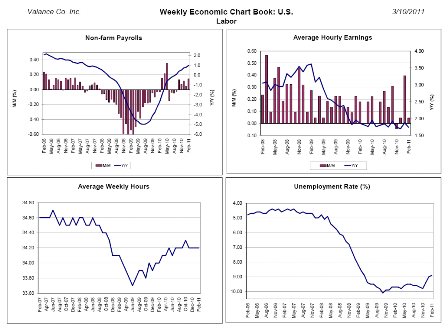
labor charts

So this was a good monthly employment report?

Ok, there were a few new jobs, but not nearly as many as there used to be each month a few years ago, in an economy a lot closer to full employment, with a much smaller output gap, and one that was considered only modest at the time.

And average weekly hours remain a lot lower than before, indicating businesses have room to increase productivity/add output without adding staff.

The fall in the unemployment rate has been substantially helped by the decline in the labor participation rate, below, meaning more people are out of work aren’t included as unemployed as they are no longer looking for work.