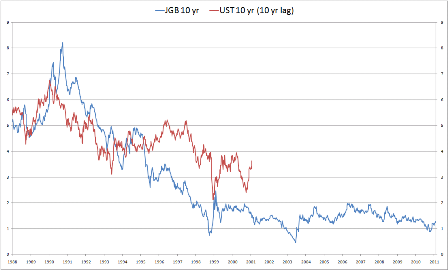
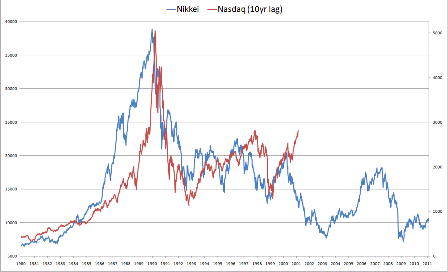
Welcome to the 7th US depression, Mr. bond market

Looks to me like the lack of noises out of Japan means there won’t be a sufficient fiscal response to restore demand.

If anything, the talk is about how to pay for the rebuilding, with a consumption tax at the top of the list.

That means they aren’t going to inflate.
More likely they are going to further deflate.
Yes, the yen will go down by what looks like a lot, maybe even helped by the MOF, but I doubt it will be enough to inflate.

In fact, all the evidence indicates that Japan doesn’t don’t know how to inflate, nor does anyone else.

Worse, what they all think inflates, more likely actually deflates.

0 rate policies mean deficits can be that much higher without causing ‘inflation’ due to income channels and supply side effects.
There is no such thing as a debt trap springing to life.
Debt monetization is a meaningless expression with non convertible currency and floating fx.
QE mainly serves to further remove precious income from an already income starved economy.

Only excess deficit spending can directly support prices, output, and employment from the demand side, as it directly adds to incomes, spending, and net savings of financial assets.

The international fear mongering surrounding deficits and debt issues is entirely a chicken little story that’s keeping us in this depression (unemployment over 10% the way it was measured when the term was defined) that’s now taking a turn for the worse.

The euro zone is methodically weakening it’s ‘engines of growth’- its own (weaker) members being subjected to austerity measures that are reducing their deficit spending that paid for their imports from Germany. And now China, Japan, the US and others will be cutting imports as well.

UK fiscal austerity measures are accelerating on schedule.

The US is also working to tighten fiscal policy, particularly now that both sides agree that deficit reduction is in order, beaming as they make progress towards agreeing on the cuts.

The US had 6 depressions while on the gold standard, which followed the only 6 periods of budget surpluses.
And now, even with a floating fx policy and non convertible currency that allows for immediate and unlimited fiscal adjustments,
we have allowed the deflationary forces unleashed by the Clinton budget surpluses to result in this 7th depression.

We were muddling through with modest real growth and a far too high output gap and may have continued to do so all else equal.

But all else isn’t equal.

Collective, self inflicted proactive austerity has been working against growth, including China’s ‘fight against inflation.’

And now Japan’s massive disaster will be deflationary shock that, in the absence of a proactive fiscal adjustment, is highly likely to further reduce world demand.

Hopefully, the Saudis capitulate and follow the price of crude lower, easing the burden somewhat on the world’s struggling populations.
If so, watch for a strong dollar as well.

And watch for a lot more global civil unrest as no answers emerge to the mass unemployment that will likely get even worse. Not to mention food prices that may come down some, but will remain very high at the consumer level as we continue to burn up our food supply for motor fuel.

And it’s all only likely to get worse until the world figures out how its monetary system actually works.

Japan- economic ramifications

Nothing much to say here about the financial aspects. Need to see how they react.

Best I can tell this doesn’t effect the world economy all that much.

Oil demand may initially fall some, due to a temporary reduction in consumption and maybe a refinery shut down. And domestic demand in general may fall until the rebuilding starts.

The power lost by the nuclear plants shutting down may amount to maybe 1-2% of total electric power consumption, and will be replaced but a combo of different sources.

Replacing the nuclear plants will cost something but not a lot in the scheme of things, and the new ones are even safer than the older ones, which seem to have help up reasonably well, especially considering the extreme stresses.

Govt deficit spending may go up by a small % of GDP as will the spending of insurance company and other private reserves.
And insurance companies then replenishing their reserves does the reverse.

I’d guess they govt will direct most of the rebuilding contracts to domestic companies.

I don’t see anything that makes the yen stronger?

Japan should have more than adequate resources of all types immediately available as emergency services, shouldn’t need any help from anyone, though for political purpose they will certainly accept it.

They’ve been saying for years there’s nothing left for govt to buy, so they must have thousands of emergency helicopters, millions of emergency temporary housing trailers, etc. etc. ready to go?

A few Boehnalities and other notables on the US going broke

Cross currents of right and wrong but always for the wrong reasons.

Bonds Show Why Boehner Saying We’re Broke Is Figure of Speech

By David J. Lynch

March 7 (Bloomberg) — House Speaker John Boehner routinely offers this diagnosis of the U.S.’s fiscal condition: “We’re broke; Broke going on bankrupt,” he said in a Feb. 28 speech in Nashville.

Boehner’s assessment dominates a debate over the federal budget that could lead to a government shutdown. It is a widely shared view with just one flaw: It’s wrong.

“The U.S. government is not broke,” said Marc Chandler, global head of currency strategy for Brown Brothers Harriman & Co. in New York. “There’s no evidence that the market is treating the U.S. government like it’s broke.”

Wrong reason! Broke implies not able to spend.

The US spends by crediting member bank accounts at the Fed, and taxes by debiting member bank accounts at the Fed.

It never has nor doesn’t have any dollars.

The U.S. today is able to borrow at historically low interest rates, paying 0.68 percent on a two-year note that it had to offer at 5.1 percent before the financial crisis began in 2007.

That’s simply a function of where the Fed, a agent of Congress, has decided to set rates, and market perceptions of where it may set rates in the future. Solvency doesn’t enter into it.

Financial products that pay off if Uncle Sam defaults aren’t attracting unusual investor demand. And tax revenue as a percentage of the economy is at a 60-year low, meaning if the government needs to raise cash and can summon the political will, it could do so.

All taxing does is debit member bank accounts. The govt doesn’t actually ‘get’ anything.

To be sure, the U.S. confronts long-term fiscal dangers.

For example???

Over the past two years, federal debt measured against total economic output has increased by more than 50 percent and the White House projects annual budget deficits continuing indefinitely.

So?

“If an American family is spending more money than they’re making year after year after year, they’re broke,” said Michael Steel, a spokesman for Boehner.

So?
What does that have to do with govts ability to credit accounts at its own central bank?

$1.6 Trillion Deficit

A person, company or nation would be defined as “broke” if it couldn’t pay its bills, and that is not the case with the U.S. Despite an annual budget deficit expected to reach $1.6 trillion this year, the government continues to meet its financial obligations, and investors say there is little concern that will change.

Still, a rhetorical drumbeat has spread that the U.S. is tapped out. Republicans, including Representative Ron Paul of Texas, chairman of the House domestic monetary policy subcommittee, and Fox News commentator Bill O’Reilly, have labeled the U.S. “broke” in recent days.

Chris Christie, the Republican governor of New Jersey, said in a speech last month that the Medicare program is “going to bankrupt us.” Julian Robertson, chairman of Tiger Management LLC in New York, told The Australian newspaper March 2: “we’re broke, broker than all get out.”

A similar claim was even made Feb. 28 by comedian Jon Stewart, the host of “The Daily Show” on Comedy Central.

So much for their legacies.

Cost of Insuring Debt

Financial markets dispute the political world’s conclusion. The cost of insuring for five years a notional $10 million in U.S. government debt is $45,830, less than half the cost in February 2009, at the height of the financial crisis, according to data provider CMA data. That makes U.S. government debt the fifth safest of 156 countries rated and less likely to suffer default than any major economy, including every member of the
G20.

There are two factors in default insurance. Ability to pay and willingness to pay. While the US always has the ability to pay, Congress does not always show a united willingness to pay. Hence the actual default risk.

Creditors regard Venezuela, Greece and Argentina as the three riskiest countries. Buying credit default insurance on a notional $10 million of those nations’ debt costs $1.2 million, $950,000 and $665,000 respectively.

“I think it’s very misleading to call a country ‘broke,'” said Nariman Behravesh, chief economist for IHS Global Insight in Lexington, Massachusetts. “We’re certainly not bankrupt like Greece.”

In any case, the euro zone member nations put themselves in the fiscal position of US states when they joined the euro.

That means a state like Illinois could be the next Greece, but not the US govt.

Less Likely to Default

CMA prices for credit insurance show that global investors consider it more likely that France, Japan, China, the United Kingdom, Australia or Germany will default than the U.S.

Pacific Investment Management Co., which operates the largest bond fund, the $239 billion Total Return Fund, sees so little risk of a U.S. default it may sell other investors insurance against the prospect. Andrew Balls, Pimco managing director, told reporters Feb. 28 in London that the chances the U.S. would not meet its obligations were “vanishingly small.”

Presumably a statement with regard to willingness of Congress to pay.

George Magnus, senior economic adviser for UBS Investment Bank in London, says the U.S. dollar’s status as the global economy’s unit of account means the U.S. can’t go broke.

That has nothing to do with it.

“You have the reserve currency,” Magnus said. “You can print as much as you need. So there’s no question all debts will be repaid.”

Any nation can do that with its own currency

The current concerns over debt contrast with the views of founding father Alexander Hamilton, the nation’s first Treasury secretary. At Hamilton’s urging, the federal government in 1790 absorbed the Revolutionary War debts of the states and issued new government securities in about the same total amount.

Alexander Hamilton

Unlike today’s debt critics, Hamilton “had no intention of paying off the outstanding principal of the debt,” historian Gordon S. Wood wrote in “Empire of Liberty: A History of the Early Republic 1789-1815.”

Instead, by making regular interest payments on the debt, Hamilton established the U.S. government as “the best credit risk in the world” and drew investors’ loyalties to the federal government and away from the states, wrote Wood, who won a Pulitzer Prize for a separate history of the colonial period.

Far be it from me to argue with a Pulitzer Prize winner…

From Oct. 1, 2008, the beginning of the 2009 fiscal year, through the current year, which ends Sept. 30, 2011, the U.S. will have added more than $4.3 trillion of debt. Despite White House forecasts of an additional $2.4 trillion of debt over the next three fiscal years, investors’ appetite for Treasury securities shows little sign of abating.

It’s just a reserve drain- get over it!

Govt spending credits member bank reserve accounts at the Fed

Tsy securities exist as securities accounts at the Fed.

‘Going into debt’ entails nothing more than the Fed debiting Fed reserve accounts and crediting Fed securities accounts and ‘paying off the debt’ is nothing more than debiting securities accounts and crediting reserve accounts

No grandchildren involved.

Longer-Term Debt

In addition to accepting low yields on two-year notes, creditors are willing to lend the U.S. money for longer periods at interest rates that are below long-term averages. Ten-year U.S. bonds carry a rate of 3.5 percent, compared with an average 5.4 percent since 1990. And U.S. debt is more attractive than comparable securities from the U.K., which has moved aggressively to rein in government spending. U.K. 10-year bonds offer a 3.6 percent yield.

“You are never broke as long as there are those who will buy your debt and lend money to you,” said Edward Altman, a finance professor at New York University’s Stern School of Business who created the Z-score formula that calculates a company’s likelihood of bankruptcy.

Who also completely misses the point.

Any doubts traders had about the solvency of the U.S. would immediately be reflected in the markets, a fact noted by James Carville, a former adviser to President Bill Clinton, after he saw how bond investors could determine the success or failure of economic policy.

No they can’t.

“I used to think if there was reincarnation, I wanted to come back as the president or the Pope or a .400 baseball hitter,” Carville said. “But now I want to come back as the bond market. You can intimidate everyone.”

Only those who don’t know any better.

Republican Dissenters

Republican assertions that the U.S. is “broke” are shorthand for a complex fiscal situation, and some in the party acknowledge the claim isn’t accurate.

“To say your debts exceed your income is not ‘broke,'” said Tony Fratto, former White House and Treasury Department spokesman in the George W. Bush administration.

The U.S. government nonetheless faces a daunting gap between its expected financial resources

It’s not about ‘financial resources’ when it comes to a govt that never has nor doesn’t have any dollars, and just changes numbers in our accounts when it spends and taxes

and promised future outlays. Fratto said the Obama administration’s continued accumulation of debt risked a future crisis, as most major economies also face growing debt burdens.

The burden is that of making data entries.

In the nightmare scenario, a crush of countries competing to simultaneously sell IOUs to global investors could bid up the yield on government debt and compel overleveraged countries such as the U.S. to abruptly slash public spending.

It could only compel leaders who didn’t know how it all worked to do that.

Not selling the debt simply means the dollars stay in reserve accounts at the Fed and instead of being shifted by the Fed to securities accounts. Why would anyone who knew how it worked care which account the dollars were in? Especially when spending has nothing, operationally, to do with those accounts.

Fratto dismissed the markets’ current calm, noting that until the European debt crisis erupted early last year, investors had priced German and Greek debt as near equivalents.

“Markets can make mistakes,” Fratto said.

So can he. That all applies to the US states, not the federal govt.

$9.4 Trillion Outstanding

If recent budgetary trends continue unchanged, the U.S. risks a fiscal day of reckoning, slower growth or both.

No it doesn’t.

Altman notes that the U.S. debt outstanding is “enormous.” As of the end of 2010, debt held by the public was $9.4 trillion or 63 percent of gross domestic product — roughly half of the corresponding figures for Greece (126.7 percent) and Japan (121 percent) and well below countries such as Italy (116 percent), Belgium (96.2 percent) and France (78.1 percent).

Once a country’s debt-to-GDP ratio exceeds 90 percent, median annual economic growth rates fall by 1 percent, according to economists Kenneth Rogoff and Carmen Reinhart.

Wrong, that’s for convertible currency/fixed exchange rate regimes, not nations like the US, Uk, and Japan which have non convertible currencies and floating exchange rates.

The Congressional Budget Office warns that debt held by the public will reach 97 percent of GDP in 10 years if certain tax breaks are extended rather than allowed to expire next year and if Medicare payments to physicians are held at existing levels rather than reduced as the administration has proposed.

So???

AAA Rating

For now, Standard & Poor’s maintains a stable outlook on its top AAA rating on U.S. debt, assuming the government will “soon reveal a credible plan to tighten fiscal policy.” Debate over closing the budget gap thus far has centered on potential spending reductions. S&P says a deficit-closing plan “will require both expenditure and revenue measures.”

Measured against the size of the economy, U.S. federal tax revenue is at its lowest level since 1950. Tax receipts in the 2011 fiscal year are expected to equal 14.4 percent of GDP, according to the White House. That compares with the 40-year average of 18 percent, according to the Congressional Budget Office. So if tax receipts return to their long-term average amid an economic recovery, about one-third of the annual budget deficit would disappear.

Likewise, individual federal income tax rates have declined sharply since the top marginal rate peaked at 94 percent in 1945. The marginal rate — which applies to income above a numerical threshold that has changed over time — was 91 percent as late as 1963 and 50 percent in 1986. For 2011, the top marginal rate is 35 percent on income over $373,650 for individuals and couples filing jointly.

Not Overtaxed

Americans also aren’t overtaxed compared with residents of other advanced nations. In a 28-nation survey, only Chile and Mexico reported a lower total tax burden than the U.S., according to the Organization for Economic Development and Cooperation.

In 2009, taxes of all kinds claimed 24 percent of U.S. GDP, compared with 34.3 percent in the U.K., 37 percent in Germany and 48.2 percent in Denmark, the most heavily taxed OECD member.

“By the standard of U.S. history, by the standard of other countries — by the standard of where else are we going to get the money — increased tax revenues have to be a part of the solution,” said Jeffrey Frankel, an economist at Harvard University who advises the Federal Reserve Banks of Boston and New York.

So much for his legacy.

U.K. Construction Grew Fastest in Eight Months in February

While the austerity measures will bite, in the UK, like much of the world, automatic fiscal stabilizers (rising transfer payments and lower tax revenues) got their deficits up high enough to reverse the downturns in GDP, and deficits remain high enough for modest growth.

The UK had weather issues in December, which are reversing.

As the austerity measures continue to come on line, they will drain off some of the aggregate demand being added by the counter cyclical deficits and keep a damper on growth.

It’s just a guess, and there are other factors as well (oil prices, China slowdown, etc.) but I suspect the actual slowdown from the austerity is still down the road a piece.


UK Headlines:


U.K. Construction Grew Fastest in Eight Months in February
King Says Raising Rate to Make a Gesture Is Self-Defeating
RBC Says Stronger Pound Highlights View BOE’s King Faces Defeat
UK House Prices Stage Surprise Rise as Mortgage Approvals Also Up

US Budget Gap Is Top Worry for NABE Economists

So much for their legacies:

US Budget Gap Is Top Worry for NABE Economists

February 28 (Reuters) — The massive U.S. budget deficit is the gravest threat facing the economy, topping high unemployment and the risk of inflation or deflation, according to a survey of forecasters released Monday.

The National Association for Business Economics said its 47-member panel of forecasters increased its estimate for the 2011 federal deficit to $1.4 trillion from $1.1 trillion in its previous survey in November.

“Panelists continue to characterize excessive federal indebtedness as their single greatest concern,” with state and local government debt the second-biggest worry, the survey said.

the Mideast, the Saudis, and our markets

First, I’ve been pretty quiet on the mideast goings ons.
I’ve been watching intently from the time Egypt made headlines,
and have yet to see anything of particular consequence to us, beyond oil prices.

I’ve yet to come up with any channel to world aggregate demand, inflation, etc. apart from oil prices.

Seems all moves in stocks and bonds have been linked directly or indirectly only to actual and potential changes in crude oil and product prices.

And the mainstream has yet to realize that ultimately the Saudis- the only producer with excess capacity, continues as price setter, at least until their excess capacity is gone.

So the price of crude oil remains set by decree, and not market forces.
And markets don’t yet seem to know that.
Credit the Saudis for outsmarting the world on that score.
They say they don’t set prices, but let the market set price, as they only set spreads to benchmark market prices they post for their refiners.
The world completely misses the simple difference between the Saudi’s reaction function as a price setter, and prices set competitively in the market place.

That’s like the Fed saying they don’t set $US interest rates, because they have a reaction function that guides them.

So what does that mean?

It means the price of crude will come down only if the Saudis want it to come down (assuming they do have excess capacity).

And my best guess is that their survival strategy includes a lower price of oil.

They will play the maestro with grand gesture and international ‘faux diplomacy’ with ‘high level’ behind the scenes goings ons with pledges to come to the rescue with promises of production increases to replace any lost output due to the crisis, making it clear that they are going the extra mile and taking extraordinary measures to ensure the western economies both won’t see any supply disruptions and prices will be contained. Making it clear that we owe them for their selfless, gargantuan, efforts and expenditures of political capital on our behalf.

It’s all a big show to ingratiate themselves to the West in the hopes of getting the western support needed to sustain their position of power.

And the west will never realize that prices went up only because the Saudis raised their posted prices under cover of their reaction function that the west mistakes for ‘market forces,’ and that prices will go down only as the Saudis simply lower their posted prices, as they continue to play us for complete fools.

Much like China does to us because we think we need to sell our Tsy secs to fund our federal spending.

And with lower crude prices we go ‘risk off’ and much of the recent moves in other markets reverse.

The other possibility is that the Saudis don’t cut price, maybe because they decide they want the increased revenues to sustain control domestically with increased distributions to their population.

One way or another, it’s all their political decision, and we don’t even understand how it works, which reduces the odds that whatever influence we might have will be used to our ultimate benefit.

Before the early 1970’s the price of oil was set by the Texas Railroad Commission, who kept it relatively low and stable, fueling growth with reasonable price stability, while govt policy fostered relatively high levels of employment and low output gaps.

Since the hand off to the Saudis in the early 1970’s, when circumstances allowed them to take over as swing producer/price setter, prices have increased dramatically with very high levels of volatility, disrupting the world order and fostering today’s very high levels of unemployment and massive output gaps, as govts struggle with fears of inflation and seemingly no understanding of the process that’s got us into that mess.

And now with the world turmoil perhaps largely a function of mass unemployment, and govts with no idea how to keep that from happening, the pendulum is shifting from order to chaos.

Testimony from Chairman Bernanke

“If government debt and deficits were actually to grow at the pace envisioned, the economic and financial effects would be severe,” Federal Reserve Chairman Ben S. Bernanke told the House Budget Committee Feb. 9. “Sustained high rates of government borrowing would both drain funds away from private investment and increase our debt to foreigners, with adverse long-run effects on U.S. output, incomes, and standards of living.”

MMT on MarketWatch

MMT breaking through???

Deficit hysteria grips Washington

By Darrell Delamaide

February 16 (MarketWatch) — Deficit hysteria is rising to fever pitch in Washington as the political jockeying over the budget begins in earnest.

“Fiscal nightmare,” “buried under a mountain of debt,” “awash in red ink” – these are some of the colorful phrases being bandied about by politicians, pundits and even journalists ostensibly reporting facts. Most of them are winging it on a single undergraduate course in economics, if that, but they know they’re right because everybody agrees.

Yet, if you look out the window, you don’t see any red ink or mountains of debt. The only nightmare is unemployment continuing near 10% and ongoing waves of foreclosures – neither of which is attributable to the federal deficit and neither of which will be fixed by budget cuts.

There is no visible harm from current deficits. Yields on U.S. Treasurys are up a tick but still near historic lows. Core inflation in the U.S. is still so far below the 2% annual rate deemed desirable by the Federal Reserve that deflation continues to be more worrying. There is no crowding out of private borrowers in the debt markets.

Just you wait, cry the deficit hawks, it will be a nightmare by 2016 or 2020 or 2050. Well, let’s wait and see. If we put those 15 million people back to work and get the economy growing at a steady clip, tax revenues will rise and cheat all those bloodthirsty hawks of their fiscal Armageddon.

Worried? Confused? Alarmed at the slow-motion train wreck in Washington?

There is cause for alarm. There is the possibility that the government, held under the sway of misguided and obsolete economic theories and driven by a not-so-hidden corporate agenda, will make genuinely harmful cuts in both discretionary spending and entitlement programs – cuts that will cause real and needless misery to millions.

The overwrought hysteria of the deficit hawks – one economist calls them deficit terrorists – has already sabotaged government stimulus that could have rebooted the economy much more quickly and alleviated unemployment to a greater extent.

It’s certainly useful to comb through the budget and reexamine programs for possible cuts. Military spending can certainly be cut back. Some recalibration of entitlements is also necessary.

But the helter-skelter axing of programs to meet a target pulled out of thin air – what’s so magic about $100 billion in spending cuts this year? – risks causing much unnecessary harm.

Before you succumb to the deficit hysteria, think about the disconnect between the dire language and the observable facts. Be careful about false comparisons – such as the U.S. going the way of Greece.

The U.S. is not Greece. The U.S. has full monetary sovereignty – that is, it has complete control over its own currency. Greece, as a member of the euro, does not, which is why it has constraints on its borrowing.

When the U.S. was bound by the gold standard, it also faced constraints. Most of the thinking and language about budgets and deficits actually goes back to this time, when the U.S. genuinely had to “finance” its deficit.

Since abandonment of the gold standard and the de facto adoption of a fiat currency, however, these constraints no longer apply. The U.S. is free to print as much money as it likes; the U.S. government is free to spend money without financing it.

How crazy, you say. What about inflation? Inflation occurs when there is more demand than supply and this simply isn’t going to happen when there is 8-10% unemployment. Treasury and the Fed have ample tools – selling debt securities and raising interest rates – to deal with inflation when it does threaten.

Modern monetary theory – which is espoused by a growing number of economists and investment managers because it explains the observable facts better than the obsolete theories driving most of the public discussion – deals with the world as it is without a gold standard.

A better comparison for the U.S. than Greece is Japan, which also enjoys full monetary sovereignty. Japan has a public debt approaching 200% of GDP. This compares to the U.S. at 60% in 2010 and on its way up.

Deficit terrorists have decided arbitrarily that 60% is the maximum limit. They have been predicting the imminent collapse of Japan – for the past 20 years. And yet Japan continues to finance its deficit with rock-bottom interest rates.

The federal government is also not comparable to a household. It does not have a checkbook to balance or a credit card to max out, even though our folksy politicians like to use these metaphors. It does not have to “live within its means” like a family or individual. Our grandchildren will never have to repay all that debt. No one will, ever. It will continue to grow as our economy grows.

All this flies in the face of all the groupthink going on in Congress, in the press and on cable TV. So if you want to reject modern monetary theory as hogwash and cling to theories that worked a century ago, you’re in good company. But think about it, look around you, and decide for yourself what best describes the world you live in.