China Macro Flash:Capital Requirement May Tighten To Further


[Skip to the end]

Looks like the push to restrict lending is continuing.

The new capital will ‘automatically’ be available for profitable loans, but it will take some time and some repricing of risk.

>   
>   (email exchange)
>   
>   On Fri, Aug 21, 2009 at 5:53 AM, Dave wrote:
>   
>   Good summary of rumored changes in China’s banking system
>   

China Macro Flash: Capital Requirement May Tighten To Further Curb Lending

The reported tightening of bank capital requirement is in a draft of
regulatory changes that are being circulated among banks for feedback.
It is likely a measure prepared by the government to curb loan growth
and asset price bubbles. If bank loans and asset prices continue to
rise, new rules could be enforced quickly, but if both stabilize or
undergo healthy adjustments or corrections, it is not clear how soon the
changes will be adopted.

The core of changes suggested in the draft is to end the connection
among banks through mutual holding of subordinated and hybrid debts.
These debts are issued by one bank and held by other lenders. Those
debts that relate one bank to another may increase systematic risk of
the banking sector.

The new rule proposes that:1) The holding of subordinated and hybrid
debts issued by other lenders should be capped. This will make new
issuance of such debts more difficult. 2) Subordinated and hybrid debts
can no longer be counted as supplementary capital. 3) Banks that fall
below the capital adequacy requirement will have to either shrink
balance sheets or issue more shares to lift capital adequacy ratios.


The proposed changes, if implemented, will likely curb loan
growth as some banks will have to cut new loans to fulfill the
requirement. Also, the changes will likely affect smaller banks more
than large state-owned banks. Almost all key state-owned banks (except
the Agricultural Bank of China) were listed in recent years, and their
capital adequacy ratios should be high enough to cope with the change.
Smaller banks facing limited channels of fund raising could suffer the
most. Current excess liquidity should help lower the cost of capital. If
banks need to fulfill the required adjustment in a short period of time,
this could tighten the liquidity condition in the market sizably,
putting downward pressure on asset prices.


[top]

China Money Rates Drop as Central Bank Stops Pushing Up Yields


[Skip to the end]

Check out the last ‘house hunting’ story.

Looks like they are on to that angle of attack, directing
that form of ‘investment’ as a matter of public purpose,
much like we have done with our public policies over the years.

Also looks like the cut back in lending was to try to moderate
what they deemed to be ‘overheating’ and should only be temporary.

Seems the rate hike was only 26 basis points (not that rates matter very much in any case).

Very interesting note here:

Chinese banks usually “frontload” lending in the first half of each year.

China Money Rates Drop as Central Bank Stops Pushing Up Yields

August 18 (Bloomberg) — China’s money-market rates dropped after the central bank stopped driving up the benchmark bill yield for the first time in six weeks, fanning speculation it will ease availability of funds to stem a slump in stocks.

The People’s Bank of China said it sold 45 billion yuan

($6.6 billion) of one-year bills at a yield of 1.7605 percent, unchanged from last week’s auction. The central bank has let the yield rise 26 basis points since resuming sales of one-year bills on July 9, following an eight-month suspension.

“The authorities may want to ease the market panic after a big slump in stocks,” said Zhang Lei, a fixed-income analyst at Shenyin Wanguo Research & Consulting Co. in Shanghai. “The unchanged yield is a signal that the central bank will stick to its loose monetary policy.”

The seven-day repurchase rate, which measures funding availability on the interbank market, declined 12 basis points, or 0.12 percentage point, to 1.30 percent as of 5:30 p.m. in Shanghai, according to the China Interbank Funding Center. A basis point is 0.01 percentage point.

A government report showed on Aug. 11 that industrial production gained 10.8 percent in July, less than the 12 percent median estimate in a Bloomberg survey of economists. Urban fixed-asset investment for the seven months to July 31 climbed

32.9 percent, which was also short of analyst forecasts.

China’s Investment-Grade Debt Ratings Affirmed by S&P

Aug. 18 (Bloomberg) — China’s investment grade credit rating was affirmed by Standard & Poor’s Ratings Services, which cited the country’s “exceptional” economic growth potential.

S&P maintained China’s A+ long-term sovereign credit rating and its A-1+ short-term rating, according to a statement issued today. The outlook on the long-term credit rating remains stable, S&P said.

“Fiscal flexibility remains significant,” S&P said in the statement. “The Chinese government faces moderate risks of balance sheet damage if there is a steeper and more prolonged economic slowdown than currently expected.”

Banks report fewer new loans

August 17 (China Daily) — China’s new lending in July fell to less than a quarter of June’s level, as banks sought to limit credit risks and the flow of money into stocks and property.

Banks extended 355.9 billion yuan in loans, down from 1.53 trillion yuan in June, the People’s Bank of China reported on its website last week. M2, the broadest measure of money supply, rose 28.4 percent.

China Construction Bank Corp, the nation’s second-largest lender, said recently that it will cut new lending by about 70 percent in the second half to avert a surge in bad debt.

The government wants to avert bubbles in stocks and property without choking off the recovery of the world’s third-biggest economy.

A smaller loan number “is probably a good thing – we’re coming off this ridiculously high level of lending in the first half,” said Paul Cavey, an economist with Macquarie Securities in Hong Kong.

Premier Wen Jiabao reiterated in a statement on Aug 9 that a “moderately loose” monetary policy and “proactive” fiscal policy will remain unchanged because the economy faces problems including sliding export demand and industrial overcapacity.

UBS AG stated in a July 31 note that the scale of China’s new lending in the first half was “neither sustainable nor necessary.” New loans of 300 billion yuan to 400 billion yuan a month in the second half would be “more than enough” to support the nation’s recovery, the report said.

Chinese banks usually “frontload” lending in the first half of each year.

The credit boom and a 4 trillion yuan stimulus package drove 7.9 percent economic growth in the second quarter from a year earlier and helped General Motors Co to report a 78 percent increase in vehicle sales in China in July.

A record $1 trillion yuan in loans through June has also helped to drive this year’s 79 percent gain in the Shanghai Composite Index.

Central bank and finance ministry officials said on Aug 7 that they will scrutinize gains in stock prices without capping new lending. The Financial Times reported the same day that the central bank had told the largest state-controlled lenders to slow growth in new loans, citing unidentified people familiar with the matter.

Credit exploded after the People’s Bank of China scrapped quotas limiting lending in November and told banks to back Wen’s 4 trillion yuan stimulus package.

Zhang Jianguo, the president of China Construction Bank, expressed concern about loan growth last week, saying some industries are growing too rapidly and some money isn’t flowing into the real economy.

Housing prices “are rising too fast and housing sales are growing too fast”, Zhang said.

Property sales climbed 60 percent in value in the first seven months from a year earlier, the statistics bureau said.

China’s banking regulator urged lenders on July 27 to ensure credit for investment projects flows into the real economy.

Three days later, the regulator announced plans to tighten rules on working capital loans.

Stephen Roach, chairman of Morgan Stanley Asia, said on July 29 that surging lending and infrastructure spending worsened imbalances in the Chinese economy and “could sow the seeds for a new wave of non-performing bank loans”.

Instead of pumping up growth, the government should do more to boost private consumption, he said.

China goes house hunting to rev up economy

August 18 (Reuters) — The Chinese government is attempting to pass the baton of growth from State-funded infrastructure investment to the private housing sector, a risky but necessary move to sustain the economic recovery.

Construction cranes sprouting in big cities, busy furniture shops and soaring property sales all show that the transition is going smoothly so far, though officials are wary that house prices may rise too high, too quickly.

China’s biggest listed property developer, Vanke, lifted its housing starts target for this year by 45 percent, while its rival Poly Real Estate said sales in Jan-July rose 143 percent from a year earlier.

On the ground, construction firms, big and small, are trying to meet the demand, last years’ downturn now a distant memory.

“It’s been a long time since we’ve had a day off. Several months, I think, though I can’t remember exactly,” said Zhang Minghui, owner of a small building company in Beijing.

“From late last year to early this year, we basically had nothing to do. Everybody was careful with their money because of the crisis and so projects got delayed.”

Zhang cut his staff to three in November but is now back up to a crew of 14.

The economic importance of the property sector in China is hard to overstate. Investment in residential housing accounted for about 10 percent of gross domestic product before a property boom turned to bust in 2008, roughly the same as the contribution from the country’s vaunted export factories.

The government’s first steps last year to revive the stalling Chinese economy were to offer tax cuts to encourage home purchases, followed by rules to ease access to mortgages.

These are bearing fruit.

With housing investment up an annual 11.6 percent in the first seven months, Chinese growth momentum is broadening out and the central government has been able to slow the pace of its stimulus spending on infrastructure.

Real economy

But Beijing must strike a fine balance in its bid to kick-start the housing market.

On the one hand, it wants rising prices to persuade house hunters to stop putting off purchases and to get developers to invest in new projects. On the other hand, it is wary of prices rising too quickly, luring speculators into the market and turning it into an asset bubble, not an economic driver.

“Because it is closely linked to so many industries, volatility in the real estate market will inevitably lead to macroeconomic volatility,” the government-run China Economic Times warned on Monday.


[top]

Hong Kong recovery ‘made in China’


[Skip to the end]

Yes, this further supports the notion that some of the world economic improvement was due indirectly to ‘one time’ inventory building and additions to capacity in China, including the eurozone, where exports nudged France and Germany to positive GDP reports.

Hong Kong Climbs Out of Recession as Trade Improves

August 14 (Bloomberg) — Hong Kong climbed out of a yearlong recession as trade improved, adding to signs that the global economy is recovering.

Gross domestic product rose a seasonally adjusted 3.3 percent in the second quarter from the previous three months, after dropping 4.3 percent in the first quarter, the government
said today. The median estimate in a Bloomberg News survey of seven economists was for a 1.2 percent gain.

The Hang Seng Index has gained 84 percent from this year’s low in March as China’s record lending and 4 trillion yuan ($585 billion) stimulus package help the city, which is a hub for
trade and finance. Hong Kong’s government raised its forecast for this year’s GDP to a contraction of between 3.5 percent and 4.5 percent today from a previous estimate of a 5.5 percent to
6.5 percent decline.

“This rebound has largely been ‘Made in China,’” said Brian Jackson, a senior strategist at Royal Bank of Canada in Hong Kong. “Exports to the mainland have picked up, while easy
liquidity conditions there have contributed to recent gains in Hong Kong’s asset prices, providing a strong boost to Hong Kong consumers.”

The economy shrank 3.8 percent in the second quarter from a year earlier, after a 7.8 percent drop in the previous three months. The first-quarter contraction from the previous three
months was the worst since data began in 1990.

Singapore Retail Sales Post Smaller Drop as Recession Recedes

By Stephanie Phang

August 14 (Bloomberg) — Singapore’s retail sales fell the least in three months in June as the nation emerged from its worst recession since independence 44 years ago and an annual island-wide sale supported spending.

The retail sales index dropped 8.2 percent from a year earlier after sliding a revised 10.4 percent in May, the Statistics Department said today. The median estimate of 11 economists surveyed by Bloomberg News was for a 9.2 percent decline. Adjusted for seasonal factors, sales rose 2.3 percent from May.

Singapore’s economy expanded for the first time in a year last quarter as manufacturing and services improved. The government raised its 2009 export forecast this week as policy makers around the world predict the worst of the global recession is past after pledging about $2 trillion in stimulus measures and cutting interest rates.

“We should generally expect gradual improvement in retail sales from hereon,” said Kit Wei Zheng, an economist at Citigroup Inc. in Singapore. He cited “firmer signs of a turnaround in labor markets, and perhaps some positive spillovers on confidence from the buoyant property and equity markets.”

Singapore’s benchmark stock index has climbed 49 percent this year and home sales by developers including Frasers Centrepoint Ltd. rose 9.1 percent in June from May, according to the Urban Redevelopment Authority.

Singapore employers fired fewer workers last quarter, cutting 5,500 jobs compared with 12,760 in the first three months of the year, the Ministry of Manpower said July 31. The seasonally adjusted unemployment rate held at 3.3 percent.


[top]

China steel expansion halted


[Skip to the end]

Yes, this further supports the notion that some of the world economic improvement was due indirectly to ‘one time’ inventory building and additions to capacity in China, including the eurozone, where exports nudged France and Germany to positive GDP reports.

China stops expansion projects in steel industry for three years

August 13 (China Daily) — China’s Ministry of Industry and Information Technology (MIIT) Thursday announced a three-year moratorium on approvals of new expansion-related proposals in the iron and steel industry, as the government pledges to eliminate outdated capacity.

MIIT Minister Li Yizhong said overcapacity in the steel industry was “the most evident” of all the industrial sectors, with this year’s estimated total output capacity at 660 million tons, compared with estimated demand at 470 million tons.

He called for steel mills to stop expansions for the next three years. Projects with total capacity of about 58 million tons already under construction would continue, he said.

“If the trend goes down like this, the steel industry will come to a dead end,” he said.

Another move to step up elimination of outdated capacity was consolidation of the industry, he said. Steel mills in Hebei province would reduce their overall capacity from 120 million tons to 80 million tons annually over the next two to three years.

He said the ministry was drafting steel industry consolidation guidelines aimed at reforming the world’s largest market. He gave no time for their publication.

The Shanghai Securities News reported in late July that China would release the guidelines in September.

The ministry will issue another guideline on energy conservation and emissions reductions in key sectors, including the chemical and steel sectors in the second half of this year.

The country’s steel mills produced 50.68 million tons of steel in July, up 12.69 percent year on year.


[top]

Trade/FOMC Preview/China Exports/Stimulus hangups


[Skip to the end]


Karim writes:

Trade: Exports up 2%, Imports up 2.3%. Imports ex-petroleum down 1% and consumer goods imports down 4.8%. Sector strength mainly in industrial goods (restocking), but indicators of final demand still look weak.

Don’t look for dramatic changes to FOMC statement; major focus will be on Treasury purchase language.

1) Econ assessment will turn slightly more positive; May mention signs of a nascent recovery, though underlying demand likely to remain weak for the foreseeable future. Inflation will remain subdued.

2) Exceptionally low FF rate for an ‘extended period’ will remain. I’d expect this phrase to be dropped about 3-4mths before they’d actually hike, with the first move possibly being a hike in the rate they pay banks on excess reserves.

3) Likely to indicate that Treasury purchases will not continue once the $300bn level has been reached, though they may restart the program in the future if needed. Language on other credit easing programs to stay intact.

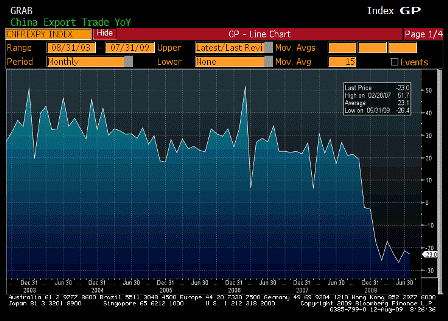
China’s export model showing little bounce (latest data last night)

Some hangups with the stimulus package (courtesy of American General Contractors):

“President Barack Obama’s stimulus spending has run into a problem: A shortage of General Electric Co. water filters,” Bloomberg News reported on Thursday. “GE makes them in Canada. Under the program’s ‘Buy American’ rules, that means the filters can’t be used for work paid for by the $787 billion fund. Contractors are searching the U.S. in vain for filters as well as bolts and manhole covers needed to build wastewater plants, sewers and water pipes financed by the economic stimulus. As officials wait for federal waivers to buy those goods outside the U.S., water projects from Maine to Kansas have been delayed….the Environmental Protection Agency, which administers the water funding, has granted six waivers and has 29 petitions pending….The rules affect water projects most because highways and bridges have been constructed under Buy American regulations for the past 30 years, and not much stimulus money has been spent so far on public housing and schools, said Chris Braddock, the U.S. Chamber of Commerce’s associate director for procurement.”

“Gun-shy [school] administrators might undermine a federal stimulus program that encourages school construction by helping districts pay down debt,” the (Wisconsin) Daily Reporter reported on Monday. “Some district leaders say they gladly are accepting a piece of $125 million in no-interest bonds but are reluctant to invest the savings in new projects. ‘The climate out there is terrible and with the cuts made in the state budget, it’s just really difficult right now,’ said John Whalen, president of the Sun Prairie Area School District Board of Education. ‘I don’t anticipate this will encourage us to do more projects,’ he added. The district received $23 million in federal bonding, more than any other district in the state, though the bonding did not encourage additional construction. Sun Prairie used it to help pay off the $30 million it put on taxpayers for construction of a new high school and conversion of the old high school into a middle school. Both schools are scheduled to open in fall 2010. While Sun Prairie stands pat, other districts might jump at the opportunity. The School District of La Crosse received $6.6 million in bonds to help pay off debt from $18.5 million in expansion, renovation and upgrade projects.”


[top]

Zombie Economy: European Industrial Production Unexpectedly Declines


[Skip to the end]

Looks to me like the world hit a ‘soft spot’ in July, maybe due to the winding down of China’s suspected ‘inventory building.’

CPI’s continue to fall in the Eurozone indicating continuing domestic demand weakness.

Strong productivity gains are not being matched with fiscal adjustments to sustain output and employment, as evidenced by a continuing rise in unemployment and a widening of the output gap.

I like the term Zombie economy as the world continues to unknowingly rely on ‘automatic stabilizers’ for a very ugly means of fiscal adjustment.

Meanwhile, as unemployment continues to rise, they wait, with blind certainty for the mythical ‘kicking in of billions’ by Central Banks to somehow take effect, and be so powerful, that they are spending their time debating irrelevant ‘exit strategies’ from this non event for aggregate demand.

Right now there is no hope for further US fiscal adjustment, barring a major economic setback. President Obama has pledged not to sign a health care bill that is not ‘revenue neutral’ and it’s all but certain marginal tax rates will rise next year.

And the increased expenditures for ‘shovel ready’ projects, merits of the projects aside, are being offset by forced cut backs by States that continue to face revenue shortages due to the fall in GDP.

Banks that have been sustained by wide net interest margins that offset lingering loan losses are now seeing portfolios run off, as those with positive cash flow (corporations with flat sales and consumers in foxholes still worried about job losses) are paying down debt and net new lending languishes.

  • European Industrial Production Unexpectedly Declines
  • Liikanen Says Next Months Will Show If Euro Area Through Worst
  • French Consumer Prices Fall for Third Month on Energy, Retail
  • European Government Bonds Extend Gain After BOE Inflation Report


[top]

valance chart review


[Skip to the end]

Not a lot to say in this short review.

Looks like credit worthiness is on the mend thanks to federal deficit spending.

While what’s been done hasn’t been my first choice for public policy, it nonetheless has added net financial assets to the non govt sectors and helped bring down debt ratios.

As they used to say, when Detroit sneezes the economy catches a cold.

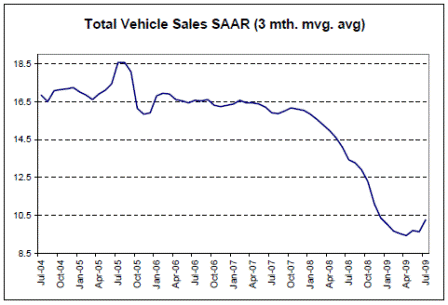
The Great Mike Masters Inventory Liquidation that began in July ended around year end.

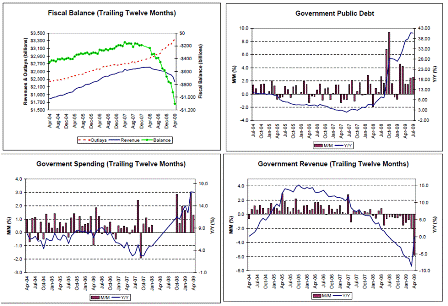
The weakening economy caused the federal deficit to rise the very ugly way via the automatic stabilizers.

By year end the deficit was high enough to turn the tide.

The rising federal deficits added to savings of net financial assets and began easing debt ratios.

Headwinds remain, including US domestic loan loss issues and China looking like markets could take a breather with talk of government action to slow credit expansion, but as long as US federal deficit spending persists at sufficiently high levels, it looks like the worst is behind us for US GDP, with unemployment likely to peak later this year at about 10%.

This is creating unwelcome social tensions for the administration, with the apparent winners being banks, corporations, the investor class in general, and higher income earners.

State and local governments are also in a bind, as they lay off essential employees while funding a few ‘shovel ready’ federal infrastructure projects.

Health care reform held the promise of adding to aggregate demand but it now looks like the final bill will be ‘revenue neutral.’


[top]

CCB to Reduce New Lending by 70% as Risks ‘Evident,’ Zhang Says


[Skip to the end]

This looks ominous if not ‘replaced’ by deficit spending.

CCB’s Second Half New Loans to Fall, President Says

Bloomberg News

August 7th (Bloomberg) — China Construction Bank Corp. will reduce new lending by about 70 percent in the second half after a surge in loans in the first six months increased credit risk, President Zhang Jianguo said in an interview.


[top]

China wanting to buy TIPS


[Skip to the end]

This is another blunder by the Obama administration due to not understanding the monetary system.

We don’t need China or any other investor to ‘buy the debt’ yet we think we do and think they are in a position to ‘demand’ anything.

Issuing/selling CPI indexed govt debt is functionally external debt. With we owe ‘real’ wealth rather than strictly nominal wealth, and are subject to nearly the same risks as if we were borrowing real goods and services and had to pay them back in kind.

The lack of understanding of the monetary system is getting more costly by the day.

U.S., in Nod to China, to Sell More TIPS

By Rob Copeland and Maya Jackson Randall

August 6 (WSJ) — The Treasury Department, responding to growing demand from China and other investors, will boost the sale of inflation-protected bonds that hold their value as consumer prices rise.

“We continue to hear growing demand for the product,” Treasury Deputy Assistant Secretary for Federal Financing Matt Rutherford said at a news conference announcing the plan on Wednesday.

The decision to increase sales of Treasury Inflation-Protected Securities, or TIPS, is part of a broader effort to ensure there is enough demand for Treasury bonds to help the U.S. finance its swelling budget deficit. The Treasury already has issued a record amount of debt in the past year, and the department said Wednesday it will sell a record $75 billion next week.

In particular, Treasury officials need to ensure demand from China, the largest holder of U.S. government debt. Last week’s auctions of fixed-rate notes saw lukewarm demand from China and other investors. Chinese officials had indicated they want inflation-protected securities, especially as the U.S. economy starts to recover.

“Inflation is the No. 1 worry,” said Marc Chandler, global head of currency strategy for Brown Brothers Harriman & Co. “This is the government saying, ‘We will take that inflation risk away from you.'”

Even with an increase, TIPS would remain a fraction of the overall market for Treasurys. Of the $6.66 trillion of government bonds issued between Oct. 1, 2008 and June 30 of this year, just $44 billion were TIPS.

The Treasury could easily sell as much as $10 billion more, said Jeffrey Elswick, director of fixed income at Frost Investment Advisors LLC. But those extra sales mightn’t be such great news for existing owners of inflation-protected notes. If the Treasury continues to ramp up TIPS sales, it will “cheapen” the bonds of existing investors, said Don Martin, a financial planner with Mayflower Capital in Los Altos, Calif.

The value of the securities fell after the announcement, sending the gap between TIPS and comparable nominal notes to a two-month high. The gap ended at 1.93 percentage points, signaling that investors expect annualized inflation of 1.93% over the next decade.

The Treasury also said it may issue 30-year TIPS in place of 20-year TIPS.


[top]

China GDP


[Skip to the end]

Adding 14% to GDP is a very serious fiscal adjustment that clearly is working.

And it is operationally sustainable if they so desire.

Not to mention the credit expansion and foreign direct investment.

Yes, there can always be setbacks, but nothing that a fiscal adjustment can’t handle.

China: Bogus Boom?

By John H. Makin

It is important to understand how China’s remarkable reported economic performance is possible in the midst of a global recession. True, China enacted a massive stimulus package last November worth about 14 percent of GDP and aimed at boosting domestic demand as exports fell sharply.


[top]