Funds Boost Bullish Commodity Bets on Global Growth Prospects

Story behind prior post on China.

Not to forget that biofuels are burning up large % of our food as motor fuel.

Funds Boost Bullish Commodity Bets on Global Growth Prospects

By Yi Tian

June 6 (Bloomberg) — Funds boosted bets on rising commodity prices to the highest in four weeks, led by copper, amid signs that the global economic recovery will remain resilient and boost demand for raw materials.

Speculators raised their net-long positions in 18 commodities by 7.3 percent to 1.26 million futures and options contracts in the week ended May 31, government data compiled by Bloomberg show. That’s the highest since May 3. Copper holdings more than doubled. A measure of bullish agriculture bets also climbed as adverse global weather curbed crop production.

The Standard & Poor’s GSCI Spot Index rose for a fourth straight week as Chinese metal inventories plunged and droughts lingered in the Asian country and Europe, trimming prospects for wheat and cotton crops. The global recovery “is gaining strength,” the Group of Eight leaders said May 27 after a summit in Deauville, France. In the U.S., consumer sentiment rose to a three-month high in May, a private report showed last month.

“We are seeing a reasonable rate of growth in worldwide economic activity,” said Michael Cuggino, who helps manage $12 billion at Permanent Portfolio Funds in San Francisco. “The supply-demand associated with that growth, combined with a weaker dollar, probably explains the move into commodities.”

Copper prices have jumped 40 percent in the past year while wheat has surged 75 percent and corn has more than doubled amid increasing demand from China and other emerging economies. Raw materials have also gained as investors boosted holdings as an alternative to the dollar, which has slumped more than 6 percent this year against a six-currency basket.

$130 Million

Investors poured $130 million into commodity funds in the week ended June 1, the second straight increase, according to EPFR Global, a Cambridge, Massachusetts-based researcher. The previous week had inflows of $702.8 million.

Managed-money funds and other large speculators boosted bullish bets on New York copper prices by 4,604 contracts to 7,304. The jump was the biggest since October 2009. Stockpiles of the metal monitored by Shanghai Futures Exchange have plunged 51 percent since mid-March.

“Destocking cannot continue indefinitely, and market participants will have to return to the market at the latest in the fourth quarter, if not for re-stocking then at least for spot purchases,” Bank of America Merrill Lynch said in a report last week.

Agriculture Bets

Speculators raised their net-long positions in 11 U.S. farm goods by 4.6 percent to 756,629 contracts as of May 31, the second straight increase. Holdings of wheat jumped 14 percent, and bets on a cotton rally gained up 12 percent, the most since August.

“It has basically been a year of the wrong weather at the wrong time, starting with the Russian droughts and then most recently excessive rains in the U.S.,” said Nic Johnson, who helps manage about $24 billion in commodities at Pacific Investment Management Co. in Newport Beach, California. Agriculture “prices could move materially higher because of low inventories and if we have below-trend yields of crops like corn.”

China Has Divested 97 Percent of Its Holdings in U.S. Treasury Bills

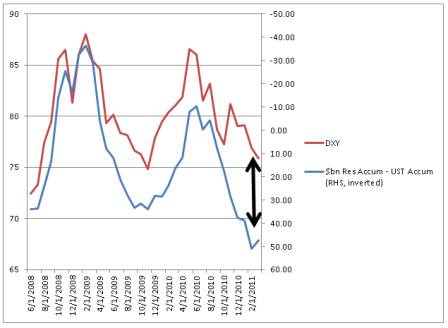
So it looks like QE2 indeed managed to scare China out of the dollar. This is the portfolio shifting previously discussed that’s been dragging down the dollar even though, fundamentally sound, as Fed Chairman Bernanke correctly stated.

And when China (and Japan) offered to buy Spanish and other euro zone national govt debt to ‘help out’, the euro zone fell for that one, watching their currency rise against their better judgement with regards to their euro wide exports.

And maybe Fed Chairman Bernanke is aware of this, and has assured China he does favor a strong dollar as per his latest public statements, and let them know that QE3 is unlikely, and has ‘won them back’? No way to tell except by watching the market prices.

And with most everyone out of paradigm with regards to monetary operations, there’s no telling what they all might actually do next.

What is known is that world fiscal balance is tight enough to be slowing things down, and looking to keep getting tighter.
And QE/lower overall term structure of rates removes interest income from the economy, and shifts income from savers to bank net interest margins.
And if China’s growth is going to slow dramatically, its most likely to happen the second half as they tend to front load their state lending and deficit spending each year.

And all the while our own pension funds continue to allocate to passive commodity strategies, distorting those markets and sending out price signals that continue to bring out increasing levels of supply that are filling up already overflowing storage bins.

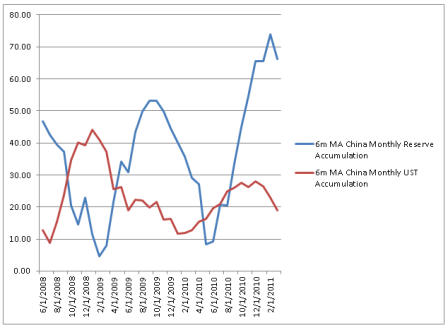
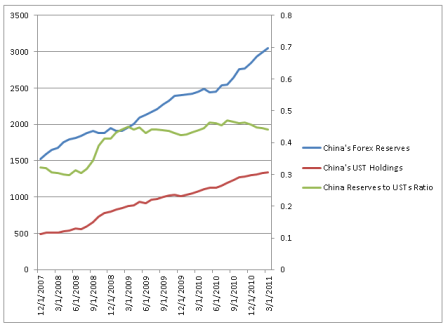
Note in particular that reserve accumulation has been high and rising recently, though UST accumulation has been moderate.

China Has Divested 97 Percent of Its Holdings in U.S. Treasury Bills

By Terence P. Jeffrey

Jun 4 (CNSNews.com) — China has dropped 97 percent of its holdings in U.S. Treasury bills, decreasing its ownership of the short-term U.S. government securities from a peak of $210.4 billion in May 2009 to $5.69 billion in March 2011, the most recent month reported by the U.S. Treasury.
Treasury bills are securities that mature in one year or less that are sold by the U.S. Treasury Department to fund the nation’s debt.

Mainland Chinese holdings of U.S. Treasury bills are reported in column 9 of the Treasury report linked here.

Until October, the Chinese were generally making up for their decreasing holdings in Treasury bills by increasing their holdings of longer-term U.S. Treasury securities. Thus, until October, China’s overall holdings of U.S. debt continued to increase.

Since October, however, China has also started to divest from longer-term U.S. Treasury securities. Thus, as reported by the Treasury Department, China’s ownership of the U.S. national debt has decreased in each of the last five months on record, including November, December, January, February and March.

Prior to the fall of 2008, acccording to Treasury Department data, Chinese ownership of short-term Treasury bills was modest, standing at only $19.8 billion in August of that year. But when President George W. Bush signed legislation to authorize a $700-billion bailout of the U.S. financial industry in October 2008 and President Barack Obama signed a $787-billion economic stimulus law in February 2009, Chinese ownership of short-term U.S. Treasury bills skyrocketed.

By December 2008, China owned $165.2 billion in U.S. Treasury bills, according to the Treasury Department. By March 2009, Chinese Treasury bill holdings were at $191.1 billion. By May 2009, Chinese holdings of Treasury bills were peaking at $210.4 billion.

However, China’s overall appetite for U.S. debt increased over a longer span than did its appetite for short-term U.S. Treasury bills.
In August 2008, before the bank bailout and the stimulus law, overall Chinese holdings of U.S. debt stood at $573.7 billion. That number continued to escalate past May 2009– when China started to reduce its holdings in short-term Treasury bills–and ultimately peaked at $1.1753 trillion last October.

As of March 2011, overall Chinese holdings of U.S. debt had decreased to 1.1449 trillion.

Most of the U.S. national debt is made up of publicly marketable securities sold by the Treasury Department and I.O.U.s called “intragovernmental” bonds that the Treasury has given to so-called government trust funds—such as the Social Security trust funds—when it has spent the trust funds’ money on other government expenses.

The publicly marketable segment of the national debt includes Treasury bills, which (as defined by the Treasury) mature in terms of one-year or less; Treasury notes, which mature in terms of 2 to 10 years; Treasury Inflation-Protected Securities (TIPS), which mature in terms of 5, 10 and 30 years; and Treasury bonds, which mature in terms of 30 years.

At the end of August 2008, before the financial bailout and the stimulus, the publicly marketable segment of the U.S. national debt was 4.88 trillion. Of that, $2.56 trillion was in the intermediate-term Treasury notes, $1.22 trillion was in short-term Treasury bills, $582.8 billion was in long-term Treasury bonds, and $521.3 billion was in TIPS.

At the end of March 2011, by which time the Chinese had dropped their Treasury bill holdings 97 percent from their peak, the publicly marketable segment of the U.S. national debt had almost doubled from August 2008, hitting $9.11 trillion. Of that $9.11 trillion, $5.8 trillion was in intermediate-term Treasury notes, $1.7 trillion was in short-term Treasury bills; $931.5 billion was in long-term Treasury bonds, and $640.7 billion was in TIPS.

Before the end of March 2012, the Treasury must redeem all of the $1.7 trillion in Treasury bills that were extant as of March 2011 and find new or old buyers who will continue to invest in U.S. debt. But, for now, the Chinese at least do not appear to be bullish customers of short-term U.S. debt.

Treasury bills carry lower interest rates than longer-term Treasury notes and bonds, but the longer term notes and bonds are exposed to a greater risk of losing their value to inflation. To the degree that the $1.7 trillion in short-term U.S. Treasury bills extant as of March must be converted into longer-term U.S. Treasury securities, the U.S. government will be forced to pay a higher annual interest rate on the national debt.

As of the close of business on Thursday, the total U.S. debt was $14.34 trillion, according to the Daily Treasury Statement. Of that, approximately $9.74 trillion was debt held by the public and approximately $4.61 trillion was “intragovernmental” debt.

China

RBS: China: Where is the slowdown?

Very good, tends to support some of my ongoing themes:

China will produce more of its own resources.

Higher rates don’t bring down demand, and probably increase it.
It’s the fiscal tightening, directly or indirectly, proactive or via auto stabilizers, that ultimately cause the tree to fall. (US budget went into small surplus in 1979, for example)

The inflation problem is severe enough for them to be using export unfriendly currency appreciation to fight it.

Hopefully it doesn’t all come apart in Q2!

CH News

China is traditionally a first half/second half story, with h2 notably slower than h1 as fiscal and lending initiatives have generally been front loaded.

So watch for a very weak h2:

China Stocks Drop for 6th Day on Slowing Growth, Tighter Credit

May 26 (Bloomberg) — China’s stocks slid for a sixth day, driving the benchmark index to the longest stretch of losses in 11 months, on concern tightening measures are slowing the economy and making it harder for small companies to borrow money.

Huaxin Cement Co., an affiliate of Holcim Ltd., dropped 2.9 percent after Shanghai Securities News reported China’s industrial output may slow. A gauge of small-capitalization stocks fell to the lowest close in four months as Citigroup Inc. said smaller companies are being squeezed by tighter credit. Kangmei Pharmaceutical Co. led declines for drugmakers on speculation the government will further lower drug prices.

“Sentiment is weak and we haven’t seen anything positive that can support stocks,” said Dai Ming, fund manager at Shanghai Kingsun Investment Management & Consulting Co. “Slowing growth, high inflation and tight lending will continue to weigh on the market in the near future.”

The Shanghai Composite Index, which tracks the bigger of China’s stock exchanges, fell 5.23 points, or 0.2 percent, to 2,736.53 at the 3 p.m. close, erasing a gain in the last half hour of trading. The six-day decline is the longest since July 1. The CSI 300 Index lost 0.4 percent to 2,978.38, while the CSI Smallcap 500 Index retreated 1 percent.

The Shanghai gauge has slumped 2.5 percent this year as the central bank raised the reserve-requirement ratio for banks 11 times and boosted interest rates four times since the start of 2010 to cool inflation, which exceeded the government target each month this year. China’s preliminary manufacturing index
fell to its lowest level in 10 months, according to a report from HSBC Holdings Plc and Markit Economics this week.

Huaxin Cement slid 2.9 percent to 22.19 yuan. Offshore Oil Engineering Co. lost 4.9 percent to 6.42 yuan, the lowest close since Aug. 27. SAIC Motor Corp., China’s largest carmaker, fell 1.4 percent to 15.96 yuan.

Slowing Industrial Output

China’s industrial output growth is expected to slow in coming months as companies continue to destock and power shortages restrain production, Xu Ce, a researcher with the State Information Center, wrote in a commentary published in Shanghai Securities News. Government efforts to cut capacity in some industries will also restrain output growth, Xu wrote.

Sanan Optoelectronics Co., China’s biggest producer of light-emitting diode chips, led declines for smaller companies, slumping 3.7 percent to 16.71 yuan. Haining China Leather Market Co. plunged 5.6 percent to 21.53 yuan.

China’s small- and medium-sized companies are being squeezed by credit rationing and rising costs, Minggao Shen, an analyst at Citigroup, said in a report after meeting clients.

Bank Funding

The seven-day repurchase rate, which measures funding availability between banks, has averaged 3.48 percent so far this month, compared with 2.83 percent in April and 2.39 percent in March. The seven-day repo rate was at 5.08 percent as of 11:31 a.m. in Shanghai, according to a weighted average compiled by the National Interbank Funding Center. It touched 5.50 percent yesterday, the highest level since Feb. 23.

Kangmei fell 8.5 percent to 11.90 yuan, the biggest decline in almost 21 months. Nanjing Pharmaceutical Co. slid 6.9 percent to 12.44 yuan. Northeast Pharmaceutical Group Co. lost 6.3 percent to 16.37 yuan.

“Institutions are selling drugmaker shares because there’s still a lot of uncertainty about the next round of drug price cuts by the government,” said Li Ying, analyst at Capital Securities Corp.

Chinese stocks are “getting close to the market bottom” after recent declines and may gain as much as 20 percent this year, according to Steven Sun, Hong Kong-based head of China equity strategy at HSBC Holdings Plc.

The nation’s equities may rally in the second half of 2011, as easing inflation from June onward allows the central bank to hold off on its policy tightening campaign, Sun said in an interview with Bloomberg Television yesterday.

“We are getting close to the market bottom,” he said. “We are talking about a 15 to 20 percent upside by the end of this year.”

China Steel Reduces Prices as Industrial Output Slows

May 25 (Bloomberg) — China Steel Corp., Taiwan’s largest producer, will cut prices for domestic customers after the island’s industrial output slowed.

Prices will fall by an average 4.2 percent for July and August contracts, the Kaohsiung-based company said in an e-mailed statement today. Hot-rolled coil, a benchmark product, will fall by an average NT$1,754 ($61) a metric ton, while cold- rolled steel will be cut by an average NT$1,419 a ton.

Steel demand may decline after industrial production increased at the slowest pace in 19 months in April. Vehicle and auto part output fell 0.35 percent last month from a year earlier, the Ministry of Economic Affairs said May 23.

China Steel dropped 0.4 percent to close at NT$34.25 in Taipei before the announcement. The stock has climbed 2.2 percent this year, compared with the 2 percent decline in the benchmark Taiex index.

Electro-galvanized sheet prices will be cut by NT$1,500 a ton, electrical sheets by NT$2,600, and hot-dipped zinc-galvanized sheets by NT$1,613, China Steel said. Prices of plates, bars and wire rods will be left unchanged, the steelmaker said, without giving specific percentage changes for the products.

Commodities, China and 2012

From Art Patten, Symmetry Capital Management, LLC

A brief overview of our current thinking on the financial market and economic outlook—please see important disclosures at the bottom of this email:


Yesterday’s rally provided a reprieve from strong selling pressures, but was low-conviction judging by trading volumes and bond market behavior. I suspect it will prove temporary and that the current trend will remain negative. Normally we could ascribe that to seasonal dynamics—for example, the old “sell in May and go away” adage—but there are some really strange forces at work, and almost all of them are bearish. They may not cause much damage in the coming quarters, but at some point they will. Our current guess is 2012, but it could start earlier.

  • Recent commodity market volatility indicates to us that the trade is highly levered on the bullish side, and thus increasingly fragile. As long as there’s real demand, the investment (speculative!?) demand from developed world investors can do OK (and then some, in recent quarters). But there are now rumors of commodity supplies being used in China in much the same way that houses were used in some western countries 2005-2007, tech stocks 1998-2000, and so on here), and monetary and credit indicators from China do not bode well for commodity prices right now.
  • There are similarly fragile dynamics in Europe, where continental banks levered up on the debt of countries that now can’t pay their bills, as they surrendered monetary autonomy to join a union with no fiscal authority (and a real anti-fiscal fetish, as embodied in the Maastricht Treaty). Money and credit indicators out of Europe look absolutely horrific at the moment.
  • Either of those fragile equilibria could break hard in 2011, with the usual contagion to financial markets and asset prices. If they are not managed proactively (a serious possibility given (1) the zero-bound on central banks’ interest rate targets and (2) the prevailing deficit and debt phobias around the world) it will spread to the global economy yet again, against a backdrop of already-high unemployment and painful relative price shocks from food and fuel.
  • On a relative basis, the U.S. looks attractive. However, in 2011-2012, the proportion of young adults in the U.S. economy turns negative here), something that is strongly associated with recessions.
  • Fiscal austerity will only worsen things. In fact, we’re not surprised by the softness in U.S. leading indicators, given announcements that federal tax receipts were better than expected. Remember—today, the federal budget deficit is what gold mines were in the 19th century. In an over-levered economy slowly recovering from recession, it would have been very hard to produce too much new gold (money) back then, and the last thing you would have done is re-bury whatever gold was produced. But ‘fiscal discipline’ today amounts to the very same thing! Granted, it’s rational to worry that larger deficits will mean higher tax rates, as few politicians—and far too few economists!—grasp the reality of our monetary system and how it interacts with fiscal policy.
  • The current trajectory of the debt ceiling negotiations is depressing. The GOP believes that government spending crowds out private investment, as though money comes from somewhere ‘out there’ or is still dug out of the ground. The Dems can’t get over their beloved ‘Clinton surpluses,’ ignoring the fact that they, like every other significant federal budget surplus, were followed by a recession. For the last few weeks, a few members of the GOP have been pointing out (correctly) that the U.S. will not default. It will direct revenues to Treasury debt holders first, and be forced to make severe spending cuts elsewhere. This will further undermine an already anemic level of overall demand. In fact, fiscal authorities in most parts of the world are doing all they can to undermine global aggregate demand. The U.S. Congress is just now joining the party.
  • U.S. equity markets aren’t indicating an imminent recession, but keep in mind that they were more of a coincident than a leading indicator when the last one started in December 2007. I expect a similar dynamic this time around, with a sideways trend eventually giving way to one or more financial shocks and the eventual realization that we’ve driven ourselves into the ditch yet again.
  • Longer-term, we’re heading into an environment in which the relative impotence of monetary policy will become a new meme, a 180-degree turn from the last four or five decades. And it will probably take at least a decade for macro policy to adjust (Japan’s policymakers still haven’t, over 20 years later). More lost decades ahead? We’re starting to think it’s a wise bet.
  • The only factors that look benign at the moment are in U.S. credit markets. They imply that the employment picture should continue to improve and that the U.S. economy is not nearing recession. If we had to guess, we’d predict one or two financial market shocks ahead, but depending on their timing, there could be something of an equity market rally after the usual summer doldrums. But it might involve significant sector rotation, and our outlook for 2012 is rather pessimistic at the moment.

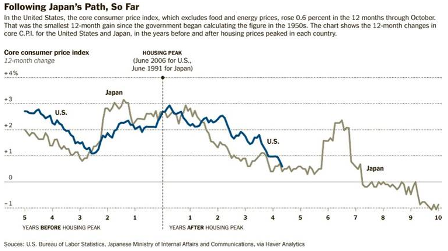
Finally, here’s a chart that the NYT ran in January that makes a compelling case that a 1970s-style inflation is off the table. If time allows, I’ll pen an Idle Speculator piece this summer on why that is. In the meantime:

Symmetry Capital Management, LLC (SCM) is a Pennsylvania-registered investment advisor that offers discretionary investment management to individuals and institutions. This publication is for informational, educational, and entertainment purposes only. It is not an offer to sell or a solicitation to buy securities, nor is it a recommendation to engage in any investment strategy. This material does not take into account your personal investment objectives, financial situation and needs, or personal tolerance for risk. Thus, any investment strategies or securities discussed herein may not be suitable for you. You should be aware of the real risk of loss that accompanies any investment activity, and it is strongly recommended that you consider seeking advice from your own investment advisor(s) when considering any investment strategy or security. SCM does not guarantee any specific outcome from any strategy or security discussed herein. The opinions expressed are based on information believed to be reliable, but SCM does not warrant its completeness or accuracy, and you should not rely on it as such.

Yuan Gains by Most in Three Weeks as Zhou Says Inflation High

This is an unsustainable paradigm but interesting while it lasts.
Actual inflation works to weaken a currency (it buys less in general, by definition). Under those circumstances, acting to keep your currency strong first causes the trade flows reverse, and then to continue to keep it strong market forces tend to eat up your fx reserves. All of them. And then some. To the point where the local currency can no longer be supported short of additional fiscal tightening sufficient to reduce ‘real’ wages vs your trading partners.

Yuan Gains by Most in Three Weeks as Zhou Says Inflation High

By Brian Parkin

May 20 (Bloomberg) &#8212 China’s yuan rose by the most in three weeks after People’s Bank of China Governor Zhou Xiaochuan said inflation remains “high,” fueling speculation further gains will be tolerated.

China needs to strike a balance between economic growth and consumer prices, Zhou said at the Lujiazui Forum in Shanghai today. Asia’s largest economy is “cautiously” promoting cross- border use of the yuan in financial transactions in addition to trade and investment, he said, adding that the onvertibility of the yuan should be a gradual, orderly, mid-to-long-term process.

“The official commentary has been leaning towards expounding the benefits of yuan flexibility,” said Emmanuel Ng, a currency strategist at Oversea-Chinese Banking Corp. in Singapore. “It has been mentioned as a bit of an inflation tool.”

The yuan rose 0.17 percent to 6.4926 per dollar as of 4:30 p.m. in Shanghai, resulting in a weekly gain of 0.08 percent, according to the China Foreign Exchange Trade System. The currency isn’t allowed to move more than 0.5 percent either side of the central bank’s daily fixing, which was raised 0.10 percent today to 6.4983. In Hong Kong’s offshore market, the yuan strengthened 0.08 percent to 6.4915.

Twelve-month non-deliverable forwards gained 0.05 percent to 6.3645 per dollar from yesterday, a 2 percent premium to the onshore spot rate, according to data compiled by Bloomberg. The contracts were little changed from last week.

A stronger currency helps tame inflation by reducing the cost of imports. Consumer prices rose 5.3 percent in April from a year earlier following a 5.4 percent increase in March that was the biggest since July 2008. The government aims to limit inflation to 4 percent this year.

China- Growth of FDI slowing

With its capital constraints FDI has been channel for speculative inflows to facilitate bets on yuan appreciation.

While month to month numbers are volatile, they’re worth keeping an eye on.

In the long run inflation weakens a currency.

Also, JPM yesterday suggested increased risk of what they called a hard landing

Growth of foreign direct investment in China slowing

May 18 (Global Times) – Foreign direct investment (FDI) in China rose to $8.46 billion in April, driven largely by investment in the property sector. The figure is 15.21 percent higher than the previous year but represents a slower rate of growth than seen in March, according to official data released Tuesday.

The slowdown of FDI growth as well as other economic indices this month showed that the economy is cooling down, economists warned Tuesday.
April’s figure was lower than the $12.52 billion invested in March and represented less than half of March’s year on year growth rate of 32.9 percent. The ministry did not elaborate on the reasons for the fall.

The property sector attracted about 24 percent of April’s investment flows, Ministry of Commerce spokesman Yao Jian said at a press briefing.
During the first four months of the year, FDI rose 26.03 percent over levels of the previous year to $38.80 billion, the data showed.

During this period, 10 Asian economies including Japan, Singapore and Hong Kong set up 6,487 new businesses, up 9.87 percent from the previous year, and invested $32.9 billion, up 31.23 percent from the previous year.

EU countries set up 562 new businesses in China, up 16.36 percent from the previous year, while investment from the EU rose 23.42 percent to reach $2.6 billion.
“Despite the financial crisis, European companies are still expanding and investing abroad, including in China. We encourage further market access in China to attract even more EU companies to invest there and indeed we also encourage Chinese companies to invest in Europe,” William Fingleton, a spokesman for the Delegation of the EU to China, told the Global Times in an email.

However, investment from the US dropped 28 percent during the first four months of this year to $1.03 billion in April.

FDI in China plunged after the financial crisis in 2008 but rebounded strongly last year to reach $105.7 billion.

“If the figures released in the first three months are regarded as volatile, April’s FDI figure as well as the month’s imports, manufacturing and other economic indices reported earlier showed a cooldown has firmly set into the economy,” Tian Yun, director of the research center of China Society of Macroeconomics, told the Global Times.

“The economy risks a further slowdown if the government’s monetary tightening policy continues and the country’s employment situation, which should always come before inflation issues, will remain worrisome,” Tian warned.

Inflation Outlook

Governor Zhou Xiaochuan said China’s central bank was focused on controlling prices, without mentioning threats to growth, an indication that he has been more concerned about inflation than any risk of a growth slowdown.

The central bank will “control the monetary conditions behind excessively rapid gains in prices,” Zhou said in comments dated April 18 and released yesterday in the central bank’s annual report. The comments tally with a monetary policy report released May 3 and were before data showing industrial output growth weakened last month.

Home prices rose in China’s 67 of 70 cities monitored by the government in April from last year, led by smaller cities that are defying efforts to control property prices nationwide. Housing prices increased at a faster pace in smaller cities and slowed in major ones, data posted on the statistics bureau’s website today showed.

Rising Coal Demand

Shenhua, the nation’s largest coal producer, rose 0.9 percent to 28.53 yuan. Yanzhou Coal Mining Co., the fourth biggest, advanced 0.9 percent to 32.99 yuan.

Demand for thermal and coking coal may increase between 8 percent and 10 percent this year as less rainfall curbs supplies of hydropower and boosts demand for coal-fired electricity, Luo Zeting, an analyst at Citic Securities, wrote in a report today.

U.S. May Assess National Security Risk of Debt to China

I suspect China knows all this and is playing us for complete fools.

From Bill Black:

I’m sorry, but this passes even my ability — while in Ireland — to apply Irish humor and simply chuckle at such surpassing stupidity. Seriously, the Chairman of House Armed Services — faced with all the real threats to security (plus all the frenzied fears that beset national security considerations and all the stupid wars we wage) — decides that what he wants to talk about and legislate against is the mythical national security threat posed by China giving us lots of goods in return for small portraits of dead politicians printed on increasingly garish paper (or, more commonly, electromagnetic bits of data). Does he think the PRC has embedded nanotechnology nukes in the crud they sell to WallMart? That concern would at least be a form of paranoia we are familiar with and could treat. Reporters have to start asking for comments on these ravings. Printing them without any analysis or alternative views by someone who is qualified to explain why this claim is equivalent to my poor Aunt who believed that the dentist, on behalf of the CIA, bugged her tooth creates “moral panics” and disastrous policies. (For an example of hucksters deliberately generating “moral panics” listen to: “The Music Man” song about “Trouble in River City”).

U.S. May Assess National Security Risk of Debt to China

By Roxana Tiron

May 25 (Bloomberg) — A senior U.S. House lawmaker is pressing top military and intelligence officials to formally assess the national security risks posed by the U.S. debt owed to China.

The chairman of the U.S. House Armed Services Committee, Representative Howard P. “Buck” McKeon, a California Republican, is asking the Congressional Budget Office to determine and make public the total amount of accrued interest the U.S. has paid China over the last five years on federal debt. Once that is complete, the U.S. defense leaders must assess the national security risks, according to his draft legislation.

McKeon’s request comes as his committee this week is writing the 2012 defense authorization bill, which sets military policy and funding targets for the fiscal year starting Oct. 1. The U.S. and China today will wrap up a two-day strategic and economic dialog in Washington.

“This year’s annual defense authorization bill will help Congress truly understand how much leverage China might have over the United States because of our debt, as well as the national security implications associated with the federal government’s out-of-control spending,” McKeon said in an e-mail statement.

Washington Talks

The chief of the general staff for the Chinese People’s Liberation Army will visit the U.S. May 15-22, as the Obama administration seeks to improve military ties with China to match economic and political contacts. General Chen Bingde will tour U.S. military bases and hold talks with his American counterpart, Navy Admiral Mike Mullen, the chairman of the Joint Chiefs of Staff. It will be the first visit of a PLA chief to the U.S. since 2004, according to Mullen’s spokesman, Navy Captain John Kirby.

Mullen has repeatedly said that the U.S. debt is a national security issue.

Part of the national security assessment, mandated in legislation written by McKeon, would be a “discussion of any options available to China for deterring United States military freedom of action in the Western Pacific as a result of its creditor status,” according to a draft of the legislation.

China held $1.15 trillion in Treasuries at the end of February, more than any other country. Vice Finance Minister Zhu Guangyao said on May 6 that China is paying “close attention” to U.S. efforts to reduce its budget deficit.

Geithner- U.S. Will Urge China to Boost Interest Rates

Even more confused than the usual out of paradigm nonsense from Geithner highlighted below:

U.S. Will Urge China to Boost Interest Rates in Washington Talks

By Rebecca Christie and Ian Katz

May 9 (Bloomberg) — Treasury Secretary Timothy F. Geithner will urge China to allow higher interest rates when he meets with Chinese leaders this week, as the U.S. extends its push for a stronger yuan.

Geithner will say China should relax controls on the financial system, give foreign banks and insurers more access and make it easier for investors to buy Chinese financial assets, said David Loevinger, the Treasury Department’s senior coordinator for China. Officials from both nations are meeting in Washington today and tomorrow as part of the annual Strategic and Economic Dialogue.

The US Treasury shamelessly fronting for the financial sector.

The U.S. is pushing for greater market access for financial firms as part of its broader effort to persuade China to ease the restrictions blamed for fueling global imbalances. U.S. officials argue that a yuan kept artificially cheap to help exporters also makes it harder for China to lift interest rates and curb an inflation rate that hit a 32-month high in March.

Budget Deficits

Chinese officials, for their part, blame record U.S. budget deficits for contributing to lopsided global flows of trade and investment. China held $1.15 trillion in Treasuries at the end of February, more than any other country. The U.S. trade deficit with China came to $18.8 billion in February.

Vice Finance Minister Zhu Guangyao said on May 6 that China is paying “close attention” to U.S. efforts to reduce its budget deficit, and his country will focus on improving the quality of itsexchange-rate mechanism.

Yes, China is chiming in on US fiscal policy and no one of political consequence believes they are wrong.

Geithner and Vice Premier Wang Qishan will meet alongside Secretary of State Hillary Clinton and State Councilor Dai Bingguo at this week’s meetings, which will draw about 30 top Chinese officials.

The Obama administration and U.S. lawmakers say China’s currency policy gives the nation’s exporters an unfair competitive advantage, costing U.S. jobs. Geithner is trying to convince Chinese officials that a stronger yuan has benefits for their economy.

‘Enhanced’ Ability

Geithner said last week that allowing the yuan to rise and making their financial system less dependent on government- controlled interest rates would give Chinese leaders an “enhanced” ability to damp inflation.

This just gets stupider and stupider with each out of paradigm iteration.

The Treasury argues that higher interest rates on deposits will also encourage consumer spending in China, another way to reduce imbalances.

Here he takes my position on monetary policy- depending on the institutional structure, higher rates add to aggregate demand via the income interest channels. But it’s totally confused in this context of fighting inflation, as higher demand adds to price pressures, and also adds to cost pressures via the cost of capital for businesses.

“We’re going to encourage China to move more quickly in lifting the ceiling on interest rates on bank deposits in order to put more money into Chinese consumers’ pockets,” Loevinger said at a briefing last week in Washington.

Investors are betting the yuan’s rise may be limited over the next 12 months. Twelve-month non-deliverable yuan forwards dropped 0.81 percent last week to 6.3520 per dollar on May 6, their biggest weekly loss of the year, on speculation that China won’t allow faster appreciation to reduce inflation.

Fundamentally, inflation and currency depreciation are pretty much the same thing. So ultimately inflation goes hand in hand with currency depreciation, as inflation removes the ability to ‘allow faster appreciation’.

17-Year High

The yuan closed little changed in Shanghai on May 6, ending a run of seven weekly gains that drove the currency to a 17-year high of 6.4892 on April 29, according to the China Foreign Exchange Trade System.

John Frisbie, president of the U.S.-China Business Council, said support for a stronger yuan among Chinese leaders has increased in the past year.

Yes, looks like inflation is bad enough in their view to throw their exporters under the bus via currency appreciation (for as long as it can last) in what looks like a desperation move.

“The strong hand has switched over to those who are saying that the exchange rate can help us fight inflation,” Frisbie said in a telephone interview. He said his group, whose members include companies such as Apple Inc. (AAPL), JPMorgan Chase & Co. (JPM) and Coca-Cola Co. (KO), wants China to resume opening its financial services sector to allow more foreign investment.

The American Chamber of Commerce in China said in a report last month that foreign banks play an “insignificant role” in China.

Foreign lenders’ market share in China has dropped since the government first opened the industry in December 2006. Banks such as New York-based Citigroup Inc. (C) and London-based HSBC Holdings Plc (HSBA) want to tap household and corporate savings that reached $10 trillion in January as China overtook Japan to become the world’s second-biggest economy.

Foxes into the hen house…

Foreign Exchange

The U.S. has delayed its semi-annual foreign-exchange report, which had been due on April 15, until after this week’s meetings. The previous report, due on Oct. 15, 2010, was released on Feb. 4 and declined to brand China a currency manipulator while saying the No. 2 U.S. trading partner has made “insufficient” progress on allowing the yuan to rise.

The yuan goes beyond the U.S. and China to become “a multilateral issue, in terms of the impact on Brazil, Korea, Thailand and India,” said Edwin Truman, a former Federal Reserve and Treasury official who is now a senior fellow at the Peterson Institute for International Economics.

‘Causing Trouble’

The “slow” appreciation of the yuan “relative to the dollar in an environment where the dollar is going down against other currencies is causing trouble for other countries and currencies,” Truman said.

Diplomats at the Strategic and Economic Dialogue also will discuss events in the Middle East, including military operations in Libya and the ramifications of the region’s popular uprisings.

Officials are likely to discuss efforts to revive six-party talks on North Korea’s nuclear program. Negotiations between the two Koreas, Russia, Japan, China and the U.S. stalled in December 2008 and tensions flared on the peninsula after North Korea’s Nov. 23 bombing of a South Korean island.

Yes, mistakenly believing we are dependent on China to fund our deficit spending has us kowtowing on human rights and nuclear weapons.

“We want to compare notes on where we stand with respect to North Korea, and we will be very clear on what our expectations are for moving forward,” Kurt Campbell, assistant secretary of state for East Asia, said on May 5.

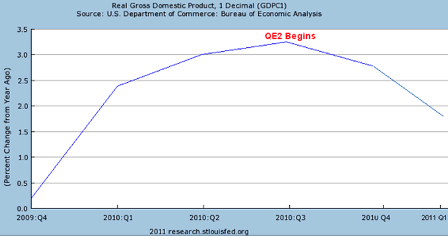
QE and Real GDP

To which they respond ‘monetary policy works with a lag’

And to which I add, yes, it lags until the next fiscal adjustment kicks in.

;)

>   
>   But equities continue to peform relatively well.
>   

Yes, they should be ok with any positive top line growth.

The risks that remain are a hard landing in China, a euro zone meltdown, and fiscal responsibility in the US and Japan.