China to keep credit growth steady: Central bank

This is ridiculous, of course:

China to keep credit growth steady: Central bank

July 14 (Reuters) — China’s central bank pledged on Sunday to use a mix of policy tools to adjust banking liquidity to ensure steady credit growth, in an apparent bid to soothe market concerns about tighter monetary conditions.

The central bank will “use a mix of price and quantitative policy tools to adjust liquidity in the banking system and guide steady and appropriate growth in money, credit and social financing”, it said in a statement on its website.

The central bank allowed short-term inter-bank borrowing costs to spike to close to 30 percent on June 20, a blunt warning to overstretched lenders that they must bring risky lending under control.

Chinese liquidity drill

With floating fx, it’s necessarily about price (interest rate) and not quantity.

That includes China’s ‘dirty float’, a currency not convertible on demand at the CB, but with periodic CB market intervention.

Loans necessarily create deposits at lending institutions, and they also create any required reserves as a reserve requirement is functionally, in the first instance, an overdraft at the CB, which *is* a loan from the CB.

So from inception the assets and liabilities are necessarily ‘there’ for the CB to price.

Liquidity is needed to shift liabilities from one agent to another.

For example, if a depositor wants to shift his funds to another bank, the first bank must somehow ‘replace’ that liability by borrowing from some other agent, even as total liabilities in the system remain unchanged.

That ‘shifting around’ of liabilities is called ‘liquidity’

But in any case at any point in time assets and liabilities are ‘in balance.’

It’s when an agent can’t honor the demand of a liability holder to shift his liability to another agent that liquidity matters.

And if a bank fails to honor a depositor’s request to shift his deposit to another institution, the deposit remains where it is. Yes, the bank may be in violation of its agreements, but it is ‘fully funded.’

The problem is that to honor its agreements to allow depositors to shift their deposits to other banks, the bank will attempt to replace the liability by borrowing elsewhere, which may entail driving up rates.

Likewise, banks will attempt to borrow elsewhere, which can drive up rates, to avoid overdrafts at the CB when the CB makes it clear they don’t want the banks to sustain overdrafts.

The problem is that only the CB can alter the total reserve balances in the banking system, as those are merely balances on the CB’s own spread sheet. Banks can shift balances from one to another, but not change the total.

So when the total quantity of reserve balances on a CB’s spreadsheet increases via overdraft, that overdraft can only shift from bank to bank, unless the CB acts to add the ‘needed’ reserves.

Or when one bank has excess reserves which forces another into overdraft, and the surplus bank won’t lend to the deficit bank.

This is all routinely addressed by the CB purchasing securities either outright or via repurchase agreements. It’s called ‘offsetting operating factors’, which also include other ‘adds and leakages’ including changes in tsy balances at the fed, float, cash demands, etc.

And when the CB does this they also, directly or indirectly, set the interest rate as they do, directly or indirectly, what I call ‘pricing the overdraft.’

So to restate, one way or another the CB sets the interest rate, while quantity remains as it is.

And those spikes you are seeing in China are from the CB setting rates indirectly.

The evidence from China is telling me that the western educated new kids on the block flat out don’t get it, probably because they were never told the fixed fx ‘monetarism’ they learned in school isn’t applicable to non convertible currency???

In any case the CB is the monopoly supplier of net reserves to its banking system and therefore ‘price setter’ and not ‘price taker’, and surely they learned about monopoly in school, but apparently/unfortunately have yet to recognize their currency itself is a simple public monopoly?

Thinking back, this is exactly the blunder of tall Paul back some 33 years ago. He made the same rookie mistake, for which he got credit for saving the US, and the world, from the great inflation of his day.

However, the fact that he made it worse, vs curing anything is of no consequence.

What matters is how the western elite institutions of higher learning spin it all…

:(

Fitch says China credit bubble unprecedented…

Nothing that fiscal adjustment can’t keep from spilling over into the real economy.

But that’s not how the western educated offspring now in charge learned it…

Fitch says China credit bubble unprecedented in modern world history

By Ambrose Evans-Pritchard

June 16 (Telegraph) — China’s shadow banking system is out of control and under mounting stress as borrowers struggle to roll over short-term debts, Fitch Ratings has warned.

The agency said the scale of credit was so extreme that the country would find it very hard to grow its way out of the excesses as in past episodes, implying tougher times ahead.

“The credit-driven growth model is clearly falling apart. This could feed into a massive over-capacity problem, and potentially into a Japanese-style deflation,” said Charlene Chu, the agency’s senior director in Beijing.

“There is no transparency in the shadow banking system, and systemic risk is rising. We have no idea who the borrowers are, who the lenders are, and what the quality of assets is, and this undermines signalling,” she told The Daily Telegraph.

While the non-performing loan rate of the banks may look benign at just 1pc, this has become irrelevant as trusts, wealth-management funds, offshore vehicles and other forms of irregular lending make up over half of all new credit. “It means nothing if you can off-load any bad asset you want. A lot of the banking exposure to property is not booked as property,” she said.

Concerns are rising after a string of upsets in Quingdao, Ordos, Jilin and elsewhere, in so-called trust products, a $1.4 trillion (0.9 trillion) segment of the shadow banking system.

Bank Everbright defaulted on an interbank loan 10 days ago amid wild spikes in short-term “Shibor” borrowing rates, a sign that liquidity has suddenly dried up. “Typically stress starts in the periphery and moves to the core, and that is what we are already seeing with defaults in trust products,” she said.

Fitch warned that wealth products worth $2 trillion of lending are in reality a “hidden second balance sheet” for banks, allowing them to circumvent loan curbs and dodge efforts by regulators to halt the excesses.

This niche is the epicentre of risk. Half the loans must be rolled over every three months, and another 25pc in less than six months. This has echoes of Northern Rock, Lehman Brothers and others that came to grief in the West on short-term liabilities when the wholesale capital markets froze.

Mrs Chu said the banks had been forced to park over $3 trillion in reserves at the central bank, giving them a “massive savings account that can be drawn down” in a crisis, but this may not be enough to avert trouble given the sheer scale of the lending boom.

Overall credit has jumped from $9 trillion to $23 trillion since the Lehman crisis. “They have replicated the entire US commercial banking system in five years,” she said.

The ratio of credit to GDP has jumped by 75 percentage points to 200pc of GDP, compared to roughly 40 points in the US over five years leading up to the subprime bubble, or in Japan before the Nikkei bubble burst in 1990. “This is beyond anything we have ever seen before in a large economy. We don’t know how this will play out. The next six months will be crucial,” she said.

The agency downgraded China’s long-term currency rating to AA- debt in April but still thinks the government can handle any banking crisis, however bad. “The Chinese state has a lot of firepower. It is very able and very willing to support the banking sector. The real question is what this means for growth, and therefore for social and political risk,” said Mrs Chu.

“There is no way they can grow out of their asset problems as they did in the past. We think this will be very different from the banking crisis in the late 1990s. With credit at 200pc of GDP, the numerator is growing twice as fast as the denominator. You can’t grow out of that.”

The authorities have been trying to manage a soft-landing, deploying loan curbs and a high reserve ratio requirement (RRR) for banks to halt property speculation. The home price to income ratio has reached 16 to 18 in many cities, shutting workers out of the market. Shadow banking has plugged the gap for much of the last two years.

However, a new problem has emerged as the economic efficiency of credit collapses. The extra GDP growth generated by each extra yuan of loans has dropped from 0.85 to 0.15 over the last four years, a sign of exhaustion.

Wei Yao from Societe Generale says the debt service ratio of Chinese companies has reached 30pc of GDP – the typical threshold for financial crises — and many will not be able to pay interest or repay principal. She warned that the country could be on the verge of a “Minsky Moment”, when the debt pyramid collapses under its own weight. “The debt snowball is getting bigger and bigger, without contributing to real activity,” she said.

The latest twist is sudden stress in the overnight lending markets. “We believe the series of policy tightening measures in the past three months have reached critical mass, such that deleveraging in the banking sector is happening. Liquidity tightening can be very damaging to a highly leveraged economy,” said Zhiwei Zhang from Nomura.

“There is room to cut interest rates and the reserve ratio in the second half,” wrote a front-page editorial today in China Securities Journal on Friday. The article is the first sign that the authorities are preparing to change tack, shifting to a looser stance after a drizzle of bad data over recent weeks.

The journal said total credit in China’s financial system may be as high as 221pc of GDP, jumping almost eightfold over the last decade, and warned that companies will have to fork out $1 trillion in interest payments alone this year. “Chinese corporate debt burdens are much higher than those of other economies. Much of the liquidity is being used to repay debt and not to finance output,” it said.

It also flagged worries over an exodus of hot money once the US Federal Reserve starts tightening. “China will face large-scale capital outflows if there is an exit from quantitative easing and the dollar strengthens,” it wrote.

The journal said foreign withdrawals from Chinese equity funds were the highest since early 2008 in the week up to June 5, and withdrawals from Hong Kong funds were the most in a decade.

China Plans to Reduce the State’s Role in the Economy

More evidence the western educated kids have taken over.

:(

China Plans to Reduce the State’s Role in the Economy

By David Barboza and Chris Buckley

May 24 (NYT) &#8212 The Chinese government is planning for private businesses and market forces to play a larger role in its economy, in a major policy shift intended to improve living conditions for the middle class and to make China an even stronger competitor on the global stage.

Tokyo Urged to Undertake Serious Fiscal Reforms

More of: “In the land of the blind the one eyed man gets his good eye poked out…”

Operationally, the BOJ, monopoly supplier of yen reserves, can peg long rates just as easily as short rates.

If they back off on fiscal they’re right back where they started from, as QE is a bit of a tax hike, but for the most part just a placebo.

And lighting up the nukes likely puts trade back in surplus, firming the yen again, with the lifers who sold JGB’s for foreign bonds and foreign currency exposure/got short yen adding a bit of excitement when they try to cover.

Not to mention the China slowdown.

And none of this helps US demand any.

Tokyo Panel Urges Abe to Tighten Finances

Mitsuru Obe

May 27 (WSJ) —TOKYO—Following last week’s brief jump in Japanese government bond yields that helped precipitate a sudden slide in Tokyo stocks, an advisory panel to Japan’s finance minister published a report Monday urging the government to undertake serious fiscal reform to avoid further rises in yields.

“Fiscal reconstruction has become all the more important” because of Prime Minister Shinzo Abe’s aggressive monetary and fiscal stimulus measures, the report said, while warning that a loss of fiscal rectitude could send bond yields higher and undermine the efforts of the Bank of Japan 8301.JA -1.43%to stimulate the economy.

The report comes after the central bank launched an aggressive bond-buying program in April. The BOJ’s change in stance initially pushed bond yields down. But uncertainty over the impact of buying on such a huge scale—up to 70% of newly issued debt—saw yields bounce back up.

As the country’s currency, the yen, broke above 100 to the dollar earlier this month for the first time in more than four years, bond yields climbed along with equity prices. When they hit 1% on May 23, a level not seen in more than a year, the equity market’s upward march halted.

The panel’s chairman, Tokyo University Prof. Hiroshi Yoshikawa, declined to say how last week’s financial turmoil may have influenced the panel’s conclusion in the report. But Mr. Yoshikawa didn’t mince his words, as he warned against any attempt by the Abe administration to push back painful reforms, such as planned tax hikes and fiscal consolidation.

“Any attempt to go ahead with more fiscal stimulus would be a contravention of the spirit of this report,” he told a news conference.

Mr. Abe’s administration came into office in late December, amid an economic slowdown in Europe and China. Pledging to lift the Japanese economy out of decadeslong stagnation, Mr. Abe’s government has launched aggressive monetary easing and fiscal stimulus measures, a policy program popularly known as Abenomics.

The report argued, however, that “such unusual policy measures cannot be continued indefinitely.”

“Unless the government moves ahead with and makes progress in fiscal consolidation, the BOJ’s policy could be viewed as an act of debt financing by the central bank, causing bond yields to rise, and canceling out the effects of its monetary easing,” it said.

The report also noted that a rise in bond yields would also complicate the task of the exiting the so-called quantitative easing program down the line. Under a newly introduced inflation target, the BOJ is obliged to achieve 2% price growth, and the bank has said it would keep its aggressive easing in place until it secures that target.

The report said that “even if the BOJ wants to reduce its government bond purchases, it won’t be able to do so unless there are alternative buyers of bonds in the market.” Without private sector buyers, long-term interest rates could go up far beyond levels in line with economic growth rates, the report warned.

The Abe administration is expected to make clear its fiscal reform goals next month.

The report urged the government to produce a credible and concrete fiscal reform road map that would include specific numerical targets, rather than just expressing a strong determination.

Asia Insights: China: Why GDP growth has weakened despite strong credit growth – 25 Apr 2013

So some was gross, not net, and some unspent:

Nomura: Asia Insights: China: Why GDP growth has weakened despite strong credit growth

  • Economic growth in China has weakened surprisingly despite rapid credit growth in H2 2012 and Q1 2013.
  • We believe a large part of the new credit supply in Q1 did not go into the real economy. For example, at least 20% of urban construction bond issuance was used to pay off expiring bank loans.
  • Recent policy signals suggest credit growth will slow in Q2. We reiterate our view that economic growth will slow in Q2, while the market consensus expects a rebound.

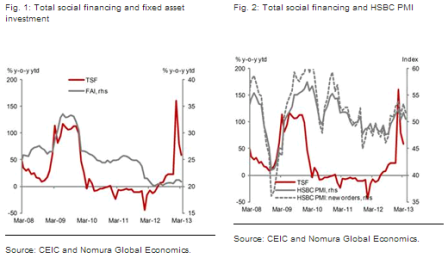
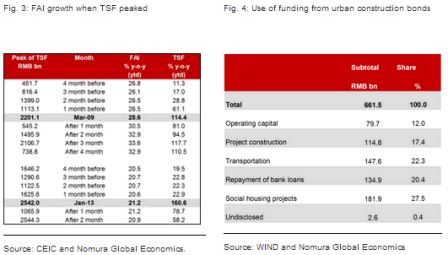
We had expected economic growth in China to rise in Q1 because of very strong credit growth, but GDP growth surprisingly slowed to 7.7% from 7.9% in Q4 2012, and economic activity in Q2 has started on a weak note. This is very different to what happened in 2009, when growth in total social financing picked up from 26.6% y-o-y in Q4 2008 to 114% in Q1 2009 and 121% in Q2 2009, growth in fixed asset investment moved up from 26.8% y-o-y in Q4 2008 to 28.6% in Q1 2009, the HSBC PMI rose to 44.8 from 40.9, and the new orders component in the HSBC PMI jumped to 43.6 from 36.1 (Figures 1, 2 and 3).

But in 2013 it is a very different story. Total social financing rose to an historical high and jumped by 160.6% y-o-y in January and by 58.2% y-o-y in Q1, but fixed asset investment (FAI) growth only picked up slightly to 21.2% y-o-y in January and February, and then slowed to 20.9% in March. GDP growth slowed to 7.7% y-o-y in Q1. The flash HSBC PMI weakened in April despite favorable seasonal factors it has only dropped once in April once during the past seven years. The new orders component of the flash HSBC PMI has dropped as well.

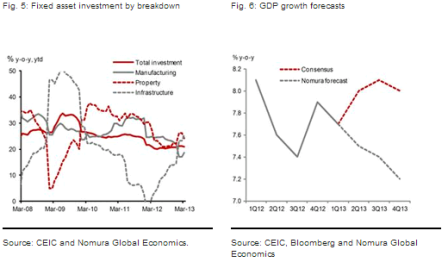
Many investors ask us the same question: where has all the money gone? We believe a large part of the new credit supply in Q1 did not go into the real economy. We do not have comprehensive information, but we provide the following two pieces of evidence. First, we collected public information on the 370 largest issues of urban construction debt that took place in 2012, and found that at least 20% of the money raised was used to repay debt (Figure 4). It is not surprising to us as many infrastructure investments projects are not yet profitable. Therefore, local government financing vehicles need to continue borrowing new funds for debt financing.

Another piece of evidence comes from a recent government policy announcement. According to a Chinese newspaper, First Financial Daily, the National Development and Reform Commission (NDRC) issued a policy notice at the end of March to ensure the funds raised for public housing construction in the bond market are not used for other purposes. We believe this policy may be triggered by cases where some funds were misused. Indeed, risks of such events have been mentioned repeatedly in government documents.

Why didnt money flow into the real economy? We think it is partly because the underlying demand for investment is weak. FAI growth for the manufacturing industry has been on a downward trend since 2011 and dropped sharply in Q1 2013 despite strong infrastructure FAI growth, which should have generated some positive spillover effects for manufacturers (Figure 5). The over-capacity problem in the manufacturing industry has been exacerbated by aggressive policy easing in 2009 and 2012.

We reiterate our view that economic growth will slow to 7.5% in Q2 as credit growth weakens (Figure 6). The consensus expects growth to recover to 8% in Q2, but recent policy signals suggest policy tightening has started and will adversely affect growth. In particular, the government has investigated several high profile corruption cases in the bond market in the past few days, and the Peoples Bank of China held a meeting on 24 April with commercial banks to clean up irregular activities in the bond market, according to a Chinese newspaper Economic Information. This initiative will likely lead to a slowdown in bond issuance and growth in total social financing in the coming months.


Full size image


Full size image


Full size image

China’s Manufacturing Growth Slows as Economic Recovery Falters

More signs the new, western educated/monetarist generation is restricting credit growth at the ‘state lending’ and local govt level:

China’s Manufacturing Growth Slows as Economic Recovery Falters

April 23 (Bloomberg) — China’s manufacturing is expanding at a slower pace this month on weakness in global and domestic demand, fueling concern that the world’s second-biggest economy is faltering.

The preliminary reading of 50.5 for a Purchasing Managers’ Index (EC11CHPM) released by HSBC Holdings Plc and Markit Economics compared with a final 51.6 for March. The number was also below the median 51.5 estimate in a Bloomberg News survey of 11 analysts. A reading above 50 indicates expansion.

China’s stocks slumped as the data provided further evidence of an economic slowdown after weaker-than-estimated numbers for gross domestic product last week prompted banks including Goldman Sachs Group Inc. to cut full-year forecasts. In Washington, central bank Governor Zhou Xiaochuan said April 20 that a 7.7 percent first-quarter expansion was reasonable and “normal,” highlighting reduced expectations after 10 percent- plus rates during the past decade.

“This paints a picture of a continued painfully slow recovery for China’s manufacturing sector,” said Yao Wei, a Societe Generale SA economist based in Hong Kong. “The government needs to help translate the easy liquidity conditions into real growth.”

President Xi Jinping’s officials are grappling with constraints on export demand, property-market overheating, the risks associated with a surge in so-called shadow banking, and weakness in consumption because of a campaign to rein in official perks such as spending on banquets.

The Shanghai Composite Index fell 2.6 percent, the biggest decline in three weeks.

From JJ Lando at Nomura

Some very interesting trends/divergences emerging:

1. Staples/Tech or cyclicals/defensives or low vol or correlations all falling completely off a cliff in spectacular fashion.

2. Forward P/Es in Japan vs in China and Korea massively diverging (fx-driven earnings drain, effectively, but only affects fwd PE this much if street is dramatically dramatically underestimating the fx impact on earnings)

3. You all know, Apple, GE, IBM vs S&P, etc.

Meanwhile consider the backdrop:

1. GE was a ‘shoot the messenger’ situation where their own ‘global growth market share’ looks fine but they say global leading indicators are poor so the market takes them down 5% and everyone else untouched

2. Weak USD, Strong commodities, China, and MOST IMPORTANTLY A MASSIVE US DEFICIT were fundamental drivers for US Equity performance for a long time. All are now pushing the opposite way. I am seeing ppl forecasting just 400+b for deficit within 2 yrs. Ppl still had 1T for this year a few months ago. It’s a STAGGERING, stealth development. It’s bad for stocks even if it’s from good growth. People thought the Fed was pumping stocks with ‘liquidity.’ There might have been some weak-USD effects but the FEDERAL BUDGET DEFICIT was the big driver. **Much of the deficit was winding up as corporate earnings the past few years rather than household income** Thus median incomes were flat, overall were up small, overall growth was small, and equity free cash flow and earnings growth has been chugging along at 7,8,9%. Where do you think that came from? Not from the Fed. That was blogoshpere nonsense. IT CAME FROM THE DEFICIT.

The biggest issue of course, is that free cash flow yields still make equities look dramatically cheap to bond-like alternatives… but they also are much more sensitive (over-sensitive) to turning points in things. If only as a punt on reactionary-ism stuff, I don’t like them here. Short for a trade. G’LUCK!