NPR discussion


[Skip to the end]

>   
>   (email exchange)
>   
>   On Mon, Sep 14, 2009 at 10:45 AM, wrote:
>   
>   By the way, you didn’t hear NPR this morning, but there was the usual hagiography
>   about how the Fed averted a Great Depression last year because it “created”
>   trillions of dollar to support the banking system.
>   
>   But my understanding is that ONLY the Treasury creates money and the Fed simply
>   tries not very successful) to determine a price for the money that is created by
>   TSY.
>   
>   When you look at it this way, the narrative changes considerably.
>   

Yes!

The Fed did loan to banks and act as broker of last resort between banks who had Fed funds and banks who needed them, but that should always be done in the normal course of business.

So I do give them credit for figuring out how to do what they were charged to do from inception in 1913, since Bernanke et al had to play the cards they were dealt.

But even now they haven’t figured out they should just trade Fed funds in unlimited quantities with member banks, at their target rate, and instead use an alphabet soup of programs to get that done indirectly.


[top]

Your thoughts on wall street remaining intact


[Skip to the end]

A Year Later, Little Change on Wall St.

As previously suggested, wealth is flowing to the top from the bottom as gdp grows some, unemployment climbs, and wages languish:

Despite the predictions last year about pay cuts, those bonuses appear secure. Kian Abouhossein, an analyst at J.P. Morgan in London, predicted this week that eight major American and European banks would pay the 141,000 employees in their investment banking units $77 billion in 2011 — about $543,000 per worker, not far from the 2007 peak — even after minor regulatory changes are adopted.

>   
>    Can the mortgage fraud environment return?
>   

Lenders/investors will be smarter for a while, best guess. But always ripe for the next fraud.


[top]

Quincy Herald Whig


[Skip to the end]

>   
>   (email exchange)
>   
>   On Mon, Sep 14, Michael wrote:
>   

Tea Party speakers rally Quincy crowd with call to ‘take back your country’

Warren Mosler, an economist who came to Quincy from St. Croix, said the Tea Party movement is gaining momentum as the situation in Washington deteriorates. Unless politicians take notice, he expects the campaign to keep growing.

Made some good progress with some now former deficit terrorists, thanks.
Some I spoke to the night before at dinner told me they altered their presentations accordingly.

Thanks for sending this link to the

Video


[top]

Stiglitz Says Banking Problems Are Now Bigger Than Pre-Lehman


[Skip to the end]

Stiglitz has part of it right, but his misguided concern about ‘who is going to finance the US government’ is disquieting at best.

Stiglitz Says Bank Problems Bigger Than Pre-Lehman

The Federal Reserve faces a “quandary” in ending its
monetary stimulus programs because doing so may drive up the
cost of borrowing for the U.S. government, he said.

“The question then is who is going to finance the U.S.
government,” Stiglitz said.


Stiglitz gave the interview before presenting a report to
French President Nicolas Sarkozy that urged world leaders to
drop an obsession for focusing on gross domestic product in
favor of broader measures of prosperity.


[top]

Trade War with China


[Skip to the end]

Markets are not going to like this action:

China Starts Probe of U.S. Auto, Chicken Imports After Obama Tire Decision

China to Probe Alleged ‘Dumping’ of U.S. Products

By Bloomberg News

September 14 (Bloomberg) — China announced a probe into the alleged dumping of American auto and chicken products, two days after U.S. President Barack Obama imposed tariffs on imports of tires from the Asian nation.

Chinese industries have complained that they’re being hurt by “unfair trade practices,” the nation’s Ministry of Commerce said on its Web site yesterday. The Beijing-based ministry is also looking into subsidies for the products, it said. It didn’t specify the imports’ value.

The European Central Bank said last week that rising protectionism may hamper world trade and undermine the global economy’s recovery from recession. The U.S. placed tariffs starting at 35 percent on $1.8 billion of tire imports from China, backing a United Steelworkers union complaint against the second-largest U.S. trading partner.


[top]

OECD Calls an End to the Global Recession


[Skip to the end]

Guess it wasn’t as bad as most of the doomsday crowd thought?

They never give sufficient credit to the automatic stabilizers and fiscal policy in general.

I suppose that were understood there would have been a policy response at least a year ago to avert the damage that resulted by their lack of appropriate action.

Nor is a double dip out of the question, with proposals to tighten fiscal looming and interest rates very low.

OECD calls an end to the global recession

By David Prosser

September 12 (The Independent) — The global downturn was effectively declared over yesterday, with the Organisation for Economic Co-operation and Development (OECD) revealing that “clear signs of recovery are now visible” in all seven of the leading Western economies, as well as in each of the key “Bric” nations.

The OECD’s composite leading indicators suggest that activity is now improving in all of the world’s most significant 11 economies – the leading seven, consisting of the US, UK, Germany, Italy, France, Canada and Japan, and the Bric nations of Brazil, Russia, India and China – and in almost every case at a faster pace than previously.

Composite Leading Indicators point to broad economic recovery

September 11 (OECD) — OECD composite leading indicators (CLIs) for July 2009 show stronger signs of recovery in most of the OECD economies. Clear signals of recovery are now visible in all major seven economies, in particular in France and Italy, as well as in China, India and Russia. The signs from Brazil, where a trough is emerging, are also more encouraging than in last month’s assessment.


[top]

Basel 3 proposals


[Skip to the end]

This comes down to the questions of:

What are banks?
What is the role of bank capital?
What are the dynamics of capital ratios?

1. What are banks?

Banks are public private partnerships presumably established and maintained for public purpose.

The presumed public purpose is to maintain and service a payments system and to make loans that further public purpose.

With most nations having learned the ugly way that the liability side of banking is not the place for market discipline,
they use a variety of methods to sustain credible deposit insurance.

With, for all practical purposes, unlimited govt. insured funding available, regulation falls on bank assets and capital.

Regulation determines what assets are ‘legal’ and presumably in line with public purpose. Regulators monitor all bank assets for compliance and assurance that bank assets are ‘worthy’ of the government deposit insurance.

2. What is the role of bank capital?

Banks can be government owned or privately owned.

When banks are 100% public institutions, government determines the price of risk, as expressed by the risk premium charged for specific loans.

As public private institutions, private capital is in a first loss position and risk is priced by private sector agents.

The US and most nations have presumably determined public purpose is served by having the private sector price loans.

Hence banks are public private partnerships with private owners investing prescribed quantities of capital.

3. What are the dynamics of capital ratios?

The capital ratios determine the minimum legal percentage of private funds at risk for the legal bank assets.
For example, a 10% capital ration would mean that private capital is providing 10% of the value of the assets as a first loss piece.

Higher capital ratios reduce both the risk and the returns on the private invested capital.

This also alters the banking system’s cost of raising capital, and thereby also alters interest rates charged by banks.

Conclusion

This understanding is not evident at the level of public policy formation, and the results are not encouraging.

The question of public purpose of capital ratios seems for the most part to be limited to the possibility of 100% of the private capital being lost, and the risk to ‘tax payer money.’

I don’t see any discussion of the larger issues of public purpose for which private bank ownership is presumably established.

And I see no need for international cooperation.

As with fiscal policy, the public purpose of each nation is better served dealing with its own insured banks unilaterally.

From GS this morning:

  • Renewed focus on bank Capital ratios – in light of G20 and the statement from Basel committee yesterday. Waiting for a more formal piece from our analysts on this – but essential conclusion from the number of press pieces around today and the Basel statement is that banks, globally, will need to improve the quality and extent of capital ratios. Nothing new in that message – but the momentum towards formalisation of this process gathering pace. Looks likely that we will get a proposal on ‘Basel 3’ by end of year – impact assement early next year and implementation by the end of 2010. Legislation that will a ) force banks to increase capital ratios b ) replace some of the hybrid capital they have raised previously in form of preference shares or subdebt with common equtiy and c ) limit share dividends in good times to increase captial buffers in downturns. Would like to get some details from our equtiy analysts here – for the moment a very mixed set of views on the implications. FT disputes recent positive price action in bank stocks given the size of equtiy issuance that is likely to be needed in medium term as these proposals take shape. Others suggest that the Basel statement has a notable skew towards banks being able to build capital ratios organically over time by limiting dividends and retaining earnings – purposefully ensuring that there is no snap requirement for capital raising once legislation is proposed. Despite this we suspect that two sectors are still vulnerable here a ) banks with high leverage ratios ( i.e european banks with large non retail operations – particularly given IFRS doesn’t net derivative exposures ) b ) those banks with high proportion of hybrid capital ( i.e particuarly those banks with large gvt investment via preference shares )


[top]

Unemployment


[Skip to the end]

Agreed.

Hence the need for a full payroll tax holiday and per capita distributions to the States

Those simple pen strokes/data entry on the government’s computer will reverse the lost aggregate demand in short order.

The homicide rate is going up as well.

The deficit myths have all but completely taken over.

Employment Report: 216K Jobs Lost, 9.7% Unemployment Rate

By CalculatedRisk

Nonfarm payroll employment continued to decline in August (-216,000), and the unemployment rate rose to 9.7 percent, the U.S. Bureau of Labor Statistics reported today. Although job losses continued in many of the major industry sectors in August, the declines have moderated in recent months.

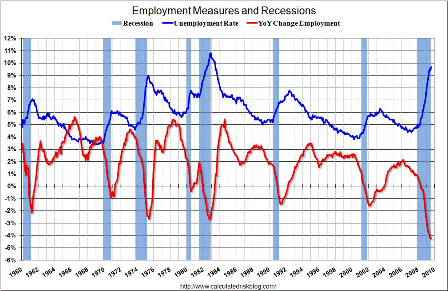
This graph shows the unemployment rate and the year over year change in employment vs. recessions.

Nonfarm payrolls decreased by 216,000 in August. The economy has lost almost 5.83 million jobs over the last year, and 6.93 million jobs during the 20 consecutive months of job losses.

The unemployment rate increased to 9.7 percent. This is the highest unemployment rate in 26 years.

Year over year employment is strongly negative.

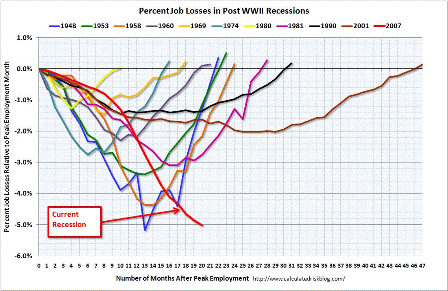
The second graph shows the job losses from the start of the employment recession, in percentage terms (as opposed to the number of jobs lost).

For the current recession, employment peaked in December 2007, and this recession was a slow starter (in terms of job losses and declines in GDP).

However job losses have really picked up over the last year, and the current recession is now the 2nd worst recession since WWII in percentage terms (and the 1948 recession recovered very quickly) – and also in terms of the unemployment rate (only early ’80s recession was worse).

The economy is still losing jobs at about a 2.6 million annual rate, and the unemployment rate will probably be above 10% soon. This is still a weak employment report – just not as bad as earlier this year. Much more to come …


[top]